
Jobs Growth Wales+ statistics: April 2024 to March 2025
Information on Jobs Growth Wales+ learning programmes and the learners enrolled on them for April 2024 to March 2025.
In this page
Introduction
The data in this release covers all four quarters of the 2024-2025 financial year (April 2024 to March 2025) with a comparison to the previous financial year. The Jobs Growth Wales Plus (JGW+) programme came into operation for new starts on 1 April 2022. All the data in this report is sourced from the Lifelong Learning Wales Record (LLWR). For information about the programme see background and context below.
Main points
- There have been 15,685 starts on the JGW+ programme in total since it launched in April 2022.
- During 2024-2025 there were 7,895 active JGW+ programmes, of which 5,205 were new starts.
- The number of starts is up 1.5% on 2023-2024 when there were 5,130. In addition to the 5,205 new starts in 2024-2025, there were 2,690 programmes continuing from the previous year.
- 4,890 JGW+ programmes ended during the 2024-2025 financial year, of which 3,275 were completed.
- Of the programmes that ended, 66.8% of leavers had a positive outcome, up from 60.3% in 2023-2024.
- The largest strand of JGW+ was Engagement with 3,385 programmes started in 2024-2025. This represents 65.0% of all programmes started.
Jobs Growth Wales+ Strands
Figure 1: Number of programmes started, by JGW+ strand and financial year, 2023-2024 to 2024-2025
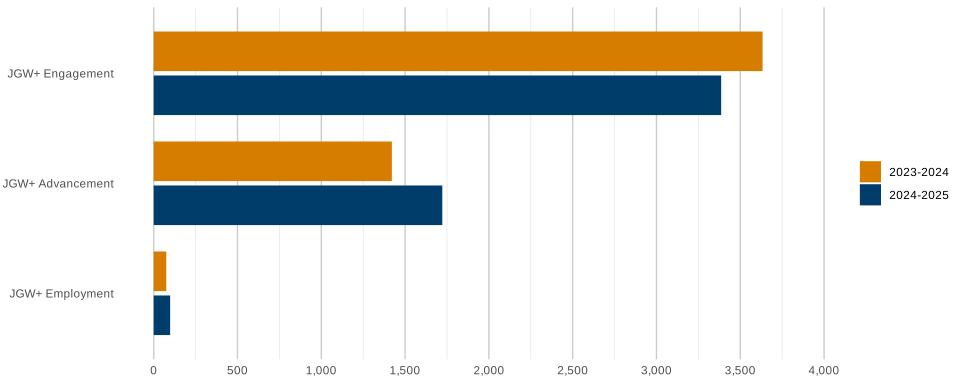
Description of Figure 1: The bar chart shows the number of programme starts in the financial years 2024-2025 and 2023-2024. It compares the number of starts across the Engagement, Advancement and Employment strands with the Engagement strand having the highest number of starts.
In the 2024-2025 financial year Engagement was the largest strand with 3,385 programmes started, accounting for 65.0% of all starts. This is a decrease compared to previous financial year. The Employment strand had the lowest number of starts at 100 (1.9%), a small increase compared to 2023-2024. The Advancement strand had 1,720 (33.1%) starts, also an increase compared to last financial year.
Jobs Growth Wales Plus Learners by Gender, Strand, and Measure on StatsWales
Across all strands, there were 5,205 programme starts in 2024-2025, up 1.5% on the previous financial year when there were 5,130. In addition to the 5,205 new starts, there were 2,690 programmes continuing from the previous year.
There have been 15,685 starts on the JGW+ programme in total since it launched in April 2022.
Destinations
From the start of the JGW+ programme in April 2022 through to the end of December 2023, the destinations of JGW+ leavers represented the destination within four weeks of leaving the programme. From January 2024 this has been adjusted to measure destinations within eight weeks of leaving the programme. All destinations are self-reported by the programme participants.
4,890 JGW+ programmes ended during the 2024-2025 financial year, of which 3,275 were completed.
Figure 2: Positive outcome rates for JGW+ leavers by strand and financial year, 2023-2024 to 2024-2025
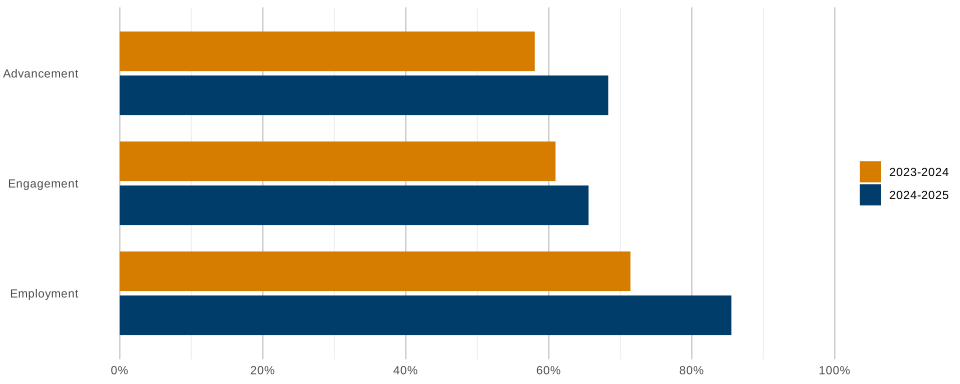
Description of Figure 2: The bar chart shows the proportion of positive outcomes for JGW+ leavers by strand and financial year. The chart shows that positive outcome rates were highest on the Employment strand in 2024-2025.
Jobs Growth Wales Plus Learners by Gender, Strand, and Measure on StatsWales
The overall positive outcome rate across all strands was 66.8% in 2024-2025, up 6.5 percentage points from 2023-2024.The Employment strand had the highest positive outcome rate in 2024-2025 at 85.5%, followed by the Advancement strand at 68.3% and the Engagement strand at 65.6%.
Figure 3: Number of JGW+ leavers by destination and financial year, 2023-2024 to 2024-2025
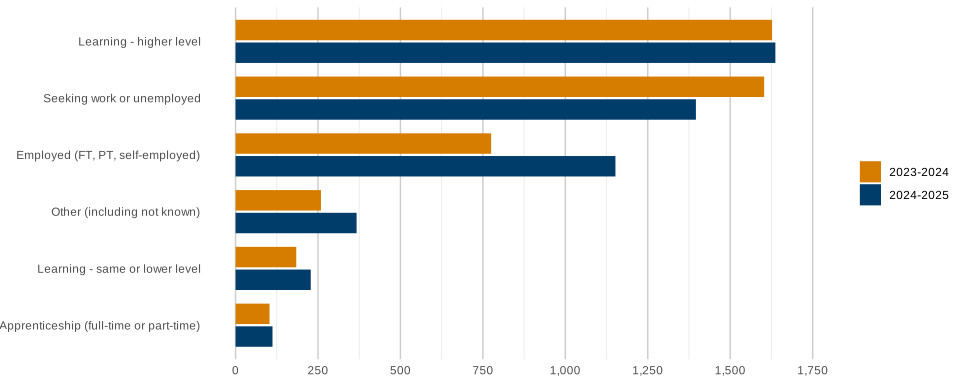
Description of Figure 3: The bar chart shows that of the JGW+ participants who reported their destination after completing or leaving the programme, the largest number are those who were learning at a higher level or who were seeking work or unemployed.
Higher level learning was the most common destination in 2024-2025 with 1,635 leavers. This was followed by leavers who were seeking work or were unemployed with 1,395 and is the only destination that has seen a decrease compared to the previous financial year. There was a large increase in the employment destination with 1,150 leavers in 2024-2025 compared to 775 leavers in 2023-2024.
See the note on positive outcomes for further information on how these categories contribute to the calculation of positive outcome rates.
Gender
Figure 4: Share of total JGW+ programmes started by gender, 2024-2025
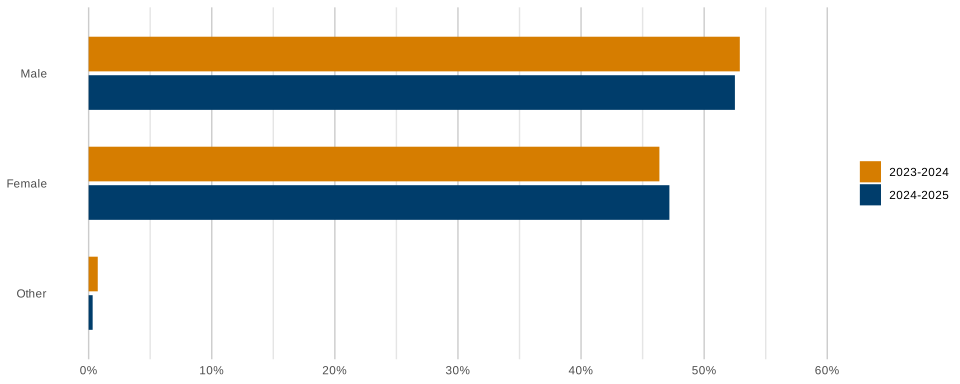
Description of Figure 4: The bar chart compares the gender distribution across the financial years 2024–2025 and 2023–2024, showing slightly more males that females started a JGW+ programme in both years.
Of the 5,205 programmes started in 2024-2025, females represented 47.2% of all starts, an increase from 46.4% in 2023-2024, whereas males represented 52.5% of all starts, a decrease from 52.9% in 2023-2024. Participants self-identifying their gender other than male or female represented 0.3% of all starts, down from 0.7% in the previous financial year.
Jobs Growth Wales Plus Learners by Gender, Strand, and Measure on StatsWales
Figure 5: Positive outcome rates for JGW+ leavers by gender and financial year, 2023-2024 to 2024-2025
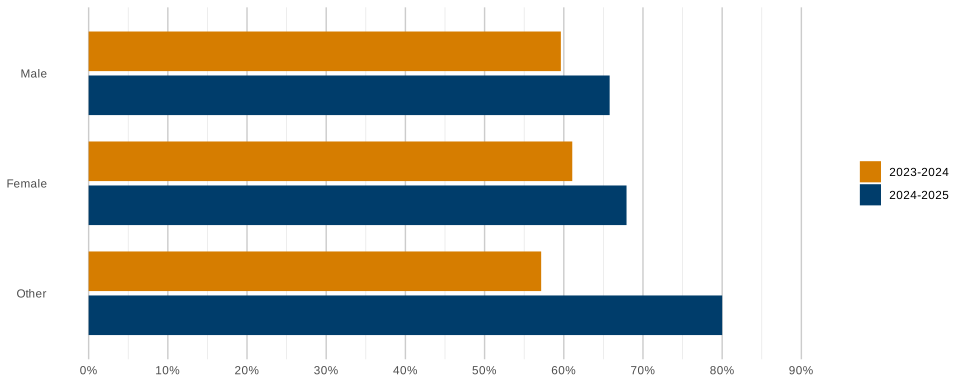
Description of Figure 5: The bar chart shows that positive outcome rates for females increased from 61.0% to 67.9% between 2023-2024 and 2024-2025. The rate for males also increased from 59.6% to 65.8% and the rate for learners with a gender other than female or male had the highest increase, from 57.1% to 80.0%.
Jobs Growth Wales Plus Learners by Gender, Strand, and Measure on StatsWales
There were 2,735 JGW+ programmes started by males in 2024-2025. 2,635 programmes ended during the year, of which 1,845 were completed. For females, there were 2,455 programmes started. 2,240 programmes ended, of which 1,415 were completed. For learners with a gender identity other than female or male, 15 programmes were started in 2024-2025. 20 programmes ended during the year, of which 15 were completed.
Ethnicity
Figure 6: Positive outcome rates for JGW+ leavers by ethnicity and financial year, 2023-2024 to 2024-2025
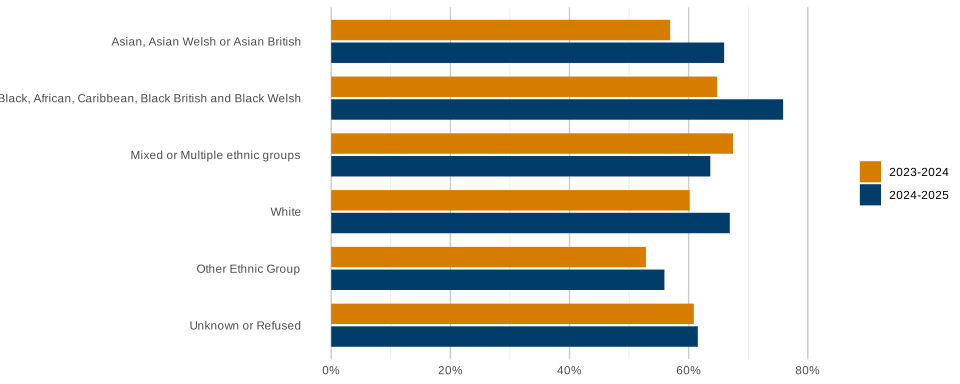
Description of Figure 6: The bar chart shows that the largest increase in the positive outcome rate was seen in learners from Black, African, Caribbean, Black British and Black Welsh backgrounds, increasing from 64.8% in 2023-2024 to 75.9% in 2024-2025.
Jobs Growth Wales Plus Learners by Ethnic Group and Measure on StatsWales
93.0% of learners starting JGW+ programmes in 2024-2025 were from a White ethnic background. 2.2% were from Mixed or Multiple ethnic groups, 1.2% were from an Asian, Asian Welsh or Asian British ethnic background, and 1.1% were from Black, African, Caribbean, Black British and Black Welsh ethnic background. The proportion of starts by learners from Other ethnic backgrounds was 2.2%.
JGW+ leavers from Black, African, Caribbean, Black British and Black Welsh backgrounds had the highest positive outcome rate in 2024-2025 at 75.9%. Learners from Other ethnic backgrounds had the lowest rate at 55.9%.
Learning Difficulty or Disability (LDD)
The Welsh Government accepts the Social Model of Disability, in which it is recognised that barriers in society act to disable people who have impairments or health conditions or who use British Sign Language.
The Lifelong Learning Wales Record (LLWR), which is the source of data for this release, captures data using the medical definition of disability (“a physical or mental impairment which has a substantial and long-term impact on a person’s ability to carry out normal day to day activities”). In the LLWR, learners are asked if they have a “disability and/or learning difficulty” – this data is used here.
Figure 7: Positive outcome rates for JGW+ leavers by disability and/or learning difficulty status and financial year, 2023-2024 to 2024-2025

Description of Figure 7: The bar chart shows that the positive outcome rate has increased for learners with a disability and/or learning difficulty between 2023-2024 and 2024-2025 from 57.9% to 62.3%. For learners without a disability and/or learning difficulty, the rate increased from 61.0% to 68.2%.
Jobs Growth Wales Plus Learners by Primary Learning Disability and Measure on StatsWales
The proportion of programmes started by learners who self-identified as having a disability and/or learning difficulty increased in 2024-2025 to 25.6% from 23.9% in 2023-2024. Of the programmes started by learners with a disability and/or learning difficulty, the most common primary types of disability and/or learning difficulty identified were dyslexia (295), autistic spectrum disorders (280) and attention deficit hyperactivity disorders (275). In total, there were 1,345 programmes started by learners with a disability and/or learning difficulty in 2024-2025. 1,245 programmes ended, of which 785 were completed.
Learning activities undertaken as part of Jobs Growth Wales+ programmes
Learning activities are typically specific qualifications, courses or learning aims pursued by the learner. JGW+ programmes may consist of one or more learning activities.
The 7,895 JGW+ programmes active in 2024-2025 contained 29,450 active learning activities during the financial year. Of these, 5,315 were regulated qualifications listed on the Qualifications in Wales database. The top three qualifications were:
- City & Guilds Entry Level 3 Introductory Award in Employability Skills
- ETCAL Level 1 Certificate of Introduction to Preparation for Military Service
- WJEC Entry Level 3 Award in Self Development and Wellbeing
Other learning activities largely consisted of job activity searches and core skills development.
80.4% of JGW+ learning activities were delivered through the medium of English. The remaining 19.6% were delivered bilingually (a 2.5 percentage point decrease on 2023-2024) with the vast majority falling into the category described as “a small amount of Welsh-medium learning”.
Background and context
The purpose of the Jobs Growth Wales+ Youth Programme was to deliver consolidated and individualised training, development and employability support to 16 to 19 year olds who are assessed as Not in Education, Employment or Training (NEET) at the time of starting the JGW+ programme.
The JGW+ programme will support delivery of the Welsh Government’s strategic priorities to tackle the consequences and risk factors associated with young people being NEET, which are integral to the Young Persons Guarantee (Working Wales), ‘Stronger, Fairer, Greener Wales: a plan for employability and skills’, the Programme for Government and to our Well-being Objectives.
Important delivery objectives of the JGW+ programme are to:
- contribute towards a reduction in the number of 16 to 19 year olds who are NEET
- achieve positive outcomes for 16 to 19 year olds at risk of becoming NEET
- progress Well-being of Future Generations objectives by delivering employability support for 16 to 19 year olds that provides equal opportunities (including Welsh language), promotes well-being and fair work, and helps embed environmental approaches that reduce harm
The three strands of JGW+ are Engagement, Advancement, and Employment. Engagement gives learners the opportunity to confirm or contextualise an occupational focus, addressing barriers preventing them from beginning a course of learning. Advancement helps learners to gain relevant skills for a particular career path, while Employment supports those who are actively looking for a job.
Outcomes
From start of the JGW+ programme in April 2022, through to the end of December 2023, the destinations of JGW+ leavers represented the destination within four weeks of leaving the programme. From January 2024, this has been adjusted to measure destinations within eight weeks of leaving the programme.
A positive outcome is either progression to learning at a higher level, progression into employment (full-time, part-time or self-employment) or progression to an Apprenticeship. For learners with a disability and/or learning difficulty, employment of less than 16 hours per week is also classed as a positive outcome.
Leavers include learners continuing from the previous financial year that were active in 2024-2025. Positive outcomes are calculated considering the number of leavers.
Where the destination is not known, or the leaver is seeking work/unemployed, the destination is classified as a negative outcome.
Voluntary work, further learning at the same or lower level, employment of less than 16 hours per week (for learners who do not have a disability and/or learning difficulty) and the ‘other’ destinations category are all classed as neutral outcomes. Learners with these outcomes are excluded from the denominator when calculating positive outcome rates. Learners who did not complete their JGW+ programme are included in the calculation of positive outcome rates.
Quality and methodology information
Rounding
All numbers have been rounded to the nearest 5. Percentages are calculated on the unrounded numbers. Differences between values are calculated using unrounded values, so there may be small discrepancies when compared with the rounded figures.
Statement of compliance with the Code of Practice for Statistics
Our statistical practice is regulated by the Office for Statistics Regulation (OSR). OSR sets the standards of trustworthiness, quality, and value in the Code of Practice for Statistics that all producers of official statistics should adhere to.
All our statistics are produced and published in accordance with several statements and protocols to enhance trustworthiness, quality, and value. These are set out in the Welsh Government’s Statement of Compliance.
These official statistics demonstrate the standards expected around trustworthiness, quality, and public value in the following ways.
Trustworthiness
These statistics are compiled from data drawn from the May 2025 freeze of the Lifelong Learning Wales Record (LLWR). JGW+ Contractors must submit information to the Welsh Government, via the LLWR, at least monthly on all young people, their programmes, activities, and awards under the JGW+ programme. The JGW+ programme specification details the data recording and submission requirements for contractors.
These statistics are pre-announced on the Statistics and Research area of the Welsh Government website. Access to the data during processing is restricted to those involved in the production of the statistics, quality assurance and for operational purposes. Pre-release access is restricted to eligible recipients in line with the Code of Practice (UK Statistics Authority).
Quality
The published figures provided are compiled by professional analysts using the latest available data and applying methods using their professional judgement and analytical skillset. Statistics published by Welsh Government adhere to the Statistical Quality Management Strategy which supplements the Quality pillar of the Code of Practice for Statistics (UK Statistics Authority) and the European Statistical System principles of quality for statistical outputs.
Files submitted for upload to the Lifelong Learning Wales Record (LLWR) undergo a series of validation checks. Welsh Government officials work with contract holders to resolve any data related issues, where necessary.
Welsh Government statisticians undertake final checks before drafting this statistical release, which is then signed off by senior statisticians and published in line with the statement on confidentiality and data access which is informed by the trustworthiness pillar contained in the Code of Practice for Statistics (UK Statistics Authority).
Occasionally, revisions can occur due to errors in our statistical processes or when a data supplier notifies the Welsh Government that they have submitted incorrect information. In these cases, a judgement is made as to whether the change is significant enough to publish a revised statistical release. Where changes are not deemed to be significant, figures will be corrected if they appear in future releases.
Value
The purpose of the statistical release and the accompanying data published on StatsWales are to provide evidence for policy development, inform the wider public about the activity and performance of the JGW+ programme and to enable contract holders to monitor their own performance.
The timeliness of the data provides the most recent update using reliable data.
You are welcome to contact us directly with any comments about how we meet these standards. Alternatively, you can contact OSR by emailing regulation@statistics.gov.uk or via the OSR website.
Well-being of Future Generations Act (WFG)
The Well-being of Future Generations Act 2015 is about improving the social, economic, environmental, and cultural well-being of Wales. The Act puts in place seven well-being goals for Wales. These are for a more equal, prosperous, resilient, healthier, and globally responsible Wales, with cohesive communities and a vibrant culture and thriving Welsh language. Under section (10)(1) of the Act, the Welsh Ministers must (a) publish indicators (“national indicators”) that must be applied for the purpose of measuring progress towards the achievement of the Well-being goals, and (b) lay a copy of the national indicators before Senedd Cymru. Under section 10(8) of the Well-being of Future Generations Act, where the Welsh Ministers revise the national indicators, they must as soon as reasonably practicable (a) publish the indicators as revised and (b) lay a copy of them before the Senedd. These national indicators were laid before the Senedd in 2021. The indicators laid on 14 December 2021 replace the set laid on 16 March 2016.
Information on the indicators, along with narratives for each of the well-being goals and associated technical information is available in the Wellbeing of Wales report.
Further information on the Well-being of Future Generations (Wales) Act 2015.
The statistics included in this release could also provide supporting narrative to the national indicators and be used by public services boards in relation to their local well-being assessments and local well-being plans.
We want your feedback
We welcome any feedback on any aspect of these statistics which can be provided by email to LabourMarket.Stats@gov.wales