
Intent behind higher rates transactions for Land Transaction Tax, July 2024 to June 2025
This article presents updated analysis on the intent behind higher rates transactions for Land Transaction Tax (LTT), including purchases of second homes and buy to let properties.
In this page
Introduction
This is our second annual article including data on the intent behind higher rates LTT transactions. We published our first article about this data in October 2024 which included data for one year only. With a second year of data now available, we can now present trends in the data for the first time. Before these two articles, we previously published annual articles to estimate individuals purchasing a dwelling that is not their main residence.
We began collecting higher rate intent data in summer 2023 using a new question on the LTT return. The question applies to all purchases of residential property to which the higher rates of tax apply. We introduced this question to help with tax compliance, to inform developments to LTT policy and to improve our information on higher rates transactions. Please read our ‘Analysing and quality assuring the data’ section for more information.
Main points
Please see the ‘How to interpret this data’ section for the limitations of the data in this article. For example, we explain that we only hold information about the intent behind higher rates transactions at the time of purchase and that the buyers’ eventual use of this property could differ.
For properties purchased between July 2024 and June 2025 (latest year) and July 2023 to June 2024 (previous year):
Wales analysis
- In the latest year, ‘buy to let landlord’ purchases made up the largest proportion of higher rate transactions out of all residential transactions (9%), followed by ‘second home, holiday home or holiday let’ purchases (6%).
- Comparing these to the previous year, ‘buy to let landlord’ purchases remained at 9%, whilst ‘second home, holiday home or holiday let’ purchases decreased by 1 percentage point (from 7%).
- The number of ‘buy to let landlord’ purchases increased by 12% in the latest year from the previous year. This was similar to the rise for all residential transactions (15%).
- Despite that large rise in residential transactions, ‘second home, holiday home or holiday let’ purchases did not follow this increasing trend, remaining unchanged.
Local authority analysis
- ‘Buy to let landlord’ purchases as a percentage of residential transactions varied across local authorities, with Merthyr Tydfil and Blaenau Gwent (both 17%) having the highest percentages.
- The percentages of ‘buy to let landlord’ purchases in local authorities remained similar to the previous year, except for larger changes in Wrexham (down 4 percentage points) and Denbighshire (down 2 percentage points).
- In the latest year, ‘second home, holiday home or holiday let’ purchases as a percentage of residential transactions varied from 3% in each of Newport, Monmouthshire and Torfaen to 13% in the Isle of Anglesey.
- For ‘second home, holiday home or holiday let’ purchases, both Isle of Anglesey and Gwynedd saw a 5 percentage point decrease in the latest year compared with the previous year, though the figures for the latest year remained higher than for any other local authority.
- Both Isle of Anglesey and Gwynedd had a higher-than-average increase in the number of main rate transactions. This may explain some of the large changes in the proportion of higher rates.
- For ‘second home, holiday home or holiday let’ purchases as a percentage of all residential transactions, the range in these figures between local authorities narrowed considerably. From a total span of 14 percentage points in the previous year, this narrowed to 10 percentage points in the latest year.
- These trends are consistent with policies around second homes in Wales having some impact on purchasing behaviour.
Tax due
- In the latest year, there was around 50% more ‘buy to let landlord’ purchases than ‘second home, holiday home or holiday let’ purchases.
- In contrast to this, the contribution of tax revenues from ‘second home, holiday home or holiday let’ purchases was around 25% higher than for ‘buy to let landlord’ purchases.
Change in intent
The analysis included in our previous article (published in October 2024) presented data on transactions effective between July 2023 to June 2024, as at July 2024. In the ‘Analysis of change in intent’ section of this article, we analyse whether the intent behind some of these transactions has changed in the 12 months since then.
When considering revisions to data for July 2023 to June 2024, there was an unexpected 7% decrease in the number of ‘second homes, holiday home or holiday let’ purchases. This can be attributed to subsequent claims for higher rate refunds against those transactions.
The corresponding changes for ‘buy to let landlord’ purchases were relatively small. Therefore, we believe the larger decrease for ‘second home, holiday home or holiday let’ purchases is due to some of those completing the LTT return having misinterpreted the question. Or in absence of knowledge of the actual intent of the purchase, the ‘second home’ option could be being used in the generic sense for purchasing an additional property.
Therefore, the likely conclusion is that the ‘second home, holiday home or holiday let’ category includes cases from some of the other categories (such as bridging) and is reported to be marginally higher than is the case in reality.
Analysing and quality assuring the data
With two years of data now available, we’ve been able to quality assure this over time. For example, although the data do not support a direct comparison, we have used data about properties currently on the Rent Smart Wales register to sense check our information in the ‘buy to let landlord’ category. This has helped inform some of the limitations we’ve identified in the data (please see the ‘How to interpret this data’ section).
In this article, we analyse data for the following types of local area:
- local authorities
- national parks
We’re also including data on the 16 new Senedd constituencies in the spreadsheet published alongside this article.
The higher rate intent question includes the following response options:
- bridging or have not sold previous main residence
- buy to let landlord
- buying a second home or holiday home
- buying a holiday let
- trade or business use (not including buy to let)
- buying for someone else (including minors)
- buying in relation to a trust
- transfer of equity (including with a mortgage)
- other (if selecting this option, users are required to enter a free text response about their reason for the higher rates purchase)
Land Transaction Tax return guidance provides further information on these options.
We have grouped the 9 possible responses to the new question into a smaller number of categories. This is to inform user need and because for some local areas, the number of responses in certain categories is too low for publication. This article uses the following categories:
- buy to let landlord
- second home, holiday home or holiday let
- higher rate refunds or bridging (higher rates transactions that are expected to be refunded)
- other
To improve the data further, we’ve analysed the free text responses where the taxpayer or agent has selected ‘Other’ on the tax return. If the free text response is clear that the purchase is one of the other categories, for example a second home, we have moved the response into that category. For many responses, these did not clearly fit into another category. For example, ‘purchasing additional property’ responses have remained in the ‘other’ category.
Relatively few responses have been re-categorised. Of the 10,450 higher rates transactions in July 2024 to June 2025, around 40 (less than 1%) were re-categorised into the ‘buy to let landlord’, ‘second home, holiday home or holiday let’ and ‘higher rate refunds or bridging’ categories used in this release.
How to interpret this data
Limitations to the data
- The data published reflects the intent stated on the tax return at the time of purchase. Or as described above, where we have re-categorised a small number of responses. The current use of the property could be different to the intent stated at the time of purchase.
- We only have limited information on how the seller previously used the property. Therefore, it’s not possible for us to identify if the buyer’s intended use represents a change in how the property is used.
- The headline data presented here is impacted by changes in both numbers of higher rate transactions and main rates residential transactions. The latter has risen significantly over the period which presents some challenges in interpreting the data, more of which is covered later.
- The data represents properties purchased in a particular year. Therefore, it may not be representative of the entire stock of properties in an area.
- With two years of data now available, we can compare the latest year against the previous year which shows some considerable change for some areas of Wales. However, we’re not able to compare this data over any longer period of time.
- The trends over time may be volatile between years. This is due to the small number of transactions in certain areas of Wales, therefore caution should be taken when interpreting this data.
- The LTT return is usually completed by solicitors or conveyancers on behalf of the taxpayer. From analysing the location and other information provided, we believe there are some instances where agents may interpret the categories of intent differently or even have assumed the intent incorrectly. For example, we believe ‘second home’ is occasionally being interpreted in a generic sense when intent is not clear, and certainly more widely than in the ‘holiday’ context. Other categories will also have variability in their responses depending on the individual completing the tax return. This is likely to have greater impact in urban areas where our analysis of location shows some clusters in or around town and city centres.
The data for July 2024 to June 2025 used in this article was extracted from our systems on 21 July 2025. For comparison purposes, the data for July 2023 to June 2024 used in this article was extracted on 15 July 2024. These are the same dates of data extract used in our latest statistical release. Therefore, total higher rate transactions presented here are consistent with the regular statistics for periods up to June 2025.
Figure 1: Percentage of residential transactions in different categories of higher rate intent, July 2024 to June 2025
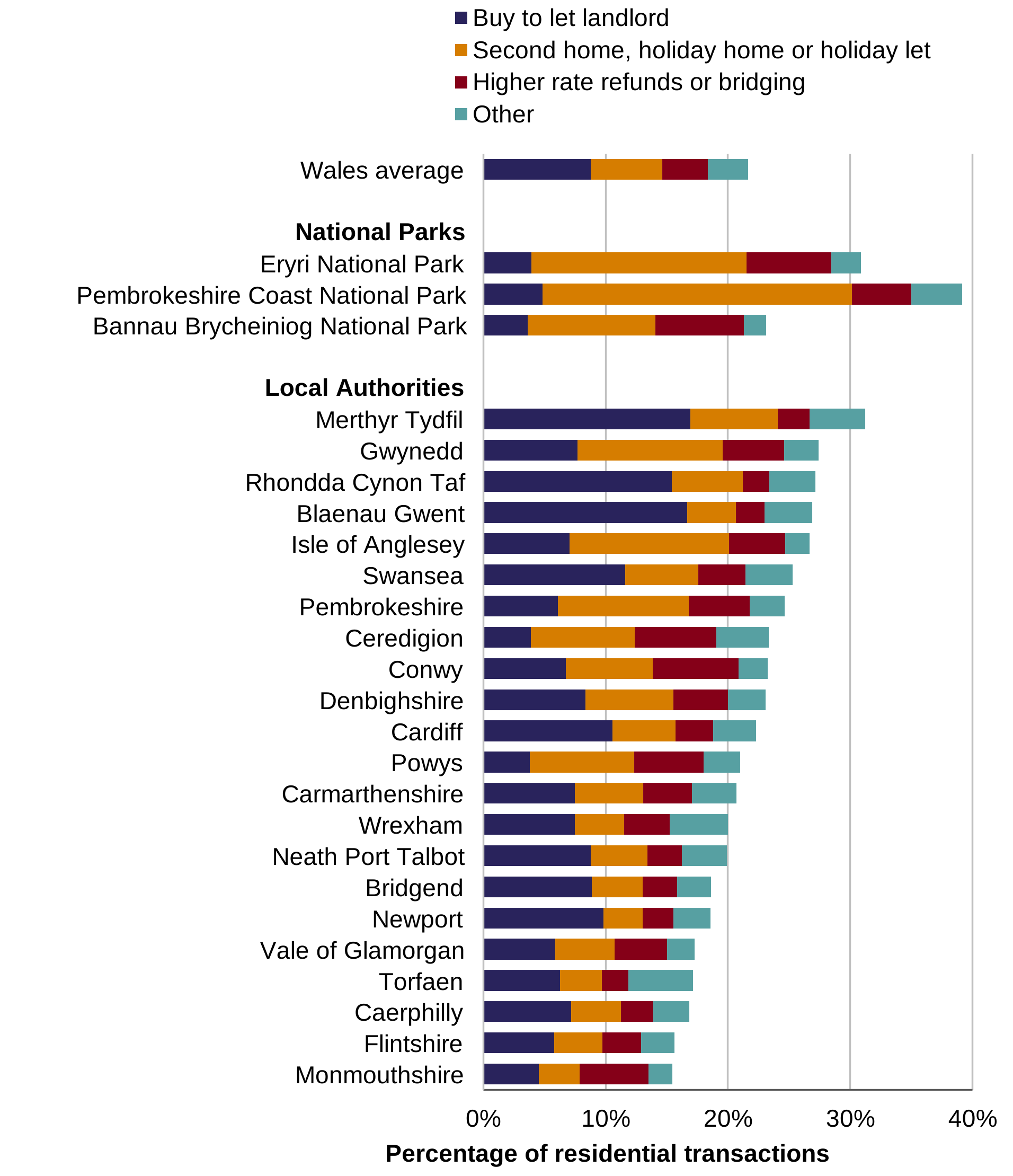
Description of Figure 1: Higher rates transactions as a proportion of all residential transactions broken down by intent: ‘buy to let landlord’ purchases, ‘second home, holiday home or holiday let’ purchases, higher rate refunds or bridging, and ‘other’ purchases. Analysis of the first two (and largest) of those categories is presented in Figures 2 and 3 below.
Source: Intent behind higher rates transactions for Land Transaction Tax [Open Document Spreadsheet, 18 Kb]
In the latest year, ‘buy to let landlord’ purchases made up the largest proportion of higher rate transactions out of all residential transactions (9%), followed by ‘second home, holiday home or holiday let’ purchases (6%). However, these percentages are not only influenced by change in the number of higher rates transactions, but also by change in total residential transactions (as used in the denominator). Therefore, in Table 1 below, we consider the actual numbers of transactions in each residential category and the change over time.
| Transaction type and higher rate intent | July 2023 to June 2024 | July 2024 to June 2025 | Percentage change |
|---|---|---|---|
| Residential, of which: | 44,600 | 51,140 | 15% |
| Main rates | 34,230 | 40,070 | 17% |
| Higher rates [Note 1] | 10,370 | 11,080 | 7% |
| Of which: buy to let landlord | 4,000 | 4,490 | 12% |
| Second home, holiday home or holiday let | 2,980 | 2,990 | 0% |
| Higher rate refunds or bridging | 1,710 | 1,910 | 11% |
| Other | 1,680 | 1,690 | 1% |
[Note 1] For consistency with Figure 1 above, transactions which were previously at the higher rates and have since been refunded are recorded in the ‘higher rates residential’ line.
Comparing data for July 2024 to June 2025 with the previous year:
- the number of residential transactions increased by 15%
- this was made up of a 17% increase in main rate transactions and a 7% increase in higher rates transactions
- higher rates transactions did not increase by as much as main rates did, mainly due to ‘second home, holiday home or holiday let’ purchases remaining flat
- however, the increase for ‘buy to let landlord’ purchases (12%) was more in line with the residential average
While there were large increases in residential transactions and for some of the higher rate intent categories, there was lack of similar growth for ‘second home, holiday home or holiday let’ purchases. This may lead to a conclusion that policies around second homes in Wales have contributed to fewer of those purchases occurring.
While that is likely to be the case, our data does not allow us to go further. We cannot directly infer that former second homes have been purchased as main residences, or that potential purchases of second homes were simply deterred from happening. However, either or both scenarios remain possible reasons for these trends.
Figure 2: Higher rates transactions with stated intent of ‘buy to let landlord’ as a percentage of residential transactions, July 2024 to June 2025 and July 2023 to June 2024
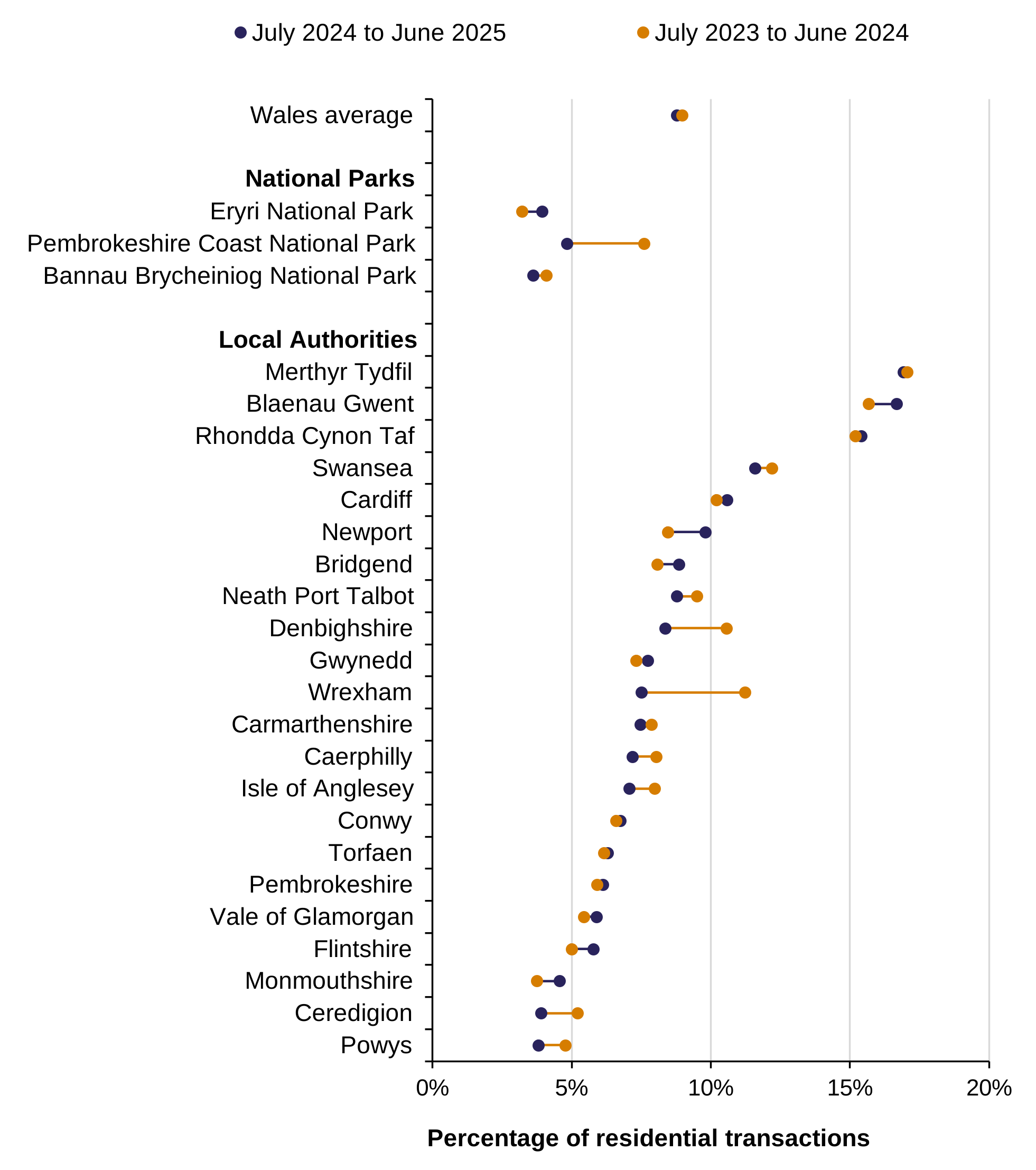
Description of Figure 2: In July 2024 to June 2025, ‘buy to let landlord’ purchases accounted for 17% of residential transactions in Merthyr Tydfil and Blaenau Gwent, the highest percentages for local authorities. The Wales average was 9%. Comparing the latest year with the previous one, the largest percentage changes were for Wrexham (down 4 percentage points) and Denbighshire (down 2 percentage points). The changes for all other local authorities were 1 percentage point or less. Some variation in these percentages from year to year would be expected. This is because the data does not represent the full stock of buy to let properties, only those purchased in a particular year.
Source: Intent behind higher rates transactions for Land Transaction Tax [Open Document Spreadsheet, 18 Kb]
Figure 3: Higher rates transactions with stated intent of ‘second home, holiday home or holiday let’ as a percentage of residential transactions, July 2024 to June 2025 and July 2023 to June 2024
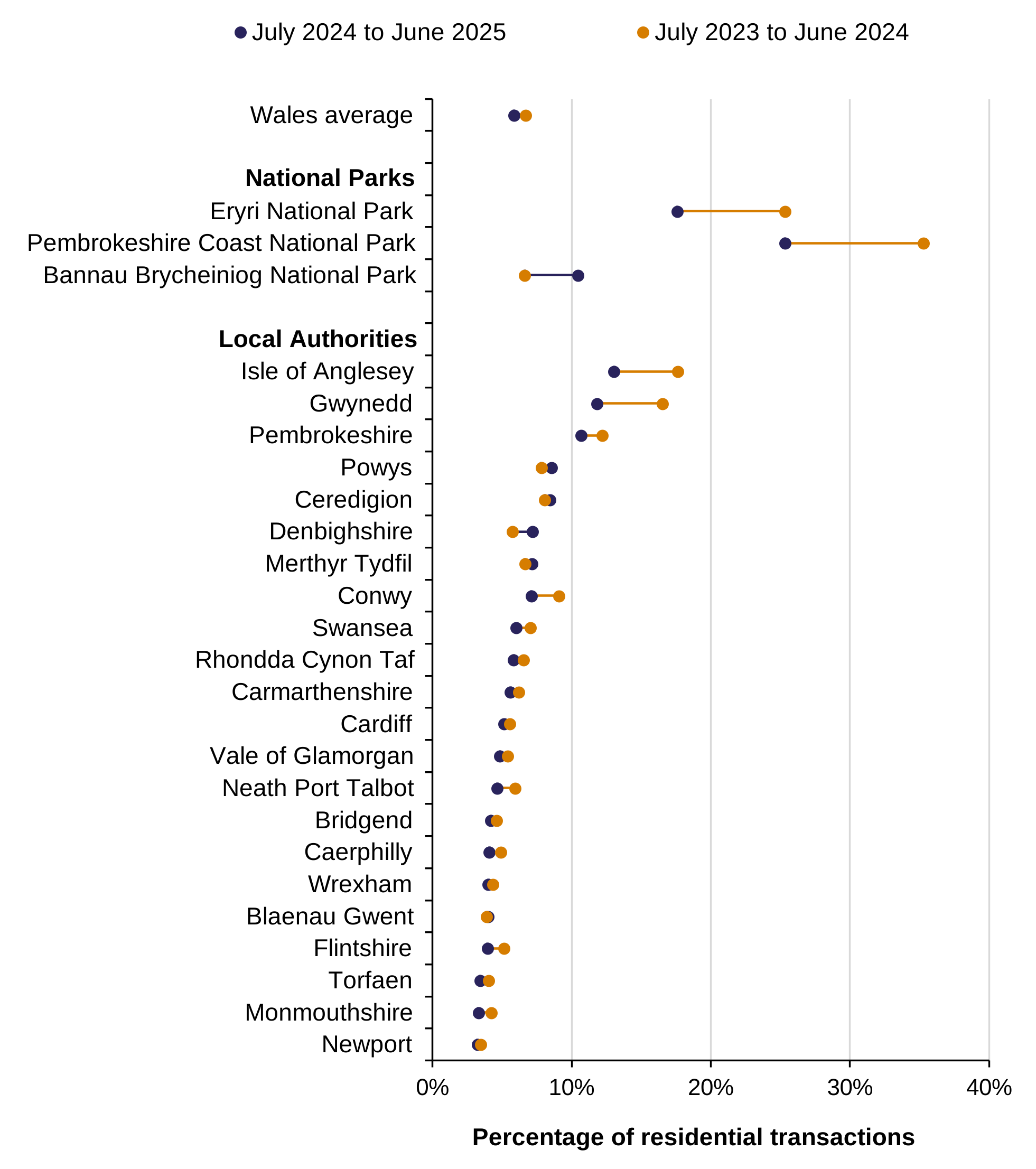
Description of Figure 3: When comparing ‘second home, holiday home or holiday let purchases’ in July 2024 to June 2025 with the previous year, both Isle of Anglesey and Gwynedd saw 5 percentage point decreases to 13% and 12% respectively. The changes for all other local authorities were 2 percentage points or less.
Source: Intent behind higher rates transactions for Land Transaction Tax [Open Document Spreadsheet, 18 Kb]
Although Isle of Anglesey and Gwynedd continue to have higher percentages than the other local authorities shown in Figure 3, the range from the top to the bottom of the distribution has narrowed from 14 percentage points previously to 10 percentage points in the latest year.
The percentage for Wales in the latest year was 6%, slightly lower than 7% in the previous year. Despite the fall in the percentage, Table 1 shows that the number of ‘second home, holiday home or holiday let’ purchases was largely unchanged on the previous year.
The percentage changes for the authorities described above are consistent with policies around second homes in Wales having some impact on purchasing behaviour.
Two National Parks also had relatively large percentage point changes in the latest year from the previous one. Pembrokeshire Coast saw a 10 percentage point decrease (to 25%) and Eryri an 8 percentage point decrease (to 18%), with these percentages remaining higher than any local authority. As stated in the caveat above, large changes in these percentages over time may be particularly influenced by the small numbers of transactions in these areas.
Figure 4: Percentage of residential transactions and tax due in different categories of higher rate intent, July 2024 to June 2025 [Note 1]
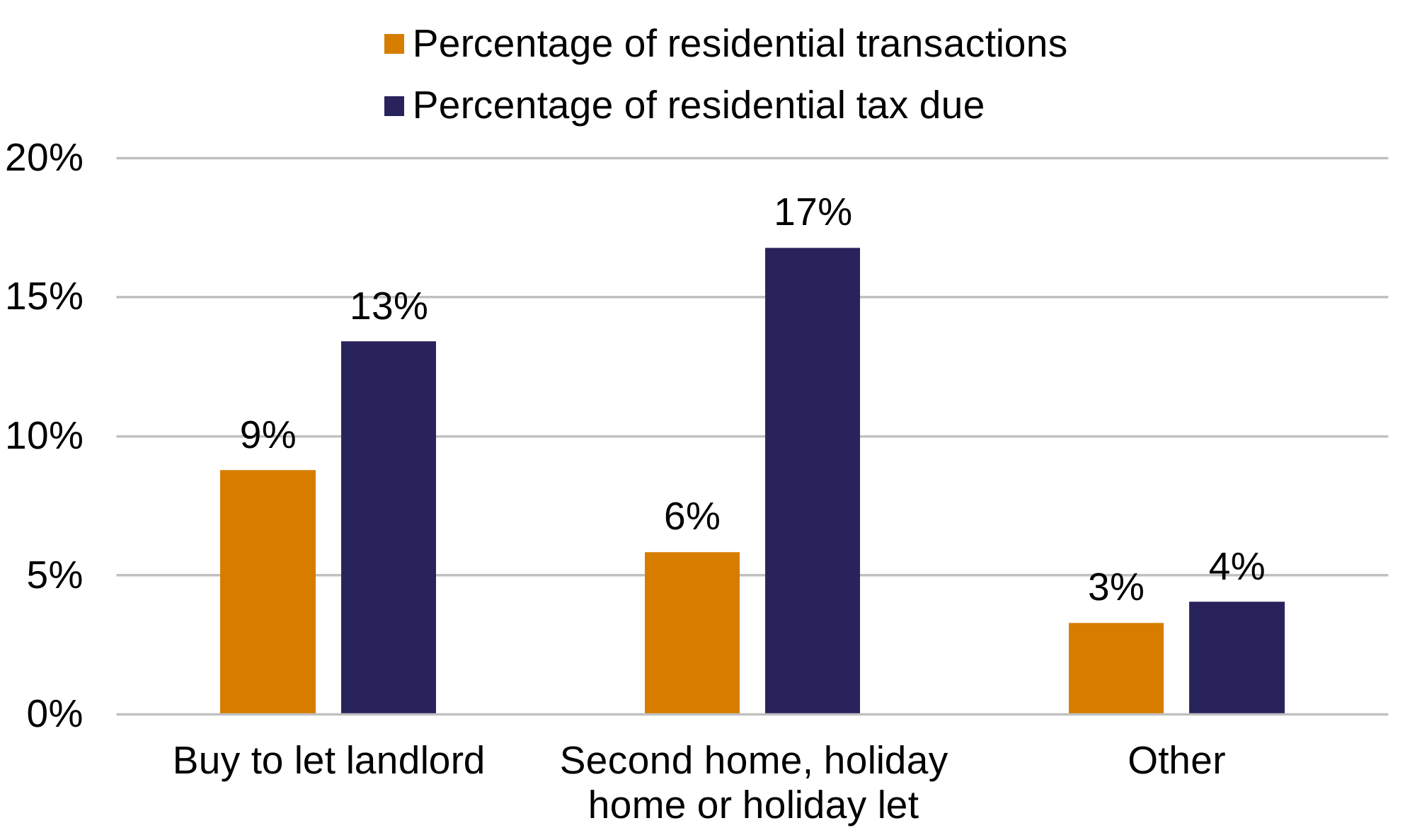
Description of Figure 4: For July 2024 to June 2025, ‘buy to let landlord’ transactions accounted for 9% of residential transactions and 13% of residential tax due (£37 million). ‘Second home, holiday home or holiday let’ purchases accounted for a lower percentage of transactions (6%) than buy to lets but a higher percentage of tax due (17% or £46 million). In July 2023 to June 2024, the corresponding percentage of tax due for ‘second home, holiday home or holiday let’ purchases was 20%. This reflects the higher average property values for this category, compared with buy to let properties.
Note 1: This chart excludes transactions related to bridging or higher rate refunds. Transactions with higher rate refunds applied are no longer charged at the higher rates of tax, therefore are no longer relevant when considering tax due in this chart. Transactions with the intent stated as bridging are expected to be claiming higher rate refunds in due course. As at 21 July 2025, the amount of tax due for all these cases stood at £30 million.
Analysis of change in intent
One of the caveats we state with the intent data is that it’s a snapshot taken at a point in time and can change subject to the buyers’ behaviours. We’re now able to identify some changes of intent, where the transaction type of the cases included in previous year’s analysis has been amended. This could happen in the following circumstances:
- the buyer has chosen to move into the property as their main residence and claims a refund of the higher rates element of the tax
- the buyer has made a claim to the WRA to amend their return from the original higher rates transaction into a main rates or non-residential transaction
- transactions previously reported as not higher rates have been amended to higher rates, for example as a result of a WRA investigation
- higher rates transactions not reported in last year’s analysis have since been filed with the WRA
Starting with the data for July 2023 to June 2024, Table 2 analyses revisions since 15 July 2024 (when this data was first published in last year’s article) and 21 July 2025. The table refers to the first two categories above as ‘no longer higher rates transactions’ and the final two categories above as ‘new higher rates transactions’.
| Category of higher rate intent | Data published in 2024 | No longer higher rates transactions [Note 1] | New higher rates transactions [Note 2] | As at 2025 | Percentage change |
|---|---|---|---|---|---|
| Buy to let landlord | 4,000 | -40 | 70 | 4,030 | 1% |
| Second home, holiday home or holiday let | 2,980 | -240 | 20 | 2,760 | -7% |
| Other | 1,680 | -20 | 50 | 1,710 | 2% |
| Bridging [Note 3] | 1,240 | -430 | 10 | 820 | |
| Higher rate refunds [Note 3] | 470 | 720 | [k] | 1,200 | |
| Total higher rate transactions and higher rate refunds | 10,370 | -10 | 150 | 10,520 | 1% |
[k] Represents a value which rounds to 0, but is not 0.
[Note 1] This counts the number of higher rates transactions which have either been amended to main rates (largely due to refunds or error) and a small number of amendments to non-residential rates due to mitigation and compliance activity.
[Note 2] This counts the number of new higher rates transactions submitted to the WRA after publication in 2024 and transactions that may have been amended from other tax rates to higher rates due to compliance activities.
[Note 3] The large revisions seen in these categories are mainly consistent with anticipated refund claims.
The table shows that the changes in data since 15 July 2024 are generally small. The main points of interest are:
- of the 720 higher rate refunds in the 12 months to 21 July 2025, only 430 cases had previously indicated an intent of bridging
- of the remainder, most (240 cases) previously indicated an intent of ‘second home, holiday home or holiday let’
- there are far fewer refunds for ‘buy to let landlord’ and ‘other’ intents (40 and 20 cases respectively)
There are three likely reasons for the 240 cases with a previous intent of ‘second home, holiday home or holiday let’.
- The intention question may have been misinterpreted by some of those completing the LTT return. Or in absence of knowledge of the actual intent of the purchase, the ‘second home’ option may be being used in the generic sense for purchasing an additional property.
- There has been an actual change of intent around ‘second home, holiday home or holiday let’ purchases which are now being used as main residences.
- Some higher rate refunds have been claimed in error.
In practice, all three reasons are likely to apply. As the numbers of cases in the ‘buy to let landlord’ and ‘other’ categories are relatively small, it is assumed that the main reason is the first. The likely conclusion is that the ‘second home, holiday home or holiday let’ category includes cases that should instead be recorded in some of the other categories. This strengthens the finding that ‘buy to let land’ purchases are the most common type of purchases in the data, especially when viewed alongside the fall in the percentage of ‘second home, holiday home or holiday let’ purchases presented in Figure 3.
While the figure of 240 cases is unexpectedly high, the overall effect on the statistics presented earlier in this article is small. We have looked at how these cases are spread over local areas in Wales. The impact on the data shown in Figure 3 would be less than 1 percentage point in any given area and would not change the broad message contained in that data.
In the next annual edition of this article, we’ll be able to expand on our analysis, considering a further year of higher rate refunds for July 2023 to June 2024 and also a year of refunds for July 2024 to June 2025.
In response to the third reason listed for these 240 cases, the WRA has already reviewed and changed some of its operational processes around the handling of higher rate refund claims.
Further information
The quality information for LTT statistics explains how we’ve resolved quality issues with local area data.
In June 2023, the Welsh Government published a statistical article ‘Second homes: what does the data tell us? This included content from our previous articles on estimating breakdowns of higher rates LTT transactions. The analysis of LTT in the Welsh Government article has now been superseded by this article analysing higher rate intent.
Your feedback
We’re considering further plans for this data and welcome feedback from users on its usefulness. Send your feedback to data@wra.gov.wales.