Landfill Disposals Tax statistics: April to June 2025
The quarterly statistical release for Landfill Disposals Tax (LDT) published by the Welsh Revenue Authority (WRA). Data includes the weight of and tax due on waste disposed to landfill.
In this page
Introduction
Landfill Disposals Tax (LDT) is a tax on waste disposed to landfill, charged by weight, and landfill site operators pay the tax. There are 17 authorised landfill site operators covering 21 sites. The intention of the tax is to reduce the amount of waste going into landfill and encourage less harmful methods of waste management such as recycling and incineration.
LDT can be broken down into:
- authorised disposals (at the lower or standard rate)
- unauthorised disposals (taxable disposals made outside of authorised landfill sites)
The Welsh Government sets the tax rates. For lower and standard rates, it has matched those in the rest of the UK for all financial years up to 2024 to 2025. In 2025 to 2026, the standard rate continues to match those in the rest of the UK while the Welsh Government has set the lower rate as 5% of standard rate. This resulted in a small increase to the lower rate relative to the rest of the UK.
LDT statistics are a valuable source of data on the amount of waste going into landfill. LDT has an important role in the Welsh Government plan to achieve net zero emissions.
Forecasting LDT revenues for Wales in future is an important use of LDT statistics. The Office for Budget Responsibility produce LDT forecasts to coincide with Welsh Government and UK Government budgets.
The glossary defines relevant terms used in this release and has been updated in this edition of the release. Our key quality information describes how LDT statistics satisfy the Code of Practice for Statistics.
LDT statistics are accredited official statistics. In February 2022, the Office for Statistics Regulation independently reviewed and accredited these statistics as complying with the standards of trustworthiness, quality, and value in the Code of Practice for Statistics. Accredited official statistics are called National Statistics in the Statistics and Registration Service Act 2007.
Our statistical output policy explains the policies and procedures we have in place for publishing official statistics. We also publish the list of posts which have pre-release access to our statistics, including for LDT.
Main points
For concluded unauthorised disposals cases, the WRA has collected £0.3 million as at May 2025. While the number of cases concluded is currently small, in the past several years there has been considerable work to develop policies, investigate and test WRA powers on a variety of case types. The WRA continues to receive new and progress existing unauthorised disposals cases. Annually in our LDT statistics (next in May 2026), we’ll consider whether it’s possible to publish further data on unauthorised disposals.
Authorised waste disposals to landfill in April to June 2025
- There were 228 thousand tonnes of authorised disposals. This is a 5% increase compared with the same period in 2024.
- Within this total, there were 71 thousand tonnes of disposals at the standard rate. This is lower by a narrow margin to data for the same quarters in 2023 and 2024 (77 thousand tonnes and 81 thousand tonnes respectively), although is substantially lower than high points seen in 2021 and 2022. We have continued to see seasonal patterns in the levels of waste disposed in the past two years, with generally higher volumes in summer months and lower volumes in winter months.
- Lower rate disposals increased by 30% to 144 thousand tonnes, mainly influenced by increases for the ‘concrete, bricks, tiles and ceramics’ category.
- These disposals resulted in £9.7 million of tax due. This is 10% higher than the tax due for the same period in 2024. For 2025 to 2026, there were increases in LDT rates above forecast inflation. The Welsh Government also increased the lower rate to 5% of the standard rate. Despite the fall in the weight of standard rate disposals described under Figure 1, the tax due increased by £0.4 million or 4%. The tax due from lower rate also increased from £0.4 million to £0.9 million.
- Fines material accounted for 24% of the weight of waste disposed at the lower rate. Soils and stones accounted for 32% and ‘other lower rate’ accounted for 25%.
- 5 landfill site operators accounted for 93% of the total tax due, with the corresponding percentages for the 6 previous quarters also being above 90%. Before that, the figure varied between 80% and 90%.
Statistician’s comment
Adam Al-Nuaimi, Head of Data Analysis in the WRA, commented on these statistics:
In April to June, the Landfill Disposals Tax due of £9.7 million was 10% higher than the same period a year earlier. This is due to increases in the tax rates being charged in 2025 to 2026. With the lower tax rate now increased to 5% of standard rate, the tax due from the lower rate increased by £0.5 million this quarter, while the tax due from the standard rate increased by £0.4 million.
Analysis
Unauthorised disposals
The WRA has been collecting and managing tax relating to the unauthorised disposals rate of LDT. Though the number of tax cases concluded is small, in May 2025 we published a figure on the total tax collected for these concluded cases. For the three year period (2022-23 to 2024-25), we’ve collected £0.3 million from concluded cases.
The unauthorised disposals team was created to issue tax charges on unauthorised disposals, which are taxable disposals made outside of authorised landfill sites. Since formation, the team have been developing policies and investigating and testing our powers on a variety of case types.
As at May 2025, the unauthorised disposals team finalised investigations on 16 cases, and of these:
- 8 cases were closed with tax due
- in some of these cases, the tax has been fully paid (what we define below as ‘concluded cases’)
- in other cases, the tax is currently unpaid or partially paid
- 3 cases received warning letters
- 5 cases were investigated and closed with no further action
‘Concluded tax cases’ are a subset of closed cases with tax due, and a concept we have not previously published statistics for. Here, we are restricting our statistics to tax collected from concluded cases because this is a new area of tax addressing less compliant behaviour. For what we define as concluded cases:
- the tax is fully paid to the WRA
- the tax amount is not being appealed by the taxpayer
Therefore we considered that this data is suitable for publication.
The WRA continues to receive new and progress existing unauthorised disposals cases. Annually, in our LDT statistics (the January to March edition published each May), we’ll consider whether it’s possible to publish further data on unauthorised disposals.
Authorised disposals
The analysis in this release includes some statistical corrections that have been applied. The reasons why we make statistical corrections include:
- where we know that information on a tax return is incorrect and we are awaiting a taxpayer amendment to be submitted to us
- where a taxpayer amendment is being reviewed by the LDT operations team for its validity, we may make statistical corrections to undo the effect of the amendment within our statistics
Table 1 below shows percentage changes for the latest quarter against the same period a year earlier. Some percentage changes are large as they are based on small numbers, therefore we advise caution on interpreting any large percentage changes shown.
| Disposed weight [thousand tonnes] Apr to Jun 2024 | Disposed weight [thousand tonnes] Apr to Jun 2025 [provisional] | % change | |
|---|---|---|---|
| Standard rate | 81 | 71 | -13% |
| Lower rate, of which: | 111 | 144 | 30% |
| Fines material [note 1] | 32 | 35 | 10% |
| Soil and stones [note 2] | 38 | 46 | 18% |
| Concrete, bricks, tiles and ceramics [note 2] | 8 | 28 | 232% |
| Other lower rate [note 2] | 32 | 35 | 10% |
| Relieved or discounted [note 3] | 26 | 14 | -48% |
| Total | 218 | 228 | 5% |
| Tax due [£ millions] Apr to Jun 2024 | Tax due [£ millions] Apr to Jun 2025 [provisional] | % change | |
|---|---|---|---|
| Standard rate | 8.4 | 8.8 | 4% |
| Lower rate | 0.4 | 0.9 | 128% |
| Total | 8.8 | 9.7 | 10% |
| Relieved tax amount [note 4] | 0.1 | 0.1 | -7% |
| Financial year | Lower rate | Standard rate | Total | Relieved tax amount [note 4] |
|---|---|---|---|---|
| 2018 to 2019 | 1.5 | 47.1 | 48.6 | 0.9 |
| 2019 to 2020 | 1.3 | 36.0 | 37.3 | 0.2 |
| 2020 to 2021 | 1.6 | 30.4 | 32.0 | 0.3 |
| 2021 to 2022 | 1.8 | 43.3 | 45.1 | 0.3 |
| 2022 to 2023 | 1.8 | 40.4 | 42.1 | 0.7 |
| 2023 to 2024 | 1.9 | 27.6 | 29.5 | 0.6 |
| 2024 to 2025 [r] | 1.8 | 29.5 | 31.3 | 0.3 |
| 2025 to 2026 [to date] [p] | 0.9 | 8.8 | 9.7 | 0.1 |
Source: Landfill Disposals Tax statistics by reporting period, tax rate and measure on StatsWales
[Note 1] Fines are particles of material produced by a mechanical waste treatment process. Landfill site operators must ensure certain criteria are met for the material to be treated as qualifying fines at the lower rate of tax. Please see the glossary page for further information.
[Note 2] Data for these categories represents non-qualifying fines material, grouped by List of Waste (LoW) code. The groupings used for these three categories is presented in our glossary page.
[Note 3] This includes weight of water removed from disposed waste, which is zero rated, and the weight of all waste which is subject to any LDT relief.
[Note 4] This is the reduction in tax due to the applications of reliefs. The amount does not include any element for water discount, which is not taxed.
Figure 1: Weight of waste disposed to landfill, by tax rate and quarter
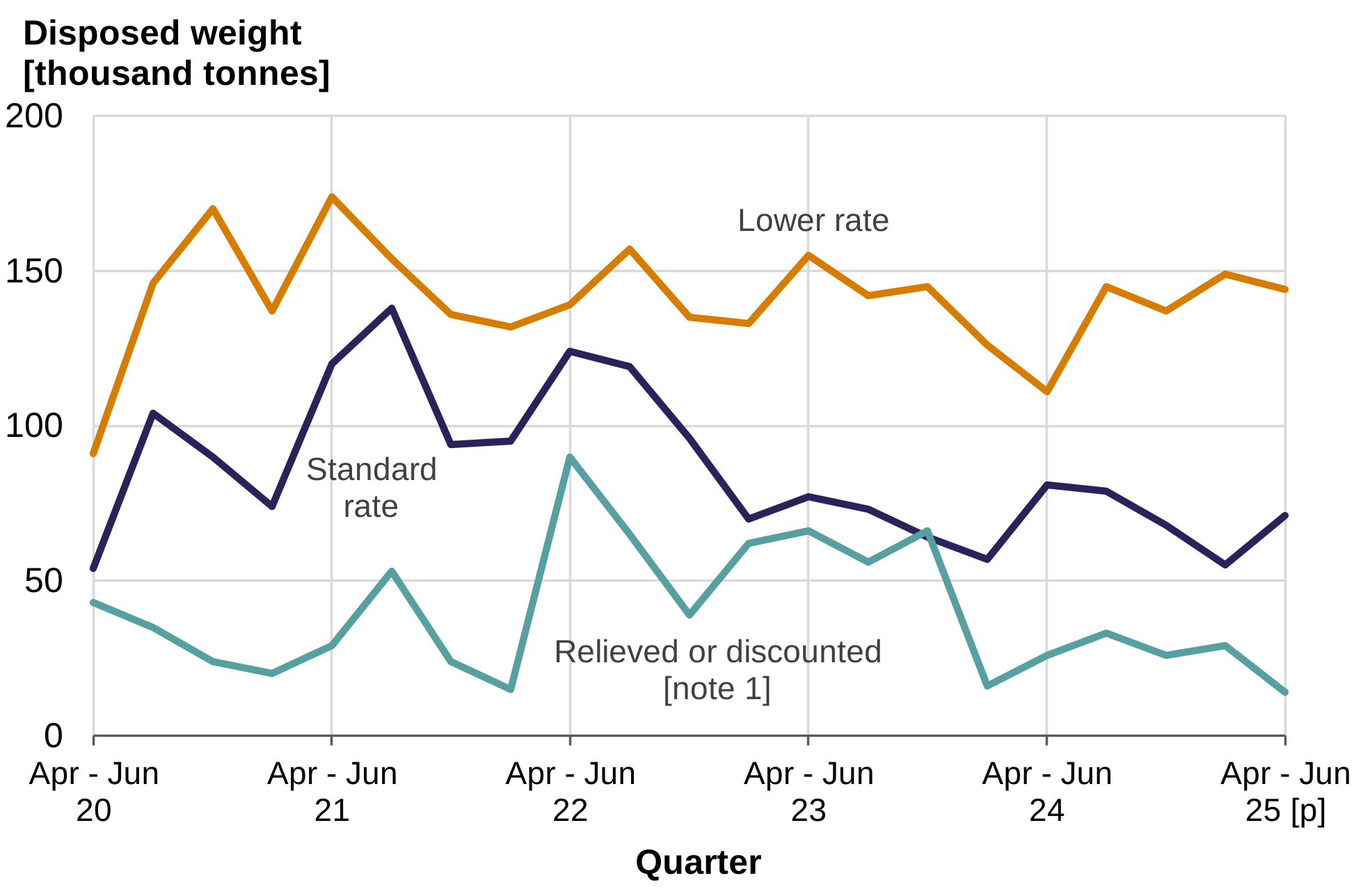
Description of Figure 1: The line chart shows that in the past 5 years, seasonal variations have generally been seen in the quarterly weight of standard rate disposals, with generally higher levels of disposals in April to June and July to September than the other 2 quarters in a year. Lower rate disposals fluctuated, appearing to follow no set pattern, while relieved or discounted disposals were generally low since April 2020 except for the generally higher numbers seen in April to June 2022 and throughout 2023.
Source: Landfill Disposals Tax statistics by reporting period, tax rate and measure on StatsWales
[Note 1] This includes weight of water removed from disposed waste, which is zero rated, and the weight of all waste which is subject to any LDT relief.
[p] The values for April to June 2025 are provisional and will be revised in a future publication.
Table 1 shows that in April to June 2025, there were 228 thousand tonnes of authorised disposals. This is 5% higher than the same period in 2024.
Within this total, there were 71 thousand tonnes of disposals at the standard rate. This is lower by a narrow margin to data for the same quarters in 2023 and 2024 (77 thousand tonnes and 81 thousand tonnes respectively), although substantially lower than high points seen in 2021 and 2022. We have continued to see seasonal patterns in the levels of waste disposed in the past two years, with generally higher volumes in summer months and lower volumes in winter months.
The 144 thousand tonnes disposed at the lower rate was 30% higher than April to June 2024. Commentary below Figures 3 and 4 analyses the categories within lower rate data contributing to this trend, particularly increases for concrete, bricks, tiles and ceramics.
In April to June 2025, the 14 thousand tonnes of relieved or discounted disposals was the lowest quarterly value seen to date. The level of relieved or discounted waste has varied greatly over time. This is usually dependent on circumstances at specific landfill sites. For example, when a landfill cell becomes full, there could be a temporary higher level of site restoration relief claimed by the operator for materials to cap the cell. Therefore it’s not straightforward to determine whether the amounts of relieved or discounted waste will rise or fall in future from historic trends.
Figure 2: Tax due on waste disposed to landfill, by tax rate and quarter
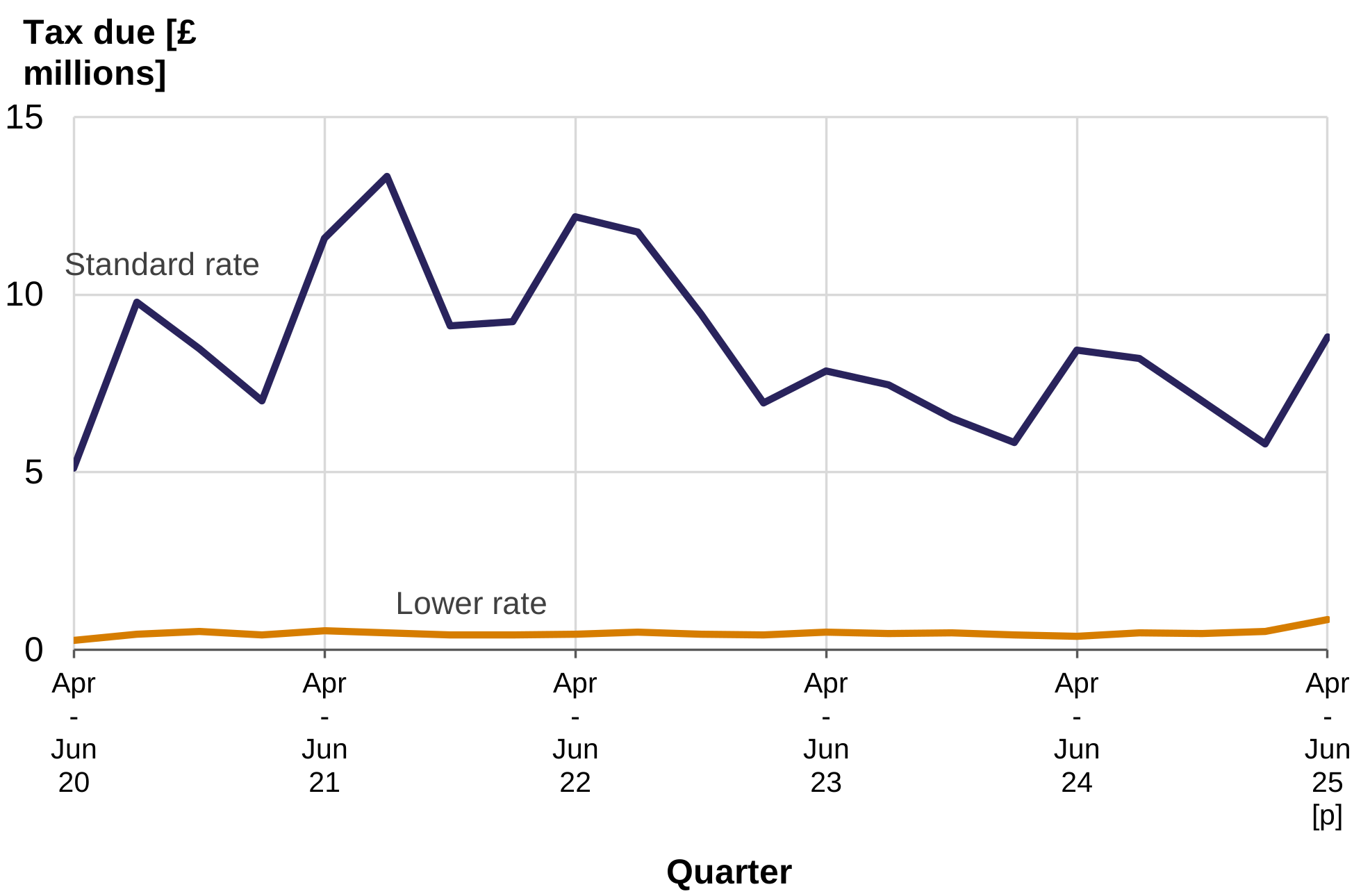
Description of Figure 2: The line chart shows that quarterly tax due from standard rate disposals followed a similar seasonal trend to the weight of disposals shown in the previous chart. The tax due from lower rate disposals was £0.9 million this quarter, as the lower rate of tax nearly doubled for 2025-26 from the previous year. Tax due from lower rate disposals previously ranged between £0.3 million and £0.5 million each quarter.
Source: Landfill Disposals Tax statistics by reporting period, tax rate and measure on StatsWales
[p] The values for April to June 2025 are provisional and will be revised in a future publication.
Disposals in April to June 2025 resulted in £9.7 million of tax due. This is 10% higher than the same period in 2024. For 2025-26, there were increases in LDT rates above forecast inflation. The Welsh Government also increased the lower rate to 5% of the standard rate. These rate changes influenced the amount of tax due this quarter. Despite the fall in the weight of standard rate disposals described under Figure 1, the tax due increased by £0.4 million or 4%. The tax due from lower rate also increased from £0.4 million to £0.9 million.
There is evidence of a seasonal pattern in the standard rate data, with shorter days in winter months potentially a factor in the level of disposals.
For April to June 2025, the 5 landfill site operators paying the most tax accounted for 93% of the total tax due, a lower figure than the 5 previous quarters. Up to July to September 2023, the figure varied between 80% and 90%. From October to December 2023 onwards, it varied between 90% and 97%.
The relieved tax amount is not shown on the chart but has ranged from very little up to £0.3 million each quarter. This value was £0.1 million in April to June 2025.
Revisions to the weight of waste disposed and tax due for January to March 2025
As described in the Methods section of this release, our estimation processes result in provisional estimates for the latest quarter being routinely revised in the next edition of the statistical release. These revisions are often relatively small.
Compared with estimates published in our previous statistical release, we have revised the January to March 2025 data as follows:
- the weight of waste disposed at the standard rate was revised downwards from 56 thousand tonnes to 55 thousand tonnes
- the weight of waste disposed at the lower rate was revised upwards from 144 thousand tonnes to 149 thousand tonnes
- the total tax due remained unchanged at £6.3 million
Figure 3: Weight of lower rate waste disposed to landfill, by type of waste and quarter
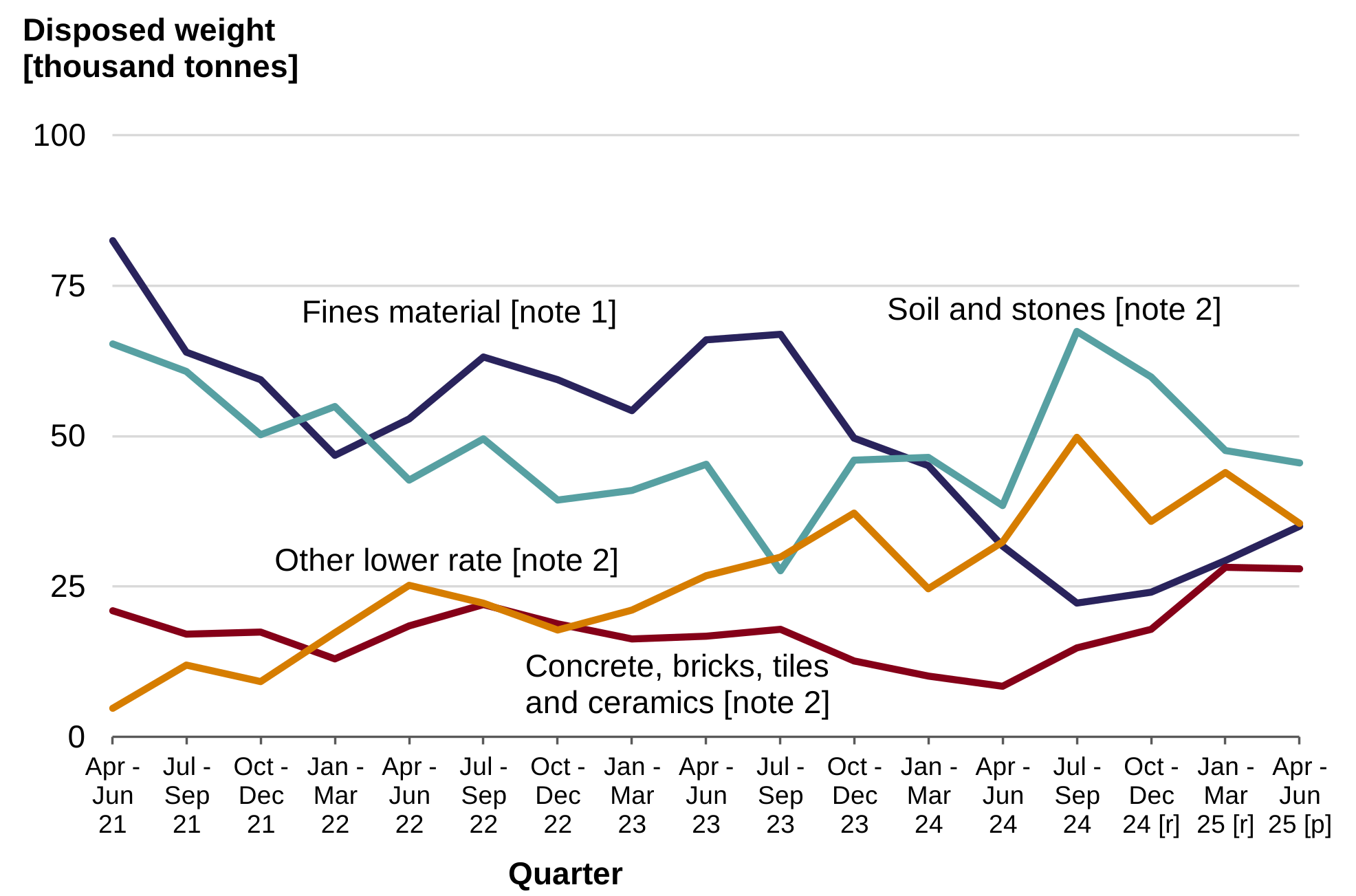
Description of Figure 3: The line chart shows that the disposed weight of fines material has risen in the past 3 quarters, after declining for 4 successive quarters prior to that. The weight disposed of soils and stones has declined in the past 3 quarters from the high seen in July to September 2024, though the current quarter remains higher than the same quarter a year earlier. ‘Other lower rate’ has generally grown over the last three years from minimal contribution and is marginally the second highest category this quarter, whilst ‘concrete, bricks, tiles and ceramics’ remains the lowest category.
Figure 4: Percentage of lower rate disposals of each waste type, by quarter

Description of Figure 4: The bar chart shows that in April to June 2025, the percentage of lower rate weight accounted for by fines material had increased for 3 quarters in a row, but remaining below all periods prior to that. Soils and stones and ‘other lower rate’ accounted for nearly a third and a quarter of lower rate disposals, respectively. ‘Concrete, bricks, tiles and ceramics’ remained at nearly a fifth of lower rate disposals, the highest quarterly figure seen to date.
Source: Landfill Disposals Tax statistics by reporting period, tax rate and measure on StatsWales
[Note 1] Fines are particles of material produced by a mechanical waste treatment process. Landfill site operators must ensure certain criteria are met for the material to be treated as qualifying fines at the lower rate of tax. Please see the glossary page for further information.
[Note 2] Data for these categories represents non-qualifying fines material, grouped by List of Waste (LoW) code. The groupings used for these three categories are presented in our glossary page.
[p] The values for April to June 2025 are provisional and will be revised in a future publication.
[r] The values for January to March 2025 have been revised in this publication.
Table 1 earlier in the release showed that in April to June 2025, 35 thousand tonnes of fines material was disposed at the lower rate of tax. This is 10% higher than the same period a year earlier but remains lower than all periods prior to that. We expect that at least some of the low level of fines material in the past 5 quarters is a temporary effect at certain sites.
Figure 4 shows that since April 2021, the quarterly percentage of lower rate waste accounted for by fines material varied between 15% and 48%. The lowest and highest values were seen in July to September 2024 and April to June 2021 respectively. The value this quarter was 24%.
Since April 2021, the quarterly percentage of lower rate waste accounted for by soils and stones varied from 19% to 47%. The lowest and highest values were seen in July to September 2023 and July to September 2024, respectively. The value this quarter was 32%.
The percentage of lower rate disposals classified as ‘other’ generally rose from 3% in April to June 2021 to 34% in July to September 2024, generally falling in subsequent quarters to 25% in April to June 2025. In future releases, it’s unlikely that we will be able to provide more detail on this category. This is due to challenges around potentially revealing information on individual operators.
To date, we have not observed any seasonal variations in the lower rate data but will continue to monitor this in future releases.
Table 4: Percentage of lower rate fines material received under each relevant List of Waste (LoW) code, April 2021 to June 2025
| LoW code | Description | Percentage |
|---|---|---|
| 19 12 12 | Other wastes (including mixtures of materials) from mechanical treatment of wastes other than those mentioned in 19 12 11 | 80% |
| 19 12 09 | Minerals (for example sand, stones) | 20% |
| 17 05 04 | Soil and stones other than those mentioned in 17 05 03 | 0% |
We previously received a request to break down data for lower rate fines material by List of Waste code. We then began publishing this table in the October to December 2022 edition of this release. In the releases since, we have updated these approximate percentages to include data for the most recent quarter, which resulted in no change to the percentages. We will continue updating these percentages in a similar way in future.
Receipts of LDT
We also publish quarterly receipts data for LDT on StatsWales. This data is based on the date the payment was received, sometimes referred to as ‘on a cash basis’.
Landfill Disposals Tax statistics on tax paid, on StatsWales
These data usually differ slightly from the data on tax due. This is because the figures are influenced by the exact accounting periods agreed with the LDT operators and the resulting payment dates. This can lead to payments falling into different quarters to the activity they cover. Generally, figures for cash receipts broadly align with the total due for the previous quarter. Cash receipt data will:
- include very small amounts of penalties and interest paid relating to LDT
- exclude any amounts of unpaid LDT, including penalties and interest as we manage any instances through our debt management processes
Accounting adjustments made in a financial year different to that when the waste was disposed
In the spreadsheet published on the headline page, Table 3 contains details of adjustments made to reflect waste disposed in one year that was accounted for in a different year within the WRA financial accounts. We update Table 3 annually in the edition of the release which follows the publication of the WRA financial accounts, which is this edition.
Differences between disposal years and accounting years can happen when a taxpayer amendment to the disposals is notified by a landfill site operator. In some situations these amendments may be accepted, or lead to an enquiry, after which the amendment may be confirmed, rejected or reversed (if it had previously been accepted). All these scenarios might lead to accounting adjustments.
The position may be further complicated by an appeal to the tribunal and a consequent further delay in accounting. Accounting adjustments may be made where there is uncertainty whether tax will eventually be due, ahead of the outcome of any appeal to the tribunal being determined.
Methods used in this release
Estimates for operators with non-standard accounting periods
Most landfill site operators report to the WRA using standard accounting periods. These align with the end of our reporting quarters.
A small number of landfill site operators use different start and end dates for reporting to the WRA. We explain here how we account for this issue when producing estimates for the current and previous reporting quarters.
In the example shown below:
- operator 1 has a standard accounting period
- operator 2 has agreed a different accounting period with the WRA
- the start and end points are different to our standard reporting quarters
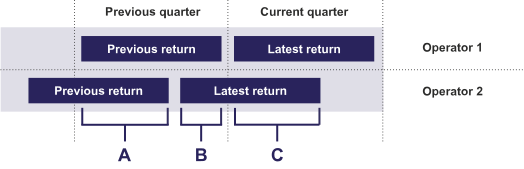
The diagram shows a timeline of the previous return and latest return for Operators 1 and 2. Letters A, B and C denote parts of the previous and latest return for Operator 2 and how these are used in the calculation.
[A + B] Two thirds of the previous return and one third of the latest return are used to give estimates for the previous quarter.
[C] The portion of the return covering the latest period is uplifted to give estimates for the current quarter. The uplift is pro-rata based on the number of days in the current quarter covered by the return.
Reliefs and discounts
In our quality information, we describe how we introduced a new tax return from April 2021. In the new return, landfill site operators record any relieved waste and any water discounts in separate parts of the return. In this release, we combine these two categories to present a ‘relieved or discounted’ category.
In the previous tax return, landfill site operators would initially record relieved waste as lower rate waste then subtract it off in a later part of their return. However, our previous releases would report relieved waste within the ‘relieved or discounted’ category but not as part of the lower rate category, so this has not led to a change in the presentation of data over time.
In our quality information, we have added new information on the reasons for differences between data from LDT returns and Natural Resources Wales data collection on input and output waste at permitted waste sites. This is relevant for relieved waste.
Customer insolvency
The LDT system allows for a credit to be made against the tax due for customer insolvency. This is when a customer of the landfill site operator has gone out of business and is unable to pay the operator for the waste disposed to landfill.
Previously, a very small amount of credit was claimed by one operator in the reporting quarter July to September 2018. However, the WRA rejected this claim and tax was due on this amount.
A small amount of credit was claimed by one operator for the reporting quarter July to September 2019. The WRA approved this claim. In this statistical release, we have subtracted the amount claimed from the total tax due.
Exempt disposals
Certain disposals of material can be treated as exempt from LDT and therefore are not reported to the WRA. We do not collect data on these exempt disposals.
Contact details
Statistician Dave Jones
Email: data@wra.gov.wales
Rydym yn croesawu galwadau a gohebiaeth yn Gymraeg / We welcome calls and correspondence in Welsh.
Media
Email: news@wra.gov.wales
Rydym yn croesawu galwadau a gohebiaeth yn Gymraeg / We welcome calls and correspondence in Welsh.