New house building: April 2024 to March 2025
Information on the number of new dwellings started, where building has commenced and those completed for April 2024 to March 2025.
In this page
Introduction
This release presents information on new house building activity in Wales in the 2024-25 financial year and its impact on overall dwelling stock. The release covers new dwellings started (where building work has commenced) and new dwellings completed (where building work has finished and the dwelling is ready for occupation). Information on new house building is used by the Welsh Government and local authorities to assess levels of housing supply across Wales.
The information presented in this release is based on the reports of local authority building inspectors and the National House Building Council (NHBC), a Private Approved Inspector (PAI). This release does not include information from other PAIs, likely resulting in an undercount in the total number of new dwellings started and completed.
Data coverage
Bridgend were unable to provide data for Quarters 2, 3 and 4 of 2024-25 (July 2024 to March 2025). Gwynedd were unable to provide data for Quarter 4 of 2024-25 (January to March 2025). Missing data for Bridgend and Gwynedd has been imputed. Please see the accuracy section of the quality and methodology information for more details.
Main points
- In 2024-25, 3,798 new dwellings were started, down 26% on 2023-24.
- In the same period, 4,631 new dwellings were completed, down 3% on the previous year.
- Of the 4,631 dwellings completed, 73% were accounted for by the private sector, 23% by Registered Social Landlords (RSLs) and 5% by local authorities.
- 39% of completions were 3-bedroom homes and 23% of completions were homes with 4 or more bedrooms.
Figure 1: Number of new dwelling starts and completions, 2015-16 to 2024-25
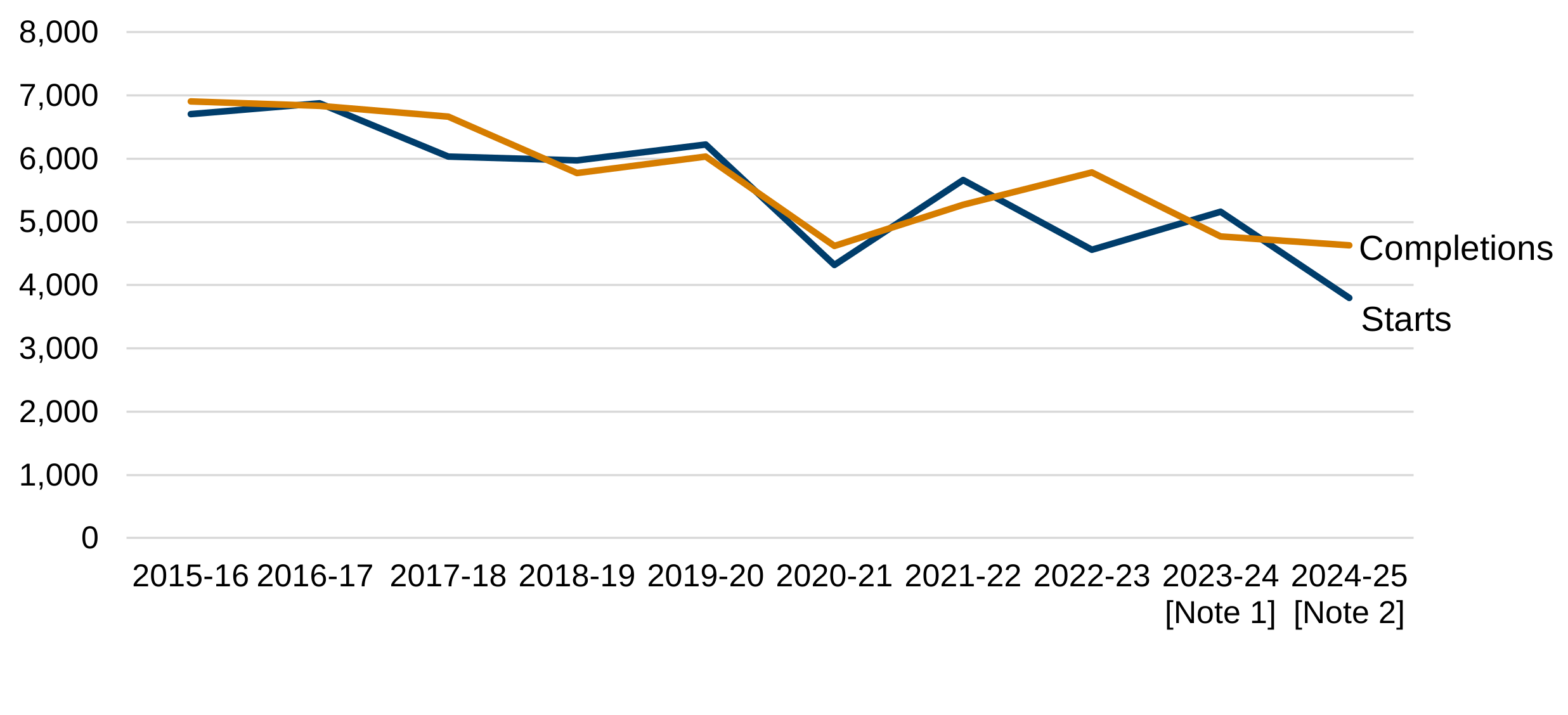
Description of Figure 1: A line chart showing that in the most recent ten-year period, there has been a general decline in the number of new dwellings started and completed.
Source: Local authority building inspectors and NHBC data
[Note 1] Includes estimated data for Quarter 4 for Gwynedd. Please see the accuracy section of the quality and methodology information for more details.
[Note 2] Includes estimated data for Quarters 2, 3 and 4 for Bridgend. Includes estimated data for Quarter 4 for Gwynedd. See the accuracy section of the quality and methodology information for more details.
Dwellings started by local authority
In 2024-25, 3,798 new dwellings were started, 26% fewer than in the previous year. This marked the lowest number of new dwelling starts on record. Based on the Welsh Government’s 2024 dwelling stock estimates, the number of new dwellings started in 2024-25 equates to approximately 3 new dwellings per 1,000 existing dwellings.
Figure 2: Number of new dwellings started per 1,000 existing dwellings by local authority, 2024-25 [Note 1]
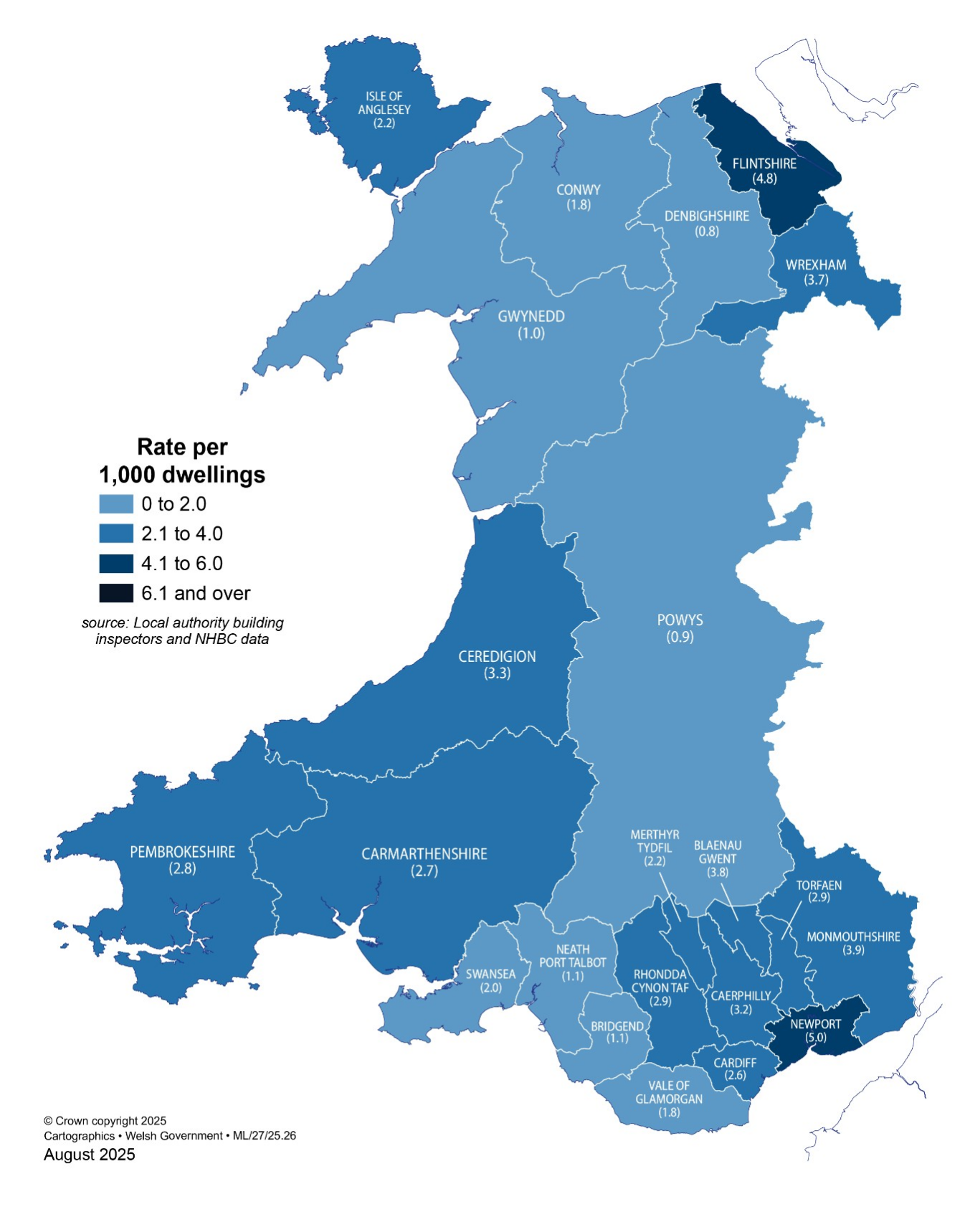
Description of Figure 2: A map showing that the number of new dwellings started per 1,000 existing dwellings was greatest in north-east and south-east Wales.
Source: Local authority building inspectors and NHBC data and Welsh Government Dwelling stock estimates
[Note 1] Includes estimated data for Quarters 2, 3 and 4 for Bridgend. Includes estimated data for Quarter 4 for Gwynedd. See the accuracy section of the quality and methodology information for more details.
New dwellings started by local authority area and dwelling type (StatsWales)
At a local authority level, the number of new dwellings started ranged from 43 in Denbighshire (equivalent to 1 new dwelling per 1,000 existing dwellings) to 412 in Cardiff (equivalent to 3 new dwellings per 1,000 existing dwellings).
The rate of new dwellings started per 1,000 existing dwellings ranged from 1 in Gwynedd, Denbighshire, Powys, Neath Port Talbot and Bridgend (with fewer than 100 new dwellings starts) to 5 in Newport (where 356 new dwellings were started).
Dwellings completed by local authority
In 2024-25, 4,631 new dwellings were completed, 3% fewer than in the previous year. This was the second lowest number on record, with the lowest number recorded in 2021-22, a year heavily affected by the coronavirus (COVID-19) pandemic (in 2021-22, 4,616 new dwellings were completed).
Based on the Welsh Government’s 2024 dwelling stock estimates, the number of new dwellings completed in 2024-25 equates to approximately 3 new dwellings per 1,000 existing dwellings.
Figure 3: Number of new dwellings completed per 1,000 existing dwellings by local authority, 2024-25 [Note 1]
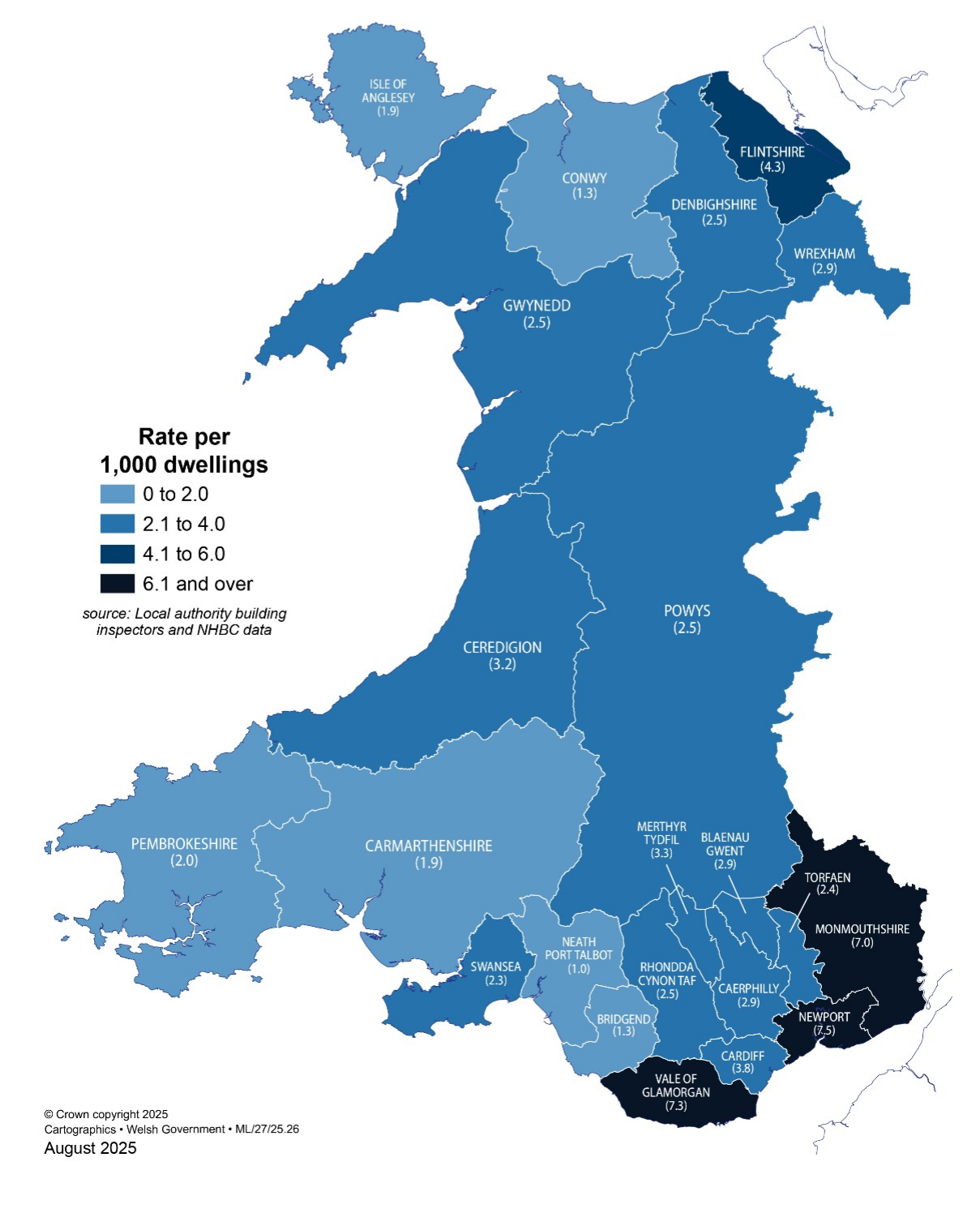
Description of Figure 3: A map showing that the rate of new dwellings completed per 1,000 existing dwellings was highest in south-east Wales.
Source: Local authority building inspectors and NHBC data and Welsh Government Dwelling stock estimates
[Note 1] Includes estimated data for Quarters 2, 3 and 4 for Bridgend. Includes estimated data for Quarter 4 for Gwynedd. See the accuracy section of the quality and methodology information for more details.
New dwellings completed by area, dwelling type and number of bedrooms (StatsWales)
At a local authority level, the number of new dwellings completed ranged from 67 in Neath Port Talbot (equivalent to 1 new dwelling per 1,000 existing dwellings) to 605 in Cardiff (equivalent to 4 new dwellings per 1,000 existing dwellings).
The rate of new dwellings completed per 1,000 existing dwellings ranged from 1 in Conwy, Neath Port Talbot and Bridgend (with fewer than 100 new dwelling completions) to 8 in Newport (where 534 new dwellings were completed).
Dwellings completed by tenure
It is not always possible for building control officers or the NHBC to determine the final tenure of a property. In these instances, the tenure is more likely to be recorded as private sector, leading to a potential overcount of dwellings in the private sector and a potential undercount of dwellings in the social sector. For this reason, tenure breakdowns should be treated with caution.
In 2024-25, most new dwelling completions were accounted for by the private sector (73%), with a smaller proportion accounted for by the social sector (27%). The proportion of completions accounted for by the social sector was higher than the previous year (22%). In 2024-25, 213 completions (5% of all completions) were accounted for by local authorities.
| Local authority | Private sector | RSL | Local authority | All tenures |
|---|---|---|---|---|
| Isle of Anglesey | 65 | 5 | 0 | 70 |
| Gwynedd [Note 1] | 157 | 0 | 0 | 157 |
| Conwy | 66 | 8 | 0 | 74 |
| Denbighshire | 111 | 2 | 12 | 125 |
| Flintshire | 134 | 175 | 0 | 309 |
| Wrexham | 135 | 23 | 19 | 177 |
| Powys | 99 | 70 | 0 | 169 |
| Ceredigion | 120 | 0 | 0 | 120 |
| Pembrokeshire | 110 | 13 | 4 | 127 |
| Carmarthenshire | 154 | 0 | 20 | 174 |
| Swansea | 207 | 59 | 0 | 266 |
| Neath Port Talbot | 59 | 6 | 2 | 67 |
| Bridgend [Note 2] | 85 | 0 | 0 | 85 |
| The Vale of Glamorgan | 206 | 122 | 124 | 452 |
| Cardiff | 513 | 92 | 0 | 605 |
| Rhondda Cynon Taf | 262 | 18 | 0 | 280 |
| Merthyr Tydfil | 46 | 46 | 0 | 92 |
| Caerphilly | 160 | 77 | 0 | 237 |
| Blaenau Gwent | 60 | 36 | 0 | 96 |
| Torfaen | 75 | 29 | 0 | 104 |
| Monmouthshire | 193 | 86 | 32 | 311 |
| Newport | 344 | 190 | 0 | 534 |
| Wales | 3,361 | 1,057 | 213 | 4,631 |
Description of Table 1: A table of new dwelling completions by local authority and tenure showing that in 20 of 22 local authorities, at least half of all new dwelling completions were accounted for by the private sector.
Source: Local authority building inspectors and NHBC data
[Note 1] Includes estimated data for Quarter 4. Please see the accuracy section of the quality and methodology information for more details.
[Note 2] Includes estimated data for Quarters 2, 3 and 4. See the accuracy section of the quality and methodology information for more details.
New dwellings completed by area, dwelling type and number of bedrooms (StatsWales)
At a local authority level, the percentage of new dwelling completions accounted for by the private sector varied from 43% in Flintshire (where 134 of 309 completions were accounted for by the private sector) to 100% in Bridgend, Ceredigion and Gwynedd (where all completions (85, 120 and 157 respectively) were accounted for by the private sector).
Looking at the social sector, the greatest number of RSL completions were observed in Newport, Flintshire and the Vale of Glamorgan (190, 175 and 122 RSL completions respectively). Most local authority completions were accounted for by the Vale of Glamorgan (with 124 local authority completions, accounting for 58% of all local authority completions).
Dwellings completed by dwelling type and bedrooms
In 2024-25, most new dwelling completions were houses or bungalows (81%), with a smaller proportion of dwellings completed as flats (19%). Since 2015-16, the proportion of dwellings completed as houses or bungalows has varied between 73% and 82%.
In the most recent year, 39% of new dwelling completions were of 3-bedroom homes and a further 23% were homes with 4 or more bedrooms. The distribution of dwellings by number of bedrooms has remained relatively stable in the past 10 years.
Typically, the private sector has focused on delivering larger homes (in 2024-25, 75% of private sector completions contained 3 or more bedrooms), while the social sector has focused on delivering smaller homes (in the same year, 72% of social sector completions contained just 1 or 2 bedrooms).
Dwellings completed across the UK
Between 2015-16 and 2019-20, there was a general increase in new house building activity in England, Scotland and Northern Ireland, whilst Wales generally observed a steady decrease. In 2020-21, new house building activity declined across the whole of the UK as the coronavirus (COVID-19) pandemic impacted the construction industry. In 2021-22 and 2022-23, new house building activity increased across the UK, reaching levels similar to those observed before the pandemic. In 2023-24 and 2024-25, there has been a decline in the number of new dwellings completed in England, Wales and Scotland, with Northern Ireland the only nation to observe an increase in the most recent year.
| Financial year | England | Wales | Scotland | Northern Ireland |
|---|---|---|---|---|
| 2015-16 | 139,710 | 6,900 | 16,960 | 5,810 |
| 2016-17 | 147,520 | 6,830 | 17,220 | 6,460 |
| 2017-18 | 160,910 | 6,660 | 17,560 | 7,100 |
| 2018-19 | 169,060 | 5,780 | 21,230 | 7,810 |
| 2019-20 | 175,330 | 6,040 | 22,220 | 7,310 |
| 2020-21 | 154,660 | 4,620 | 15,880 | 6,440 |
| 2021-22 | 171,240 | 5,270 | 21,430 (r) | 7,280 |
| 2022-23 | 174,840 | 5,790 | 23,860 (r) | 6,410 |
| 2023-24 | 160,390 (r) | 4,770 | 20,030 (r) | 5,410 (r) |
| 2024-25 | 152,100 (p) | 4,630 | 19,290 | 6,130 |
Description of Table 2: A table showing how the number of new dwelling completions varies by UK country between 2015-16 and 2024-25. The trend is described in the text above.
(p) Data is provisional and subject to revision.
(r) This data item has been revised.
Sources by country
England
Local authority new build form returns, NHBC data and approved inspector data returns.
New house building in England statistics (Department for Levelling Up, Housing and Communities)
Wales
Local authority building inspectors and NHBC data.
New house building in Wales statistics (Welsh Government)
Scotland
Local authority new build form returns and Scottish Government Affordable Housing Supply Programme.
New house building in Scotland statistics (Scottish Government)
Northern Ireland
District Council Building Control.
New house building in Northern Ireland statistics (Northern Ireland Statistics and Research Agency)
Figure 4: Indexed number of new dwellings completed across the UK (2015-16 = 100) [Note 1]
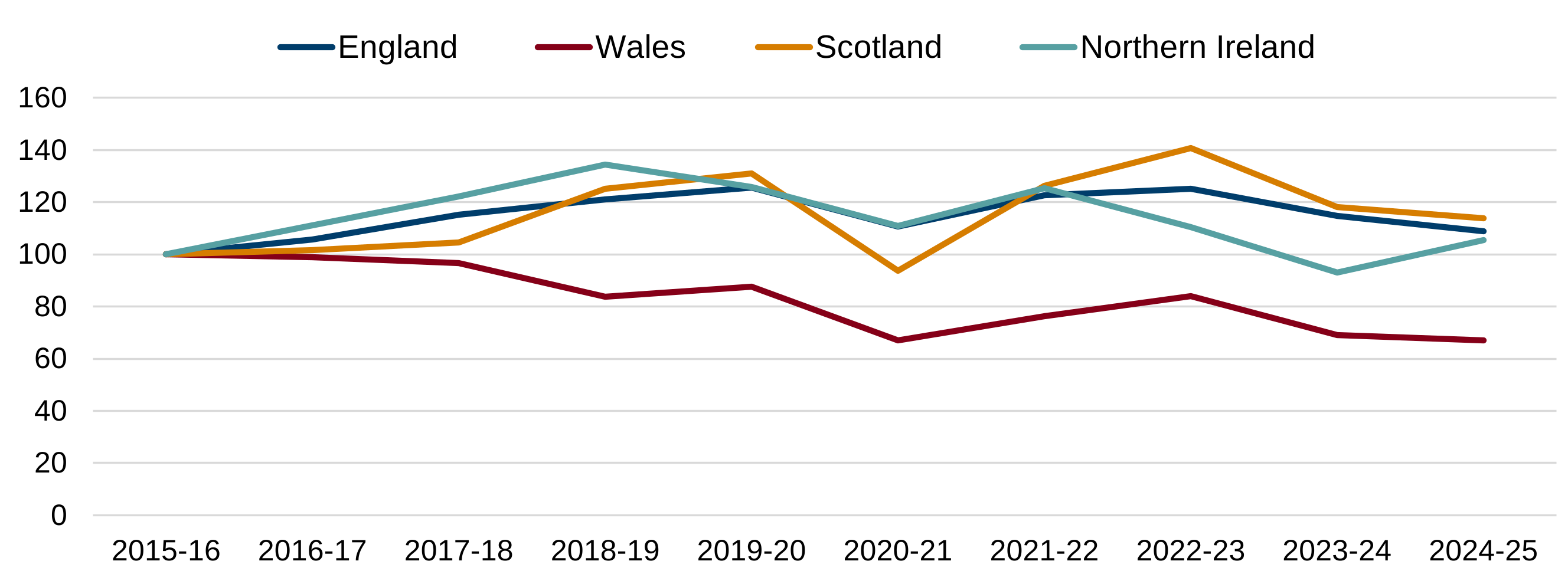
Description of Figure 4: A line chart showing how new house building has varied across the UK nations since 2015-16. The trend is described in the text below.
Sources by country
England
Local authority new build form returns, NHBC data and approved inspector data returns.
New house building in England statistics (Department for Levelling Up, Housing and Communities)
Wales
Local authority building inspectors and NHBC data.
New house building in Wales statistics (Welsh Government)
Scotland
Local authority new build form returns and Scottish Government Affordable Housing Supply Programme.
New house building in Scotland statistics (Scottish Government)
Northern Ireland
District Council Building Control.
New house building in Northern Ireland statistics (Northern Ireland Statistics and Research Agency)
[Note 1] The actual number of new dwellings completed varies considerably, the data shown in the chart has been indexed, with 2015-16 used as the base year and set at 100, to allow comparability in terms of scale.
Figure 4 highlights fluctuations in new house building activity across the UK, with activity declining across all nations in 2020-21 as the effects of the pandemic become apparent. In the most recent ten-year period, there has been an overall increase in the number of new dwellings completed in England, Scotland and Northern Ireland, with activity peaking in the two years prior to the pandemic and the two years following the pandemic. In Wales, new house building activity is shown to steady decline over the ten-year period.
Wider context
The Welsh Government’s Dwelling stock estimates are produced using Census data, alongside New house building and Housing demolitions data. Please see Dwelling stock estimates: as at 31 March 2024 for more information for more information on how these estimates ae produced.
The latest Welsh Government Dwelling stock estimates show that at 31 March 2024, there were an estimated 1.5 million dwellings in Wales, marking a 5% increase on March 2015. In the past 10 years, the percentage of dwellings split between the private sector and social sector has remained stable (with 84% of dwellings accounted for by the private sector and the remaining 16% by the social sector). At 31 March 2024, it is estimated that 70% of stock is accounted for by owner occupiers, 14% by private renters, 10% by RSLs and 6% by local authorities.
In 2020, an update to the Estimates of future housing need was published. These estimates, which are not a housing target, provide a range of need for additional housing units based on past trends and best available data. The Welsh Government are planning to publish updated estimates of additional housing need, based on updated household projections, by the end of 2025.
The number of additional affordable housing units delivered through new build, purchase, acquisition, leasing or conversion is published in the annual Affordable housing provision release.
Quality and methodology information
Accuracy
Bridgend were unable to provide data for Quarters 2, 3 and of 2024-25 (July 2024 to March 2025). Data provided by Bridgend for Quarter 1 2024-25 has been used for Quarters 2, 3 and 4.
Gwynedd were unable to provide data for Quarter 4 of 2024-25 (January to March 2025). Data provided for Quarter 1 to Quarter 3 of 2024-25 for Gwynedd has been averaged and used for Quarter 4.
Official Statistics status
All official statistics should show the standards of the Code of Practice for Statistics (UK Statistics Authority).
These are accredited official statistics, published by the Welsh Government. They were independently reviewed by the OSR in November 2012. They comply with the standards of trustworthiness, quality and value in the Code of Practice for Statistics.
It is Welsh Government’s responsibility to maintain compliance with the standards expected of accreditation. If we become concerned about whether these statistics are still meeting the appropriate standards, we will discuss any concerns with OSR promptly. Accreditation can be cancelled or suspended at any point when the highest standards are not maintained, and reinstated when standards are restored.
Accredited official statistics are called National Statistics in the Statistics and Registration Service Act 2007.
Statement of compliance with the Code of Practice for Statistics
Our statistical practice is regulated by the Office for Statistics Regulation (OSR). OSR sets the standards of trustworthiness, quality and value in the Code of Practice for Statistics that all producers of official statistics should adhere to.
All of our statistics are produced and published in accordance with a number of statements and protocols to enhance trustworthiness, quality and value. These are set out in the Welsh Government’s Statement of Compliance.
These accredited official statistics (OSR) demonstrate the standards expected around trustworthiness, quality and public value in the following ways.
Trustworthiness: we have made these statistics available in a timely manner to meet user needs. We have followed relevant protocols for releasing these statistics, ensuring that circulation before publication has been restricted to eligible recipients only.
Quality: we have made the limitations of this data clear to users (for example, highlighting that building activity by some PAIs is not captured, resulting in a small undercount of new build starts and completions). We intend to publish an article later in 2025-26 exploring the feasibility of using administrative data to complement and quality assure housing supply statistics.
Value: we have made every effort to ensure these statistics are accessible to users, using clear and succinct language. We welcome any feedback on how we can improve the value of these statistics.
You are welcome to contact us directly with any comments about how we meet these standards. Alternatively, you can contact OSR by emailing regulation@statistics.gov.uk or via the OSR website.
Well-being of Future Generations Act (WFG)
The Well-being of Future Generations Act 2015 is about improving the social, economic, environmental and cultural wellbeing of Wales. The Act puts in place seven wellbeing goals for Wales. These are for a more equal, prosperous, resilient, healthier and globally responsible Wales, with cohesive communities and a vibrant culture and thriving Welsh language. Under section (10)(1) of the Act, the Welsh Ministers must (a) publish indicators (“national indicators”) that must be applied for the purpose of measuring progress towards the achievement of the wellbeing goals, and (b) lay a copy of the national indicators before Senedd Cymru. Under section 10(8) of the Well-being of Future Generations Act, where the Welsh Ministers revise the national indicators, they must as soon as reasonably practicable (a) publish the indicators as revised and (b) lay a copy of them before the Senedd. These national indicators were laid before the Senedd in 2021. The indicators laid on 14 December 2021 replace the set laid on 16 March 2016.
Information on the indicators, along with narratives for each of the wellbeing goals and associated technical information is available in the Well-being of Wales report.
Further information on the Well-being of Future Generations (Wales) Act 2015.
The statistics included in this release could also provide supporting narrative to the national indicators and be used by public services boards in relation to their local wellbeing assessments and local wellbeing plans.