
National Survey for Wales: terms and definitions 2024 to 2025
This report provides information on the terms and definitions used by the National Survey including those on material deprivation, qualification levels and age standardisation.
In this page
Introduction
The National Survey for Wales is a large-scale, random sample survey covering people across Wales. Prior to March 2020, the survey was carried out face-to-face in the respondents’ homes. Since May 2020 the survey has been carried out by telephone. In 2021, a follow-up online section was added; and from 2024-25, a proportion of addresses that had not been reached by telephone were visited by interviewers to offer face-to-face interviews. For more details on methodology see the quality report. Information on sample sizes can be found in the fieldwork report.
The headline results for the monthly and quarterly survey are available on the National Survey for Wales webpages. Detailed charts and tables of results are available in our interactive results viewer. This report defines the terms used in those releases.
Area deprivation: Welsh Index of Multiple Deprivation
The Welsh Index of Multiple Deprivation (WIMD) is used as the official measure of area deprivation in Wales. Deprivation is a wider concept than poverty. Deprivation refers to wider problems caused by a lack of resources and opportunities. The WIMD is constructed from eight different types of deprivation. These are: income, housing, employment, access to services, education, health, community safety and physical environment.
Wales is divided into 1,909 Lower-Layer Super Output Areas (LSOA), each having about 1,600 people. Deprivation ranks have been worked out for each of these areas: the most deprived LSOA is ranked 1, and the least deprived 1,909. In releases, we have grouped the people living in the 20% of LSOAs that are most deprived based on WIMD score and compared them against the 20% of the LSOAs that are least deprived.
Economic status
Respondents are classified into the following three groups according to what they said they were doing in the previous 7 days.
Respondents in employment are:
- in any paid employment or self-employment (or away temporarily)
- on a government sponsored training scheme
- doing unpaid work for a business that you or a relative owns
- waiting to take up paid work already obtained
- furloughed from work due to coronavirus
Unemployed respondents are:
- unemployed and looking for work
- intending to look for work but prevented by temporary sickness or injury (28 days or less)
Economically inactive respondents are:
- a full-time student (including on holiday)
- unable to work because of long-term sickness or disability
- retired
- looking after home or family
- doing something else
Ethnicity
Different categories are typically grouped together for analysis purposes (it is not usually possible to provide sufficiently-precise results for more detailed disaggregations).
White (Welsh, English, Scottish or Northern Irish)
People self-identifying as white Welsh, white English, white Scottish, white Northern Irish, white British.
White (Irish, Gypsy, Irish Traveller or another white background)
White Irish, white Gypsy, white Traveller, other white background.
Black, Asian or Minority Ethnic
All other ethnicities (including black African, black Caribbean, black British, black Welsh, Asian, Asian British, Mixed ethnic groups).
Qualifications
Respondents’ highest qualifications are coded by National Qualification Framework (NQF) levels, where level 1 is the lowest level of qualifications and level 8 is doctoral degree or equivalent. For reporting purposes, respondents are grouped into 5 categories, as follows.
National Qualification Framework levels
National Qualification Framework levels
NQF levels 4 to 8
Higher education (Level 4+)
NQF level 3
'A' level and equivalent (Level 3)
NQF level 2
GCSE grades A to C and equivalent (Level 2)
Below NQF level 2
GCSE below grade C (below Level 2)
No qualifications
No qualifications
Material deprivation
Material deprivation is a measure which is designed to capture the consequences of long-term poverty on households, rather than short-term financial strain. The material deprivation questions in the National Survey are taken from the Family Resources Survey.
Non-pensioner adults are asked whether they have things like a holiday away from home for at least a week a year, enough money to keep their home in a decent state of decoration, or can make regular savings of £10 a month or more. The questions focus on whether they can afford these items or not.
Pensioners are asked slightly different questions such as whether their home is kept adequately warm, whether they have access to a car or taxi when needed, or whether they have their hair cut regularly. If they do not have these things, they are asked why this is.
Respondents’ answers are used to calculate a material deprivation score, such that if due to financial reasons they didn’t have any of the items at all they would have a score of 100; and if they have all items they would have a score of 0. Non-pensioners with a score of 25 or more are classed as deprived and pensioners with a score of 20 or more are classed as deprived.
In publications the non-pensioner and pensioner measures of deprivation are combined to provide an ‘adult’ deprivation variable. The terms ‘adult’ and ‘household’ deprivation may be used interchangeably depending on context.
An additional set of questions is asked relating to material deprivation of children in the household. The answers are combined with the answers to the non-pensioner adult questions in order to calculate a child material deprivation score.
For each of the three sets of deprivation question, a prevalence weighted approach is used to calculate the material deprivation score for the relevant respondents, as is done for the Family Resources Survey. This approach allows for the fact that the absence of some items is more uncommon, and so may be considered to represent a greater severity of deprivation than others. Items that are more uncommon are therefore given a higher weighting.
Loneliness
Various measures of loneliness can be used for data analysis purposes but the National Survey uses the De Jong Gierveld This is calculated using De Jong Gierveld loneliness scale - see terms and definitions 6-point loneliness scale. For this scale, respondents are shown a series of six statements and asked to indicate, the extent to which each statement applied to the way they feel. There are three statements about ‘emotional loneliness (EL)’ and three about ‘social loneliness (SL)’.
- I experience a general sense of emptiness (EL)
- I miss having people around me (EL)
- I often feel rejected (EL)
- There are plenty of people I can rely on when I have problems (SL)
- There are many people I can trust completely (SL)
- There are enough people I feel close to (SL)
The scale uses three response categories: Yes / More or less / No - where the neutral and positive answers are scored as “1” on the negatively worded questions (in this instance, questions 1 to 3). On the positively worded items (questions 4 to 6), the neutral and negative answers are scored as “1”. This means that an answer of ‘more or less’ is given the same score as ‘yes’ or ‘no’, depending on the question.
The scores for each individual question are added together to provide an overall loneliness measure. This gives a possible range of scores from 0 to 6, where 0 is least lonely and 6 is most lonely. For reporting purposes we have considered people who have a score of 4 to 6 as being lonely.
Sense of community
Respondents are asked to respond to what extent they agreed or disagreed with the following statements:
- ‘I belong to my local area.’
- ‘This local area is a place where people from different backgrounds get on well together.’
- ‘People in my local area treat each other with respect and consideration.’
Responses are combined, with those agreeing to all three statements deemed as feeling a sense of community within their local area.
Sexual orientation
Where sexual orientation is reported against, the following categories are usually used (the smaller categories are too small to produce precise results):
Heterosexual or straight
People self-identifying as heterosexual or straight.
Another response
All other responses (including gay or lesbian, bisexual, other, don’t know, and prefer not to say).
Subjective wellbeing
Respondents are asked to reply to a series of wellbeing questions , scoring their responses on scales of 0 to 10, where 0 indicates ‘not at all’ and 10 represents ‘completely’. The following four questions are asked:
- ‘Overall, how satisfied are you with your life nowadays?’
- ‘Overall, to what extent do you feel that the things you do in your life are worthwhile?’
- ‘Overall, how happy did you feel yesterday?’
- ‘Overall, how anxious did you feel yesterday?’
For life satisfaction, worthwhileness of life, and happiness scales, scores 0 to 4 are classed as low, 5 to 6 as medium, 7 to 8 as high, and scores 9 to 10 as very high. For anxiety the scale is grouped so that scores 0 to 1 are classed as very low, scores 2 to 3 as low, 4 to 5 as medium and scores 6 to 10 as high levels of anxiety.
Urban and rural
“Urban” includes settlements with a population of 10,000 or more and small towns and their fringes, where the wider area is less sparsely populated. “Rural” includes all other areas.
Smoking
Respondents are asked whether they:
- smoke (daily or occasionally)
- used to smoke (daily or occasionally)
- have never smoked
‘Current smokers’ are those who smoke either daily or occasionally; ‘ex-smokers’ are those who used to smoke daily or occasionally; ‘never smoked‘ are those who have never smoked; ‘non-smokers’ are those who have never smoked plus ex-smokers.
Alcohol consumption
Respondents are asked a set of questions about their alcohol consumption.
The weekly alcohol guideline for both men and women suggests drinking no more than 14 units a week on a regular basis.
Respondents are asked to indicate how often they consumed each type of alcohol during the past 12 months, and how much they usually consumed. The table that follows shows alcohol units for the different types of drink included in the questions. The question was modified compared with previous versions to accommodate the move to a telephone-first survey, and some types of alcohol were combined.
| Type of drink | Measure | Alcohol units |
|---|---|---|
| Beer or cider | Pints | 2 |
| Beer or cider | Large cans | 2 |
| Beer or cider | Small cans | 1.5 |
| Beer or cider | Bottles | 1.5 |
| Wine (including fortified wine and sparkling wine) | Large glass (250ml) | 3 |
| Wine (including fortified wine and sparkling wine) | Standard glass (175ml) | 2 |
| Wine (including fortified wine and sparkling wine) | Small glass (125ml) | 1.5 |
| Wine (including fortified wine and sparkling wine) | Bottles (750ml) | 9 |
| Spirits (including alcopops and liqueurs) | Measures (single) | 1 |
Average weekly consumption of each type of drink is calculated by multiplying the units usually consumed on a day when that type of alcohol was drunk by a factor representing the frequency with which it was drunk. The results for each type of drink are added together to give an overall weekly figure. The frequency multipliers used are:
| Drinking frequency | Multiplying factor |
|---|---|
| Almost every day | 7.0 |
| 5 or 6 times a week | 5.5 |
| 3 or 4 times a week | 3.5 |
| Once or twice a week | 1.5 |
| Once or twice a month | 0.375 |
| Once every couple of months | 0.115 |
| Once or twice a year | 0.029 |
Health-related behaviours can be a complex area to measure and there may be some differences between what people report and what they actually do (for instance, people may tend to underestimate their alcohol consumption). However, survey data still provides a reliable means of comparing patterns for these behaviours between different groups and over time.
Fruit and vegetable consumption
The survey includes questions about a range of food items in order to determine the overall amounts of fruit, vegetables and pulses consumed the previous day.
For each food item, respondents are asked whether they had eaten it and, if so, how much they consumed. Guidelines recommend eating at least five portions of a variety of fruit and vegetables each day. The questions and analysis are based on the concept of portions of 80g each and the information collected is converted into standard portions at the analysis stage.
The table that follows shows portion sizes for the different food items covered. The question was modified compared with previous versions to accommodate the move to a telephone survey, and some types of fruit were combined.
| Food item | Portion size |
|---|---|
| Salad | 1 small bowlful |
| Pulses | 3 tablespoons |
| Vegetables (fresh, raw, tinned, frozen) | 3 tablespoons |
| Dishes made mainly from vegetables or pulses | 3 tablespoons |
| Very small fruit (eg grapes, berries) | 2 handfuls |
| Small or medium fruit (eg apples, plums) | 1 medium fruit, 2 small fruits |
| Large or very large fruit (eg grapefruit, melon) | ½ large fruit, 1 slice very large fruit |
| Frozen or tinned fruit | 3 tablespoons |
| Dried fruit (eg raisins, apricots) | 1 handful |
| Dishes made mainly from fruit | 3 tablespoons |
| Fruit juice or smoothie | 1 small glass |
At the analysis stage, rules for certain foods are applied: respondents can obtain no more than one portion of their daily intake from fruit juice, one portion from pulses, and one portion from dried fruit. These rules are in line with guidelines, which state that a variety of fruit and vegetables should be consumed.
Health-related behaviours can be a complex area to measure and there may be some differences between what people report and what they actually do. However, survey data still provides a reliable means of comparing patterns for these behaviours between different groups and over time.
Physical activity
Physical activity guidelines recommend that adults should aim to do at least 150 minutes of moderate activity during the week. Alternatively, comparable benefits can be achieved by 75 minutes of vigorous activity, or an equivalent combination of the two.
Respondents are asked on what days in the previous week they walked, completed some moderate physical activity and completed some vigorous physical activity for at least 10 minutes at a time and then they are asked how much time, on average, they spent doing these activities each time. The respondents are also asked about their walking pace and the effort involved. Walking is included as a moderate activity for those walking at a ‘fairly brisk’ or ‘fast’ usual pace. For those aged 65 and over, walking at any pace is included if the effort is enough to make them breathe faster, feel warm or sweat. The information is combined to provide an estimate of the equivalent number of moderate minutes of activity undertaken the previous week. Those with the equivalent of 150 minutes or more moderate activity are classed as meeting the guidelines. For reporting purposes, those with the equivalent of less than 30 minutes moderate activity the previous week are classed as inactive.
Health-related behaviours can be a complex area to measure and there may be some differences between what people report and what they do (for instance, they may tend to overestimate their levels of physical activity). However, survey data still provides a reliable means of comparing patterns for these behaviours between different groups and over time.
Body Mass Index
Respondents are asked to report their height and their weight. In order to define overweight or obesity, a measurement is required which allows for differences in weight due to height. The Body Mass Index (BMI) is calculated as weight (kg) divided by squared height (m²). However, BMI does not distinguish between mass due to body fat and mass due to muscular physique, nor does it take account of the distribution of fat. BMI is calculated for all respondents, excluding pregnant women, with valid height and weight measurements and classified into the following BMI (kg/m²) groups:
- less than 18.5 is underweight
- 18.5 to under 25 is a healthy weight
- 25 to under 30 is overweight
- 30 and over is obese
- 40 and over is morbidly obese
Height and weight of respondents are self-reported, and there is evidence to show that some people tend to under-report weight and/or over-report height, resulting in an under-estimation of the prevalence of overweight and obesity.
Number of healthy lifestyle behaviours
The number of heathy lifestyle behaviours followed by each adult is derived by combining responses for the following 5 behaviours:
- not smoking
- not drinking above weekly guidelines
- eating 5 or more portions of fruit & vegetables the previous day
- being physically active for at least 150 minutes the previous week
- maintaining a healthy weight / body mass index
Age standardisation
Age standardisation is used in selected analyses in order to enable groups to be compared after adjusting for the effects of any differences in their age distributions. When different sub-groups are compared in respect of a variable on which age has an important influence (such as health), any differences in age distributions between these sub-groups are likely to affect the observed differences in the proportions of interest.
Age standardisation is carried out using the direct standardisation method. The standard population to which the age distribution of sub-groups is adjusted is adapted from the 2013 European Standard Population. Calculations are done in Stata.The age-standardised proportion p' was calculated as follows, where pi is the age specific proportion in age group i and Ni is the standard population size in age group i:
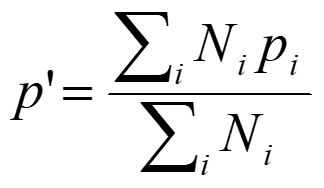
Therefore p' can be viewed as a weighted mean of pi using the weights Ni. Age standardisation was carried out using the age groups: 16 to 24, 25 to 34, 35 to 44, 45 to 54, 55 to 64, 65 to 74, 75 and over.
Feedback or further information
If you have would like further information, contact us at surveys@gov.wales. We welcome comments from users of the survey, including on the content and presentation of our publications.