
Material deprivation and low income: April 2023 to March 2024
Information on the Department for Work and Pensions’ updated material deprivation measures
In this page
Introduction
The Department for Work and Pensions (DWP) has updated its method for estimating material deprivation, making the latest data for the financial year ending (FYE) 2024 not directly comparable to previous years. Since this is the first year using the updated method, only one year of data is available.
Due to sample size and coverage issues in the Family Resources Survey (FRS) on which these measures are based, single year estimates for different UK countries and regions aren't published. Historically, a three-year average has been used for such areas, but recent changes exclude data for FYE 2021, due to the impact of the COVID-19 pandemic on the underlying survey.
Because of these changes, DWP can't update the usual three-year estimates for Wales right now. This article explains the changes and provides some single-year estimates for Wales, along with confidence intervals.
The material deprivation measure, and why it has been reviewed
The material deprivation measure is a direct indicator of poverty, designed to assess whether individuals lack essential items and services due to financial constraints. The measure is used in the Households Below Average Income (HBAI) statistics and is based on responses to the FRS. It complements income-based poverty measures derived from the same source.
A review of the material deprivation measures was undertaken by DWP in collaboration with the London School of Economics and Political Science (LSE), following a recommendation from the Office for Statistics Regulation (OSR) Review of Income-based Poverty Statistics. The review aimed to ensure the measures remained relevant and reflective of contemporary living standards in the UK, given that the previous updates dated back to FYE 2010.
The updated methodology, first implemented in FYE 2024, aims to provide measures of material deprivation based on updated questions that are more relevant to society today and an improved data collection. It will replace the previous methodology in future HBAI publications. More details on the analysis and decisions underpinning the updated material deprivation measures can be found in the DWP’s technical report on the updated material deprivation measures.
The review introduced updated questions, a simplified methodology, and a consistent “financial constrained lack” definition across all age groups. These changes were informed by recommendations from the LSE Review, statistical modelling, broader conceptual perspectives, and discussion of the analysis with an Expert Advisory Group consisting of academics and users from third sector organisations.
Updated questions and method
The updated approach includes 29 questions tailored to children, working-age adults, and pensioners, within which 11 household-level items are asked across all groups. These questions assess whether individuals or households lack essential items due to financial constraints, such as adequate clothing, access to the internet, or the ability to pay bills without cutting back on essentials. More details on the questions can be found in an annex to the technical report (DWP).
A key methodological change is the adoption of a “simple count” approach, replacing the previous prevalence-weighted scoring system. Each item is given equal weight, and individuals are considered materially deprived if they lack a certain number of items - four or more for children and pensioners, and five or more for working-age adults. This method is more transparent and easier to interpret.
The definition of a “lacked” item has also been standardised. Most items now use a “financial constrained lack” definition, which means the item is lacking due to affordability and priority, rather than only for other reasons such as choice or constraint due to health or disability. A few items use a “simple absence” rule. These changes, informed by the LSE Review and extensive analysis, aim to provide a more robust measure for tracking poverty over time.
Comparability over time
Estimates between FYE 2024 and previous years are not comparable as FYE 2024 estimates are based on the updated questions and updated methodology, whereas older estimates are based on the old questions and old methodology. The updated methodology aims to provide measures of material deprivation that use updated questions that are more relevant to society today, an improved data collection methodology, as well as to apply a transparent, simple count approach to counting the number of items lacked and a consistent definition of lacking an item across groups.
To assess a break in the series, 25% of households in the FYE 2024 sample (around 4,000 UK households) were asked the old questions, allowing for limited comparison. In the latest HBAI technical report (DWP), the DWP presents charts showing the percentage of children, working age adults and pensioners (separately) in material deprivation in the three samples.
The DWP advises that those charts should be used for information only. The main HBAI report and publication tables present the FYE 2024 estimates based on the updated measure, so the estimates for FYE 2024 using the old measure should not be reported.
Estimates for the UK
DWP has published headline estimates for material deprivation in the UK for FYE 2024 based on the updated measures in the latest HBAI report (DWP).
UK headline estimates, FYE 2024
- The proportion of children in material deprivation was 28% and the proportion of children in combined relative low income and child material deprivation was 16%.
- The proportion of working-age adults in material deprivation was 23% and the proportion of working-age adults in combined relative low income and material deprivation was 10%.
- The proportion of pensioners in material deprivation was 11%.
In the above measures, a low-income household is classified as one with income (before housing costs) below 70% of the median.
Note that from FYE 2024, DWP have included additional material deprivation estimates in their supplementary tables, including some combined low income and material deprivation measures after housing costs.
Estimates for Wales
FYE 2024 is the first year using the updated FRS questions and updated measures, and due to volatility in sample sizes and coverage, single-year estimates for different UK countries and regions have not been published by DWP. Historically, a three-year average has been used, but recent changes exclude data for FYE 2021. Three-year average estimates for UK countries and regions will not be published until the HBAI FYE 2026 publication.
This article presents some single-year material deprivation estimates for Wales for FYE 2024, along with confidence intervals. We are doing this to ensure full transparency, but we advise against use and further reporting of the single-year data due to the uncertainty of the estimates.
Wales estimates, FYE 2024
- Note that we advise against further use of this data due to the high level of uncertainty.
- The proportion of children in material deprivation was 27% and the proportion of children in combined relative low income and child material deprivation was 18%.
- The proportion of working-age adults in material deprivation was 25% and the proportion of working-age adults in combined relative low income and material deprivation was 11%.
- The proportion of pensioners in material deprivation was 11%.
In the above measures, a low-income household is classified as one with income (before housing costs) below 70% of the median.
The uncertainty in the figures is illustrated in the charts below, which show rates of material deprivation (figure 1), and combined relative low income and material deprivation (figure 2) in Wales by age group for FYE 2024, alongside 95% confidence intervals. Confidence intervals give a range within which the ‘true’ value for the population is likely to fall. There is a 1 in 20 chance that the 95% confidence interval does not contain the true value. The larger the confidence interval, the less precise an estimate is.
Figure 1: Percentage of children, working age adults and pensioners in material deprivation in Wales, FYE 2024 with confidence intervals
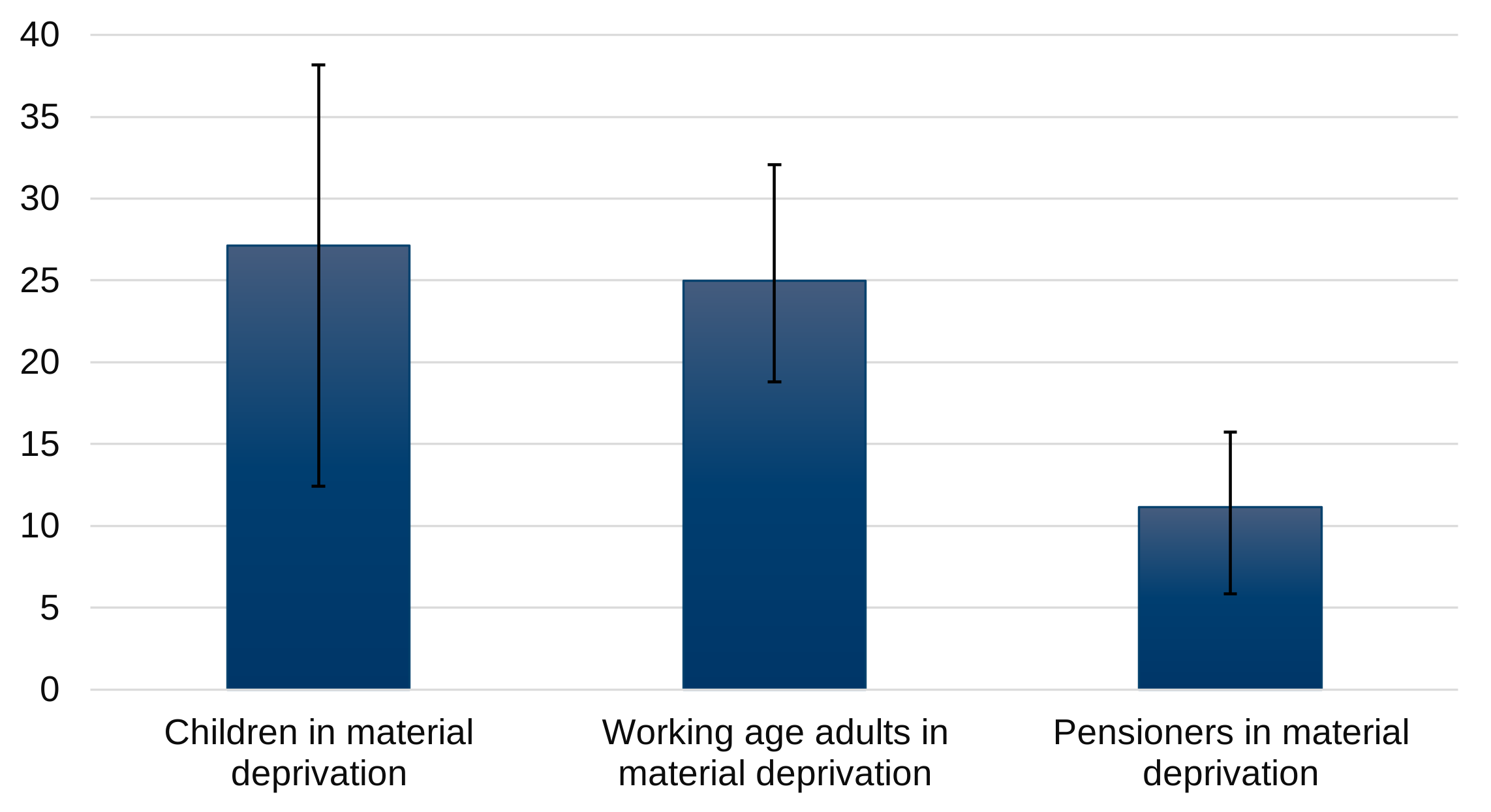
Description of Figure 1: A column chart showing the percentage of children (27%), working age adults (25%), and pensioners (11%) in material deprivation, with confidence intervals indicating a high level of uncertainty around point estimates.
Source: Department for Work and Pensions Households: Below Average Income dataset
Figure 2: Percentage of children and working age adults in combined relative low income and material deprivation in Wales, FYE 2024 with confidence intervals
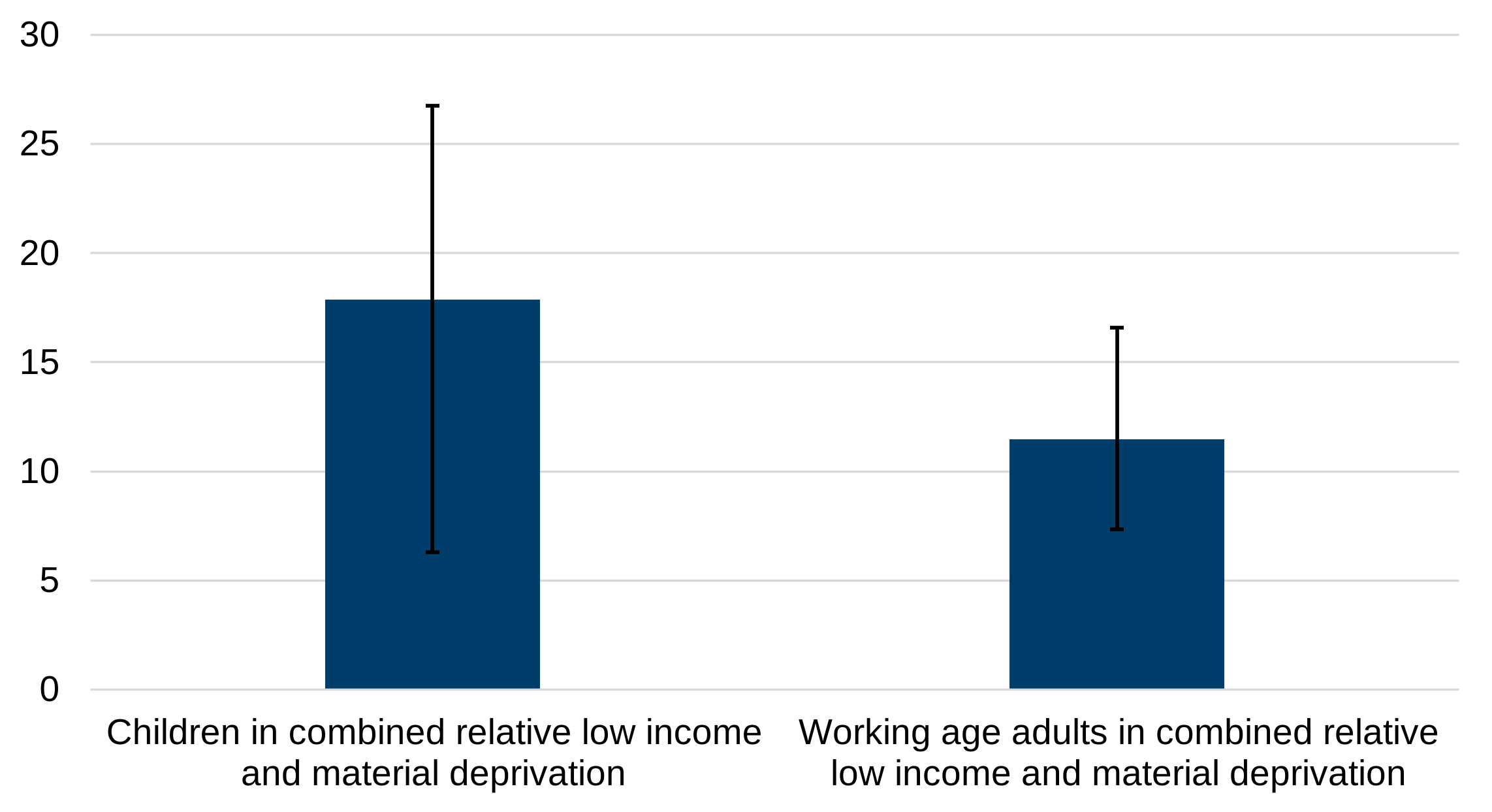
Description of Figure 2: A column chart showing the percentage of children (18%) and working age adults (11%) in combined relative low income and material deprivation, with confidence intervals indicating a high level of uncertainty around point estimates.
Source: Department for Work and Pensions Households: Below Average Income dataset
Estimates for Wales for FYE 2023 and previous years, based on the old questions, are available via our material deprivation and low income statistics series page.
In March 2026, DWP will update the UK measures of material deprivation published in the latest HBAI report using data for FYE 2025. Three-year average estimates for regions and UK countries will not be published until the HBAI FYE 2026 publication.
Notes on the use of statistical articles
Statistical articles generally relate to one-off analyses for which there are no updates planned, at least in the short-term, and serve to make such analyses available to a wider audience than might otherwise be the case. They are mainly used to publish analyses that are exploratory in some way, for example:
- introducing a new experimental series of data
- a partial analysis of an issue which provides a useful starting point for further research but that nevertheless is a useful analysis in its own right
- drawing attention to research undertaken by other organisations, either commissioned by the Welsh Government or otherwise, where it is useful to highlight the conclusions, or to build further upon the research
- an analysis where the results may not be of as high quality as those in our routine statistical releases and bulletins, but where meaningful conclusions can still be drawn from the results
Where quality is an issue, this may arise in one or more of the following ways:
- being unable to accurately specify the timeframe used (as can be the case when using an administrative source)
- the quality of the data source or data used
- other specified reasons
However, the level of quality will be such that it does not significantly impact upon the conclusions. For example, the exact timeframe may not be central to the conclusions that can be drawn, or it is the order of magnitude of the results, rather than the exact results, that are of interest to the audience.
The analysis presented does not constitute an official statistic, but may be based on official statistics outputs, and we have applied the principles of the Code of Practice for Statistics as far as possible during development. An assessment of the strengths and weaknesses in the analysis will be included in the article, for example comparisons with other sources, along with guidance on how the analysis might be used, and a description of the methodology applied.
Articles are subject to the release practices as defined by the release practices protocol, and so, for example, are published on a pre‑announced date in the same way as other statistical outputs.
Contact details
Statistician: Nia Jones
Email: stats.inclusion@gov.wales
Media: 0300 025 8099