
Welsh Housing Conditions Survey (WHCS) 2017-18 fuel poverty projections for Wales 2024: methodology report
This methodology report is a guide for all users who wish to learn more about the modelling approaches undertaken to estimate the level of fuel poverty in Wales as at October 2024.
In this page
Introduction
The Welsh Government has committed to undertake a periodic biennial review of its plan to tackle fuel poverty from 2021 to 2035. To enable this, estimates of fuel poverty levels in 2024 have been calculated.
Users will find detailed descriptions of the data sources and methods used to predict fuel poverty levels in Wales using the Welsh headline indicator.
A household is classified as being fuel poor if they are unable to keep their home adequately heated at a reasonable cost. Different definitions of what constitutes fuel poverty are used across the UK, with the definitions used in Wales summarised below.
Definitions
A household is defined as being fuel poor if they spent more than 10% of their income on fuel. This is calculated using the equation below:
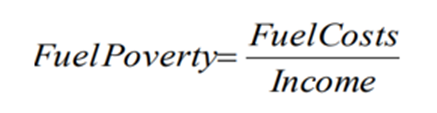
If the ratio from the above equation is greater than 0.1, the household is defined as fuel poor. The value for total fuel costs for a household is modelled using standard heating regimes that consider how much money each household would need to spend on fuel to reach these established standards for comfort.
If the ratio to the above equation is greater than 0.2 the household is defined as being severely fuel poor. The Welsh Government also monitors the number of households deemed to be at risk of fuel poverty. This is defined as a household needing to spend between 8 and 10% of their income on the fuel needed to heat their home.
How are projections of fuel poverty estimated
To calculate levels of fuel poverty for any point in time, information is needed on the income of the household and their fuel costs. The 2017-18 Welsh Housing Conditions Survey (WHCS) (and the matching household data from the National Survey for Wales data) is the best source of information available to describe the Welsh housing stock in terms of these key measures. Further information is provided in the 2017-18 methodology report on how each of the components of fuel poverty were modelled from the 2017-18 survey data.
To project fuel poverty to 2024 required new information and data on how income, energy consumption and fuel costs may have changed since the 2017-18 survey. These updates were incorporated into the existing models to revise fuel poverty component data. The updated key metrics were then used to re-calculate fuel poverty to the 2024 position. October 2024 was chosen as the reference point, as it falls in line with the energy price cap reviews. Caution should be taken when reporting on these fuel poverty estimates due to the elapsed time since the original base data was collected, and the limitations in this work associated with altering this base to reflect the position in 2024 for householders and their homes.
The following sections of this report provide information on the data sources and the methodologies used for each component of the modelling. Base data household weighting provides information on the base data and weighting approach. Income model has details of the full household income measure used in the Wales definition of fuel poverty. Fuel prices covers changes to the fuel prices, and Energy consumption and costs has details on the energy efficiency upgrades and heating regimes. Finally, Fuel poverty indicators provides further information on the calculation of fuel poverty, with strengths and limitations and quality of the methodology provided at the end of the report.
Base data and household weighting
The household and dwelling data from the National Survey for Wales 2017-18 and the Welsh Housing Conditions Survey 2017-18, respectively, were used as the base data sources for the fuel poverty 2024 projections work. Weighting factors were updated to reflect the increase in household numbers in Wales.
National Survey for Wales 2017-18
The National Survey for Wales (NSW) is an interview survey that involves around 12,000 people each year and covers a wide range of topics. Between July 2017 and March 2018, it collected specific information required for the calculation of fuel poverty in 2018 (income, housing costs, energy payment method etc.). Being an interview survey, the NSW does not collect detailed information about the dwellings in which the responding households reside.
Welsh Housing Conditions Survey (WHCS) 2017-18
Accurate and detailed information about the dwelling is crucial for the calculation of fuel poverty and therefore the Welsh Government commissioned the Welsh Housing Conditions Survey (WHCS) 2017-18. This involved a physical inspection of the dwelling by a trained surveyor. The WHCS 2017-18 survey ran from August 2017 until the end of April 2018. The data collected from WHCS provided information to create an accurate representation of the housing stock in Wales in 2018. Eligibility for the WHCS was established at the NSW interview stage and permission was sought by the interviewer.
Household weighting
WHCS builds a picture of the Welsh housing stock by surveying a sample of dwellings from around the country. A weighting factor needs to be applied to the data to obtain figures that reflect the whole Welsh stock, for dwelling occupants. In 2017/18, there were estimated to be 1.33 million households in Wales. Based on information from StatsWales, household numbers have increased since 2017. Using data on the estimates of household numbers in Wales in 2017 (1,328,269) and 2023 (1,377,071), and assuming a linear trend to 2024, the weighting factors were uniformly adjusted to represent 1.39 million households in Wales in 2024. This does not account for any adjustment in the housing stock, and so caution should be taken with the use and interpretation of household numbers when using the 2024 weighting factor.
Income model
Household income is a key component that is needed to calculate fuel poverty and is derived using complex modelling from a variety of data sources. This section contains a detailed description of the methodologies used for calculating the final projected 2024 fuel poverty household income variables.
Overview
The Welsh Government’s primary 10% definition of fuel poverty uses an unequivalised [footnote 1], before housing costs income measure known as ‘full household income’. This is the net income of the whole household which includes income from the Primary Benefit Unit (PBU) and any Additional Benefit Units (ABUs) in the household [footnote 2], including housing related benefit payments and net of council tax payments.
Figure 1: Wales fuel poverty income model
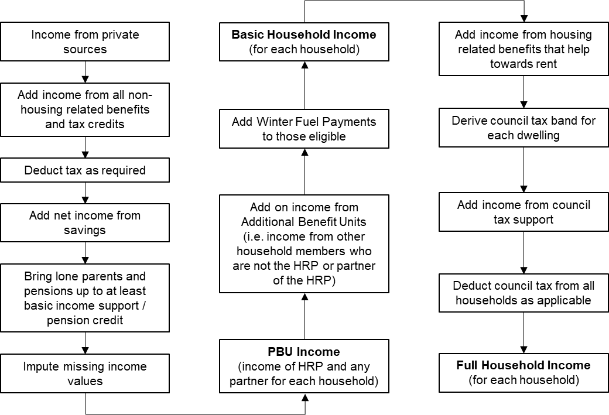
Description of figure 1: flow chart outlines the main steps in the income modelling process in calculating the full household income. A detailed description of the full household income modelling is provided in the 2017-18 methodology report.
Source: Building Research Establishment Domestic Energy Model (BREDEM)
Projecting the full household income measure to 2024
A core requirement of the Wales 2024 projections was to establish the change in the full household income measure between 2017-18 (as collected for the National Survey for Wales 2017-18) and the reference point of October 2024. As mentioned in the strengths and limitations, the scope of this work did not factor in new policies, or external factors such as take up of available welfare benefits or changes in household composition, apart from Winter Fuel Payment where methodology changes have been considered.
To carry out the household income projection work, four derived income variables found on the Wales 2017-18 fuel poverty indicator dataset were used as a base for the 2024 projection modelling. These derived variables ‘split’ the 2017-18 household income into individual components:
- EARNINGSx (earnings income)
- BENEFITSx (benefit income including from housing related benefits)
- SAVINGSx (savings and investment income)
- OTHERx (income from all other sources e.g. private pensions, occupational pensions etc, including income from additional household members who are not the HRP or partner of the HRP)
The fifth and final derived 2017-18 income split variable WFPx (Winter Fuel Payment) was not used as a base in the 2024 projection modelling. For the 2024 fuel poverty projections, the Winter Fuel Payment (WFP) methodology has been updated and remodeled to the new criteria. Previously, for the Welsh Fuel Poverty 2018 estimates, WFP was a universal benefit paid (and allocated in the modelling) to those of pension age without any means-test.
The WFP eligibility changed for the winter of 2024/25 so that pensioner households are only eligible for WFP if they are on pension credit or certain other means-tested benefits. Therefore, WFP has been re-modelled for the 2024 projections and has only been assigned to households where the HRP/partner meet both the age and the means-test criteria (the latter is based upon benefit receipt as selected on the National Survey for Wales 2017-18 data i.e. the base interview survey data that the derived income variables are built upon). Whilst the WFP criteria changed between the 2017-18 modelling and the 2024 projections, the WFP rates have remained the same at £200, and a higher amount of £300 for those aged 80 or over.
The full income for each household is derived by the sum of the five income split components (EARNINGSx, BENEFITSx, SAVINGSx, OTHERx and the re-modelled 2024/25 WFP) minus the modelled council tax payable for the property.
For the 2024 full household income projection, using the data sources and uplift factors explained in the next section, each base component of income (including the council tax payable) was adjusted from the 2017-18 values to a projected October 2024 position. To carry out this task, further breakdown of the benefit income split variable was required to allow for different uplift factors for the range of state benefits.
The housing costs associated with rent payments were calculated as part of the Wales 2018 fuel poverty statistics (see Section 3.6.1 of the previously published 2017-18 methodology report for details on rent modelling). Whilst rent payments were not directly required as input into the Wales 2024 fuel poverty projections, projected 2024 rent payments were used to derive the uplift factors associated with housing related benefit towards rent payments. The rent payments as previously calculated in the 2017-18 methodology were projected to 2024 values using the data sources and applicable uplift factors (based on tenure).
Once the individual components of income had been uplifted to a 2024 position for each household, the 2024 full household income projection was derived by adding together the five income split variables and deducting the projected 2024 council tax payable for the property. The annual full household income is capped at £100,000 before the calculation of the Wales 2024 fuel poverty figures.
The 2024 fuel poverty dataset also includes the projected 2024 fuel poverty basic household income measure. This was constructed in the same way as the projected full household income by using the uplifted income split variables. However, the basic household income variable does not include income from housing related benefits or deduct the council tax payable from the household income (see Section 3 of the previously published 2017-18 methodology report for more detail on the basic household income). The annual basic household income is capped at £100,000.
Uplift factor and dataset details (17 to 24)
Income split: EARNINGSx uplift factor and details
EARNINGSx (Uplift 1.392): The ONS percentage rise in average weekly earnings for Great Britain (GB) was favoured over Wales specific Annual Survey of Hours and Earnings (ASHE) data so that the reference point of October (2017 and 2024) could be used, compared to the ASHE data where statistics are presented based on an April reference point. The ONS earnings statistics showed high growth in earnings between April 2024 and October 2024, and therefore by using the ONS data, this was considered in the Wales 2024 income projections.
The ONS Earnings data was validated against the Wales specific ASHE data (StatsWales). The percentage rise in earnings as observed in Wales ASHE data between April 2017 to April 2024 was on trend with the comparison ONS GB statistics. Therefore, it was deemed suitable to use the ONS GB statistics to reflect the rise in Wales earnings between October 2017 and October 2024.
Income split: BENEFITSx uplift factor and details
Working age benefits (e.g., Universal Credit, income support, tax credits (Department for Work & Pensions (DWP)) and child-benefit (HM Revenue & Customs) (Uplift 1.238): A benefit freeze was in place keeping most working age benefits at the same rate over a four year period between April 2016 and April 2020, hence the lower uplift factor for this subcategory.
State pension (Uplift 1.386): For the data projection period, the state pension benefit amount was protected by the ‘triple lock’, a government commitment to increase the value of state pension by at least 2.5% every year.
Pension credit (DWP) (Uplift 1.369): Pension Credit Guarantee Credit is required to increase at least in line with the previous year’s earnings increase and was not subject to the benefit freeze between April 2016 and April 2020.
Other non-housing related benefits (e.g. DLA, PIP, AA) (Uplift 1.306): Inflation-linked benefits rise in line with the Consumer Price Index (CPI) rate of inflation using the value for the month of September (the September prior to the year of increase).
Housing related benefit towards rent payments (Uplift PRS – 1.356, LA – 1.324, RSL – 1.323): The uplift factors applied for the housing related benefit towards rent payments are aligned to the applicable rent uplift factors used for the Private Rented Sector (PRS) (ONS), local authority (LA) (StatsWales) housing and Registered Social Landlords (RSL) (ONS).
Council Tax Support (Uplift Range from 1.32 to 1.55): The uplift factor applied for the council tax support benefit payments is aligned to the applicable Unitary Authority council tax payment uplift factor.
Income split: BENEFITSx uplift factor and details
OTHERx (Uplift 1.297): This factor represents the Consumer Price Inflation (CPI) (ONS) inflation rate from a base of October 2017 to October 2024.
Income split: SAVINGSx uplift factor and details
SAVINGSx (Uplift 1.149): This factor represents the Bank of England cumulative Base Rate from a base of October 2017 to October 2024.
Council tax payable uplift factors and details
Council tax payable (Uplift Range from 1.32 to 1.55 depending on Unitary Authority): The percentage rise in average council tax between 2017 and 2024 was determined for each Unitary Authority. A smoothing methodology was applied to the factors to protect the identity of the Unitary Authority. These factors were applied to the 2017-18 council tax payable values to project 2024-25 levels.
Rent uplift factors and details used for the housing related benefit uplift factors
Local authority rents (StatsWales) (Uplift 1.324) and Registered Social Landlords rents (Uplift 1.323): Selected report ‘Average weekly rents in stock at social rent by provider and accommodation’. Applied the filter to dwelling drop down to select 'self-contained total (including self-contained bedsits)’. Values crossed checked against the ‘Social landlord housing stock and rents reports’ for the relevant years.
Private sector rents (ONS) (Uplift 1.356): This ONS publication provides the average monthly private rent in Wales over time (achieved rent data are collected for both new and existing tenancies). The reference points October 2017 and October 2024 were used to determine the private rent uplift factor.
Lower income households
For the Wales fuel poverty modelling, lower income is defined as being less than 60% of the average relative median household income Before Housing Costs (BHC) as published annually in the Households Below Average Income (HBAI) report (DWP).
For the 2024 Wales projection work, whether a household is defined as lower income was modelled using the projected 2024 full household income as a base, with the relevant BHC Organisation for Economic Co-operation and Development (OECD) equivalisation factors applied to reflect the fact that different households have different spending requirements. This creates the ‘equivalised BHC income’. The BHC equivalisation factor was determined for each household by summing the appropriate factors for each household member. The BHC income equivalisation factors used are consistent with those used by the DWP in their production of Households Below Average Income (HBAI) statistics.
Before Housing Costs (BHC) OECD equivalisation factors
- First adult in the household (BHC equivalence scale = 0.67)
- Subsequent household members aged 14 and above (BHC equivalence scale = 0.33)
- Children under 14 (BHC equivalence scale = 0.20)
Using the projected 2024 values, the weighted median of all BHC equivalised incomes in the dataset was calculated [footnote 3]. Households are defined to be ‘lower income’ in the 2024 Welsh fuel poverty dataset if their equivalised income is below 60% of the weighted median household income before housing costs are considered.
Fuel prices
Overview
Fuel price is another component needed to calculate fuel poverty. The fuel price component of the fuel poverty model generates an output that is fed into the energy consumption model to produce the final fuel costs. Fuel prices used in the modelling of the 2024 fuel poverty figures were produced using information extracted from a variety of external sources, following a similar approach to the methodology used to calculate the 2018 fuel prices.
Data sources
Metered fuels (Electricity and Gas)
The average annual fuel prices for metered fuels are provided by DESNZ on a calendar year basis as part of the Quarterly Energy Prices (QEP) publication (Department for Energy Security and Net Zero). The data provided by DESNZ contains mains gas and electricity ‘average unit price’ and ‘average fixed costs’ (standing charges) for energy supply regions across the UK. Specifically, the prices are published within the following DESNZ published tables:
- Average variable unit costs and fixed costs for electricity for UK regions (QEP 2.2.4) (Department for Energy Security and Net Zero)
- Average variable unit cost and fixed cost for gas for regions in Great Britain (QEP 2.3.4) (Department for Energy Security and Net Zero (DESNZ))
The QEP data divides Wales into two regions, namely ‘South Wales’ and ‘Merseyside and North Wales’. The fuel prices for Wales were calculated on the assumption that 74% of households are in South Wales and 26% of households are in Merseyside & North Wales. This assumption was based on analysis of the populations in each energy supply region.
The data for the ‘average unit price’ and ‘average fixed costs’ for energy supply regions in Wales are subdivided into three types of payment (direct debit, standard credit and pre-payment) so that the method of payment identified in the survey can be taken into account when assigning fuel prices to households. These are shown in Table 1. It is assumed that no changes to method of payment type have taken place for households between 2017-18 WHCS and 2024.
| Metred fuels | On peak | Off peak | Standing charge (£/year) |
|---|---|---|---|
| Gas | 0.066 | N/A | 124.90 |
| Standard electricity | 0.262 | N/A | 245.24 |
| Economy 7 | 0.311 | 0.169 | 246.79 |
Description of table 1: table showing Fuel prices (Standard Credit) for 2024, unit charges (£/kWh) and standing charge (£/year)
Source: DESNZ Quarterly Energy Prices (QEP). Average variable unit costs and fixed costs for electricity for UK regions (QEP 2.2.4) and Average variable unit cost and fixed cost for gas for regions in Great Britain (QEP 2.3.4).
| Metred fuels | On peak | Off peak | Standing charge (£/year) |
|---|---|---|---|
| Gas | 0.064 | N/A | 111.39 |
| Standard electricity | 0.256 | N/A | 224.87 |
| Economy 7 | 0.335 | 0.155 | 220.43 |
Description of table 2: table showing Fuel prices (Direct Debit) for 2024, unit charges (£/kWh) and standing charge (£/year)
Source: DESNZ Quarterly Energy Prices (QEP). Average variable unit costs and fixed costs for electricity for UK regions (QEP 2.2.4) and Average variable unit cost and fixed cost for gas for regions in Great Britain (QEP 2.3.4).
| Metred fuels | On peak | Off peak | Standing charge (£/year) |
|---|---|---|---|
| Gas | 0.060 | N/A | 89.74 |
| Standard electricity | 0.243 | N/A | 192.89 |
| Economy 7 | 0.286 | 0.161 | 213.06 |
Description of table 3: table showing Fuel prices (Pre-payment) for 2024, unit charges (£/kWh) and standing charge (£/year)
Source: DESNZ Quarterly Energy Prices (QEP). Average variable unit costs and fixed costs for electricity for UK regions (QEP 2.2.4) and Average variable unit cost and fixed cost for gas for regions in Great Britain (QEP 2.3.4).
Non-metered fuels except wood (e.g. coal, LPG, fuel oil)
The Sutherland Tables provide fuel price data for Liquefied Petroleum Gas (LPG), bottled gas, heating oil, house coal and smokeless fuel [footnote 3]. The unit rates for these fuels are shown in Table 4. Fuel prices from the Sutherland Tables are available quarterly and are split regionally to show comparative heating costs across the UK. The Sutherland Tables published in September 2024 were used as this reflects the reference date and the time of year of high fuel demand and prices, so the methodology does not underestimate costs. Sutherland Tables data are an average of prices collected over the preceding three months.
| Non-metered fuels | Unit rate (£/kWh) |
|---|---|
| Heating oil | 0.060 |
| Bulk LPG | 0.094 |
| Bottled gas | 0.145 |
| House coal | 0.084 |
| Smokeless fuel | 0.081 |
Description of table 4: table showing non-metered fuels for 2024, unit rate of non-metered fuels (£/kWh).
Source: Sutherland Tables
Wood, Economy 10 Electricity, 24hr Tariff Electricity, Communal Heat from Boilers and Communal Heat from CHP
SAP 2012 fuel prices (from the Government’s Standard Assessment Procedure for the energy rating of dwellings) were used for other fuels and tariffs (where their use is relatively minor), including biofuels, communal heating, and Economy 10 and 24 electricity tariffs. The price of Economy 10 and 24 hour electricity were set as the SAP 2012 prices (BRE Group), inflated to October 2024 prices using the CPI for electricity. The prices of wood and other biofuels were also based on SAP 2012 prices and inflated from 2012 prices using the change in the CPI for solid fuels from this date. The price of communal heat was calculated using SAP 2012 communal prices, inflated using the CPI for gas for October 2024.
Energy consumption and costs
Overview
The last component needed for the calculation of fuel poverty is the amount of fuel consumed to provide the energy needs of the household. A detailed description of the energy consumption modelling is provided in Section 5 of the previously published 2017-18 methodology report. The energy consumption projections for 2024 used the same underlying BREDEM 2012 energy calculation, although the model has had some updates since the 2018 indicator was produced, the most notable being that the modelling of ventilation from chimneys, fans and flues was updated to align more closely with RdSAP, along with a minor improvement to the calculation of the number of sheltered sides. The dimensions used in the calculation for energy requirements remained unchanged from 2018, however, the modelling of a ‘satisfactory heating regime’ had been updated since the 2018 fuel poverty estimates were produced and this new heating regime was used for the 2024 projections, as detailed below.
Energy efficiency upgrades
Energy efficiency upgrades were applied in line with the measures installed in the housing stock, based on the best data available for each upgrade measure. This data includes information from Energy Company Obligation (ECO), Renewable Heat Incentive (RHI), Boiler Upgrade Scheme (BUS), Photovoltaic (PV) deployment and from trends in the WHCS data (2008-2017) and EHS data (2008-2023). The rates of instalment seen in these data sources were then used to estimate the number of measures in 2024. An adjustment for new builds was also applied, so that the number of measures were focused on retrofitting households only. Other energy efficiency scheme data was assessed but due to the lack of granularity in the data it was not used directly as a data source, however it was used to inform the final target numbers of energy efficiency improvement measures.
All households that were eligible to receive any of the upgrades were flagged as such. In addition, an ECO eligibility flag was derived from the household interview data, to enable ECO targeting of households for certain measures. The following have been modelled to identify households that qualify for ECO3 funding, based on criteria outlined in the Ofgem Energy Company Obligation (ECO3) Guidance:
- Private sector households who receive specific benefits, known as the ‘help to heat group’ (HTHG) (DESNZ)
- Private sector households who are fuel poor, or are vulnerable low-income households (DESNZ)
- Social rented households, in a dwelling with an EPC rating of E, F or G
An ECO4 eligibility flag was also modelled, as the ECO4 scheme came into effect from April 2022, but all households eligible for ECO4 in the Wales 2017/18 housing condition survey data were already eligible under the ECO3 flag.
Information on the total number of upgrades applied in the stock, the basis of these estimates, and the proportion targeted at ECO eligible households are shown below.
Estimated improvement measure installations in Wales, between 2017 and 2024
Loft insulation
Number of upgrades 65,000
Percentage target at ECO eligibility (DESNZ) 20%
Change in base data 2008 to 2017, adjusted using EHS 2017 to 2023 (EHS 2023 to 2024: headline findings on housing quality and energy efficiency (Ministry of Housing, Communities and Local Government)). Includes adjustment for new builds, a component of the trend in high levels of loft insulation will be due to newly built stock; to obtain the trendline for retrofit upgrades only, an estimation of the number of new build installations for relevant measures was made using data from StatsWales and the LiW 2017 data.
Cavity wall insulation
Number of upgrades 21,000
Percentage target at ECO eligibility (DESNZ) 90%
Change in base data 2008 to 2017, adjusted using EHS 2017 to 2023. Includes adjustment for new builds.
Solid wall insulation
Number of upgrades 22,000
Percentage target at ECO eligibility DESNZ) 30%
Change in base data 2008 to 2017, adjusted using EHS 2017 to 2023.
Hot water cylinder
Number of upgrades 25,000
Percentage target at ECO eligibility (DESNZ) 0%
Change in base data 2008 to 2017.
Double glazing
Number of upgrades 64,000
Percentage target at ECO eligibility (DESNZ) 0%
Change in base data 2008 to 2017, adjusted using EHS 2017 to 2023. Includes adjustment for new builds.
Solar hot water
Number of upgrades 0
Percentage target at ECO eligibility (DESNZ) N/A
Renewable Heat Incentive (RHI) (Department for Energy Security and Net Zero and Department for Business, Energy & Industrial Strategy) (Table 2.3) October 2017 and March 2024
Condensing boiler
Number of upgrades 232,000
Percentage target at ECO eligibility (DESNZ) 10%
Change in base data 2008 to 2017, adjusted using EHS 2017 to 2023. Includes adjustment for new builds and double counting from CH installations.
Central heating
Number of upgrades 1,000
Percentage target at ECO eligibility (DESNZ) 100%
ECO (DESNZ) (Tables 1.5 and 1.6)
Air source heat pump
Number of upgrades 4,000
Percentage target at ECO eligibility (DESNZ) 0%
RHI and BUS statistics (DESNZ). Boiler upgrade scheme statistics. Table 1.2A
Solar PV
Number of upgrades 26,000
Percentage target at ECO eligibility (DESNZ) 0%
Solar photovoltaics (PV) deployment for installations of up to 4kW. Solar photovoltaics deployment (DESNZ): table 1 capacity.
Storage heater
Number of upgrades 3,000
Percentage target at ECO eligibility (DESNZ) 100%
ECO (DESNZ) (Tables 1.5 and 1.6)
Measures were randomly applied to eligible households, prioritising ECO eligible households, so that the number of measures applied were as close as possible to the target numbers. This was repeated 100 times, and the following run was selected:
- the run that closely matched the average for all runs, in terms of the proportion of households in fuel poverty for all households and when split by tenure (DESNZ)
- most accurately represented the required number of improvements (DESNZ)
Alterations were made to the base data, in line with the measures applied to households, and the data was then input into the fuel poverty BREDEM energy model to calculate energy consumption and costs for each household following the ‘satisfactory heating regime’ requirements, as detailed in the next section.
Heating regimes
Satisfactory heating regime
The definition of a satisfactory heating regime as described in the ‘Tackling fuel poverty 2021 to 2035’ policy document, has been used for the 2024 projections. Under this definition, for vulnerable households with older (a person aged 60 and over) or disabled (a person living with a long-term limiting illness or who is disabled) people, an internal demand temperature of 23°C in the living room and 18°C in other rooms is required for 16 hours in a 24-hour period in households. For all other households, 21°C in the living room and 18°C in other rooms is required for nine hours in every 24-hour period on weekdays, and 16 hours in a 24-hour period on weekends. The original definition, as used in the calculation of fuel poverty in 2018, is detailed in section 5.3.4.
Extent of Heating/under-occupancy
Some dwellings are considered excessive in size for the number of occupants that live there; these are labelled as “under-occupied”. In under-occupied dwellings only a portion of the dwelling will need heating. The same methodology for determining the extent of heating was used for the 2024 projections as for the 2018 fuel poverty statistics.
Fuel costs
Energy costs for the household were then calculated based on the fabric and requirements for each household, in line with the method used in 2018. After energy costs have been modelled, the Warm Home Discount (WHD) was applied to eligible households, for the purpose of calculating fuel poverty using the Wales headline indicators.
The WHD flags that were produced for the 2017-18 WHCS data publication and subsequently used in the 2021 projections were based on an old set of WHD criteria. This was made up of a core group (those in receipt of the ‘guarantee element’ of pension credit) and broader group (combination of low income and vulnerability criteria), and the rebate amount was £140. The WHD scheme criteria has since been changed and as of the reference point in October 2024, it is now made up of core group 1 (the same criteria as the previous core group) and core group 2 (combination of low income and high energy cost) with the rebate amount now £150. The total numbers of those receiving the WHD in Wales has increased as well, by nearly 75,000 households, from 2017 to 2024.
For the 2024 projections, the WHD flags have been remodelled to represent the latest criteria and rebate amount. The control totals for core group 1 and core group 2 were taken from the latest DESNZ statistics on WHD receipt, published June 2024. Information on benefit receipt and the dwelling characteristics needed to model the eligibility were taken from the 2017-18 WHCS data. A stratification model was used to select households to reach the control totals. When modelling the eligibility, priority was given to those households who previously received the WHD under the 2017-18 WHCS WHD flags and who are eligible under the latest criteria.
Fuel poverty indicators
The new 2024 income and fuel costs combine to create the fuel poverty indicators. In Wales, a household is defined as fuel poor if they need to spend more than 10% of their income on fuel to maintain an adequate level of warmth. This is referred to as the 10% measure and is calculated using the ‘fuel poverty ratio’. This calculation has three components – fuel prices (unit and standing charges), fuel consumption and income. The equation takes the following simplified form:

Or the following more detailed form:

Where for each household the following applies.
- The unit fuel price (£/kWh) is applied to each fuel type.
- Fuel consumption (kWh) is the energy use for each fuel type.
- Standing charges (£) are applied where applicable for each fuel type.
- Income (£) is the annual full income of the whole household.
An adequate level of warmth is defined using a ‘satisfactory heating regime’ as outlined in Energy consumption and costs. For every household, all applicable use and cost values are summed for each fuel type, and then the WHD is deducted from the total fuel costs for selected households.
If the fuel poverty ratio is greater than 0.1 (i.e. a household spends more than 10% of their income on fuel) then the household is considered to be fuel poor. If the ratio is greater than 0.2 then the household is severely fuel poor (known as the 20% measure), while if the ratio is greater than 0.08 and less than 0.1, the household is at risk of fuel poverty.
Strengths and limitations
Detailed information on the strengths and limitations of the WHCS is provided in Section 3.1 (Relevance) of the quality report.
Specific strengths of the fuel poverty analysis were:
- established processes and procedures, which have been used for multiple years and across multiple datasets both in Wales and across other nations of the UK
- use of high-quality input data, primarily of National Statistics quality for interview and physical survey data
- robustness of the survey approach, sample size and weighting process, as provided for the 2017-18 base data
- external data, used in the projections of each fuel poverty component, were based on large scale and high-quality statistics
- models have been updated to the most up-to-date versions, and methodologies all use the latest definitions
- comprehensive quality assurance processes were undertaken as part of the modelling
Specific limitations of the fuel poverty analysis were:
- data is from a sample survey so subject to sampling errors
- detail collected by both physical and interview surveys is limited by time available and access to elements of the property (physical survey is non-intrusive). No documentary evidence for income sources is required
- due to changes in the methodology for calculating fuel poverty in Wales in 2024, with the introduction of the satisfactory heating regime since 2017, results cannot be directly compared over time
- the scope of this work did not include the modelling of demographic or household compositional changes within the household weighting over this period
- data on the number of energy efficiency upgrades between 2017 and 2024 is limited, and some information had to be inferred to give a best representation of the housing stock in Wales in 2024, however no modelling adjustments were undertaken for any other changes to dwellings e.g. extensions
- the scope of this work did not account for changes to the benefit system or change to benefit or employment take up rates, apart from Winter Fuel Payment and Warm Home Discount where methodology changes have been considered
- the scope of this work did not include any adjustment to method of payment type for fuel between the base data and 2024 projections
Footnotes
[1] Unequivalised income refers to household income before any adjustments are made to account for differences in household size or composition.
[2] The PBU income refers to income of the Household Reference Person (HRP) and any partner of the HRP, the ABU income refers to income from other adult household members who are not the HRP or partner of the HRP.
[3] To align with HBAI calculations, to achieve the median income that represents the income of the individual in the middle of the distribution, the dataset was weighted by a person proxy weighting (derived by multiplying the household weighting factor by household size).
[4] For the 2021 projections, prices of heating oil and smokeless fuel were obtained from ONS timeseries, however the price data for 2024 was not available at the time of the analysis. Prices of heating oil and smokeless fuel were therefore obtained from Sutherland Tables.
Quality and methodology information
Statement of compliance with the Code of Practice for Statistics
Our statistical practice is regulated by the Office for Statistics Regulation (OSR). OSR sets the standards of trustworthiness, quality and value in the Code of Practice for Statistics that all producers of official statistics should adhere to.
All of our statistics are produced and published in accordance with a number of statements and protocols to enhance trustworthiness, quality and value. These are set out in the Welsh Government’s Statement of Compliance.
These official statistics demonstrate the standards expected around trustworthiness, quality and public value in the following ways.
Trustworthiness
We have made these statistics available in a timely manner to meet user needs. We have followed relevant protocols for releasing these statistics, ensuring that circulation before publication has been restricted to eligible recipients only.
Quality
We have made the limitations of this data clear to users (for example, highlighting where comparisons cannot be made across previous estimates due to methodology). Information on the strengths and limitations of fuel poverty estimates are provided.
Value
We have made every effort to ensure these statistics are accessible to users, using clear and succinct language (for example, we have expanded commentary to include more policy and economical context). This is supported by our Fuel poverty in Wales: interactive dashboard and published tables (fuel poverty estimates).
You are welcome to contact us directly with any comments about how we meet these standards. Alternatively, you can contact OSR by emailing regulation@statistics.gov.uk or via the OSR website.
Well-being of Future Generations Act (WFG)
The Well-being of Future Generations Act 2015 is about improving the social, economic, environmental and cultural wellbeing of Wales. The Act puts in place seven wellbeing goals for Wales. These are for a more equal, prosperous, resilient, healthier and globally responsible Wales, with cohesive communities and a vibrant culture and thriving Welsh language. Under section (10)(1) of the Act, the Welsh Ministers must (a) publish indicators (“national indicators”) that must be applied for the purpose of measuring progress towards the achievement of the wellbeing goals, and (b) lay a copy of the national indicators before Senedd Cymru. Under section 10(8) of the Well-being of Future Generations Act, where the Welsh Ministers revise the national indicators, they must as soon as reasonably practicable (a) publish the indicators as revised and (b) lay a copy of them before the Senedd. These national indicators were laid before the Senedd in 2021. The indicators laid on 14 December 2021 replace the set laid on 16 March 2016.
Information on the indicators, along with narratives for each of the wellbeing goals and associated technical information is available in the Wellbeing of Wales report.
Further information on the Well-being of Future Generations (Wales) Act 2015.
The statistics included in this release could also provide supporting narrative to the national indicators and be used by public services boards in relation to their local wellbeing assessments and local wellbeing plans.