Affordable housing provision: April 2024 to March 2025
Number of additional affordable housing units delivered and how the planning system contributed to the provision for April 2024 to March 2025.
In this page
Introduction
Affordable housing applies to housing where secure mechanisms are in place to ensure that it is accessible to those who cannot afford market housing, both on first and subsequent occupation as defined in Technical Advice Note (TAN) 2: Planning and Affordable Housing (2006).
The figures cover all additional affordable housing units, whether through new build, purchase, acquisition, leasing or conversion of existing dwellings. They do not take account of any loss of affordable housing stock through demolitions or sales during the year.
The Programme for Government published in June 2021 and updated in December 2021, along with the Minister for Climate Change’s Written Statement on Social Housing in Wales (15 June 2021), sets out a commitment to deliver 20,000 new low carbon homes for rent within the social sector during this current government term. This commitment uses a different definition to the TAN 2 definition. Therefore, in this release we specify which figures are being used when referring to progress against the commitment. This year, we have added a small amount of management information to the release, to improve the timeliness of the reporting. The Chief Statistician’s blog explains more about the definitions and how the data can and can’t be used.
Throughout the report, references to financial years are used. When referencing financial years 'to' are used (e.g. 2024 to 2025).
Main points
Figure 1: additional affordable housing provision, between 2007 to 2008 and 2024 to 2025
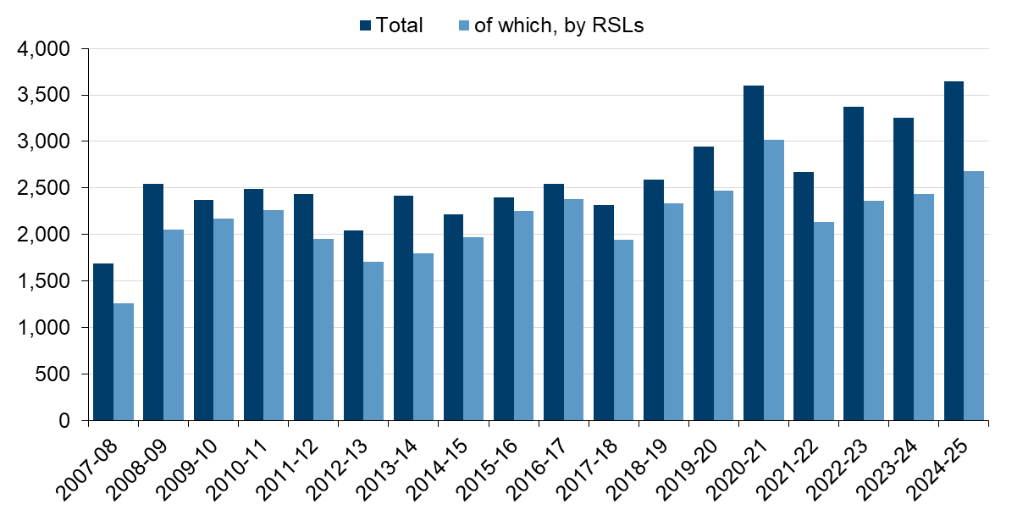
Description of figure 1: a bar graph showing the number of additional affordable housing units delivered in Wales each year between 2007 to 2008 and 2024 to 2025, split by total and number delivered by registered social landlords. The number of units delivered in 2024 to 2025 increased from the previous year.
Source: Affordable Housing Provision data collection, Welsh Government
Additional affordable housing provision by location and year (StatsWales)
- In 2024 to 2025, 3,643 additional affordable housing units were delivered across Wales. This is a 12% increase on the previous year and the highest total since data was first recorded in 2007 to 2008.
- Using the target definition, 3,900 units (including voids) were delivered in 2024 to 2025. This brings the total delivered between April 2021 and March 2025 to 13,399.
- Welsh registered social landlords (RSLs) continued to make the largest contribution to additional affordable housing in Wales, delivering 74% of all additional affordable housing provision during 2024 to 2025 (2,681 units).
- 79% of all affordable housing units were delivered with capital grant funding.
- 76% of affordable homes delivered were new build (excluding ‘other’ providers, as this is unknown).
- 92% of affordable homes delivered were for rent (including social and intermediate rent), 5% were shared ownership and 3% shared equity. These percentages exclude ‘other’ providers as tenure is unknown.
Measuring progress on the Welsh Government commitment to deliver 20,000 new low-carbon homes for rent in the social sector during 2021 to 2026
Welsh Government has committed to delivering 20,000 new low carbon homes for rent within the social sector during this government term. These official statistics have traditionally been the source for monitoring progress against that target.
To measure progress, we include homes for social rent, intermediate rent and shared ownership. These units are delivered by registered social landlords, local authorities, and private sector providers (referred to as ‘others’). The figures also include housing units leased for more than one year to provide accommodation for homeless families although these do not fully meet the TAN 2 definition.
The reported target figure excludes shared equity affordable housing units.
In May 2025, the Cabinet Secretary for Housing and Local Government accepted a recommendation from the Affordable Housing Taskforce that ’void’ social housing units funded by the Transitional Accommodation Capital Programme (TACP) should be treated the same as acquisitions and included within the 20,000 target.
Following this decision, we have included voids delivered by TACP in our reporting against the target. Since the start of the scheme in 2022 to 2023 to the end of the 2024 to 2025 financial year, 936 voids have been delivered. Data on voids is based on management information as it is not collected through official statistical returns. As such, it has not undergone the same level of quality assurance, however we believe it provides a reasonable indication of activity. Further details are available in the management information section and the accompanying quality report.
The chart below shows the official statistics on the cumulative number of homes delivered since the beginning of April 2021. A separate line shows the numbers delivered including voids. A reference point at 20,000 is shown for 2025 to 2026, to illustrate progress towards the target.
Figure 2: cumulative number of homes delivered in relation to the target measure
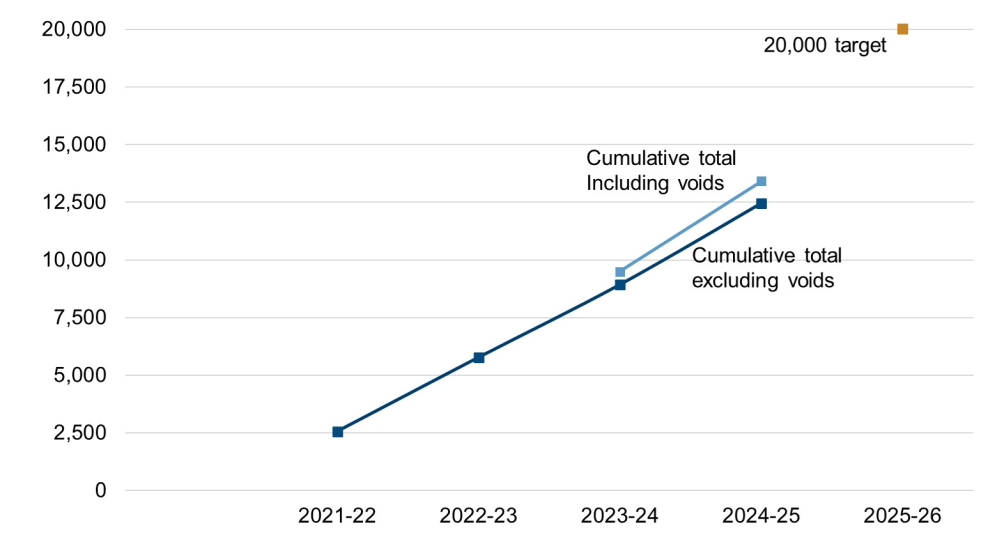
Description of figure 2: a line graph showing progress towards the 20,000 additional homes for rent in the social sector commitment with, and without, the addition of voids.
Between April 2024 and March 2025, 3,530 affordable housing units were delivered for rent in the social sector across Wales. In addition, 370 void units were brought back into use through TACP funding.
This brings the total number of units delivered towards the target from April 2021 to March 2025 to 13,399 (12,463 if you exclude voids).
Of the 3,530 units delivered in 2024 to 2025:
- 2,921 were for social rent
- 344 were intermediate rent
- 162 were shared ownership
- 103 were affordable units delivered by other providers
Management information collected throughout the year provides a more up to date position than the official statistics. This data suggests that between April and September 2025, 956 homes were delivered and 21 void units were brought back into use.
Target data on StatsWales
In response to recommendations from the Local Government and Housing Committee’s report on Social Housing Supply and Audit Wales’ report on Affordable Housing we have published further data on StatsWales. We now provide more detailed breakdowns of the homes delivered towards the target including tenure type which includes social rented, intermediate rented and shared ownership, as well as data on voids. Further breakdowns are also available by delivery method and whether homes are new build or acquisitions / conversions.
Additional affordable housing delivered
Between 1 April 2024 and 31 March 2025, a total of 3,643 additional affordable housing units were delivered across Wales (under the TAN 2 definition). Since 1 April 2007, when information on affordable housing was first collected, a cumulative total of 47,541 additional affordable housing units has been delivered. The 3,643 additional affordable housing units delivered during 2024 to 2025 were an increase of 12% (388 units) compared to the units delivered the previous year and is the highest total since data was first recorded in 2007 to 2008.
RSLs delivered 10% more additional affordable housing units during 2024 to 2025 than in the previous year (2,681 compared with 2,433), and 13% more units than in 2022 to 2023 (2,366). The proportion of all affordable housing units that were delivered by RSLs remained similar from the previous year at 74%. Of these, 2,257 (84%) were newly built properties.
A further 849 units (23%) were local authority owned affordable housing units, the highest total since data was first recorded in 2007 to 2008. The majority of these (68%) were delivered by 4 local authorities, Cardiff (246 units), Vale of Glamorgan (147 units), Carmarthenshire (98 units) and Pembrokeshire (89 units). Of the 849 units, 49% (415 units) were newly built with 37% (154 units) being built in Cardiff and 34% (141 units) in the Vale of Glamorgan (see 'Provision' data on StatsWales for full details).
The remaining 113 units (3%) were delivered by other providers and included additional affordable housing units delivered directly by private developers through the planning system via Section 106 agreement. Further information on Section 106 agreements is in the Glossary section of this release.
The number of additional affordable housing units delivered within the national park areas increased to 55 units in 2024 to 2025. This is an increase of 15 units compared to the 40 units seen in 2023 to 2024. This represented 2% of all additional affordable housing provision during 2024 to 2025.
Each local authority sets an affordable housing planned delivery target and this will influence provision. At an individual local authority level, 14 of the 22 authorities reported increases in the provision of additional affordable housing during 2024 to 2025 compared to the previous year, with notable increases in Powys (from 118 to 241) and Flintshire (from 97 to 213). The largest decreases were seen in Cardiff (from 636 to 544) and the Isle of Anglesey (from 169 to 87).
The additional affordable housing figures shown within this release also includes housing units leased to provide accommodation for homeless families where the lease is for more than a year. In 2024 to 2025 there were 135 such housing units, up from the 108 units in 2023 to 2024.
Additional affordable housing planned for delivery in 2025 to 2026
Each year, data on the number of affordable housing units planned for delivery during the next financial year are collected on the official statistics returns alongside data on units delivered in the previous year.
According to the data collected at the end of financial year 2024 to 2025, local authorities estimate that a further 4,202 affordable housing units are planned for delivery during 2025 to 2026. Over the past 2 years planned figures have closely aligned with the official statistics for final delivery, with delivery figures within 5% of the planned figure.
Management information is collected by Welsh Government to support monitoring of housing delivery linked to government funded programmes. This alternative source of data indicates 4,800 homes are forecast for delivery in 2025 to 2026 (of which 956 had been delivered by 30 September 2025). This projection is around 600 higher than the planned figure reported in the official statistics.
Figures from these two data sources will differ because the definition used for the Programme for Government commitment is not the same as that used in affordable housing official statistics. Additionally, the management information is provided later in the year and reflects more up to date data.
Further breakdown on affordable housing provision by location and year can be found on StatsWales.
Rate of all additional affordable housing
To take into account the number of households in each area, for 2024 to 2025, the rate of additional affordable housing provision per 10,000 households has been calculated using Household estimates: mid-2023 for Welsh local authorities published by the Welsh Government 11 December 2021.
Figure 3: rate of all additional affordable housing units delivered per 10,000 households, by local authority area, April 2024 to March 2025
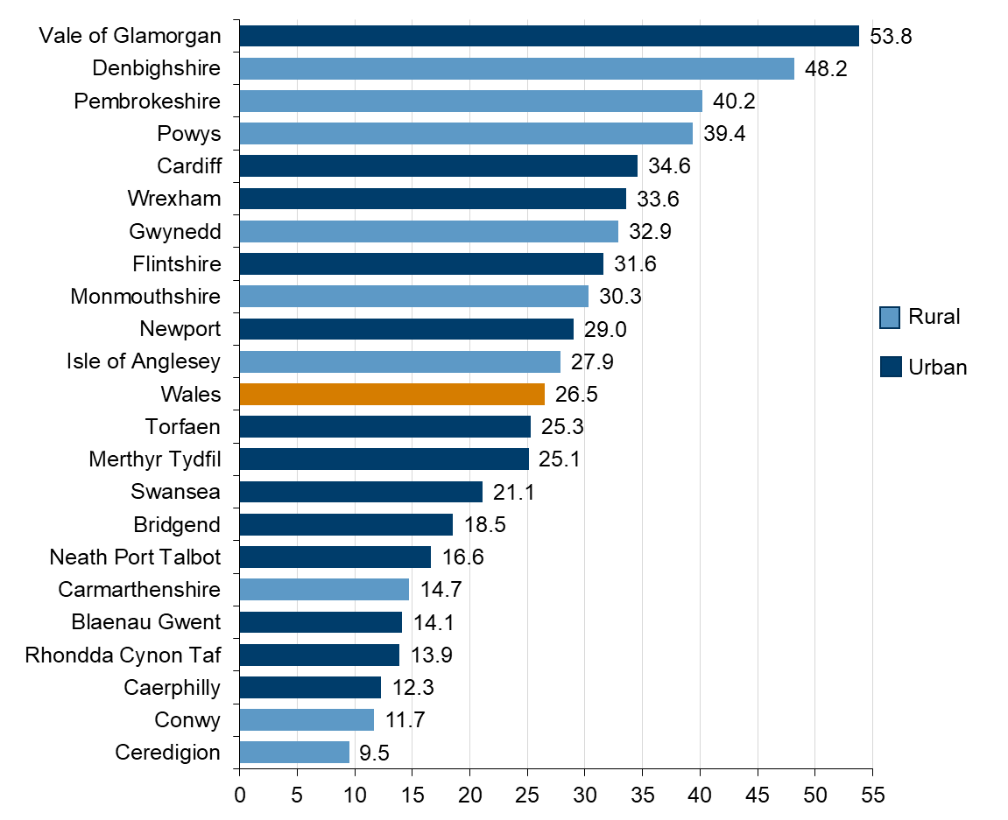
Description of figure 3: a bar graph showing the rate of additional housing units delivered per 10,000 households in Wales, by local authority area. 11 of the 22 local authorities have rates higher than the Wales average.
Source: Affordable Housing Provision data collection, Welsh Government and mid-2023 Household Estimates, Welsh Government
Figure 3 shows that during 2024 to 2025 the rate of additional affordable housing delivery across Wales as a whole was 26.5 units per 10,000 households.
The local authority with the highest number of affordable housing units delivered in 2024 to 2025 was Cardiff (544 units or 15% of the Wales total). However, when considering the number of households in each area, Vale of Glamorgan was the authority with the highest delivery rate at 53.8 units per 10,000 households.
Ceredigion had the lowest delivery rate at 9.5 units per 10,000 households, with 30 units delivered in 2024 to 2025.
Additional affordable housing by funding source
The availability of Welsh Government grant funding for affordable housing such as Social Housing Grant (SHG), recycled Social Housing Grant (RCG), Transitional Accommodation Capital Programme (TACP), Housing Finance Grant (HFG) and Housing with Care Fund will impact on the ability of all providers, but particularly RSLs, to deliver additional affordable housing across Wales.
Figure 4: number of additional affordable housing delivered by funding source between 2009 to 2010 and 2024 to 2025 [Note 1]
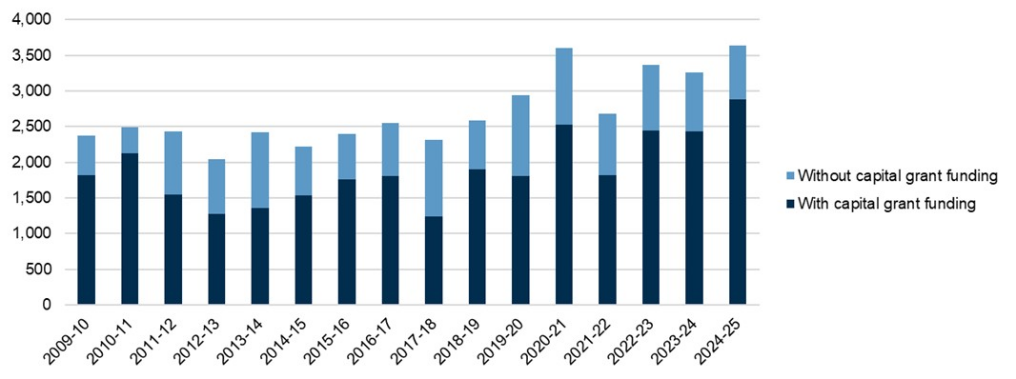
Description of figure 4: a bar chart showing the number of affordable housing units delivered each financial year with and without capital grant funding.
Source: Affordable Housing Provision data collection, Welsh Government
Additional affordable housing provision by location, year and funding (StatsWales)
[Note 1] 2009 to 2010 was the first time funding source was collected using the current definition.
79% of affordable housing units were delivered through capital grant funding in 2024 to 2025, higher than the proportion for 2023 to 2024 (75%). The proportion of affordable housing units delivered without capital grant fund decreased from 25% (822 units) in 2023 to 2024 to 21% (764 units) in 2024 to 2025.
During 2024 to 2025, 79% of all RSL affordable housing provision in Wales were delivered with some form of capital grant funding, up from 75% during the previous year. Across Wales, RSL provision with capital grant funding reached over 80% in 14 local authorities.
A breakdown of these figures can be found on the StatsWales website.
Additional affordable housing delivered by RSLs
Welsh RSLs continue to make the largest contribution delivering 74% of all additional affordable housing in Wales in 2024 to 2025. As the major provider of additional affordable housing across Wales, RSLs are required to provide more detailed information to Welsh Government including the tenure type of the housing units delivered and the number which are delivered by RSLs within the national park areas.
Welsh RSLs delivered all the additional affordable housing in 5 of the 22 local authorities across Wales and more than half of all the additional affordable housing in 16 of the 17 remaining local authorities. The exception was Carmarthenshire where RSLs were responsible for 20% of all affordable housing provision in 2024 to 2025.
RSL delivery by tenure
Figure 5: number of additional affordable housing delivered by Welsh registered social landlords, by tenure between 2007 to 2008 and 2024 to 2025 [Note 1] [Note 2]
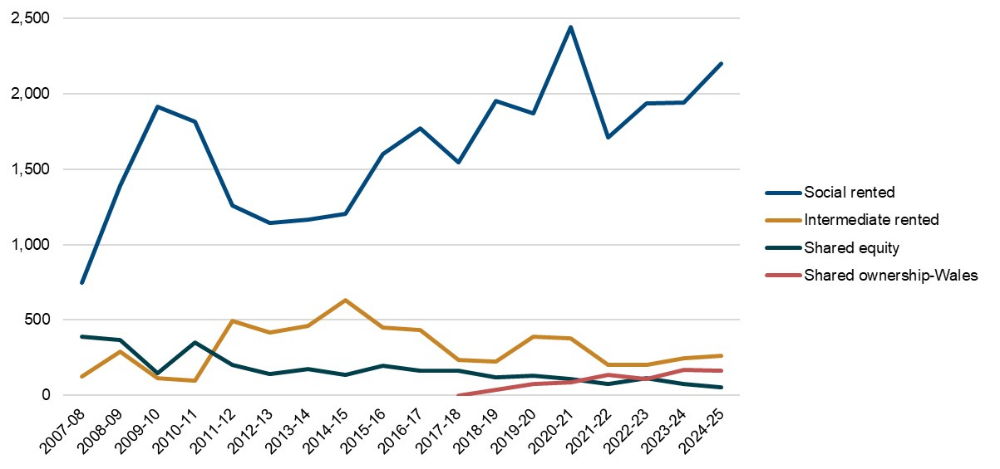
Description of figure 5: a bar chart showing the number of affordable housing units delivered each year and the tenure of the units. Each year since the start of the collection, the majority have been for social rent.
Source: Affordable Housing Provision data collection, Welsh Government
[Note 1] Information taken from registered social landlords returns, detailing all additional affordable housing delivered within the local authorities in which they operate.
[Note 2] Shared ownership Wales was introduced in February 2018 with the first purchase occurring in 2017 to 2018.
Figure 5 shows that of the 2,681 affordable housing units delivered by Welsh RSLs during 2024 to 2025, 82% were social rented housing (2,203 units). This is similar to the proportion of RSL social rented units delivered in 2023 to 2024. The social rented housing units provided by RSLs during 2024 to 2025 accounted for 60% of all additional housing delivered by all providers.
A further affordable housing option is intermediate rented properties where the rents are above those of social rents, but below market housing rents.
During 2024 to 2025 a total of 264 intermediate rented properties were delivered by RSLs, a 6% increase on the 249 units delivered in 2023 to 2024. Intermediate rented properties accounted for 10% of all RSL provision.
RSLs also provide shared equity units for those who are not eligible for social housing, but who cannot afford to buy or rent a property on the open market (see Glossary). During 2024 to 2025, 52 shared equity units were delivered, a decrease of 31% from 2023 to 2024 and the lowest figure since the collection began in 2007 to 2008. Shared equity units accounted for just 2% of all RSL provision.
From April 2024 to March 2025, RSLs across Wales delivered 162 additional affordable housing units via the Shared-ownership - Wales scheme (see Glossary), a decrease of 3% on 2023 to 2024.
Most of the additional affordable housing provided during 2024 to 2025 by RSLs were ‘general needs’ properties. These properties include self-contained units that are not reserved for specific client groups and also properties that are adapted for use for people with disabilities but where no additional services or support are provided as part of the terms of occupancy. During 2024 to 2025 these types of property accounted for 91% (2,430 units) of all additional affordable housing provision by RSLs. The remaining 9% (251 units) were housing units provided for use by particular client groups or for specific purposes.
Further information on social rented, intermediate rented, shared equity and also shared ownership - Wales housing units is available in the Glossary.
Additional affordable housing through planning obligations
The number of affordable homes to be provided in a particular area will be determined by the local planning authority’s planning policy and discussions with developers about what is feasible given the economic circumstances and other factors. The agreed affordable housing contribution will be secured by what is known as a planning obligation (or a section 106 agreement) which is a legally binding contract between a developer and a local planning authority that operates alongside a planning permission to make a development acceptable to both parties. These arrangements may be used to offset negative consequences of development, to help meet local needs or to secure benefits which would make a development more sustainable.
Figures 6a and 6b below show the number of additional affordable housing units that were granted planning permission each year through planning obligations (section 106 agreements) or planning conditions either as part of, or because of, market housing developments. Granted planning permission refers to final detailed (i.e. not outline) planning permissions granted during the year and will mean that a section 106 agreement (where applicable) has already been signed.
The figures also show information on the number of additional affordable housing units that were delivered each year, irrespective of when the planning permission was granted. This includes local authorities, registered social landlords, community land trusts and private sector provision.
It should be noted that additional affordable housing units delivered or granted planning permission through planning obligations may or may not be on affordable housing exception sites.
Figure 6a: additional affordable housing delivered through planning obligations (number granted planning permission) between 2007 to 2008 and 2024 to 2025
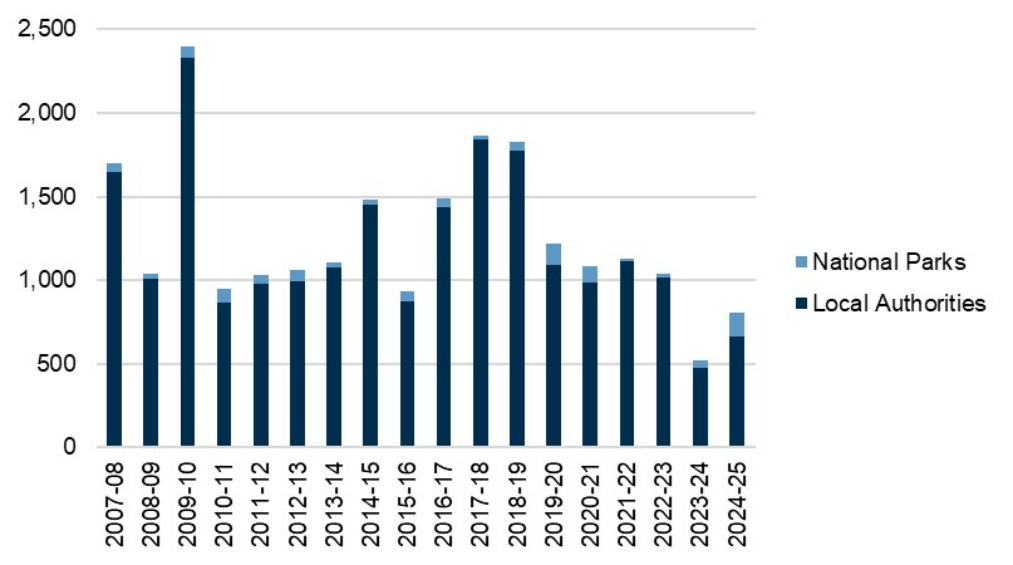
Description of figure 6a: a bar chart showing the number of affordable housing units granted planning permission through planning obligations in local authorities and national parks. This number peaked at 2,399 in 2009 to 2010.
Figure 6b: additional affordable housing delivered through planning obligations (number delivered) between 2007 to 2008 and 2024 to 2025 [Note 1]
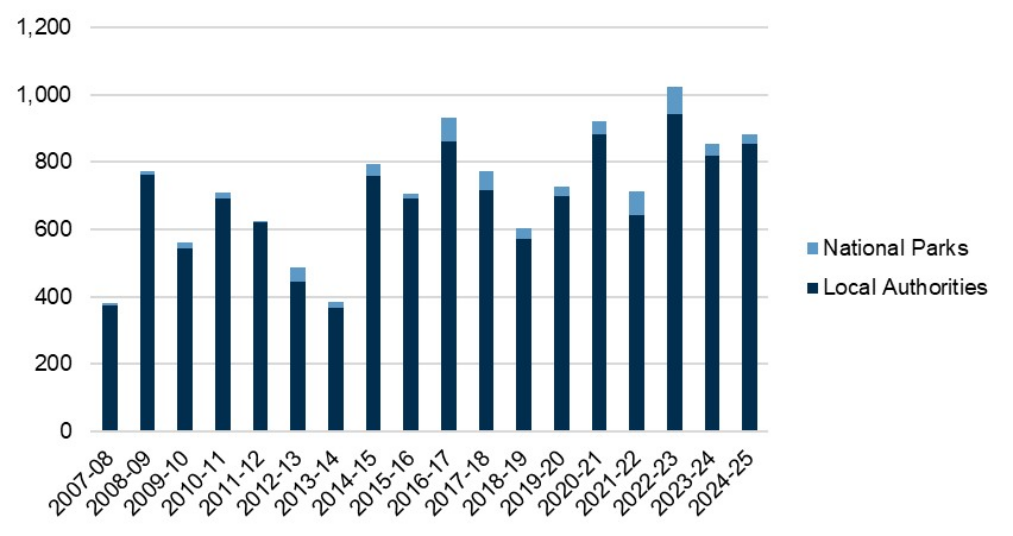
Description of figure 6b: a bar chart showing the number of affordable housing units delivered through planning obligations in local authorities and national parks. This number peaked at 1,024 in 2022 to 2023.
Source: Affordable Housing Provision data collection, Welsh Government
[Note 1] Housing units delivered through planning obligations cannot be summed with those delivered on affordable housing exceptions sites, as a housing unit may be delivered through planning obligations and be on a housing exception site.
During 2024 to 2025, the number of additional affordable housing units granted planning permission increased by 54% to 804. Affordable housing units granted planning permission in national parks nearly tripled (an increase of 190%) from the previous year to 142, this is the highest figure recorded since this collection began. Additional affordable housing units granted planning permission in local authorities (outside national park areas) increased by 40% to 662 units.
During 2024 to 2025, the total number of additional affordable housing units delivered through planning obligations (Section 106 agreements), including national parks, increased by 3% compared with the previous year to 882 units.
The number of additional affordable housing delivered through planning obligations was up by 4% (from 820 to 856) for local authorities. Gwynedd accounted for 16% of the units delivered through planning obligations, followed by Pembrokeshire with 15% and Cardiff with 13%. For national parks the number of additional affordable housing delivered through planning obligations was down by 28% (from 36 to 26 units) during 2024 to 2025 (Figure 6b).
During 2024 to 2025, 24% of all additional affordable housing was delivered through planning obligations compared with 26% the previous year and 30% during 2022 to 2023.
Additional affordable housing on housing exception sites
Affordable housing exception sites are small scale housing sites within or adjoining existing settlements for the provision of affordable housing to meet local needs, which would not otherwise be allocated in the development plan. Prior to July 2010 these were known as ‘rural exceptions sites’.
The number of affordable housing units granted planning permission to be built on affordable housing exception sites decreased by 73% to 30 units in 2024 to 2025, all of which were within local authorities (Figure 7a).
Figure 7a: additional affordable housing delivered on housing exception sites (number granted planning permission) between 2007 to 2008 and 2024 to 2025 [Note 1]
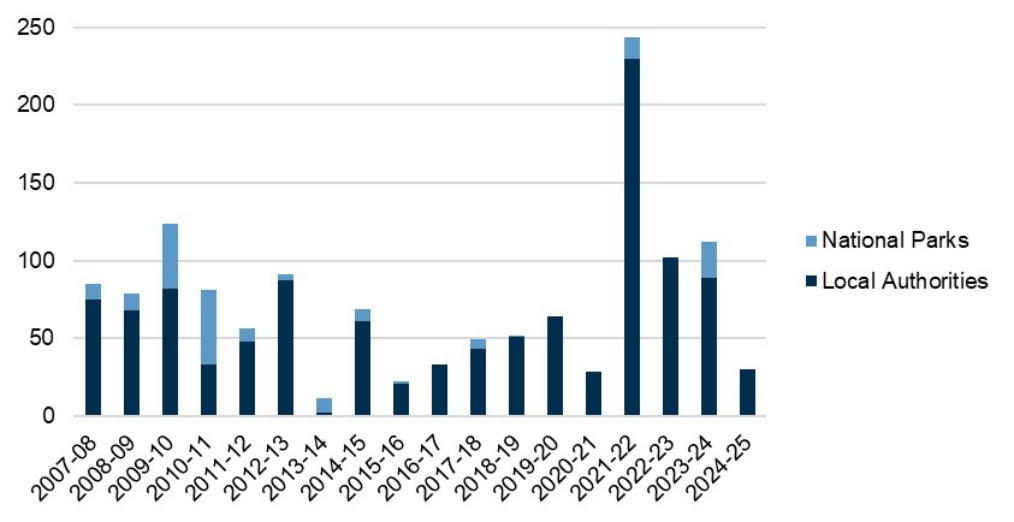
Description of figure 7a: a bar chart showing the number of affordable housing units granted planning permission on exception sites in local authorities and national parks. This number peaked at 244 in 2021 to 2022.
Figure 7b: additional affordable housing delivered on housing exception sites (number delivered) between 2007 to 2008 and 2024 to 2025 [Note 1]
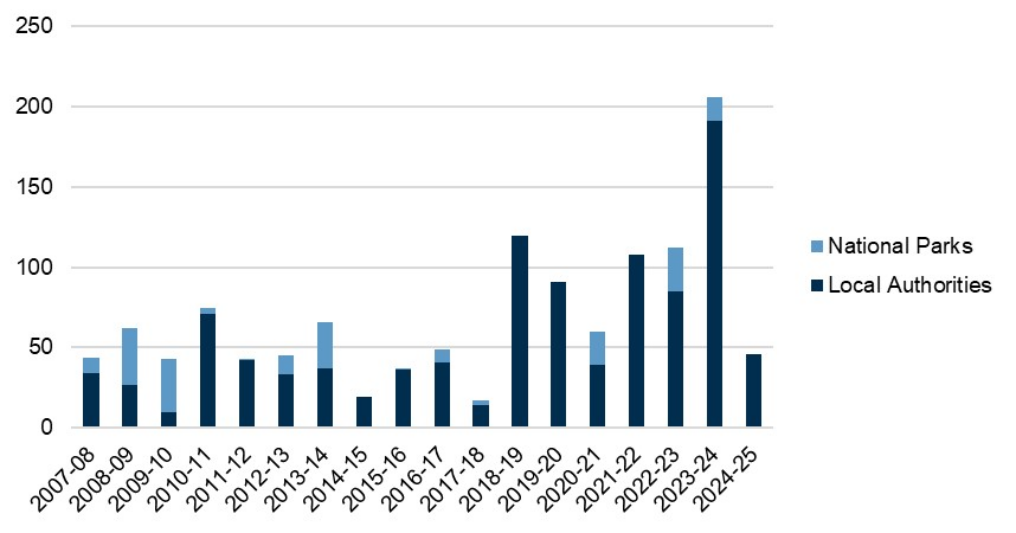
Description of figure 7b: a bar chart showing the number of affordable housing units delivered on housing exception sites in local authorities and national parks. The number peaked at 206 in 2023 to 2024.
Source: Affordable Housing Provision data collection, Welsh Government
[Note 1] Housing units delivered through planning obligations cannot be summed with those delivered on affordable housing exceptions sites, as a housing unit may be delivered through planning obligations and be on a housing exception site.
Figure 7b shows that in 2024 to 2025, the number of additional affordable housing units delivered on affordable housing exception sites decreased by 78% to 46 units compared to 206 in the previous year. These were in Neath Port Talbot (37 units), Gwynedd (7 units) and Powys (2 units). No units were delivered on affordable housing exemption sites for the remaining 19 local authorities or in any national park.
Where a local planning authority has identified a lack of affordable housing it must consider including an 'affordable housing exception site' policy in its development plan, setting out the circumstances where sites may be released for 100% affordable housing to meet local needs as an exception to the policies for general housing provision.
Additional affordable housing on public sector land
Figure 8 below shows the extent to which the public sector, including local authorities, are releasing their own land for the purpose of providing additional affordable housing.
During 2024 to 2025, the number of additional affordable housing units delivered on all public sector land increased by 25% to 606 units and accounted for 17% of all affordable housing provision.
Figure 8: additional affordable housing delivered on land made available by the public sector, April 2024 to March 2025 [Note 1] [Note 2]
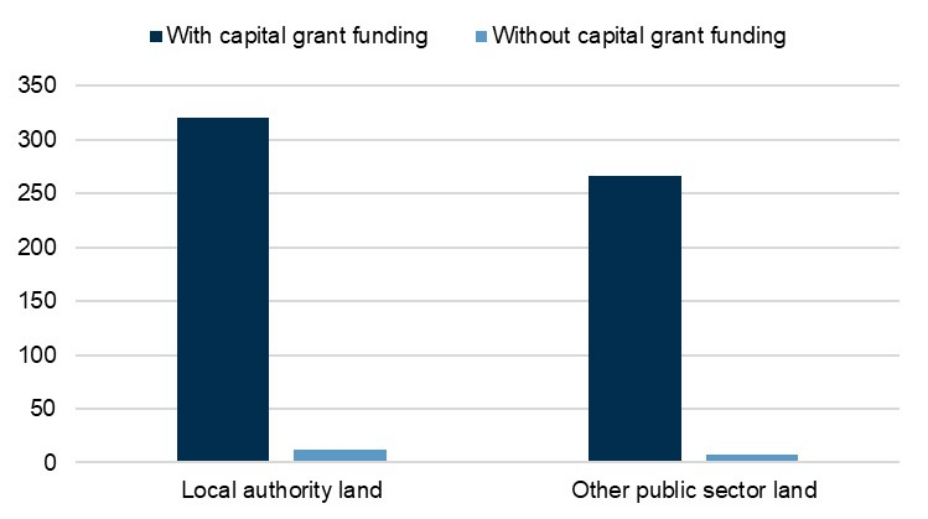
Description of figure 8: a bar chart comparing the number of affordable housing units delivered on local authority land and other public sector land for 2024 to 2025. As well as comparing what was delivered with and without capital grant funding.
Source: Affordable Housing Provision data collection, Welsh Government
[Note 1] Information taken from returns from local authorities detailing all additional affordable housing provided within their respective areas.
[Note 2] Other public sector bodies include the Welsh Government and Welsh Government sponsored bodies, other central government departments, health authorities and police, fire and rescue services/authorities. Further details are provided in the Glossary towards the end of the release.
Figure 8 shows the majority of units delivered on public sector land continued to be delivered with capital grant funding. The percentage of units delivered on public sector land with capital grant funding increased from 91% in 2023 to 2024 to 97% in 2024 to 2025.
The number of units delivered with capital grant funding on local authority land increased on the previous year from 255 units to 320 while on other public sector land the number of units increased from 186 units to 266 (Figure 8).
Of the 332 units delivered on local authority land in Wales, 47% (155 units) were delivered in Vale of Glamorgan, followed by 20% (66 units) in Powys and 14% (47 units) in Pembrokeshire. 16 local authorities recorded no units delivered on local authority land.
4 of the 22 local authorities reported additional affordable housing units being delivered on land released by other public sector bodies during 2024 to 2025, with Torfaen accounting for 34%, Vale of Glamorgan 33%, Cardiff 20% and Blaenau Gwent 13%.
Further details of the other public sector bodies included are provided in the Glossary.
Management information
Use of management information
This statistical release reports progress towards that commitment.
Due to the nature of data collection, there is a time lag between the end of the reporting period and the publication of the official statistics. Official data for homes delivered in 2025 to 2026, as well as the total delivered between April 2021 and the end of March 2026 will be published in autumn 2026.
To improve the timeliness of data, management information has been included in this statistical release to complement existing accredited official statistics. Estimates of homes delivered are available from management information collected throughout the year. This data supports monitoring of housing delivery linked to government funded programmes, including the SHG, TACP, RSL Loans scheme and Leasing Scheme Wales, among others.
Ahead of the next official statistics release, we recognise the public interest in understanding whether the target has been met. In line with the Office for Statistics Regulation (OSR) guidance on intelligent transparency (OSR) and the Standards of the Code of Practice (UK Statistics Authority), additional management information has been published alongside this release. This includes projections for the expected number of homes to be delivered and voids to be brought back into use through TACP during the 2025 to 2026 and 2026 to 2027 financial years. These projections provide transparency around expected progress towards the target beyond the timeframe covered in this release.
In recent years, the quality and reliability of this management information have improved. As a result, the gap between management information and official statistics has narrowed, with both sources now offering a broadly consistent view of delivery.
Given these developments, we will explore how we might make greater use of management information in the future, and whether there remains a need to maintain two distinct sets of figures.
Currently we do not collect official statistics on void properties funded through TACP and brought back into use by local authorities and RSLs. However, management information is collected from these organisations throughout the year to monitor delivery under the TACP scheme.
Quality of management information
Management information is drawn from a live system that is continuously updated by RSLs and LAs. For each funding programme, providers update scheme milestones, completion dates and add or remove schemes. Because the system reflects real time changes the projections change over time. For example, management information for the 2024 to 2025 financial year extracted in May 2025 – one month after the end of the financial year – estimated delivery of 3,489 homes. This figure increased to 3,650 when data was extracted in October 2025, six months after the financial year ended. Further information can be found in the quality report.
The management information extracted 17 October 2025 indicates that (excluding voids) 956 homes had been delivered by 30 September 2025 in the 2025 to 2026 financial year, with a further 3,844 planned for delivery.
Data on the number of affordable housing units planned for delivery during 2025 to 2026 are also collected alongside data on units delivered in 2024-25 on the official statistics returns. These official statistics show that local authorities estimate an additional 4,202 affordable housing units are planned for delivery during 2025 to 2026. These estimates are based on data collected at the end of the 2024 to 2025 financial year, with the submissions due by 20 June 2025. The data collection guidance states: ‘this refers to any additional affordable housing units which are currently being developed and are scheduled to be delivered during the current financial year 2025 to 2026’.
These figures represent the total number of affordable housing units, which may include shared equity homes, but excludes voids. This definition differs from that used for the Programme for Government commitment.
To ensure the robustness of void data included in the measurement of the government target, a quality assurance exercise was conducted in September 2025 using the UK Statistics Authority’s Administrative Data Quality Assurance Toolkit. Two RSLs and two local authorities were selected for interview with explored various aspects of data quality, including:
- how organisations defined voids eligible for TACP funding (e.g. vacancy length, condition, tenure)
- timing and frequency of data recording and updates (e.g. whether it is updated through a live system or set time periods)
- errors such as whether a unit might be recorded as a TACP void but not brought back into use, or whether double counting could occur between RSLs and LAs
- potential for previously delivered affordable homes to be reclassified as TACP voids
- validation processes and sign-off procedures
Findings indicate that a robust quality assurance process is in place, with data captured at multiple stages—such as the expressions of interest form, grant applications, and scheme uploads to the portal. These are recorded at the individual scheme level and undergo validation to ensure accuracy and completeness. There remains a small possibility that a home previously reported as delivered since the start of affordable housing records in 2007 to 2008 could be included again. However, safeguards such as checks on funding history during grant applications help ensure properties are accurately classified. It is also very unlikely that the same property would be both recorded as delivered and subsequently counted as a void within this government term, thereby being double counted towards the target.
Further information is available in the quality report.
Coherence with other statistical publications
The data collected and published annually on affordable housing are based on information collected via annual statistical returns completed by local authorities, registered social landlords and national park authorities in Wales. It includes provision through new house building as well as the purchase, acquisition, leasing or conversion of existing dwellings. A subset of the affordable housing data will therefore be included in the Welsh Government’s new house building statistics, which are published separately.
However, the new house building statistics are based on the reports of local authority building inspectors and the National House Building Council (NHBC). Information is not collected from other smaller inspectors which is likely to lead to an under-count of the total number of new dwellings. It is sometimes difficult for building control officers who record the data to identify the intended final tenure of the property and this may lead to an under-count of social sector new house building and an over-count for the private sector. As such, there may be some apparent disparity between new build statistics and affordable housing statistics.
Further information can be found in the relevant quality reports for affordable housing statistics and new house building statistics.
On 6 November 2019, ONS published two reports on affordable housing statistics as part of a UK wide programme of work to improve housing and planning statistics:
- Comparing affordable housing in the UK (ONS), an article making cross-UK comparisons of affordable housing statistics.
- Affordable Housing Statistics in the UK (ONS), a review of definitions, terminology and the feasibility of harmonising affordable housing statistical definitions.
Glossary
Additional affordable housing
Affordable housing provided through newbuild or through the purchase, leasing or conversion of existing units on or after 1 April 2007. This therefore excludes existing affordable units that have been renovated or refurbished, as they are not classed as being additional. Where there was a net loss of affordable units over the year, this was recorded as zero. For example, if two self-contained flats in one property were converted into one family home, the number of additional units is zero as there has been a reduction in the number of affordable units.
Affordable housing exception sites
Affordable housing exception sites are small scale housing sites within or adjoining existing settlements for the provision of affordable housing to meet local needs, which would not otherwise be allocated in the development plan. Prior to July 2010 these were known as ‘rural exceptions sites’.
Capital Grants Funding
Capital Grants Funding includes Social Housing Grant (SHG), any recycled Social Housing Grant (RCG), Transitional Accommodation Capital Programme (TACP), Housing Finance Grant (HFG) and Housing with Care Fund (HCF) but excludes those housing units funded from other sources.
Conversions
When one unit is changed into multiple units or multiple units are changed into one. For example, where one family house is converted into shared accommodation for three occupants, the number of additional units is two.
Delivered
Means that the unit is completed and is available for occupation.
Extra care Housing
Offers more support to residents than other retirement housing but allows them to retain more independence than moving to a care home. Residents still live in self-contained flats, but meals may be provided‚ either in the flat or a shared dining room and access to on-site care and support tailored to their individual needs
General needs
Self-contained units that are not reserved for specific client groups. Properties adapted for use for people with disabilities were included here if no additional services or support were provided as part of the terms of occupancy.
Granted planning permission
Refers to final detailed (i.e. not outline) planning permissions granted during the year. Granted Planning Permission will mean that a section 106 agreement has already been signed.
Housing unit
Self-contained dwelling which provides a minimum of one habitable room, with exclusive use of a kitchen, bathroom/shower, sink and toilet.
NB: In shared housing, a unit will relate to the number of bed spaces or bedrooms provided exclusively for use by the occupant or family in the case of hostels or refuges. For example, one house may provide supported accommodation for three occupants – each occupant has exclusive use of a bedroom and shares lounge, kitchen and bathroom facilities. This was counted as three units. Bedrooms used exclusively by staff were not counted.
Housing with Care Fund (HCF)
The Housing with Care Fund is capital grant provided by Welsh Government to support a range of interventions including affordable housing with care delivered by local authorities and RSLs. The funding can be used to fund the building of new extra care housing for older people and supported housing for adults with physical or learning disabilities.
Intermediate housing
Where prices or rents are above those of social rented housing but below market housing prices or rents. This can include equity sharing schemes (for example Homebuy) or homes which are let at intermediate rent levels. Intermediate housing differs from low-cost market housing, which the Welsh Government does not consider to be affordable housing for the purpose of the land use planning system.
National park authorities (NPAs)
Bannau Brycheiniog (Brecon Beacons) NPA has boundaries in Blaenau Gwent, Caerphilly, Carmarthenshire, Merthyr Tydfil, Monmouthshire, Neath Port Talbot, Powys, Rhondda Cynon Taf and Torfaen.
Pembrokeshire NPA has boundaries in Pembrokeshire only.
Eryri (Snowdonia) NPA has boundaries in Conwy and Gwynedd.
Other public sector bodies
Additional affordable housing units are delivered on land made available by the local authority and on land formerly owned by the following public sector bodies:
- Welsh Government including Welsh Government Sponsored Bodies
- Other Central Government Departments (including for example former Ministry of Defence sites or Courts sites)
- Welsh Health Estates (covering National Health Service sites formerly owned by Health Authorities, Health Trusts and Ambulance Trusts etc)
- Police forces/authorities
- Fire and rescue services/authorities
Planned
This refers to any additional affordable housing units which are currently being developed and are scheduled to be delivered during the financial year 2025 to 2026.
Planning obligations (Section 106 agreements)
As part of market housing developments developers are often asked to make a contribution to meeting identified local need for affordable housing. The number of affordable homes to be provided on a particular site will be determined by the local planning authority’s planning policy (usually based on a percentage for sites above a certain size) and negotiations with the developer about what is feasible given the economic circumstances and any other site-specific factors. The agreed affordable housing contribution will be secured by what is known as a planning obligation (or a section 106 agreement) which is a legally binding contract between a developer and a local planning authority that operates alongside a planning permission. The land itself, rather than the person or organisation that develops the land, is bound by a Section 106 Agreement, so this is something any future owners will need to take into account.
These arrangements to overcome obstacles which may otherwise prevent planning permission from being granted, may be used to offset negative consequences of development, to help meet local needs or to secure benefits which would make a development more sustainable.
Rent to Own – Wales
This scheme was introduced in February 2018 and to offer the opportunity of home ownership to households who can afford the monthly mortgage payments but do not have the level of deposit normally required to purchase a home. Under Rent to Own – Wales, aspiring buyers will pay market rents for new-build homes from participating housing associations, and will have the option to purchase these from the end of the second year of their rental period.
Upon exercising the option to purchase, the aspiring buyer will be gifted an amount equivalent to 25% of the rent they have paid and 50% of any increase in the value of the home, to use as a mortgage deposit. This will help them to purchase the home that they are renting.
Housing delivered via the Rent to Own – Wales scheme does not fully conform to the TAN2 definition of affordable housing and the number of units delivered under the scheme is not included in the overall total for additional affordable housing shown in this release.
The Rent to Own scheme closed to new applicants from 31 March 2021.
Section 106 agreements
See ‘Planning obligations’.
Shared equity
This includes:
- units where the registered social landlord provides an equity loan to assist with the purchase of a property (e.g. through the Homebuy scheme)
- units where there is any other low-cost home ownership arrangement
- units that are offered under ‘neutral tenure’ principles (where applicants can choose to rent or buy depending on individual circumstances) if the first occupancy is on equity sharing terms.
Prior to the introduction of the new Shared Ownership – Wales scheme in February 2018, units where there is shared ownership between the occupant and the RSL (e.g. part ownership / part rent) may have been included under 'Shared Equity'.
Shared Ownership – Wales
Shared Ownership - Wales is a part-buy, part-rent scheme introduced in February 2018. It is aimed at aspiring buyers who have some deposit but are unable to obtain the level of mortgage to purchase the home outright. Aspiring buyers can purchase an initial share of 25% to 75% of the value of new-build homes, which are available for this scheme from participating housing associations.
They can staircase up to full ownership at any time. Rent will be payable on the un-owned share. The affordable housing units delivered under this scheme do conform to the TAN 2 definition of affordable housing and the numbers delivered have been included in the overall total for additional affordable housing provision shown in this release.
Sheltered housing
Designed specifically for older people, commonly built in developments of about 20 to 40 self-contained flats or bungalows. There is almost always an alarm system linked to a 24-hour communication centre which can summon help in an emergency.
Social Housing Grant (SHG)
Social Housing Grant is the main capital grant programme given by Welsh Government to deliver additional affordable homes. The grant can be used to fund the building of new general needs, extra care and supported housing, as well as the acquisition of existing homes. Homes can be for Social Rent, Intermediate Rent or Shared Ownership.
Social rented housing
Social rented housing is provided by local authorities and Welsh RSLs where rent levels are below market rents and are set within the framework of the Welsh Government Rent and Service Charge Standard.
Stair-casing
Stair-casing is when the owner of a Shared Ownership – Wales property exercises their legal right to acquire additional shares (equity) in their property.
Supported housing
There are many different types of supported accommodation to meet the needs of a wide range of people. Residents may have extra needs due to disability, their age or other reasons. The accommodation may have been specially adapted or designed to meet particular physical needs or it may provide extra support with wardens or other staff to help residents live independently.
Transitional Accommodation Capital Programme (TACP)
The Transitional Accommodation Capital Programme is funding provided by Welsh Government to provide additional affordable homes quickly in response to homelessness and temporary accommodation pressures. The funding can be used to acquire existing homes, convert non-domestic properties into homes, provide modular accommodation on meanwhile sites and refurbish voids. Homes are mainly social rent.
Voids
A ‘void’ property refers to a dwelling owned by a local authority or registered social landlord that is currently unoccupied and not available for letting. A void can occur for various reasons such as the property being between tenancies i.e. awaiting necessary repairs, maintenance, or refurbishment, or properties pending sale or demolition.
The voids programme under TACP is intended to address strategic longer-term voids and does not fund standard re-lets. TACP funding is used to bring back into use properties that are financially unviable or under consideration for sale, preventing the loss of affordable homes.
Quality and methodology information
Detailed information on data quality and methodology can be found in the Affordable housing provision quality report.
Official statistics status
All official statistics should show the standards of the Code of Practice for Statistics (UK Statistics Authority).
With the exception of the stated management information, these are accredited official statistics. They were independently reviewed by the Office for Statistics Regulation (OSR). They comply with the standards of trustworthiness, quality and value in the Code of Practice for Statistics.
It is Welsh Government’s responsibility to maintain compliance with the standards expected of accreditation. If we become concerned about whether these statistics are still meeting the appropriate standards, we will discuss any concerns with OSR promptly. Accreditation can be cancelled or suspended at any point when the highest standards are not maintained, and reinstated when standards are restored.
Accredited official statistics are called National Statistics in the Statistics and Registration Service Act 2007.
Statement of compliance with the Code of Practice for Statistics
Our statistical practice is regulated by the OSR. OSR sets the standards of trustworthiness, quality and value in the Code of Practice for Statistics that all producers of official statistics should adhere to.
All our statistics are produced and published in accordance with a number of statements and protocols to enhance trustworthiness, quality and value. These are set out in the Welsh Government’s Statement of Compliance.
These official statistics demonstrate the standards expected around trustworthiness, quality and public value in the following ways.
Trustworthiness
The data is collected directly from local authorities, RSLs and other providers that have delivered affordable housing in Wales.
Quality
The published figures provided are compiled by professional analysts using the latest available data and applying methods using their professional judgement and analytical skillset. Statistics published by Welsh Government adhere to the Statistical Quality Management Strategy which supplements the Quality pillar of the Code of Practice for Statistics (UK Statistics Authority) and the European Statistical System principles of quality for statistical outputs.
Data is collected by Welsh Government directly from local authorities, RSLs and other housing providers. They complete data collection forms based on data stored on their respective IT systems and return the completed forms to Welsh Government via its secure web data transfer system.
Validation checks are performed by Welsh Government statisticians and queries referred to local authorities where necessary. The statistical release is then drafted, signed off by senior statisticians and published in line with the statement on confidentiality and data access which is informed by the trustworthiness pillar contained in the Code of Practice for Statistics (UK Statistics Authority).
Value
The purpose of the statistical release is to provide evidence for policy development and is used in informing Ministerial advice and decision making in the wider policy context. Furthermore, it provides the wider public with information about social housing stock and how many additional units are being delivered and planned within the next financial year.
You are welcome to contact us directly with any comments about how we meet these standards. Alternatively, you can contact OSR by emailing regulation@statistics.gov.uk or via the OSR website.
Well-being of Future Generations Act (WFG)
The Well-being of Future Generations Act 2015 is about improving the social, economic, environmental and cultural wellbeing of Wales. The Act puts in place seven wellbeing goals for Wales. These are for a more equal, prosperous, resilient, healthier and globally responsible Wales, with cohesive communities and a vibrant culture and thriving Welsh language. Under section (10)(1) of the Act, the Welsh Ministers must (a) publish indicators (“national indicators”) that must be applied for the purpose of measuring progress towards the achievement of the wellbeing goals, and (b) lay a copy of the national indicators before Senedd Cymru. Under section 10(8) of the Well-being of Future Generations Act, where the Welsh Ministers revise the national indicators, they must as soon as reasonably practicable (a) publish the indicators as revised and (b) lay a copy of them before the Senedd. These national indicators were laid before the Senedd in 2021. The indicators laid on 14 December 2021 replace the set laid on 16 March 2016.
Information on the indicators, along with narratives for each of the wellbeing goals and associated technical information is available in the Wellbeing of Wales report.
Further information on the Well-being of Future Generations (Wales) Act 2015.
The statistics included in this release could also provide supporting narrative to the national indicators and be used by public services boards in relation to their local wellbeing assessments and local wellbeing plans.