
Welsh Index of Multiple Deprivation (WIMD) 2025: interim technical report (new indicators)
Outlines important technical information for the Welsh Index of Multiple Deprivation (WIMD) results report.
This file may not be fully accessible.
In this page
Introduction
This interim technical report outlines important technical information for the Welsh Index of Multiple Deprivation (WIMD) results report.
A full technical report covering all domains will be published in early December. Technical information about several indicators is detailed below, as they are either new to the index or key to calculating the index.
This interim report details the income and employment deprivation indicators that have changed significantly since WIMD 2019 and are in the highest weighted domains for WIMD 2025.
It also details the 4 new indicators of WIMD 2025, in the access to services, housing, and physical environment domain.
This report will be replaced by a full report covering all domains and indicators in early December, and we will email our subscription list when this is available. You can ask to join our list by emailing the social justice statistics team.
About WIMD
Background
The Welsh Index of Multiple Deprivation (WIMD) is the official measure of relative deprivation for small areas in Wales. It identifies areas with the highest concentrations of several different types of deprivation. WIMD ranks all small areas in Wales from 1 (most deprived) to 1,917 (least deprived). It is an accredited official statistic produced by statisticians at the Welsh Government, working under the Code of Practice for Statistics.
WIMD is calculated from 8 different domains (or types) of deprivation, each compiled from a range of different indicators. Our WIMD guidance document provides more information on the definition of deprivation, how to interpret and use WIMD. Our WIMD results report also provides examples of applications of WIMD.
How WIMD is constructed
There are three main components of the index:
- the 54 underlying indicator datasets
- ranks for the 8 separate domains (or types) of deprivation, created by combining relevant indicators within each domain
- overall WIMD ranks, created by combining the domain ranks
All these components are calculated for each of the small areas (Lower layer Super Output Areas or LSOAs) in Wales and published. A full list of the indicators can be found in the results report.
The way the indicators and domains are combined is designed to reliably distinguish between areas at the most deprived end of the distribution, but not at the least deprived end. This means that differences between the least deprived areas in Wales are less well defined than differences between the more deprived areas.
Changes for WIMD 2025
The methodology is broadly the same as for previous indices, with the same 8 domains or types of deprivation captured. However, some new datasets, methodologies and geographies have been used to produce WIMD 2025, meaning outputs are not directly comparable to previous indices.
Domain scores
The overall index and domain ranks are the main output for WIMD. As part of the process for calculating WIMD ranks, deprivation scores (domain and overall) are produced, see the guidance report for further advice on interpreting scores.
The individual domain ranks, calculated by ranking the weighted sum of domain indicators, are then exponentially transformed to produce domain scores. Areas have scores (transformed ranks) ranging between 0 (least deprived) and 100 (most deprived) on each domain. The scores increase exponentially so that the most deprived areas have more prominence. This reduces the extent to which deprivation in some domains can be cancelled by lack of deprivation in others.
The sets of domain scores are then weighted according to the respective domain weight and added together to produce the overall WIMD score, which is, in turn, ranked to provide the overall WIMD ranks.
Domain weights
Domain weights control the relative contribution of each domain to overall deprivation. Their values are based upon expert advice and the quality of the indicators available. If a domain has a higher weight, changes in that domain will have a bigger impact on the overall index.
Table 1 domain weights for WIMD 2025 alongside the weights used in 2019
| WIMD domain | WIMD 2025 domain weight | WIMD 2019 domain weight |
|---|---|---|
| Income | 22% | 22% |
| Employment | 20% | 22% |
| Health | 15% | 15% |
| Education | 14% | 14% |
| Access to services | 10% | 10% |
| Housing | 9% | 7% |
| Community safety | 5% | 5% |
| Physical environment | 5% | 5% |
The addition of 2 new indicators in the housing domain has led to a small increase in its weight from 7% to 9%. To allow for this, the weight for the employment domain has been reduced slightly from 22% to 20%, but this remains the second highest weighted domain because it is a strong determinant of deprivation.
WIMD geographies
Super output areas
Following the 2001 Census, the ONS developed a geographic hierarchy called Super Output Areas (SOAs). They were designed to improve the reporting of small area statistics in England and Wales. The areas were reviewed, and some changes made, following the 2021 Census (ONS). Where possible, official statistics are published at the SOA geography.
There are three layers of SOA: Lower layer, Middle layer, and Upper layer. This is because disclosure requirements mean that some sets of data can be released for much smaller areas than others. To support a range of potential data requirements, it was decided to create these three SOA layers.
- A Lower layer SOA (known as an LSOA) must have a minimum population of around 1,000.
- The mean size of all the LSOAs is around 1,600.
- LSOAs are built from groups of Census Output Areas (usually between 4 and 6).
- A Middle layer SOA (MSOA) must have a minimum population of around 5,000.
- The mean size of all the MSOAs is around 8,200.
Geographic unit for WIMD
The geographic areas used in the calculation of WIMD 2025 are the 1,917 LSOAs in Wales. LSOAs were used as the geographic unit in WIMD 2005, 2008, 2011, 2014 and 2019. The ONS reviewed LSOA boundaries after the release of Census 2021 data, and there are now 1,917 LSOAs instead of the previous 1,909 for WIMD 2019.
Although the overall WIMD ranks are only calculated at LSOA level, we will make deprivation profiles for larger areas (like local authorities, local health boards, MSOAs and Senedd Constituency areas) available on StatsWales. These look at the proportion of small areas within a larger area that are very deprived. Individual indicator data will also be published at a range of geographies on StatsWales. For most domains, indicator data are allocated to an LSOA by the data suppliers as part of the collection process. However, data is provided at a lower geographical level for some indicators in the access to services, education and community safety domains.
Income domain
The purpose of this domain is to measure the proportion of people experiencing deprivation relating to low income. The income domain has a relative weight of 22% in the overall WIMD 2025 index.
Indicators
The income domain has one indicator made up of several components, a cross-sectional snapshot of people in receipt of income-related benefits and tax credits and supported asylum seekers.
It involves non-overlapping counts of means-tested claimants: both those that are out-of-work, and those that are in work but who have low income. The summed counts are then expressed as a percentage of the estimated total population for the LSOA.
Percentage of people in income deprivation
Type of indicator
Percentage
Numerator
The domain numerator captures the following categories of claimant, their dependent partners and children, as of end March 2024:
- ‘Legacy’ out-of-work means-tested benefits
- income support
- income-based Jobseeker’s Allowance
- income-related Employment and Support Allowance
- Pension Credit (Guarantee)
- Universal Credit (UC) ‘out of work’ conditionality groups
- no work requirements
- planning for Work
- preparing for work
- searching for work
- UC ‘in work’ conditionality groups, with equivalised income below 70% UK median threshold (after housing costs, AHC)
- working with requirements
- working, no requirements
- Housing Benefit, with estimated equivalised income below a 70% UK median threshold (AHC)
- Tax Credit, with estimated income below a 70% median threshold
- Asylum seekers in dispersed accommodation in receipt of support
Denominator
The overall (de-duplicated) count is then expressed as a proportion of the total population of the LSOA. The denominators are the mid-2022 small area population estimates (SAPE) published by the Office for National Statistics (ONS) on 25 November 2024.
Source and time period
- The Department for Work and Pensions (DWP): income-related benefit claimants, and people on UC as at end March 2024
- His Majesty’s Revenue and Customs (HMRC): tax credit recipients as at end March 2024
- Home Office: Supported Asylum Seekers as at March 2024
- ONS: mid-2022 small area population estimates
The choice of snapshot at end of March 2024 captures the point at which managed migration of Tax Credit-only to UC claimants is complete, but before the migration of Housing Benefit-only to UC claimants.
Additional notes
Using DWP’s Registration and Population Interaction Database (RAPID), Single Housing Benefit Extract (SHBE) and UC monthly database, different groups (certain claimants, their dependent partners and children) are identified according to specific criteria across a range of benefits, ensuring that all relevant individuals are captured for the domain as of the end of March 2024. A full description of the criteria and data sources is included in the English indices of deprivation 2025 technical report (Ministry of Housing, Communities and Local Government, MHCLG).
Comparability with WIMD 2019
The income deprivation indicator is not directly comparable with that for WIMD 2019. Some of the reasons for this are:
- a change in coverage to include those claiming only Housing Benefit below an income threshold
- a change to the income threshold applied to working families (previously 60% of median before housing costs (BHC)), to better align with DWP deprivation measurement work and to reflect that administrative microdata now enables a direct AHC approach
- a change in the underlying welfare system with rollout of UC replacing several other benefits (known as legacy benefits) and using different eligibility criteria and thresholds
- an underlying increase in working age benefit claimants (DWP) during the pandemic that had not returned to the pre-pandemic baseline in this data
- updated definitions for asylum seekers in dispersed accommodation receiving support
- prisoners are now included in the denominator, as some benefits (such as Housing Benefit or UC housing element) may apply during initial custody periods
For the 2025 indicator, non-claiming partners of claimants were included in numerators, and claimants of both DWP benefits and HMRC tax credits were removed, to avoid double counting. These are both improvements to the previous Welsh income domain, which cancel each other out to some extent. The net impact of these two changes on the absolute and relative positions of small areas within Wales has been found to be very small.
Domain construction
The indicator values are ranked, then ranks exponentially transformed to form domain scores for use in the calculation of WIMD 2025. The domain has a relative weight of 22% in the overall index.
Changes since WIMD 2019
The introduction of UC, and other policy and data developments have had a significant impact on the measurement of the income domain of WIMD. The English indices of deprivation team at the MHCLG have worked with the key data suppliers, DWP, to develop a new income deprivation indicator for small areas that incorporates both UC and legacy benefits. This work has been undertaken both for small areas in England and in Wales.
We have adopted the approach recommended by DWP and MHCLG and support better comparability between indices for different nations of the UK, where appropriate.
Additional information
Two additional indicators were created, which are subsets of the income deprivation indicator. These are income deprivation for children (aged 0 to 15) and income deprivation for older people (aged 60 or over).
Employment domain
The purpose of this domain is to measure the proportion of working-age people involuntarily excluded from the labour market. This includes people who may want to work but are unable to do so due to unemployment, sickness or disability, or caring responsibilities. The domain has a relative weight of 20% in the overall index.
Indicators
The domain has one indicator made up of several components, a cross-sectional snapshot of working age people in receipt of unemployment-related benefits, expressed as a percentage of the estimated population aged 18 to 66 in an LSOA.
Percentage of working age people in receipt of employment-related benefits
Type of indicator
Percentage
Numerator
The numerator is a count of individuals aged 18 to 66, averaged over 12 separate monthly timepoints from April 2022 to March 2023, who were entitled to:
- Jobseeker’s Allowance (both contribution-based and income-based)
- New Style Jobseeker’s Allowance
- Employment and Support Allowance (both contribution-based and income-related)
- New Style Employment and Support Allowance
- Incapacity Benefit
- Severe Disablement Allowance
- Carer’s Allowance
- Income Support
- Universal Credit (UC) claimants in the following conditionality groups:
- no work requirements
- planning for work
- preparing for work
- searching for work
Denominator
The overall (de-duplicated) count is then expressed as a proportion of the working age population of the LSOA. The denominators are the mid-2022 small area population estimates (SAPE) published by the Office for National Statistics (ONS) on 25 November 2024.
Source and time period
- Department for Work and Pensions (DWP), April 2022 to March 2023
- ONS: mid-2022 small area population estimates
Additional notes
A full description of the criteria and data sources is included in the English indices of deprivation 2025 technical report (Ministry of Housing, Communities and Local Government, MHCLG).
Comparability with WIMD 2019
The employment deprivation rates are not directly comparable with those for WIMD 2019. Some of the reasons for this are:
- a change in coverage of the Welsh indicator to include those involuntarily excluded from the labour market due to caring responsibilities (those on carer-related benefits and UC conditionality groups covering carers and parents of young children)
- a change in the underlying welfare system with rollout of UC replacing several other benefits (known as legacy benefits) and using different eligibility criteria
- an underlying increase in the number of claimants for health related reasons (DWP), and a sharp increase in unemployment claimants during the pandemic that had not returned to the pre-pandemic baseline in this data
- a different definition of ‘working age’ as 18 to 66 (it was 16 to 64 for WIMD 2019) to reflect the change in retirement age, and for comparability with England
- prisoners are now included in the denominator, as some benefits (e.g. UC) may apply during initial custody periods
Domain construction
The indicator values are ranked, then ranks exponentially transformed to form domain scores for use in the calculation of WIMD 2025. The domain has a relative weight of 20% in the overall index.
Changes since WIMD 2019
The introduction of Universal Credit (UC) has a significant impact on the way WIMD's employment domain is measured.
The English indices of deprivation team at the MHCLG have worked with the key data suppliers, DWP, to develop a new employment deprivation indicator for small areas in both England and Wales that incorporates both UC and legacy benefits.
To mitigate the UC rollout issue, the indicator uses data from April 2022 to March 2023, predating Managed Migration, ensuring more consistent national coverage.
We have adopted the approach recommended by DWP and MHCLG and support better comparability between indices for different nations of the UK, where appropriate.
The addition of two new indicators in the housing domain has led to a small increase in its weight from 7% to 9%. To allow for this, the weight for the employment domain has been reduced slightly from 22% to 20%, but this remains the second highest weighted domain.
Access to services domain
The purpose of this domain is to capture deprivation as a result of a household's inability to access a range of services considered necessary for day-to-day living, both physically and online.
This covers both material deprivation (for example not being able to get food) and social aspects of deprivation (for example not being able to attend after-school activities).
The domain has a relative weight of 10% in the overall index.
This interim technical report provides details for the new indicators in this domain. There is also a new approach to calculating average travel times and some changes to location data sources for other indicators, which will be detailed in the upcoming full technical report.
Travel time by public and private transport to the nearest childcare provider
Type of indicator
Average return travel time (in minutes) from residential dwellings to the nearest childcare provider.
Source and time period
The sources used for the access point locations were:
- Childcare provider: Care Inspectorate Wales (CIW), June 2025
Additional notes
‘Childcare provider’ has been added as a service type to the physical access subdomain for WIMD 2025. There are two new indicators measuring the average return travel time to the nearest childcare provider by public and private transport. Unique Property Reference Numbers (UPRNs) for all registered service providers in Wales were supplied by Care Inspectorate Wales (CIW), the independent regulator of social care and childcare services in Wales. The types of childcare provision included are:
- children’s day care
- full day care including day nurseries
- sessional day care (e.g. playgroups)
- crèche
- out of school care
- open access provision
- childminder
Housing domain
Conceptually, the purpose of the housing domain is to identify inadequate housing, in terms of physical and living conditions and availability. Here, living condition means the suitability of the housing for its inhabitant(s), for example in terms of health and safety, and necessary adaptations. The domain has a relative weight of 9% in the overall index.
Indicators
This interim technical report provides details for the two new indicators in this domain, which are:
- inability to afford to enter owner occupation or the private rental market
- energy efficiency
Inability to afford to enter owner occupation or the private rental market
Type of indicator
Overall indicator is a score (indicator sub-components are rates, see additional notes).
Numerator
For the indicator sub-components: the number of relevant households estimated to be unable to afford to enter owner occupation or the private rental market for the relevant cohort.
Denominator
For the indicator sub-components: the total number of relevant households.
Source and time period
The main data sources are:
- the Family Resources Survey (FRS) for household incomes and composition, financial years ending 2024, 2023, 2022 and 2020
- the ONS House Price Index (formerly Land Registry) for house prices, 2023
- data from Rent Officers Wales (equivalent to administrative data collected in England by the Valuation Office Agency) for rents, 2023
Other sources used included a range of Census 2021 and other published or official data at LSOA level, including ONS 2021-based classifications of LSOAs and local authorities, ONS populations for LSOAs, NOMIS claimant counts, and some other indicators at local authority level including from the Annual Population Survey and the Annual Survey of Hours and Earnings.
Private rent data from Rent Officers Wales reflects achieved rents across tenancies of varying lengths. This may not accurately represent the cost of securing a new tenancy today, as advertised rental prices are dictated by the current market conditions, which are generally higher than existing tenancies.
Additional notes
We have introduced a new indicator on inability to afford to enter owner occupation or the private rental market produced by Heriot-Watt University. This indicator has been used in several iterations of the English indices of deprivation (MHCLG), for younger households with head of household aged under 40. Our measure also considers older private renters with a head of household aged 40 to 65.
Please see annex 1 for further details.
Comparability with WIMD 2019
New indicator.
Energy efficiency
Type of indicator
Average score.
Numerator
Total value of final (observed and imputed) energy performance certificate (EPC) scores.
Denominator
Total number of residential properties.
Source and time period
Numerator: EPC data for assessments undertaken between January 2012 and December 2024 (MHCLG open data).
Denominator: Ordnance Survey National Geographic Database.
Additional notes
We have introduced a new measure of energy efficiency, based on average Standard Assessment Procedure (SAP) scores for residential properties in the area, using data from Energy Performance Certificate (EPC) records. MHCLG have developed this indicator for residential dwellings in England and Wales, imputing estimated EPC scores for all dwellings that do not currently have a valid EPC.
Since around 55% of properties in Wales do not have a valid EPC, the measure imputes estimated EPC scores for all dwellings that do not currently have a valid EPC. EPC open data was linked to Ordnance Survey data including building-level characteristics (such as building type and age) to inform the imputation, based on an average (median) EPC score for nearby properties of similar type.
Please see the English indices of deprivation 2025 technical report (MHCLG) for further details on the approach.
Separately, the WG data science unit (DSU) have used machine learning to build a virtual EPC dataset for all homes in Wales which has been used to quality assure the data used in WIMD. We have used the simpler MHCLG model for WIMD 2025 as this will provide consistency with the approach for England, and since the impact of the choice of data on WIMD was small. This choice of data source will be reviewed ahead of the next index as the DSU project develops.
Comparability with WIMD 2019
New indicator.
Domain construction
There are 4 indicators in the housing domain, split into two sub-domains and weighted as follows.
- Housing availability.
- Overcrowding 25%.
- Inability to afford to enter owner occupation or the private rental market 25%.
- Housing conditions.
- Poor quality 25%.
- Energy efficiency 25%.
The relevant indicators within each of the sub-domains are standardised by ranking and transforming to a normal distribution and combined using equal weights.
Sub-domain scores are then standardised through being ranked, which gives us the sub-domain ranks for availability and conditions. These two sets of ranks are then transformed to exponential distributions and combined with equal weights to create the overall domain score.
The domain has a relative weight of 9% in the overall index. This has increased from 7% in the 2019 index, due to the addition of new indicators on energy efficiency and the inability to afford suitable housing.
Physical environment
The purpose of this domain is to measure factors in the local area that may impact on the wellbeing or quality of life of those living in an area. The domain has a relative weight of 5% in the overall index.
This interim technical report provides details for the new indicator in this domain, the noise pollution indicator.
Noise pollution indicator
Type of indicator
Proportion of population exposed to a combined road and rail Lden greater than or equal to 55dB. Ldenstands for Day-Evening-Night Level, and is used to describe average noise exposure over a 24-hour period, with penalties applied for evening and night-time noise.
Numerator
Population within LSOA exposed to a combined road and rail Lden greater than or equal to 55dB.
Denominator
Population of LSOA.
Source and time period
Round 4 strategic noise maps, Noise Modelling System (NMS), Department for Environment, Food and Rural Affairs (DEFRA). Data relates to 2021.
Population: Census 2021, ONS.
Additional notes
Scope and background
Noise Consultants Limited (NCL) were appointed by the Welsh Government Environmental Protection Division in 2021 to prepare the Round 4 strategic noise maps and associated noise exposure statistics in Wales. NCL partnered with Mott MacDonald, Oden Systems, Acustica and Stapelfeldt (the ‘Project Team’) to develop the model and provide the required outputs. The maps and models were delivered to Welsh Government in 2023.
The requirement to produce strategic noise maps is due to the Environmental Noise (Wales) Regulations 2006. The Regulations require the following to be mapped:
- major roads (those with over 3 million annual movements)
- major railways (those with over 30,000 annual train passages)
- major airports (those with over 50,000 annual movements)
- sources in agglomerations (industry, road and rail sources)
The Regulations require that noise mapping is undertaken every 5 years. To date, there have been four rounds of strategic noise mapping, with the most recent round (Round 4) based on the situation in 2021.
The model data and associated results used for the derivation of LSOA noise exposure statistics are taken from the Round 4 strategic noise mapping model and results. The noise mapping results therefore relate to the year 2021.
Following completion of the mapping, Welsh Government contacted NCL seeking to understand the feasibility of providing noise exposure statistics based on the results of the road and rail noise mapping for Wales at LSOA level, to factor into WIMD 2025.
NCL had already completed and delivered LSOA-level noise exposure statistics to Deprivation.org to factor into the English Indices of Deprivation 2025, therefore to ensure consistency, the approach adopted for the Welsh LSOA noise-exposure statistics was similar.
Derivation of noise exposure statistics
Statistical boundary dataset
To produce the noise exposure statistics at LSOA level, the LSOA boundary dataset was sourced from the Office for National Statistics Open Geography Portal.
Noise metrics
Noise exposure statistics were produced from the noise mapping results for the Lden noise metric. The Lden noise metric, also referred to as the ‘day-evening-night level’, represents the annual average long-term noise over 24 hours, and includes the application of a 5 dB(A) penalty for noise within the evening period (19:00-23:00) and 10 dB(A) penalty for noise within the night time period (23:00-07:00).
The penalties are applied to account for the increased sensitivity to noise levels within these periods.
The Lden noise metric is widely used in health effect studies, linking long term noise exposure to the risk of ischaemic heart disease (IHD), hypertension, stroke and annoyance. This metric is therefore considered appropriate for the WIMD. More information can be found in the World Health Organization’s Environmental Noise Guidelines for the European Region.
Noise sources included
The LSOA noise exposure statistics uses the Round 4 noise mapping results from road traffic and railway noise sources, where every public road and railway in Wales has been modelled and mapped. Industry noise in Round 4 has been modelled at a relatively high-level in comparison to road and rail, and is only modelled within agglomerations. Industry noise was therefore considered inappropriate for inclusion within the LSOA noise exposure statistics, and combined exposure data is based on the Round 4 road and railway sources only.
Overview of processing steps
This section provides a summary of the processing steps undertaken to generate the LSOA noise exposure statistics. A more detailed overview of the process undertaken to produce the LSOA-level noise exposure statistics is presented in an appendix of the full technical report.
Create road and rail building level results
The calculation of noise exposure at building level for road and railway sources requires associating modelling results for building façade receivers with the number of dwellings within buildings, as well as the assignment of the number of people to each dwelling.
The approach to assigning calculated levels at the façade receivers to dwellings and people in dwellings is set out in CNOSSOS-EU. Three methods are available, summarised below:
Method 1: The location of individual dwellings is known
Where the location of individual dwellings is known (such as with detached, semi-detached, terraced houses, or apartment buildings where the internal division of the buildings is known), the dwelling and number of people within the dwelling is assigned to the façade receiver point at the most exposed façade of the dwelling.
Method 2: Information is available showing that dwellings are arranged within an apartment such that they have a single façade exposed to noise
Method 2 applies to apartment blocks that have all windows within each apartment only facing one direction. Under this method, the dwellings and people in dwellings are assigned to all façade receivers associated with the building, weighted by the façade length that each façade receiver represents, resulting in the dwellings and number people within the dwellings being assigned the lowest, median, and highest calculated noise levels around the building façade.
Method 3: Information is available showing that dwellings are arranged within an apartment building such that they have more than one façade exposed to noise
Method 3 applies to apartment buildings that have dwellings with windows facing more than one direction. This approach is also to be considered the default in situations where the layout of dwellings within a building is unknown. Under this method, the dwellings and people within dwellings are assigned noise levels above the median of all building façade receivers.
It has not been possible to consider Method 2, given that the layout of dwellings within the buildings considered in the Round 4 maps is unknown. Therefore:
- method 1 has been applied to buildings with one dwelling; and
- method 3 has been applied to all other multi-dwelling residential buildings.
Noise levels were assigned to population and dwellings using the methods described above by merging attribute data from the building’s dataset, façade receiver dataset, and all required information within the model results files. The estimated exposure results were output at each building for each representative receptor and each 1 dB noise exposure band for all calculated noise metrics, including Lden.
Assign LSOA code to extracted road and rail results
Spatial analysis was undertaken to identify the LSOA boundary that each building is within, and assign the building with its corresponding LSOA code (‘LSOA21CD’) and name (‘LSOA21NM’).
Calculate the consolidated noise level at the buildings
A consolidated noise level combining the building-level road and rail noise levels was calculated by means of logarithmic summation, as follows:
Derivation of LSOA noise exposure statistics
The processing set out above produced a building dataset where each building was attributed with the following:
- LSOA code and name
- population
- consolidated noise exposure (road and rail combined, Lden)
- road traffic noise exposure (Lden)
- railway noise exposure (Lden)
The attributed data was used to calculate the total population and population exposed to road, rail, and consolidated Lden, and output as a CSV file that included the population exposed to road, rail, and consolidated noise per LSOA in 1 dB bandings from 40 dB up to >=75 dB and the total population as calculated from the building results layer per LSOA.
Annex 1: inability to afford to enter owner-occupation or the private rental market
Overview
A new indicator developed for WIMD 2025 by Heriot-Watt University measures the difficulty of accessing owner-occupation or the private rental market. It primarily focuses on younger households (with a head aged under 40), assessing their ability to afford to buy or rent a suitably sized home at local threshold prices and rents in 2023. The indicator incorporates a secondary element for older private renters (aged 40 to 65), reflecting the growing vulnerability of this group.
These indicators are comparable to those provided to the Ministry of Housing Communities and Local Government (MHCLG) to update the English indices of deprivation.
Indicator description
The indicator is based primarily on the estimated proportions of younger (aged under 40) households able to:
- afford to buy a home of appropriate size (based on household composition) at the local threshold price level in 2023
- afford to rent a home of appropriate size in the private market at the local threshold rent level in 2023
This aims to capture the cohort of households entering the housing market, recognising that most first-time buyers are in the younger adult age group.
The indicator also considers an additional group in potential need, by including estimates for the proportion of ‘older private renters’ (with household head aged 40 to 65) able to afford buying or market renting in the local area. This group has grown in size and remains relatively more vulnerable in terms of affordability, security and dwelling quality and hence potential candidates for more affordable alternatives.
The rationale for focusing on these groups is that they are the main target for local housing and planning policies for the provision of additional social and affordable housing.
All indicators are model-based estimates available down to the lower super output area (LSOA) level. The methodology broadly follows that used in the 2015 and 2019 indices of deprivation for England, but with some detailed methodological changes and the extension to older private renters.
Using these four sets of estimated proportions, we calculate a ‘housing affordability’ measure of the difficulty of access to housing for the two age groups separately, by inverting, standardising and combining the ‘buying’ and ‘renting’ elements with equal weight. These two measures are then combined into an overall housing affordability indicator measuring the inability to afford to enter owner-occupation or the private rental market. This is done by standardising and combining the measures for the two age groups with 75% weighting for the younger group and 25% for older private renters. This reflects the relative size of these populations and arguably provides a reasonable representation of their relative importance for housing and planning policies.
Methods and data sources
Data sources
The main data sources are the Family Resources Survey (FRS) for household incomes and composition, the ONS House Price Index (formerly Land Registry) for house prices, and data from Rent Officers Wales (equivalent to administrative data collected in England by the Valuation Office Agency) for rents. Other sources used included a range of Census 2021 and other published or official data at LSOA level, including ONS 2021-based classifications of LSOAs and local authorities, ONS populations for LSOAs, NOMIS claimant counts, and some other indicators at local authority level including from the Annual Population Survey and the Annual Survey of Hours and Earnings.
Private rent data from Rent Officers Wales reflects achieved rents across tenancies of varying lengths. This may not accurately represent the cost of securing a new tenancy today, as advertised rental prices are dictated by the current market conditions, which are generally higher than existing tenancies.
Income
Income is defined as the income of the ‘first benefit unit’ in the household, excluding income from means-tested benefits and from benefits intended to cover the additional costs associated with disability (DLA, PIP, AA). The first benefit unit is defined as the main householder and any partner where the household reference person is aged under 40. Other adults present in any ‘complex’ household are separate benefit units, and their income is not included because these would not be considered reckonable income for the purposes of obtaining a mortgage and because it is assumed that it is the core benefit unit that would be seeking to buy or rent an appropriate housing unit. This means that ‘concealed households’ (such as adult children or other adults living within a larger household) are not included in the measure, even though they may also be trying to access housing independently.
Housing market areas
As far as assumptions about where a particular family may be looking to live, the approach uses “housing market area” (HMA) geographies rather than LSOAs, as people are likely to reach wider than an LSOA boundary when looking to buy or rent. There would also likely be insufficient price and rent data at small area level to derive reliable threshold costs for different sized accommodation to input to this model.
The threshold house prices and rents for England in preceding work were calculated for HMAs derived from the 2010 study of The Geography of Housing Market Areas in England (Jones, Coombes and Wong, 2010), undertaken for the former National Housing and Planning Advice Unit and published by the Department for Local Government and Communities.
This work aimed to identify the optimal areas within which planning for housing should be carried out, using Census data about commuting and migration patterns. The lower tier of local market areas (LHMAs) was used for this purpose, with small area price data and local authority level rent data apportioned to LHMAs. The same approach is followed for Wales.
Figure 1: map of local housing market areas in Wales used in WIMD 2025
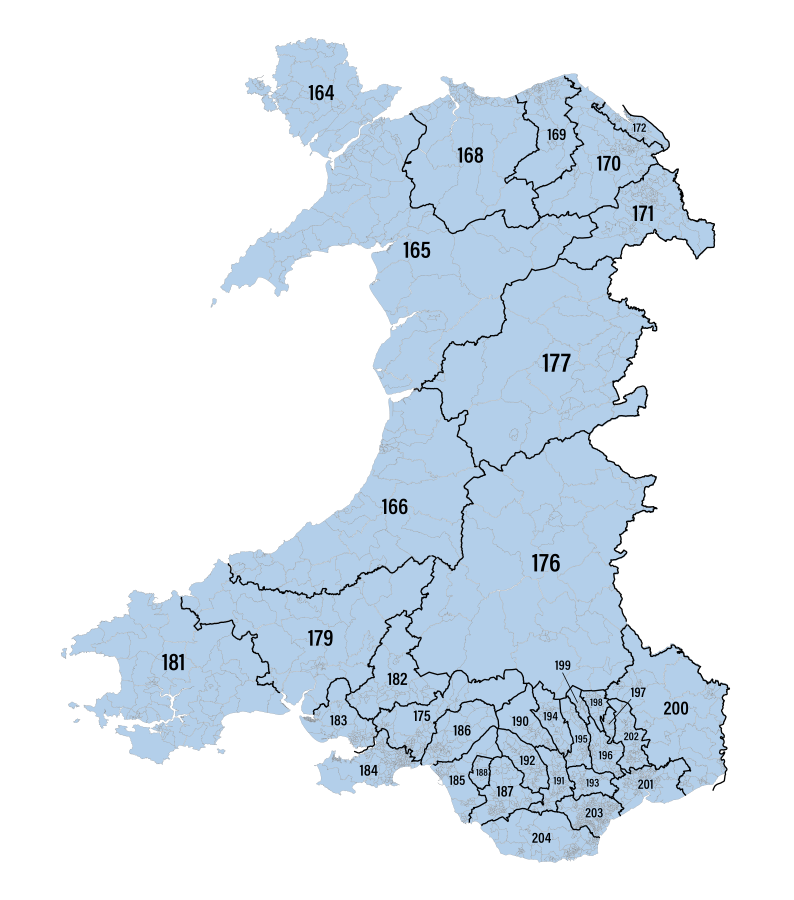
Description of figure 1: the map shows that the 35 resultant LHMAs are close to the current local authority areas, with subdivisions in several cases. Examination of 2001 ward level information on the LHMAs for Wales suggested that there was only one pair of authorities (Neath-Port Talbot and Bridgend) where there were substantial areas crossing LA boundaries, plus three larger ‘valleys’ type authorities where smaller HMAs representing different valleys were part of the system. In addition three large rural authorities were also split into more than one HMA.
Rental data for local authorities was used to approximate rental data for LHMAs using evidence on the relationship between rents and prices: variation in rents between areas was found to be in proportion to the variation in house prices raised to the power of 0.7. Mapping LHMAs onto LSOAs involved some approximation, since LHMAs were built from wards and some originally crossed the border with England.
The measure does not aim to capture variation in house prices between small areas within a given authority or city, nor does it attempt to capture the availability or supply of suitable housing. Instead, it reflects likely variation in household income and bedroom requirements at the small area level, alongside a threshold housing cost based on the wider housing market area. The aim is to estimate how likely it is that households in a small area can reasonably afford to buy or rent a suitable home within the broader market area.
While other datasets, such as House price statistics for small areas in England and Wales (ONS), focus on local price variation, this measure takes account of household circumstances and assumes that people may move a reasonable distance to find affordable housing.
For example, a household living in a relatively low-income neighbourhood may not be able to afford housing in their immediate area, but could potentially afford a suitable property in a nearby part of the wider housing market area. The measure reflects this by combining local income and household composition data with housing cost thresholds set at the broader market level, rather than attempting to capture fine-grained price differences between adjacent neighbourhoods.
Affordability thresholds and criteria
Whether for buying or renting, a household must pass two ratio-based affordability thresholds, one relating the ratio of house price or rent to income, and the other based on the ratio of residual net income after housing costs to a standard based on household basic requirements allowing for household composition. Criteria used in previous work were updated to account for academic analyses, market practices, and recent evidence on housing choices of key target groups.
Price/rent thresholds: The threshold price is based on the lower quartile of all sales within size groups (1, 2, 3 and 4+ bedroom) at Housing Market Area level, and similarly the lower quartile private market rent within size groups. The size criteria for affordability to buy includes a spare bedroom. For affordability to rent in the market the lowest size category included was one-bedroom.
Ratio of price/rent to income: For buying the ratio is a lending multiplier from gross income to maximum mortgage (4.0 for one earner 3.6 for 2 earners), whereas for renters it would be a ratio rent to net income of 30%.
For house purchase, it is assumed that a 95% mortgage would be taken out but allowance is also made for ‘excess’ savings (over £12,000) already held by the household to be contributed. Some households are enabled to buy thanks to large wealth transfers from parents or other relatives; the indicator makes no allowance for this. The chosen lending multipliers reflect recent practice and are consistent with the ratio of payment to net income of 30% with interest rates at around 4% and mortgage term of 30 years (different terms and multipliers would apply to older renters depending on age).
Ratio of residual income to basic requirement: For both tenures the residual income ratio is set at 1.4 times an amount derived from 90% of selected core budget items from the Minimum Income Standard (MIS).
Modelling sequence
The indicator is modelled using FRS data, as this has a large sample (with pooling of four years of data) and contains the most authoritative income and benefits data. The years of data used were financial years ending 2024, 2023, 2022 and 2020. Data for financial year ending 2021 is not considered sufficiently complete or reliable owing to Covid restrictions on survey fieldwork.
Estimation of incomes and affordability measures occurs in stages. First a model is built using certain variables in the FRS sample survey data to predict the measures of income and affordability. Then a dataset of equivalent predictor variables is created using Census and other sources. The predictive model parameters from the FRS analysis are then applied to generate predicted values for the incomes and affordability measures at LSOA level. These LSOA estimates are then adjusted for consistency using control values based on area types (whether in higher or lower priced regions) and local authority categories, applying an iterative fitting method.
At the final stage the individual LSOA controlled predicted values were checked for outliers or missing cases. In these cases, an alternative estimate would be generated using ‘affordability elasticities’ (generated within the FRS analysis) applied to price or rent differences from group averages.
The approach involves modelling incomes and affordability across England and Wales as a whole, with the same predictive functions applying to both as FRS sample numbers for Wales are not adequate to enable effective modelling for Wales alone. However, at the stage of controlling the estimates, predicted affordability rates are checked for consistency with the FRS micro estimates at the Wales level.
Limitations and considerations
Concealed households
The measure focuses on the income of the ‘first benefit unit’ in a household and excludes other adults in complex households. This means that concealed households (such as adult children or unrelated individuals living within a larger household) are not captured, even though they may face affordability barriers. Most new household formation takes place within the age range up to 40, so it is assumed that this group provides a broad representation of new households entering and becoming established in the housing system.
Private rent data
The rental data used is sourced at the local authority level, which limits the ability to reflect finer-grained variation in rents within authorities (and some of the LHMAs in use are smaller sub-divisions of local authorities). Reflecting wider evidence, rents are assumed to vary between HMAs within local authorities, proportional to the variation in house prices to a power of 0.7 Additionally, the data may underrepresent smaller landlords and exclude tenancies involving housing benefit, potentially skewing results away from the lower end of the market.
Housing market areas
Affordability thresholds for each LSOA are based on wider housing market areas (rather than individual neighbourhoods). This reflects the assumption that households may move a reasonable distance to access desired housing, but it means the measure does not capture very localised price differences.
Tenure and age focus
The indicators target younger households (under 40) and older private renters (aged 40 to 65), based on their relevance to housing policy. However, affordability challenges may also affect other groups not directly covered. The overall indicator does not account for variations in age distribution across areas of Wales, that is, the two indicators are combined into an overall measure using the same weighting for all small areas, 75% weighting for the younger group and 25% for older private renters. However, we will publish the indicator data for each component (by age and tenure) separately, allowing for further analysis if required.
Affordability thresholds
The measure uses two criteria: housing cost-to-income ratio and residual income after housing costs, based on updated evidence and modelling. While robust, these thresholds are still simplifications of complex household circumstances.
Sample size constraints
For older private renters, sample sizes in the FRS are relatively small, which limits the precision of estimates and required further grouping of areas to meet minimum reporting thresholds.