Initial teacher education: August 2022 to July 2024
Information about individuals on initial teacher education (ITE) courses that lead to qualified teacher status (QTS) for August 2022 to July 2024.
In this page
Introduction
This bulletin provides information about individuals training to be teachers at Welsh higher education providers, including the Welsh national centre of the Open University. Initial Teacher Education (ITE) courses that lead to Qualified Teacher Status (QTS) are the main route to becoming a teacher.
The primary source of data is the Higher Education Statistics Agency (HESA) student record. The HESA academic year begins on 1 August and ends on 31 July the following year. For example, the academic year 2023 to 2024 begins on 1August 2023 and ends on 31 July 2024.
The initial release of 2022 to 2023 and 2023 to 2024 data can be found in the Initial teacher education: August 2022 to July 2024 (headline results). The headline results release includes information about Welsh students and entrants studying in the UK, but changes to the HESA student record mean that further breakdowns are not readily available and have therefore not been included in this bulletin.
The combination of delays in receiving the HESA student data, data quality issues and a restructuring of the data have caused delays in ITE publications compared with previous years.
All numbers are based on a count of enrolments. The data primarily refers to students starting their course. These students are known as entrants. In rare cases where a student started two different ITE courses in the same academic year, they would be counted as two entrants. Data on entrants, students and qualifiers is available on StatsWales: Higher education.
Main points
- There were 1,405 ITE entrants in 2023 to 2024, 3% higher than in 2022 to 2023.
- There were 895 ITE entrants training to teach in primary school in 2023 to 2024, 2% higher than in 2022 to 2023.
- There were 505 ITE entrants training to teach in secondary school in 2023 to 2024, 4% higher than in 2022 to 2023.
- There were 80 ITE entrants from a Black, Asian and Minority Ethnic background (6% of ITE entrants whose ethnicity was known).
- There were 335 ITE entrants permanently addressed in Wales known to be fluent Welsh speakers in 2023 to 2024, 7% higher than in 2022 to 2023.
- There were 265 ITE entrants permanently addressed in Wales training to be able to teach in Welsh in 2023 to 2024, 13% higher than in 2022 to 2023.
- 13% of priority subject (excluding Welsh) entrants permanently addressed in Wales were training to be able to teach in Welsh in 2023 to 2024.
- There were 1,190 ITE qualifiers obtaining QTS in 2023 to 2024, 4% lower than in 2022 to 2023.
Policy context
Policy
Between 2005 to 2006 and 2013 to 2014, the Welsh Government aimed to reduce the number of people taking ITE courses, to better match the needs of schools in Wales. This was in response to a Review of Initial Teacher Training Provision in Wales. From September 2019 under new accreditation criteria, only PGCE programmes were accredited to deliver ITE for secondary education; no undergraduate programmes for secondary subject specialisms were submitted for accreditation by the ITE Partnerships.
Current recruitment priorities for ITE in Wales are:
- student teachers from diverse backgrounds including Black, Asian and Minority Ethnic students
- student teachers training for specific secondary subject specialisms. The subject specialisms are Biology, Chemistry, Design and Technology, Information Technology, Mathematics, Modern Foreign Languages (MFL), Physics and Welsh
- secondary subject specialism student teachers training to teach through the medium of Welsh
Initial Teacher Education Partnerships
In the 2023 to 2024 academic year, the following Initial Teacher Education Partnerships delivered accredited programmes of initial teacher education with QTS:
- CaBan - Bangor North Wales Partnership
- Yr Athrofa: Professional Learning Partnership (APLP)
- Cardiff Partnership
- Aberystwyth ITE Partnership
- University of South Wales ITE Partnership
- Swansea University Schools Partnership
- Open University Partnership
Allocations for the 2023 to 2024 academic year
For 2023 to 2024, the Education Workforce Council (EWC) set the allocations for ITE courses in Wales. Separate allocations were set for the Open University by the Welsh Government. The allocations are set for numbers of student teachers to teach at primary and secondary school levels, and for numbers of students studying postgraduate and undergraduate ITE degrees. Postgraduate and PGCE are often used to mean the same thing, despite subtle differences. See ‘Level of study or qualification’ in ‘Initial teacher education: definitions’ for more information.
| ITE phase | Postgraduate | Undergraduate | All |
|---|---|---|---|
| Primary | 379 | 252 | 631 |
| Secondary | 1,056 | 0 | 1,056 |
| All | 1,435 | 252 | 1,687 |
Source: Education Workforce Council (EWC) ITE allocations for 2023 to 2024
| ITE phase | Postgraduate | Undergraduate | All |
|---|---|---|---|
| Primary | 127 | 0 | 127 |
| Secondary | 93 | 0 | 93 |
| All | 220 | 0 | 220 |
Source: Welsh Government
| ITE phase | Postgraduate | Undergraduate | All |
|---|---|---|---|
| Primary | 506 | 252 | 758 |
| Secondary | 1,149 | 0 | 1,149 |
| All | 1,655 | 252 | 1,907 |
Source: Education Workforce Council (EWC) ITE allocations for 2023 to 2024 and Welsh Government
ITE entrants to Welsh higher education providers
Figure 1: entrants and intake allocations to ITE courses in Wales, academic year 2014 to 2015 to academic year 2023 to 2024
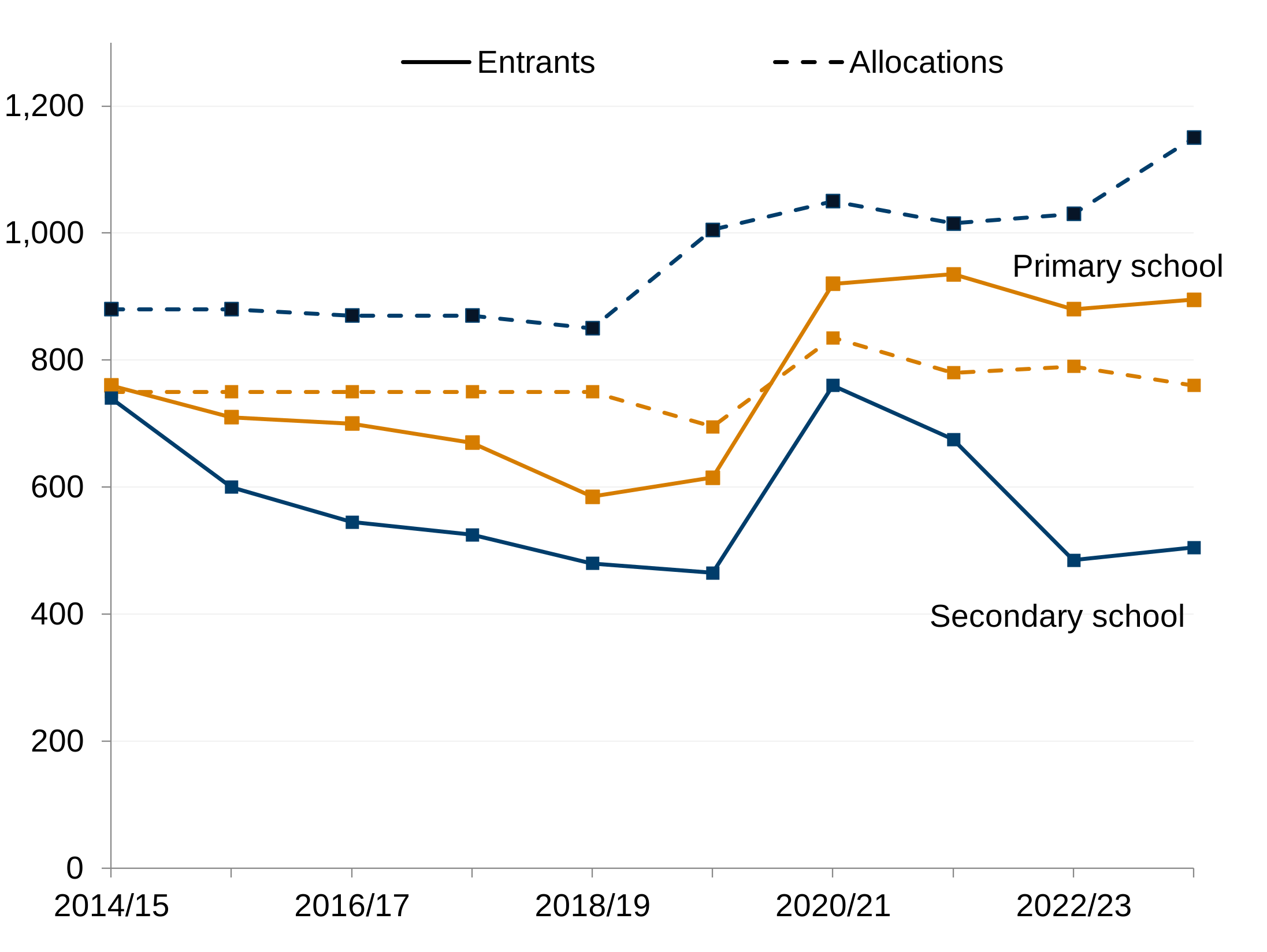
Description of figure 1: a line chart showing that entrants training to teach in primary school surpassed allocations for the fourth consecutive year. Entrant enrolments for secondary school have been lower than allocations since 2014 to 2015.
Source: HESA student record, Education Workforce Council (EWC) ITE allocations and Welsh Government
- There were 1,405 ITE entrants in 2023 to 2024, 3% higher than in 2022 to 2023.
- Of the 1,405 ITE entrants in 2023 to 2024, 87% were permanently addressed in Wales and 6% were permanently addressed elsewhere in the UK prior to enrolment.
- There were 895 ITE entrants training to teach in primary school in 2023 to 2024, 2% higher than in 2022 to 2023.
- The number of ITE entrants training to teach in primary school was 18% higher than the allocations in 2023 to 2024.
- There were 505 ITE entrants training to teach in secondary school in 2023 to 2024, 4% higher than in 2022 to 2023.
- The number of ITE entrants training to teach in secondary school was 56% lower than the allocations in 2023 to 2024.
The Open University began to offer the postgraduate certification in education (PGCE) in Wales in 2020 to 2021. There are two routes that can be taken when undertaking a PGCE at the Open University- the part-time route and the salaried route.
Some shorthand is used in this table, [r] = revised
| Postgraduate route | 2020/21 | 2021/22 | 2022/23 | 2023/24 |
|---|---|---|---|---|
| Salaried | 85 [r] | 90 [r] | 60 | 85 |
| Part time | 60 [r] | 70 [r] | 75 | 95 |
| Total | 140 | 160 | 135 | 180 |
[r] Previously published data on postgraduate entrant routes at the Open University in the 'Initial teacher education: September 2021 to August 2022' bulletin assigned the incorrect labels to the values. The salaried route was incorrectly treated as the part time route, and the part time route was treated as the salaried route.
Source: HESA student record
Personal characteristics of ITE entrants
Data quality on personal characteristics in the HESA student record, particularly from 2022 to 2023, impacts on how data is reported.
For sex, data quality issues identified by HESA mean that it is not appropriate to publish ‘Information Refused’, ‘Not Available’ and 'Other' separately. For the purposes of publication, they have been aggregated together as ‘Other or unknown’. For more information, see the HESA definition of sex.
Ethnicity data is only collected and reported for individuals permanently addressed in the UK prior to starting their course.
For sex, ethnicity and age, proportions are calculated using only records with known data. For disability, unknown responses and those recorded as ‘No known impairment’, ‘Prefer not to say’ or ‘Not available’ are grouped with records where the data is unknown and categorized as ‘No known disability’. This means disability figures show the proportion known to have a disability, and improvements in data completeness can affect year-on-year changes.
Data on ITE enrolments at Welsh higher education providers by age, disability status, ethnicity and sex is available on StatsWales: Initial teacher education enrolments at Welsh higher education providers by personal characteristics.
See the ‘Initial teacher education: Methodology and quality report’ for more information about the methodology and data quality in personal characteristics data.
Secondary school subject specialisms by sex are reported in Secondary school subject specialisms at Welsh higher education providers.
- Of ITE entrants whose sex was known, 75% (1,045) were females and 26% (355) were males.
- The sex gap in ITE entrants narrowed slightly from 2022 to 2023 (76% female and 24% male in 2022 to 2023)
- There were 250 ITE entrants aged 30 or above in 2023 to 2024 (18% of ITE entrants).
- The number of ITE entrants aged 30 or above in 2023 to 2024 was 5% lower than it was in 2022 to 2023.
- There were 260 ITE entrants were known to have a disability in 2023 to 2024 (18% of entrants).
- The number of ITE entrants known to have a disability in 2023 to 2024 was 20% higher than it was in 2022 to 2023.
- There were 80 ITE entrants from a Black, Asian and Minority Ethnic background (6% of ITE entrants whose ethnicity was known) in 2023 to 2024.
- The number of ITE entrants from Black, Asian and Minority Ethnic background in 2023 to 2024 was 77% higher than it was in 2022 to 2023.
ITE entrants and Welsh language
This section provides information about the Welsh language among ITE entrants to Welsh higher education providers, including Welsh speaker status and whether entrants were training to be able to teach in Welsh or not.
Individuals can train to be able to teach in Welsh by undertaking an ITE course that is designed to enable them to teach bilingually, whether or not this leads to formal certification. Teachers do not need to have undertaken this training to be able to teach in Welsh.
Only data on ITE entrants who were known to be permanently addressed in Wales is reported in this section. Data on Welsh language for individuals not known to be permanently addressed in Wales is available on StatsWales: Initial teacher education enrolments at Welsh higher education providers by bilingual teacher training status and Welsh speaker status.
In 2022 to 2023, there were substantial changes to the Welsh speaking ability data collected in the HESA student record due to the introduction of the Data Futures model of data collection. Welsh speaking ability data was therefore not completely comparable to data provided prior to 2022 to 2023. The quality of Welsh speaker status data was also impacted following the implementation of the Data Futures model. Given these issues, Welsh speaker status is reported as those known to be fluent in speaking Welsh, with all other categories, including where Welsh speaker status is not known, treated as not known to be fluent in speaking Welsh. This means Welsh speaker status figures show the proportion known to be fluent Welsh speakers, and improvements in data completeness can affect year-on-year changes.
A number of data quality issues were also identified in bilingual teacher training status across multiple years of historical data. Where potential issues with data quality were identified, they were corrected in this release. This means that data may not match previously published data.
See the ‘Initial teacher education: methodology and quality report’ for more information about the methodology and data quality in Welsh language related data.
Secondary school subject specialisms by Welsh speaker status and bilingual teacher training status are reported in Secondary school subject specialisms at Welsh higher education providers.
- There were 335 ITE entrants known to be fluent Welsh speakers in 2023 to 2024, 7% higher than in 2022 to 2023.
- There were 225 primary school phase ITE entrants who were known to be fluent Welsh speakers in 2023 to 2024.
- There were 110 secondary school phase ITE entrants who were known to be fluent Welsh speakers in 2023 to 2024.
- There were 265 ITE entrants training to be able to teach in Welsh in 2023 to 2024, 13% higher than in 2022 to 2023.
- Of the primary school phase ITE entrants in 2023 to 2024, 23% (180) were training to be able to teach in Welsh.
- Of the secondary school phase ITE entrants in 2023 to 2024, 20% (85) were training to be able to teach in Welsh.
Secondary school subject specialisms of ITE entrants
Individuals training to be secondary school teachers choose a subject to specialise in. For 2023 to 2024, the priority subjects were Biology, Chemistry, Design and Technology, Information Technology, Mathematics, Modern Foreign Languages (MFL), Physics and Welsh.
Subjects are measured in Full Person Equivalents (FPE). This means that if a course was focussed on a maths subject specialism half of the time, and physics the other half, they would show up as 0.5 enrolments in a maths specialism and 0.5 enrolments in a physics specialism.
See the ‘Initial teacher education: methodology and quality report’ for more information about the methodology and data quality in subject specialism related data.
Figure 2: secondary school phase ITE entrants by subject specialisms and sex, 2023 to 2024 [Note 1]
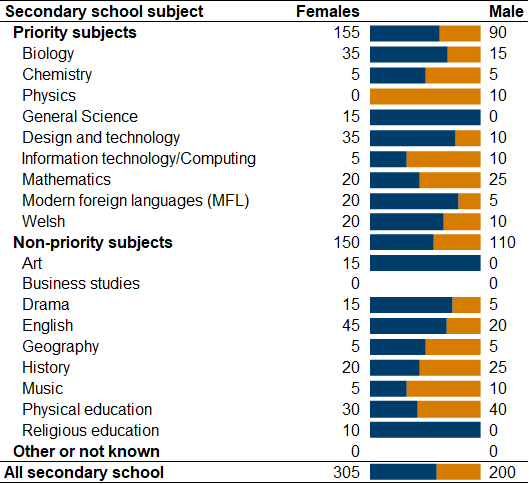
Description of figure 2: a bar chart showing that the majority of entrants training to teach in secondary school were females for both priority subjects and non-priority subjects.
Source: HESA student record
[Note 1] Bars are displayed as proportions calculated on rounded figures and may therefore be misleading.
- Of the priority subject specialisms for secondary school ITE courses, biology had the most entrants (50), while physics and chemistry had the fewest entrants (10).
- PE was the subject specialism with the highest number of male entrants (40), and English was the subject specialism with the highest number of female entrants (45).
Figure 3: secondary school phase ITE entrants permanently addressed in Wales by bilingual teacher training status, 2023 to 2024 [Note 1]
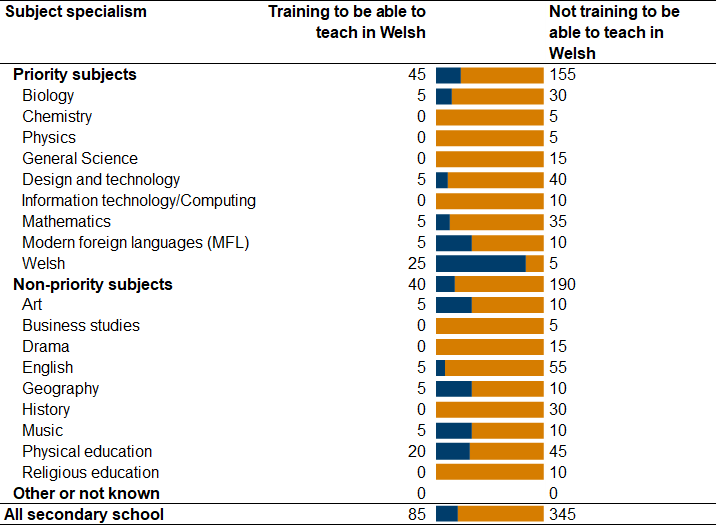
Description of figure 3: a bar chart showing that, of the priority subject specialisms, chemistry, physics, general science and information technology had no entrants training to be able to teach in Welsh.
Source: HESA student record
[Note 1] Bars are displayed as proportions calculated on rounded figures and may therefore be misleading.
Only data on ITE entrants who were known to be permanently addressed in Wales is reported in this section. Data on Welsh language for individuals not known to be permanently addressed in Wales is available on StatsWales: Secondary school initial teacher education enrolments at Welsh higher education providers by secondary school subject specialism.
- 13% of priority subject (excluding Welsh) entrants were training to be able to teach in Welsh in 2023 to 2024.
- 17% of non-priority subject entrants were training to be able to teach in Welsh in 2023 to 2024.
- Excluding Welsh, physical education had the highest number of entrants training to be able to teach in Welsh (20).
ITE qualifiers from Welsh higher education providers
Qualifiers are those who received a qualification from course in that year. All qualifiers’ data is based on a count of enrolments associated with the awarding of a higher education qualification. Only qualifiers who have successfully obtained a QTS qualification are included. In rare cases where an individual successfully obtained QTS for two different courses in the same year, they would be counted as two qualifiers. Data on ITE qualifiers from Welsh higher education providers is available on StatsWales: Initial teacher education enrolments at Welsh higher education providers by personal characteristics.
- There were 1,190 ITE qualifiers in 2023 to 2024, 4% lower than in 2022 to 2023.
- The number of ITE qualifiers was highest in 2021 to 2022 (1,325).
- There were 770 ITE qualifiers trained to teach in primary school in 2023 to 2024.
- The number of ITE qualifiers trained to teach in primary school was highest in 2022 to 2023 (790).
- 420 ITE qualifiers trained to teach in secondary school in 2023 to 2024.
- This was the lowest number of qualifiers trained to teach in secondary school since 2018 to 2019 (405).
Methodology and quality information
The primary source of data for most of the statistics is the HESA student record. From the 2022 to 2023 academic year, the HESA student record moved from the legacy format to the Data Futures model. This represented a substantial change to the structure, and resulted in substantial challenges to the timing and validation of data. Data quality issues were identified in the HESA student record for 2022 to 2023 and 2023 to 2024, some of which required corrections at a higher education provider level.
Due to the nature of the changes and the move from the legacy format to the Data Futures model, the methodology and definitions of the previous ITE releases were also reviewed. Data quality issues were identified with some of the data published in previous releases for academic years prior to 2022 to 2023, which were corrected in this release.
Welsh Government continues to work with Jisc and Medr to improve data quality over time. Where comparisons are made, they should be interpreted in the context of the quality and methodology information provided, which can be found in the ‘Initial teacher education: methodology and quality report’.
Official statistics status
All official statistics should show the standards of the Code of Practice for Statistics (UK Statistics Authority).
These are accredited official statistics. They were independently reviewed by the Office for Statistics Regulation (OSR) in December 2010. They comply with the standards of trustworthiness, quality and value in the Code of Practice for Statistics.
It is Welsh Government’s responsibility to maintain compliance with the standards expected of accreditation. If we become concerned about whether these statistics are still meeting the appropriate standards, we will discuss any concerns with OSR promptly. Accreditation can be cancelled or suspended at any point when the highest standards are not maintained, and reinstated when standards are restored.
Accredited official statistics (OSR) are called National Statistics in the Statistics and Registration Service Act 2007.
Statement of compliance with the Code of Practice for Statistics
Our statistical practice is regulated by the Office for Statistics Regulation (OSR). OSR sets the standards of trustworthiness, quality and value in the Code of Practice for Statistics that all producers of official statistics should adhere to.
All of our statistics are produced and published in accordance with a number of statements and protocols to enhance trustworthiness, quality and value. These are set out in the Welsh Government’s Statement of Compliance.
These accredited official statistics (OSR) demonstrate the standards expected around trustworthiness, quality and public value in the following ways.
Trustworthiness
These statistics are produced by Welsh Government statisticians in accordance with the Code of Practice for Statistics, ensuring independence, integrity, and transparency. Where delays or changes have occurred due to the transition from HESA’s legacy student record to Data Futures, these have been communicated openly to maintain trust. Where data quality issues have been identified, they have been highlighted in the ‘Initial teacher education: methodology and quality report’.
Quality
The transition from the HESA’s legacy student record to Data Futures introduced structural changes and data quality challenges. Welsh Government has worked closely with providers, Medr and HESA to improve data quality, applying validation checks to ensure the published figures are as accurate and reliable as possible. Where data quality issues have been identified, they have been highlighted in the ‘Initial teacher education: methodology and quality report’.
Value
The statistics in this bulletin are used both within and outside the Welsh Government to monitor trends in ITE provision at Welsh higher education providers. Some of the main users are:
- Welsh Ministers and the Research Service in the Senedd
- officials in the Welsh Government
- higher education providers and representative bodies
- students, researchers, and academics
- individual citizens, private companies, and the media
These statistics are used in a variety of ways. Some examples of these are:
- advice to Welsh Ministers
- to inform the education policy decision-making process in Wales
- to help model future supply and demand for teachers and inform ITE intake allocations
- to forecast future expenditure of student support schemes for Welsh domiciled students
You are welcome to contact us directly with any comments about how we meet these standards. Alternatively, you can contact OSR by emailing regulation@statistics.gov.uk or via the OSR website.
Well-being of Future Generations Act (WFG)
The Well-being of Future Generations Act 2015 is about improving the social, economic, environmental and cultural wellbeing of Wales. The Act puts in place seven wellbeing goals for Wales. These are for a more equal, prosperous, resilient, healthier and globally responsible Wales, with cohesive communities and a vibrant culture and thriving Welsh language. Under section (10)(1) of the Act, the Welsh Ministers must (a) publish indicators (“national indicators”) that must be applied for the purpose of measuring progress towards the achievement of the wellbeing goals, and (b) lay a copy of the national indicators before Senedd Cymru. Under section 10(8) of the Well-being of Future Generations Act, where the Welsh Ministers revise the national indicators, they must as soon as reasonably practicable (a) publish the indicators as revised and (b) lay a copy of them before the Senedd. These national indicators were laid before the Senedd in 2021. The indicators laid on 14 December 2021 replace the set laid on 16 March 2016.
Information on the indicators, along with narratives for each of the wellbeing goals and associated technical information is available in the Wellbeing of Wales report.
Further information on the Well-being of Future Generations (Wales) Act 2015.
The statistics included in this release could also provide supporting narrative to the national indicators and be used by public services boards in relation to their local wellbeing assessments and local wellbeing plans.
Contact details
Higher Education and Student Finance Statistics
Email: HigherEducationAndStudentFinance.Stats@gov.wales
Media: 0300 025 8099
SB 6/2026