
Additional learning needs (ALN): decision-making and communication
Guidance on making and communicating transparent, evidence-informed ALN decisions.
In this page
Introduction
This non‑statutory guidance is based on the provisions of the Additional Learning Needs and Education Tribunal (Wales) Act 2018 (‘ALN Act’). It supplements the statutory Additional Learning Needs Code for Wales (‘ALN code’).
It does not alter the principles or statutory requirements of the relevant legislation. Instead, it provides information to enhance understanding of the ALN Act and the ALN code.
The purpose of this guidance is to support maintained schools and local authorities in Wales to:
- gather comprehensive and robust information to make fair, consistent, and transparent decisions about whether a child or young person has ALN
- communicate clearly with children, young people and their families
It has been co-developed with local authorities and representatives from the education sector in response to the ALN legislative review. The review identified areas for improved clarity, consistency and understanding in the application of the ALN legislative framework.
Work is ongoing to increase national understanding of provision made generally across Wales.
This guidance may be updated or withdrawn at any time to reflect:
- changes in legislation
- policy developments
- emerging evidence of effective practice
Where the guidance says ‘parent’, this includes any person who is not a parent but who has parental responsibility for a child and any person who has care of a child.
Who this guidance is for
This guidance is primarily intended for local authorities and maintained schools in Wales.
The guidance may also be of interest to:
- other professionals supporting children and young people with ALN
- parents
- children
- young people
Relevant legislation and guidance
- Additional Learning Needs and Education Tribunal (Wales) Act 2018 (‘ALN Act’)
- The Additional Learning Needs Code for Wales 2021 (‘ALN code’)
- The Additional Learning Needs (Wales) Regulations 2021
- Curriculum and Assessment (Wales) Act 2021
- The ‘Enabling learning’ section of the Curriculum for Wales guidance
- The Curriculum for Wales: Progression Code
- Professional standards for all school practitioners
Making evidenced-informed decisions
This section sets out expectations for schools and practitioners to make professional judgements to:
- understand learner progress
- identify barriers
- adapt approaches so that all learners can access the curriculum
It also sets out the role of educators to collect evidence to understand if the learner is experiencing a significantly greater difficulty in learning across one or more of the 4 areas of need:
- communication and interaction
- cognition and learning
- behaviour, emotional and social development
- sensory and (or) physical
Chapter 20 of the ALN code provides guidance on determining whether a child or young person has ALN.
The process for making evidenced-informed decisions involves:
- evaluating progress
- enabling learning
- gathering evidence
- evaluating functional impact
Evaluating progress
The Supporting learner progression: assessment guidance outlines the key principles and purpose of assessment, designed to support learner progress. It provides guidance to:
- schools and settings
- pupil referral units (PRU)
- education other than at school (EOTAS) providers
It explains what they must consider when designing school level curriculum and assessment arrangements.
Assessment has 3 main roles in the process of enabling learner progression:
- supporting individual learners on an ongoing, day-to-day basis
- identifying, capturing and reflecting on individual learner progress over time
- understanding group progress to reflect on practice
The professional standards for teaching and leadership reinforce the expectation that schools and practitioners should use their professional judgement to:
- understand learner progress
- identify barriers
- adapt approaches so that all learners can access the curriculum
Professionals should evaluate the pace of progression, working with all learners, including those with ALN.
When considering the child or young person’s needs, it may become evident that they are making strong progress from their individual starting point. This reflects the learner’s strengths and the effectiveness of current provision.
Ensuring an inclusive curriculum is in place can support all learners to:
- participate
- progress
- have their needs met
Comparison alone is not an appropriate method for identifying ALN. Each learner will progress at their own pace. Schools and local authorities need to remain mindful that learners may progress:
- in a variety of ways
- at different points in the learning journey
- over different lengths of time
If a learner’s progress shows that they would benefit from further support, developmentally appropriate pedagogical approaches may be needed. These approaches should support progression and adapt to learners’ needs.
Enabling learning
Many children and young people will:
- have some difficulty in learning at some point in their education
- require a differentiated approach in some aspect of their education
If a learner’s progress is not adequate, it will be necessary to consider alternative action to enable learning. All education settings are expected to put in place differentiated teaching or other targeted interventions to secure better progress where appropriate, for all learners.
The Enabling learning guidance supports the design, planning and realisation of the Curriculum for Wales. This is to ensure that all learners can make progress in a developmentally and pedagogically appropriate way.
It reinforces that:
- enabling adults, engaging experiences and effective environments are essential to enabling learning
- an understanding of child development must underpin curriculum design
The guidance emphasises that observation, reflection and understanding of individual learners are vital parts of progression.
Pedagogical principles
- guide effective learning and teaching
- ensure that all learners can achieve their potential
- support educators in creating effective learning environments and experiences
The principles emphasise the importance of understanding how:
- learners learn
- to adapt teaching strategies accordingly
They are underpinned by an in-depth understanding of child and adolescent development.
The Curriculum for Wales progression code
The Curriculum for Wales: Progression code sets out how a curriculum must make provision for all learners. It ensures that:
- all learners receive a comprehensive and inclusive education
- practitioners understand how learners progress in their knowledge, skills and understanding over time
It emphasises the importance of personalised learning experiences to meet the diverse needs of all learners, including those with ALN. Those expectations are set out in the Curriculum for Wales.
Other services may also need to be involved in the child or young person’s life such as:
- educational psychologists
- education welfare services
- social services
- health bodies
Where progress continues to be less than expected, even after differentiated teaching or standard targeted interventions, this would usually indicate that the learner may have ALN.
Maintained schools should have clear processes for staff to raise concerns and seek further advice and support.
Gathering evidence
Identifying and deciding whether a child or young person has ALN requires evidence. This evidence helps practitioners to understand whether a learner has a learning difficulty across one or more of the 4 areas of need:
- communication and interaction
- cognition and learning
- behaviour, emotional and social development
- sensory and (or) physical
Practitioners should build a reliable, person-centred picture. They should use multiple sources of information over time to understand a learner’s difficulty. This will help determine whether this difficulty is significantly greater than the majority of learners of the same age.
Evidence and information will look different for every learner. It should be objective and contextualised, and show both:
- the area of difficulty
- how it affects learning and a learner’s ability to access the curriculum
Schools and local authorities in Wales are encouraged to take a holistic view. This includes recognising the close connection between:
- wellbeing
- mental health
- a child or young person’s ability to engage in learning
This is in line with the whole-school approach to emotional and mental well-being.
Schools and local authorities can build a comprehensive understanding of what may be affecting participation and progress by drawing on information from:
- families
- professionals
- the learner themselves
- considering both strengths and barriers
Evidence that could be included
- Information from the child, their parents or the young person.
- Information on child and adolescent development.
- Progress or attainment data.
- Educational psychologists’ assessments.
- Specialist teacher or therapist reports.
- School records (attendance and behaviour or attitude to learning data if relevant to learning barriers).
- Observations of the learner (including cognitive and relational observations).
- Records of existing support measures and their effectiveness.
- Evidence of a disability or condition affecting access to education.
- Health and social services professional input.
- Assessments from other agencies, such as health bodies.
This is not an exhaustive list.
Schools and local authorities should also consider whether the child or young person has any engagement with or support from:
- statutory services (education, health or social services)
- other agencies
- third sector organisations
In some cases, it might be necessary to get medical advice from a health body about the effect of a disability or medical condition. This can help identify:
- whether the learner has a disability or learning difficulty
- the nature of what disability or learning difficulty
- what provision the learner needs, which may include additional learning provision (ALP) (detailed in chapter 21 of the ALN code).
The school or local authority should involve relevant professionals as appropriate, when deciding whether the child or young person has ALN.
Evaluating functional impact
Assessing barriers to learning
To determine whether the learning difficulty creates a significant barrier to learning, consider:
- how the difficulty affects the learner’s ability to engage with and benefit from their learning environment
- the degree of any adverse effect caused by the difficulty
For example, if a learner requires aids to access learning, it may indicate a sustained and significant barrier to learning. This could include:
- specialised seating
- hearing devices
- assistive technology
If, despite high-quality teaching and support, the learner continues to experience persistent difficulty in engaging with and benefiting from the curriculum, this could meet the 2-stage test for ALN.
Medical diagnoses and ALN
A medical or neurodivergent diagnosis is not, in itself, sufficient to determine whether a child or young person has ALN.
The determining factor is whether the child or young person experiences a significant barrier to learning even when appropriate strategies and support, which are part of a school’s usual practice, are in place.
Therefore, a diagnosis does not automatically mean ALN. The focus should be on the child or young person’s functional needs and participation. The decision should not be based solely on diagnostic labels. This ensures that provision is tailored to the child or young person’s learning needs. It means applying a social model of disability rather than a medical one.
Identifying ALN
This section sets out expectations around the duty to decide whether a child or young person has ALN. It includes the importance of:
- acknowledging notifications of potential ALN
- understanding and applying the 2-stage test to identify whether a child or young person has ALN
Communication with the child, their parents or young person often starts when the school or the local authority becomes aware that a learner may have ALN. This notification or request can be initiated in various ways, including by:
- the child or their parent
- a young person
- a professional involved in their education or care
For children registered in a maintained school, the school will usually trigger the notification through its established monitoring and tracking processes.
Getting consent from learners aged 16 and over
For young people aged 16 years or above, both the school and local authority must get the young person’s consent before starting the process of identifying ALN.
What schools and local authorities must do to decide whether a learner has ALN
Where a maintained school or a local authority become aware that a learner may have ALN, they must decide whether the learner has ALN. This is unless any of the circumstances detailed in paragraph 12.2 or 12.3 of the ALN code apply.
The maintained school or local authority must:
- designate a person who will be responsible for coordinating the actions required to make the decision. If an individual development plan (IDP) is required, they will also be responsible for preparing it. This could be, but doesn’t have to be, the additional learning needs coordinator (ALNCo)
- record the date on which it is brought to its attention, or it otherwise appears, that the learner may have ALN
- record a summary of how the possibility that the learner has ALN has been brought to its attention or why it otherwise appears to it that the learner may have ALN
- notify the child, their parents or the young person that it is deciding whether the child or young person has ALN
- give contact details of the designated person at the school or local authority to the child’s parents or to the young person
- give the child’s parents or the young person information about how to access the responsible local authority’s information and advice arrangements about ALN and the ALN system
- offer an initial meeting with the child, their parents or the young person to discuss the process
- provide an indication of the likely timescale for the process (school: 35 school days and local authority: 12 weeks) (see paragraphs 12.5, 12.6 and 12.7 of the ALN code and the section on ALN timescales in this guidance provides further information)
Applying the legal test
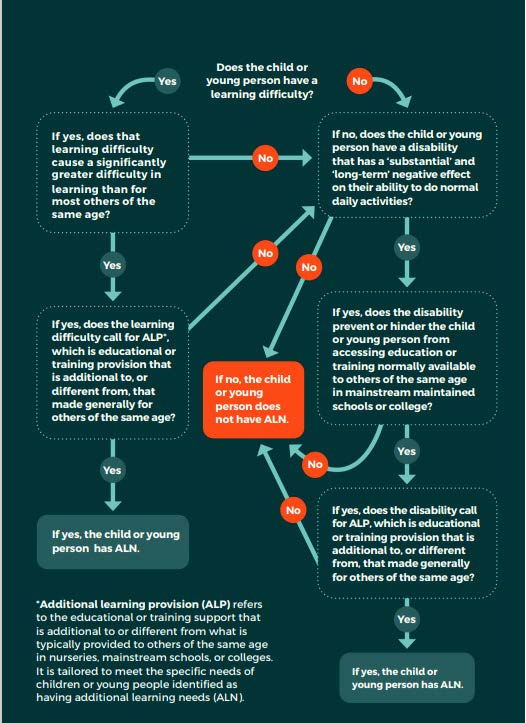
Maintained schools or local authorities must apply a 2-stage statutory test to determine whether a child or young person has ALN.
- Stage 1: determine whether the learner has a learning difficulty or disability.
- Stage 2: assess whether that difficulty or disability calls for additional learning provision (ALP). This means support that is additional to or different from what is made generally in mainstream education.
This 2-stage test is set out in Additional Learning Needs and Education Tribunal (Wales) Act 2018 (‘ALN Act’).
This process ensures that decisions are:
- consistent
- evidence-informed
- focused on the learner’s needs
‘Additional learning needs’ or ‘ALN’ has the meaning given by section 2 of the ALN Act, namely:
(1). A person has additional learning needs if he or she has a learning difficulty or disability (whether the learning difficulty or disability arises from a medical condition or otherwise) which calls for additional learning provision.
(2). A child of compulsory school age or person over that age has a learning difficulty or disability if he or she:
- (a) has a significantly greater difficulty in learning than the majority of others of the same age, or
- (b) has a disability for the purposes of the Equality Act 2010 (c. 15) which prevents or hinders him or her from making use of facilities for education or training of a kind generally provided for others of the same age in mainstream maintained schools or mainstream institutions in the further education sector.
(3). A child under compulsory school age has a learning difficulty or disability if he or she is, or would be if no additional learning provision were made, likely to be within subsection (2) when of compulsory school age.
Further information about this legal test can be found in the ALN code.
Only if both stages are met is the child or young person considered to have ALN under the ALN Act. If the legal definitions are not met:
- the child or young person is not considered to have ALN under the ALN Act
- the statutory ALN system does not apply
Other forms of support may still be appropriate.
It is crucial that schools and local authorities understand how to apply the legal definitions of ALN and ALP correctly when making decisions. A decision that a child or young person has ALN must be evidence informed and should follow this 2-stage test flow diagram.
Identifying whether a child or young person may have ALN and deciding whether or not they have ALN requires evidence. This evidence might come from:
- staff within the school
- other services which have been involved with the child or young person
- the child, their parents or the young person themselves
Stage 1
Stage 1: question 1
Does the learner have a significantly greater difficulty in learning than the majority of others of the same age?
Many children and young people may have some difficulty in learning at some point throughout their education. It is important to understand if this is a significantly greater difficulty. The level of significance must be clearly understood in relation to the specific learning difficulty that the child is experiencing.
‘Learning’ includes academic progress and access to and engagement with learning. It is important to consider access to learning across the 4 broad categories that are outlined in the ALN code to fully understand the learner’s difficulty:
- communication and interaction
- cognition and learning
- behaviour, emotional and social development
- sensory and (or) physical
To understand whether there is a significant difficulty in learning, practitioners should:
- observe and compare the learner’s progress
- identify barriers to accessing learning
This is across academic, social and emotional domains. A range of evidence may be used to inform an understanding of learner progress, including:
- attainment data
- observations of behaviour and engagement
Stage 1: question 2
Does the person have a disability (as defined by the Equality Act 2010) that prevents or hinders them from accessing education or training facilities generally available to others of the same age?
To answer this:
- Apply the legal definition
Determine whether the learner meets the definition of disability under the Equality Act 2010.
- Understand available facilities
Identify what facilities for education or training are generally provided for others of the same age in mainstream maintained schools.
- Assess impact
Decide whether the disability prevents or hinders the learner from making use of those facilities.
Stage 2
Stage 2: question 1
Does the learning difficulty or disability call for additional learning provision?
To answer this:
To determine whether a child or young person has ALN, the second stage of the ALN Act test asks whether their learning difficulty or disability calls for ALP.
For a person aged 3 or over, ALP is defined as:
“Learning or training provision that is additional to or different from that which is made generally for others of the same age in mainstream maintained schools in Wales.”
Key considerations
All maintained schools and settings should provide high-quality, accessible teaching and inclusive practices that cater for the diverse needs of all learners. This includes:
- high-quality teaching
- differentiated classroom teaching strategies
- targeted intervention designed to meet needs and secure better progress
- adopting a whole-school approach to mental health and emotional wellbeing
The Curriculum for Wales applies to learners aged 3 to 16 in maintained schools, settings and funded non‑maintained nursery education. It promotes inclusion by
embedding:
- equity
- accessibility
- learner‑centred practice
throughout:
- curriculum and assessment design
- teaching
- whole‑school culture
When considering whether provision is ‘additional to’ or ‘different from’ what is generally made available you are applying a national test. Work is ongoing to increase national understanding of provision made generally across Wales.
Therefore, any ALP must be compared against provision that is:
- made generally across Wales
- part of the general offer of high quality, differentiated classroom teaching
- for learners of the same age in maintained mainstream schools
It is not correct to compare against the provision in one school or local authority, even if that provision is high quality.
In many cases the ALP initially will mean that the child or young person’s needs are fully met. Only when progress continues to cause concern, is increased or different ALP likely to be needed. Some children and young people may gradually require less ALP if the interventions are a success (see the paragraph 20.24 of the ALN code).
Disabled children and young people
Where a child or young person is a disabled person under the Equality Act 2010, schools and local authorities have a duty to make reasonable adjustments where applicable. This duty is separate from the duties under the ALN Act. It applies whether or not a child or young person who is disabled has ALN.
If disabled children and young people do not meet the definition of ALN under the ALN Act, schools and local authorities must still consider what reasonable steps they can take, to avoid the substantial disadvantage these learners may experience compared to those who aren’t disabled.
If a learner meets the definition of ALN, reasonable adjustments can be considered as part of the overall consideration of what ALP should be put in place. However, it is important to remember that the duty to make reasonable adjustments and the duty to provide ALP derive from separate and distinct duties.
A failure to comply with the duty to make reasonable adjustments is disability discrimination. A detailed explanation of what constitutes a disability under the Equality Act 2010 and the duties owed to disabled persons under that Act is beyond the scope of this guidance. Information can be found on the GOV.UK website.
Transparent decisions and communication
This section sets out expectations around:
- informing children, their parents and young people of decisions clearly
- explaining the rationale
- what is being proposed
- the proposed way forward
- routes to reconsideration
- rights to appeal
Effective communication and engagement
Effective communication:
- builds trust
- ensures consistency between home and school
- supports a collaborative approach to meeting the child or young person’s needs
The ALN parent and carers toolkit
A Toolkit for parents and carers of children with additional learning needs is available to help parents and carers understand the:
- ALN system in Wales
- support available for children and young people
Links to the toolkit should be made available on school and local authority websites and used to support communication and engagement.
Person-centred practice
The child, their parent or the young person should be supported to participate as fully as possible in the decision-making processes.
Schools and local authorities should maintain open, clear, and regular communication with parents. This involves:
- using accessible jargon-free language
- providing timely updates on their child’s progress and support
Parents should be actively involved in discussions and invited to person-centred meetings so they can share their views and concerns.
Tools to support person-centred practice can be found online at:
- Person-centred reviews toolkit: guidance for education providers
- How to prepare for your person-centred review
- Person-centred practice in education
Transparent decision-making
The ALN Act places key duties placed on schools, local authorities and health bodies to ensure transparent decision making for children and young people with ALN. This approach promotes fairness and accountability. It provides children, their parents, and young people with the right to challenge decisions through:
- reconsideration by the responsible local authority
- appeal to the Education Tribunal for Wales (ETW)
This reinforces their entitlement to appropriate support.
All decisions about the identification, support and provision for learners with ALN must be communicated in a clear and accessible manner to the individual and their family. This transparency includes:
- outlining the reasoning behind each decision
- the evidence that informed it
- the intended outcomes
This ensures that families are fully informed and able to engage meaningfully in the process.
Children and young people also have the right to request and receive information about:
- how decisions were made
- what support is available
Local authorities must respond to these requests promptly and in an accessible format. This reinforces transparency and trust.
It is important that decisions made by school and local authority regarding ALN are clear, consistent and transparent. This includes:
- clear criteria: the responsible body should apply agreed-upon criteria to ensure fairness and consistency. They should be transparent about the nature and membership of decision-making panels
- documented rationale: each decision should include a written explanation outlining the evidence considered and the reasoning behind the outcome
- accessible communication: decisions should be communicated promptly and in an understandable format to learners, parents and professionals
- accountability and review: establish mechanisms for appeal and review to maintain trust and confidence in the process
Communicating decisions when ALN is not identified
If the maintained school or local authority decides that the child or young person does not have ALN, it must notify the child, their parent or the young person of:
- the decision
- the reasons for that decision
This may be discussed through a person-centred meeting. However, it is important that the parent also receives the decision in an accessible written format.
The written correspondence from school and local authorities must include:
- contact details of the school or the local authority, including the contact details of the designated officer
- information about how to access the responsible local authority’s arrangements for providing people with information and advice about ALN and the ALN system
- details of the responsible local authority’s arrangements for the avoidance and resolution of disagreements and its independent advocacy services
- information about the right to request the responsible local authority to reconsider the matter and contact for the responsible local authority
In addition, decisions made by the local authority must include:
- information about the right of appeal to the ETW
It is considered good practice to show and explain:
- the evidence used to make the decision
- how this aligns to the 2-stage test for ALN
Including the method used and details of the roles of any panel members involved.
The notification should also explain the actions the school will take to ensure that the needs of any child or young person (identified as not having ALN) are met. This could include describing and reassuring families of the provision made generally in the school and how this will support their child.
Communicating next steps
It is paramount that the support a child or young person receives at school is understood and explained in a way that children, their parents or young people can understand.
All practitioners should:
- form positive and respectful relationships with learners
- actively engage with parents and the wider community as partners in learning
Practitioners can explain that the Curriculum for Wales is underpinned by principles that:
- guide effective teaching and learning
- ensure that all learners can achieve their potential by adapting teaching strategies to best support learning
The expectations of good teaching and learning include:
- supporting social and emotional development and positive relationships
- employing a broad repertoire of teaching approaches
- promoting problem solving, creative and critical thinking
- building on previous knowledge and experience to engage interest
Practitioners should also emphasise that the child or young person’s needs and their progress will continue to be closely monitored. This will be reviewed, reported and discussed during progress reporting and scheduled parent consultations throughout the year.
Preparing, maintaining and issuing an individual development plan (IDP)
Where ALN is identified, an IDP must be prepared.
An IDP is a document that contains:
- a description of a child or young person’s ALN
- the ALP that is called for by the child or young person’s learning difficulty and disability
It also provides a record against which a child or young person’s progress can be monitored and reviewed.
An IDP only has value if it leads to real effective support that:
- meets the child or young person’s needs
- improves their outcomes
Everyone involved in creating and maintaining and IDP should keep this in mind.
Key elements and structure of an IDP
It is important that all IDPs contain certain key elements and follow the same basic structure. This helps to ensure:
- consistency and equity in how learners are supported
- fairness across schools and local authorities
- a cohesive ALN system
- portability of IDPs when learners move between schools or settings
Using the standard IDP form
Schools and local authorities must use the standard form set out in Annex A of the ALN code (there is a different form for looked after children). Although they must use the standard form, there is flexibility. They can adapt:
- length
- style
- visual appearance (for example adding a school or local authority logo)
- accessibility features such as larger or alternative fonts
For example, a child or young person with less severe or complex needs is likely to have a simpler and shorter IDP.
A child or young person with severe, or complex needs will often need specialist input and advice. Their IDP is likely to contain contributions from a wide range of agencies and detail a much wider range of interventions.
What information the IDP should include
Created through collaboration
The information in an IDP should be created by involving, where appropriate, agencies and professionals working together to identify:
- the child or young person’s ALN
- the provision to meet those ALN
It should be created through collaboration with the child, their parent or the young person.
Person-centred and flexible
The IDP should:
- be focused on meaningful person-centred outcomes
- be designed to ensure support
- tailor ALP to the individual, so they can achieve those outcomes
Written for the learner
Schools and local authorities should write the IDP:
- in a style that shows that it belongs to the child or young person and is not just part of an administrative process
- using a style and, where possible language, to reflect the age of the child or young person
- so that it clearly distinguishes between what has been said by the child or young person and what has not
- in plain language (whether that is Welsh or English or both), avoiding the use of jargon
- explaining the relevance of any technical terminology that needs to be included, so that everyone who reads the IDP is able to understand it, including, whoever possible, the child or young person
Where appropriate, the IDP may be prepared, reviewed and revised at the same time as another document or plan relating to the child or young person is prepared, reviewed or revised.
Further information on writing the IDP can be found in chapter 23 of the ALN code.
Resolving disputes, reconsiderations and rights to appeal
This section sets out expectations around informing children, their parents and young people about:
- access to support to avoid and resolve disputes
- routes to local authority reconsideration
- rights to appeal to the Education Tribunal for Wales (ETW)
Avoiding and resolving disputes
Disagreements may arise when children, their parents or young people are dissatisfied about an ALN or ALP decision.
What local authorities must do to avoid or resolve disagreements at the earliest opportunity
- Promote and clearly communicate the arrangements for avoiding and resolving disputes and ensure they are delivered free of charge.
- Publish clear and accessible information about the arrangements on their websites. This should help children, their parents and young people to understand the arrangement, for example by using plain language.
- Published information should include how to access these arrangements, such as providing a point of contact, a telephone number or email address.
- Provide appropriate training and development so that staff delivering the arrangements fully understanding the ALN system, and their impartial role in the process.
- Enable children to access dispute arrangements separately from their parents, when requested.
- Provide for a representative to take part on behalf of the child’s parent or a young person who lacks capacity at the relevant time.
- Concerns related to NHS care or treatment
If a child, their parent or a young person has concerns about their care or treatment, they should be encouraged to talk to the healthcare staff involved. Staff will try and resolve their concerns as quickly as possible. If this does not help, or they do not want to speak to the staff, they can contact the health board or trust’s complaints team.
If they want to make a formal complaints about NHS care, treatment or dissatisfaction with NHS Wales, they should use the ‘Putting Things Right’ formal complaints procedure for NHS services in Wales.
Local authority reconsiderations and rights to appeal
If a child, their parents or a young person are:
- dissatisfied or disagree with the decision of a maintained school about whether the child or young person (who is registered at the school) has ALN
- dissatisfied with an IDP maintained by a school
there will be times when this is not resolved with the school.
When this happens, the child, their parents or the young person can ask the responsible local authority to reconsider decisions that relate to the:
- school’s decision on whether the child or young person has ALN
- content of an IDP maintained by a school with a view to it being revised
- local authority taking over responsibility for an IDP that is currently being maintained by the school
In these circumstances, schools should:
- advise children, their parents and young people that any request for reconsideration should be made directly to the responsible local authority
- provide information on how to contact the local authority
Families can find the relevant local authority ALN webpages by using the search tool. They can then contact the local authority directly to submit their request for reconsideration.
Schools should:
- advise families to include all relevant correspondence and decision letters as part of their request
- provide copies of documents to support the request
Following the request, the local authority must inform:
- the child (or their parent) or young person of the request, and invite representations (if the school have made the request)
- the school of the request and invite representations (where the request is from a child, their parent or a young person)
The local authority should make its decision promptly. They must do this within 7 weeks of receiving the request, unless circumstances beyond its control prevent this.
Communicating decisions and rights to appeal
Local authorities must clearly explain their decisions to the child, their parent or the young person. All decisions and reasons for the decisions must be provided in writing. The written correspondence from a local authority must include:
- contact details for the local authority
- information on how to access advice about ALN and the ALN system, including details of the local authority’s information and advice services
- details of the local authority’s arrangements for avoiding and resolving disagreements, including how to access independent advocacy services
- information about the rights to appeal to the ETW
A child, their parent or a young person can appeal to the ETW. They may appeal if they disagree with:
- the outcome of a local authority’s reconsideration of a school’s decision on ALN
- the contents of an IDP
- taking over responsibility for maintaining a school IDP
Information about the right to appeal a decision to the ETW must be included in the written correspondence.
Appealable decisions to the Education Tribunal for Wales (ETW)
The ETW hears and decides appeals about the decisions of a local authority in Wales.
The ETW hears and decides appeals and applications in relation to children and young people which have or may have ALN. The ETW is independent of:
- government
- local authorities
- schools
- further education institutions
Its decisions are legally binding.
Chapter 33 of the ALN code explains appeals and applications to the ETW. Further information can be found on the ETW website. This includes:
- advice and guidance on the appeal process
- the procedures that must be followed
Matters which can be appealed
A child, their parent or a young person may appeal to the ETW about:
- a local authority’s decision as to whether the child or young person has ALN
- in the case of a young person, a local authority’s decision as to whether it is necessary to prepare and maintain an IDP
- the description of a person’s ALN in an IDP
- the ALP in an IDP, or the fact that ALP is not in an IDP, including whether the IDP specifies the ALP should be provided in Welsh
- the provision included in an IDP by a local authority under sections 14(6) or 19(4) of the ALN Act, or the fact that provision under those sections is not in an IDP
- the school named in an IDP for the purpose of admitting a child or young person to a named institution, or if no school is named in an IDP for the purpose of admission
- a decision by the local authority not to revise an IDP where the local authority has been asked by a child, their parent or a young person to reconsider an IDP maintained by a maintained school
- a decision by the local authority not to take over responsibility for an IDP, which is maintained by a school, where it is requested to do so by a child, their parent, a young person or the governing body of that school
- a decision to cease to maintain an IDP
- a refusal to decide a matter on the basis that there is not a material change in needs or no new information that materially affects the decision
ALN decision-making timescales
The table provides a high-level summary of the duties and expectations set out in the ALN code.
Contact details
Additional Learning Needs Reform Branch
Support for Learners
Education Directorate
Welsh Government
Cathays Park
Cardiff
CF10 3NQ
email: additionallearningneedsbranch@gov.wales