
Use this guidance to check if building work to an existing building brings it under the higher-risk building regime in Wales.
Contents
Introduction
This guidance sets out the criteria for a building to be considered a higher-risk building during building work in an existing higher-risk building. This includes building work to an existing building which will make it a higher-risk building (for example adding storeys) or for a building undergoing a change of use. Higher-risk buildings are subject to the requirements of the new higher-risk regime set out in the Building (Higher-Risk Buildings Procedures) (Wales) Regulations 2025 overseen by local authorities.
Higher-risk buildings during building work in an existing building are specified for the design and construction phase of building work, in the Building Safety (Description of Higher-Risk Building) (Design and Construction Phase) (Wales) Regulations 2023 (“the Regulations”).
Higher-risk buildings are buildings with at least one residential unit, children’s homes, care homes, or hospitals which are at least 18 metres in height or have at least 7 storeys. Some types of buildings are excluded from being a higher-risk building, such as those comprised entirely of hotels, secure residential institutions and military barracks or other Ministry of Defence accommodation.
This definition does not amend definitions of higher-risk buildings in other legislation. For example, the definition of similar buildings in occupation in the Building Safety (Wales) Act 2026.
This guidance document includes the relevant text from the 1984 Act and from the Regulations with explanations and diagrams. It is a tool to help potential dutyholders (i.e., the client, designer, principal designer, contractor, and principal contractor) and accountable persons determine if their building is a higher-risk building. This guidance should be used with other guidance covering buildings, height measurements and/or storey measurements to determine whether the definition of higher-risk building set out in law applies to your building. This guidance and the specific circumstances of your building need to be considered by you when discharging your duties under building regulations.
In addition to becoming a higher-risk building under the Regulations, your building may also be subject to other legislation and statutory duties, such as the Regulatory Reform (Fire Safety) Order 2005. You will need to work with the relevant dutyholders in the building to ensure it is safe.
Diagrams in this guidance document show examples of potential buildings and are for illustrative purposes only. You will need to consider the legislation carefully to understand whether you are responsible for a higher-risk building in scope of the higher-risk regime. You may wish to seek legal advice on this.
The definitions of key terms in this guidance can be found in the Glossary.
Guidance for understanding whether your building is a higher-risk building during building work in an existing building
Key criteria to consider when determining if a building is higher-risk includes:
- Use criteria: What is my building used for? Does it meet any of the included or excluded categories of building?
- Legal definition of building: How does the reference to a building (including a structure) in the Regulations apply to my building structure?
- Height and storeys: How do the methods for measuring height and calculating storeys in the Regulations apply to my building? Does my building meet either the 18-metre or 7-storey height threshold when using these methods?
You will need to consider all 3 criteria.
Use criteria
To be considered a higher-risk building during building work in an existing building, a building must meet a certain set of use criteria. This is in addition to meeting the height or storeys threshold.
If a building meets the height or storeys threshold and contains at least one residential unit, is or contains a hospital, a care home or a children’s home, then it is a higher-risk building. This applies unless the entire building is used as a secure residential institution, hotel, or military barracks, or if the building contains any living accommodation provided by the Ministry of Defence for military personnel. These buildings are explicitly excluded.
Use criteria for buildings during building work in an existing building under the Building Act 1984 and the Building Safety (Description of Higher-Risk Building) (Design and Construction Phase) (Wales) Regulations 2023
Section 120I of the Building Act 1984 sets out the buildings which are included in the design and construction part of the higher-risk regime.
120I. Higher-risk buildings and higher-risk building work: Wales
(2) “Higher-risk building” means a building of a description specified in regulations made by the Welsh Ministers.
(3) “Higher-risk building work” means any work relating to a higher-risk building or a proposed higher-risk building, including—
- any work relating to a building that is not a higher-risk building that causes it to become such a building, and
- any work relating to a higher-risk building that causes it to cease to be such a building.
Regulation 3 of the Building Safety (Description of Higher-Risk Building) (Design and Construction Phase) (Wales) Regulations 2023 specifies the buildings which are included in the design and construction part of the higher-risk regime.
3. A higher-risk building for the purposes of section 120I(2) of the Building Act 1984 is a building (including a structure) that
- is
- at least 18 metres in height (when measured in accordance with regulation 4), or
- has at least 7 storeys (when calculated in accordance with regulation 5), and
- at least 18 metres in height (when measured in accordance with regulation 4), or
- contains
- at least one residential unit,
- a hospital that has at least one bed intended for use by a person admitted to the premises for an overnight stay,
- a care home, or
- a children’s home, and
- is not an excluded building
Regulation 6 sets out the buildings which are excluded from the design and construction part of the higher-risk regime.
6. A building is an excluded building if it
- is comprised entirely of
- a secure residential institution,
- a hotel,
- military barracks,
- living accommodation provided by the Ministry of Defence, or
- living accommodation for
(aa) His Majesty’s forces, or
(bb) any visiting force or international headquarters or defence organisation designated for the purpose of the International Headquarters and Defence Organisations Act 1964;
- comprises residential and non-residential uses, in which all the living accommodation is provided by the Ministry of Defence.
This means that buildings proposed to be mixed-use buildings are subject to the requirements of the higher-risk regime. For example, if a building contains a shopping centre but also has one or more residential units, then it is a higher-risk building, provided it meets the height or storeys threshold. Buildings which are boarding accommodation in schools and university accommodation are also considered to be higher-risk buildings, provided they meet the height or storeys threshold for a higher-risk building, and contain residential units.
Buildings that contain supported and sheltered accommodation are considered higher-risk buildings if they meet the height or storeys threshold, as they contain residential units. Examples of supported and sheltered accommodation which we consider could fall under the higher-risk regime include domestic abuse refuges, and supported or sheltered homes for older people and those with additional care needs.
Residential unit
A residential unit is a dwelling or any other unit of living accommodation and is defined in regulation 2 of the Regulations.
Examples of what we consider a residential unit are include a flat, a studio flat, a home of multiple occupation, shared accommodation within university halls (e.g. a bedroom with shared kitchen and bathroom) or a room in a hostel.
A residential unit can be found within any type of building and could have any tenure. Privately owned, private rented and social rented units are all considered residential units under the higher-risk regime.
Care homes, children’s homes and hospitals
Care homes are places which provide care home services to people wholly or mainly aged 18 or over. Generally this will be accommodation, together with nursing or personal care, at a place in Wales for people because of their vulnerability or need.
Children’s homes are places which provide care home services or secure accommodation services to people wholly or mainly aged under 18. Generally this will be accommodation, together with nursing or personal care, at a place in Wales for people because of their vulnerability or need (care home services), or the provision of accommodation for the purpose of restricting the liberty of children at residential premises in Wales where care and support is provided to those children (secure accommodation services).
However, children’s homes do not include further education institutions or accommodation provided for holidays, or leisure, recreational, sporting, cultural or educational activity (where a person aged under 18 is accommodated for more than 28 days in any 12 month period).
For detail of the definitions of care home services and secure accommodation services can be found in Schedule 1 to the Regulation and Inspection of Social Care (Wales) Act 2016.
Hospitals are institutions for receiving and treating those who are ill, convalescing or need medical rehabilitation, or a maternity home.
Buildings used for receiving and treating those who are ill, convalescing or need medical rehabilitation, or a maternity home without at least one bed for an overnight stay are not considered hospitals under the higher-risk regime. For example, a general practitioner surgery which does not allow overnight stays would not meet the definition of a hospital for the purpose of the Regulations.
Exclusions
Secure residential institutions
Buildings used entirely as secure residential institutions are excluded from the higher-risk regime. Secure residential institutions include prisons, young offenders’ institutions, detention centres, secure training centres, custody centres, short-term holding centres, secure hospitals or secure local authority accommodation for people aged 18 or over.
Hotels and other serviced accommodation
Buildings used entirely as hotels are excluded from the higher-risk regime. Hotels will not generally contain any residential units, instead providing overnight accommodation for customers who stay for the purpose of leisure or business.
We consider hostels which provide overnight accommodation to customers for leisure or business similar to hotels and so if a building is used entirely as this type of hostel, then it is not considered a higher-risk building. Hotels are excluded regardless of how long these buildings are occupied by individuals or groups of customers.
Serviced apartments do not fall within the meaning of hotel and we consider are higher-risk buildings if they meet the height or storeys threshold.
We consider a short-term let (for example, a short-term rental property let online) is a residential unit. If there was another residential unit within the building and the height or storeys threshold was met then the entire building, including the short-term let property, is considered a higher-risk building.
Military premises
Buildings used exclusively as military barracks are excluded from the higher-risk regime.
Buildings which contain any living accommodation either for His Majesty’s forces, any visiting forces or an international headquarters or defence organisation are also excluded.
Counting storeys and measuring height
For a building to be a higher-risk building it will meet either the height or storeys threshold – it does not need to meet both (although it may). The height threshold is set at 18 metres or higher. The storeys threshold is set at 7 storeys or more.
If a building meets the 7-storey threshold and meets the use criteria set out in this guidance, it is a higher-risk building and does not need to be measured against the height threshold. If a building is 18-metre in height and meets the use criteria, then it is a higher-risk building and does not need to meet the storeys threshold.
If a building does not meet either of the 18-metre or 7-storey height thresholds (for example, it is 17 metres and six storeys in height), then it is not a higher-risk building, regardless of whether it meets the use criteria.
Prescribed method for measuring height and calculating storeys in the Building Safety (Description of Higher-Risk Building) (Design and Construction Phase) (Wales) Regulations 2023.
Regulation 4 sets out the method for measuring height:
(1) The height of a building is to be measured from ground level to the top of the floor surface of the top storey of the building.
(2) But any storey which is a roof-top machinery or roof-top plant area or consists exclusively of roof-top machinery or roof-top plant rooms is to be ignored.
Regulation 5 sets out the method for calculating storeys:
(1) The number of storeys a building has is to be calculated at the position that gives the greatest number of storeys, subject to—
(a) any storey that is below ground level is to be ignored;
(b) any storey which is a roof-top machinery or roof-top plant area or consists exclusively of roof-top machinery or roof-top plant rooms is to be ignored;
(c) any mezzanine floor is to be regarded as a storey if its internal floor areas is at least half of the internal floor area of the largest storey in the building that is not below ground level.
(2) A storey is below ground level if the finished surface of the ceiling of the storey is below ground level.
Regulation 2 defines ground level for these Regulations.
“ground level” (“lefel y ddaear”), in relation to a building, means—
(a) where the level of the surface of the ground on which the building is situated is uniform, the level of the surface of the ground immediately adjacent to the building, or
(b) where the level of the surface of the ground on which the building is situated is not uniform, the level of the lowest part of the surface of the ground immediately adjacent to the building.
Storeys should be calculated from the storey at ground level to the top storey. Height should be measured from ground level to the top of the floor surface of the top storey of the building. The method set out in this guidance should be used when determining whether your proposed building is a higher-risk building, rather than methods set out in other documents.
Ground level
When calculating storeys and measuring height you should measure from ground level. You will need to carefully consider where ground level is for your building. There may be situations in which small spaces have been created adjacent to the building below the level of normal ground floor access such as lightwells. It is unlikely to be appropriate to consider such areas for the purpose of identifying ground level.
If the building being measured sits on uniform flat ground, then ground level is the surface of the ground which is directly adjacent to the building. This is demonstrated in Diagram 1.
When calculating storeys, any storeys which are below ground level should not be counted. A storey is considered below ground level and should not be counted if the storey’s finished surface of the ceiling is below ground level for the building. Similarly, when measuring height, parts of the building which are below ground level are not measured. Measurements always start from the ground level. This is demonstrated in Diagram 1.
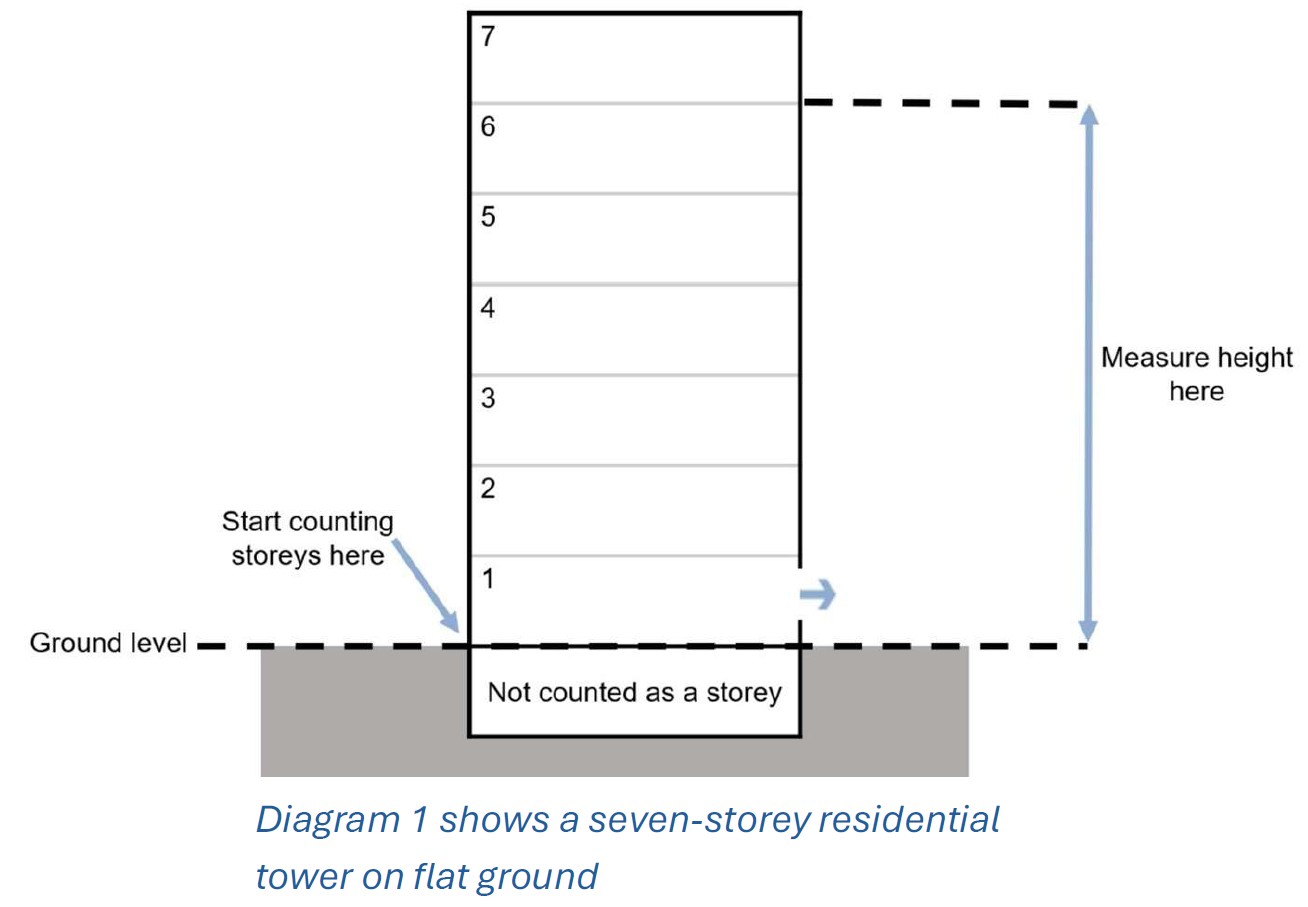
Diagram 1 shows a 7-storey residential tower on flat ground.
For the type of building shown in Diagram 1, storeys should be calculated from the first storey above ground level, as indicated by the arrow on the left. The storey below ground level should not be counted. Height should be measured from ground level to the floor surface of the top storey, as indicated by the arrow on the right.
For the building shown in Diagram 1, based on the method for calculating storeys in the Regulations, this structure would have 7 storeys.
When calculating storeys and measuring height, if the building being measured sits on uneven ground (for example, a sloping area), then ground level is the lowest part of the surface of the ground immediately adjacent to the building. This is demonstrated in Diagram 2.
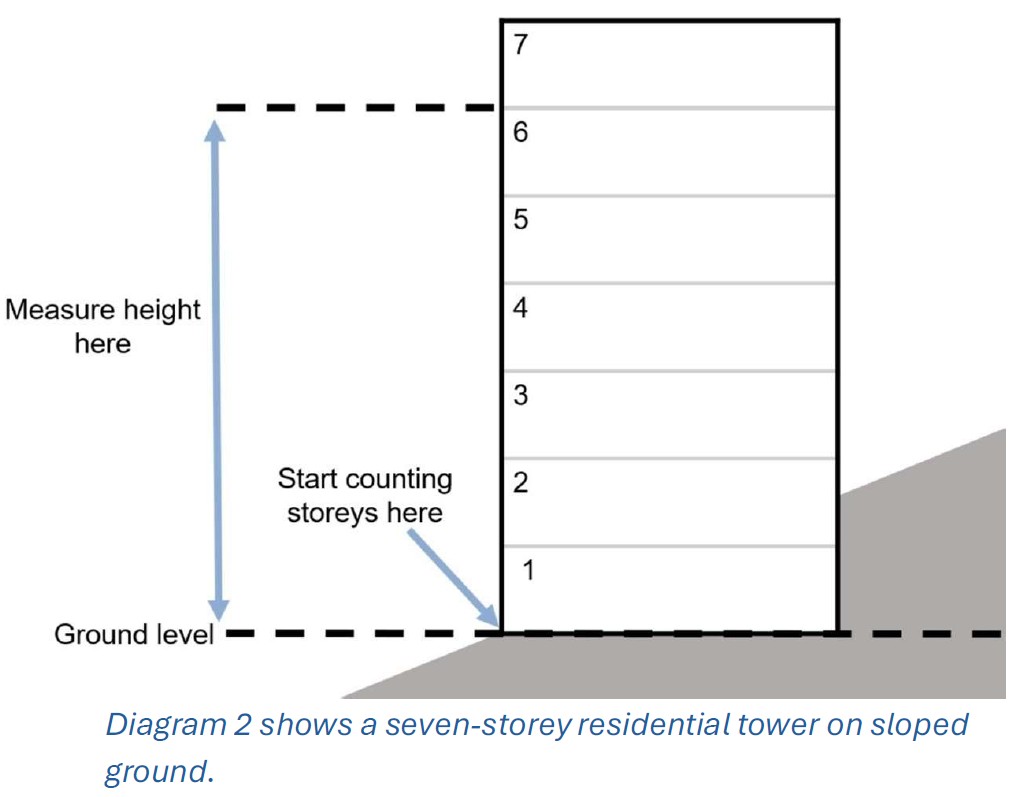
Diagram 2 shows a 7-storey residential tower on sloped ground.
In this example, based on the method for calculating storeys in the Regulations, this structure would have 7 storeys
Roof-tops
When calculating storeys, any storeys which contain exclusively rooftop machinery or rooftop plant rooms should not be counted. Rooftop machinery is considered to be machinery which provides services to the building (for example, an air-conditioning system). Plant rooms are considered areas which contain machinery or equipment that provides services to the building. Only rooftop plant rooms and areas made up exclusively of rooftop machinery are excluded – for example, if floor three of a 7-storey building contained exclusively plant rooms and machinery, it should still be counted as a storey.
When measuring the height of a building, the building should be measured up to the top of the floor surface of the top storey, that is not exclusively rooftop machinery or plant rooms. This is demonstrated in diagram 3.
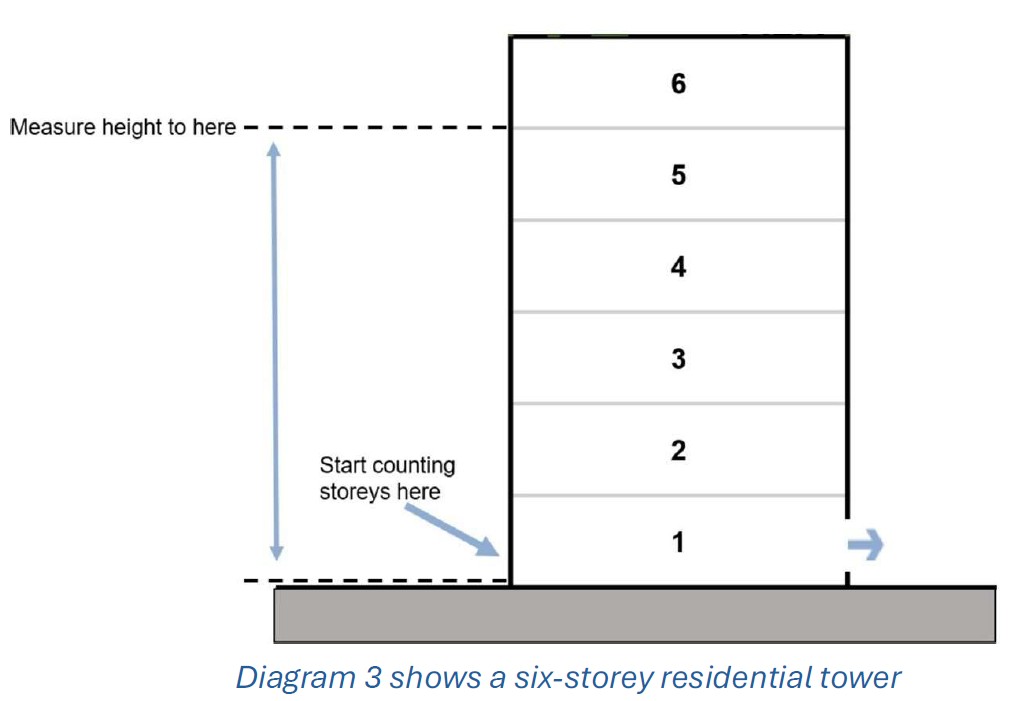
Diagram 3 shows a 6-storey residential tower.
In this example, height should be measured to the proposed floor surface of the top storey, as indicated by the arrow. Storeys should be counted from the first storey above ground. The proposed building in Diagram 3 has 6 storeys.
If the top storey is exclusively rooftop machinery or plant rooms, then the height of the building should be measured to the top floor surface of the storey below. This is demonstrated in Diagram 4.
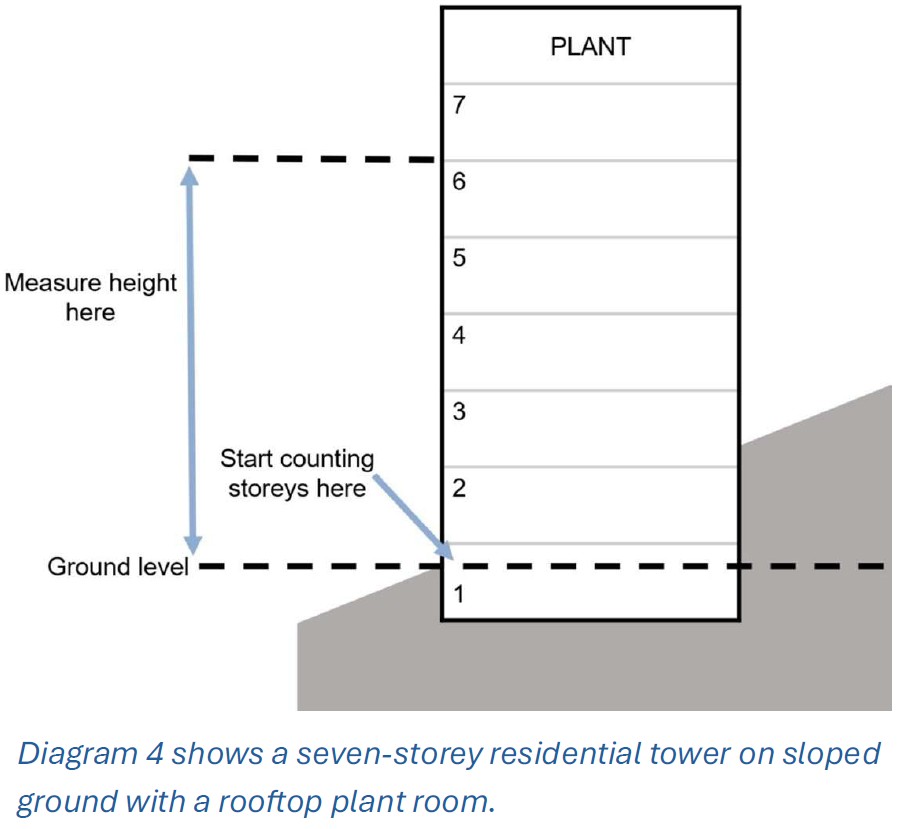
Diagram 4 shows a 7-storey residential tower on sloped ground with a rooftop plant room.
In this example, height should be measured from ground level to the floor surface of the top storey, which is not a plant room, as indicated by the arrow. Storeys should be calculated from the first storey above ground. The first storey in this building would not be considered below ground level as no part of its finished ceiling is below ground level for the overall building.
Based on the method for calculating storeys in the Regulations, this building is considered 7 storeys and is a higher-risk building as it contains one or more residential units.
Gallery floors
Some buildings may have gallery floors. Gallery floors may also be known as mezzanines (as referenced within the Regulations). A mezzanine is an internal area within a building. Mezzanines are considered intermediate areas that do not cover the whole length of the building between two main storeys.
Gallery floors should only be counted as a storey if the internal floor area of the gallery floor is at least 50% of the internal floor area of the largest above-ground storey . Once a gallery floor meets the 50% threshold, it will become a storey and should be calculated as such. For example, if a gallery floor, forming the third storey of a building, has an internal floor area half the area or more of the largest other storey, then this gallery floor should be counted as a separate storey. If the gallery floor is smaller than half the area of the largest storey, then it should not be counted as a separate storey. An example of how gallery floors should be counted is given in Diagram 5.
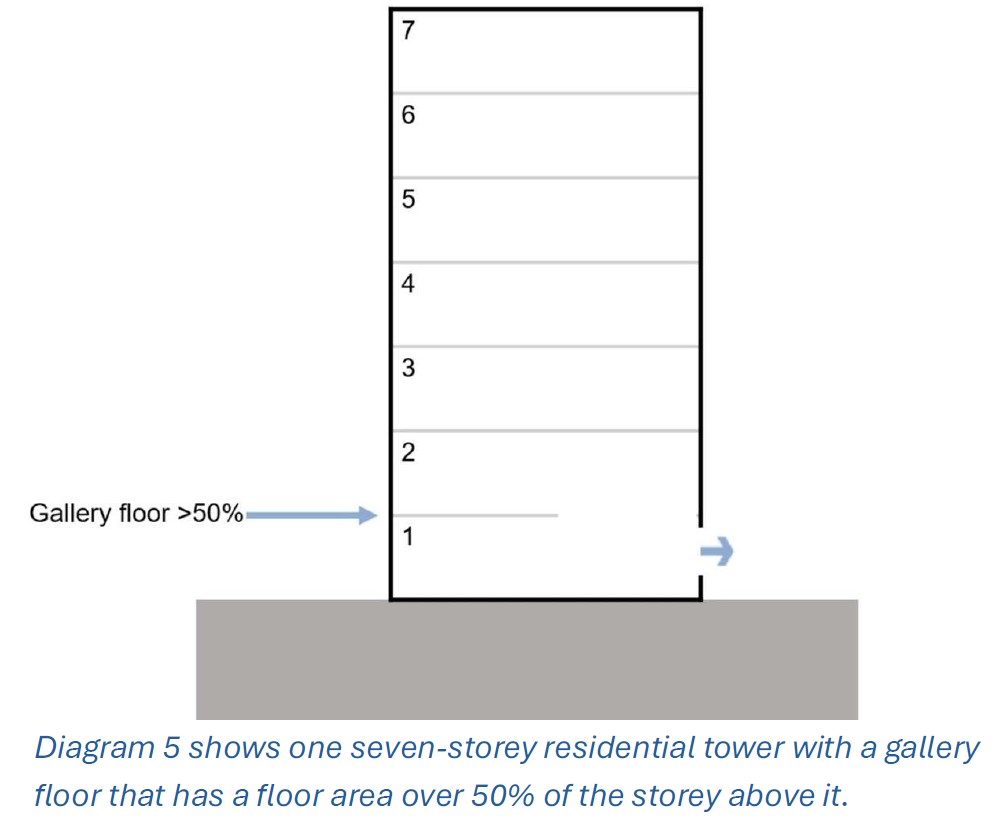
Diagram 5 shows one 7-storey residential tower with a gallery floor that has a floor area over 50% of the storey above it.
In this example, the gallery floor’s internal floor area is greater than 50% of the internal floor area of the storeys above it. Based on the method for calculating storeys in the Regulations, the gallery floor in this structure would be considered a storey and the building would have 7 storeys.
Glossary of key terms used in this guidance
The Building Safety Act 2022 (the Act)
The Building Safety Act 2022 (the Act) was granted Royal Assent on 28 April 2022. It implements the recommendations made in Dame Judith Hackitt’s report Building a Safer Future to create a new robust regulatory system for higher-risk buildings. Her recommendations set out clear duties and responsibilities for those who commission, design, construct and refurbish higher-risk buildings, and those who are responsible for making sure that buildings are safely managed when occupied. Part 3 of the 2022 Act relates to a dutyholder regime for higher-risk building during the design and construction phase and is applicable in Wales. The Act is available at – Building Safety Act 2022.
Dutyholders
Dutyholders (whether individuals or organisations) fulfil the key roles that are assigned specific responsibilities at particular phases of the building life cycle.
Higher-risk building
Higher-risk building is the technical term for buildings within the scope of the higher-risk regime. This guidance is designed to help users understand whether a building meets the criteria to be considered a higher-risk building.
The Building Safety (Description of Higher-Risk Building) (Design and Construction Phase) (Wales) Regulations 2023 (the Regulations)
The Building Safety (Description of Higher-Risk Building) (Design and Construction Phase) (Wales) Regulations 2023 (the Regulations) are Regulations made under the 1984 Act to specify the legal definition of higher-risk building. These are available in the Building Safety (Description of Higher-Risk Building) (Design and Construction Phase) (Wales) Regulations 2023.
Plant room
A plant room is an area which contains machinery or equipment that provides services to the building.
Residential unit
A residential unit is a dwelling or any other unit of living accommodation. Examples are considered to include a flat, studio flat, shared accommodation within university halls or a unit within a supported accommodation building.