
Welsh Government annual report on compliance with Welsh Language Standards 2025 to 2026
The 10th report on how we are ensuring compliance with the Welsh Language Standards.
In this page
Introduction
It is 10 years since the Welsh Government published its first annual report on the implementation of and compliance with the Welsh Language Standards (the standards), in accordance with the Welsh Language (Wales) Measure 2011. The standards set out how we must consider the Welsh language and provide information and services in Welsh to the people of Wales in different circumstances.
Welsh Ministers' compliance with the standards is one part of a wider language planning strategy that will support the government in achieving its 2050 targets; the first aim is to increase the number of Welsh speakers in Wales to 1 million and significantly increase the day-to-day use of the language, while the second relates to the government's internal working practices as we aim to become a truly bilingual organisation.
A compliance notice has been imposed by the Welsh Language Commissioner on the Welsh Ministers, and it lists the standards that apply to their activities. The notice can be viewed here: Welsh Language Commissioner's compliance notice.
1. Compliance with the service delivery standards
1.1 General
The Service Delivery Standards set out how we provide services and information to the people of Wales in Welsh. Our aim is always to ensure that people can engage with their government in their language of choice and provide high quality bilingual services on all occasions.
To do this we continue to operate a network of bilingual service co-ordinators, made up of representatives from across the organisation.
The co-ordinators are responsible for assisting with the mainstreaming of the Welsh language across the organisation, including:
- ensure that Safonau'r Gymraeg, led by the Welsh Language Standards Team, is rooted in the organisation, and
- ensure that the objectives of the Cymraeg 2050 strategy are mainstreamed in the Government's policy and legislation work.
1.2 Complaints
During the 10th year of implementation of the standards, 22 complaints were received about Welsh Government’s Welsh language services. 6 of these complaints directly relate to Welsh Ministers becoming the Operators of Last Resort of the Wales and Borders rail franchise in 2021, a service operated by Transport for Wales on a day-to-day basis.
Of the 20 complaints received by the Welsh Language Commissioner’s office, no investigation was carried out in 11 cases, 2 investigations have concluded, and 7 investigations are ongoing.
2 complaints were received directly from members of the public and were resolved immediately under Stage 1 of the Welsh Government's Complaints Policy.
| Status | Number |
|---|---|
| No investigation carried out | 11 |
| Investigation concluded | 2 |
| Investigation ongoing | 7 |
| Complaints received from the public | 2 |
| Total | 22 |
Transport for Wales (Rail)
Transport for Wales has worked to improve the bilingual services provided to customers using its rail services and the TrawsCymru bus network in Wales since becoming responsible for these services. Recent activities include the following:
- Work has taken place to ensure bilingual information for customers, both audio and visual, on all new train fleets – Transport for Wales continues to use the new Class 197 and Class 231 across the rail network, which provide announcements and information fully bilingually. 77.1% of journeys on the network are now made on the new trains (this equates to 31.7m train journeys). Brand new Class 197 trains will be introduced on the Cambrian Line (Pwllheli to Birmingham) later this autumn, further increasing the number of new trains providing bilingual services on the Wales and Borders network.
- Bilingual announcements at railway stations are being upgraded, with most of this work completed.
- A project was developed to unify the company's technological platforms, in order to ensure consistency and better service to users, including consistent language use. This includes ending English-only journey planning platforms.
- A 2.0 version of the Transport for Wales app was launched, which continues to offer a Welsh app and the ability to easily toggle between the 2 languages.
- Our first podcast episode was broadcast in Welsh and the company continues to provide bilingual social media content on all platforms.
- Cultural events across Wales have been supported, including Tafwyl, The Welsh Music Prize, the Urdd Eisteddfod, the Urdd Fund and the National Eisteddfod. Significant support was provided to the National Eisteddfod (in Wrexham) including a train service (almost 10,000 customers were carried during the week), a shuttle bus to Maes (for 23,500 customers), a warm and bilingual welcome for everyone to the station, a presence on the Maes and targeted marketing to encourage people to use public transport.
- A successful campaign and partnership with the singer Al Lewis resulted in 120,000 hits across all content included in the online campaign, promoting access to gigs on the train. Al continues to work with the company to promote Tafwyl and the Eisteddfod
- Mistar Urdd Train – a train was named "Mistar Urdd" to mark Transport for Wales' donation to the Urdd Fund and to promote the Eisteddfod in Port Talbot.
- Transport for Wales was the main sponsor of S4C's broadcast of the National Eisteddfod and they are also a regular sponsor of drama and sports programmes on S4C.
- Travellers across Wales were entertained by a host of St David's Day celebrations as Transport for Wales marked the occasion with food, music and community spirit. A food stall served traditional Welsh rarebit outside Cardiff Central station, with Cwmbach Male Voice Choir performing, turning one of Wales' busiest stations into the perfect place to celebrate St David's Day. The celebrations also stretched across the network, with passengers on the TrawsCymru T2, T3 and flexi routes in Machynlleth and Dolgellau being offered Welsh cakes by staff.
- More induction and language awareness training sessions were introduced for staff, with encouragement for everyone to use the Welsh they have. Welsh lessons for staff were relaunched in 2026.
2025-2026 complaints relating to the Welsh Language Standards
This report outlines all valid complaints received about the Welsh Government’s services (including services provided by third parties). All complaints received are noted, distinguishing between those that led to an investigation by the Welsh Language Commissioner and those where no further investigation was required. Complaints received directly from members of the public are also listed. The purpose of providing the table is to ensure transparency and provide a complete picture of the nature and outcome of the complaints raised.
| Complaint Number | The nature of the complaint | Standard Category | Outcome |
|---|---|---|---|
| 1 | Complaint about errors on app and website. (Transport for Wales) | Service Delivery | No investigation has been carried out – the commissioner was satisfied that steps have already been taken to resolve the matter. |
| 2 | Complaint about errors on website. | Service Delivery | An investigation was carried out and actions have been taken to avoid a repeat of the matter in place. |
| 3 | Incomplete Welsh text in statement.
| Service Delivery | No investigation was conducted. Advice provided by the commissioner and implemented. |
| 4 | An English-only announcement on a train. (Transport for Wales) | Service Delivery | No investigation was conducted. An action plan is already in place to address the issue. |
| 5 | Lack of a face-to-face Welsh service by officers. | Service Delivery | No investigation was conducted. Advice provided by the commissioner and implemented. |
| 6 | Errors in the Welsh version of a consultation response document. | Service Delivery | Complaint from a member of the public. The document was corrected, and a response was sent directly to the complainant. |
| 7 | Errors in a Welsh version of a table on a website. | Service Delivery | Complaint from a member of the public. The table was corrected, and a response was sent directly to the complainant. |
| 8 | Error on information screen at station. (Transport for Wales) | Service Delivery | No investigation was conducted. Actions to avoid repetition of the issue have been set and implemented. |
| 9 | An English-only text message was sent to a member of the public. | Service Delivery | No investigation was conducted. An action plan is already in place to address the issue. |
| 10 | A suggestion of treating the Welsh language less favourably than English in relation to corporate identity. | Service Delivery | No investigation was conducted. |
| 11 | An English-only response was provided by email. (Transport for Wales) | Service Delivery | No investigation was carried out – the commissioner is satisfied that steps have already been taken to resolve the matter. |
| 12 | Correspondence in English only was sent to an individual applying for a job. | Service Delivery | No investigation has been carried out – the commissioner is satisfied that steps have already been taken to resolve the matter. |
| 13 | English-only correspondence was sent to a recipient who had Welsh as their preferred language. | Service Delivery | No investigation was carried out – the commissioner is satisfied that steps have already been taken to resolve the matter. |
| 14 | Sub-site in English only. (Transport for Wales) | Service Delivery | No investigation was conducted. Action plan approved and in place. |
| 15 | Lack of consideration of the Welsh language in impact assessment relating to a Bill. | Policy Making | The commissioner's investigation is ongoing. |
| 16 | A complaint about a lack of consideration of the Welsh language in a consultation document and impact assessment. | Policy Making | The commissioner's investigation is ongoing. |
| 17 | Complaint that a recruitment process treated Welsh less favourably than English. | Operational | No investigation was conducted.
Advice provided by the commissioner. |
| 18 | Allegation of lack of consideration of the Welsh language in the preparation of legislation. | Policy Making | The commissioner's investigation is ongoing. |
| 19 | A complaint about an audio announcement and information on an English-only screen on a train. (Transport for Wales) | Service Delivery | Response submitted. No decision yet on an investigation by the commissioner. |
| 20 | Allegation of lack of consideration of the Welsh language in the preparation of legislation. | Policy Making | The Commissioner's investigation is ongoing. |
| 21 | Complaint that an impact assessment on the Welsh language was not part of a consultation. | Policy Making | The commissioner's investigation is ongoing. |
| 22 | A complaint about a number of errors in Welsh when submitting a request on a website. | Service Delivery | The commissioner's investigation is ongoing. |
2. Compliance with the policy making standards
2.1 General
'Cymraeg 2050: A million speakers' is the Welsh Government's strategy for promoting and facilitating the use of the Welsh language. In line with the Well-being of Future Generations (Wales) Act 2015, the commitment in the Cymraeg 2050 strategy demonstrates that the Welsh language is a strategic priority for the Welsh Government. The Welsh Government's vision is to see the Welsh language flourish, with a significant increase in the number of people speaking and using the language in their daily lives.
The policy making standards require the Welsh Government to:
- consider the effects of our policy decisions on the Welsh language (positive and negative)
- consider how to increase positive effects, mitigate or reduce adverse effects and take advantage of every opportunity to promote the use of Welsh
- seek views on the effects on the Welsh language when engaging or consulting and seek the views of Welsh speakers and users of the language.
The Welsh Government has an integrated impact assessment framework in place. The purpose of the framework is to advise staff on considering a range of topics, including the Welsh language, when making policy decisions. The framework guides staff through the process of considering the effects of policy decisions on opportunities to use the Welsh language and the principle that the Welsh language should not be treated less favourably than English. The Welsh language impact assessment is one of the statutory, mandatory assessments that officers must complete when developing, reviewing or amending policies and legislation.
2.2 Complaints
5 complaints regarding the implementation of the policy making standards in 2025-2026 were received by the Commissioner's office. No complaint was received directly from members of the public.
3. Compliance with the operational standards
3.1 Developing a policy on the internal use of the Welsh language
The Welsh Government's strategy for mainstreaming the Welsh language within the organisation, and providing more opportunities for our staff to use it, is 'Cymraeg. It belongs to us all'. The strategy was launched in April 2020, and the themes underpinning the implementation of the strategy during its first 5 years are:
- leadership
- recruitment
- training
- technology.
The strategy sets out a long-term vision up to 2050, with arrangements to be reviewed regularly and a series of 5-year objectives to ensure continued progress. During the first phase, the aim was to become an exemplar organisation in terms of increasing the internal use of the Welsh language, and steps were taken to share the vision and inspire other organisations.
Significant progress was made between 2020 and 2025, particularly by strengthening learning provision, increasing the number of staff learning Welsh, and promoting the use of the Welsh language by leaders and staff. Changes to recruitment practices were introduced, along with technology initiatives to facilitate bilingual working.
Looking ahead to the 2026–2030 period, the focus will be on developing evidence-based recruitment, training and promotion policies, with the aim of building a bilingual workforce by 2050. This will be supported by analysing skills data and modelling the change needed to reach the 2050 goal.
The work will continue through 5 main themes: leadership, learning, recruitment, technology, and increasing confidence and use of the Welsh language.
3.2 Complaints
1 complaint regarding the implementation of the operational standards was received by the Commissioner's Office during the reporting period.
4. Welsh skills data
31 March 2026
| Reading | Speaking | Understanding | Writing | |
|---|---|---|---|---|
| 0 | 1859 (34%) | 2415 (45%) | 2027 (38%) | 2708 (50%) |
| 1 | 1623 (30%) | 1401 (26%) | 1407 (26%) | 1208 (22%) |
| 2 | 528 (10%) | 314 (6%) | 607 (11%) | 345 (6%) |
| 3 | 367 (7%) | 224 (4%) | 255 (5%) | 342 (6%) |
| 4 | 326 (6%) | 274 (5%) | 321 (6%) | 326 (6%) |
| 5 | 791 (15%) | 855 (16%) | 885 (16%) | 521 (10%) |
31 March 2025
| Reading | Speaking | Understanding | Writing | |
|---|---|---|---|---|
| 0 | 1814 | 2299 | 1970 | 2613 |
| 1 | 1464 | 1287 | 1246 | 1100 |
| 2 | 481 | 295 | 566 | 327 |
| 3 | 345 | 202 | 231 | 317 |
| 4 | 310 | 268 | 309 | 308 |
| 5 | 721 | 784 | 816 | 461 |
People Survey
The People Survey is a survey that is carried out across the Civil Service and is completed annually by means of an anonymous electronic survey. The survey is adapted for the purposes of the Welsh Government with specific questions relating to working for the organisation, including questions about Welsh language skills and language use in the workplace.
Our Knowledge and Analytics Service has provided results for Welsh language skills based on the results of the 2025 People Survey in the form of tables.
Welsh Skills – People Survey 2025
Skills data in the People Survey is based on the following question:
Which of the following best describes your ability in spoken Welsh?
- I'm fluent in Welsh
- I'm able to speak a lot of Welsh
- I'm able to speak a little bit of Welsh
- I can only say a few words in Welsh
- I'm unable to speak Welsh
| Welsh Language Skill Level | Percentage of staff |
|---|---|
| I’m fluent in Welsh | 18% |
| I’m able to speak a lot of Welsh | 9% |
| I’m able to speak a little bit of Welsh | 22% |
| I can only say a few words in Welsh | 35% |
| I’m unable to speak Welsh | 16% |
| Total | 100% |
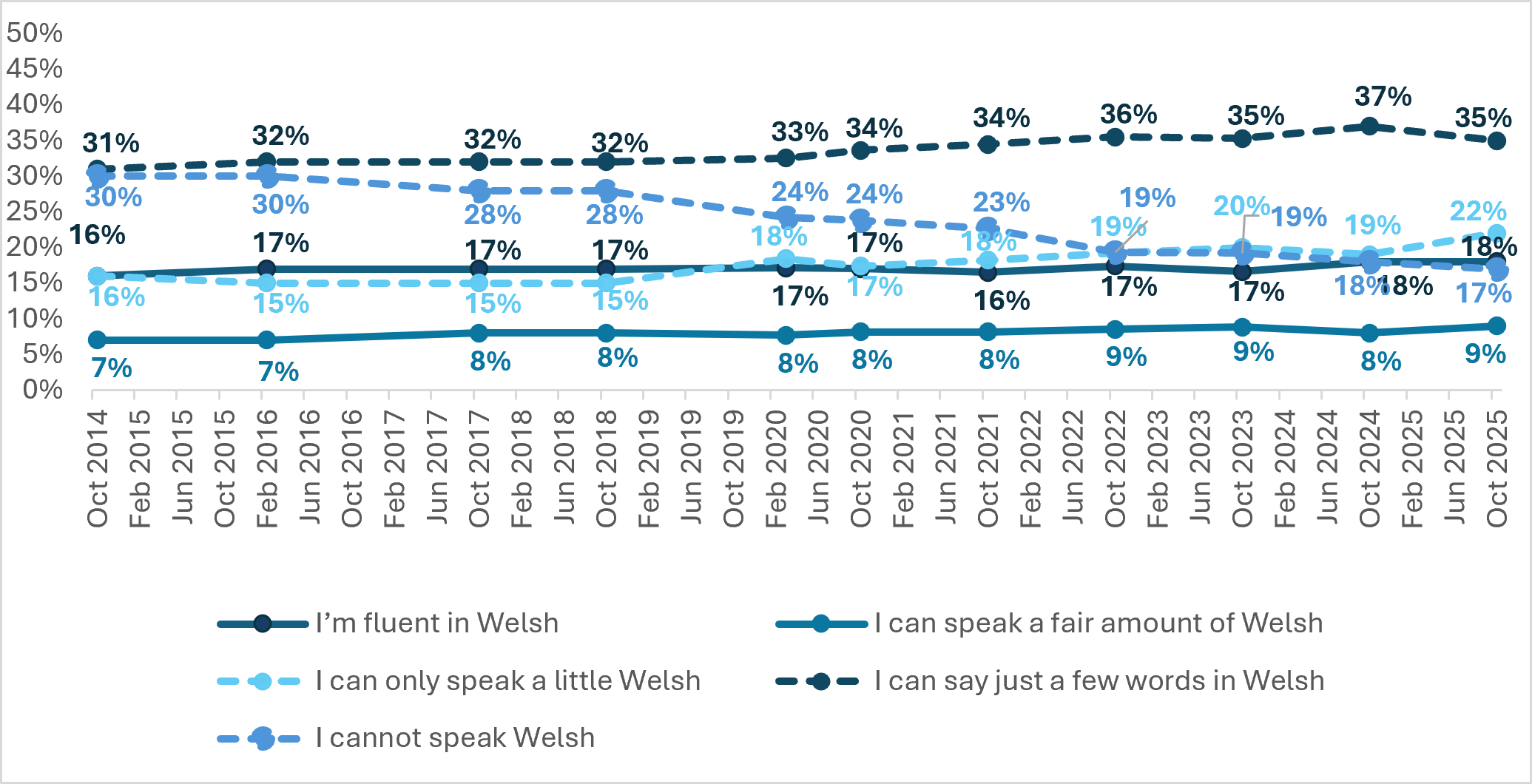
Welsh Language skills levels: staff percentages
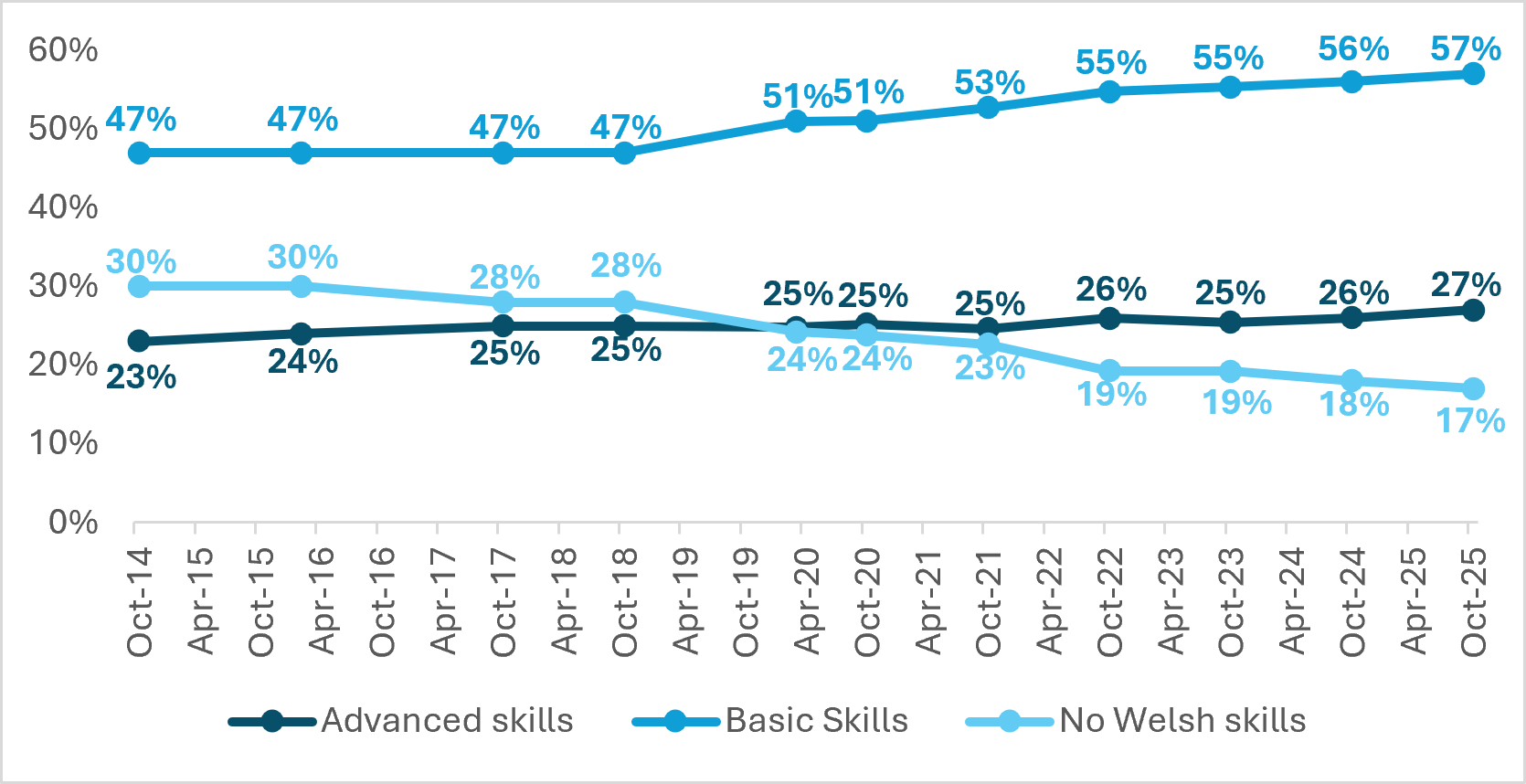
| Welsh Language Skill Level | Percentage of staff |
|---|---|
| Advanced skills | 27% |
| Basic Skills | 57% |
| No Welsh skills | 16% |
| Total | 100% |
5. Welsh Language Learning Programme Data 2025–2026
General engagement with Welsh language learning
- Weekly classes: 216
- 1:1 tuition: 55
- Blended Learning: 48
- Intensive block courses: 12
- Welsh language certificate: 7
- Gloywi: 24
- Codi Hyder: 29
- Professional Welsh course: 17
- Residential courses: 13
- Welsh Pronunciation: 6
- Kick off Cymraeg: 6
- Clwb Cymraeg: 52
- Chairing Bilingually and Hosting Bilingual Events and meetings: 28
- Private Office Short Courses (initial skills level assessment): 87
- Cymraeg Learning and Skills: Supporting Your Language Development in 2025: 96
- The Welsh Language in the Welsh Government – Induction Sessions: 279
- Working Bilingually – Cabinet Office Bespoke Induction Session: 15
- SCS Welsh Induction sessions: 1
- Total: 991
This is an overall increase of 338 in engagement from last year. A breakdown of the above table can be found below.
Weekly lessons data
Our weekly classes are based on the Learn Welsh curriculum with courses available throughout Wales. Applications open in April with courses starting in September and run through to December, we then offer a separate term beginning in January and ending in May. Learners can choose between 2 or 4 hours per week classes. Classes are available from beginner through to proficient.
| Weekly classes: Sept 2025 & Jan 2026 | Total | Mynediad (Entry) | Sylfaen (Foundation) | Canolradd (Intermediate) | Uwch (Higher) | Hyfedredd (Proficient) |
|---|---|---|---|---|---|---|
| Applications | 428 | 218 | 92 | 45 | 49 | 24 |
| Enrolled | 345 | 181 | 87 | 30 | 41 | 6 |
| Currently still learning | 216 | 108 | 58 | 24 | 23 | 3 |
| Withdrawn since enrolling | 129 | 73 | 29 | 6 | 18 | 3 |
| Withdrawn before enrolling | 83 | 37 | 5 | 15 | 8 | 18 |
1:1 tutoring
We have 1:1 tutoring available for those who require additional support to learn Welsh (ALN) and customised sessions are provided based on learning needs and requirements. 1:1 tuition is also available to all members of the Senior Civil Service (SCS).
- Senior Civil Service: 42
- Additional Learning Needs: 13
- Total: 55
Blended learning
Following feedback from both tutors and learners about online self-study (where learners complete their learning in their own time at their own pace), we began a blended approach for the 2025-2026 financial year. The classes combine online self-study with periodic monitoring and mentoring from tutors, allowing learners the freedom to complete learning at their own pace whilst seeking support and checking progress with a tutor from time to time. We offered blended learning from beginner through to higher levels.
Number of learners:
- Mynediad: 34
- Sylfaen: 9
- Canolradd: 3
- Uwch: 2
- Total: 48
Block course
Our intensive block courses are run based on 4 levels available from beginner to higher. The course follows the same curriculum as our Weekly class offer above but is condensed to 20 full days of training over 4 weeks. The course is structured as 9:00am-3:00pm, Monday-Friday over 4 weeks and is equivalent to completing a full level. Learners also have the option to attend 2 weeks of the course, allowing them to complete half a level. This year we ran block courses for Mynediad and Sylfaen levels.
Number of staff:
- Mynediad: 7
- Sylfaen: 5
- Total: 12
Welsh Language Skills Certificate
This course is for proficient Welsh speakers. It includes a week of tutoring and revision at Nant Gwrtheyrn, followed by examinations a few weeks later.
The Certificate demonstrates the ability to communicate accurately, confidently and professionally through the medium of Welsh, both verbally and in writing. The assessments are designed to test skills in using Welsh in the workplace.
The course was not delivered in 2025–2026; however, 7 members of staff completed the course in 2024–2025 and received their results in 2025–2026. A plan is in place to track the language use of the Certificate cohort after they complete the course in order to assess their use of Welsh back in the workplace.
Gloywi
As part of our corporate Cymraeg training offer, we have a programme of refresher training sessions aimed at skilled Cymraeg speaking colleagues who are keen to improve their spoken and written language skills in general. This programme is entirely demand-led. This course is delivered by an expert tutor who develops the programme based on the topics chosen by interested participants.
Number of staff who completed the course: 24
Codi Hyder
This option is designed for individuals with existing Cymraeg skills who have had limited opportunities to use Cymraeg or have lost confidence through lack of practice. Its purpose is to rebuild confidence and positively change linguistic habits, enabling participants to use Cymraeg more naturally in everyday family, social and work contexts. The course is delivered over 20 to 30 hours within 10 to 15 weekly 2‑hour sessions.
Number of staff who completed the course: 29
Professional Welsh Course
This course is aimed at proficient speakers, to help refine their Cymraeg writing and communication skills for a bilingual workplace.
Number of staff who completed the course: 17
Residential courses
Welsh Government staff can book intensive courses at Nant Gwrtheyrn through the National Centre for Learning Welsh. There are a variety of residential Cymraeg courses available at different learning levels, from Entry to Gloywi. These are intensive courses of approximately 5 hours of training per day over a period of up to 5 days. This involves a commitment of time over the course of a week but enables learners to progress quickly. The residential element also includes opportunities to socialise and relax through the medium of Cymraeg.
Number of staff completed who completed the course: 13
Welsh pronunciation
A practical session for all Welsh Government employees to build confidence in pronouncing and using Cymraeg. Participants practise key words, phrases, names and place‑names, explore common pronunciation challenges, and gain practical tools to support everyday use of Cymraeg. The course encourages a positive, inclusive approach to “giving it a go” and learning together.
Number of staff who completed the course: 6
Kick off Cymraeg
Kick Off Cymraeg is a 3-hour virtual session that allows participants to explore the Cymraeg language and the Welsh Government's strategy in relation to its internal use – 'Cymraeg. It belongs to us all'. The session explores the essence of the Cymraeg language and its significance in Wales. Topics include:
- Your language journey
- What is language and how did we get here
- The role you play within the Welsh Government
Number of staff who completed the course: 6
Clwb Cymraeg
Informal chat sessions known as "Clwb Cymraeg" – these informal sessions are facilitated by a tutor on a weekly basis, and each session is for a specific level. These sessions are open to all members of staff, not just learners following a formal learning programme, to provide them with an opportunity to use their Cymraeg. These sessions are designed to give staff the opportunity to practise their Cymraeg in a safe and constructive environment with a tutor on hand to instruct and support.
Number of staff attending, on average: 52
Chairing bilingually and hosting bilingual events and meetings
This course is delivered by ‘Iaith cyf.’ and is a bilingual session aimed specifically at those who want to learn how to chair, conduct or attend a bilingual meeting.
Number of staff who completed the course: 28
Office of the First Minister (OFM) Group Bespoke Programme of Learning
For the first time in 2025-2026, we worked with the OFM and the National Centre for Learning Welsh on a model of learning to upskill OFM Group staff in an accelerated way, with a view to supporting staff to learn Cymraeg or to develop their existing Cymraeg skills. The programme started in spring 2025-2026 with the following activities completed by the end of March 2026:
Initial interest
111 colleagues from the OFM (91) and the communications profession (20) initially expressed an interest in taking part in the offer.
Assessments
A qualified tutor assessed the Cymraeg skills level of each OFM staff member who expressed an interest in proceeding to learn / improve their Cymraeg. 87 staff proceeded to complete language skills level assessments, enabling us to group staff into classes based on skills levels.
E-learning / Cymraeg Croeso
Building on the current ‘Cymraeg Croeso’ e-learning, a version tailored to Welsh Government staff was created and offered to OFM staff at Mynediad (Entry) level. The tailored version included vocabulary specific to Welsh Government as well as example pronunciation. 17 staff completed the Cymraeg Croeso e-learning. This updated e-learning offer will be rolled out to the wider organisation in 2026-2027.
Bitesize Learning
Optional twice-weekly 30-minute sessions were offered to OFM staff to build on their existing Cymraeg skills ahead of 2-week blocks of intensive learning. 24 staff took part in the bitesize learning sessions.
The ensuing intensive block learning courses for OFM and Communications profession staff will take place in the new financial year; information on participation in these will be provided in the 2026-2027 report.
Cymraeg Learning and Skills: Supporting your language development in 2025
These are informal information sessions provided by a member of the Cymraeg Learning & Development Team, providing an overview of the Cymraeg learning opportunities available to Welsh Government staff.
Number of staff attended: 96
Induction sessions: Welsh language in the Welsh Government
All new members of the Welsh Government workforce are required to undertake induction training. The corporate induction course instructor uses incidental Cymraeg throughout the 4-part course, and Cymraeg is a key theme throughout.
As part of the induction, the Welsh Language Standards Team provides a language awareness session. This is an hour-long session that explains the Welsh Government's vision for the language, both internally as a bilingual organisation and externally in terms of our objective to see the language flourish in our communities. Opportunities to learn Cymraeg and develop their skills in the workplace are also highlighted to new staff during the session. The requirements of the Welsh Language Standards are introduced as part of the course, and how the Standards affect the day-to-day work of officers is discussed.
Number booked on to session:
- 10 April 2025: 11
- 15 May 2025: 14
- 12 June 2025: 12
- 21 July 2025: 13
- 14 August 2025: 10
- 25 September 2025: 8
- 09 October 2025: 23
- 12 November 2025: 38
- 24 November 2025: 13
- 01 December 2025: 16
- 11 December 2025: 13
- 22 January 2026: 17
- 29 January 2026: 19
- 25 February 2026: 29
- 13 March 2026: 29
- 25 March 2026: 14
- Total: 279
There is also a dedicated induction session for new members of the Cabinet, the Senior Civil Service and non-executive directors of the Welsh Government Board. The session focuses on our statutory duties and policy objectives in our strategies for Cymraeg, ‘Cymraeg 2050: A million Welsh speakers’ and ‘Cymraeg. It belongs to us all’, bilingual work considerations, leadership mindsets, bilingual working tools, services such as the Translation Service, and Cymraeg learning opportunities. These are 1:1 sessions and the new member of staff usually contacts the Welsh Language Standards Team to arrange a session. One Cymraeg induction session was held this year for a Senior Civil Service staff member.
Working Bilingually – Office of the First Minister (OFM) Group Bespoke Induction Session
In addition to the above Induction sessions, the Welsh Language Standards Team delivered a further session to new OFM Group staff. This session discussed what tools and technology are available to support staff working in both Cymraeg and English.
Number of staff attended: 15
Other activities: St David’s Day week
Once again this year, events relating to the Welsh language were held for staff to celebrate St David’s Day.
Number of staff booked on to events:
- AI and the Welsh Language: 71
- Drop-in Session: The Welsh Government’s Cymraeg Learning Offer: 13
- Time Out and Meditation: 30
- Eisteddfod 850: 91
- Talwrn y Beirdd (Bardic competition): 57
- Sgwrsio – discussion with new Welsh speakers in Welsh Government: 51
- Total: 313
The Welsh Language Network (Rhwydaith Cymraeg)
The aim of this network is to provide space for staff learning / speaking Cymraeg to practice and improve their confidence by having conversations and sharing the latest news and information regarding training opportunities, media, etc. with others.
A total of 321 Welsh Government employees are members of our internal Microsoft Teams Welsh Language Network. All new learners and employees are encouraged to join the network.
6. Recruitment data
The number of new and advertised vacancies categorised as requiring jobs:
- Essential Welsh Skills
- Welsh language skills to learn in the role
- Desirable Welsh Language Skills
Here are the 2025-2026 data:
| Category | Advertised in-house | Advertised externally |
|---|---|---|
| Essential | 30 | 11 |
| To be learnt in role | 1 | 35 |
| Desirable | 850 | 170 |
| Total Amount | 881 | 216 |
Public Appointments: Welsh skills assessments
All roles assigned to them through the Welsh Ministers' public appointment process are subject to a Welsh language skills assessment. Of the 39 assessments carried out this year, 8 roles were categorised as having Welsh as essential, and 31 with Welsh as desirable. All assessments are subject to scrutiny and clearance by the Welsh Language Standards Team.
Tables
Welsh Language skills of WG staff (People Survey data - full breakdown)
| Date | I'm fluent in Welsh | I can speak a fair amount of Welsh | I can only speak a little Welsh | I can say just a few words in Welsh | I cannot speak Welsh |
|---|---|---|---|---|---|
| October 2014 | 16% | 7% | 16% | 31% | 30% |
| February 2016 | 17% | 7% | 15% | 32% | 30% |
| October 2017 | 17% | 8% | 15% | 32% | 28% |
| October 2018 | 17% | 8% | 15% | 32% | 28% |
| February 2020 | 17% | 8% | 18% | 33% | 24% |
| October 2020 | 17% | 8% | 17% | 34% | 24% |
| October 2021 | 16% | 8% | 18% | 34% | 23% |
| October 2022 | 17% | 9% | 19% | 36% | 19% |
| October 2023 | 17% | 9% | 20% | 35% | 19% |
| October 2024 | 18% | 8% | 19% | 37% | 18% |
| October 2025 | 18% | 9% | 22% | 35% | 17% |
Welsh Language skills of WG staff (People Survey data - full breakdown)
| Date | Advanced skills | Basic skills | No Welsh language skills |
|---|---|---|---|
| October 2014 | 23% | 47% | 30% |
| February 2016 | 24% | 47% | 30% |
| October 2017 | 25% | 47% | 28% |
| October 2018 | 25% | 47% | 28% |
| February 2020 | 25% | 51% | 24% |
| October 2020 | 25% | 51% | 24% |
| October 2021 | 25% | 53% | 23% |
| October 2022 | 26% | 55% | 19% |
| October 2023 | 25% | 55% | 19% |
| October 2024 | 26% | 56% | 18% |
| October 2025 | 27% | 57% | 17% |