Pupils educated other than at school: September 2025 to August 2026
Data relating to pupils known by local authorities to be receiving education outside of school from September 2025 to August 2026.
In this page
Introduction
This release covers data on pupils receiving Education Other than at School (EOTAS), including at Pupil Referral Units (PRU). It includes data by age, sex and type of provision.
In this report we refer to academic years, for example 2025 to 2026. This covers the period of September 2025 to August 2026 unless otherwise stated.
Please see the quality report for:
- information on the impact of the coronavirus (COVID-19) pandemic on this data collection
- the criteria for EOTAS and the categories of EOTAS provision
Main points
- 7.1 of every 1,000 pupils receive some EOTAS provision, up from 6.5 in 2024 to 2025; up from a previous high of 6.5 of every 1,000 pupils in 2024 to 2025.
- 14.1 of every 1,000 pupils eligible for free school meals are mainly educated outside school, up from 14.0; there have consistently been proportionately more pupils mainly educated outside school eligible for Free School Meals (FSM) since 2009 to 2010.
- 55.6 of every 1,000 pupils with additional learning needs are mainly educated outside school, up from 47.8.
- The rate of electively home educated pupils in 2025 to 2026 is 17.0 of every 1,000 pupils, up from 1.6 of every 1,000 pupils in 2009 to 2010.
Education Other than at School (EOTAS) pupils
In 2025 to 2026 there are 3,221 pupils receiving some type of EOTAS provision, whether that is their main or subsidiary provision. That is 7.1 of every 1,000 pupils, compared to 6.5 in 2024 to 2025.
There are 2,792 EOTAS pupils mainly educated outside school, 6.1 of every 1,000 pupils, up from 5.8 in 2024 to 2025.
The percentage of EOTAS pupils mainly educated outside school is 86.7%.
Figure 1: rate per 1,000 pupils educated outside school, 2009 to 2026
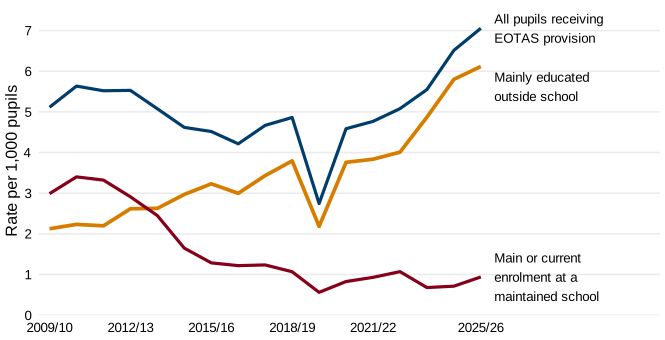
Description of figure 1: a line chart showing a long-term upward trend in the rate per 1,000 pupils of those mainly educated outside school, 2009 to 2010 onwards. There is a sharp increase from 2022 to 2023 onwards. There is an apparent sharp dip in the rate in 2019 to 2020, which is likely to be due to incomplete data submitted in the COVID-19 period.
Source: EOTAS Pupil Census and PLASC
Provision
Figure 2: percentage of pupil enrolments, by educational provision, 2025 to 2026
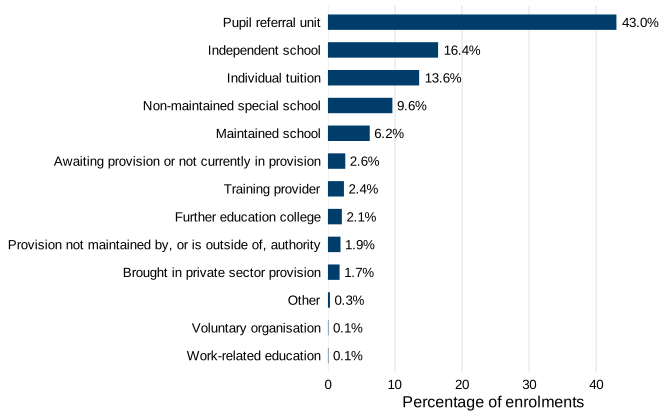
Description of figure 2: a horizontal bar chart showing the percentage of pupil enrolments by type of educational provision, 2025 to 2026. The largest share is in pupil referral unit, at 43.0%.
Source: EOTAS Pupil Census
The largest share of enrolments is in:
- pupil referral unit at 43.0%
- independent school (16.4%)
- individual tuition (13.6%)
Elective home education
Figure 3: rate per 1,000 electively home educated pupils, 2009 to 2026
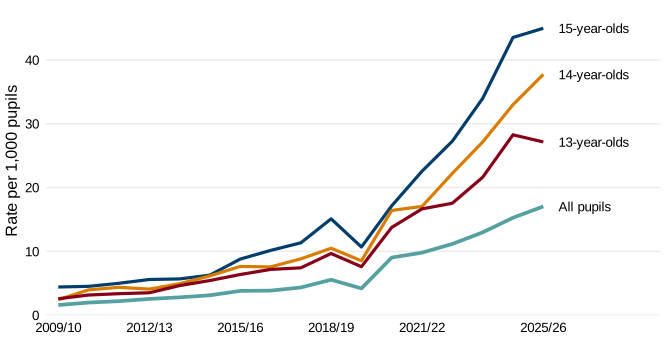
Description of figure 3: a line chart showing a long-term upward trend in the rate per 1,000 pupils of those electively home educated, 2009 to 2010 onwards.
Source: EOTAS Pupil Census
Parents voluntarily notify their local authority that they are home educating their children, unless they have withdrawn their child from school. This means the data might not include all electively home educated children.
The Welsh Government publishes guidance on elective home education.
In the 2025 to 2026 academic year, 7,917 children were known to be electively home educated. This number is not included in the total EOTAS pupil numbers earlier in this release. The rate of electively home educated pupils in 2025 to 2026 is 17.0 of every 1,000 pupils, up from 1.6 of every 1,000 pupils in 2009 to 2010.
Ceredigion had the highest rate, at 33.8 of every 1,000 pupils. In 2025 to 2026 the rate in Ceredigion reached:
- 33.1 of every 1,000 pupils for females
- 34.5 of every 1,000 pupils for males
The highest proportional growth was in Blaenau Gwent, with an increase to over 36 times the rate of home educated pupils it had in 2009 to 2010.
The most common age for home educated pupils, by number of pupils, is 15. In 2025 to 2026 there were:
- 49.6 of every 1,000 15-year-old female pupils electively home educated
- 40.6 of every 1,000 15-year-old male pupils electively home educated