
Science Research Evidence: winter modelling 2026 to 2027 - Part 4: primary care (ARI GP Consultations and 111 calls)
This paper provides modelled scenarios for influenza, COVID-19 and respiratory syncytial virus (RSV) for the upcoming winter season.
In this page
GP ARI consultation rate
Acute respiratory infection (ARI) refers to a sudden onset of one or more respiratory symptoms, where clinical judgement determines the illness is caused by a viral infection such as COVID-19, flu, or RSV.
GP consultations data related to acute respiratory infections are provided by Public Health Wales.
The GP consultation rate data relies on syndromic evaluation of patients, without conducting specific pathological tests for confirmation.
Therefore, it is likely that GP consultations might over or underestimate the incidence of infectious diseases.
GP consultations (as with 111 calls, which are covered later in Part 4) provide an early signal of respiratory pressure in the community, typically rising ahead of hospital admissions and offering a lead indicator for out of hours, minor injuries and emergency department demand.
The peak daily ARI consultation rates are estimated to occur on or around the bank holidays at Christmas and New Year.
Potential closures in GP surgeries may put additional pressure on out of hours services, minor injuries services and emergency departments, and the modelled peaks should be interpreted alongside the 111 calls scenarios when planning surge cover for that fortnight.
ARI GP consultation rates in children (ages 0 to 14 years)
Consultation rates in children show a pronounced winter seasonality, rising from October, peaking in December and declining through February and March in all years for the past 5 years.
The amplitude of the winter peak has fallen in each successive year since winter 2022 to 2023. (Figure 22)
Children’s rates peaked at:
- 70.9 GP consultations per 100,000 population during winter 2023 to 2024
- 69.4 GP consultations per 100,000 population during winter 2024 to 2025
- 31.8 GP consultations per 100,000 population during winter 2025 to 2026
In the 2025 to 2026 winter, children had fewer GP consultations due to ARI than in the 2024 to 2025 winter, with a daily average rate of 17.9 consultations per 100,000 population compared to 31.7 the previous winter. (See Figure 22)
The projected peak GP consultation rates for children under the modelled Scenarios A, B and C are:
- 261.5 consultations per 100,000 GP population, occurring on 11 December 2026
- 45.6 consultations per 100,000 GP population, occurring on 12 December 2026
- 14.0 consultations per 100,000 GP population, occurring on 31 October 2026 to 1 November 2026
(See Figure 23)
Figure 22: 7 day rolling average of daily ARI GP consultation rate in children (ages 0 to 14 years), between April 2021 and March 2026
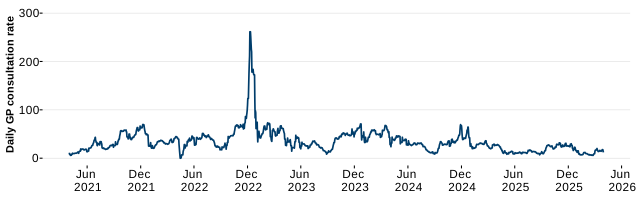
Description of figure 22: a line chart showing the 7-day rolling average of daily GP consultation rates in children.
Source: Public Health Wales
Figure 23: Daily ARI GP consultation rate scenarios in children (ages 0 to 14 years) – between September 2026 and March 2027
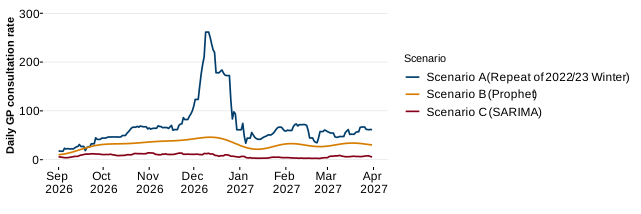
Description of Figure 23: A line chart representing projected daily GP consultation rates (children), for Winter 2026 to 2027.
Source: SRE calculations using data provided by PHW
Figure 24: 7 day rolling average of daily ARI GP consultation rate in ages 15 years and above, between April 2021 and March 2026
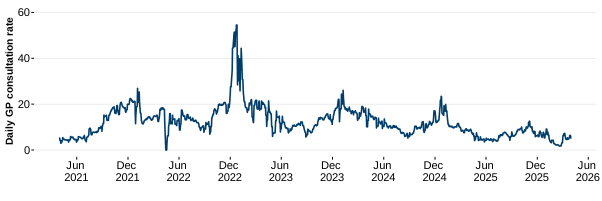
Description of Figure 24: a line chart showing the 7-day rolling average of daily GP consultation rates in Adults.
Source: Public Health Wales
Figure 25: Daily ARI GP consultation rate scenarios in ages 15 years and above – between September 2026 and March 2027
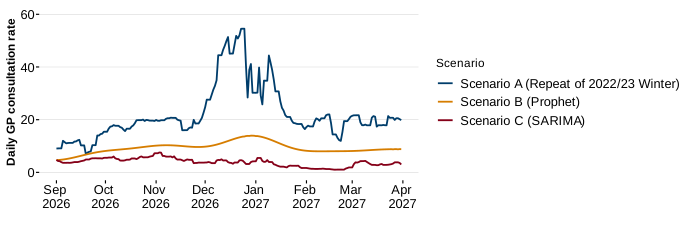
Description of Figure 25: A line chart representing different projected daily GP consultation rates (Adults), for Winter 2026/27.
Source: SRE calculations using data provided by PHW
GP ARI consultation rate
Acute respiratory infection (ARI) refers to a sudden onset of one or more respiratory symptoms, where clinical judgement determines the illness is caused by a viral infection such as COVID-19, flu, or RSV.
GP consultations data related to acute respiratory infections are provided by Public Health Wales.
The GP consultation rate data relies on syndromic evaluation of patients, without conducting specific pathological tests for confirmation.
Therefore, it is likely that GP consultations might over or underestimate the incidence of infectious diseases.
GP consultations (as with 111 calls, which are covered later in Part 4) provide an early signal of respiratory pressure in the community, typically rising ahead of hospital admissions and offering a lead indicator for out of hours, minor injuries and emergency department demand.
The peak daily ARI consultation rates are estimated to occur on or around the bank holidays at Christmas and New Year.
Potential closures in GP surgeries may put additional pressure on out of hours services, minor injuries services and emergency departments, and the modelled peaks should be interpreted alongside the 111 calls scenarios when planning surge cover for that fortnight.
Implications across both age groups
Because these are rates (per 100,000 GP population) rather than counts, the higher rates observed in children does not mean that children account for more consultations overall.
Adults make up the larger share of actual appointments, simply because there are far more of them in the population.
Children record materially higher consultation rates (per 100,000 GP population) than adults in every winter of the observed series and under every modelled scenario.
Both groups show year-on-year decline since 2023 to 2024, and both are modelled to peak within the same fortnight.
Because adults form the large majority of the registered population, however, the absolute volume of ARI GP consultations remains higher in adults despite the lower ARI GP consultation rate.
111 calls
NHS Wales 111 call data provides an important early indicator of respiratory illness burden in the community, often preceding increases in emergency department attendances and hospital admissions by several days.
Calls to 111 due to breathing problems (includes the following causes: Breathing Difficulty, Breathing Difficulty or Wheezing and Breathing Problems excluding chest pains) are monitored throughout the winter period as part of the wider respiratory surveillance framework in Wales.
This section presents historical trends in daily 111 calls that are answered at a Wales level and modelled scenarios for the 2026 to 2027 winter period.
It is important to note that 111 call data reflect community-level demand and is not directly comparable to hospital-based metrics; a single caller may contact 111 multiple times, and not all calls result in onward referral to emergency or secondary care.
The highest recorded daily volumes reached 170 calls answered in winter 2022 to 2023 during peak winter periods.
Outside of winter, call volumes generally stabilise at a baseline of around 50 to 75 calls per day (based on data from July 2021 to March 2026), reflecting the lower burden of respiratory illness during summer months.
The most recent 2025/26 winter showed a moderate peak (130 calls per day on 1 January 2026) broadly consistent with previous non-pandemic winters, suggesting a continued return to more typical seasonal patterns following the elevated activity of earlier post-pandemic years.
Figure 26 presents three modelled scenarios for daily 111 calls due to respiratory problems across Wales for the 2026 to 2027 winter season.
- Scenario A, based on a repeat of the 2023 to 2024 winter, represents the higher-burden projection and estimates a peak of 169 calls per day in early January 2027.
- Scenario B, derived from the mean of the past five winters, projects a moderate trajectory with a peak of around 147 calls per day over a similar timeframe.
- Scenario C, generated using the Prophet forecasting method, produces the most conservative projection with a peak of 116 calls per day.
All three scenarios anticipate the highest call volumes occurring around the first week of January 2027, consistent with the historical patterns observed in Figure 26.
The spread between scenarios reflects inherent uncertainty in season severity and the influence of factors such as circulating pathogen mix, public behaviour, and vaccination uptake all of which are difficult to predict in advance.
These projections should be interpreted alongside hospital admissions and emergency department (ED) attendance scenarios when informing winter service planning.
Figure 26: 7-day rolling average of daily 111 calls due to respiratory problems between April 2021 and March 2026
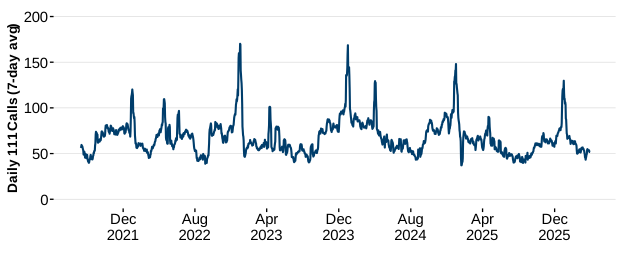
Description of Figure 26: A 7-day rolling average of daily 111 calls attributed to respiratory problems across Wales from April 2021 to March 2026. Call volumes display a clear and consistent seasonal pattern, with peaks occurring predominantly during the winter months of December and January each year.
Source: Welsh Ambulance Service University NHS Trust (WAST)
Figure 27: 111 calls due to respiratory problems scenarios– between September 2026 and March 2027
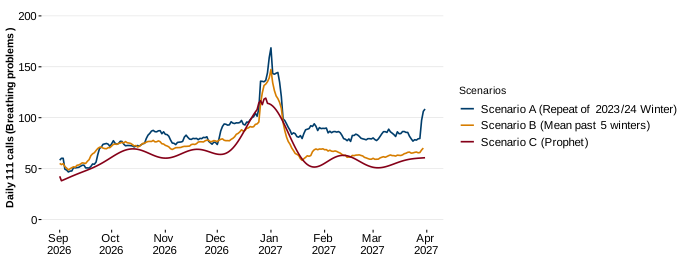
Description of Figure 27: A line chart representing three modelled scenarios of daily 111 calls relating to breathing problems for Winter 2026 to 2027.
Source: SRE calculations using data provided by WAST