
Flying Start, summary statistics April 2025 to March 2026
The report provides a statistical overview of how the programme is working for April 2025 to March 2026.
In this page
Introduction
Flying Start is a Welsh Government early years programme, delivered by local authorities. It provides support for families with children aged 4 and under, particularly in disadvantaged areas with the aim of improving outcomes. The programme provides a package of support including: funded, part-time, high-quality childcare for 2 year olds; enhanced health visiting; parenting support; support for speech, language and communication. Flying Start was launched in 2006, and all 4 elements were expanded to more families from September 2022.
This statistical release covers data collected and submitted by local authorities under the previous government, from April 2025 to March 2026.
Phase 2 and Phase 3 of the early years expansion programme focuses on delivering the childcare element of Flying Start to more 2-year-olds across Wales. Phase 2 began in April 2023, and Phase 3 began in April 2025. This statistical release separately reports on the children being offered and taking up childcare under the early years expansion programme.
Further information on data sources and changes to provision are detailed in the quality and methodology section and in the quality report.
Throughout this release, the term ‘year’ refers to the financial year, which is from April to March. Where this is not the case, the months have been specified.
Main points
In 2025 to 2026
- The number of children receiving a Flying Start health programme contact fell by 5.6% since the previous year but remained just above the expected number.
- The number of contacts by Flying Start staff has fallen since a peak around 2014 to 2015 but has remained stable in recent years.
- A total of 211,000 Flying Start contacts were made.
- Each child received an average of 3.2 health visitor contacts, an increase of 11.1% since the previous year.
- There was a small decrease in the number of full-time equivalent (FTE) health visitors and wider health team staff providing Flying Start services compared to the previous year.
- A higher percentage of children eligible for Flying Start were from Black, Asian and minority ethnic backgrounds than the percentage of ethnic minority children in the general population of Wales.
- Flying Start childcare was offered to families of nearly all eligible children in Flying Start areas (98.5%); the offer was accepted for 85.4% of these children.
- 13,468 additional childcare places were offered as part of the Phase 2 and Phase 3 childcare expansion programme of Flying Start.
Children receiving Flying Start services
The Phase 1 expansion across all elements of the Flying Start programme began in September 2022, therefore the number of children expected to receive Flying Start services increased to 38,500 from 2023 to 2024 onwards. In 2025 to 2026 the expected number remained at 38,500.
Figure 1: number of children in receipt of Flying Start services, 2015 to 2016 to 2025 to 2026 [Note 1] [Note 2] [Note 3]
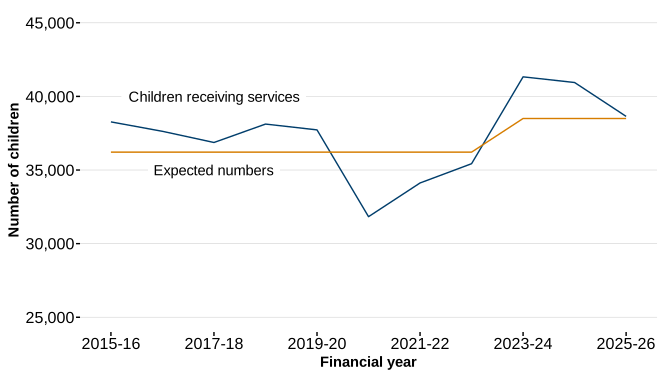
Description of figure 1: line chart showing the number of children receiving Flying Start services exceeded the expected numbers in each year of the programme until 2020 to 2021, and remained below expected until 2023 to 2024.
Source: Welsh Government Flying Start Data Monitoring Returns
[Note 1] The expected numbers increased in 2023 to 2024 following an expansion of the Flying Start programme.
[Note 2] The definition of “children in receipt of Flying Start services” changed in 2023 to 2024. Previously, children in receipt of Flying Start services was defined as the number of children who had a contact with a Flying Start health visitor. In 2023 to 24, all individual children who received a Flying Start health programme contact were counted as in receipt of Flying Start services, whether the contact was made by a Flying Start health visitor or by a member of the wider Flying Start health or local authority team.
[Note 3] Y axis does not start at zero.
In 2025 to 2026, 38,642 children received Flying Start services. This was 0.4% higher than the expected number.
The number of children who a local authority is providing services to is known as the caseload. The number of children and percentage of the child population on health visitor caseloads varies by local authority area and is shown in the StatsWales table linked above.
47.8% of children aged under 4 in Blaenau Gwent were on Flying Start health visitor caseloads (the highest), compared to 18.5% in Monmouthshire (the lowest).
As the eligibility for Flying Start services is area-based, the total number of children in receipt of Flying Start services is affected by the number of children aged under 4 years living in Flying Start areas in each year. This is, in turn, affected by changes to population demographics. The number of 0- to 4-year-olds has decreased by between 0.6% and 3.2% each year since 2012.
As children may move in or out of Flying Start areas during the year, the total number of children counted as receiving Flying Start services, may not actually receive services for the duration of a whole year.
Activity of Flying Start programme
The Flying Start programme enables children to receive services from a range of different professionals, including health visitors; wider health professionals such as dieticians, midwives and social workers; and other staff, such as assistants to fully qualified health staff. More information on staff groups is available in the quality report.
Figure 2: number of contacts by staff group, 2015 to 2016 to 2025 to 2026
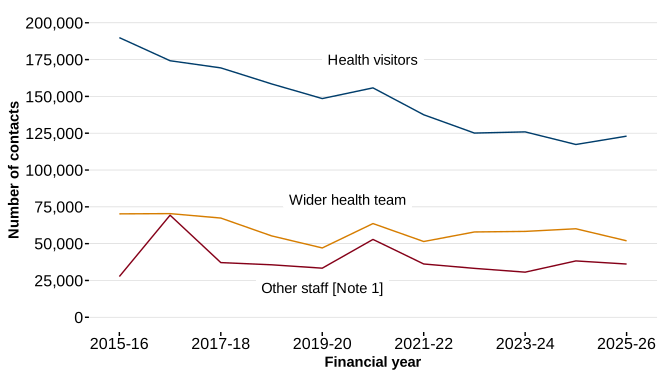
Description of figure 2: line chart showing the number of contacts by Flying Start staff have been on a broadly downward trend between the years 2015 to 2016 and 2025 to 2026.
Source: Welsh Government Flying Start Data Monitoring Returns
[Note 1] The definition of “other staff” includes any unregistered staff. Contacts by other staff are only available from 2015 to 2016 onwards.
The number of contacts with children up to age 4 by health visitors and the wider health team have been on a broadly downward trend since a peak between the years 2014 to 2015 and 2015 to 2016. Contacts by other staff members were recorded from 2015 to 2016 onwards and have remained broadly stable in 6 of the last 7 years.
In 2025 to 2026 there were 123,009 contacts with health visitors, an increase of 4.8% since the previous year; 51,924 contacts with wider health staff, a decrease of 13.6% since the previous year; and 36,155 contacts with other staff, a decrease of 5.5% since the previous year.
Figure 3: average number of contacts per child receiving Flying Start services in the year, 2015 to 2016 to 2025 to 2026
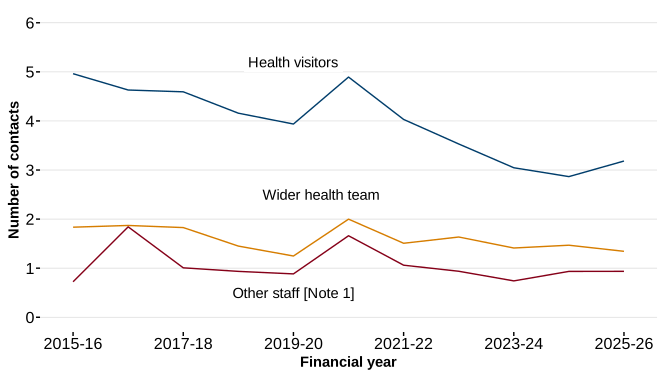
Description of figure 3: line chart showing the average number of contacts per child has been on a broadly downward trend since data was first collected.
Source: Welsh Government Flying Start Data Monitoring Returns
[Note 1] The definition of ‘other staff’ includes any unregistered staff. Contacts by other staff are only available from 2015 to 2016 onwards.
In 2025 to 2026, each child received an average of 3.2 health visitor contacts, an increase compared to the previous year, following a broadly downward trend.
The average number of contacts with the wider health team decreased slightly, while the number for other staff remained the same compared to the previous year. Both have remained relatively stable over time.
The average number of contacts per child in receipt of Flying Start services varies widely by local authority and is shown in the StatsWales tables linked above.
Flying Start workforce
Local authorities submit data on the total number of hours worked by members of each staff group providing Flying Start services. A conversion factor is then applied to estimate the full-time equivalent (FTE) number of staff providing Flying Start services in the year. 1 FTE is the equivalent of a member of staff working 37.5 hours per week. More detail on this is provided in the quality report.
Figure 4: number of full-time equivalent (FTE) staff 2015 to 2016 to 2025 to 2026
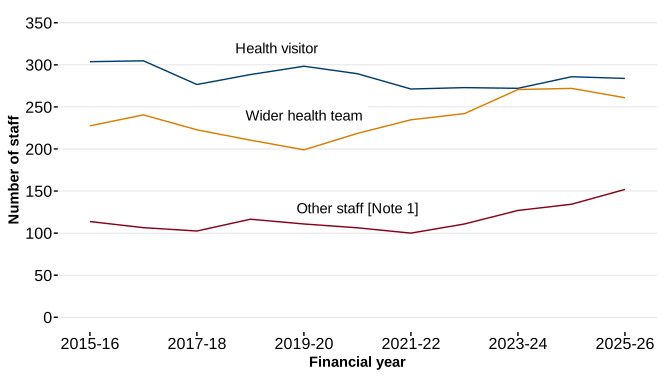
Description of figure 4: line chart showing an initial increase in number of full-time equivalent health visitors up until 2016 to 2017 followed by some year-to-year volatility. There have been increases in the number of FTE staff for both the wider health team and other staff group in recent years.
Source: Welsh Government Flying Start Data Monitoring Returns
[Note 1] Contacts by other staff are only available from 2015 to 2016 onwards.
In 2025 to 2026 there were 284 FTE health visitors, a decrease of 0.7% from 2024 to 2025.
The number of FTE wider health team providing Flying Start services increased until 2016 to 2017, followed by a decrease every year up until 2019 to 2020, before increasing again every year until 2024 to 2025. In 2025 to 2026, there was a slight decrease of 4.1%, to 261 FTE wider health team staff.
There were 152 FTE other staff providing Flying Start services in 2025 to 2026, a 13.1% increase on the previous year.
Characteristics of children on the Flying Start caseload
The number of children on the health visitor caseload in 2025 to 2026 was 34,296 children.
The number of children on the caseload is generally lower than the number of children who have received Flying Start services in the year because families move in and out of Flying Start areas throughout the course of the year and, as children grow older, they may become ineligible for services at a faster rate than new arrivals become eligible.
Figure 5: percentage of caseload by ethnicity, Welsh language and disability, 2015 to 2016 to 2025 to 2026
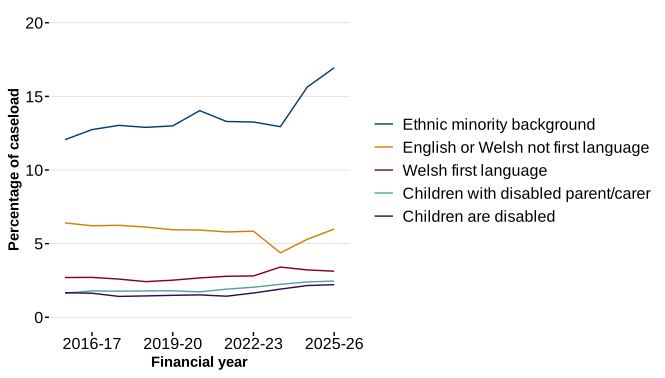
Description of figure 5: line chart showing there has been an increase in the percentage of children on flying start caseload from ethnic minority backgrounds in the past 2 years. Other characteristics have remained relatively stable over time.
Source: Welsh Government Flying Start Data Monitoring Returns
In 2025 to 2026 the percentage of the caseload where children were from an ethnic minority background was 16.9%, a 1.3 percentage point increase since the previous year. For comparison, the 2021 Census (Office for National Statistics (ONS)) estimated that 10% of children aged 0 to 4 in Wales were from an ethnic minority. Also, data from the National Community Child Health Database estimates that between 10% and 17% of new-borns in Wales born between 2018 and 2025 were from an ethnic minority.
The percentage of the caseload where children were from families where English or Welsh was not the first language was 6.0%, an 0.7 percentage point increase since the previous year.
The percentage of the caseload where children were from families where Welsh is the first language was 3.1%, a 0.1 percentage point decrease since the previous year.
The percentage of the caseload where children have a disabled parent or carer was 2.5%, a 0.1 percentage point increase since the previous year.
The percentage of caseload where the child was disabled was 2.2%, the same as the previous year.
Childcare
In 2025 to 2026, parents of 2 to 3-year-old children eligible for all 4 Flying Start elements were offered high-quality childcare for 2.5 hours a day, 5 days a week for 39 weeks of the year. In addition, at least 15 sessions are provided for the family during the school holidays. Families can choose to accept either the full offer or a reduced offer if only some of the sessions are needed.
Figure 6: percentage of full or reduced offers of Flying Start-provided childcare made to newly eligible children, 2015 to 2016 to 2025 to 2026 [Note 1]
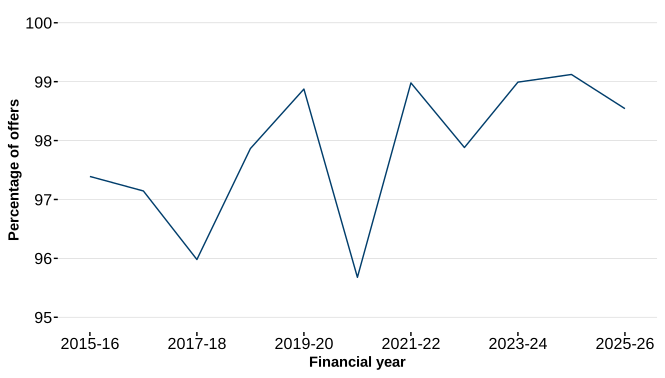
Description of figure 6: line chart showing the percentage of eligible children offered childcare has fluctuated between 96% and 99% over the last 10 years but showed an overall upward trend.
Source: Welsh Government Flying Start Data Monitoring Returns
[Note 1] Y axis does not start at zero
The families of 98.5% of eligible children were offered Flying Start-provided childcare in 2025 to 2026, a decrease of 0.6 percentage points since last year.
19 local authorities offered childcare to families of 100% of the eligible children in their area. Cardiff had the lowest percentage (85.5%) of eligible children offered Flying Start-provided childcare in 2025 to 2026.
While childcare offers are made by local authorities, it is each family’s choice to accept the offer or not.
Figure 7: percentage of children whose families accepted Flying Start provided childcare, 2015 to 2016 to 2025 to 2026 [Note 1] [Note 2]
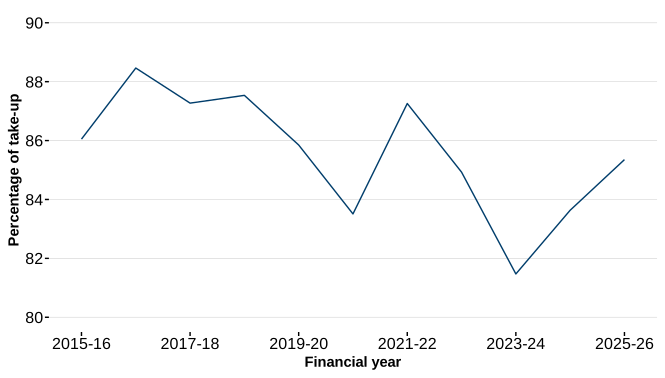
Description of figure 7: a line chart showing the percentage of children whose families accepted Flying Start childcare has remained fairly steady in the last 10 years and varied between 81% and 89%.
Source: Welsh Government Flying Start Data Monitoring Returns
[Note 1] Y axis does not start at zero
[Note 2] This refers to whether the offer of childcare is accepted regardless of whether the child subsequently attends childcare, though some local authorities have provided attendance-based acceptance figures in 2024 to 2025 and 2025 to 2026.
The percentage of children whose families accepted Flying Start childcare increased by 1.8 percentage points in 2025 to 2026 to 85.4%.
The StatsWales table linked above shows how the acceptance rate varied between local authorities. 100% of offers were accepted in Monmouthshire, the highest rates in Wales, compared to 68.0% in Neath Port Talbot, the lowest rate in Wales.
Expansion of childcare provision
Phase 2 and Phase 3 of the early years expansion programme focuses on delivering the childcare element of Flying Start to more 2-year-olds across Wales. Phase 2 began in April 2023 and Phase 3 began in April 2025.
These statistics are based on management information collected by Welsh Government from local authorities to monitor the progress of Phase 2 and Phase 3 of the expansion. They are the best estimate we have on the number of childcare places offered and taken up in April 2025 to March 2026. As the expansion of the programme develops and the way in which these data are collected evolves, these statistics remain badged as official statistics in development (Office for Statistics Regulation (OSR)).
Figure 8: number of childcare places offered, by delivery phase, against the estimated population of 2-year-olds, 2015 to 2016 to 2025 to 2026
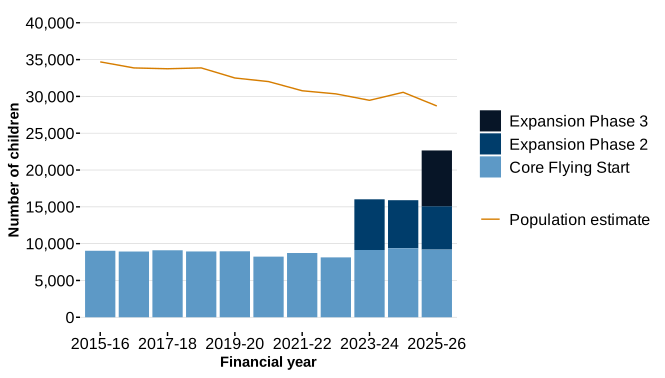
Description of figure 8: a combined bar and line chart. The bars show that the number of childcare places offered to 2-year-olds in Wales through the full Flying Start programme (Core Flying Start) and the phased childcare expansion has increased in recent years, reaching 22,658 in 2025 to 2026 due to the expansion of early years programme. The line shows the population of 2-year-olds, which has steadily decreased over the last 10 years to 28,698 in 2025 to 2026.
Source: Welsh Government Flying Start Data Monitoring Returns
Children offered or attending Phase 2 Flying Start childcare, by local authority | StatsWales
Children offered or attending Phase 3 Flying Start childcare, by local authority | StatsWales
Figure 9: number of childcare places taken up, by expansion phase, against the estimated population of 2-year-olds, 2015 to 2016 to 2025 to 2026 [Note 1]
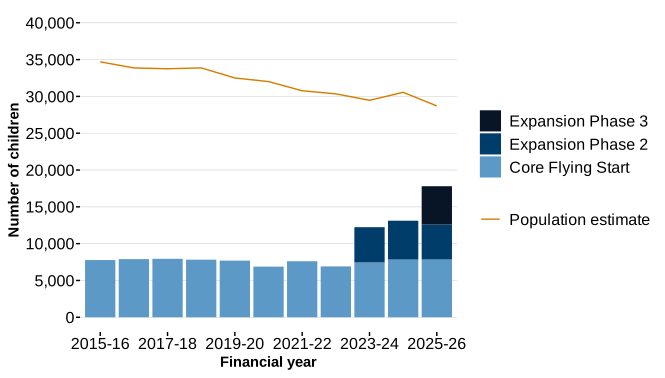
Description of figure 9: a combination of a bar and line chart. The bars show that the number of childcare places taken up in Wales through the full Flying Start programme (Core Flying Start) and the phased childcare expansion has increased in recent years to 17,799 in 2025 to 2026 due to the expansion of early years programme, while the line shows the population of 2-year-olds, which has steadily decreased over the last 10 years to 28,698 in 2025 to 2026.
Source: Welsh Government Flying Start Data Monitoring Returns
Children offered or attending Phase 2 Flying Start childcare, by local authority | StatsWales
Children offered or attending Phase 3 Flying Start childcare, by local authority | StatsWales
[Note 1] From 2024-25, take-up in Phase 2 and Phase 3 is defined as a child attending at least 1 session of Flying Start childcare. For all other measures, take-up refers to whether the offer of childcare is accepted, regardless of whether the child subsequently attends childcare, though some local authorities have provided attendance-based acceptance figures in 2024 to 2025 and 2025 to 2026 for the core offer. See quality report.
In 2025 to 2026, the Phase 2 childcare target was for 5,522 additional 2-year-olds to access high-quality Flying Start childcare. 5,895 places were offered as part of Phase 2, a decrease of 9.7% compared to the previous year. 80.4% (4,742) of places offered were taken up, a decrease of 0.3 percentage points compared to 2024 to 2025. Of the children taking up funded childcare in 2025 to 2026, 1,131 (23.9%) did so in a Welsh-medium setting, an increase of 3 percentage points compared to the previous year.
In 2025 to 2026, the Phase 3 childcare target was for 4,471 additional 2-year-olds to access high-quality Flying Start childcare. 7,573 places were offered as part of Phase 3, of which 68.8% (5,213) places were taken up. Of these, 1,133 (21.7%) took up a funded childcare place in a Welsh-medium setting.
This is the first year for which data on Phase 3 has been collected and published. Some local authorities did not launch their Phase 3 programme until September 2025.
Parenting
Every family with a Flying Start eligible child must be offered formal parenting support every year. In addition to the formal parenting offer, other parenting support may be delivered such as informal parenting support, bespoke enhanced 1-to-1 sessions and informal drop-in sessions. Formal and informal structured courses are defined as those with a structured curriculum and a set start and end date.
In 2025 to 2026 the take-up of courses offered to parents of Flying Start children was 79.6% for formal structured parenting courses, an increase of 4.4 percentage points from the previous year. Take-up was 77.1% for informal structured parenting courses, a decrease of 0.1 percentage points when compared to the previous year. The definition for informal structured courses changed in 2023 to 2024 to only include parenting courses, whereas previous years included informal speech, language and communication courses. Therefore, comparisons of uptake of informal courses cannot be made to years prior to 2023 to 2024.
National and local authority data is available on StatsWales: Number of formal and informal parenting courses taken up and percentage completed, by local authority (StatsWales)
Speech, language and communication
Speech, language and communication (SLC) support is offered to parents as part of the Flying Start programme. New guidance has been issued on how to measure the outcome of SLC interventions. Data collection during 2025 to 2026 included these new measures, but the data is not yet available for publication.
Births in Flying Start areas
In January to December 2025, 22.5% of live births were to mothers who were resident in Flying Start areas, a small decrease since 2024.
This varied between local authorities, from 41.0% in Merthyr Tydfil (highest) and 13.4% in Monmouthshire (lowest). Broadly, this reflects the coverage of the programme in each local authority.
Local authority data is available on StatsWales: Number and percentage of live births to Welsh residents, by Flying Start status and local authority (StatsWales)
Health outcomes
Infant feeding
In 2025, 50.1% babies residing in Flying Start areas were fed any breast milk at 10 days old, compared to 62.6% of those in non-Flying Start areas.
Over the course of the 10-year time series, the gap between the 2 groups has remained relatively stable with the rate between 12 and 16 percentage points lower for babies in Flying Start areas. Both groups have experienced an upward trend over the last 10 years and are at their respective highest on record in 2025.
The percentage of mothers living in Flying Start areas who were breastfeeding at 10 days varied at local authority level from 65.2% in Cardiff (highest) to 30.2% in Wrexham (lowest).
Local authority data is available on StatsWales: Number and percentage of babies who received any breast milk at 10 days old, in Flying Start and non-Flying Start areas, by local authority (StatsWales)
Uptake of routine childhood immunisation
Vaccines are offered to all children as part of the routine childhood immunisation schedule starting 8 weeks after birth. The aim is for all children to be fully immunised by their 4th birthday. More information on the childhood immunisation schedule is available in the quality report.
The percentage of all children who are fully immunised by age 4 has remained broadly consistent since 2013 to 2014, although it has decreased in recent years.
In 2025 to 2026, 80.5% of children living in Flying Start areas were fully immunised at age 4 compared to 85.5% of children living in non-Flying Start areas.
Local authority data is available on StatsWales: Number and percentage of children who are fully immunised by their 4th birthday, living in Flying Start and non-Flying Start areas, by local authority (StatsWales)
The StatsWales table above shows the differences in immunisation rates for Flying Start eligible children living in different local authorities, ranging from 91.9% in Pembrokeshire (highest) to 70.9% in Newport (lowest).
In most local authorities (18 out of 22) immunisation rates were higher for children living in non-Flying Start areas than in Flying Start areas. Anglesey, Gwynedd, Ceredigion and Pembrokeshire all had an immunisation rate over 90% for children living in Flying Start areas, and in these local authorities the immunisation rate was higher for children living in Flying Start areas than non-Flying Start areas.
Healthy weight
The Child Measurement Programme for Wales (Public Health Wales) is a surveillance programme set up in 2011. Public Health Wales deliver a national height and weight measuring programme for Wales, to give a better understanding about how children in Wales are growing. The programme standardises the way in which primary school children (aged 4 and 5) are measured across Wales.
In the academic year 2024 to 2025 (the latest data available) 68.4% of children aged 4 to 5 living in Flying Start areas had a healthy weight compared to 74.0% in non-Flying Start areas. While the percentage of children with a healthy weight in Flying Start areas has been consistently lower than non-Flying Start areas since data was first collected, 2024 to 2025 saw the largest recorded difference between the 2 groups (5.6 percentage points).
Local authority data is available on StatsWales: Percentage of children in ‘healthy weight’ categories for children aged 4 to 5 years resident within Flying Start and non-Flying Start areas, by local authority (StatsWales)
Education: children recorded on roll at a maintained school
The numbers of Flying Start children starting nursery education (the statutory curriculum for all 3- to 7-year-olds in both maintained and non-maintained schools) measures the degree to which Flying Start children are taking-up early years education opportunities.
In academic year 2025 to 2026, 93.4% of children at age 3 living in Flying Start programme areas were recorded on maintained school rolls compared to 81.9% of children at age 3 living in non-Flying Start areas.
The percentage of children living in Flying Start areas on maintained school rolls has remained fairly steady throughout the duration of the programme, varying between 90% and 94%.
National and local authority data is available on StatsWales: Number and percentage of children aged 3, recorded on roll at a maintained school in PLASC, living in Flying Start and non-Flying Start areas, by local authority (StatsWales)
Quality and methodology information
A full quality report is published alongside this statistical release.
Impact of COVID-19
Information about the impact of COVID-19 on this data collection can be found in the quality report that is published alongside this statistical release.
Statement of compliance with the Code of Practice for Statistics
Our statistical practice is regulated by the OSR. OSR sets the standards of trustworthiness, quality and value in the Code of Practice for Statistics that all producers of official statistics should adhere to.
All of our statistics are produced and published in accordance with a number of statements and protocols to enhance trustworthiness, quality and value. These are set out in the Welsh Government’s Statement of Compliance.
These official statistics (OSR) demonstrate the standards expected around trustworthiness, quality and public value in the following ways. This applies to all the statistics in this release apart from those relating to the Phase 2 and Phase 3 expansion of the childcare element of Flying Start which are official statistics in development (OSR). These statistics are not classed as official statistics. However, we have applied the principles of the Code of Practice for Statistics as far as possible during development.
Trustworthiness
These statistics are compiled from a range of sources. The main source of data used in this statistical release is management information collected via the Welsh Government Flying Start Data Monitoring Return directly from local authorities. This data collection started in April 2012 to March 2013. Additional data were requested from local authorities on the Phase 2 and Phase 3 expansion of the childcare element of Flying Start. Supplementary data is sourced from the National Community Child Health Database, the Pupil Level Annual School Census, the Child Measurement Programme, and the Coverage of Vaccination Evaluation Rapidly (COVER) report. ONS mid-year estimates are used for population analysis.
Quality
The published figures provided are compiled by professional analysts using the latest available data and applying methods using their professional judgement and analytical skillset. Statistics published by Welsh Government adhere to the Statistical Quality Management Strategy which supplements the Quality pillar of the Code of Practice for Statistics and the European Statistical System principles of quality for statistical outputs.
Most of the data included comes from administrative sources which are used in the management of the Flying Start services. The data is dependent on local authorities maintaining accurate records but systems are well established and reliable. Supplementary data sourced from other national databases are also of high quality and considered reliable
Data for the Welsh Government Flying Start Data Monitoring Return is collected by Welsh Government directly from local authorities. Local authorities complete data collection forms based on data stored on their respective IT systems and return the completed forms to Welsh Government via Objective Connect, a secure web data transfer system.
Validation checks are performed by Welsh Government statisticians and queries referred to local authorities where necessary. While the Flying Start Monitoring Return has been validated, data from all other sources is requested. The statistical release is then drafted, signed off by senior statisticians and is published in line with statement on confidentiality and data access which is informed by the trustworthiness pillar contained in the Code of Practice for Statistics.
The additional data collected for the Phase 2 and Phase 3 expansion of the childcare element of Flying Start is also compiled by local authorities using data stored on their own IT systems. As 2023 to 2024 was the first year of this expansion, some variation in the definitions used for uptake of childcare and the definition of a Welsh medium setting occurred. Around half of local authorities defined uptake of childcare as acceptance of an offer, whereas others used attendance at a childcare setting as the measure of acceptance. Similarly, there is variation across local authorities in how a Welsh medium setting is defined and the extent to which Welsh is used to constitute a Welsh medium setting. Work is underway to ensure a uniform definition is applied for future data collection.
Value
The purpose of the statistical release is to provide evidence for policy development; to allow local authorities to monitor and benchmark their service provision against all other local authorities in Wales; and to inform for the wider public about provision of the Flying Start programme. The annual statistical release also supports the Welsh Government’s long term plan for health and social care: A Healthier Wales.
The timeliness of the data provides the most recent update using reliable data. Making this information available in this form provides a single definitive source of data on the activity, uptake and provision of the Flying Start programme.
Well-being of Future Generations Act (WFG)
The Well-being of Future Generations Act 2015 is about improving the social, economic, environmental and cultural wellbeing of Wales. The Act puts in place seven wellbeing goals for Wales. These are for a more equal, prosperous, resilient, healthier and globally responsible Wales, with cohesive communities and a vibrant culture and thriving Welsh language. Under section (10)(1) of the Act, the Welsh Ministers must (a) publish indicators (“national indicators”) that must be applied for the purpose of measuring progress towards the achievement of the Well-being goals, and (b) lay a copy of the national indicators before Senedd Cymru. The 46 national indicators were laid in March 2016.
Information on the indicators, along with narratives for each of the wellbeing goals and associated technical information is available in the Wellbeing of Wales report.
Further information on the Well-being of Future Generations (Wales) Act 2015.
The statistics included in this release could also provide supporting narrative to the national indicators and be used by public services boards in relation to their local wellbeing assessments and local wellbeing plans.
Contact details
Children and Families Research
Email: Research.ChildrenAndFamilies@gov.wales
Media: 0300 025 8099
SFR/SB: 28/2026