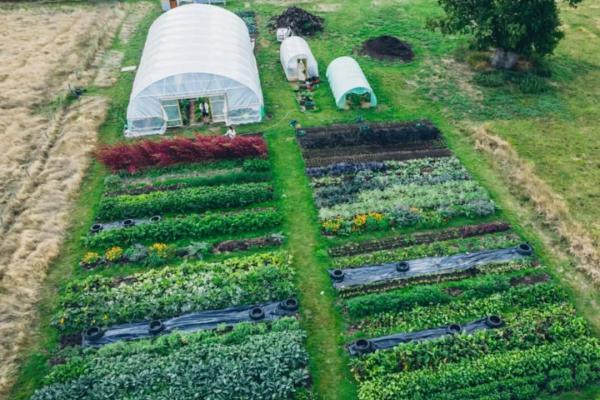
The Future Farm project was developed through a multi-partner collaboration and aligns with Welsh policy priorities.
Introduction
The Future Farms Pilot was established to test a practical and scalable model for enabling new entrant horticultural businesses to access land, secure affordable on-site homes and supply local markets in Powys and wider Wales. Piloted in Sarn, Powys, The Future Farm project was developed through a multi-partner collaboration and aligns with Welsh policy priorities around food resilience, climate, biodiversity, public health, the foundational economy and the well-being of future generations.
The pilot demonstrates how public land can be repurposed for small-scale regenerative food production where planning, partnership, funding and political commitment align. At Sarn, five new entrant growers now operate three independent horticultural businesses with accommodation, shared infrastructure and access to local markets.
The challenge
The project set out to address several structural barriers that make it difficult for new entrant growers to establish viable horticultural businesses. These included access to affordable land, secure housing, planning constraints, infrastructure costs, flood risk, utilities, water security, skills, and the lack of local food production infrastructure.
The Sarn site was bare agricultural land with no existing buildings, no formal drainage and no services connections. The project also had to navigate community concerns, compressed funding deadlines, complex lease arrangements, planning requirements for rural enterprise dwellings, and the need to provide infrastructure that would support three independent businesses without creating unnecessary dependency.
The approach
From the offset, a cross-sector partnership was formed, where it identified land from the Powys County Council farm estate and progressed work to establish three small-scale commercial horticultural holdings at Sarn. Detailed site assessment and feasibility work informed the layout, considering soil, drainage, biodiversity, water supply, access, infrastructure, markets and economics. Planning permission was secured for rural enterprise dwellings, a shared packing shed, polytunnels and renewable energy systems.
The project combined an array of grants including Asset Collaboration Programme Wales capital funding, local authority collaboration, third-sector coordination and specialist input to overcome barriers relating to land access, flood risk, infrastructure provision and planning policy interpretation.
The design included shared infrastructure to reduce the capital burden on growers, while also recognising the importance of business autonomy, separate utilities and infrastructure divisibility for future models.
Contributes towards
- Well-being of Future Generations Act commitments, particularly through prevention, collaboration, long-term thinking and support for healthier, resilient communities.
- Community Food Strategy for Wales, by supporting local food resilience and growth in horticulture.
- Sustainable Farming Scheme and wider policy aims around sustainable land management, biodiversity and climate resilience.
- Universal free school meals and local food procurement ambitions, by helping build local horticultural supply capacity.
- Powys nature recovery, net zero, foundational economy and local food partnership priorities.
- Community asset and public land stewardship objectives by demonstrating how public land can support long-term community benefit and local economic participation.
Impacts and outcomes
- Five new entrant growers are operating three independent horticultural businesses at Sarn, with access to accommodation, shared infrastructure and local markets.
- Planning permission was secured for rural enterprise dwellings, a shared packing shed, polytunnels and renewable energy systems.
- The pilot contributed directly to new local planning guidance for horticultural holdings in Powys and Bannau Brycheiniog National Park, helping reduce uncertainty for future schemes.
- The site has become a live demonstrator for Wales, showing that public land can be repurposed to support small-scale regenerative food production.
- Growers achieved first vegetable sales in June 2025 and started veg boxes in July 2025. Over the final five months of 2025, the veg box scheme sold 455 boxes to 60 households within a 15-mile radius.
- Community engagement evolved from early skepticism to cautious support and, in many cases, active enthusiasm as growers became visible, approachable and involved in local life.
- The project generated learning on blended finance, housing association partnerships, water security, infrastructure design, lease clarity, utilities, community engagement and grower support.
Lessons learnt and future planning
Positive learning includes that public land can be unlocked for new entrant agroecological growers where there is strong partnership working, local authority support and clear political commitment. Affordable on-site housing is essential to viable small-scale horticulture, and shared infrastructure can reduce capital costs when it supports, rather than constraints, business autonomy.
Key challenges included compressed funding timescales, delayed lease completion, uncertainty for growers, planning delays, water-security concerns, infrastructure snagging and the difficulty of balancing short -term affordability with long-term quality.
The next phase is focused on replication, including exploring alternative blended finance models and partnerships with housing associations to reduce reliance on public grant funding while retaining affordability and long-term stewardship controls.