
Jobs Growth Wales+ statistics: April to June 2026
Information on Jobs Growth Wales+ learning programmes and the learners enrolled on them for April to June 2026.
In this page
Introduction
The data in this release covers the first quarter of the 2026 to 2027 financial year (April to June 2026). Figures are provisional and are likely to be revised in future publications as data is updated. The Jobs Growth Wales+ (JGW+) programme came into operation for new starts on 1 April 2022.
Main points
During April to June 2026
- The number of starts was unchanged when compared to the same quarter in the previous year.
- There were 3,990 active JGW+ programmes, of which:
- 3,225 continued from the previous quarter
- 765 were new starts
- The local authorities with the highest number of starts were:
- Cardiff (14.5%)
- Swansea (10.2%)
- Caerphilly (8.5%)
- The local authorities with the lowest number of starts were:
- Denbighshire (0.4%)
- Ceredigion (0.8%)
- There were 910 JGW+ programmes that were completed.
- The local authorities with the highest number of completed programmes were:
- Cardiff (11.6%)
- Rhondda Cynon Taf (11.5%)
- Pembrokeshire (10.7%)
- The local authorities with the lowest number of completed programmes were:
- Denbighshire (0.0%)
- Conwy (0.2%)
- Flintshire (0.6%)
- There were 1,200 JGW+ programmes that ended.
- 60.9% of leavers had a positive outcome based on their destination within 8 weeks of completion.
- 295 JGW+ participants self-reported their destination as Employed (Full-time, Part-time or Self-employed) after completing or leaving the programme.
At the end of June 2026
- 2,790 programmes were continuing.
- There had been 21,745 programme starts since the programme began in April 2022, of which:
- 18,955 have ended
- 13,085 have completed
Figure 1: destination of Jobs Growth Wales+ leavers, April to June 2026 (provisional)
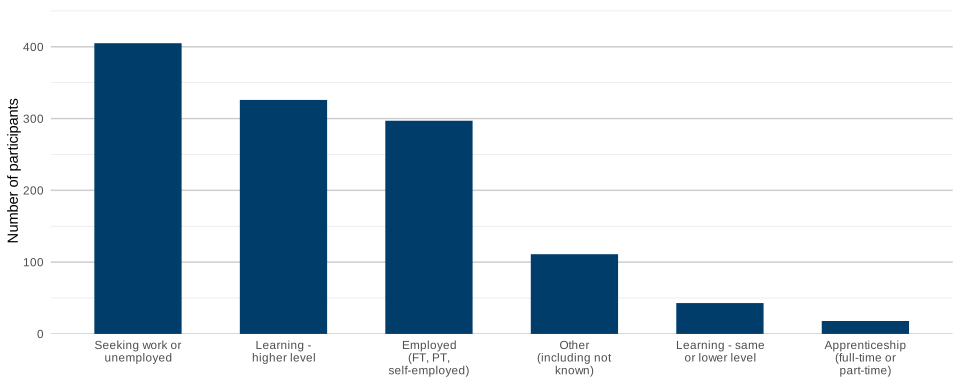
Description of figure 1: this bar chart shows the number of Jobs Growth Wales+ leavers between April to June 2026 by self-reported destination after completing the programme. The largest single category is ‘Seeking work or unemployed’ at 405 participants (33.8%), followed by ‘Learning – higher level’ at 325 participants (27.2%) and ‘Employed’ at 295 participants (24.8%).
Participant values are rounded to the nearest 5.
All destinations are self-reported by the programme participants within eight weeks of leaving their JGW+ programme.
Source: Lifelong Wales Learning Record (LLWR)
Background and context
The purpose of the Jobs Growth Wales+ Youth Programme is to deliver consolidated and individualised training, development and employability support to 16 to 19-year olds who are assessed as NEET (Not in Education, Employment or Training) at the time of starting the JGW+ programme.
The JGW+ programme is aimed at breaking down the barriers that young people who are NEET face and allowing them to reach their full potential. This is integral to the Welsh Government’s commitment to unleashing the potential of the Welsh economy, and creating good, well-paid jobs.
The main delivery objectives of the JGW+ programme are to:
- contribute towards a reduction in the number of 16 to 19-year olds who are NEET
- achieve positive outcomes for 16 to 19-year olds at risk of becoming NEET
- progress Well-being of Future Generations objectives by delivering employability support for 16 to 19-year olds that:
- provides equal opportunities (including Welsh language)
- promotes wellbeing and fair work
- helps embed environmental approaches that reduce harm
The period from 1 March 2022 to 31 March 2022 was a period of transition for learners previously on the Traineeships programme.
The proportion of JGW+ starts and completions by local authorities might be influenced by the population of 16 to 19 year olds in each local authority. For instance, a local authority with a higher population of 16 to 19 year olds is likely to account for a higher proportion of starts and completions.
From the start of the JGW+ programme in April 2022 through to the end of December 2023, the destinations of JGW+ leavers represented the destination within 4 weeks of leaving the programme. From January 2024 this has been adjusted to measure destinations within 8 weeks of leaving the programme.
Positive outcomes
Positive outcomes are measured on the learner’s destination within 8 weeks of leaving their JGW+ programme. For learners on the Engagement and Advancement Strands, a positive outcome is either:
- progression to learning at a higher level
- progression into employment (full-time, part-time or self-employment)
- progression to an Apprenticeship
For learners on the Employment Strand, a positive outcome is either:
- progression into employment (full-time, part-time (16 or more hours per week) or self-employment)
- progression to an Apprenticeship
For disabled learners, employment of less than 16 hours per week is also classed as a positive outcome.
Voluntary work, further learning at the same or lower level, and employment of less than 16 hours per work are all classed as neutral outcomes. Learners with these outcomes are excluded from the denominator when calculating positive outcome rates.
Seeking work or unemployed and all other outcomes (including where the destination within 8 weeks is not known) are classed as negative outcomes.
All destinations are self-reported by the programme participants.
Statement of compliance with the Code of Practice for Statistics
Our statistical practice is regulated by the Office for Statistics Regulation (OSR). OSR sets the standards of trustworthiness, quality, and value in the Code of Practice for Statistics that all producers of official statistics should adhere to.
All our statistics are produced and published in accordance with several statements and protocols to enhance trustworthiness, quality, and value. These are set out in the Welsh Government’s Statement of compliance.
These official statistics demonstrate the standards expected around trustworthiness, quality, and public value in the following ways.
Trustworthiness
The JGW+ programme offers young people a holistic approach to employability support. Programme participants will have an Individual Learning Plan to be developed and delivered by procured contractors who will support them to attain the skills, qualifications and experience that enables them to progress learning at a higher level, or into fair and sustainable employment (including self-employment) or an apprenticeship.
JGW+ Contractors must submit information to the Welsh Government, via the Lifelong Wales Learning Record (LLWR), at least monthly on all young people, their programmes, activities, and awards under the JGW+ programme. The JGW+ programme specification details the data recording and submission requirements for contractors.
These statistics are pre-announced on the Statistics and Research area of the Welsh Government website. Access to the data during processing is restricted to those involved in the production of the statistics, quality assurance and for operational purposes. Pre-release access is restricted to eligible recipients in line with the Code of Practice (UK Statistics Authority).
Quality
The published figures provided are compiled by professional analysts using the latest available data and applying methods using their professional judgement and analytical skillset. Statistics published by Welsh Government adhere to the Statistical Quality Management Strategy which supplements the Quality pillar of the Code of Practice for Statistics and the European Statistical System principles of quality for statistical outputs.
Files submitted for upload to the LLWR undergo a series of validation checks. Welsh Government officials work with contract holders to resolve any data related issues, where necessary.
Welsh Government statisticians undertake final checks before drafting this statistical release, which is then signed off by senior statisticians and published in line with the statement on confidentiality and data access which is informed by the trustworthiness pillar contained in the Code of Practice for Statistics.
Occasionally, revisions can occur due to errors in our statistical processes or when a data supplier notifies the Welsh Government that they have submitted incorrect information. In these cases, a judgement is made as to whether the change is significant enough to publish a revised statistical release. Where changes are not deemed to be significant, figures will be corrected if they appear in future releases.
Value
The purpose of the statistical release is to provide evidence for policy development, inform the wider public about the activity and performance of the JGW+ programme and to enable contract holders to monitor their own performance.
The timeliness of the data provides the most recent update using reliable data.
You are welcome to contact us directly with any comments about how we meet these standards. Alternatively, you can contact OSR by emailing regulation@statistics.gov.uk or via the OSR website.
Data source
Data is drawn from the August 2026 freeze of the LLWR. JGW+ Contractors must submit information to the Welsh Government at least monthly on all young people, their programmes, activities and awards under the JGW+ programme.
All numbers have been rounded to the nearest 5. Percentages are calculated on the unrounded numbers.
Contact details
Labour Market and Skills Statistics
Email: labourmarket.stats@gov.wales
Media: 0300 025 8099