
Welsh language data from the Annual Population Survey: July 2025 to June 2026
Data on people’s ability in Welsh and how often they speak the language for July 2025 to June 2026.
In this page
Introduction
These estimates were previously classified as accredited official statistics. Due to a fall in sample sizes in the Annual Population Survey (APS) in recent years, and because the survey has not been reweighted to the latest population estimates, this accreditation has been removed, and the estimates are now designated as official statistics (Office for Statistics Regulation, OSR). The Office for National Statistics (ONS) has confirmed that it will not seek to regain accredited official statistics status for the Labour Force Survey (LFS) and APS, instead focusing its efforts on ensuring that the Transformed Labour Force Survey (TLFS) meets the requirements for accreditation, with OSR agreeing to this approach.
It is still appropriate to use these statistics. However, please note the increased uncertainty around estimates derived from the APS. Estimates for smaller geographies or population sub-groups are less reliable.
Users should consider trends presented in this release alongside other data on Welsh speakers, such as from the National Survey for Wales. The Welsh Government considers the census of population to be the key source of information to measure the number of Welsh speakers in Wales.
Census 2021 results about the number of people able to speak Welsh were published in December 2022. Census estimates of Welsh language ability continue to be lower than estimates from household surveys such as the APS. However, this was the first time that the census estimated declining numbers of people able to speak Welsh at the same time as the APS estimated an increasing number of people able to speak Welsh.
Users should note that there are fundamental differences between these data sources, including differences in how the data are collected and their timeliness.
In April 2023, we published a joint workplan with the ONS, which details further work to improve our understanding of these differences. We have since published a statistical article exploring differences between estimates of Welsh language ability in Census 2021 and the Labour Force Survey, which is the basis for the APS, together with the results of a short survey on the need for data on Welsh language outside Wales. An update on the progress of other projects outlined in the workplan is provided below.
Main results
Figure 1: number of people aged 3 years or older able to speak Welsh, 2001 to June 2026
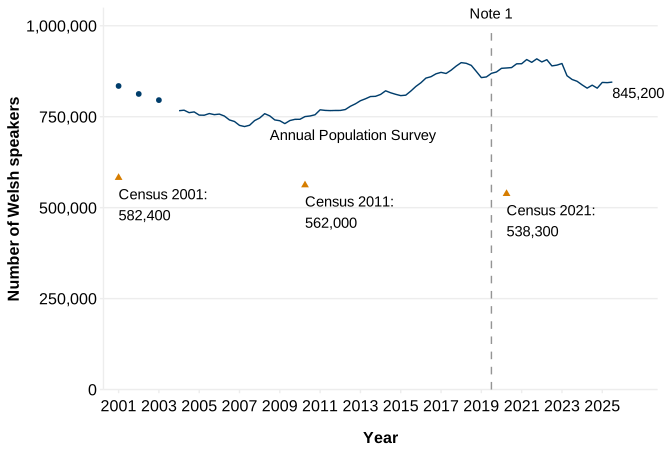
Description of figure 1: the line chart shows that the number of Welsh speakers has declined in general over the past 2 years. Despite the recent fall, the overall trend since March 2010 has been one of growth (25.2%, 731,000), following a gradual decline between 2001 and 2007. According to the APS, there were an estimated 845,200 Welsh speakers living in Wales in the year ending 30 June 2026. The number of Welsh speakers recorded in the 2001, 2011 and 2021 Census are plotted on the same chart, labelled 582,400, 562,000 and 538,300 respectively.
Source: APS (ONS) and population census (ONS).
[Note 1] Changed to phone interviews only in March 2020. Face-to-face interviews were reintroduced in autumn 2023.
For the year ending 30 June 2026, the APS estimated that 27.4% of people aged 3 years or older were able to speak Welsh. This figure equates to around 845,200 people.
The latest estimate is around 0.2 percentage points higher than the year ending 30 June 2025 when an estimated 27.2% of people aged 3 years or older were able to speak Welsh. This increase is not statistically significant and should be interpreted with caution due to a change in the survey mode between the 2 periods, and the temporary suspension of the accredited official statistics status of the APS as a result of increasing uncertainty outlined above.
Children and young people aged 3 to 15 years were more likely to report that they could speak Welsh (48.3%, 234,300) than any other age group. This is consistent over time, but the percentage of children and young people aged 3 to 15 years who can speak Welsh has been decreasing in general since the beginning of 2019.
The highest estimated numbers of Welsh speakers are found in Cardiff (93,900), Gwynedd (93,300) and Carmarthenshire (85,500).
The lowest estimated numbers of Welsh speakers are in Merthyr Tydfil (7,400) and Blaenau Gwent (8,500).
The highest estimated percentages of Welsh speakers can be found in Gwynedd (75.9%) and the Isle of Anglesey (64.6%).
The lowest estimated percentages of Welsh speakers are in Merthyr Tydfil, Blaenau Gwent (both 12.3%) and Bridgend (12.7%).
31.5% (972,300) reported that they could understand spoken Welsh, 25.0% (771,400) could read and 22.5% (693,800) could write in Welsh.
Note
The Annual Population Survey (APS) is a UK-wide survey conducted by the ONS. The APS, which began in 2004, is compiled from interviews for the Labour Force Survey (LFS). Details about how the survey is developed and carried out can be found on the ONS website.
The APS results should not be compared with census results, nor used to measure progress towards the Welsh Government target of a million Welsh speakers by 2050. The previous Welsh Government’s Welsh language strategy, Cymraeg 2050, clearly states that this target was based on census data and that progress towards this target will be monitored using census of population data.
The census results and APS results for 2001, 2011 and 2021 have been included on the chart above to show the differences between the 2 sources at the same time periods. Differences in the estimates of Welsh language ability between the census and household surveys such as the APS are longstanding, and both the ONS (‘Differences in estimates of Welsh Language Skills’) and the Welsh Government (‘Welsh language data from the Annual Population Survey: 2001 to 2018’) have explored possible reasons for some of these differences in the past. For example, the census is a statutory self-completion questionnaire while the APS is a voluntary survey, which uses face-to-face and telephone interviews. A blog post published by the Chief Statistician in 2019 ('Chief Statistician’s update: a discussion about the Welsh language data from the Annual Population Survey'), discussed briefly how to interpret the Welsh language data from the APS.
Statistics on frequency of speaking Welsh are not included in this release. A methodological issue was identified during quality assurance work, and the calculation method is currently under review. We will reintroduce these statistics once the revised methodology has been finalised and quality assured.
Update on the joint workplan with the ONS
In April 2023, we published a workplan which outlines the work that the ONS and the Welsh Government are planning to undertake to improve our understanding of the main survey and administrative data sources used to produce statistics about the Welsh language. This workplan was accompanied by a blog post published by the Chief Statistician ('Chief Statistician’s update: plans to improve the coherence of Welsh language statistics in Wales').
While some elements of the programme have taken longer than originally anticipated because of the complexity of the data linkage work and the associated governance and approvals processes, work continues on the remaining projects.
A data linkage project comparing responses collected through the Census and the National Survey for Wales is nearing completion, with findings expected to be published during autumn 2026. This work is expected to provide a more detailed understanding of the factors that influence how people report their Welsh language skills across different data sources.
Work is also underway to develop a further data linkage project combining survey responses with administrative data from the Pupil-Level Annual School Census. Building on earlier analyses, this project will explore the characteristics of children whose Welsh language ability is recorded differently across sources.
In parallel, research continues into the impact of data collection methods, including online, telephone and face-to-face surveys, on information collected about the Welsh language.
The ONS is also continuing its programme of labour market transformation and development of the Transformed Labour Force Survey (TLFS) (ONS). The ONS published an update on the progress of the labour market transformation project and the future design of the TLFS in August 2026.The implications of these changes for Welsh language statistics will continue to be considered as the coherence programme progresses.
Together, these projects will provide additional evidence to improve understanding of differences between the main Welsh language data sources and support monitoring of progress towards the ambitions of Cymraeg 2050.
Changes to the survey
Following government advice regarding the coronavirus (COVID-19) pandemic, the APS as well as all other ONS face-to-face studies about people, families and households were suspended. Further details of these changes can be found in a statement on the ONS website: Ensuring the best possible information during COVID-19 through safe data collection.
Face-to-face interviews were reintroduced in autumn 2023, for all Labour Force Survey (LFS) wave 1 and 2 cases. The APS switched from face-to-face to phone interviews in mid-March 2020 due to the COVID-19 pandemic and subsequently during the dual run with the TLFS. The ONS has been monitoring the impact this change has had on the survey and as a result have re-weighted the estimates accordingly.
By comparing people who completed the survey over the telephone with people who completed the survey face-to-face in the period before March 2020, respondents did appear to be more likely to state that they could speak Welsh when answering the survey over the telephone.
At present, it is not possible to say whether any recent changes in Welsh language ability are as a result of the change in the way the survey is conducted, or real changes in the population’s ability in Welsh. The results should therefore be interpreted with caution.
These estimates were previously classified as accredited official statistics. Due to a fall in sample sizes in the APS in recent years, and because the survey has not been reweighted to the latest population estimates, this accreditation has been removed, and the estimates are now designated as official statistics. The ONS has confirmed that it will not seek to regain accredited official statistics status for the LFS and APS, instead focusing its efforts on ensuring that the TLFS meets the requirements for accreditation, with OSR agreeing to this approach.
It is still appropriate to use these statistics, however, please note the increased uncertainty around estimates derived from the APS. Estimates for smaller geographies or population sub-groups, however, are less reliable.
Data
Following the beta launch of the new StatsWales platform, since 26 September 2025 all new and updated datasets are published exclusively via the new service. More information about the new service is available in the Chief Statistician’s blog: six months on: an update on the new StatsWales open data service. The old StatsWales site is no longer available.
Datasets and interactive tools
Review of publication arrangements
We are reviewing our arrangements for the publication of Welsh language statistics from the APS to ensure that they continue to effectively meet consumer needs. This includes considering options for future publication of data and analyses.
If you would like to provide feedback on how you use this data, please contact the Welsh Language Statistics team.
Contact details
Welsh Language Data
Email: welshlanguagedata@gov.wales
Media: 0300 025 8099