This is a collaborative project being undertaken by Flintshire County Council (FCC), and Denbighshire County Council (DCC), to transform the archive service provision across both councils.
Introduction
Both Authorities have a legislative duty to hold, maintain, conserve and make available archive material.
FCC’s archive is housed in the Old Rectory, Hawarden, which was designed for historical residential use. The building has been retrofitted with archive storage facilities, a conservation room, a search room and reference library and staff accommodation. It currently opens to the public 3 days per week.
DCC’s archive is within Ruthin Gaol, which was designed for incarceration. 70% of the building has been repurposed for the archive service, with the remainder of the building used by the Heritage Service as a visitor attraction. Archive storage is provided in the 64 cells which are each separately monitored. There is a search room and reference library and staff facilities. It currently opens to the public 3 days per week.
The services provided include a traditional archive service offer with a limited number of events. A web site enables users to access some of the collection online, Digital media is used to promote the service and events.
The challenge
Both archive services had reached a critical point where their existing facilities could no longer provide a sustainable future for the service, and they were unable to transform how the region’s documentary heritage was protected, accessed and shared.
The archive buildings require significant capital investment to keep them functional and have reached their practical and operational limits. Storage capacity is close to being exhausted, some accommodation no longer meets modern archive requirements, and the buildings restrict the ability to provide the specialist environmental conditions needed to preserve nationally significant collections.
The operation of ageing buildings is labour intensive, and creates operational inefficiencies, reducing the capacity of staff to focus on audience development, partnership working, volunteering and digital access hence limiting opportunities for public engagement.
The need for change has been driven by the changing expectations of communities. The current facilities have limited space for learning, exhibitions, community activity and creative engagement, making it difficult to attract new audiences or deliver the inclusive programme that communities have told us they want. The consultation undertaken, has demonstrated strong demand for an archive service that is more welcoming, accessible and relevant, reflecting the diverse histories and experiences of North East Wales.
The approach
Both authorities recognised that their archive services faced similar challenges and choose to work together, to find a joint solution.
A Project Board comprising senior officers and the respective Lead Members for the service area was established. A client project manager from DCC’s Corporate Project Team was allocated to support the development and delivery of the project, and a project structure including officers from across both councils has been established. Both services have committed to shared project and service development costs, and the relationship is currently governed by a Memorandum of Understanding.
Working in partnership to deliver an improved and sustainable archive service for North East Wales, the project aimed to:
- create a shared archive service for FCC and DCC to enable both authorities to combine their resources and to continue to undertake their respective statutory duties.
- relocate the collections of both authorities, to a secure environmentally controlled environment where they can be easily accessed and preserved for future generations.
- engage more people from a wider demographic in the archive collections, using the stories of the past and relating them to present day audiences.
To achieve the aims, the project design included:
- the creation of a single shared service, to formalise the existing joint working relationship between FCC and DCC, which is known as North East Wales Archive Service, (NEWA).
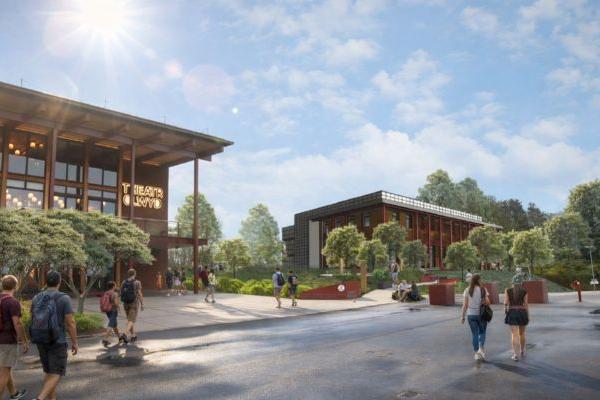
- the construction of a new net zero carbon in operation purpose-built archive centre, with a repository built using Passivhaus principles, (although not accredited as such), to house both the physical Archives & the new Service operations
- an outreach programme, which will make the collections accessible to a wider and more diverse audience.
Element 1
NEWA was formed in April 2020 with the joint archive service operating over 2 sites – The Old Rectory in Hawarden & Ruthin Gaol.
Element 2
A site adjacent to Theatr Clwyd in Mold was selected after extensive feasibility work across both authorities. The site enables great potential for partnership work with Theatr Clwyd, using archives to promote inclusion and involve wider range of people in heritage, which has already commenced. It will also provide an opportunity to establish a cultural hub at the gateway to North East Wales.
Element 3
An outreach programme is currently being delivered on a small scale whilst NEWA operates over 2 sites. The move to a new archive centre will release capacity to deliver larger scale engagement activities, using partners such as libraries, care homes, schools, and Theatr Clwyd to reach out to local communities.
The project is currently funded by grants from The National Lottery Heritage Fund, (the Heritage Fund), Welsh Government and financial contributions from both councils.
The project structure included five workstreams:
- Capital Build which is being led by an Employers Agent who is acting on behalf of DCC who is delivering the capital scheme. A Design and Build Contractor has been procured via the North Wales Construction framework. The scheme is currently part way through RIBA stage 4.
- Legal workstream which is being led by the Client Project Manager which includes the development of collaborative agreements and a lease that reflect the project delivery arrangements, future ownership and service delivery. This will replace the Memorandum of Understanding.
- Engagement Work Programme which is being led by the Community Officer from the archive, and includes market assessment, consultation, and piloting of activities to refine the activity plan
- Business Change which is being led by the Joint Archive Service Manager which has included the appointment of the community officer and the evaluation consultant for the project, the development of a business plan, and other plans for marketing, volunteering, interpretation, fundraising, training for the NEWA team, funder recognition, and management and maintenance for the new archive facility. The Student placement provision, TUPE process and the Partnership agreement/Memorandum of Understanding with Theatr Clwyd were also included in this workstream.
- Relocation workstream which is being led by NEWA archivists and the Conservator, includes an expanded packaging programme and bar coding of the collections in readiness for moving, a procurement specification for the decant and relocation of the collections and equipment, and the development of new environmental monitoring arrangements
Contributes Towards
DCC’s Corporate Plan
- Supports ‘A Healthier, Happier Caring Denbighshire’ through the engagement work planned
- Supports a learning and growing Denbighshire through the engagement work planned, development of bilingual resources and volunteer opportunities.
- Supports ‘A greener Denbighshire’ as the Project will make a least a neutral contribution but more probably a positive contribution to the Council becoming Net Carbon Zero and Ecologically Positive by 2030.
- Project Listed in DCC’s Corporate Plan - “Working in partnership to deliver an improved and sustainable archive service for North East Wales”
FCC’s Corporate Plan
- Supports the ‘Green Society and Environment priority’ by limiting and enhancing the impact of the Council’s Services on the natural environment
- Supports ‘Personal and Community Wellbeing’, through supporting people in need to live as well as they can
- Supports ‘Education and skills’ through the wider engagement work that is planned and the improved digital offer.
- Contributes to ‘A Well Managed Council’ as the joint service will provide resilience
Well-being of Future Generations (Wales) Act 2015
A Wellbeing Impact Assessment has been completed, and the contribution that the project makes is as follows:
- A prosperous Denbighshire and Flintshire – Positive
- A resilient Denbighshire and Flintshire – Neutral
- A healthier Denbighshire and Flintshire – Positive
- A more equal Denbighshire and Flintshire- Positive
- A Denbighshire and Flintshire of cohesive communities- Positive
- A Denbighshire and Flintshire of vibrant culture and thriving Welsh Language- Positive
- A globally responsible Denbighshire and Flintshire – Neutral
Impacts and outcomes
Element 1: the creation of a single shared service
This is working well and is benefitting from areas such as shared costs, skills-sets, catalogue, website, staff resilience, social media etc. NEWA has also been awarded archives accreditation, as a joint service. The service already has greater resilience, and the involvement of staff both leading and within the workstreams, has exposed them to new learning and invested them in the project.
Element 2: the construction of a new net zero carbon in operation purpose-built archive centre
The project is currently at RIBA stage 4. The involvement of the archive staff in the detailed design, has defined the operational spaces required within the building and has informed some of the construction detailing and methodology. Lessons learned from other archive projects have been incorporated. Future proofing has been built into the design to provide flexibility and longevity. A PassivHaus consultant with wide experience of repository construction and operation was engaged to advise the client team, with a view to minimising the mechanical and electrical plant and equipment required.
Element 3: an outreach programme which will make the collections accessible to a wider and more diverse audience
Through the work already done via the engagement workstream, extensive consultation has been carried out with regular users, harder to reach groups and others. Further to the consultation, a wide range of activities have already been identified, piloted, evaluated and refined. As a result, many more groups know what an archive is, the work that is does and the opportunities for learning and engagement that are available. The specific needs of some groups have informed the design of the building.
Lessons learnt and future planning
The importance of competitive tendering
The Design and Build contract was tendered via a framework that enabled a direct award. Further to the completion of RIBA stage 2, the scheme was retendered. This has resulted in more value going into the building and improved the client’s ability to manage risk.
Programme development
The development of a programme for the project that was efficient and met the funders and Council approval timescales was critical. This took some time to get right but was worth the investment of time at the outset, as it has helped to manage risk at key decision points.
Sufficient and adequate resource for the project and strategic leadership
There have been some significant project set- backs, but the strategic leadership provided by senior officers has kept the project vision and requirement on track. Given that the project has benefitted from Welsh Government and the Heritage Fund grants, there have been resource pressures associated with grant application deadlines and associated processes, which have been challenging at times.
Key stakeholder engagement
Early and continued engagement is important, as is the value of site visits to demonstrate where the building will be located, and its relationship to other site features and services.
Weekly Joint Officer Group meetings
These have helped to coordinate the delivery of the capital aspects between both authorities, within the context of the wider plans for the site.