Toolkit for insourcing in Wales by The Centre for Local Economic Strategies (CLES)

First published: 19 December 2022
Last updated: 19 December 2022

1. Introduction

Foreword

Within the refreshed Programme for Government, under the pledge to ‘Make our cities, towns and villages even better places in which to live and work’ there is a commitment to:

“… explore where services and contracts can sustainably and affordably be brought back into a strengthened public sector.

The Centre for Local Economic Strategies (CLES) have been appointed by the Welsh Government to review the procurement landscape in Wales and to produce a toolkit to help organisations across the public sector in Wales put that commitment into practice.

The key policy driver behind the commitment of exploring insourcing is the pursuit of a socially just, fair work agenda for Wales, recognising that insourcing can result in enhanced local employment conditions.

This toolkit for insourcing in Wales highlights the importance to embed a systematic and proactive approach to consider insourcing and the impact insourcing can make to service models. Such an approach takes a rounded view of value for money, applying a Well-being of Future Generations Act lens to service design options. The toolkit will help guide organisations to put the commitment into practice, to consider insourcing at a strategic level.

This toolkit will help to ensure that insourcing is routinely considered with a clear thread from the Well-being of Future Generations Act running through the decision-making process of the service design options. However, it is important to note that the responsibility of routinely considering insourcing does not just sit with procurement; insourcing needs to be considered holistically within organisations, with ‘buy’ in from senior leaders.

Moving forward, the toolkit should be used as a proactive and routine appraisal for insourcing against the Well-being Goals and Ways of Working, with a view to achieving longer term social and economic goals and improved population well-being, as well as service efficiency and quality, which can also affect costs in in the long term.

Image

John F Coyne
Director, Commercial & Procurement
Welsh Government

Introduction and purpose of the toolkit

The Programme for Government contains a commitment to:

“… explore where services and contracts can sustainably and affordably be brought back into a strengthened public sector.”

The Welsh Government has commissioned the Centre for Local Economic Strategies (CLES) to produce a toolkit to help organisations across the public sector in Wales put that commitment into practice.

The toolkit has been produced by CLES with support from APSE (Association for Public Service Excellence).

It aims to provide advice, guidance, and information on:

  • The policy background, rationale, and strategic case for exploring the potential to insource.
  • Prompts and touchpoints in the service planning and commissioning cycle where insourcing should be considered.
  • The types of services and contracts which should be considered.
  • An options appraisal methodology to guide the decision-making process.
  • A generalised ‘roadmap’ for the various stages of the insourcing journey.
  • Key considerations and risks.
  • Case studies.

What is insourcing?

There are a number of potential definitions and interpretations about what is meant by ‘insourcing’. However, a broadly accepted definition is the cessation of a previously outsourced contract and the re-establishment of the service under the direct operation and control of a public authority (Rebuilding capacity: the case for insourcing public contracts. APSE, 2019). One key factor here is the direct employment relationship between the public authority and the employees delivering the service.

Insourcing is likely to be explored as one of a range of different service model options, across a spectrum from in-house to outsourced. These vary in terms of the degree of control exercised by the public authority and not all models are available across all parts of the public sector in Wales (for example, health boards in Wales do not currently have the power to establish or have share interests in subsidiary companies or cooperatives).

Service model Typical characteristics
In-house Where a public authority runs a service itself and has a direct employment relationship with the employees delivering the service.
Direct service organisation A business unit established by a public authority to undertake specific types of work, e.g., construction or maintenance. Staff are employed by the public body.
Shared service organisation A business entity established by 2 or more public bodies to provide services across them. Staff are either be employed directly by one of the parent organisations, or by the shared service organisation.
Wholly owned company A separate company, which generates revenues from the public sector (and potentially the private sector). Staff are employed directly by the company. The degree of public sector control varies depending on the governance model adopted.
Joint venture A commercial partnership set up by 2 or more entities, where risks and benefits are shared, typically free to trade more broadly. Joint ventures can take several forms, e.g., public-commons partnership, or public-private partnership.
Outsourced Where private or third sector businesses are contracted to provide goods or services. Staff are employed by the contractor.

Who is this toolkit for?

The toolkit is applicable for all parts of the public sector in Wales. It is intended to assist and inform anyone who has responsibility for spending public money or who has influence over service design and delivery approaches. This will include:

  • Welsh Government departments and civil servants
  • Chief Executives and Directors of Finance
  • Directors and heads of service
  • Service designers and commissioners
  • Procurement leads
  • Trade unions
  • Local government councillors (in both cabinet and overview and scrutiny roles)
  • Board and committee members

Structure of the toolkit

1. Background to public service insourcing in Wales

  • Introduction and purpose
  • Rationale and context
  • The case for public service insourcing

2. Guide to exploring the potential for insourcing

  • Prompts and touchpoints in the service planning and commissioning process
  • Types of services which should be considered for insourcing
  • An options appraisal methodology
  • A’ roadmap for the insourcing journey’
  • Key considerations and risks

3. Information and advice

  • Case studies

The toolkit includes:

  • Key messages – summary, headline points
  • Further information – more detailed narrative and explanation
  • Useful resources – such as checklists
2. Background

Rationale and context

Key messages

The key policy driver behind the commitment on insourcing in the Programme for Government is the pursuit of a socially just, fair work agenda for Wales, recognising that insourcing can result in enhanced local employment conditions.

However, as is explored elsewhere in this toolkit, insourcing has the potential to contribute positively across a range of other domains, wellbeing goals and objectives.

The rationale for the approach outlined in this toolkit is that in exploring the potential to insource services and contracts, public sector organisations in Wales do so in a way that:

  1. Systematically applies a Wellbeing of Future Generations lens to service design and delivery options,
  2. Achieves strategic synergy – not considering insourcing in isolation, but instead having regard to the full range of policy commitments set out in the Programme for Government, in addition to existing statutory frameworks governing the public sector,
  3. Takes account of the specific local economic context, and
  4. Seeks to strengthen the public service core

Well-being of Future Generations Act

The Well-being of Future Generations Act provides the high-level context for the desired outcomes which Welsh Government is seeking to achieve by prompting consideration of insourcing, and the proposed decision-making criteria to be applied by public sector organisations when doing so.

The table below provides an illustration of how insourcing can contribute, either directly or indirectly, to the wellbeing goals.

Table 1: Potential contribution to wellbeing goals
Wellbeing goal Potential contribution
A prosperous Wales

By progressing the fair work agenda (better pay, improved terms and conditions, and better opportunities for development and career progression).

By strengthening local supply chains.

A resilient Wales

By reversing the trend toward delivery of public services for private gain, restoring public values in public sector delivery.

Safeguarding against market instability and market failure.

A healthier Wales By pursing a socially just, fair work agenda, recognising the contribution of good work as a social determinate of health.
A more equal Wales By contributing to improved and more universal access to public services.
A Wales of more cohesive communities

By supporting increased access to key services delivered as part of a vibrant foundational economy.

By considering insourcing as part of a suite of approaches, with an explicit aim that the approach should enhance and not undermine the role and contribution of community organisations, locally rooted democratic businesses and the third sector.

A Wales of vibrant culture and thriving Welsh language Because insourced services will be delivered in line with public bodies existing commitments in relation to Welsh language and culture.
A globally responsible Wales Through more direct control of supply chain relationships.

The 5 ways of working described in the Act are relevant to the decision-making criteria adopted and the process of insourcing.

Table 2: Alignment to the Well-being of Future Generations Act – ways of working
Way of working Alignment
Long term: Looking to the long term so that we do not compromise the ability of future generations to meet their own needs

By framing insourcing in terms of its potential contribution to key societal and economic challenges facing Wales including the climate and nature emergency, and the economic consequences associated with the legacy of deindustrialisation.

By focusing on market stability and resilience to ensure sustainable service delivery over the longer term.

Integration: Taking an integrated approach so that public bodies look at all the well-being goals in deciding on their well-being objectives

By ensuring that the approach to insourcing developed for Wales works in synergy with other policy commitments in the Programme for Government, as part of an integrated approach where a range of possible models are assessed in terms of their potential contribution to fair work, social justice and wellbeing.

By supporting an integrated approach to delivery - exploring how insourcing can maximise the potential for service integration and partnership working to deliver in the wider public interest, as opposed to against a more narrowly defined service specification.

Prevention: Understanding the root causes of issues to prevent them from occurring

By explicitly positioning the fair work objectives of an insourcing approach as a longer-term preventative factor, in a wellbeing economy approach.

This is consistent with the need for public bodies to look at future trends and take preventative steps now for the longer term.

Involvement: Involving a diversity of the population in the decisions that affect them

By evaluating insourcing through an industrial relations lens.

By ensuring that the process of insourcing is rooted in citizen, service user and workforce engagement and involvement

Collaboration: Working with others in a collaborative way to find shared sustainable solutions

By ensuring the approach developed is underpinned by the Welsh Government’s commitment to work in social partnership.

By exploring how insourcing can promote collaboration, particularly as an alternative to profit-seeking, extractive behaviours in the outsourced market

Strategic synergy

Consideration of insourcing should be as part of a systematic and regular options appraisal of service design and delivery approaches – for example, in anticipation of the end of a procurement contract period and before considering contract renewal. The potential pros and cons of insourcing in relation to national and local strategic priorities should be explored as well as cost and operational service implications.

In terms of national priorities, other Programme for Government commitments are relevant in this context, as explored below.

Provide effective, high quality and sustainable healthcare

Insourcing could work in support of this policy objective, by reducing the friction in developing a collaborative public sector focus on prevention and tackling health inequalities. Whist this is not impossible to achieve via outsourced services – for example, a recent NHS Confederation report (Leisure and Culture Trusts Health and Wellbeing Support to the NHS in Wales. NHS Confederation, 2022 ) highlighted examples of collaboration between the NHS and leisure and culture trusts – direct collaboration between Public Service Board partners would arguably be easier if those services were all inhouse.

The process of outsourcing requires commissioners to delineate a specific service specification through the procurement process. In so doing there is a risk that specifications are narrowly described, inadvertently excluding opportunities to flex provision or innovate in the broader public interest.

Protect, re-build and develop our services for vulnerable people

Insourcing is of particular relevance to the commitments to pay care workers the real living wage and to eliminate private profit from the care of children looked after. However, insourcing can be positioned as part of a broader spectrum of more generative service models, including not-for-profit and cooperative models of delivery. Clearly this policy commitment is also contingent on social care funding to commissioners being commensurate with living wage staff costs, regardless of model of delivery.

Build an economy based on the principles of fair work, sustainability and the industries and services of the future

Insourcing can support the strengthening of local supply chains in that it is easier to influence supply chain relationships directly rather than through the procurement process. Outsourcing providers, particularly larger national or multi-national providers, will often have national supply chain arrangements and may not be able to flex towards more local provision. This is particularly an issue in more rural or remote areas.

Additionally, the public sector is arguably more influenceable than private, outsourced providers in terms of the 30% target for working remotely.

Build a stronger, greener economy as we make maximum progress towards decarbonisation. Embed our response to the climate and nature emergency in everything we do

The processes of service design or review and the development of options appraisals are opportunities to proactively consider how a service design or model could be adapted to support carbon reduction objectives. Insourcing can be a vehicle to achieve higher environmental standards as opposed to trying to influence the market through the procurement process. The closer the proximity of service provision to local policy, the easier it is to ensure adherence to those policies. As APSE reported (Insourcing: a guide to bringing local authority services back in-house. APSE, 2009): “in-house teams are far more likely to adhere to Green Accords and local environmental strategies”. This is particularly relevant in the current context where public bodies will be strengthening policy in line with climate emergency commitments. Again, however, insourcing is not the only model. For example, there may be opportunities to partner with a local social enterprise, community business or cooperative that has explicit environmental and social objectives – for example, one designed with circular economy principles.

Make our cities, towns and villages even better places in which to live and work

Insourcing explicitly sits under this objective in the Programme for Government. It could also impact on other commitments under this objective. The commitment to “Establish Unnos, a national construction company, to support councils and social landlords to improve the supply of social and affordable housing” (Programme for government: update. Welsh Government) prompts an interesting question for the insourcing work, in that the same rationale on whether to bring services back into the public sector could also be applied to the development of new public sector provision as alternatives where there are market gaps or known extractive practices.

Build on our approach to the Foundational Economy and develop a Backing Local Firms Fund to support local businesses

The interface with foundational economy work, including the role of progressive procurement as a lever, is of particular importance, and a nuanced approach will be needed to ensure that exploring the potential for insourcing supports and doesn’t undermine foundational economy objectives.

As CLES set out in their recent publication on employee ownership in Wales :

The Welsh government is committed to strengthening the foundational economy in Wales as a cornerstone of their economic strategy. The foundational economy is a concept that has been developed to describe the economic importance of the goods, services and other forms of provision that are necessary for a “good life to be enjoyed by as many people as possible”. This can include a diverse range of policy areas including housing, childcare, utilities, health, education, public parks/recreation and culture. Traditionally, many of these goods and services were provided by the state as part of a collective endeavour because of their importance in providing the foundations of a better life for workers, and in recognition of their importance for a more inclusive economic system.

However, in recent decades, programmes of privatisation have disrupted traditional ideas about how everyday services are provided and also given powerful corporate actors access to public services, data and money. There is ample evidence that this transfer of ownership and provision means that these services are often delivered more for the benefit of private rather than public interest.

Measures which provide the basis to disrupt monopolies of foundational economy provision, or at the very least question its power, are vital to help ensure that workers, particularly those on the lowest incomes, can continue to access the everyday goods, services and other provision that are essential to help them live a life that they have a reason to value.

(Owning the workplace. Sean Benstead and John Heneghan, CLES. 2022)

There are both potential benefits and risks posed for the foundational economy agenda by insourcing. As set out above, insourcing can reverse the trend toward delivery of public services for private gain, restoring public values in public sector delivery. The foundational economy accounts for every 1 in 4 jobs in Wales, presenting a significant opportunity for insourcing to affect fair employment as a lever of progressive economic development. However, other mechanisms of delivery also have a potential role to play in this regard, including delivery via worker owned cooperatives, the not-for-profit sector, and social enterprise.

All these approaches can be used to progress the fair work agenda (better pay, improved terms and conditions, and better opportunities for development and career progression). They can also contribute to improved and more universal access to public services. However, these benefits are with caveats – it cannot be presumed that all private operators are bad employers (or indeed that all public provision is good). There have been significant efforts – supported by the Welsh Government procurement policy statement to drive social value driven through procurement, and there many examples of good private sector provision.

However, insourcing does provide for a more stable and sustained approach to achieving social value. When public procurement is flexed to deliver a positive social value return there can be a tendency for positive changes not to be sustained, for example if supply chains are subsequently offshored.

Public sector procurement can also provide a stable level of baseline demand for Welsh SMEs and other generative economic actors, which contributes to the objective to grow the “missing middle” - establishing a stable base of medium sized Welsh firms capable of selling outside Wales but which have decision-making rooted firmly in communities.

Nurturing the third sector, including social businesses, not-for-profit enterprises, and democratic businesses such as worker-owned co-operatives, is key to maximising the benefits of a foundational economy approach. These organisations, provided they sit within a generative business structure, are hard-wired to redistribute surplus and benefits locally, so increasing their prominence in the economy, locks more wealth and benefits into local communities. It will be important, therefore, to ensure that the insourcing approach does not result in reducing the very demand which is nurturing this generative local economic activity.

Public sector bodies will also want to have in view the relative pros and cons across the spectrum of service delivery models. For example, social enterprise/cooperative models can result in:

  • The ability to access different forms of finance, including grants and income generation from commercial activities which can in some cases cross-subsidise other aspects of service delivery.
  • Enhanced citizen engagement in decisions and delivery – e.g., member-led businesses. Social enterprise tends to be based in, and formed of, the local community.
  • Ability to work across geographical administrative boundaries.
  • Ability to integrate with communities, for example, by working with existing volunteering and community activity.

However, there are only limited circumstances in which procurement can explicitly be ringfenced for social enterprises, and not all social enterprises have a generative ownership structure (for example, some social enterprises are arms of profit-making corporations).

As CLES pointed out in its recent report on employee ownership in Wales (Owning the workplace. Sean Benstead and John Heneghan, CLES. 2022), even when democratic businesses do feature in public sector supply chains, these have tended to be management buyouts, as opposed to worker cooperatives, and be at risk of corporate acquisition. Whilst there should always be an imperative to develop progressive procurement approaches which seek to maximise the role of generative business in supply chains, the reality of competitive procurement is that these may be displaced by more extractive competition when tenders come up for renewal. Insourcing, conversely, can lock in these local economic benefits over the longer term.

There are some services where there is a particularly strong case for their delivery via social enterprise or cooperative models – including some aspects of social care. However, there is also a compelling argument that Welsh Government will only be able to fully maximise the levers at its disposal for fair work in the social care sector if significant elements of provision are brought within the public sector.

Housing is another example of where social enterprise models have realised additional benefits – since the move towards stock transfer to housing associations, delivery has often stayed in the ‘public sphere’ but with additional freedoms to innovate. Particularly in Wales, housing associations have tended to have remained smaller, and firmly committed to a public service ethos. These include mutual models providing an equal voice for tenants, owners, and community.

However, some social enterprise organisations will likely not be able to match the pay and conditions of the public sector unless additional funding is made available through commissioning.

The local economic context

Choices in respect of service design and delivery should be made having regard to the specific local economic context, in particular the make-up of the local economy in terms of its ‘generative’ capacity, and the nature of provision of foundational economy goods and services.

Issues of scale may also be relevant, with insourcing particularly prioritised on larger-scale provision, where the current delivery mechanism is more extractive, as opposed to smaller contracts where insourcing could potentially conflate with the Welsh foundational economy agenda of supporting the development of the cohort of medium-sized firms in Wales.

Strengthening the public service core

A central consideration ought to be the extent to which services are seen as a core to the public service being delivered. No public sector organisation could ever be, or would want to be, fully self-sufficient – there will always be a need to procure some goods and services. The NHS in Wales, for example, does not want to be in the business of manufacturing hospital beds or surgical equipment. However, what we have seen over many years across the UK has been large scale outsourcing of some essential frontline and back-office services as if they are peripheral.

These services – catering and cleaning, for example - are often delivered by workers at the lower ends of the pay scale and frequently have female dominated workforces. Their cost-base is predominantly labour costs, so any ‘efficiencies’ from outsourcing are inevitably at the expense of terms and conditions, most notably pensions contributions. The services these workers provide are as vital to public service outcomes as other parts of the public sector workforce, so there is a moral, as well as a social and economic case, for them to be brought back into a strengthened Welsh public sector. Consideration of what is core versus peripheral should therefore be a key part of a public body’s decision-making. Additionally, insourcing of core services will then yield greater ability to influence the peripheral.

Social Partnership and Public Procurement Bill

In so far as insourcing can contribute to fair work objectives, the approach complements fair work objectives being pursued through the Social Partnership and Public Procurement Bill.

The Bill provides for a framework to enhance the well-being of the people of Wales, including by improving public services, through social partnership working, promoting fair work and socially responsible public procurement.

The strategic case for exploring the potential to insource

Key messages

Insourcing has the potential to deliver long-term benefits for local places and communities, particularly relevant in the context of the Wellbeing of Future Generations Act, as well as advantages at the organisational level.

Place-based benefits can include:

  • Local economic benefits – such as improvements to local labour market conditions, the strengthening of local supply chains and keeping more wealth circulating in local economies.
  • Increased community wellbeing and satisfaction – for example, when insourcing leads to improvements in service quality or accessibility.
  • Environment and sustainability – by bringing service delivery within the direct remit of a public sector organisations own environmental or sustainability policy it may be easier to achieve higher standards than by trying to influence the market through the procurement process.

Organisational advantages can include:

  • Strengthened governance – by bringing decision-making and service delivery closer together.
  • Increased flexibility – by not being constrained by narrowly described service specifications which can limit the ability to flex provision or innovate in the broader public interest. This flexibility can also be used to develop more integrated approaches to service delivery, for example at the neighbourhood level.
  • Stability of provision – by removing risks associated with potential market instability or market failure.

It is important that these factors are routinely considered, and not just as a reactive response, for example to concerns about the cost or quality of current provision. This means embedding a systematic and proactive approach to considering the implications of choices in relation to service models and approaches. Such an approach would take a rounded view of value for money, applying a Wellbeing of Future Generations Act lens to service design options.

This agenda provides a further opportunity for public bodies to reflect on their wellbeing plans and assessments and ensure that consideration is given to how the potential organisational benefits associated with insourcing link back to their wellbeing objectives.

It is also a further opportunity to ensure that spending and procurement are considered at the strategic level – consistent with the expectation in the Social Partnership and Public Procurement Bill to produce a procurement strategy.

Place-based benefits

Local economic benefits

At the local economy level, labour market conditions have significant bearing on wellbeing objectives. Good work is an essential component of a more inclusive local economy geared towards reducing inequalities and improving health. Good work means:

  • Paying fairly and offering lasting security
  • Ensuring good working conditions
  • Enabling a good work life balance
  • Providing training and opportunities to progress

Insourcing to a strengthened Welsh public sector can be used to positively influence the local labour market, using the direct employment relationship to ensure good terms and conditions for groups who would otherwise be in weaker labour market conditions. Public sector organisations are often sizeable local employers so this can also have a wider influence in the local economy beyond any benefits for the specific insourced workforce.

Insourcing can also support the strengthening of local supply chains in that it is easier to influence supply chain relationships directly rather than through the procurement process. Outsourcing providers, particularly larger national or multi-national providers, will often have national supply chain arrangements and may not be able to flex towards more local provision. This can particularly be an issue in more rural or remote areas where tier 1 suppliers may themselves not be locally based.

In the context of local economic development insourcing can be a key tool to support local economies by combating wealth extraction. Here, there is particular potential to prioritise the consideration to insource where the Welsh public sector is reliant on providers which extract wealth that could otherwise be used to provide additional benefits for citizens and the state. Removing the role of private-equity- and venture-capital-backed providers in the care sector would be one such example. Recent reports have highlighted the prominent role of private equity firms in the UK care home sector. This includes firms with beneficial ownership via offshore tax havens which use debt and financial restructuring arrangements to extract profit disguised as rent and loan repayment costs (Plugging the leaks in the UK care home industry. Vivek Kotecha. 2019). More generally, businesses which are geared towards generating returns for distant shareholders are likely to generate less local economic multipliers than locally rooted and more democratic businesses.

Community wellbeing and satisfaction

For many public bodies the decision to insource has been a pragmatic one, driven by concerns about the quality of service provision. Insourcing leads to greater direct control and therefore enhanced ability to focus on improving service quality to increase user satisfaction levels.

Environment and sustainability

The processes of service design or review and the development of options appraisals are opportunities to proactively consider how a service design or model could be adapted to support carbon reduction objectives. Insourcing can be a vehicle to achieve higher environmental standards as opposed to trying to influence the market through the procurement process. The closer the proximity of service provision to local policy, the easier it is to ensure adherence to those policies. As APSE reported (Insourcing: a guide to bringing local authority services back in-house. APSE, 2009): “in-house teams are far more likely to adhere to Green Accords and local environmental strategies”. This is particularly relevant in the current context where public bodies will be strengthening policy in line with climate emergency commitments. Again, however, insourcing is not the only model. For example, there may be opportunities to partner with a local social enterprise, community business or cooperative that has explicit environmental and social objectives – for example, one designed with circular economy principles.

Organisational advantages

Strengthened governance, continual improvement, responsiveness, and flexibility

Insourcing can strengthen governance by bringing decision-making and service delivery closer together.

More generally, good governance in the public sector should go beyond a narrow focus on service and cost efficiency. It should also be about place stewardship and maximising public sector organisations contributions as positive agents of change, working towards a strategic vision for their locality. Consideration of insourcing as part of an options appraisal of potential service delivery models has a role to play in this regard – by evaluating options through a Wellbeing of Future Generations Act lens, and taking account of the broader social, economic, and environmental implications associated with different service model options, as well as issues of service delivery and cost.

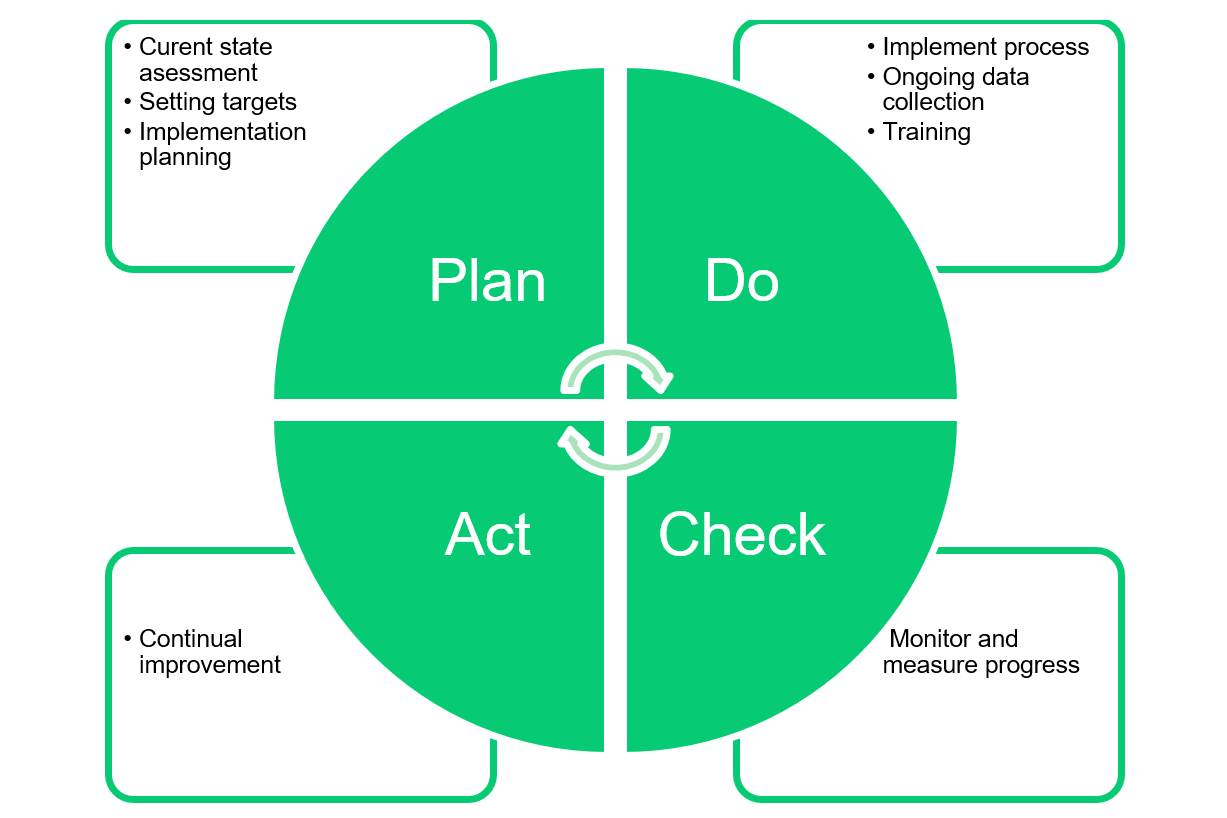
One of the functions of governance in the public sector is to create the conditions under which continual improvement can take place. This is typically achieved through the service planning process - an ongoing process that uses performance monitoring data to feed into service improvement planning and implementation. Whilst there are clearly definable elements to service planning, the process is cyclical. Examples of models include Plan Do Check Act (PDCA) from Lean Six Sigma. The diagram below illustrates how this is an ongoing process focussed on continual improvement through marginal gains. This approach is intended to avoid the disruptive and often counterproductive upheaval that major, periodic change creates.

Image
Plan Do Check Act (PDCA) from Lean Six Sigma

Plan

  • Current state assessment
  • Setting targets
  • Implementation planning

Do

  • Implementation process
  • Ongoing data collection
  • Training

Check

  • Monitor and measure progress

Act

  • Continual progress

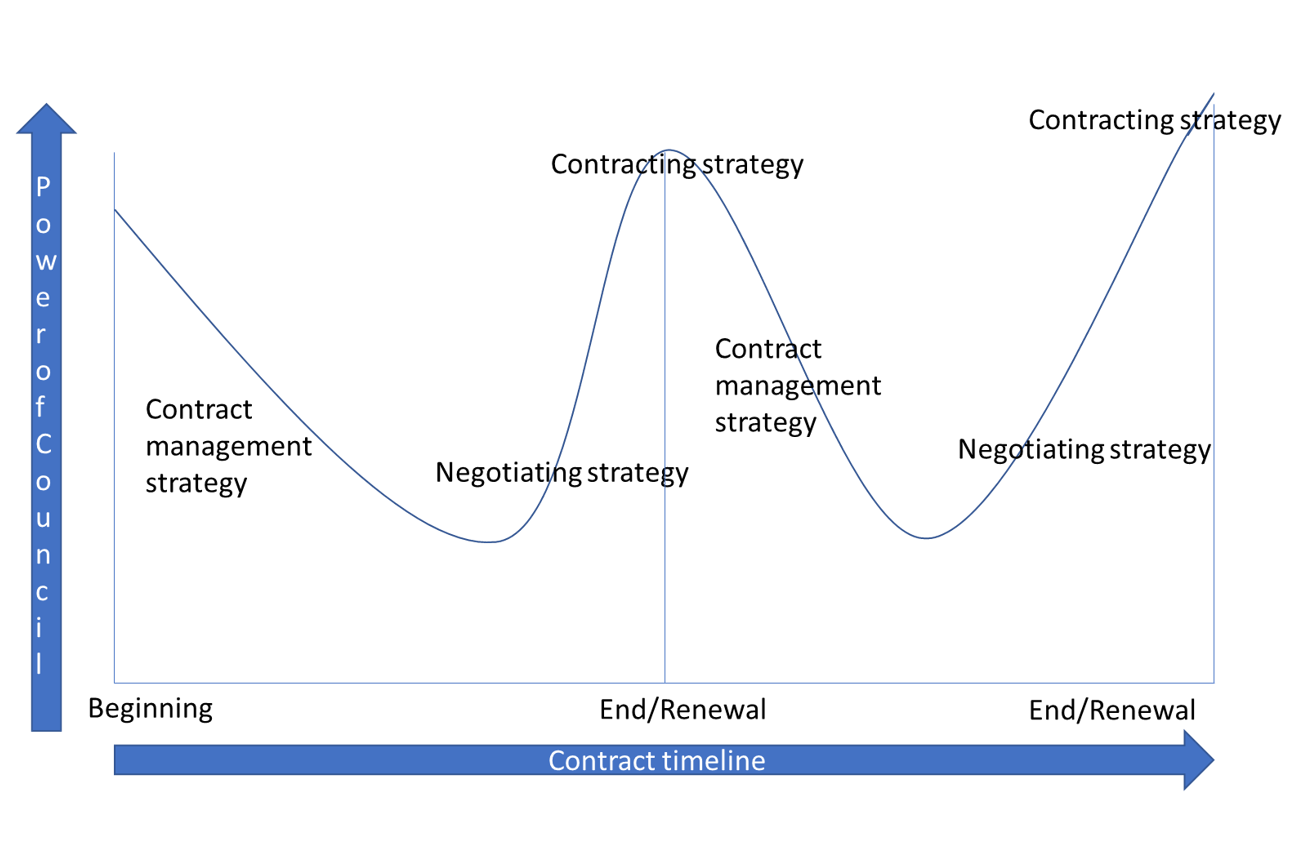
Outsourcing can limit the effectiveness of this approach. This is because although in theory the same principles ought to apply to contracted out services and should inform contract management strategy, in practice contracts are essentially linear, with defined beginning, review and end points. Most of the time contracting authorities are in a relatively weak position and unable to force through changes outside of contractual mechanisms. Unexpected changes in priorities can be difficult to accommodate, reducing the ability of authorities to respond to supply side pressures or demand side changes.

Contract change mechanisms are often constrained, ineffective and costly. It is only at the contract letting and contract renewal stage that contracting authorities are really able to act to ensure that changing priorities and objectives are reflected in contractual terms. In between these points they are often in weak negotiating positions. Long term contractual arrangements can therefore mean that opportunities for significant change rarely come along.

Image
Variation in the power of the council over the duration of the contract timeline

Contracts exist to define and crystalise the terms of an agreement between the parties to them. They are intended to protect parties from unilateral changes implemented by other parties. The benefit of this is that parties have clarity over risk – suppliers have guaranteed income, so can safely invest in staff and equipment, whilst contracting authorities have guaranteed supply at a pre-agreed price. Notwithstanding that contractors do nonetheless sometimes walk away from contracts or secure increases in price or reductions in requirements, under threat of doing so, the process of crystalising contractual terms does as a matter of course drastically reduce the ability of contracting authorities to adapt to changes in patterns of demand or supply side pressures.

Directly delivered services, however, organised for continual improvement are often more able to adapt to supply side pressures such as reductions in funding or labour shortages. Resources can be moved within and between different service areas to create dynamic synergies that can be very difficult to achieve in a far less fluid contracting environment. A whole system approach that integrates different activities to deliver joint strategic objectives can achieve high levels of efficiency whilst still being responsive to changing needs and requirements. This includes periods when patterns of demand are distorted by external factors or events. This was clearly seen during the COVID-19 pandemic when directly provided council and other public services proved to be highly flexible and adaptable to new requirements, such as organising support to vulnerable people.

Stability of provision

Insourcing can also provide for more stability of provision, removing the risks around potential market instability and market failures. There are prominent recent examples of significant market failures in outsourced services - the collapse of Carillion and the recent decision to bring probation services fully back in house in England and Wales being notable examples.

3. The potential for insourcing

Prompts and touchpoints in the service planning and commissioning cycle

Key messages

The potential for insourcing should be explored routinely and not just as a reactive response, for example to concerns about the cost or quality of current provision. This means embedding a systematic and proactive approach to considering the implications of choices in relation to service models and approaches.

This means building in opportunities to explore insourcing: 

  • as part of the regular cycle of service review and planning
  • as part of internal governance mechanisms, such as review or scrutiny processes
  • in anticipation of the end of a procurement contract period and before considering contract renewal

To support this process, it is important to have a robust and transparent approach to data, to make visible the value of outsourced contracts and the scale of outsourced work by service area.

Further information

At a practical level, embedding a more systematic and proactive approach to considering the implications of choices in relation to service models and approaches requires consideration of:

  • Strategy and governance
  • Service design and review processes
  • The cycle of commissioning and procurement

Strategy and governance

At a strategic level, this means acknowledging the contribution that choice of service delivery model can make in relation to the fair work agenda and other strategic priorities and, where appropriate, making this explicit. This may require a shift in emphasis from positioning the responsibility for service design simply as an operational choice, where service specifications, cost, and efficiency are the guiding factors, to acknowledging its relevance at a strategic level and contribution to the Wellbeing of Future Generations goals and ways of working.

This may differ in emphasis across different types of public sector organisation, but could include:

  • Framing insourcing in terms of its potential contribution to priorities identified in Public Service Board Wellbeing Plans – for example, the climate and nature emergency, the fair work agenda, and local economic development
  • Recognising the contribution of good work as a social determinant of health

There are various touchpoints in the governance arrangements and decision-making cycles of public sector organisations where the consideration of insourcing can be prompted or encouraged. In terms of political and governance cycles this could include:

  • Manifesto commitments of local politicians – where elected politicians at a local level have clearly articulated to the electorate that consideration of insourcing is a political priority.
  • Public Service Board Wellbeing Plans – the process of agreeing, refreshing and implementing Wellbeing Plans provides an opportunity for cross-partner discussions on how an approach to insourcing could contribute to local wellbeing priorities
  • Governance meetings – provide an opportunity for committee or board members to question or challenge the degree to which insourcing has been considered. This could include cross-partner discussions at the Public Service Board as well as via individual organisations governance structures (e.g., cabinet, overview and scrutiny, committees, or board meetings)

Operationally, opportunities to consider insourcing will arise as part of the annual process of service review and the commissioning and procurement cycle, and this can be embedded into the service planning process and the ongoing process of contract management and review.

Checklist

  • Policy and decision makers in my organisation are aware of the commitment to explore insourcing and how this relates to other commitments in the Programme for Government.
  • There is awareness, at a strategic level, of the potential contribution that insourcing can make to the 7 Wellbeing Goals and 5 Ways of Working in the Wellbeing of Future Generations Act.
  • Mechanisms are in place, at both organisational and Public Service Board levels, to routinely consider the strategic case for exploring insourcing (place-based benefits and organisational advantages).

Types of services which should be considered for insourcing

In comparison to the position in England, public bodies in Wales have not historically embraced outsourcing to the same degree as their English counterparts. Wales is therefore starting from a baseline of less outsourced services to potentially return to a strengthened Welsh public sector. This is in part a reflection that despite a UK-wide shift towards increased marketisation and fragmentation of public services from the 1980s onwards, Wales has consistently maintained a stronger focus on public value and the importance of the public service ethos.

Due to the fragmented nature of reporting and classification it is difficult to provide an accurate quantification of the scale of outsourcing by public service area. Published reports (Government outsourcing. Institute for Government, 2020) on UK-wide data suggest that just over a quarter of the money spent on adult social care goes on in-house providers, with the figure being significantly higher for children’s social care.

42% of UK-wide waste collection budgets were spent with outsourced providers in 2018/19.

A 2013 National Audit Office report (The role of major contractors in the delivery of public services. National Audit Office, 2013) stated that 4 large contractors (Atos, Capita, G4S and Serco) accounted for a significant proportion of outsourcing in the UK across all public services. Examining the Atamis spend data for the Welsh public sector reveals that spending with these firms in Wales was £43m in 2018/19 and £30m in 2019/20 (note that this analysis is based on matching supplier names, not a complete analysis of beneficial ownership across all suppliers).

Based on stakeholder engagement, currently outsourced services with the most potential to insource are:

  • Facilities management
  • Catering
  • ICT
  • Leisure
  • Social Care

It is recognised that there are specific issues and nuances which will need to be considered on a case-by-case basis.

In relation to catering, for example, a key barrier to insourcing is concern about the internal capacity of individual public sector organisations to navigate the complex regulatory regimes and auditing requirements relevant to food preparation and service. However, this capacity is likely to exist, particularly within local authorities, suggesting that a more creative partnership approach across Public Service Board partners could unlock opportunities to insource.

Catering is also a good example of where some outsourcing decisions are made because the outsourced provision provides a valuable and ongoing income generation opportunity. For example, franchised café facilities on public estates can provide ongoing revenue streams without the risks associated with insourced provision. This suggests a need, over the longer term, for Welsh Government to consider how the funding regimes for different parts of the Welsh public sector can strike to achieve the right balance and incentivise activity which delivers a broader societal benefit but at the expense of individual bodies’ balance sheets where there is a compelling case to do so.

Social care provision requires more nuanced consideration. There is a compelling case for removing profit from social care provision, and an existing commitment in the Programme for Government to do so in relation to services for children looked after. There is a compelling case to minimise the presence of extractive providers in local care markets. However, wholescale insourcing could undermine the valuable contribution of the third sector and democratically owned provision, which provides enhanced reach and reciprocity in communities and underpins the foundational economy approach. In CLES’ 2020 report (A progressive approach to adult social care. CLES, 2020) we suggest that a progressive approach to adult social care would represent a blend of provision encompassing:

  • Inhouse delivery – where the service is delivered by the local state.
  • Municipal enterprise – arm’s length management organisations and mutually owned companies.
  • Worker ownership – cooperatives.
  • Community ownership – community business, social enterprise and CICs.
  • Local private ownership that supports a triple bottom line – namely, a concern for the wider community, the environment and workers, alongside the pursuit of profit.

4. Options appraisal methodology

Review framework

Stage 1: Establish what the objectives are and how you will know and be able to demonstrate if they are being met

Decisions about how to provide public services are subject to general and sometimes specific legal requirements to make the best use of scarce public resources. Decisions must be reasonable in the sense that they should be in line with what would appear reasonable to a disinterested, fully informed, third party. This is not to say that in any given circumstances there will be only one reasonable choice, but it does suggest that a rational process should be followed to establish which of a range of possible options is to be preferred. This process is usually called options appraisal.

Options appraisal should always begin with establishing objectives. It is equally important to understand how progress against objectives will be measured, so it will be possible to know whether the service is delivering against them. This can be difficult for big corporate outcome objectives that are impacted by multiple factors, including many that are not wholly within the control of the wider public body, let alone an individual service. This is why, to be meaningful, broad outcome objectives such as social, economic and environmental well-being must ultimately be drilled down from to identify the specific service outputs that are expected to contribute to their delivery and which can be measured.

Drilling down from a non-specific corporate objective can be done through a series of questions and answers. The aim is to link the delivery of outcome objectives, such as a flourishing local economy, to the things that a public body can do to contribute to achieving them. Thus, whilst the answer to the question of how a flourishing local economy can be achieved is multi-faceted, the things that a council or other public service provider can do to help deliver it are specific and measurable.

Public bodies are, by definition, accountable to democratically elected leaders. The strategic objectives that they set for public services will always therefore be the starting point for establishing what a service is trying to achieve. Value for money will always be in the mix but this very rarely means lowest cost. Elected leaders often establish relatively specific outcome requirements but they also frequently stipulate what inputs are needed to achieve them. Objectives for effective policing, for example, are often accompanied by commitments to increase the number of police officers and even how they are to be deployed – an increase in beat officers for example. In these cases, these commitments, whilst they pertain to inputs should be regarded as outcome objectives by operational decision makers. In a democratic society it would be wrong for unelected officials to ignore or override the promises elected politicians make to the electorate.

Notwithstanding the above, there will in many cases, be multiple and possibly conflicting, objectives. An example is where a local authority has a clearly stated goal of achieving net zero carbon emissions but is also subject to strict affordability criteria that effectively rule out the purchase of electric vehicles when these can be three times the cost of fossil fuelled equivalents. Where such conflicts occur, there must be clarity over which objectives take precedence.

In practice decisions between options are rarely clear cut and whilst it is important to have an understanding about which priorities are most important, options appraisal is often a balancing exercise. Often this will include balancing organisational objectives against wider policy aims.  Where wider government level objectives are enshrined in legislation, such as those set out in the Well-being of Future Generations (Wales) Act 2015, these must be given priority.

Historically, the consideration to insource has tended to be a reactive, and not a proactive, one. This tends to be a pragmatic response to concerns about the current provision – for example, in relation to cost and value for money, workforce considerations, service quality, or market stability. Decision-making in relation to insourcing is therefore highly weighted to these factors, within the local context of the service in question.

The approach suggested in this toolkit is to embed a more systematic consideration of the implication of local choices in relation to service models for the local economy or through the framing of the Well-being of Future Generations Act, and that these factors should be more routinely considered and balanced against other issues as part of the decision-making process.

Stage 2: Current state assessment

If objectives and their associated measures have been properly identified, the assessment of the effectiveness of current arrangements is largely a matter of data analysis. The assessment should link back to output objectives to assess the effectiveness of the service. It must also include an analysis of cost and value for money. These indicators benefit from contextualisation against benchmark data and over time. The former should be drawn from organisations with similar objectives and requirements to ensure the validity of the comparison.

Cost should be broken down to ensure transparency. So, for example, data might include:

  • over-all cost of service, including client-side costs, where contracted out
  • the cost of taking any corrective measures or resolving contract disputes where relevant
  • net cost of service after any income is taken into account
  • unit costs, i.e. overall cost per user and/or per household
  • cost of front-line staff as a proportion of total cost
  • level of central charges

Value for money can be indicated by comparison with other service providers and by reference to cost/performance indicators such as units of service delivery per staff member and cost per member of staff.

The output from this stage will provide a baseline case against which alternative approaches can be appraised.

Stage 3: Review of delivery arrangement

For contracted out services this will include:

  • An assessment of the effectiveness of contract specifications, including, in particular the degree to which they reflect the objectives for the service concerned.
  • An assessment of the ongoing compatibility of contracting out with wider social, economic and environmental policy imperatives. In Wales this means considering whether outsourcing is the best way to meet the 7 statutory goals set out in Well-being of Future Generation Act.
  • An assessment of the effectiveness of contract management arrangements.
  • An assessment of the legal basis of the contract and whether provisions are adequate to protect the public interest. Where a pressing need for change is indicated this might include options for full or partial termination.

To be able to assess contribution to wider economic, social and policy objectives will require an understanding of the local context, for example by reference to any Wellbeing Assessment and locally identified priorities and relating these to the current delivery arrangements. For example, to assess impact in relation to local economic development and fair work objectives requires asking questions about the nature of current provision, and its impact from a fair work perspective, and for keeping wealth circulating for the benefit of the local economy.

For in-house services the review will include:

  • An assessment of whether service standards are aligned to service objectives
  • An assessment of whether the service in question is contributing to delivery of wider social, economic and environmental policy objectives. The 7 statutory goals established by the Well-being of Future Generations Act provide an effective frame of reference for this.
  • An assessment of the efficacy of internal management and reporting arrangements
  • An assessment of work systems – could they be improved to boost productivity and efficiency and/ or to further the well-being of employees?
  • An assessment of the adequacy of resources 
  • An assessment of whether there are opportunities to generate additional income through external charging or trading

Stage 4: Options identification and appraisal

Option appraisal is often treated as if it is purely about the make or buy decision. In fact, the judgement about whether to provide in-house or to contract out should be informed by decisions around the sort of service that is required and how elected leaders would like it to be delivered. Where there is a will to deliver services that are flexible, and responsive to changing local need for example it can be very difficult to create a robust contract specification and there will be a high risk of unexpected costs where outsourcing occurs. Similarly, where an organisation wants to make use of new technology or innovative delivery methods the risk of doing so is likely to be greater with a contractor than with an in-house team.

Options appraisal should be evidence driven. This does not necessarily mean data driven but there should be some rational approach to estimating the potential for each identified option to deliver the required outcomes. As discussed, political or otherwise strategic commitments that would normally be.

Stage 5: Business case for change and/or service improvement plan

Where the options appraisal indicates a major change in the way that a service is to be provided a formal business case and/or service improvement plan (SIP) should be developed. As well as identifying (and justifying) any additional capital and/or revenue requirements, a business case should set out how the proposed change will deliver against strategic objectives and be legally compliant. The business case and/or SIP should incorporate a risk assessment and include measurable output objectives by which progress can be assessed. A typical balanced business case format could use the following or similar headings.

The strategic case

How the proposed change will contribute to the strategic aims of the council and wider social, economic and environmental policy.

The legal case

The legal basis for the proposed initiative, including any restraints or requirements.

The commercial case

Where there is a proposal to trade on a commercial basis there should be clarity over what is being traded, who the target customers are and who the competitors are. Crucially the case should provide answers to key questions such as what the likelihood of commercial success is and what this will mean in terms of additional income.

The operational case

This part of the business case sets out operational requirements including staffing, plant, equipment and vehicles and accommodation. It should provide clarity over what will be needed and where it is to come from. Where a service is being insourced TUPE is likely to ensure that front line staffing requirements are met but it cannot always be relied on for managers and/or highly skilled personnel who the outgoing contractor may try to retain via offers of other work. In some areas it can be difficult to identify office space for new staff or locations for depots where the outgoing contractor wants to retain existing ones.

The financial case 

The financial case is designed to provide assurance that the proposed change is affordable and/or to illustrate how and when any initial investment will be recovered. Where there is an expectation of external trading or charging it should include a profit and loss projection for at least the first 3 years of trading.

Stage 6: Implementation plan

The final stage before actual implementation is to create an implementation plan. This should provide a timeframe, show key milestones and who in the organisation is responsible for making sure they are met. The implementation plan is particularly important where there is a critical deadline such as a contract end point or where significant change is taking place. Without it a change project can easily lose impetus.

The timeframe required for change is often underestimated. Although there are examples of insourcing taking place quickly where, for example, a contract has failed, experience suggests that the review process should begin as far as 2 years out from a contract end date. This allows time for fully considered decisions to be made and to address difficult issues, such as meeting the accommodation requirements of a newly insourced service. It also recognises the sometimes-lengthy lead in times and processes that must be followed to procure plant, equipment and vehicles where needed.

Key considerations and risks

All approaches to service delivery have risks associated with them. For in-house services concerns about capacity and resources will be dominant. For outsourced arrangements the main worries will be around the possibility of contractor failure and the lack of ability to effect changes to reflect new and emerging priorities.

Failure demand and risk premium

Outsourcing is often portrayed as a way of transferring risk to the provider. Aside from the fact that, as evidenced by numerous high profile contractor failures, risk is never fully transferred, it is always priced into bids. The greater the degree of risk transfer, the higher will be the price.

When contractors fail, public authorities often incur high costs in making arrangements to keep services going, but even where demand risks do fall on contractors, public sector clients can find themselves faced with having to renegotiate payment terms to maintain contractor ‘viability’ or risk the provider walking away, rather than make a loss.

Churn costs

Where profitability relies on minimising cost, i.e., for service areas with comparatively low margins and where staffing costs make up a disproportionate element of the cost, low pay and onerous working conditions can result in a relatively high employee churn rate and difficulty in recruiting high quality staff. This impacts on service quality, potentially adding to risk and costs associated with responding to service failure. It also leads to pressure on training budgets, which is likely to be passed on in the form of higher prices.

Variation costs

In a contractual relationship the provider party is obliged to do only the things that are demanded by the contract. Anything that goes beyond this is likely to result in additional charges or may not be done at all. It is almost impossible to know in advance exactly what will be required from a public facing service, particularly when contract terms can run to 20 years or more. As a result, it is rarely the case that the tendered price is the actual price paid for outsourced provision. Changes to requirements can be incorporated into specifications via a schedule of rates or benchmarked pricing but even where this is the case, can result in significant cost increases that would not apply to inhouse service provision.

Contract management risks

In many respects the objectives of contracting parties are in conflict. The purpose of a contract is to resolve this by setting out the roles and responsibilities as agreed by both parties. So long as these are kept to, the contract can be expected to meet the needs of both sides. Failures and breaches do occur, however, and effective contract management is essential if satisfactory performance is to be maintained and potentially expensive and disruptive disputes avoided. This can add significantly to cost and given that contractual payments are broadly fixed can be undermined when funding comes under pressure.

A roadmap for the insourcing journey

1. Organisational awareness

  • of the Programme for Government commitment and related policy objectives
  • of the potential contribution insourcing can make from a Wellbeing of Future Generations Act perspective
  • of the strategic case for insourcing (place-based benefits and organisational advantages)

2. Embedding a systematic approach

  • Strategy and governance
  • Service design and review
  • Cycle of commissioning and procurement

3. Review framework

  • Stage 1: Establish objectives
  • Stage 2: Current state assessment
  • Stage 3: Review of delivery arrangements
  • Stage 4: Options identification and appraisal
  • Stage 5: Business case
  • Stage 6: Implementation plan

5. Information and advice

Case studies

Our stakeholder engagement and consultation has provided a bank of case studies from which key points of learning can be drawn. This learning has been distilled below.

Pressures from costs and overheads to insourcing

Some stakeholders, particular in Welsh quasi-public sector institutions where outsourcing is more common, offered a more pessimistic view on the ability to insource. Here there was a feeling that that the costs aren’t always fully understood and that there is a sense that some people do not understand the “real costs of doing things in-house and therefore tend to prefer in-house options”. More specifically, there was a concern about pressure of new overheads in general administration, managing supply chains and navigating complex regulatory regimes and auditing requirements. Catering stands out as a particular service area where this challenge is most apparent, where outsourcing is practiced as a means to ensuring expertise to alleviate the aforementioned pressures of overheads. However, this challenge is not insurmountable, pressures of overheads and costs of expertise can be shared across several institutions or across public bodies and local authorities.

Benefits and opportunities for innovation unlocked by insourcing

The primary policy driver for public sector insourcing, from the Welsh Government’s perspective, is the pursuit of a socially just, fair work agenda for Wales. Indeed, the ability for public bodies and institutions to instil socially just, fair work practices is a key benefit of insourcing as it works to actively de-financialise public service delivery and tackle the wealth extraction it entails. For more on the role of financialisation, privatisation and outsourcing in wealth extraction from public services, see chapter ‘Wrecking the Foundational’ in: Foundational Economy Collective (2018). Foundational Economy: The Infrastructure of Everyday Life. Manchester University Press.

Much of our engagement with contracting authorities who have engaged with insourcing has shone a light on opportunities for innovation in service delivery as a direct consequence of insourcing whereby the boundaries around service specification, essential for outsourced contracting, are dissolved. Examples here include:

  • innovation in leisure services, where insourcing has enabled the development of an active-lifestyle approach to social care provision and better integration with health services to ensure the development of a healthier and more active local populace – easing pressure on resources in health services in the longer term
  • Insourcing of housing repairs and maintenance enabling a skills expansion and local recruitment programme by ensuring that TUPE’d staff are supported to learn new trades and creating opportunities for local residents and traditionally underrepresented groups within the industry o access new traineeships.

Insourcing also presents an opportunity to establish greater control over supply chains of periphery contracts to aid local economic development in favour of people, planet and place. For example, after insourcing on-board catering services, Transport for Wales have aimed to utilise their demand for food supply to support generative Welsh firms in line with Welsh Government ambitions to support the foundational economy in Wales.