
Behind-the-meter energy systems: guidance
How to develop and set up small-scale local renewable energy systems.
In this page
Purpose
This guide is intended as a starting point to support those interested in developing small-scale renewable energy systems that can reduce electricity costs or generate income through local energy sales. Focusing on "Behind-the-Meter" (BTM) models, it provides accessible, practical information to help understand the key design, financial, legal, and operational considerations involved in setting up such a system.
By outlining proven models such as invest-to-save installations and roof-top lease Power Purchase Agreements (PPAs), the document aims to provide the knowledge needed to identify opportunities and take the first steps toward implementation. It also highlights the strategic, financial, and environmental benefits of BTM systems, alongside potential risks and limitations.
Whether the goal is to save money on electricity, generate income from clean energy, or support a more resilient, locally based energy future, this guide is a starting point.
Behind-the-meter (BTM): description
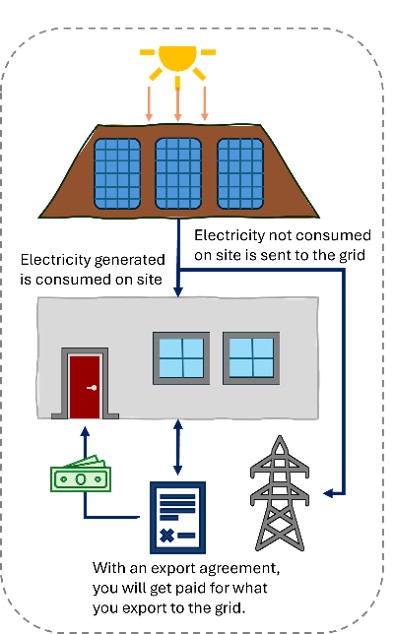
Behind-the-meter (BTM) energy systems are localised energy solutions installed at a specific site, typically featuring on-site generation like rooftop solar PV, often paired with battery storage. These systems use smart energy management to prioritise on-site use of generated electricity, reducing reliance on grid power and its associated costs. Surplus energy can often be exported.
Essentially, BTM systems enable the generation and consumption of electricity locally, offering greater energy independence and cost savings. While operating on a smaller scale, they represent a straightforward step towards decentralised energy and can be a building block for more extensive Local Energy Markets.
A BTM system is usually located at the site of the electricity consumer and can sometimes be funded and owned by a third party, with an agreement in place to sell the energy to the consumer at a discounted market rate.
System design
Physical: BTM systems fundamentally require on-site generating technology, such as rooftop solar PV, ideally coupled with battery storage and located close to the point of energy consumption.
Commercial: BTM systems generally involve straightforward legal and administrative processes, with export PPAs needed for selling surplus energy and key financial benefits derived from displacing grid electricity or, in models like roof-top lease PPAs, selling power to occupiers.
Strategic suitability
BTM systems are strategically versatile and adaptable to a wide range of settings, including both domestic and commercial buildings. Their implementation is particularly well-suited to locations with sufficient space for installing generating assets (such as ample rooftop area for solar PV) and that have demand to use the electricity that is generated. While not mandatory, a grid connection enhances the value of BTM systems by enabling the export of surplus electricity.
Benefits
BTM systems offer several advantages. They are simple and cost-effective to implement. They are financially beneficial, generating savings by reducing grid electricity use and enabling the sale of surplus electricity back to the grid. BTM systems are adaptable, integrating with technologies like battery storage, heating and Electric Vehicle (EV) charging. They also enhance grid resilience and reduce carbon emissions. In addition, income can be created for the owner of the generating assets (i.e. in roof-top lease agreements).
Costs, limitations and risks
BTM systems also have some limitations. Remuneration for exported electricity is often low. They require an initial capital investment, ongoing maintenance, and reliable electricity demand to match the generated electricity for the life of the generating asset. Additionally, they may be subject to certain regulatory requirements, such as permission from planning authorities and District Network Operators (DNOs). Your DNO connects you to the electricity network. You may have to check with them before trying to connect to their network.
Case study: SCEES
The Swansea Community Energy and Enterprise Scheme (SCEES) was established in 2015 as a Community Benefit Society to develop and manage community-owned solar projects in Swansea. SCEES has successfully installed solar BTM systems on nine schools and one care home. The upfront costs for these installations were funded through a combination of a short-term construction loan and a community share offer, which raised £467,000 from 170 investors who now receive a 6% annual return. SCEES's business model is based on holding a long-term Lease and PPA for 20 years with the building landlord and tenant. The lease covers the ongoing operation and maintenance costs, while the PPA ensures the sale of the generated electricity to the consumer at a market discounted price, providing the host buildings with cleaner, more affordable energy. This successful scheme has generated a community benefit fund of over £500,000.
1. Behind the meter (BTM)
1.1 Description
BTM electricity systems are localised energy solutions installed at a specific site, integrating on-site electricity generation assets (most commonly rooftop solar). These systems frequently incorporate battery storage to enhance energy independence and optimise consumption, which can further increase financial savings. A crucial element is the inclusion of sophisticated energy management systems, which dynamically determine the most effective use for the generated electricity in real-time, prioritising on-site needs to displace the import of more expensive grid power (electricity passing through the utility meter). Surplus energy generated that isn't consumed on-site can be exported and sold back to the grid. BTM systems are relatively a straightforward approach to establishing local energy supply and are typically operated on a smaller scale. BTM systems have the potential to generate considerable benefits for the system owner and the consumer.
1.2 Models and variations
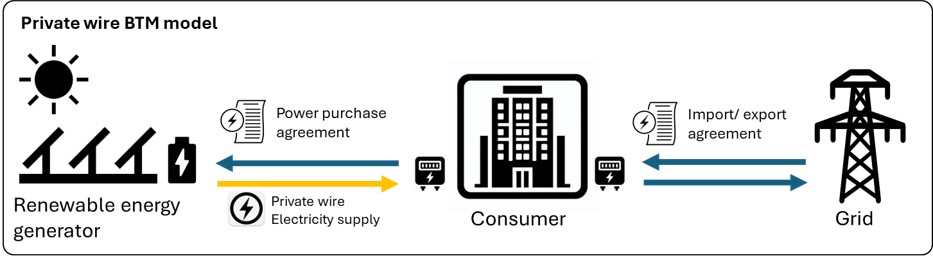
Standard Model
This involves installing on-site electricity generating assets (most commonly rooftop solar PV), which are often coupled with battery energy storage technologies. The electricity generated is primarily used on-site, directly reducing or eliminating the need to import electricity through the utility meter.
Roof-top Lease PPA
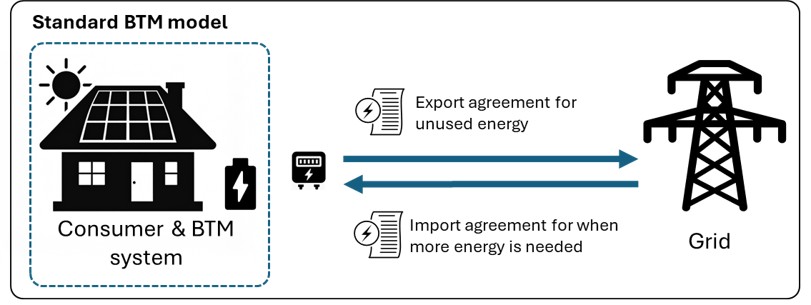
In this model, a third party (such as a community energy organisation, housing association, or landlord) finances the upfront and maintenance costs of the BTM system. The asset owner then generates income by selling the generated electricity to the building occupier. This model is sometimes referred to as the ‘rent-a-roof’ model. The financial benefits of this model are shared between the owner of the generating assets and the consumer, with benefits for the consumer often coming by being sold the generated electricity at a reduced rate to market prices.
Private Wire (Site-to-Site)
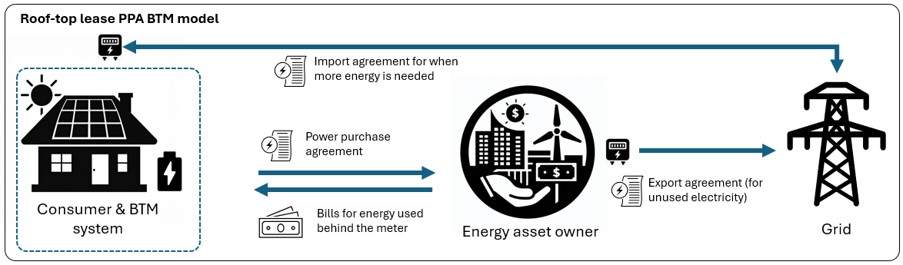
This concept is similar to a standard BTM system in that electricity generation and consumption occur independently of the grid. However, the key difference is that a physical electrical connection (private wire) is required to transfer the electricity between where the energy is generated and where the energy is consumed.
Additionally, the generator and consumer are typically distinct entities, and a Private Wire Power Purchase Agreement (PPA) governs the terms of the electricity transfer between them (Please refer to our separate profile for a more detailed explanation of Private Wire systems).
1.3 Key parties
BTM electricity systems usually involve one primary party: the building occupier, who installs and has direct control over the electricity generated on-site. While models like the roof-top lease Power Purchase Agreement (PPA) bring in additional stakeholders who own the generation assets and sell the power to the occupier, the core concept of a BTM system centres around sizing on-site power generation to match on-site consumption.
1.4 Term / longevity
BTM electricity systems are inherently long-term solutions, with their longevity primarily determined by the lifespan of the installed equipment in owner-operated models (eg. solar panels, inverters and battery storage systems). For roof-top lease Power Purchase Agreement (PPA) systems, however, the duration is primarily governed by the terms of the contract between the owner of the BTM and the building occupier, which may or may not directly correlate with the equipment's lifespan.
2. Case Study: EGNI Co-op
Egni Co-op, a Community Benefit Society, has developed a successful and sustainable model for deploying BTM solar energy systems. By funding the upfront costs of solar photovoltaic (PV) installations and selling the generated electricity back to consumers at a market discounted rate, Egni Co-op provides a compelling solution for organisations seeking to reduce their energy costs and carbon footprint without capital expenditure.
Egni's journey began with a pilot project in 2013, installing solar PV on seven community buildings. Since 2019, the co-op has scaled its operations to over 80 sites, achieving a total capacity of 4.3MWp. This rapid growth demonstrates the viability and appeal of their BTM model.
A core element of Egni's success is its innovative funding approach. The co-op has raised a remarkable £5 million through community shares, demonstrating strong local support and a commitment to shared ownership. This community-driven capital is supplemented by a £2 million investment from the Development Bank of Wales, providing a robust financial foundation for their projects. This hybrid funding model allows Egni to finance the entire installation and associated costs, including solar panels, inverters, and labour.
Egni's business is built on the Rooftop Lease PPA model. Under a typical 21-year agreement, the building tenant agrees to purchase the solar electricity generated on-site. The key features of this PPA are that the price per unit of solar electricity set at an agreed percentage lower than the standard grid unit price, providing immediate and guaranteed savings for the consumer. While the price increases annually with the Retail Price Index (RPI), a crucial safeguard is in place: the price is capped, ensuring the consumer will never pay more than their day time electricity price supplied from the grid. Egni, in turn, mitigates the risk of fluctuating grid electricity prices by setting a 'floor price' based on the RPI-inflated initial solar purchase price. This stable, minimum level of income ensures the co-op can cover its debts and running costs, while also allowing them to offer the maximum possible discount to consumers.
Egni provides comprehensive services to ensure the systems operate at peak performance throughout the lease term. Egni is responsible for all cleaning, regular checks, remote monitoring for safety and performance, and any necessary repairs and replacements. Electricity usage is automatically metered and billed quarterly using the Orsis system, simplifying the process for the tenant. In the event the roof requires repairs, Egni will handle the removal and reinstallation of the PV panels at their own cost. This service is limited to three times and a total of 270 days over the lease term, providing a clear and fair provision for unforeseen circumstances.
Egni Co-op's model is a powerful example of how a community-focused approach can drive the adoption of renewable energy. By eliminating the financial barrier of upfront costs, offering a guaranteed discount on electricity, and managing all aspects of the installation and maintenance, Egni provides a compelling, low-risk solution for consumers. This innovative funding and operational strategy not only benefits individual tenants but also contributes to the broader community by generating a stable, sustainable source of clean energy and using any profits for community benefit.
3. Physical design
3.1 Infrastructure requirements
BTM electricity systems typically have limited infrastructure requirements, especially when compared to more complex local energy models. The main requirements involve the purchase and installation of on-site generating technologies, which can include solar PV, wind turbines, or battery energy storage systems. While not strictly a requirement, maintaining a grid connection offers the advantage of allowing any surplus electricity generated to be sold back to the national grid. Small systems usually only need the electricity network operator (DNO) to be notified. Larger systems (over 3.68kW) will usually need the DNO's approval before they can be connected to the grid.
3.2 Design requirements
A generating technology, such as rooftop solar PV, is a fundamental requirement for these systems. The integration of battery energy storage offers significant benefits, particularly in addressing the intermittent nature of renewable generation and accommodating unpredictable or seasonal consumption patterns. Battery energy storage can also be used in isolation to purchase electricity at times when it is cheap and discharge at times when electricity prices are higher.
Critically, the generating assets must connect directly to the premises where the energy is used, typically necessitating on-site location, which in turn demands sufficient space for ground-mounted installations (like solar PV or wind turbines) or suitable rooftop area for solar panels.
Ideally, the generating capacity should be sized to closely match on-site demand, minimising surplus energy sent to the grid, a balance that can be supported by on-site battery storage, and other technologies such as heat pumps and electric vehicle charging.
For solar installations, ensuring adequate irradiance with minimal shading is essential, with south-facing roofs in the UK generally offering the highest daily light exposure, although multi-directional arrays can help to smooth energy generation across different times of the day.
3.3 ‘Smartness’
The inherent 'smartness' of BTM systems can vary significantly. While simple BTM setups primarily function to reduce reliance on grid imports and enhance resilience, integrating generation technologies with battery energy storage and Distributed Energy Resource Management Systems (DERMS) can substantially elevate their ‘smartness’. DERMS enable dynamic decision-making regarding the optimal use of available energy at any given moment, with battery storage providing the flexibility to store and release power to support these decisions. Furthermore, the 'smartness' of BTM systems can be enhanced through the incorporation of other technologies such as solar hot water diverters, electric vehicle chargers, and vehicle-to-grid (V2G) chargers, enabling more sophisticated energy management and greater onsite consumption.
4. Commercial design
4.1 Legal and administrative considerations
Given the relatively straightforward nature of BTM electricity systems, there are generally no major legal or administrative hurdles. However, if the system owner intends to receive payment for any surplus electricity exported to the grid, an export PPA will be necessary. Additionally, it is prudent to consult with mortgage providers and insurance companies prior to installation to ensure compliance with their terms and conditions.
For roof top lease projects, where a third party owns the solar panels, the arrangement typically involves a lease or hire agreement with the building owner for siting the equipment, alongside a Power Purchase Agreement (PPA) that sets out the terms and pricing for electricity supplied to the tenant or building owner. This structure introduces more complex legal obligations and generally involves the use of legal representatives for both parties.
4.2 Regulatory considerations
BTM systems have few regulatory requirements compared to more complex LEM models. From a planning perspective, the installation of BTM equipment typically falls under permitted development, with only limited circumstances (such as development within a conservation area or on a listed building) requiring planning approval. It is important to engage with the DNO early in the system’s development to ensure that your BTM system and site are able to connect to the grid.
4.3 Future viability and replicability
Given the forecast decrease in costs for solar PV and lithium batteries, BTM electricity systems are likely to become an increasingly attractive option. Their ease of replication is supported by mature technology supply chains and limited legal and regulatory hurdles. Compared to more complex LEM models, a well designed and operated BTM system are cost-effective and offer clear benefits through displaced grid electricity. The ongoing development of new market opportunities, such as aggregation and flexibility services, further bolsters their future potential.
5. Strategic suitability
5.1 Strategic suitability
BTM systems are highly versatile and can be implemented in a wide range of situations, including domestic and commercial buildings. A key enabling factor is having sufficient space to install generating assets, encompassing suitable rooftop areas for solar PV installations or available land for ground-mounted systems, and sufficient on-site electricity demand to match the generated electricity. An active grid connection is also beneficial, allowing any surplus electricity to be exported for potential revenue. Generating assets larger than 3.68kW capacity will require the owner to notify the DNO. Importantly, BTM systems can provide value, offering a means to reduce grid imports and associated costs in almost any scenario, providing that the generating assets are sized appropriately to the site’s electricity demand profile.
5.2 Required partnerships
BTM systems require few partnerships. Most systems are operated and maintained by the energy consumer. Alternative models, such as the roof-top lease PPA model, require a partner to install and maintain the system. This tends to be a community energy organisation, housing association or landlord. Utilising these partners can provide advantages, such as not needing to fund the up-front costs of installing the system.
5.3 Key enablers
BTMs are generally enabled by the following:
- owning the premises or premises where you wish to install the system
- having the required capital to outlay for the system’s installation
- having an active grid connectivity
- having permission from mortgage and insurance providers
- having the ability to the connect to the grid is often important, particularly during times where generated electricity is not used at the site
- having sufficient on-site electricity demand to match the generated electricity
6. Benefits
6.1 Benefits and outcomes
- Simple implementation and cost effective: BTM electricity systems are among the easiest LEM solutions. They generally involve a single party and site and require limited or basic contractual arrangements. In addition, BTM systems are quick to develop and often represent a cost-effective solution (both from a capital requirements and return on investment perspective).
- Substantial financial benefits: BTM systems are one of the most financially beneficial forms of local energy supply, as savings are generated by using electricity generated and displacing expensive grid imports. Furthermore, any electricity generated that is not consumed on site can be sold back to the grid (although savings are normally highest if all or most of the generated energy is consumed locally). Furthermore, there is limited need to install further costly technology that would reduce return on investment.
- Integration and adaptability: BTM systems can integrate with a broad range of system enhancing technologies, such as battery energy storage systems (BESS), heat pumps, EV charging, vehicle-to -grid charging and solar hot water diverters.
- Grid and resilience: BTM systems can provide the operator with a reduced reliance on the grid, with some systems offering ‘island mode’ which means electricity can be generated and used on-site during grid outages. There is also potential for BTM systems to access system-wide innovations, such as aggregation and flexibility services. Furthermore, reduced transmission and distribution losses can be achieved, contributing to a more efficient electricity network.
- Environmental Benefits: Utilising renewable generation like solar PV directly reduces carbon emissions.
6.2 Commercial mechanism
The commercial mechanisms (i.e. how financial benefits are generated) are noted below for the two notable BTM models:
- Standard model (invest-to-save): Savings are achieved by displacing electricity imports from the grid, and utilising electricity generated on site. Savings are used to pay-off upfront capital costs over time (systems often pay back in less than 10 years) and are enhanced where demand matches the total generation.
- Roof-top lease PPA model: the organisation investing in the BTM pays the upfront costs for the required technologies. The electricity generated is then sold to the premises occupiers using a simple contractual arrangement (i.e. a simple PPA or rental agreement). The price of the electricity can be fixed or variable. Variable prices tend to be linked to the retail price for electricity, normally offering a discounted rate (between 10% and 50% depending on the agreement) and often include annual inflationary increases in line with the Retail Price Index.
7. Costs, limitations and risks
7.1 Limitations, costs and complexities
BTM systems have few significant limitations. The list below discusses some of the limitations associated with BTM systems, however most are minor in nature and are outweighed by the potential benefits they generate.
- Low remuneration for unused electricity: unused energy is generally exported to the grid at a rate considerably lower than market tariffs for consumption
- Timing and intermittency of generation: BTM systems generally utilise solar PV, which means it cannot generate electricity at night, and is subject to inconsistent generation and seasonal fluctuations
- Upfront capital investment required: an initial investment in electricity generation technologies required (such as solar PV or wind) and battery storage (optional) is needed to implement a BTM system
- Monitoring and maintenance requirements: technologies installed require monitoring and maintenance (including cleaning for solar PV) to ensure they operate optimally
- Regulatory requirements: BTM systems could have planning, DNO, mortgage or building insurance requirements, but in most cases these are minimal.
7.2 Risks
There are few risks to consider for BTM systems. The most significant risk is early system or equipment failure, which could result in elements of the system needing to be replaced, although equipment failure is generally covered by warranties provided upon installation. There is also a risk of not meeting associated regulatory requirements, and system developers are encouraged to engage with their local planning authority and DNO to understand if there are any requirements during the early stage of project development. It is also prudent to contact any associated mortgage and insurance providers before installing a BTM system.
Maintaining consistent electricity consumption throughout the lifespan of generating assets is important. A drop in demand risks reducing savings for consumers or income for third-party owners, potentially preventing the recovery of initial capital costs.
8. Next steps
If you're interested in exploring BTM systems for your community organisation or business you can:
- Look at your electricity use and available space
- Ensure you own the building or have permission from the owner
- Check whether there’s funding available: Finance locator | Business Wales / Funding Wales
- Contact contractors to discuss your requirements: Find An Installer: MCS
- Contact your local authority to check whether planning permission is needed or whether your plans are considered 'permitted development'
- Contact your DNO to check you can connect to the grid: Who’s my electricity network operator? Energy Networks Association (ENA)
- Talk to your mortgage and insurance providers
- Contact Ynni Cymru for advice and support: YnniCymru@localpartnerships.gov.uk
9. Conclusion
Behind-the-meter energy systems offer a straightforward and effective way to generate and use electricity locally, helping reduce energy bills, improve resilience, and lower carbon emissions. Whether installed by the building occupier or through a third-party lease model, BTM systems are adaptable to a wide range of settings and can deliver long-term financial and environmental benefits.
If you're considering a BTM system, whether to cut costs, generate income, or support a more sustainable energy future, this guide is a practical starting point. The next step is to explore how the model could work for your site or organisation.
For tailored advice, practical support, or help turning your ideas into action, contact Ynni Cymru.