
Breastfeeding data: 2025
Data includes breastfeeding status at birth, 10 days, 6 to 8 weeks, and 6 months by local health board for 2025.
In this page
Introduction
The purpose of this release is to provide a statistical overview of breastfeeding in Wales including analyses of mothers’ characteristics. The data and analyses are used to inform Welsh Government’s maternity policy development.
This release also provides data to support the Wellbeing of Future Generations Act 2015 which states that every child in Wales should receive the best start in life.
Data in this release is sourced from Maternity Indicators dataset (MI ds) for mothers’ intention to breastfeed and from the National Community Child Health Database (NCCHD) for breastfeeding at all other ages.
Complimentary statistics on maternity and births will be published on 4 August 2026.
Main points
- Breastfeeding rates were the highest on record for birth, 10 days, 6 weeks and 6 months, continuing longer term trends of increasing breastfeeding rates.
- 66% of babies were breastfed at birth.
- First-time mothers continued to report higher rates of intention to breastfeed than mothers who had previously given birth.
- Mothers aged 35 or older were most likely to breastfeed at birth with their breastfeeding rate 33 percentage points higher than those aged under 20.
- The breastfeeding rate for babies who were born at home was 15 percentage points higher than children born in hospital.
- Breastfeeding rates in the Black ethnic group were higher than any other ethnic group for all children’s age points from mother’s intention to 6 months whereas the White ethnic group were the lowest at all age points.
- Mothers in the most deprived areas were less likely to breastfeed than those in the least deprived areas: 55% of mothers in the most deprived areas breastfed at birth compared with 76% of mothers in the least deprived areas.
Breastfeeding and age of child
In the Maternity Indicators dataset (MI ds) a mother’s intention to breastfeed prior to birth is recorded. Since this data refers to the mother, data presented includes the 24,688 mothers who gave birth in 2025, rather than children born in 2025.
Data for breastfeeding at birth and for babies turning 10 days, 6 weeks and 6 months are recorded in the National Community Child Health Database (NCCHD) and refers to records where there was any breastfeeding. This includes babies fed exclusively breastmilk and those who were combination fed.
For breastfeeding at birth, the data refers to the 26,417 live births in 2025. For breastfeeding at the other age points, data refers to the babies who became the reference age in 2025: 26,263 babies turned 10 days, 26,105 turned 6 weeks, and 26,488 turned 6 months. Only records with a known breastfeeding status are recorded in the rate calculations.
Figure 1: intention to breastfeed and breastfeeding at birth, 10 days, 6 weeks, 6 months, 2016 to 2025 [Note 1] [Note 2] [Note 3]
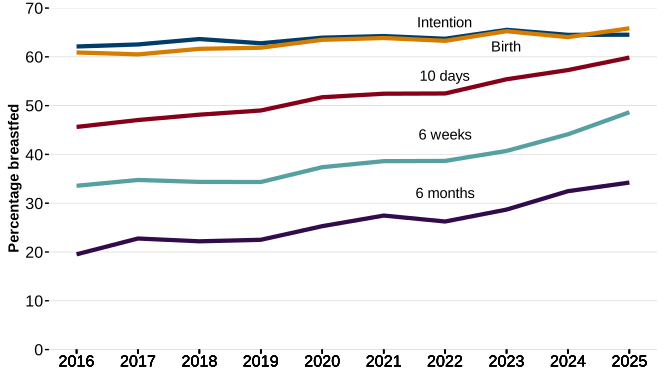
Description of figure 1: line chart showing rates of breastfeeding at 10 days, 6 weeks, 6 months, have for the most part increased over the past 9 years.
Source: MI ds, NCCHD, Digital Health and Care Wales
Breastfeeding by age of baby and local health board (StatsWales)
[Note 1] Percentages are of the total number of records with stated breastfeeding status: In 2025 the percentage of records with no stated breastfeeding status was 2% at intention, 11% at birth, 9% at 10 days, 12% at 6 weeks and 16% at 6 months.
[Note 2] Total number of records for percentage calculations at each point are: the number of women due to give birth for 'Intention to breastfeed'; all live births for 'birth'; and of babies turning the reference age for all other age points.
[Note 3] In 2024, Aneurin Bevan were excluded from the intention to breastfeed analysis due to data quality issues; data for Wales represents the 6 remaining health boards. All health boards are included for the other age points.
Breastfeeding rates were the highest on record at birth, 10 days, 6 weeks and 6 months.
65% of all mothers intended to breastfeed prior to giving birth. This percentage has remained broadly stable over the longer term and in the latest year it had remained the same as the previous year but increased by 0.6 percentage points when compared to five years ago.
Across all other age points there has been an upward trend in breastfeeding over the longer term.
66% of babies were breastfed at birth, 2.4 percentage points higher than five years ago and 1.8 percentage points higher than in 2024.
60% of babies were breastfed at 10 days, 8.1 percentage points higher than five years ago and 2.6 percentage points higher than 2024.
49% of babies were breastfed at 6 weeks, 11.3 percentage points higher than five years ago and 4.5 percentage points higher than 2024.
34% of babies were breastfed at 6 months, 8.9 percentage points higher than five years ago and 1.8 percentage points higher than 2024.
Breastfeeding data at all points in time are subject to data quality issues as some mothers and babies have incomplete records. Breastfeeding data after birth is collected when children have health visitor and GP appointments through the Healthy Child Wales Programme. If a child does not receive a contact, their breastfeeding data may be missing at that contact point.
In addition to annual data, quarterly breastfeeding data with data completeness percentages are published on StatsWales, by local health board.
Breastfeeding and parity
The number of times pregnant women have previously given birth (parity) is recorded in the MI ds, which can be analysed with their intention to breastfeed.
Figure 2: intention to breastfeed by number of times mothers had previously given birth (parity) 2016 to 2025 [Note 1] [Note 2] [Note 3]
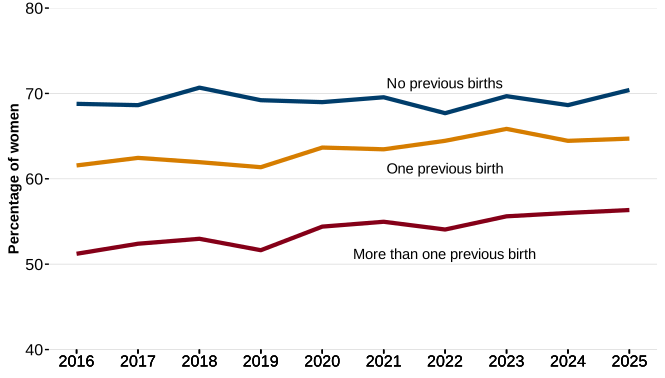
Description of figure 2: line chart showing intention to breastfeed has been higher for first time mothers throughout the time series. The percentage has been lowest for mothers who have had multiple previous births throughout the time series.
Source: MI ds, Digital Health and Care Wales
Intention to breastfeed by number of times mothers had previously given birth (parity) (StatsWales)
[Note 1] Percentages are of the total deliveries minus records with no stated breastfeeding status.
[Note 2] In 2024, Aneurin Bevan were excluded from the intention to breastfeed analysis due to data quality issues; data for Wales represents the 6 remaining health boards.
[Note 3] Y axis does not start at zero.
70% of first-time mothers intended to breastfeed, compared with 65% of mothers who had given birth once previously, and 56% of mothers who had given birth more than once.
The intention to breastfeed rate for first-time mothers has been broadly stable since 2016 but increased by 1.8 percentage points in the last year. The rate for mothers who had given birth once previously and mothers who had given birth more than once has been on a slight upward trend over the past five years and both increased by 0.3 in 2025 compared with 2024.
Breastfeeding and place of birth
Figure 3: percentage of live births breastfed at birth by place of birth 2016 to 2025 [Note 1] [Note 2]
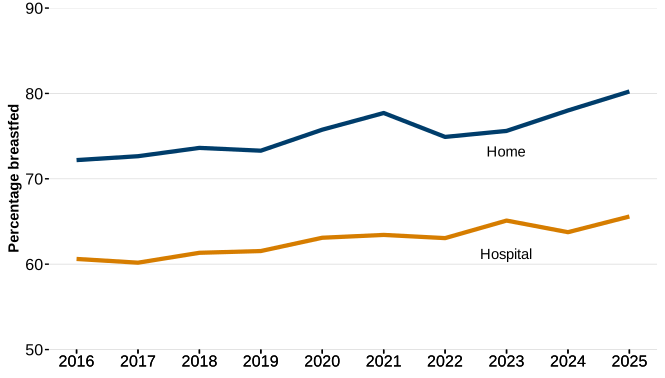
Description of figure 3: line chart showing a higher percentage of babies born at home were breastfed at birth compared with those born in hospital, but the percentage for both has increased at a similar rate over the past nine years.
Source: NCCHD, Digital Health and Care Wales
Breastfeeding at birth by place of birth and local health board (StatsWales)
[Note 1] Percentages are of the total live births minus births with no stated breastfeeding status at birth: 11% had no stated breastfeeding status for hospital births; 7% had no stated breastfeeding status at birth for home births in 2025.
[Note 2] Y axis does not start at zero
In 2025, of the 467 babies born at home, 80% were breastfed at birth which is the highest on record. This is an increase of 2.2 percentage points from the previous year and is 4.5 percentage points higher than five years ago.
Of the 25,813 babies born in hospital, 66% were breastfed at birth which is the highest on record. This is an increase of 1.8 percentage points from the previous year and is 2.5 percentage points higher than five years ago.
Additionally, in 2025, 72 babies’ place of birth was recorded as ‘born in transit’, while 65 had no stated place of birth.
Breastfeeding data for babies born in Neonatal Units (born at less than 33 weeks gestation) is published in the National Neonatal Audit Programme (NNAP) 2024 Annual Report (Royal College of Paediatrics and Child Health), and shows that for 2024, 65.8% of 11,596 babies born at less than 34 weeks’ received their mother’s milk at discharge, a 2.7 percentage points increase from the previous year (2023: 63.1%).
Breastfeeding and age of mother
Figure 4: breastfeeding at birth by mothers’ age group 2016 to 2025 [Note 1] [Note 2]
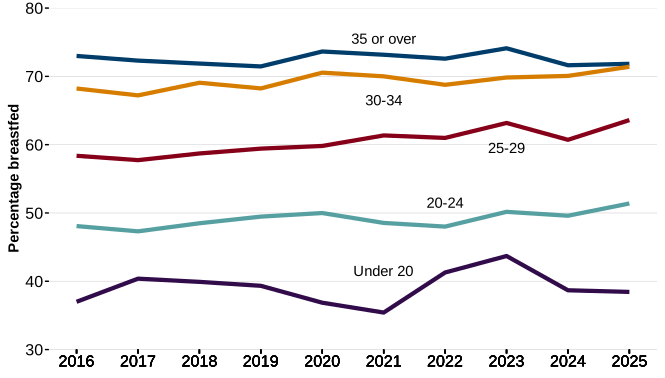
Description of figure 4: line chart showing breastfeeding rates at birth in older mother’s age groups has been consistently higher than in younger mother’s age groups. Rates in most mother’s age groups have generally slightly increased since 2016.
Source: NCCHD, Digital Health and Care Wales
Breastfeeding by age of baby and age of mother (StatsWales)
[Note 1] Percentages are of the total births minus births with no stated breastfeeding status at birth
[Note 2] Y axis does not start at zero
At birth, 72% of babies whose mother was aged 35 or older were breastfed. 64% of babies were breastfed where the mother was aged 25 to 29, and 38% babies were breastfed where the mother was under 20.
Figure 5: breastfeeding by mothers’ age group and age of baby 2025 [Note 1] [Note 2]
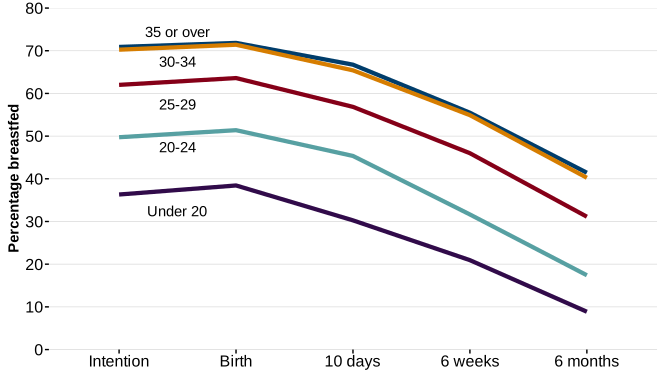
Description of figure 5: line chart showing while breastfeeding rates were higher in the older mother age groups, the reduction in breastfeeding rates as the child gets older is similar across all age groups.
Source: MI ds, NCCHD, Digital Health and Care Wales
Breastfeeding by age of baby and age of mother (StatsWales)
[Note 1] Percentages are of the total records minus records with no stated breastfeeding status: In 2025 the percentage of records with no breastfeeding status was 2% at intention, 11% at birth, 9% at 10 days, 12% at 6 weeks and 16% at 6 months.
[Note 2] In 2024 Aneurin Bevan were excluded from the intention to breastfeed analysis due to data quality issues; data for Wales represents the 6 remaining health boards. All health boards are included for the other age points.
Breastfeeding rates decreased across all mother’s age categories as the age of the child increased. The extent of this decrease with age of child in breastfeeding varied across mother’s age groups between birth and 10 days where mothers aged 35 and over decreased by 5.1 percentage points and mothers aged under 20 decreased by 8.2 percentage points.
The decrease in breastfeeding rates also varied across mother’s age groups between 10 days and 6 weeks, where rates decreased by between 9 and 14 percentage points for all age groups.
Breastfeeding and ethnic group
Figure 6: breastfeeding by ethnic group and age of baby 2025 [Note 1] [Note 2] [Note 3] [Note 4]
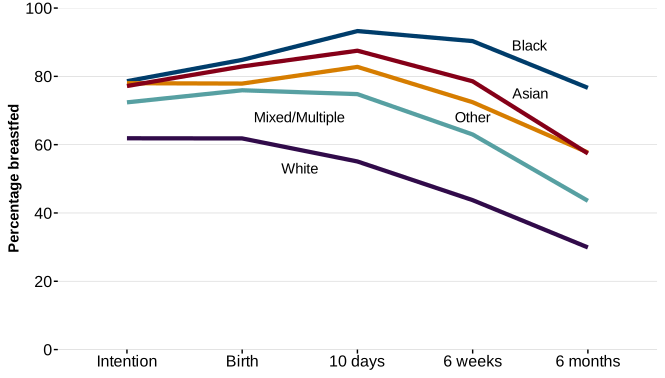
Description of figure 6: line chart showing breastfeeding rates were higher for people of Black, Other or Asian ethnicities. The rates at which breastfeeding changed with the age of the child were different by ethnic group.
Source: MI ds, NCCHD, Digital Health and Care Wales
Breastfeeding by age of baby and ethnic group (StatsWales)
[Note 1] Intention to breastfeed is based on the ethnic group of the mother, whereas breastfeeding rates at other points in time refer to the ethnic group of the baby. Definitions of ethnic groups are provided in the quality report.
[Note 2] Percentages are of the total records minus records with no stated breastfeeding status: in 2025 the percentage of records with no breastfeeding status was 2% at intention, 11% at birth, 9% at 10 days, 12% at 6 weeks and 16% at 6 months.
[Note 3] In 2024 Aneurin Bevan were excluded from the intention to breastfeed analysis due to data quality issues; data for Wales represents the 6 remaining health boards. All health boards are included for the other age points.
[Note 4] Y axis does not start at zero.
Breastfeeding rates in the Black ethnic group were higher than any other ethnic group for all children’s age points from mother’s intention to 6 months: 79% for intention, 85% at birth, 93% at age 10 days, 90% at 6 weeks, and 77% at age 6 months.
Mothers from the Other ethnic group had the second highest intention to breastfeed at 78%, and this rate dropped to 58% at 6 months.
Asian mothers had the third highest intention to breastfeed at 68% but were the second highest ethnic group to be breastfed at birth at 83%.
72% of mothers of Mixed or multiple ethnicities intended to breastfeed, and a slightly higher proportion of Mixed or multiple ethnicity children were breastfed at birth (76%). The breastfeeding rate decreased at all age points after birth, and 44% of children from Mixed or multiple ethnicities breastfed at 6 months.
Breastfeeding rates for the White ethnic group were lower than any other ethnic group at all points at which data was collected. 62% of mothers intended to breastfeed and the same proportion (62%) were breastfed at birth. The rate decreased to around half of White children breastfed at age 10 days (55%), 44% breastfed at age 6 weeks, and 30% breastfed at age 6 months.
Breastfeeding and number of babies
Figure 7: intention to breastfeed by number of babies 2016 to 2025 [Note 1] [Note 2] [Note 3] [Note 4]
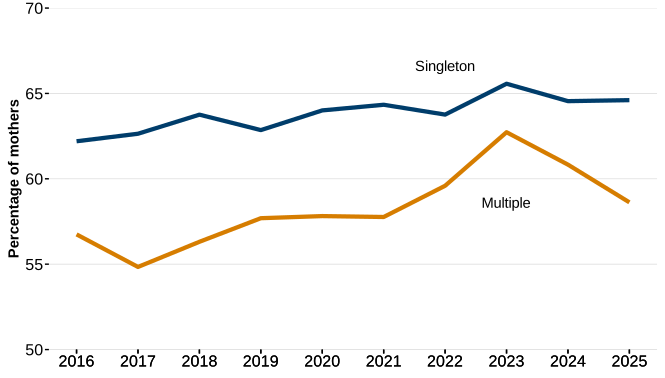
Description of figure 7: line chart showing a higher percentage of mothers of singleton babies intended to breastfeed compared with mothers of multiple babies since 2016. The percentage has increased in both groups over time, but the increase has been greater for the multiple group.
Source: MI ds, Digital Health and Care Wales
Intention to breastfeed by number of babies (StatsWales)
[Note 1] Percentages are of the total records minus records with no stated breastfeeding status. In 2025 the percentage of records with no breastfeeding status was 2%.
[Note 2] Singleton refers to a single baby born; multiple refers to twins, triplets or more babies born through a single pregnancy.
[Note 3] Aneurin Bevan have not provided correctly recorded data for the intention to breastfeed data item in 2024 so have been excluded from this analysis. Data for Wales in 2024 represents the 6 remaining health boards.
[Note 4] Y axis does not start at zero.
65% of mothers who gave birth to one baby intended to breastfeed in 2025. This is the same as the previous year and 0.6 percentage points higher than the rate five years ago.
59% of mothers who gave birth to multiple children (twins, triplets or quadruplets) intended to breastfeed in 2025. This is 2.2 percentage points lower than the previous year and 0.8 percentage points higher than the rate five years ago.
Breastfeeding and deprivation
Mothers in the most deprived areas were less likely to breastfeed than those in the least deprived areas: 55% of mothers in the most deprived areas breastfed at birth compared with 76% of mothers in the least deprived areas in 2025.
Breastfeeding rates at birth within each quintile of deprivation have remained relatively stable since 2019. However there has been an increase of 5.9 percentage points in breastfeeding rates at birth in the most deprived areas from 49% in 2019 to 55% in 2025. Comparatively there was an increase of 1.8 percentage points over the same time period for those in the least deprived areas.
Quality and methodology information
All data used in this release is published on StatsWales and more detailed information on the sources of data and analyses in this statistical release are provided in the quality report.
Quality of specific data items
Not all records on the MI ds and the NCCHD have complete records for breastfeeding status. The completeness rate decreases with the age of the baby and in 2025, was as follows: 98% for intention to breastfeed; 89% at birth; 91% at 10 days; 88% at 6 weeks; and 84% at 6 months.
A completeness table for all data items used in this release from both data sources is available in the quality report.
Development plans
We are developing confidence intervals around all breastfeeding rates to be able to provide a measure of uncertainty within the data. We hope to publish these confidence intervals as part of our StatsWales data in the coming months.
Please get in touch with any feedback or suggestions for development at the following email address: stats.healthinfo@gov.wales
Statement of compliance with the Code of Practice for Statistics
Our statistical practice is regulated by the Office for Statistics Regulation (OSR). OSR sets the standards of trustworthiness, quality and value in the Code of Practice for Statistics that all producers of official statistics should adhere to.
All of our statistics are produced and published in accordance with a number of statements and protocols to enhance trustworthiness, quality and value. These are set out in the Welsh Government’s Statement of Compliance.
These statistics were originally assessed and given accreditation as part of 2 assessments by the Office for Statistical Regulation (OSR) covering Statistics on births, infant mortality and teenage conceptions (OSR) in 2011 and Statistics on health and personal social services in Wales (OSR) in 2012. Since the statistics were originally assessed, the data sources from which the statistics are generated has changed, and the maternity and births release covers a much wider range of factors than at the time of the initial assessment. Breastfeeding statistics are also now reported separately.
Given the change of data sources, OSR agreed to carry out a compliance review of both sets of statistics to determine whether the accredited official statistics status is still appropriate for the releases.
OSR found the Maternity and births statistics and Breastfeeding statistics to continue to comply with the Code of Practice for Statistics (UK Statistics Authority) and should continue to be designated as accredited official statistics.
These accredited official statistics (OSR) demonstrate the standards expected around trustworthiness, quality and public value in the following ways.
Trustworthiness
The data used in this statistical release is collected via two sources, the NCCHD and the MI ds. The NCCHD consists of anonymised records for all children born, resident or treated in Wales and born after 1987. It brings together data from the child health system databases which are held by local health boards. This is a long-established data collection and database. The MI ds combines a child’s birth record with their mother’s initial assessment record (where possible). There are some data quality issues with certain data items in this dataset which are explained in more detail in the quality report.
Quality
The published figures provided are compiled by professional analysts using the latest available data and applying methods using their professional judgement and analytical skillset. Statistics published by Welsh Government adhere to the Statistical Quality Management Strategy which supplements the Quality pillar of the Code of Practice for Statistics and the European Statistical System principles of quality for statistical outputs.
The NCCHD data included in this release comes from administrative data collection forms which are used in the management of the Healthy Child Wales Programme. The data is dependent on local authorities maintaining accurate records but systems are well established and reliable.
Data is collected by Digital Health Care Wales directly from local health boards via local Child Health Systems.
Validation checks are performed by Welsh Government statisticians and queries referred to local health boards where necessary. The statistical release is then drafted, signed off by senior statisticians and is published in line with statement on confidentiality and data access which is informed by the trustworthiness pillar contained in the Code of Practice for Statistics.
Value
The purpose of the statistical release is to provide evidence for policy development; to allow local health boards to monitor and benchmark their service provision against all other local health boards in Wales; and to inform for the wider public about breastfeeding rates in Wales. This annual statistical release also supports the Welsh Government’s long-term plan for health and social care: A Healthier Wales.
You are welcome to contact us directly with any comments about how we meet these standards. Alternatively, you can contact OSR by emailing regulation@statistics.gov.uk or via the OSR website.
Well-being of Future Generations Act (WFG)
The Well-being of Future Generations Act 2015 is about improving the social, economic, environmental and cultural wellbeing of Wales. The Act puts in place seven wellbeing goals for Wales. These are for a more equal, prosperous, resilient, healthier and globally responsible Wales, with cohesive communities and a vibrant culture and thriving Welsh language. Under section (10)(1) of the Act, the Welsh Ministers must (a) publish indicators (“national indicators”) that must be applied for the purpose of measuring progress towards the achievement of the wellbeing goals, and (b) lay a copy of the national indicators before Senedd Cymru. Under section 10(8) of the Well-being of Future Generations Act, where the Welsh Ministers revise the national indicators, they must as soon as reasonably practicable (a) publish the indicators as revised and (b) lay a copy of them before the Senedd. These national indicators were laid before the Senedd in 2021. The indicators laid on 14 December 2021 replace the set laid on 16 March 2016.
Information on the indicators, along with narratives for each of the wellbeing goals and associated technical information is available in the Wellbeing of Wales report.
Further information on the Well-being of Future Generations (Wales) Act 2015.
The statistics included in this release could also provide supporting narrative to the national indicators and be used by public services boards in relation to their local wellbeing assessments and local wellbeing plans.
Contact details
Community and population health statistics
Email: stats.healthinfo@gov.wales
Media: 0300 025 8099
SFR 53/2026