
Building culture for the future - Chapter 11. Diving deeper, learning together
A manual for applying the Wellbeing of Future Generations Act.
In this page
Opportunities to learn together
Learning together is very important. Choose the activity that suits you best:
Daily morning practice? Join us once a week or every day
Just need a bit of a top-up? Join our one-hour interactive on-line session
Want to remind yourself about systems? Systems Thinking Mini-Course
Looking for a deeper dive through free training? Join MIT’s u-lab
Just need to find a friend? Try establishing a coaching pair.
Up for a regular one-hour monthly reflection? Choose a community of practice.
Working in a specific location? Try some tips from the People’s Practice.
Want to establish a change team in your organisation? Try the Enzyme Project.
See the Future Generations Commissioner’s website for other sources of learning and development
Co-coaching or reflective pairs
Co-coaching is a great way to reflect and learn together. Here is how some of us are going about it.
Identify someone you know, with whom you would like to spend some reflective time. Ask them how they are (discuss) and find out if they would be interested in sharing some thinking space. In the first instance you are only looking for agreement to a first meeting so that you can feel your way together - it might work, it might not, if it doesn't you've just had a lovely cup of tea together, so nothing is lost. It might only need a slight tweak to work better next time.
Meet to try it out. We did this by allocating half of the time to each of us (i.e. 30 mins each) and a few minutes to agree next steps. We met face-to-face and also virtually. Each person used their time to ask (and answer for) themselves a key question (e.g. What do I want to achieve? What is the biggest challenge just now?) while the other person listened, took an interest, asked good questions, spotted links and tried not to interrupt too much. At the end, we felt better so we agree to meet again.
You could ask questions like these:
- tell me about something that went well this week
- can you use any lessons from there in other settings?
- tell me about something that went badly/well
- what could you try differently next time?
- what if that was/wasn’t true?
- if you could change one thing what would it be and why?
Our first attempt was only partially successful; we got commitment and had a useful meeting but then failed to get together regularly for a couple of months. So we tried again; using Outlook to put a regular weekly one and a half hour meeting into our diaries. We don't use all of that time every time (but usually approx. 30 mins each). Having the 90 minutes ringfenced in our diaries ensures time for self-reflection in addition to the co-coaching.
We make sure that we both get the time we need to talk one problem/challenge/issue through, and we focus the questions on being open, encouraging, thoughtful and compassionate. We focus on all four energies – physical, emotional, mental and spiritual.
We hold some of the meetings by phone and via Teams and occasionally we can be physical in the same location. Virtual meetings have worked fine if we are both stationary (preferably with a cup of tea). Being in motion or on a shopping trip is not conducive to good listening! And, if on the mobile, make sure you have a good signal strength before you start, so that you don't lose each other at a difficult moment.
We have held regular weekly meetings and missed only a couple of these sessions (for holidays mainly) over the last couple of months. It is improving our performance during the rest of the week. It is great when both people want to learn to do better in any aspect of their work.
We recommend choosing to work with someone with a similar, but not exactly the same role, as a bit of distance from each other’s work brings perspective and a wider variety of issues and questions.
It seems to work best in the sessions where we are a bit more strict about ‘coaching’ each other - i.e. when the listener asks penetrating questions and doesn’t make too many interruptions. These are better than the rather more wandering discussions that we have sometimes.
Creating a people’s practice
See also the People’s Practice Community of Practice for regular monthly support.
The ideas below are offered as suggestions and invitations. They were developed and tested by interested people across Wales. We hope they will help you and others to take increasingly positive action in response to climate and biodiversity emergency. Some of them can also be used to improve a meeting on any topic.
What is a people’s practice?
A people’s practice is a way of encouraging and coordinating action in response to the climate and biodiversity emergency.
A people’s practice is a hub for organisations, groups and individuals who are all committed to tackling the climate crisis, to network, share ideas and focus on key issues and positive actions, collectively.
A people’s practice is a space for discussing and deciding on our own actions, not for telling other people what they should or should not do.
A people’s practice is about action that changes how we live, not about activism to raise awareness. This is what Extinction Rebellion and others already do.
What do you need to get started?
You need a small group of motivated people and a place to meet. We started with 4 people. Some of us offered a public space in which to meet (in our case, the local museum). Some of us offered to facilitate and some of us offered help with communications, inviting others to join in (There can be overlap between the roles).
Firstly, we agreed how we wanted to work together/what we wanted to do. Then we chose some dates and invited people to join in. We chose to meet monthly and this is how we agreed to work together:
We will:
- Accept that there is an emergency and get on with doing something about it
- Focus on working together not disagreeing
- Appreciate everyone’s contribution
- Build on each other’s energy
- Talk to and bring in new people
- Involve all ages and generations
- Create a space where people can make connections and build relationships
- Allow ourselves to imagine a utopia and work towards this through reality
- Make connections between climate, biodiversity and food
- Consider how we can re-localise our local economy.
What are the basic principles?
You can see our principles in the bullet point list above. We asked some other people who are setting up similar practices (mainly in work-based settings), and they told us about the principles that are important to them:
The idea came from the Climate Rebellion, who ask that anyone participating in any climate related action abide by some basic principles of non-violence, compassion, etc.
We like the idea of holding meetings differently. Some people are still deeply wedded to the standard board format. Spelling this out is helpful for people.
Our group have agreed that they are all self-appointed – no one has been asked to attend because of their job role or position of hierarchical power. It is a voluntary group.
The network is also self-authorising. We do not report to anyone but accept that we need to liaise with some formal structures to help get the messages across. The idea is that we chose who and when to talk to, and how to ask questions of people.
Group members have agreed to champion the network within their own workplaces. We will do those things that we can do within our working remit and then work together to challenge / support change within the organisation where the issues sit outside of our control.
We have also agreed to use the group to help educate and develop each other. The first request has been for the Estates team, who manage carbon re duction, to present an overview of things that are already happening. Many of the initial ideas generated by the network are already being done or have been explored and rejected. People were surprised by just how much work has already been undertaken, un-noticed in the organisation.
Legitimacy: Some members have identified that their line managers want reassurance that the work is legitimate and fits with their day job. Under the Wellbeing of Future Generations Act in Wales everyone has a responsibility in relation to climate change. Many organisations use the idea of ‘corporate contribution’ to enable people to contribute their wider skills to collective goals, either alongside or instead of other objectives. We need to enable more of this.
What techniques might you use?
We are continuously developing our practice. Here are some of the methods we’ve tried so far:
Variety of language
A recent European report concluded that: ‘people will exhibit less bias when making decisions in a foreign language, so promoting linguistically diverse working spaces may be beneficial’. It is important to us that our group is open and inclusive, so we facilitate our sessions in English and Welsh and encourage a range of languages to be spoken in the practice.
Whoever is leading/facilitating says a part in Welsh and either they or another facilitator repeats each element in English. We encourage people to use Welsh (or other languages) and either translate themselves or ask a friend to provide a translation in the same way.
Hand signals
To help us have better quality discussions, we use hand signals based on the theory of non-violent communications. You can read more here: https://nonviolentcommunication.com/
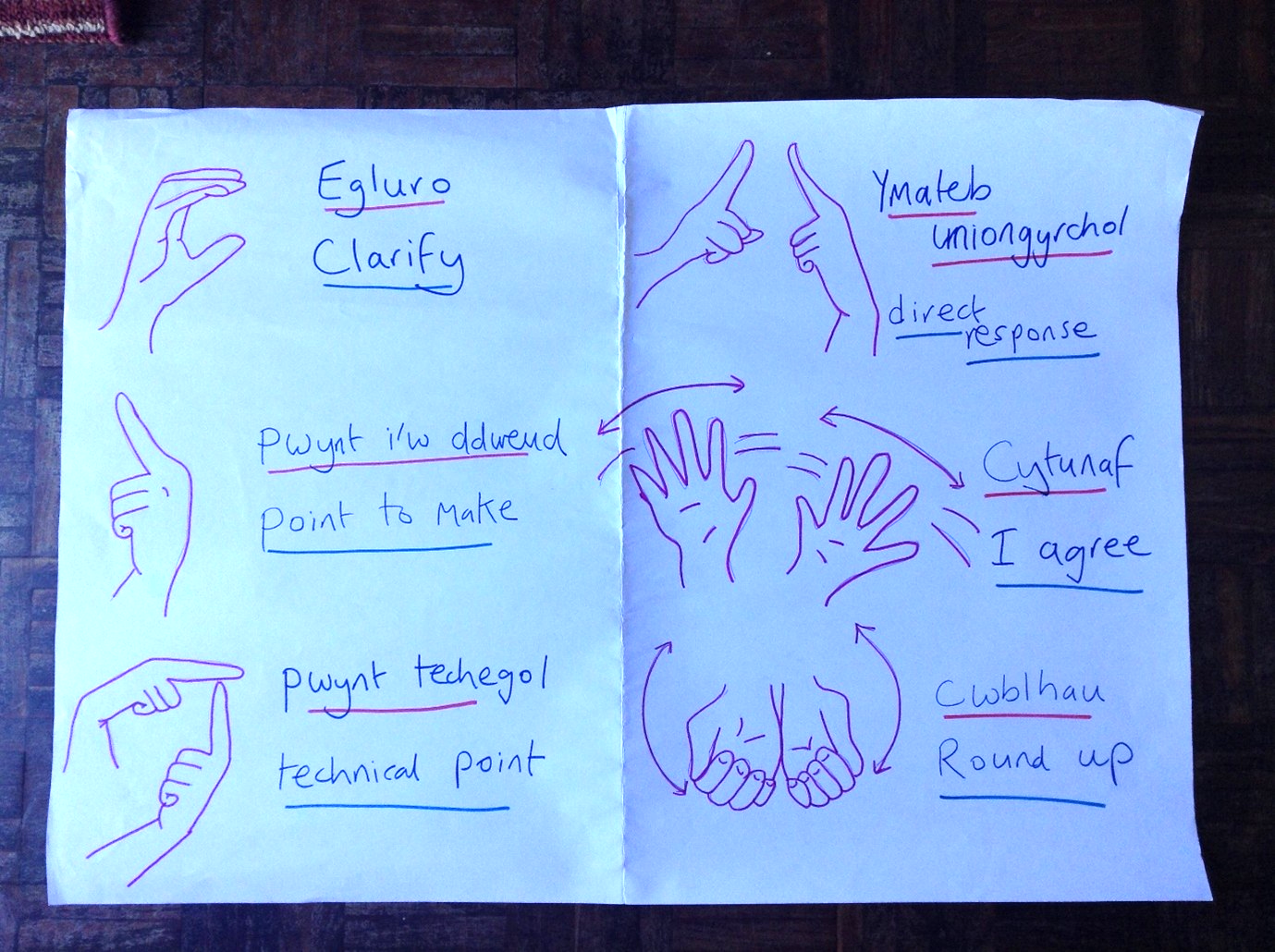
Non-violent communication hand signals – a home-made poster
Pauses
Research has shown that even the briefest of pauses can help us make better decisions. It takes only about 120 milliseconds for the brain to shift focus and block out distractions, to make a more accurate call.
We use pauses and short meditations (e.g. body scan) to help pace our practice.
Everything starts with a pause.
Circles, rounds and talking sticks
Sitting in a circle (of chairs and sofas) physically represents the equal importance of everyone in the room. It also allows us to ensure that everyone gets a turn to speak and be heard, and to listen.
A round means everyone taking a turn to give a short response, either by taking turns round the circle, or by allowing each person to offer their answer when they are ready. Getting everyone’s thoughts into the room can lead to more options, more creativity and better decision making.
A talking stick can be helpful if you have particularly enthusiastic participants. Any handheld item can be used as a ‘stick’. Once in use, only the person with the stick can speak. Everyone else listens, until the stick is passed to the next person. Take time to explain the use of the stick carefully. When holding the stick, pauses are allowed, and you have a responsibility not to talk for too long.
Co-production
Co-production enables people to share power and responsibility, and to work together in equal, reciprocal and caring relationships. Co-production always starts with assets, i.e. what resources, skills and talents do we already have? How can we help each other?
Find out more here: Search the co-production knowledge base.
Going outside
There is increasing evidence that being in nature can improve our comprehension, thinking and decision making, as well as making a substantial contribution to our wider health and wellbeing.
Drawing a picture
When we can’t go outside, we can bring the ‘outside’ in by drawing pictures. We can even bring possible ‘futures’ into the room by drawing those. Being creative is good for our thinking, decision making, wider health and wellbeing.
Open space technology
When we have a big group (20 to 2000+) we use open space technology to organise our meeting. See: Open Space World
Working groups
We encourage working groups to form and continue their work together between meetings. We connect and share with other people with similar purposes.
Joining the Enzyme Project
The context
The Welsh Government Culture Change Service (previously known as the Sustainable Behaviour Change Programme) supports positive behaviour change across Welsh Government in accordance with the sustainable development principle. We provide a range of resources and tools, along with spaces and permissions for colleagues to reflect on how to work differently in order to encourage innovation, culture change and continuous improvement, all whilst aligning with the Well-being of Future Generations Act.
The metaphor
We are currently moving from a ‘patchwork quilt’ to a ‘mycelium’ or ‘ecosystem’ metaphor for public service in Wales. Benefits of this new metaphor include:
- that we see ourselves as part of the mycelium rather than outside the patchwork
- that mycelium is a living dynamic system (that is both individual and collective)
- the added benefits of using a nature-based analogy
- As enzymes change things around them, they also change themselves
Mycelium has many parts, including enzymes that move from place to place throughout the mycelium and are shared with the soil around it. These enzymes create protection for the mycelium and help provide resources, information, medicine and nutrition to the wider ecosystem – trees, plants and so on.
The proposal
We are inviting you to establish small cross-cutting teams of individuals within your public body or other organisation. We are interested in talking to anyone across Wales who has an interest in deepening their understanding and application of the Well-being of Future Generations Act.
Such a team may already exist in your organisation, or you might already be acting as part of the mycelium by sharing and encouraging good practice in line with the Well-being of Future Generations Act.
Would you like to identify or create a small cross-cutting team that can be supported by (and will support the work of) the Chief Executive (or equivalent) in your organisation?
If so, we are asking you to set up the simplest possible structure for a regular interaction between:
- this team and your CEO
- this team (more frequently) to reflect together
- one or two members of your team with the Welsh Government Culture Change Service (monthly)
We recommend that you make use of the latest best practice methods for meetings, but you can set up your structure and processes in any way that suits you and your organisation.
You will be supported by the Welsh Government Culture Change Service through monthly meetings, sharing of direct insights from the latest science and simple guides to support your activities.
If you are interested in evaluating this project, we’d also be interested in hearing from you.
Next steps
If any of the above sounds interesting, however tentatively, please send a short email message to Sustainable.Futures@gov.wales briefly stating:
Communities of practice
Please choose the society, group, team or community that best matches your needs. Can’t see what you need? On the wrong day for you? Please contact us to find out what else is available. For further details, or to join a particular community, contact: Sustainable.Futures@gov.wales
Regular informal practice to support your wellbeing and your work
Do you just need somewhere to build your basic skills or look after yourself better? Then try joining a regular free Breathing Space (daily, weekly or monthly) online here: Breathing Space via Zoom, Monday to Friday, at 8-8:30am.
Rhwydwaith Sefydliadau Cefnogi / Supporting Organisations Network
Convened 6-monthly by the Office of the Future Generations Commissioner with email updates between members on an ad hoc basis.
This network is for representatives of organisations supporting public bodies or Public Services Boards to implement the Well-being of Future Generations Act i.e. those that provide resources, training and expertise to public bodies.
Our goals
- A space for sharing what people are doing and what they are planning
- Connecting People and projects, encouraging collaboration
- Working across the sector in an integrated way, avoiding unnecessary duplication.
Our How
- Apply systems thinking.
- Encourage connections and collaboration.
- Integrate work and avoid unnecessary duplication.
For further details, contact the Future Generations Commissioner Wales: contactus@futuregenerations.wales
SDCC+ (Sustainable Development Coordinators Cymru Plus)
SDCC+ is an independent, inclusive network supporting public bodies in Wales to implement the WFG Act and sustainable development. The network provides a reliable, friendly and safe space to voice and explore new ideas related to sustainable development.
It offers a learning and sharing programme, including Future Generations Knowledge Exchange sessions. SDCC+ have been established as a sound network to advise, challenge and collaborate with the Welsh Government, Future Generations Commissioner’s Office, Welsh Local Government Association, Wales Audit Office, and Cynnal Cymru.
Engagement is facilitated through online and in-person meetings, workshops, seminars, a bespoke website, and a Teams channel. For further information please contact: www.sdccplus.org.uk.
All Wales Continuous Improvement Community (AWCIC)
This community is for continuous improvement practitioners working in Welsh Public Services. You can join the All Wales Continuous Improvement Community in the Networks area of the Academi Wales website, where you can access information around continuous improvement including tools, techniques and recent materials.
You must have an Academi Wales account and be logged in to your Academi Wales account to be able to join this network. You should also subscribe to the weekly bulletin to get regular updates. We:
- connect people with a wide knowledge base of continuous improvement techniques, who are doing the same type of work, facing the same problems and celebrating the same successes as you
- strengthen links between public services – making contacts across a range of organisations and use each other’s knowledge and experience
- learn together via Case Studies and Events. A list of upcoming AWCIC events can be accessed here
- find opportunities to collaborate on projects with practitioners in other organisations
- change the way we work, using collaborative learning to shape decision making
- influence change and policy making by using data and experiences from our community
For further details contact AcademiWales@gov.wales
Compassion practices
Are you interested in exploring what inhibits and enables compassion to flourish? Free training and support on the practical steps required to widen application of compassion practices is available via Compassion Practices Collaborative.
Various times available on-line and in person. Sign up here to receive details by email.
Creativity, biodiversity and behaviour change
One of our longest standing circles – originally called Biodiversity4Cymru. Welcome to artists, ecologists, policy activists and all others with an interest in the connections between creativity, biodiversity and how our connections with these can create culture change.
We meet monthly on MS Teams, 4-5pm on Wednesdays.
Cynghrair egino / the Edgy Alliance
Cynghrair Egino (emergent alliance) is the core element of the Climate Psychology Alliance in Wales. We share learning together and have an overlapping membership. You do not have to be a member of one to join the other.
The emergent alliance is a network of individuals who are, in various ways, supporting people, organisations and communities through the emotional and psychological challenges of Brexit, Covid, social, economic, climate and biodiversity emergency. We are a mixture of trained psychologists, psychotherapists, councillors, facilitators (the Work that Reconnects, Death Cafés, to name a few), trainee shaman, end of life doulas and people of faith.
We meet virtually once a month using Zoom to share progress and learning and to develop new ideas and services.
Decolonisation support group
Supporting the Anti-racist Wales Action Plan and wider equalities and inclusion policies. We meet to better understand how we can decolonise Wales’ assets, behaviours and working practices. The National Library provides support, so that those who wish to do so can record and upload stories to the People's Collection Wales website.
You can sign up for monthly sessions either 3-4 on Thursdays or 10-11 on Fridays, or attend both if you need more frequent support. You can bring a question along to sessions or just attend and listen.
Delivering Net Zero
Building on the highly successful community of practice that already supports key actors working on challenges to decarbonise Welsh homes, we are extending and deepening our practice to learn from each other and do things better. We have a growing network of Communities of Practice. There are a range of opportunities from bringing Chief Executives together, working with communities, collaboration in local areas, peer learning and more. Peer facilitators support the groups to get up and running.
Governance and scrutiny
The role of non-executive board members and trustees is crucial in supporting (or undermining) the way an organisation conducts itself, the culture it creates, and the extent to which it improves well-being in its widest sense.
Every board member has their own personal journey in understanding what is required of them.
This group is for anyone who wants to explore how we can make action learning work for governance.
Housing decarbonisation
We support key actors working on challenges to decarbonise Welsh homes to learn from each other and do things better.
We have 7 different facilitated groups who meet regularly, involving citizens, chief executives and technical experts. We also have a facilitators circle for those who are supporting these groups.
Impact assessments
Many public bodies have drawn on the integration way of working under the WFG Act to combine various impacts assessments into one place, either on paper or via discussion groups. This group meets to share and learn more about how we can improve impact assessment. We are exploring the following:
- What does impact assessment look like in our organisations?
- How can integrated impact assessment (IIA) support application of the Well-being of Future Generations Act?
- How can we support the Commissioner for Future Generations and others in their work to produce collective guidance on IIAs?
People's practice
As part of the Welsh Government's response to climate and biodiversity emergency, we produced guidelines for creating a People's Practice, to help increase practical local action.
There are a range of similar groups active in Wales including Community Councils, Transition Towns, Repair Cafes, Local Food resilience, Community Renewables, Transport Shares, Library of things and others.
This group is for anyone who is bringing together a local group of people to enable local practical responses to climate and ecological challenges. Meetings are agenda-less and reflective. You can even say nothing and just notice how you feel. It is a good opportunity to share and learn from others and realise that you are not alone.
We meet monthly via Zoom 4-5pm on Wednesdays.
Shambolic Warriors
We are a group keen to work differently to better align with the Wellbeing of Future Generations Act. We want to respond to the complex challenges we face, not only as a public sector but as a society. All are welcome!
The Shambolic Warriors concept is based on the Shambhala Warrior Prophecy.
Some Shambolic Warriors meet by MS Teams 12-1 on the last Friday of the month.
Copyright
© Crown copyright 2025: With the exception of the items identified in the text, you may re-use this material freely under the Open Government License 3.0. See details at: https://www.nationalarchives.gov.uk/doc/open-government-licence/version/3/
For feedback or enquiries contact: Sustainable.Futures@gov.wales
Acknowledgements
This guide has been designed with generous input from a huge range of people including:
The Compassion Practices Collective.
Centre for Mindfulness Research and Practice and Mindfulness Wales
The Presencing Institute and u-Lab
Every university in Wales
People’s practices and other civil society circles all over Wales.
Hundreds of civil servants from the Welsh Government and their stakeholders
We’d like to thank everyone for all their ideas, hard work, insights and suggestions.