
Co-production of Government Social Research: lessons learned from a Welsh Government and Disability Rights Taskforce prototype - Background
This research aimed to assess how feasible it was to co-produce Government Social Research. The findings are based on two collaborative projects exploring recommendations proposed by the taskforce.
In this page
Rationale for the co-production prototype
In September 2023, the Disability Rights Taskforce mutually agreed to collaborate with the Equality, Race and Disability Evidence Units with the aim of co-producing Government Social Research (GSR) informed by lived experience. The research would prototype the extent to which GSR can be co-produced, working together to navigate barriers and embrace enablers for change.
This was considered important to strengthen the evidence base, improve knowledge and understanding and use innovative methods such as co-production in GSR.
Background to co-production
Co-production is not new, but it is increasing in prominence as more organisations recognise the value that lived experience can bring to decision making. Co-production as both a practice and a debated concept dates back to the 1970’s. Elinor Ostrom originally defined co-production as a way in which citizen participants could have a role in formulating public policy (The Multiple Facets of Co-Production: Building on the work of Elinor Ostrom by Alford, 2014, available at Taylor and Francis online).
More recently, the emergence of a “new public governance model” has placed the focus on inter-organisational relationships, networks, collaborative partnerships, participatory governance and other forms of multi-actor relations (Understanding co-production as a new public governance tool by Sorrentino and others, 2018, available at Oxford Academic). The trend in the UK in recent decades has been towards co-production, conceptualised as a “common sense shift to delivering public services” (Reflections on Making Co-production Work: The Reality of Co-production from an Insider Perspective by Fillingham and others, 2023, available at Oxford Academic).
Arnstein (A Ladder of Citizen Participation, 1969, available at Taylor and Francis online) conceptualises the levels of possible participation in decision making as rungs on a ladder (Figure 1). At the lowest level of participation, citizen partners with lived experience are manipulated by the organisation that involves them. Partners do not have agency and are imposed on by organisations and institutions which assume they understand the issues best. At the highest level of participation, citizen partners have strong control over the decisions that are made. They have full agency and are considered active participants, with equal power to other members of the team.
Figure 1: levels of public involvement shown using Arnstein’s ‘Ladder of Participation’
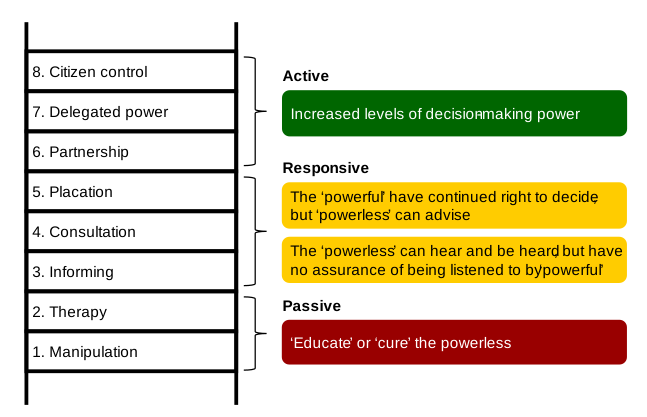
By definition, co-production should involve participation at the higher levels of the ladder. However, most research claiming to be co-production falls around the consultation level, meaning that partners do not actually have the power to actively make decisions. Critiques of co-production do not undermine the value of co-production but call for a more nuanced definition of the process. This new definition should appreciate the links between the process of public service delivery and the value that delivery aims to bring to society (Beyond co-production: Value creation and public services by Osborne and others, 2021, available at Wiley online library). Ocloo and Matthews (From tokenism to empowerment: progressing patient and public involvement in healthcare improvement, 2016, available at BMJ Journals) argue that service improvement projects should take a democratic rights-based, and values-based approach, emphasising direct involvement, empowerment and democratisation of decision making at the community level.
Aims of the co-production prototype
The research aimed to prototype co-production as a way of conducting social research alongside representatives of disabled people and using the principles of the social model of disability.
The research aimed to enable delivery of the Equality, Race and Disability Evidence Units mission “to improve the availability, quality, granularity and accessibility of evidence about individuals with protected and associated characteristics to fully understand the level and types of inequalities in Wales.” The ambition, as part of contributing to a more equal Wales under the Well-being for Future Generations (Wales) Act 2015, was to enable decision makers to develop better informed policies and drive better outcomes for people. ‘Involvement’ was introduced as one of the act’s sustainable development principles to achieve the wellbeing goals. The co-production prototype provides learning for the GSR community and policy officials to support the delivery of this principle in practice.
The research involved co-production with the Disability Rights Taskforce. In July 2021, the Locked out: liberating disabled people’s lives and rights in Wales beyond COVID-19 report highlighted the inequalities experienced by disabled people in society. One of the previous Welsh Government’s responses to the report was to set up the Disability Rights Taskforce, a partnership between Welsh Government and disabled people. The Taskforce was co-chaired by the then Cabinet Secretary for Social Justice, Trefnydd and Chief Whip and a chosen representative from the Welsh Government Disability Equality Forum. The Taskforce operated on the principle of co-production, with more than 200 Welsh Government policy officials and 350 external stakeholders working together to develop recommendations, aimed at improving outcomes for all disabled people in Wales. These recommendations have been used to inform the outcomes and actions of the Disabled People’s Rights Plan.
Research context in which the prototype was delivered
Equality and reciprocity are essential in co-production. The prototype aimed to test the extent to which co-production can be achieved within a GSR setting when considering the GSR code. GSR is the professional membership organisation for social research in government. The GSR code is an addendum to the Civil Service Code and includes the core values of integrity, honesty, objectivity and impartiality. This sets out a number of standards that must be met for research to be considered GSR. The GSR competency framework and the GSR publication protocol also guide the way social researchers produce research. All GSR researchers are responsible for upholding ethical assurance in their research.
The 6 ethical principles for GSR research
- Principle 1: research should have a clear user need and public benefit.
- Principle 2: research should be based on sound research methods and protect against bias in the interpretation of findings.
- Principle 3: research should adhere to data protection regulations and the secure handing of personal data.
- Principle 4: participation in research should be based on specific and informed consent.
- Principle 5: research should enable participation of the groups it seeks to represent
- Principle 6: research should be conducted in a way that minimises personal and social harm.
Overview of the research topics explored in the co-production prototype
The prototype was intended to strengthen the legacy of the Disability Rights Taskforce recommendations that had previously been identified and proposed to the Welsh Government. Two recommendations were selected by Taskforce Chairs to research furtherand these formed the basis of the co-production project.
Research topic 1: National Centre for Independent Living in Wales
The first research topic explored the potential for establishing a National Centre for Independent Living in Wales. An online workshop was held with a range of stakeholders to explore ideas for establishing a National Centre. This included exploring what independent living meant in practical terms, how a National Centre could help to support independent living for disabled people and options for possible delivery models. The workshop included:
- disabled people
- representatives from impairment groups and Disabled People’s Organisations
- local government and other public sector organisations
- the social care sector
- trade unions
- Welsh Government officials
- individual stakeholders in disability rights activism
Research topic 2: Disability Confident Employer Scheme in Wales
The second research topic explored ways to improve the Disability Confident Employer Scheme in Wales. Taskforce Working Group members recommended that the Disability Confident Employer Scheme needed improvement and increased engagement with existing avenues of support and advice from disabled people with lived experience and expertise. Three focus groups were held and comprised of employers, trade unions, and representatives from Disabled People’s Organisations and Impairment Groups. They proposed new ideas for the scheme, which included a distinct employer kitemark for Wales, an enhanced scheme with a Welsh element or to seek improvements to the current UK-wide scheme.
Two research reports were published in June 2025 in accessible versions including HTML in English and Welsh, and executive summaries were published in additional versions including British Sign Language (BSL) and Easy Read.
The co-production team
The co-production team included Welsh Government social researchers and policy officials, Disability Rights Working Group Taskforce Chairs and a PhD student. Many members of the co-production team had lived experience of being disabled by barriers in society, which included some of the Welsh Government officials.
Disability Rights Working Group Taskforce Chairs brought research expertise and experience from the academic and voluntary sectors as well as having relevant experience in mixed methods approaches and co-production.
A ‘co-producer’ is defined as a member of the cross-sector team who worked together to prototype co-production of a GSR report for either of the 2 research topics.
Vision for the co-production prototype
After the co-production team had been established, the team worked together to co-design and agree the overall prototype vision. This defined co-production for the prototype as “working in equal partnership, learning how to produce research together, involving Disability Rights Taskforce Chairs without over-burdening them, and publishing reports of a good standard as co-produced and co-authored research”.
The vision set out the co-production team’s intention to adopt ways of working together that valued diversity, were inclusive, transparent and allowed the team to be creative and learn from each other.
During the scoping stages of the co-production prototype, it was agreed that the team would co-produce both research projects based on the 2 Disability Rights Taskforce recommendations as noted above and produce a follow on ‘lessons learned’ project which is the basis for this report. The aims of this project are set out below.
Research aims for this co-production lessons learned research
The overall aim of the lessons learned research project was to understand to what extent it is possible for government social researchers to co-produce social research. Additionally, the research aimed to consider any lessons on applying the social model of disability in GSR.
The social model of disability focuses on societal barriers rather than impairments, advocating for the same rights for disabled people as their peers. The social model shifts responsibility to society, calling for the removal of barriers (structural, cultural, and discriminatory) which hold back disabled people's participation.
The objectives of the lessons learned research project were:
- to draw conclusions about what level of involvement is feasible at each stage of a GSR project
- to understand the barriers and enablers to co-producing research in government social research
- to understand the added value of doing research collaboratively with people with lived experience and expertise of being disabled by barriers in society and incorporating the social model of disability
This research report is a presentation of the evidence of the lessons learned following the co-production prototype.
For reference, when ‘the prototype’ is referred to within this report, this means the delivery of 2 GSR social research projects using a co-production approach led by a team of co-producers.