Connecting on-site generation to the grid: technical note
Guidance on connecting renewable electricity generation to the electricity distribution network.
In this page
Who should read this note?
- Owners of premises who are intending to install, or who have already installed, a renewable electricity generating station (e.g. roof top solar PV) and/or battery storage, on-site to primarily, or entirely, supply the same premises. (This may be referred to as self-consumption, on-site generation or auto-generation.) The premises may be a new-build and yet to be connected to the electricity distribution network, or it may be an existing building already connected to the electricity distribution network.
- Prospective owners of on-site electricity generators or battery storage, who wish to sell or supply surplus generation via the electricity distribution network.
- Current owners of on-site electricity generators wishing to supply or sell electricity via the electricity distribution network but do not have an export Meter Point Administration Number (MPAN) or fiscal export meter.
Purpose of the note
The note summarises industry-compliant routes to connect generation to the distribution network and, if required, to export surplus generation to the grid. The note is for high-level guidance and does not replace the requirement for site-specific expert advice.
The note does not cover the legal restrictions to selling or supplying electricity, nor does it provide comprehensive information or advice about the commercial market for exported electricity.
Background
The operation of generating stations and battery storage systems may impact the function of the electricity distribution network. To maintain a safe, balanced network Distribution Network Operators (DNOs) must authorise all installation of generating stations and battery storage systems in any premises connected to their electricity network, even if there is no intention to export any surplus electricity.
Compliance with the DNO’s Engineering Recommendations is the sole responsibility of the premises owner.
Design and timescale
It is important to contact the DNO at the outset of a project and to note:
- if your design requires a new grid connection, or a change to the existing connection, this may not be available immediately
- there may be a cost associated with connecting equipment to the grid
- adjustments may need to be made to the initial design to meet the relevant Engineering Recommendation, this may take some time
- changes to the electrical design of the installation may impact the technical, financial or commercial viability of the project
- generation and storage capacity at the same connection point are considered cumulatively, i.e. 20 kW generation plus 20 kW battery = approximately 40 kW grid connection
Connecting generation to the grid
Comprehensive information on connecting commercial generation to the grid is available from the Electricity Networks Association, Connecting commercial generation to the electricity networks – Energy Networks Association (ENA)
When equipment that generates or stores electricity is installed at a premises connected to the electricity distribution network, the DNO must be notified, must authorise and, sometimes, witness the connection, even when no electricity will be exported to the grid.
The owner of the premises is responsible for applying to or notifying the DNO in the manner described in the relevant DNO Engineering Recommendation (ER). In practice, it is usually the installer of the equipment who will liaise with the DNO on the owner’s behalf. The owner should ensure they retain evidence of ER compliance from the installer for future use.
High-level summary of steps the system designer or installer should take
- Identify the electrical capacity of the installation. The capacity of the installation equals, generation capacity plus battery storage capacity (where present).
- Ensure the electrical design is detailed and accurate enough to meet the DNO’s requirements.
- Identify the local Distribution Network Operator.
- In North Wales and part of mid-Wales, this is Scottish Power Electricity Networks (SPEN) Understanding the Connection Process - SP Energy Networks and Generation: Connecting a Generator to the Power Grid - SP Energy Networks
- In South Wales and part of mid-Wales, it’s National Grid Electricity Distribution (NGED) National Grid - New connection
- Identify the correct connection compliance route for the installation i.e. Engineering Recommendation G98, G99, and/or G100 (replacing G59 and G83):
- a single generation or export installation up to and including 3.68kW (single phase) or 11.04kW (3-phase): G98 connect and notify
- multiple generation or export installations up to and including 3.68kW (single phase) or 11.04kW (3-phase): G98 apply in advance
- single or multiple generation or export installations above 3.68kW (single phase) or 11.04kW (3-phase): G99 apply in advance
- any installation using export limitation e.g. ‘island mode’ to enable generation to continue during power cuts: G98 or G99 (as applicable) plus G100 apply in advance
- battery storage capable of export: treated as generation under G98 or G99. Apply in advance
- Confirm the generation and/or storage equipment is compliant with the relevant DNO Engineering Recommendation. Manufacturers may list their compliant equipment in the Electricity Networks Association Type Test Register, ENA Connect Direct .
- Complete the grid connection application, or notification, via the appropriate ER route. Make any appropriate alterations to the design and inform the owner of the length of time to connect to the grid.
- At the point of commissioning, the installation must be certified as compliant with the appropriate Engineering Recommendation. Where commissioning does not have to be witnessed by the DNO, the DNO must receive evidence of ER compliance within 28 days of commissioning.
- If the installation is capable of export, the DNO will automatically issue an export MPAN to the customer or their installer. (For single G98 installations, the DNO will assume an export capacity equal to the capacity of the installation.)
Exporting surplus electricity to the grid
Generators cannot supply or sell electricity to another premises or organisation, via the distribution network, without an export meter. To sell or supply (export) surplus generated electricity using the distribution network, a power purchaser will ask for;
- a Microgeneration Certification Scheme (MCS) certificate associated with the installation, or proof the installation and installer are accredited in accordance with EN 45011 or EN ISO/IEC 17065:2012;
- a Meter Point Administration Number (MPAN) attributed to the export connection point, and
- evidence of an industry compliant export meter capable of recording and storing half-hourly data
- proof of DNO Engineering Recommendation compliance and,
- an electrical design schematic drawing of the generation and/or battery storage installation.
If you have the above items, a Smart Export Guarantee Licensee is obliged to offer you an export tariff on request.
Smart Export Guarantee Supplier List | Ofgem
Want to export, but don’t have an export MPAN or an export meter?
A Meter Point Administration Number is a necessity for supplying and selling electricity using the distribution network. Distribution Network Operators provide new MPANs, in response to a request from a Licensed Electricity Supplier or from a site owner (or their agent).
If an installation is capable of export, an export MPAN is issued automatically by the DNO at installation, when the connection is confirmed as compliant with Engineering Recommendation (G98/G99/G100 or the earlier G83/G59). But if an Export MPAN remains unregistered for a year or more, it may become void and the premises owner will need to apply to the DNO for a new MPAN number.
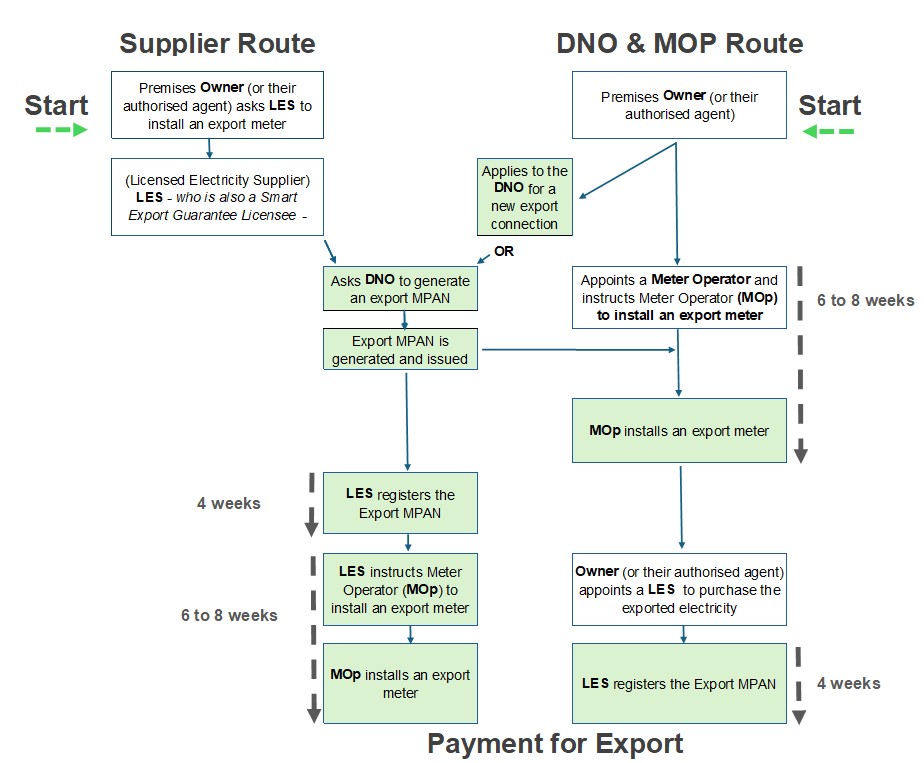
The Supplier route to export
If an owner has all items listed in 6, a Licensed Electricity Supplier, who is also a Smart Export Guarantee Licensee, is obliged to offer a Smart Export Guarantee tariff on request.
If an owner has items 6.i, 6.iv and 6.v a Licensed Electricity Supplier, or Smart Export Guarantee Licensee, may be prepared to arrange for the creation of an export MPAN and the installation of an export meter at the premises, if the owner contracts to sell the volume to them for a period of time. They are not obliged to arrange for an export MPAN or an export meter, nor is there any mechanism to restrict the financial charge they may apply when installing an export meter.
Please note: Licensed Electricity Suppliers are obliged to provide half-hourly import meters free of charge.
Owners may increase the likelihood of a supplier agreeing to arrange for the installation of an export meter by the following means:
- Providing evidence of how much electricity may be exported to the grid in a 12-month period. (The installer should be able to provide an annual estimate of how much volume will be exported. If a generating station is already exporting without a meter, the solar monitoring platform should record export data.)
- Providing the historic export data in a half-hourly format. (There is a free tool for converting 5-min, 10-min, and 15-min data into half hourly data here, generation-data-converter-tool.xlsx)
- Providing half-hourly export data for all generating sites is likely to be the most attractive format. The export data from a single site may appear of negligible value to a Licensed Electricity Supplier, but the export from a portfolio of sites across an estate may be a more attractive proposition.
- Using buyer’s leverage of an estate-wide electricity import contract, to gain commitment from a Licensed Electricity Supplier to install export meters across the estate.
- If the existing import meter is due to be exchanged or upgraded, you might ask the Licensed Electricity Supplier to schedule the installation of an export channel/meter during the same appointment slot. However, the Supplier is not obliged to do so.
The DNO route and Meter Operator route to export
If an owner of an existing generating station or battery storage facility wishes to export electricity to the grid, but does not have an export MPAN, they should locate their record of compliance with the relevant DNO Engineering Recommendation (G98/G99/G100 or the earlier G83/G59) and apply to the DNO for a new export connection, providing the import MPAN and making clear the generating station is already connected to the network. If the ER compliance record cannot be found, the owner of the generating station, or their authorised agent, must contact the DNO to see if they hold a record of ER compliance. If no such record exists, a suitably qualified party will need to carry out retrospective compliance testing. There is likely to be a cost associated with this, and, in a worst-case scenario, the generating station may be forced to switch off until compliance is achieved.
SPEN: gettingconnected@spenergynetworkscrm.co.uk
NGED: nged.newsupplies@nationalgrid.co.uk
The owner will appoint their own Meter Operator to arrange for the installation of a separate fiscal half-hourly export meter. Presence of an export meter and MPAN creates an obligation for a Licensed Electricity Supplier to offer a Smart Export Guarantee tariff to a grid compliant generating station on request (if they are also a Smart Export Guarantee Licensee). This does not have to be the same Supplier contracted to the import meter MPAN.
A list of meter operators can be found here: Our Members - Association of Meter Operators
The benefits of having an export meter will likely need to be weighed up against ongoing direct meter operator charges. It may be worth considering this on an estate-wide basis, rather than as separate single buildings.
Some benefits you may consider are:
- Being able to choose the best market tariff for your exported electricity.
- Being able to access ‘Flexible Tariffs’. (It is possible to be paid to export, or not to export at particular times of day.)
- ‘Complex Sites’: It is likely that before the end of 2026, an organisation may be allowed to consume their surplus generation locally in another local building they own. They may also be able to sell surplus generation at preferable rates to local consumers. Selling to a Licensed Electricity Supplier may no longer be the only option for surplus generation. It will be necessary to have a half-hourly fiscal export meter, and an export MPAN, to be a generator within a Complex Site.