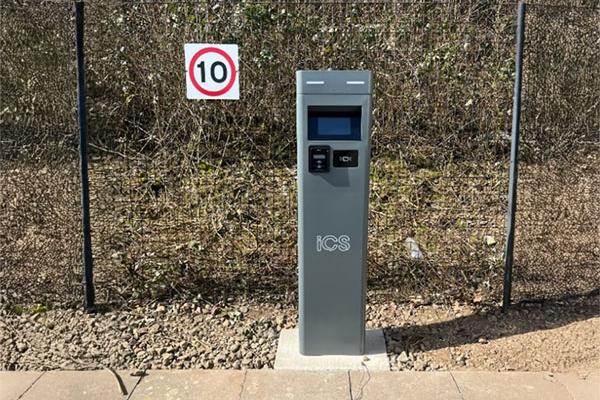
The Electric Vehicle Charging (EVCP) project at IP5 Newport is a part of ambitions to decarbonise the NHS Wales Shared Services Partnership estate.
Introduction
The Electric Vehicle Charging (EVCP) project at IP5 Newport is part of NWSSP ambitions to decarbonisation Strategic Delivery Plan published in March 2021.
As part of the programme, Shared Services is implementing a range of decarbonisation initiatives including installing Photovoltaics (PV), Electric Vehicle Charging Points (EVCPs), building fabric improvements and energy monitoring. Part of the shared service provided to the NHS in Wales by NWSSP is a national procurement division which provides a sourcing, supply chain and purchasing service to the NHS in Wales. IP5 is our main distribution hub, storing various fast moving consumable products for delivery throughout Wales.
In addition, Health Courier Services (HCS) has a fleet of over 90 vehicles transporting material such as mail, laundry, medical records, blood products, etc.
Challenge
The main challenge for all projects of this nature is the capacity of the electrical infrastructure and the potential capital cost required to provide this capacity. We were fortunate that IP5 had spare electrical capacity in its existing electrical infrastructure enhanced by the edition of a 330kW solar farm and 100kWh storage battery.
Approach
One target of the decarbonisation plan is to ensure all new cars and light goods vehicles procured across NHS Wales after April 2022 will be battery-electric where practically possible. Funding was secured from Welsh Government for the procurement of an additional 30 electrical commercial vehicles with delivery by March 2025. This requires additional EVCPs to be installed to enable the new fleet to be suitably charged. The initial phase of IP5 Solar PV project included for the electrical infrastructure associated with the electrical vehicle charging.
This project comprises of 12 twin chargers consisting of 6 twin 7kW single phase units and 6 twin 22kW three phase units providing 248kW of charging capacity. A 22kW EV charger is typically three time faster than a 7kW EV charger and six times faster than a 3-pin plug charger, adding 37-50 miles of range per hour. In turn, a 22kW charger can fully charge an electric vehicle in approximately 3-4 hours and take 1-2 hours top up.
With the funding secured we were able to also procure a 100kWh battery storage to work in conjunction with the solar farm and EVCPs.
Contributes towards
Well Being of Future Generations Act 2015
- Globally responsible (on site renewable energy generation, use of local suppliers etc.)
Welsh Government decarbonisation Strategic Delivery Plan (Initiative 10 – Onsite renewable energy generation)
Impacts and outcomes
The charging infrastructure provides a load management system which monitors the power usage in the building and regulates the charging power draw to ensure efficient charging and prevent grid overload. It involves adjusting power allocation based on real-time demand and available capacity to maintain a stable and balanced electrical system.
A back-of-house EVCP management system has been installed, providing administrative and operational tasks involved in managing EVCP infrastructure, including charging stations, charging networks, and related services. This includes functions like monitoring charging activities, managing user accounts, handling payments, and ensuring the smooth operation of the charging infrastructure.
Lessons learnt and future planning
As funding was confirmed quite late in the financial year there was pressure to complete the project by the end of March. Ideally going forward designs and quotations should be in place so we can progress with the schemes in a timelier manner.