
Demystifying heat from the ground: advice note
Guidance for public sector energy managers on the benefits of ground source heat pumps.
In this page
Introduction to ground source heat
This advice note is intended to support public sector energy managers in Wales in critically evaluating whether their estate could benefit from ground source heat pumps (GSHPs) and other geothermal technologies. The document will help you to:
- become familiar with technical terms, concepts and common misconceptions
- explore the pros and cons of GSHP systems
- assess whether ground source heat could be a viable alternative heat source for your site
Heat pumps are relatively simple devices that transfer heat from one environment to another. Depending on the technology, they can extract heat from ambient air, soil, bedrock, rivers, lakes, the sea, and even flooded mine workings. The CO2e savings will depend on the type of fuel displaced by the heat pump (e.g., gas or oil) and the carbon intensity of the electricity used to operate it. The electricity supplied through the National Grid has been progressively decarbonising, with an increasing proportion generated from low-carbon sources such as wind, solar, nuclear, and electricity imported via interconnectors. As the grid continues to decarbonise, the carbon benefits of heat pumps will continue to improve over time.
- the largest CO2e savings are achieved when replacing fossil fuel-fired boilers (e.g., gas, oil, LPG) with heat pumps
- modest CO2e savings can also be realised when switching from biomass boilers or direct electric heating, depending on fuel source, system performance and operating temperatures
- larger and more complex systems, such as communal or district heating networks, properties with simultaneous heating and cooling needs, or sites currently using combined heat and power plants (CHPs), can also benefit from integrating heat pumps to improve efficiency and reduce emissions
While air source heat pumps (ASHP) extract heat from the outside air, GSHPs extract heat from the ground. GSHPs are generally more efficient and cheaper to run because ground temperatures remain higher and more stable than air temperatures throughout the heating season. As a result, the heat pump’s compressor has to do less work to raise the heating water to the required temperature, meaning the system uses less electricity to deliver the same amount of heat. In general, GSHPs are quiet, reliable and safe. They produce no local air pollution and do not require gas flue pipes or chimneys (except for gas absorption heat pumps, which are not covered here).
Note that a coefficient of performance (COP) of 4 (a typical COP for a well-designed GSHP system) means that for every unit of electricity (kWhe) consumed by the heat pump, four units of usable energy (kWhth) are produced. Heat pumps do not ‘create heat’ but rather raise low-grade heat from the environment (i.e., 10°C) to a usable temperature level (i.e., 60°C), which requires mechanical work by the heat pump’s electrically driven compressor.
Unlike ASHPs, GSHPs do not require external units that occupy outdoor or rooftop space, making them a space-efficient and visually unobtrusive option. They also generate no external noise, which can be an advantage in sensitive sites or densely built areas. The Welsh Government has developed a Heat Strategy for Wales (July 2024), which sets out how Wales will achieve Net Zero heat across all sectors by 2050. The strategy covers homes, businesses, industry, and public services, and outlines the policies and programmes needed to transform heating systems and improve energy efficiency. It includes a strong focus on heat pumps, with an ambition to install 580,000 by 2035, alongside actions to address barriers such as cost, skills, supply chain capacity, and planning. The strategy also highlights the role of local energy planning, the expansion of heat networks, and the wider social and economic benefits of heat decarbonisation.
The Welsh Government continues to support heat decarbonisation through a range of capital grant schemes and revenue funding for project development. These and other support mechanisms are available via the Welsh Government Energy Service.
Types of heat recovery from the ground
Wales has a varied geological makeup, but in many areas the bedrock and water table lie relatively close to the surface. As a result, ground source heat pumps can be deployed in most locations. Shallow geothermal heat is widely recognised as one of the most stable and reliable heat sources for heat pumps. This is because ground temperatures change far more slowly than air temperatures, creating a seasonal “lag” that GSHP systems can exploit to maintain higher and more consistent efficiencies throughout the heating season.
The ground temperature around 100 metres below the surface in Wales typically ranges from 9 to 15°C throughout the year, varying mainly with elevation: warmer around the coast and cooler in the upland areas. Rock and soil have an advantage over air for heat storage because of groundwater. Water has a significantly higher heat capacity than air, meaning it can store much more energy per unit volume.
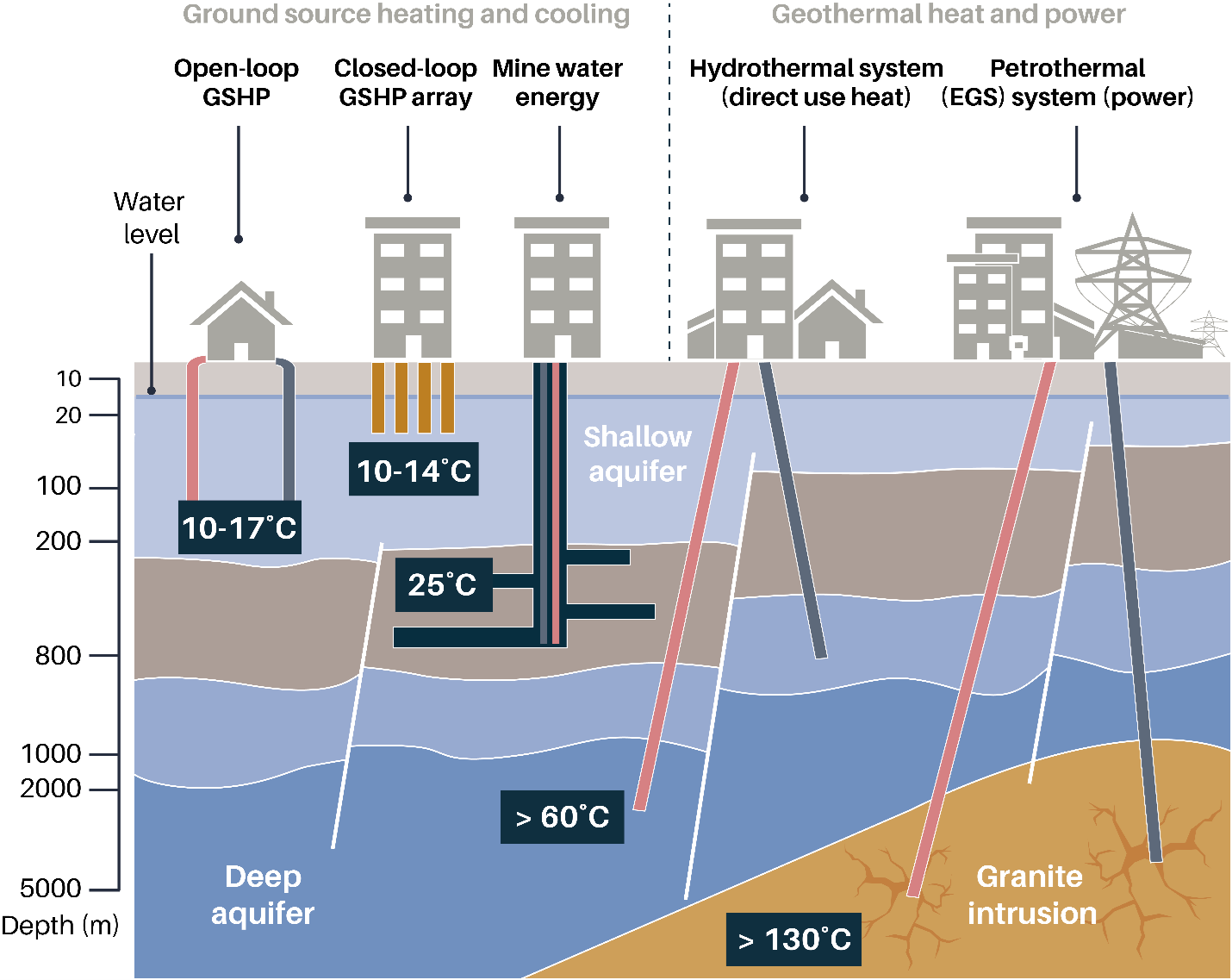
The sun’s rays constantly heat the ground, and ‘warm’ rainwater percolates down in the warmer months, topping up the ground heat supply. There is also a small proportion of heat from below, produced by the radioactive decay of certain minerals deep inside the Earth's crust, which is much more relevant to deep geothermal heat extraction. Although the UK does not have high-grade deep geothermal resources near the surface (unlike volcanic regions such as Iceland), it does have ‘low-grade’ heat resources of 10 to 20°C almost everywhere, which are well suited to GSHP applications.
In the UK, ground temperatures typically increase by about 2.8°C per 100 metres of depth. In Cardiff, for example, the groundwater sitting 10 metres below the surface is constant 13°C throughout the year, increasing to approximately 14°C at depths of ~200 metres. This stable, moderately warm environment makes the ground and shallow aquifers reliable sources of low-grade heat for heat pumps and, in some cases, may also provide opportunities for intraseasonal (i.e., long-term) thermal energy storage.
By comparison, ASHPs, though typically two to three times more energy efficient than gas boilers, do not benefit from such stable source temperatures. Outside air temperature fluctuates throughout the year, with the lowest temperatures occurring in winter when heating demand is highest. The lower the source temperature, the more work the heat pump’s compressor must do, and the larger the quantity of electrical energy required to produce (or ‘upgrade’) one unit of heat. This is why ASHPs generally achieve lower seasonal efficiencies than ground source systems.
Special case: deep geothermal heat and power
Deep geothermal energy refers to higher-temperature resources (>120°C) at several kilometres depth and should not be confused with shallow or ambient geothermal resources, which are what ground-source heat pumps usually exploit.
Drilling to depths of 3,000 to 5,000 m in Wales may encounter ground temperatures exceeding 100°C, sufficient to generate renewable electricity using steam-powered turbines or Organic Rankine Cycle (ORC) systems. However, deep geothermal power production is yet to be proven in Wales. Pilot projects are currently being trialled at sites in England, with similar initiatives planned for Scotland and Northern Ireland.
Commercial deep geothermal, hydrothermal, and petrothermal heat-and-power production plants are established in France, which shares aspects of its geology with the UK.
Default case: ground source open and closed loop, boreholes and ground arrays
Ground source heating, with boreholes drilled to depths of up to 300 metres, can be installed in most locations across Wales. These systems are well established at the domestic scale, clusters of homes and for larger public and commercial buildings.
Heat pumps can also be integrated with low-temperature 4th and 5th generation heating and cooling networks. In these systems, boreholes can act as thermal stores, absorbing surplus heat (or coolth) and releasing it back into the network when required at a different time or even in a different season.
Ground heat storage avoids the high cost, land take, and planning constraints associated with above-ground storage tanks.
There are six main ways to harvest heat from the ground:
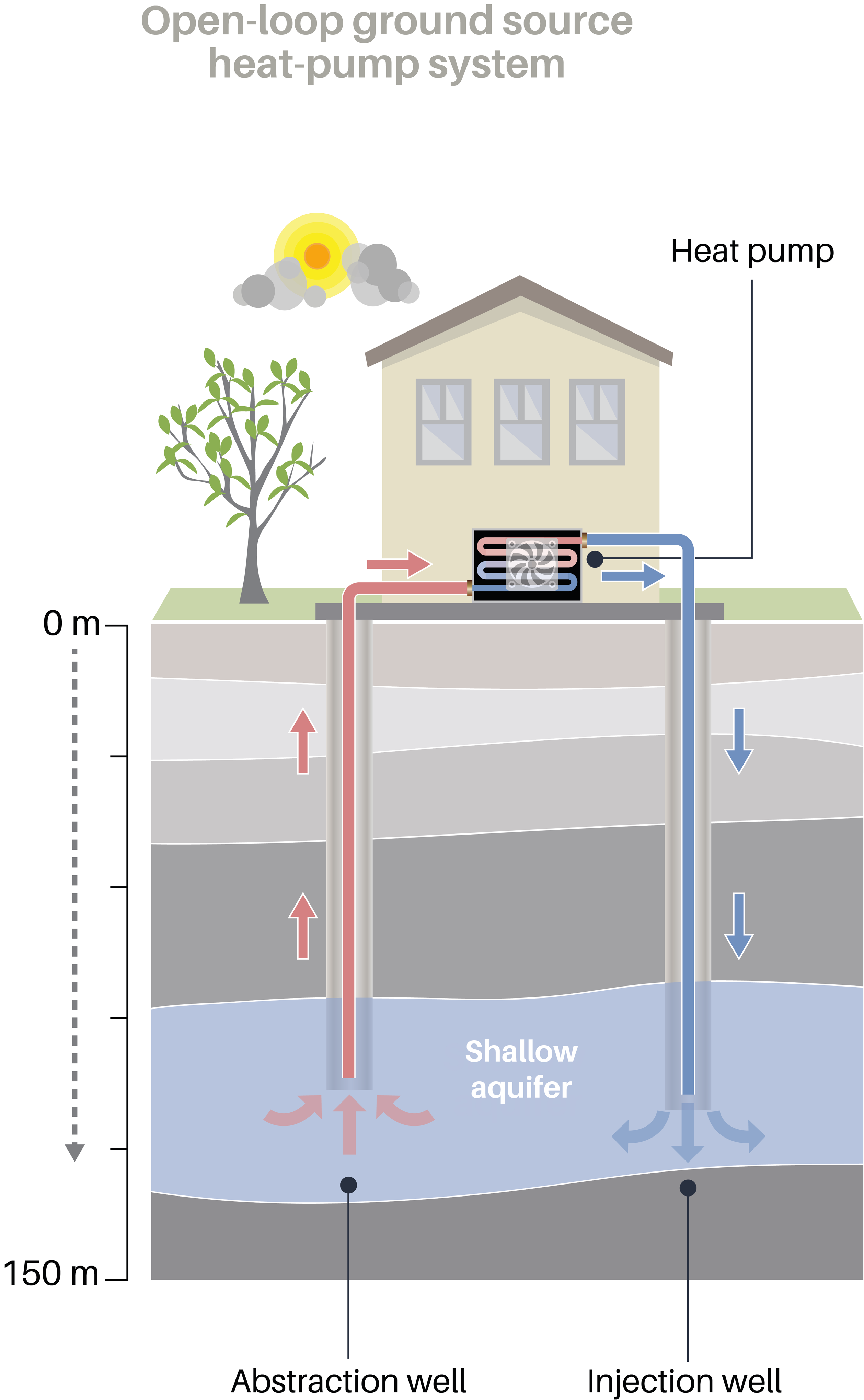
- open loop: extracting groundwater from an aquifer and reinjecting it after use (Figure 3)
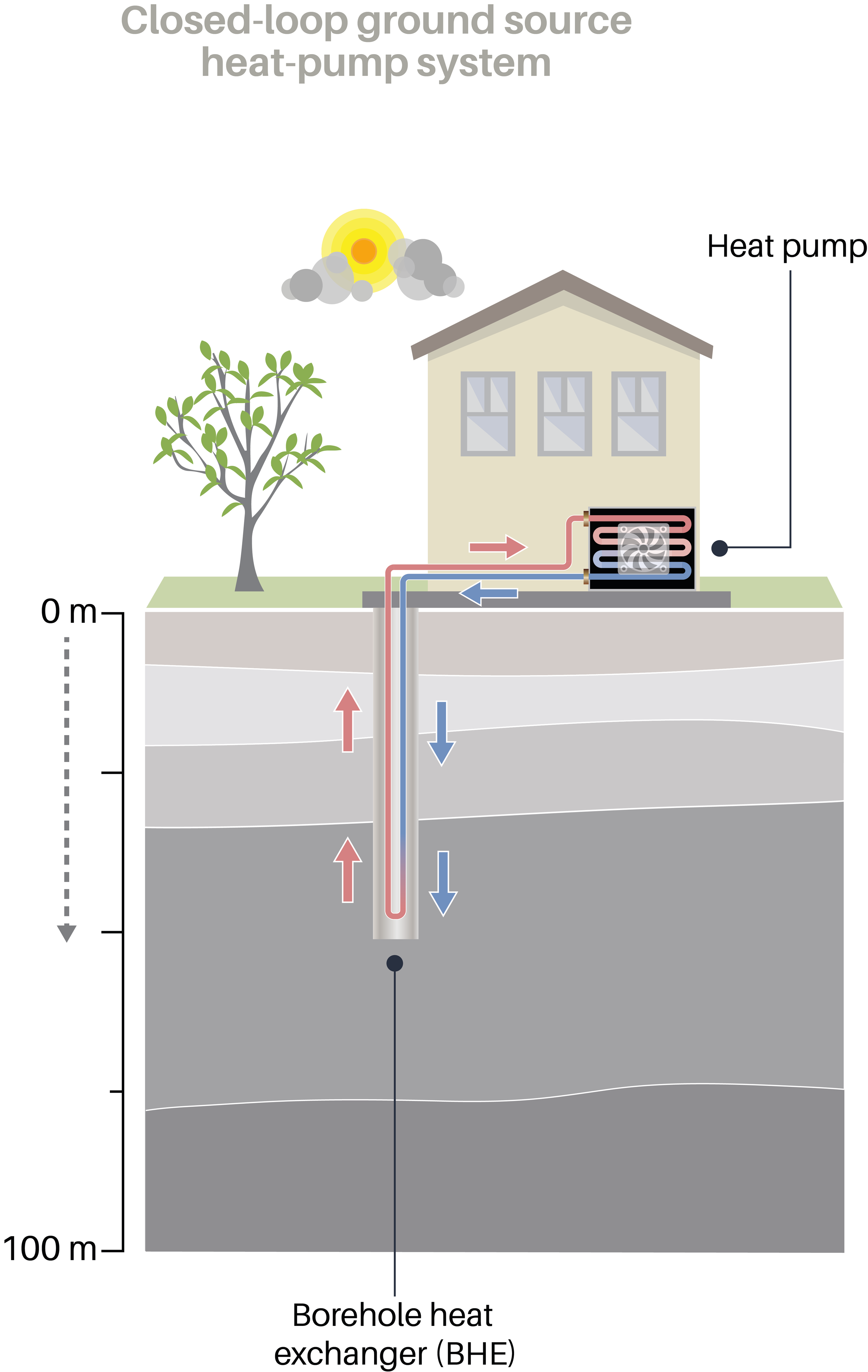
- closed loop: either long horizontal shallow trenches, or vertical deeper boreholes containing pipe loops (Figure 2)
- mine water: abstracting heat from flooded former mine workings
- energy geostructures: integrating heat exchange systems within building foundations, retaining walls
- open water: large lakes, rivers and the sea can also be used to harvest ambient heat, which is known as Water Source Heat Pumps
- waste heat recovery from underground infrastructures: capturing heat from underground infrastructures such as railways, sewage systems, service tunnels and high-voltage cable ducts
Special case: mine water heat
Mine water heat refers to the heat stored in groundwater trapped in old coal and metal mines. When the mines were closed, the large pumps that kept them dry for workers were often turned off, allowing the water to return to its natural level. In the Welsh coalfields, temperatures of up to 21°C have been recorded in mine water at depths of around 200 metres, making this a particularly attractive low-carbon heat resource at relatively shallow depths.
Old photos of Welsh miners at work in the deeper mines suggest they did not need much clothing, as it was uncomfortably hot down there, reflecting the geothermal gradient and the insulating properties of the surrounding rock. While mine water temperatures are not usually high enough for direct space heating, they pair exceptionally well with heat pumps, enabling efficient production of hot water at typical heating system temperatures.
Some local authorities in Wales lie above former mining areas. Early advice on mine water opportunities can be sought from the Mining Remediation Authority, which has recently published Mine Water Heat Opportunity Maps for Wales to help identify suitable locations.
Closed loop
In urban areas, where land access or space is limited or reserved for future development, the most common method is to drill vertical or fanning inclined closed-loop boreholes. These typically range from 100 to 200 metres in depth and contain a single or double U-shaped plastic pipe (also called ‘probes’ or ‘ground arrays’).
Each borehole heat exchanger can typically provide between 3 and 8 kW of heating power, depending on the soil and rock composition, the water table depth, and groundwater flow rates. More boreholes are added or deepened until the required heating load is satisfied.
The second approach, called the horizontal closed loop, is commonly chosen in rural areas where there is sufficient open land unlikely to be disturbed or developed in the near future. This method involves excavating shallow trenches, typically 1.5-2 metres deep, and laying several 100 metres of plastic pipes (also called ‘slinkies’). These pipes connect back to a central manifold, then to the heat pump unit located in a plant room.
Note, ground source heating in Wales is not new, with over 500 domestic systems installed to date. Sport Wales’ National Outdoor Centre for Wales in Caernarfon for example is using closed-loop borehole GSHP technology to provide heat, a system that has been implemented to replace heating oil-fired boilers. In addition, a trial open-loop groundwater heat pump system installed in a shallow gravel aquifer has successfully provided heating to a school in Cardiff since 2015.
Open loop
Where a suitable aquifer, an underground layer of rock or sediment that holds usable quantities of water, exists beneath a site, an open-loop or groundwater heat pump system may be an option. These systems typically involve constructing one or more pairs of water wells, with one well fitted with a submersible pump and the other used to inject thermally spent water back into the aquifer to maintain water pressure. The abstraction and injection wells are illustrated in Figure 3.
Well depths vary depending on local conditions, such as water-table depth, aquifer characteristics, and the volume of water required to meet heating demand. Typically, well depths are around 20 metres, but can be deeper in some locations.
Abstracted groundwater is usually passed through a stainless-steel heat exchanger to transfer heat to the heat pump refrigerant, which is then delivered to the building at a higher temperature.
After passing through the system, the cooled water, usually around 5°C, is reinjected back into the aquifer, typically several hundred metres away from the abstraction point to prevent thermal “short-circuiting”. In some cases, subject to environmental approvals, thermally spent water may instead be discharged to a nearby surface water body or the sea. Mine water geothermal systems operate on the same principle as open-loop systems, abstracting water from flooded mine workings rather than natural aquifers.
Think creatively
For new buildings, extensions, it is worth considering the inclusion of boreholes, thermally active piles, and even inter-seasonal heat storage from the outset. Car parks, brownfields and green spaces are often suitable locations for drilling and can usually be reinstated within a few months. With early design consideration, boreholes can also even be sited under new buildings if considered timely in the design, with heat exchange systems integrated within foundations.
Where space for drilling is very tight, inclined boreholes can be drilled out in a fan shape from a single well pad to extract heat from under existing buildings, maximising the use and value of the available ground volume under the property.
Can my site work with ground source?
Yes, most sites in Wales are compatible with GSHP systems.
Sounds good, but when can’t I use ground source?
GSHPs become impractical where digging or drilling would be too disruptive, technically unfeasible, or prohibitively expensive. Examples include sites with:
- dense urban areas with limited open space
- buried utilities such as pipelines, cables, sewers, cesspits and tanks
- former landfills
- near overhead HV power lines
- in-service tunnels, other sensitive underground infrastructure
- protected habitats or archaeology that must be preserved
- areas prone to severe flooding or land earmarked for future development or special use
- areas of unstable ground, such as heavily land-slipped ground, sinkholes, ground prone to erosion, or areas of very shallow mining
Geotechnical specialists and engineering geologists should carefully evaluate these ground conditions/hazards during the feasibility and planning phases. In some cases, the risks to the project, long-term performance, or third-party liability may be too significant and avoiding those areas is the safest option.
Boreholes can, however, potentially be positioned in areas that are frequently submerged by floods, and even in woods, car parks or under solar panels.
Boreholes and trenches are best avoided in areas prone to intense soil erosion and scouring, such as actively eroding cliffs, beaches, active dunes, peat bogs, and active river tracts.
Ground with artesian groundwater, where water is under pressure and raises the borehole once penetrated, can be challenging to control and seal. These conditions often increase drilling complexity and cost, and in some cases can jeopardise a project. Such sites are best avoided or must be approached with careful planning and specialist input.
Similarly, areas with suspected old mine workings need to be appropriately investigated, starting with a detailed desk study and a mine plan review, and considering all options.
In some cases, if old mine shafts or workings are identified and surveyed early in the feasibility stage, using geophysical investigations, condition surveys, and probing, these features can be accurately mapped. This allows unsuitable areas to be avoided, or, where appropriate, ground improvement measures to be incorporated into the main development. In some cases, it may even be possible to integrate old shafts and mine workings into the project to save on drilling costs. Pre-drilling ground surveys and exploration pits would be undertaken to avoid buried services and to identify issues with ground stability, unexploded ordnance, and land or water contamination.
These investigations also help ensure the protection of water features, sensitive habitats, and areas of special scientific or archaeological interest.
Do I need a permit or a licence?
For closed loop systems, generally no. Closed loop systems are the most common type in the UK and do not currently need permits but may fall under specific General Binding Rules. General Binding Rules (GBRs) are a set of pre-defined environmental protection rules issued by regulators (in Wales, Natural Resources Wales – NRW) that allow low-risk activities to go ahead without needing a permit, as long as the activity complies fully with the prescribed conditions.
It is good practice to register boreholes with National Resources Wales (NRW) and to notify the British Geological Survey (BGS) by sending them copies of the location coordinates, drilling strata logs, and any pump or thermal response testing undertaken. Depositing this information is mandatory for public sector projects under the rules set out in the Government Play Book for any ground investigation.
In areas with a history of underground coal mining, the Mining and Remediation Authority must be informed to obtain a mine access agreement.
No one legally owns the heat stored in the ground, only the right to access it through the land. It is therefore sensible to consider current and future users and to plan schemes in collaboration with neighbouring landowners to ensure stakeholders receive their fair share.
For open-loop systems, yes. If it is intended to pump more than 20m3 of water per day from an aquifer, then, by law, consent to investigate a groundwater source needs to be applied to NRW, which will consider:
- where water is discharged during a water pumping test
- a water features survey (desk study and field survey) and
- a risk assessment to assess the impacts on existing users, such as nearby water abstraction licence holders or habitats
At the time of writing, there is no fee associated with the licence. The process usually takes about 45 working days but can take longer for complex sites. A professional hydrogeological advisor can suggest where best to develop a source, or whether it is worth doing at all.
The BGS GeoReports service provides hydrological water-borehole reports for users intending to extract > 20 m³/day (i.e., commercial use). It contains an evaluation of the geological formations beneath the site in terms of aquifer potential, including anticipated groundwater yields, water levels and groundwater quality.
Electricity capacity
Most commercial electric heat pumps (>45 kWth output) use three-phase electricity supplies with a significant impact on electricity demand. Therefore, early engagement with District Network Operators (DNOs) is important to ensure sufficient power is available for the heat pumps and associated peripherals.
Similar assessments are also provided by hydrogeological consultants. They can also design and supervise pumping tests and produce the required groundwater impact assessment. If the anticipated flow and water quality are confirmed and the project remains viable, an abstraction licence must be applied for with NRW to continue abstracting groundwater. Abstraction licences are not automatically guaranteed, even if it is proven that the source provides enough groundwater.
To return the thermally spent water to the ground, a separate application must be submitted to NRW (environmental permit and potentially an exemption to discharge into another borehole or watercourse if that is desired). NRW has a dedicated permitting team to guide you through the process. The Energy Service and BGS are available to support this process. Early engagement with NRW is recommended as the whole process can take several months.
Stages of ground source heat pump feasibility assessments
First and foremost: don’t be put off
Most, if not all, public-sector decarbonisation finance schemes have tight timeframes. This can deter building service engineers from fully considering ground-source technology solutions because they require additional planning and upfront costs for ground investigation, testing, drilling, and permitting.
However, these concerns should be discussed with the Energy Service, funders, or heat pump specialists. They may be able to help negotiate some flexibility in return for the higher energy-efficiency gains and greater carbon savings achieved by employing ground-source heating and cooling.
Added benefit of a long-lasting investment
Because ground source heat pump units and associated tanks do not contain many moving parts such as fans of ASHPs, and they are housed inside, away from the elements, they tend to last up to twice as long as ASHPs (i.e., +20 years). The below-ground parts of the system, including the heat exchanger boreholes and connecting pipes are designed to last at least 50 years, if they are sited away from unstable or contaminated ground and tree roots to avoid damage. Circulation pumps will need replacing from time to time as with any other heating system. Therefore, the permanent infrastructure (boreholes and pipework) can be considered a permanent investment which should be highlighted in the appraisal.
There are no fixed rules on how a GSHP project must be approached. The Energy Service suggests splitting the assessment of GSHP feasibility into three distinct stages, with the option to opt out after each stage:
Stage 1: red flag check/concept
A high-level review of the building’s energy demands and any obvious site constraints.
Stage 2: initial feasibility
A more detailed investigation of the ground conditions is required to assess technical viability. For example, investigate if an aquifer is present, assess whether the ground can support drilling rigs, etc.
Stage 3: detailed feasibility/design
Where a suitable GSHP solution is tailored to the building’s heat demand, the site layout, as well as the specific geological and hydrogeological conditions, the output of this stage should be of sufficient detail to inform both a robust business case and the preparation of a technical specification for procurement.
Stage 1: red flag check/concept
Building consumption analysis
Monitor building energy usage or analyse recent consumption data to identify building peak heating (and cooling) loads and required or design flow temperatures. Heat pumps operate most efficiently with lower-temperature heating systems (e.g., 35/30°C flow and return temperatures as with underfloor heating), with sufficiently large heat emitters and well-insulated buildings that require stable internal air temperatures. However, modern closed-loop GSHPs can still achieve good performance when supplying domestic hot water or higher-temperature systems. Flow temperatures of around 60°C are typical, and some specialist configurations can deliver temperatures above 80°C by cascading multiple heat pumps in series.
Heat source analysis
Consider how much of the heating load could be covered by ground source and whether there is a cooling load that could be integrated, now or in the future. Heat pumps can modulate and operate partially loaded or can be assisted by other heat sources during peak demand. Existing boilers are sometimes retained for resilience or to provide peak capacity as part of a transitional strategy while heat emitters are upgraded and building fabric improvements are implemented. However, burning fossil fuels for heating these buildings should be avoided, and decarbonisation plans should outline how the usage of other heat sources is minimised and eventually phased out.
Once the heat demand is known, the required ground extraction rate can be calculated, along with the number and depth of open- or closed-loop boreholes needed to meet that demand. For open loop, a typical pair of 6-inch diameter water wells, spaced 200m apart, producing 10l/s (864 m3/day) of 13°C groundwater and re-injecting at 5°C (ΔTgw 8 K) would provide around 67kW of thermal power. The project’s hydrogeologist (or BGS) can help determine whether this is likely to be feasible and assess the chances of success.
Power supply analysis
Review the power demand required to operate the heat pump and consult the DNO to determine whether electricity supply upgrades will be required, what the cost implications would be, and the timescales involved. As a rule of thumb, the peak electricity capacity a GSHP requires is the peak heat demand divided by the lowest expected COP, e.g., 90kWth heat demand and a COP of 3.0 equals 30kWel additional peak electricity demand. The actual calculation is more complex and depends on many additional factors, such as product specifics, thermal storage, and alternative heat sources, but it provides a good enough indication of whether the electricity supply may be a concern / red flag.
Final sense check
Consider whether any significant constraints would make drilling or excavation impractical or undesirable at the site. Potential red flags may include:
- sensitive landscapes or protected ecological areas
- listed buildings
- tunnels, basements
- buried utilities such as gas or fuel pipelines, HV cables, sewers or storage tanks
- active or abandoned mines
- steep slopes, spoil tips, active landslides, sinkholes, or eroding ground
- landfills or contaminated land
- protected graves or archaeology
- areas with planned developments, mineral rights/planned workings or quarries; and
- other environmental sensitivities or protected trees
Stage 2: initial feasibility
Identify suitable land space for drilling or trenching, geology and drilling and ground engineering hazards. At this point, you can begin to determine whether open- or closed-loop ground-source heat, or even water-source heat, is a possibility. This stage likely requires specialist support.
As an initial step, NRW, BGS, and the local authority can be consulted to determine whether similar schemes have been successfully implemented in the region under consideration and whether other users are abstracting groundwater for public or private supply in the vicinity. If no reliable information is available, a geothermal geologist or hydrogeologist should undertake a feasibility-level desk study to assess the likely ground conditions and main GSHP opportunities.
- If there is no aquifer, closed-loop boreholes will likely be the default option, and this should be investigated further by consulting with suitably qualified and experienced GSHP professionals. There is a list of companies offering such services on the GSHPA website and through the Heat Pump Federation.
- Identify parcels of land that could be used for drilling boreholes, allowing for manifolds and trenches back to a plant room, road and river crossings, or a larger area for trenching for a horizontal loop. Typical borehole numbers and lengths are usually assumed in the feasibility stages, assuming 3 kW to 8 kW output per 100-metre borehole (typically 5 kW) or 30-50 W/m of borehole, depending on the strata at depth. Closed-loop boreholes are usually spaced 5-10 metres apart and can be arranged in lines or more complex grid formations to fit within available land.
- Assess ground quality and constraints: Consider whether the ground conditions are suitable for drilling. Issues may include very soft or unstable ground that cannot support heavy drilling rigs, waterlogged soils, or known/suspected soil or groundwater contamination. Consult the BGS online geology maps and other data layers such as GeoIndex. These features/factors can be mapped and overlaid with building plans in CAD or GIS for visualisation, allowing problematic ground to be avoided, engineered solutions to be developed, and any unexpected opportunities, such as flooded mine workings, to be incorporated into the plans and concepts.
- Identify preferred drilling areas or zones as close as possible to planned heat centres to reduce trenching costs and to focus initial discussions and develop concepts with designers and building service engineers.
Rules of thumb for GSHP land requirements
- Boreholes: Most vertical boreholes should be around 10 metres apart, so for 100 kW of heat, that requires between 13-20 boreholes, require ~1200 m2 of space.
- Slinkies: The ~1 metre deep trenches need to be around 2 metres wide and 5 metres apart from centre to centre of the trench. 10 metres of trench provide roughly 1 kW of heat.
- Open loop: The extraction well should be located far upstream to the point of reinjection, ideally +100 metres. In some circumstances, the regulator (e.g., NRW) may allow for surface/river injection.
Stage 3: detailed feasibility design
Detailed feasibility entails conducting topographic surveys, ground investigations, and buried services surveys (typically including ground-penetrating radar (GPR)), alongside trial boreholes/trenches. Ideally, this stage also includes thermal response testing (TRT) to determine the ground's thermal characteristics accurately.
Completed wells will usually have a standard manhole cover and can be flush with the ground level, sunken or raised as required.
Rules of thumb for estimating the required numbers of boreholes are fine for initial business cases and indicative costings. However, for projects requiring 10 or more boreholes, detailed design should be based on measured ground temperatures and thermal properties obtained from in-situ TRTs. These tests typically take 4 to 5 days and cost in the region of £4,000 to £6,000 depending on location and test type. TRTs can reduce drilling costs by 10 to 20% and support the optimisation of system performance, making them a highly worthwhile investment. TRTs are usually conducted on the first borehole in the array, and this information allows the GSHP array designer to adjust the final number of boreholes and optimise the well designs for the local geological conditions. The gathered data can then be used to procure the actual work and to specify the components and engineering services required.
Several GSHP systems operate safely and reliably across Wales, including those installed at the Welsh Senedd and Cardiff University's School of Optometry. Please engage with the Energy Service or BGS to learn more.
Water source, an often-forgotten alternative
Why not use surface water as a heat source? Wales has extensive river and coastal resources, many of which offer favourable temperatures for heat pump operation. However, licensing these systems involves more complex requirements, and heat exchangers must meet stringent standards for safety, fouling control, and maintenance.
A notable example is the National Trust’s water source heat pump (WSHP) installation at the Menai Straits in North Wales. If a WSHP scheme is being considered, early engagement with NRW and, where relevant, the Crown Estate is essential. The Welsh Government Energy Service can provide support through this process.
Further reading
There are several guidelines and application manuals from CIBSE with real examples on how to integrate heat pumps into larger public sector buildings and multi-residential buildings. These include:
AM17 (2022): AM17 Heat pump installations for large non-domestic buildings | CIBSE
AM16 (2021): AM16: Heat pump installations for multi-unit residential buildings | CIBSE
TM51 (2023): TM51: Ground Source Heat Pumps | CIBSE
CP1 (2021): CP1 Heat networks: Code of Practice for the UK (2020) (pdf) | CIBSE
CP2 (2016): CP2 Surface water source heat pumps: Code of Practice for the UK
CP3 (2019): Code of Practice 3: Open-loop groundwater source heat pumps: Code of Practice for the UK (2019) | CIBSE
MCS published multiple guides such as for drilling boreholes
The Mining Remediation Authority Mine Water Heat Opportunities in Wales reports
The Mining Remediation Authority online viewer
North Wales marine water source heat pump example
North Wales ground source heat pump example
British Geological Survey has many useful sources such as:
Supplier and industry resources: Home - HPA UK
Wales Public Sector Low Carbon Heat Technology Introduction & Project Learnings
Welsh Government Energy Service provides the latest on active grants, case studies and other relevant advice
The Welsh Government Energy Service (“WGES”) is funded by the Welsh Government with the aim of developing energy efficiency and renewable energy projects that contribute to public sector decarbonisation and national energy targets. The WGES is delivered by the Carbon Trust, Energy Saving Trust and Local Partnerships (the “Delivery Partners”). This report (the “Report”) has been produced by the Delivery Partners and, whilst the views expressed in it are given in good faith based on information available at the date of this Report:- (i) these views do not necessarily reflect the views of the Welsh Government, which accepts no liability for any statement or opinion expressed in the Report; (ii) the Report is intended to provide general guidance only, rather than financial, legal or technical advice for the purposes of any particular project or other matter, and no-one in receipt of the Report should place any reliance on it in substitution for obtaining their own advice from an appropriate third party advisor; and (iii) any person in receipt of this Report should therefore obtain their own financial, legal, technical and/or other relevant professional advice insofar as they require specific guidance on what action (if any) to take, or refrain from taking, in respect of any project, initiative, proposal, involvement with any partnership or other matter to which information contained in the Report may be relevant; and (iv) the Delivery Partners accept no liability in respect of the Report, or for any statement in the Report and/or any error or omission relating to the Report.