
Development of an engagement strategy
RIWSG 06/19 - these papers are provided for discussion purposes to inform Cabinet decisions and do not represent an agreed Welsh Government policy.
In this page
Purpose
The Steering Group is being asked to offer views on:
- the objectives and principles for the engagement strategy
- key stakeholders to engage with
- options for targeting harder to reach groups
Introduction
1. This paper sets out initial ideas and opportunities for external engagement to meet commitments to co-produce with stakeholders a new regional investment approach to replace the EU Structural and Investment Funds once the UK leaves the EU.
2. Through our engagement so far, it is clear that there is a strong consensus for strengthening partnership working in the development and delivery of a new policy and framework, and for such partnership to be fully inclusive and representative. This is also a requirement in the ways of working described in the Well-being of Future Generations Act.
3. The Regional Investment for Wales Steering Group will be the high-level strategic and national mechanism for engagement with stakeholders from the public, private and third sectors, but it will need to be complemented by a wider range of engagement and coproduction mechanisms in order to achieve meaningful involvement of the full range of partners and audiences.
4. At the regional level engagement will be led by the Economic Action Plan (EAP) and the related work of the Chief Regional Officers and regional teams. There will also be engagement mechanisms associated with the Employability Plan and wider Welsh Government policy (e.g. regeneration, Valleys Taskforce, etc).
5. Consideration will need to be given to engagement timelines and the importance of factoring key measures around specific and significant milestones; for example, activities around the EAP, the work of the OECD (e.g. study visits, seminars), and a formal consultation and supporting events.
6. Members are asked to discuss fresh perspectives for full and successful engagement and coproduction, in particular for how traditionally less engaged groups such as the private sector, young people and citizens/communities can be involved in the process. The engagement strategy will need to be dynamic to respond to new ideas and opportunities as they arise. Initial ideas for key engagement objectives and mechanisms are set out below. Discussion will inform a comprehensive stakeholder engagement strategy to be brought to a future meeting.
External engagement objectives
- Engage and inform stakeholders with the aim of drawing on their expertise and knowledge to co-produce a new regional investment framework in Wales
- Build a strong consensus regarding the future of regional investment in Wales, to present a unified Welsh position as we progress discussions with the UK government on replacement funding and arrangements
- Raise awareness among stakeholders of the implications of changes to regional investment approaches, including managing the transition to a new approach and the new opportunities being created
- Ensure engagement interactions are geographically spaced across each region enabling greater coverage and opportunity for engagement
- Seek to use a multitude of different types of engagement to ensure as wide a reach as possible, including business, young people, and citizens
- Undertake a formal public consultation (and events) during 2020 on a regional investment policy framework, ensuring proposals reflect stakeholder discussions, NAfW Committee findings, Cabinet discussions
- Provide clarity on what can and cannot be done
- Engage with, as early as possible, stakeholders deemed to be most at risk from changes to future funding arrangements
- Provide feedback and updates to stakeholders throughout the engagement process
Key external stakeholders
- Regional Investment for Wales Steering Group and any related sub-groups and work-streams established (private, third, and public sectors, HE/FE, trade unions, local government, equality bodies)
- Ministerial Stakeholder groups (e.g. European Advisory Group, Valleys Taskforce; Third Sector Partnership Council; Social Partner Strategy Group)
- Other partnership groups (e.g. Regional Partnerships; City Deal Regions, NWEAB, etc)
- Assembly and Parliamentary Committees (e.g. Finance and the External Affairs and Additional Legislation Committee)
- OECD
- Assembly Members and MPs
- Whitehall Ministers and departments (namely DExEU; BEIS; Wales Office, and priority area departments)
- Devolved counterparts
- Research / think tanks
- Press / media
- Businesses, young people, citizens/communities
Stakeholder engagement channels and opportunities
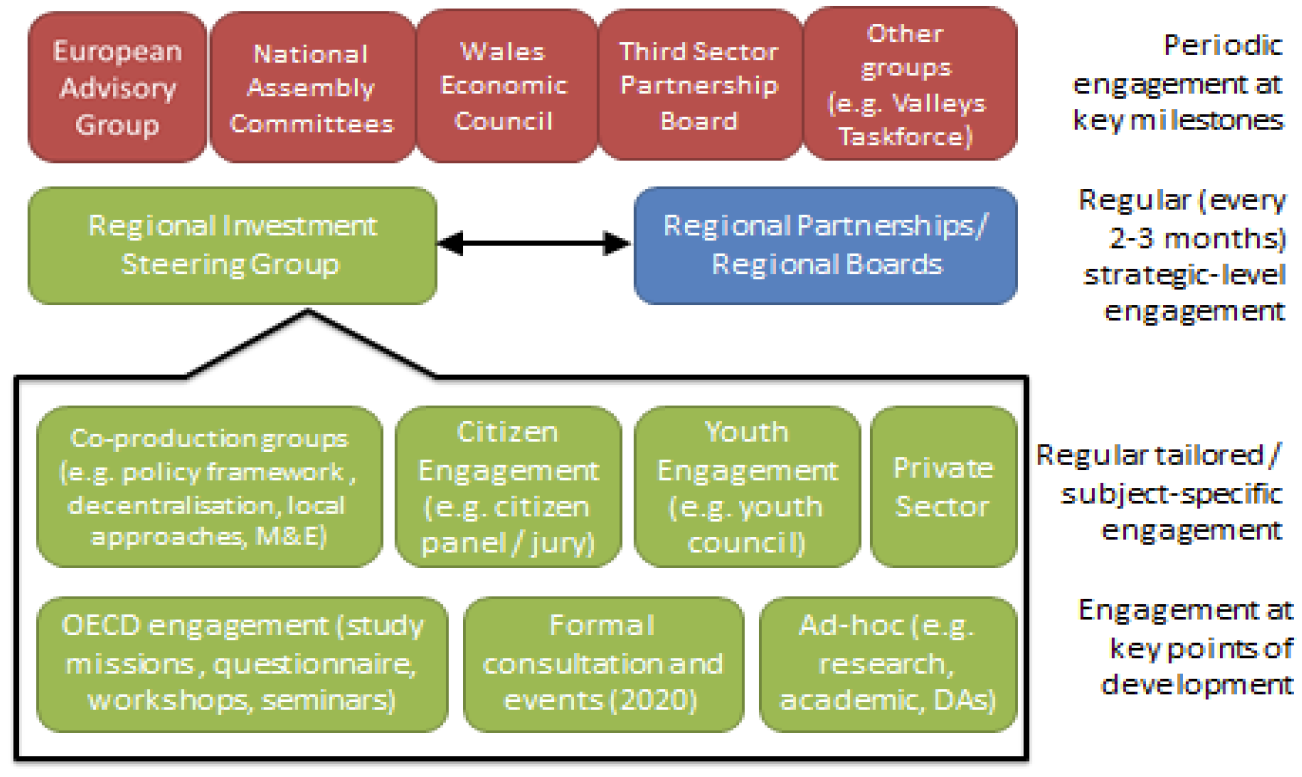
7. Initial ideas on the type/level of stakeholder engagement are set out in Diagram 1 below, and this is supported by the following overview of key points for consideration:
Regional Investment Steering Group
8. As highlighted in the Oral Statement (16 Oct 2018), this group will be the strategic external stakeholder channel for the co-production of an evidence-based regional investment framework in Wales.
9. It will draw on the wealth of knowledge and experience in our businesses, local authorities, our academic institutions, the third sector and the wider public sector across Wales and will play an important role by discussing strategic issues and new ideas about policy direction and implementation approaches, informing advice to Cabinet. The group will also help us shape our broader engagement with our partners across Wales and will have an important role to play in informing the bodies and sectors it represents about co-production developments and opportunities for engagement.
10. An important early consideration for this group will be whether to establish some co-production sub groups to help inform thinking and ideas around specific issues and processes (for example, the policy framework, local approaches, monitoring and evaluation, engagement). Further to feedback from the group, proposals on the formation, role, and type of co-production groups could be considered for agreement at the next meeting of this group.
11. To support the group’s co-production role, a digital platform is being explored for group members’ access to discussion and thematic papers and presentations. We also plan to publish summary versions of papers and actions on the Welsh Government’s web pages to ensure transparency of this group’s work programme.
OECD project
12. OECD involvement should contribute to better relationships with partners at regional and local levels, as we seek to learn from examples of ‘best practice’ policy elsewhere, including internationally.
13. During this 2-year project, there will be significant opportunities for engagement with internal and external partners; for example, we will be seeking input from partners to inform the OECD’s analytical work, as well as involving partners (policy-makers, academics and researchers, representatives of the business community, financial institutions, NGOs) in OECD planned study missions and workshops. There will also be OECD-led seminars with partners to test preliminary recommendations.
14. We will prepare regular strategic communications on the progress of this work, including Ministerial press notices and statements, and web / social media updates.
Chief Regional Officers and Regional Partnerships / Boards
15. Local government and other regional partners should be actively involved in co-designing a new regional policy for Wales and the work of the Regional Partnerships, which are already developing place-based plans for their areas, will be key to achieving this.
16. We propose to utilise existing regional engagement arrangements wherever possible, led by the Welsh Government’s Chief Regional Officers (and their regional teams). This will include regular engagement with regional partnerships (e.g. City Regions, North Wales Economic Ambition Board, Growing Mid-Wales Partnership). This approach will, in particular, help ensure engagement activity around the EAP’s regionalisation agenda and future regional investment model is joined up, and should facilitate stronger engagement with stakeholders at regional and local levels.
Other boards / groups / committees
17. We will also seek to engage, on a periodic basis, other groups representing political, sector and thematic issues. NAfW Committees (notably the Finance and External Affairs and Additional Legislation Committees), the European Advisory Group, Third Sector Partnership Council, Valleys Taskforce, and Social Partner Strategy Group are just a few examples. Engagement with other groups will also be explored in order to address early stakeholder feedback that consideration should also be given to other priorities (e.g. housing, health and social care) for regional investment and that the experience of the LEADER model should be explored for local development more widely than just solely rural areas.
18. We are also keen to participate in events, workshops / seminars planned by a wide range of sectors and organisations across Wales. This would be consistent with our stakeholder engagement in early 2018 on our Brexit paper’s guiding principles, with Ministers and Welsh Government officials attending events and seminars organised by the WLGA, WCVA, Third Sector Partnership Council, Pembrokeshire Enterprise Network, and others. It will be important to align our engagement activity with key milestones and developments around the work programme.
19. Many of the approaches we will be co-producing with stakeholders will be system level, requiring their expertise and knowledge of regional investment policy and delivery mechanisms. Yet we also recognise the need for businesses, young people, and citizens to be more engaged in the development of a new regional investment approach, as it is important that our future investment landscape in Wales is shaped and informed by those for which it is intended.
20. The comments and feedback gained from all of the following groups can be collated into various reports which can be used by this Steering Group and to advise Ministers on the potential impact and reception to new regional investment approaches and the recommendations in the formal consultation report.
Targeting harder to reach stakeholders
Businesses
21. Historically, businesses have benefited from the European Structural and Investment funding programmes indirectly as beneficiaries of EU projects (e.g. Business Wales, SMART Cymru, Wales Business Fund, Advanced Design Engineering, Social Business Growth Fund) led by the public, HE or Third sectors, rather than as lead sponsors of projects. As a result, our approach to engaging with businesses during the development and delivery of EU programmes has been through the lead sponsors themselves as well as though representative organisations / bodies (e.g. CBI Wales and FSB, Wales Co-operative Centre) as members of Ministerial groups and Programme Monitoring Committees.
22. This group, which includes representatives from CBI Wales, the Federation of Small Businesses and the third sector, will play an important role in ensuring that the interests of business, including social enterprises, are fully reflected in our new regional investment framework. Co-production groups, the establishment of which will be subject to this Group’s consideration and agreement, could also provide businesses with the opportunity to be involved in our work programme, as well as the OECD work and the EAP regionalisation agenda being taken forward by the Chief Regional Officers and their teams. As noted earlier, groups such as the Ministerial Social Partners Strategy Group, which meets monthly and comprises representatives including the Wales TUC, CBI, EEF etc, will also be important channels of engagement with this sector. Complementing these measures it is also proposed that at key stages of development events such as Business breakfasts are arranged to gather ideas and views.
Young people
23. Young people, like businesses, benefit indirectly from the EU funding programmes as participants of projects (e.g. Apprenticeships, Traineeships, STEM Cymru, Knowledge Economy Skills Scholarships).
24. To help seek views from young people on future regional investment approaches, we will hold discussions with the office of the Children’s Commissioner for Wales to identify potential opportunities for participation in events. The recently established Welsh Youth Parliament, comprising 60 members aged 11-18 years, could also prove to be an important platform for engaging with young people across Wales. Similarly, we will approach HE and FE bodies about potential opportunities to participate in campus events or seminars, as well as EU project sponsors which are supporting young people.
Citizens and communities
25. To achieve genuine public engagement, and using the expertise of citizen event/feedback companies, several one-off citizen juries or panels could be arranged across Wales. Local authorities also regularly undertake citizen panels on its obligations around local service delivery, and these could prove to be a cost-effective and useful mechanism for engaging with the general public.
Other engagement channels
26. General engagement measures through web, media/press, and social / digital will be undertaken as part of our commitment to transparency in this work programme. Ministerial press notices and statements, for example, will be issued to mark significant developments and milestones, including the work of the OECD.
27. An external web page on the Future of Regional Policy after Brexit already exists on the Welsh Government’s pages, but this will be developed further as work progresses, including the publication of this Group’s summary papers, formal consultation exercise documents, and other useful updates.
28. Communication around key developments will continue to be made through WEFO’s e-newsletter (EU funds in Wales) and Twitter channel. To deliver cross-government working and reach wider audiences, we will also align engagement and communications activity with other government departments; for example, communications associated with the EAP (e.g. Business Wales website), Rural development (e.g. Gwlad and Wales Rural Network e-newsletters), and Brexit (e.g. the Welsh Government’s Preparing for Wales website).