
A digital action plan for the built environment sector in Wales
Recommends actions to increase digital adoption in Wales’ construction and built environment sector.
In this page
Purpose and contents
Welsh Government published its Digital Strategy for Wales in 2021 which brought refreshed focus to the prioritisation of Digital to all facets of society in Wales. Following the recently successful exercise in the Agricultural sector which produced the Agri-tech action plan, the Built Environment/Construction Sector has been identified as a priority sector that will benefit significantly from increased digital adoption and innovation.
This action plan has been produced with the involvement of a diverse range of stakeholders and includes priorities for the sector as they relate to digital deployment, adoption and possible/proposed initiatives to bring about change. The purpose of the action plan is to be a collective voice that identifies clear priorities and areas where joint effort can move the dial on key issues impacting the sector and wider digital economy.
Introduction
The sector is an integral part of Wales’ Foundational Economy and is a key factor within the Welsh Economic Action Plan through its connection to place. It is an enabler of the well-being goals and ways of working found within the Well-Being of Future Generations Act and key to leading Wales towards a net zero, greener economy.
The sector is impacted by several challenges which affect productivity, efficiency, profitability, safety and sustainability. These range from its low margins, fragmented characteristics, traditional approaches rooted in restrictive behaviours, disjointed project stages, and varying levels of understanding of digital terms and adoption of digital technologies. To make improvements, Legislative, Policy and Industry based drivers have steered direction of travel towards an increasingly digital future as seen by the Building Safety Act, UK Construction Playbook, BIM (Information Management Mandate), National Digital Twin Programme, UK Industrial Strategy. In the business ecosystem, manufacturing led industrialised construction principles have started to set the stage for standardisation and replicability as technology becomes integral to business models/strategy on the journey towards digital transformation. These technologies are changing the shape of built environment/construction sector businesses through creating faster, cheaper, more effective and safer results.
Digital, therefore has an important role to play in sector transformation right from the start. Constructing Excellence in Wales exemplar case studies highlight the importance of clear enabling conditions and identify procurement (part of a digital approach) as a key determinant of how well clients will benefit from productivity, innovation, collaboration, skills, and experienced supply chains. Regulations, such as the Building Safety Act (BSA) provides an important opportunity to further improve information management as a standardised led, connected compliance and transparency driven eco-system. Technologies deployed across the staged construction processes have the potential to enhance connectivity, integration and collaboration improve processes and workflows; optimise, automate and lead to better decision-making, increase awareness and evidence; monitor and benchmark and train and upskill. Data led asset management and post occupancy can deliver cross-cutting benefits for net zero, safety and re/upskilling.
The scale and method of digital impact is vast and the typology of Built Environment/Construction Sector digital technologies is diverse. For the purposes of the content of this action plan and the priorities associated to the Digital Economy in Wales, this document frames the intent and scope of the Built Environment/Construction Sector Digital Action Plan, in alignment with the Agri-tech Action Plan and wider Digital Economy Mission within the Digital Strategy for Wales where ‘digital plays an important part in the ongoing longer-term transformation of the Welsh Economy’. Through digitalisation, this action plan therefore champions pathways for built environment/construction sector digital transformation. This includes highlighting the importance of behaviours and cultures to inform concepts within the digital ecosystem. Greatest impact is felt through economic levers: business, projects and people across the construction process as digitalisation progresses in the built environment, which is a deeply interconnected system of systems i.e. built systems, natural systems, cyber-physical.
Digital landscape in Wales
The following diagram captures the landscape of digital in Wales.
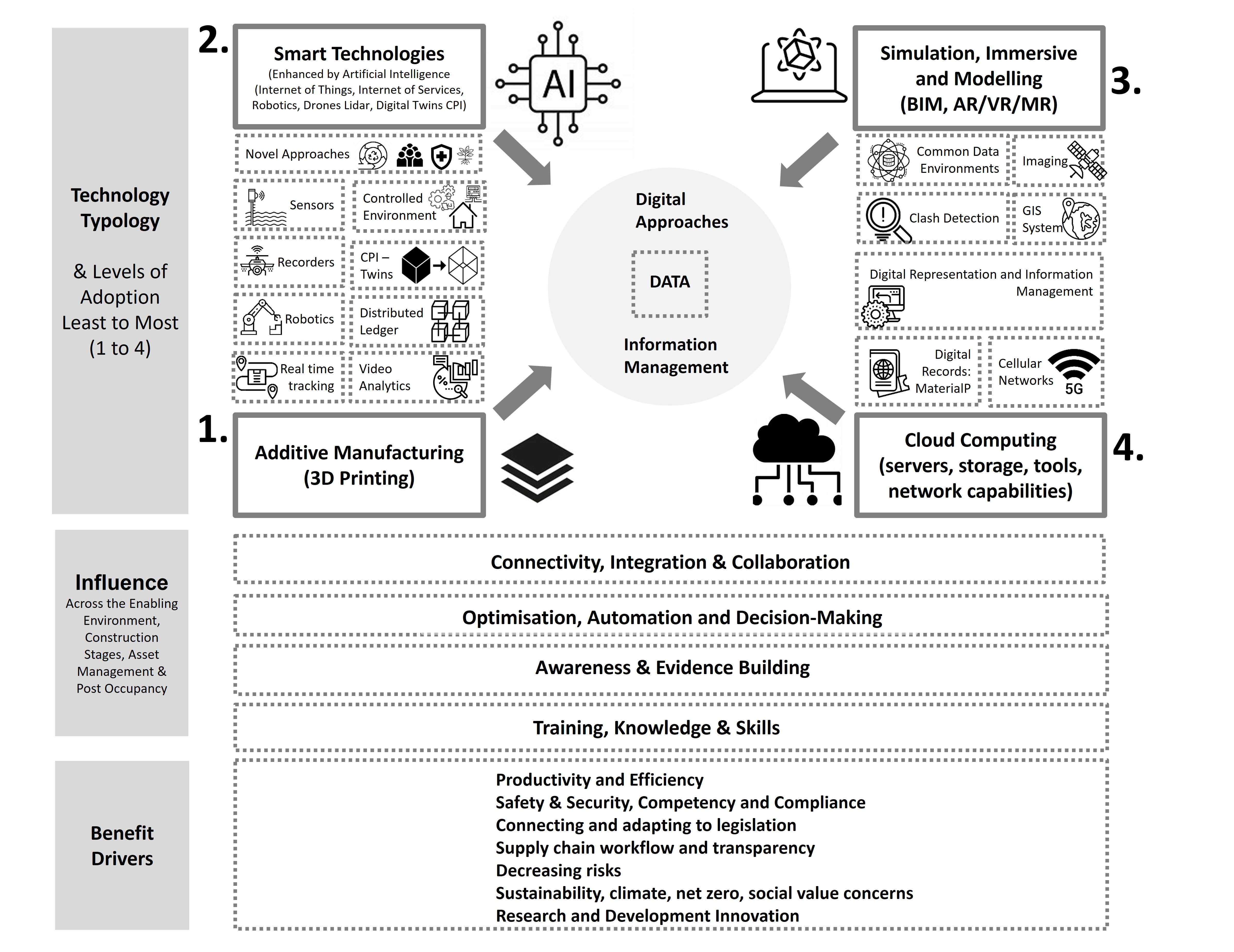
Technology typology and levels of adoption (least to most (1 to 4))
Informs data, digital approaches and information management:
- Additive manufacturing (3D printing)
- Novel Approaches
- Sensors
- Controlled Environments
- Recorders
- Cyber Physical Infrastructure (CPI) –Digital Twins
- Robotics
- Distributed Ledger
- Real time tracking
- Video Analytics
- Smart Technologies (Enhanced by Artificial Intelligence (Internet of Things, Internet of Services, Robotics, Drones Lidar, Digital Twins CPI)
- Simulation, Immersive and Modelling (BIM, AR/VR/MR)
- Digital Records: Material Passports
- Cellular Networks (5g)
- Digital Representation and Information Management
- Clash Detection
- GIS System
- Common Data Environments
- Imaging
- Cloud Computing (servers, storage, tools, network capabilities)
Influence across the enabling environment, construction stages, asset management and post occupancy
- Connectivity, Integration & Collaboration
- Optimisation, Automation and Decision-Making
- Awareness & Evidence Building
- Training, Knowledge & Skills
Benefit drivers
- Productivity and Efficiency
- Safety & Security, Competency and Compliance
- Connecting and adapting to legislation
- Supply chain workflow and transparency
- Decreasing risks
- Sustainability, climate, net zero, social value concerns
- Research and Development Innovation
Background and vision
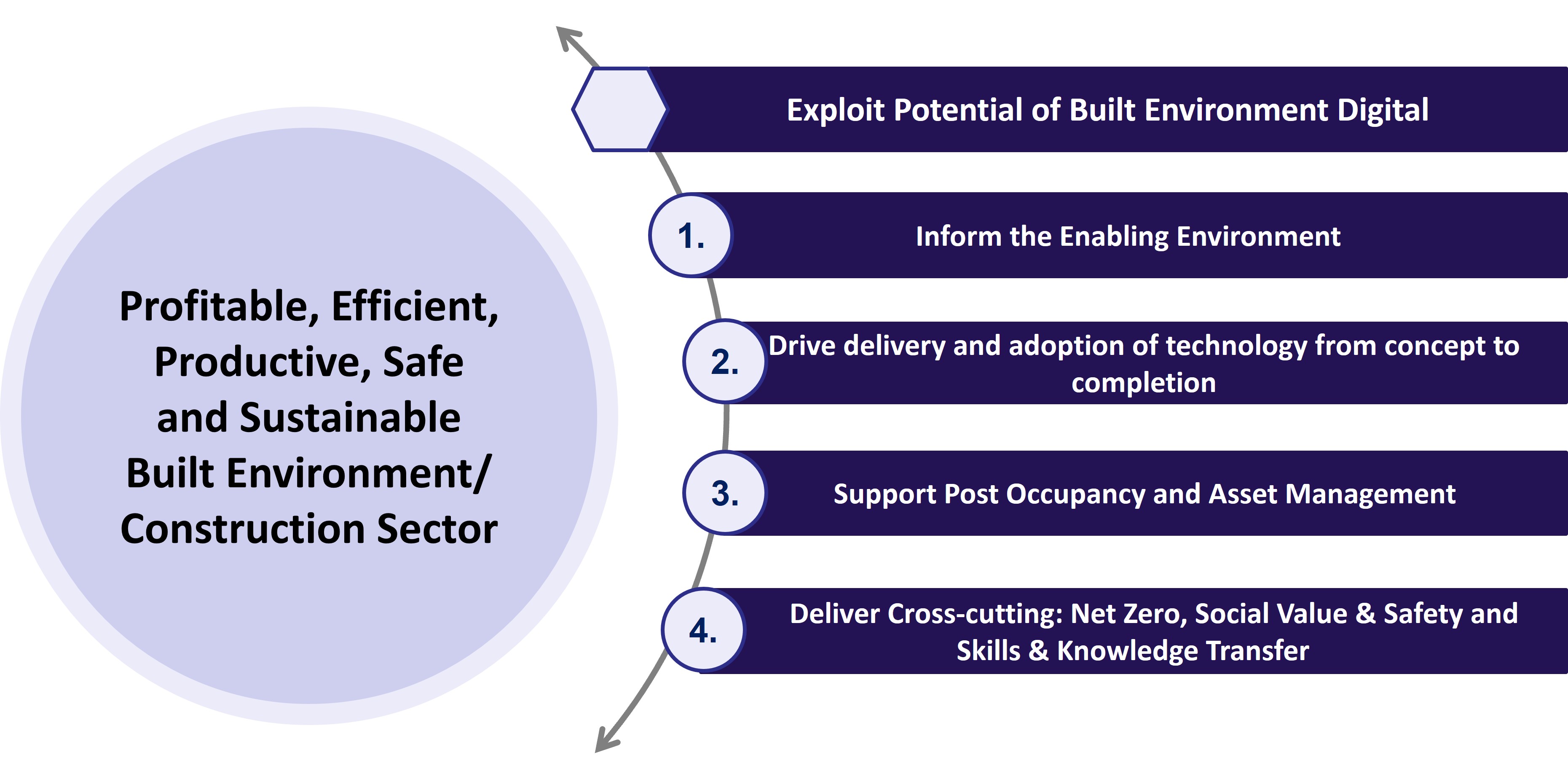
Similarly to the Agri-tech action plan, the Built Environment/Construction Digital Action Plan, aims to deliver on the key priorities outlined in the Digital Strategy for Wales 2021. In particular, the fourth mission, Digital Economy sets out overarching priorities which includes the ambition to ‘Drive economic prosperity and resilience by embracing and exploiting digital innovation’. Digital in the sector is a strategic area of growth for the Welsh economy and a chance to improve sectoral efficiency, productivity and safety at pace. The vision is to exploit the potential of digital to improve efficiency, productivity, profitability, safety and sustainability as noted in the following diagram.
Vision and mission of the action plan
Vision
Profitable, efficient, productive, safe and sustainable built environment/construction sector.
Mission
Exploit potential of built environment digital.
- Inform the enabling environment
- Drive delivery and adoption of technology from concept to completion
- Support post occupancy and asset management
- Deliver cross-cutting: net zero, social value and safety and skills and knowledge transfer
For this, Welsh Government commissioned Constructing Excellence in Wales to provide research and development of the action plan inclusive of specifications 1 to 5 as listed below. Whilst not an exhaustive study, it provides significant and necessary intelligence upon which to build the foundations of the Built Environment/Construction Sector Digital Action plan.
- Desk-based research presenting drivers, legislative and regulatory requirements as they may relate to the deployment and provision of construction sector focussed digital technologies such as BIM, Digital Twins, Cyber Security/Resilience, and other relevant technologies.
- Mapping and collating of information relating to existing levels of digital maturity/adoption in the construction sector in Wales and initiatives or activities by industry or other stakeholders that promote and support digital adoption in the construction sector.
- Presenting examples of best-in-class deployment or working practices of UK and international deployments of digital construction technologies relevant to the Welsh construction industry. This is also to include examples of any academic expertise Wales may have in the field.
- Hosting and coordinating a series of workshops with key stakeholders to explore and identify major challenges, priorities, barriers, and opportunities to the adoption of construction focussed technologies and identify early priorities to inform foundations.
- Produce a report that captures all of the above and includes draft Digital Action Plan for Construction which includes priorities for the sector as they relate to digital deployment and adoption and possible/proposed initiatives to bring about change.
Policy and strategy context
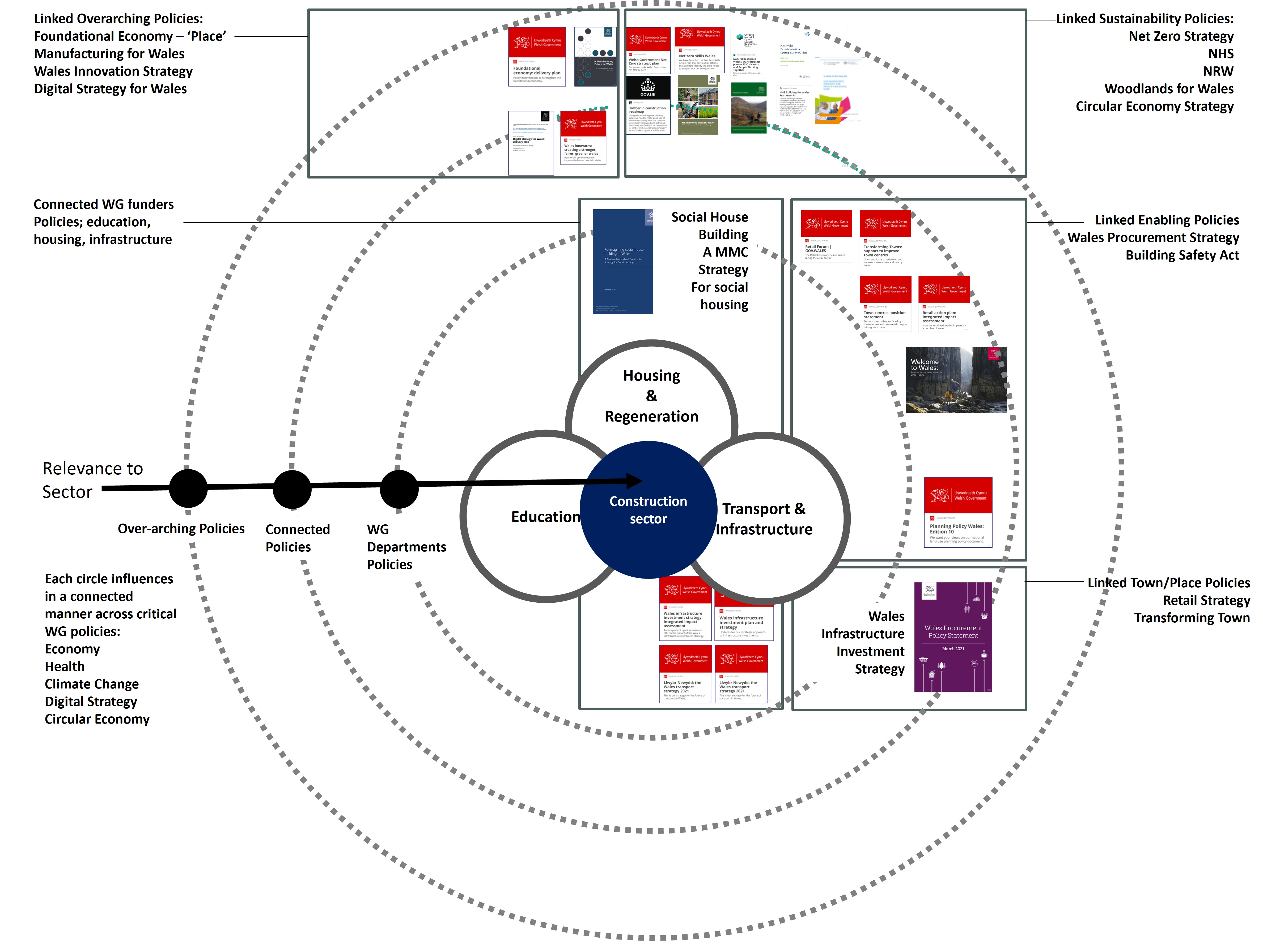
The Programme for Government (PfG) 2021-2026, published December 2021, sets out the ambitious commitments that Welsh Government will deliver. The creation and implementation of a Built Environment/Construction Sector Action plan will contribute to several commitments contained within the PfG. These include:
- Deliver the Digital Strategy for Wales
- Make our cities, towns and villages even better places in which to live and work
- Help key areas of our economy (and supply chains) to innovate, grow and reduce their carbon footprint.
The Economic Mission for Wales (EMW), published in 2023 further sets four national priorities which the Action plan will contribute to, including but not limited to:
- Enabling industry to become a world-leader in low-carbon manufacturing
- Develop local opportunities for young people
- Strengthen the foundational economy
- Back innovation and commercialisation, including into new and rapidly evolving technologies, such as Artificial Intelligence
In addition to the Digital Strategy for Wales, PfG and EMW, relevant strategy and policy areas to which the Construction/Built Environment Action Plan will contribute are:
- Building Safety Act UK & Wales
- Social Value & Procurement Act
- Wellbeing of Future Generations Act
- Net Zero Wales & Just Transitions
- Foundational Economy Wales
- Circular Economy Wales
- A Manufacturing for Wales
- Innovation Strategy for Wales
- UK Industrial Strategy
- UK Construction Playbook
- Gold Standard
- Housing, Devolved Public Sector Estate and Public Health Wales Healthy Homes
- Sustainable Schools Challenge
- NHS Buildings for Life
Rationale and approach
There are several drivers for sector digital development, and its’ relevance varies by legislative agendas (eg: Building Safety), market pressures, delivery stages, risk appetite and the level of focus on productivity and efficiency (MMC as part of the industrialised construction narrative, on the path towards net zero). Identified drivers include but are not limited to the list below. A more detailed explanation of these drivers can be found below.
- Productivity, profitability and efficiency
- Safety and security, competency and compliance
- Legislation
- Supply chain transparency
- Risks
- Sustainability, climate, net zero, social value
Varied challenges and opportunities underpin the delivery, adoption and successful implementation of digital in the sector. These can be classified as economic, environmental and social where improvements in each category will have a co-benefit impact on the others. Some examples are:
Economic: business, projects, people examples:
- Increasing Productivity and Efficiency – shifting traditional processes to an Industrialised Narrative with principles of standardisation as found within Constructing a Gold Standard.
- Improving Safety & Security, Competency and Compliance
- Improving supply chain transparency
- Decreasing risks
Environmental and social examples:
- Responding to sustainability, climate, net zero, social value concerns
- Resources/Skills
- Behaviours
- Mindsets
The impact of this action plan can be addressed through sector challenges, drivers, opportunities and barriers based around four key areas:
- Getting the enabling environment right
- Improving delivery across concept to completion stages
- Better post occupancy and asset management
- Cross cutting factors: Net Zero, circular economy, well-being of future generations, social value and safety, skills and knowledge transfer
Where the use of digital will aim to:
- Unify the sector, justify business cases and improve decision-making using outcomes and timely evidence led best practice approaches
- Secure efficiencies within the sector across the project/building lifecycle achieving co-benefits
- Improve management and maintenance of sector assets and reduce waste
- Improve sectors direct impact on people and planet utilising limited resources effectively and ensuring a just transition towards a greener economy
Emerging areas and outcomes
The section below addresses the emerging areas and outcomes in relation to the identified challenges, priorities, drivers, opportunities and barriers.
1. Enabling Environment through strategic leadership
Outcomes
Unify the sector, justify business cases and improve decision-making
Strategic challenges
Industry Characteristics: fragmented & siloed, SME majority with low margins and low investment, traditional approaches and fear of change, two types of digital maturity areas; the building and infrastructure sector
Priorities and drivers
- Legislation Compliance – BSA (CDM, Fire) Information Management,
- Ongoing BE/C Joint Policy Statement, Procurement Reform,
- Net Zero, CE, SV, Data Structuring, Move to industrialised construction to enable MMC
Opportunities for adoption
- Strong Leadership, Value-based Procurement, Pipeline Visibility, Digital KPIs -Shared measurable goals for a unified digital framework,
- Outcomes led awareness,
- Standardisation, Promoting sector value
Barriers
Leadership readiness and clarity of information requirements, Low cost focus, Standardisation
2. Delivery and adoption across stages
Outcomes
Secure efficiencies within the sector across the project/building lifecycle achieving co-benefits
Strategic challenges
Construction Method & Processes: Existing inefficiencies in the sector across project/building lifecycle with benefits difficult to understand
Priorities and drivers
Efficiency and productivity towards Green Economy – less waste, WBFGA joined up policy approach, Supply chain workflow and transparency
Opportunities for adoption
Early stage, outcomes driven strategic approach with digital embedded, Data chains, Benchmarking for consistency
Barriers
Capability and understanding of information exchange, Training and upskilling, Risk Burden high for SMEs
3. Post completion: asset management
Outcomes
Improve management and maintenance of sector assets and reduce waste
Strategic challenges
Considerable inefficiencies in the management & maintenance of sector assets
Priorities and drivers
Decision-making that drives better investment decisions, Sustainability and Net Zero
Opportunities for adoption
Data structuring, information requirements clarity and adoption support
Barriers
Client readiness and digital capability to monitor and manage assets
4. Cross cutting: net zero, circular economy, safety, social value
Outcomes
Improve sectors direct impact on people and planet utilising limited resources effectively and ensuring a just transition towards a greener economy
Strategic challenges
Climate impact, limited resources, reliance on virgin materials driving costs, risks of safety
Priorities and drivers
Sustainability, Data management, data collection and data interoperability, Research and Development, Innovation
Opportunities for adoption
Pathfinders and pilots, Links with academia and research innovation
Barriers
Benchmark consistency, supply chain traceability and clarity of requirements
Skills and training: as cross-cutting feeding into each section
Outcomes
Improve sectors direct impact on people and planet utilising limited resources effectively and ensuring a just transition towards a greener economy
Strategic challenges
Challenges in skills and competency with large gaps in knowledge and capabilities especially addressing the transition to low carbon approaches
Priorities and drivers
- Social value, productivity and efficiency, just transitions, decreasing risks, sustainability, safety and security
- Competency and compliance to legislation
Opportunities for adoption
Links with existing sector providers, universities and businesses
Barriers
SME support crucial, Financial challenges to upskill, core digital capabilities missing and behaviour change required
Sectoral challenges and opportunities
Getting the enabling environment right
Key characteristics of the construction sector make it more challenging to adopt digital technologies and work in an efficient and transparent manner. These include fragmentation, one-of-a-kind approaches in traditional delivery models, inconsistencies and resource transience combined with a slow-moving decentralised process that can be rooted in limiting behaviours, hierarchical and bureaucratic opaqueness and traditional risk profiles. In Wales, the SME majority adds further complexity, operating in low risk and tighter margins. Improvements in procurement, frameworks, pipeline visibility and uptake of project bank accounts have been identified to achieve systems led positive transformation and position the sector towards standardisation as part of a longer-term vision of industrialised construction which then, as an example, allows for the full connected benefits found within Modern Methods of Construction. As part of this, Constructing the Gold Standard provides a framework for improving digital practices in public procurement within the construction industry. Transforming the enabling environment is crucial and requires strong leadership with digital enabling cultures, skills & capabilities - using levers, such as procurement and contracts in an effective manner i.e. clarity of requirements, shared risks to manage uncertainties driven by innovation, value-based procurement and centralised processes with cyber secure, data access. Ensuring better decision-making, knowledge and education on value and local skills development around core digital skills for client readiness and improved understanding across supply chains is needed. To bridge the growing skills gap, demonstrating and promoting the value of the sector through best-practice digital is integral.
Improving delivery and adoption of technology from concept to completion
Addressing the strategic approach around construction methods and processes, inclusive of digital strategies, at the earliest stage is important. At procurement level, strategic decision-making of projects/mobilisation, vital aspects are missed at such early stages which impacts the project through its lifecycle. There is a need to get better at ensuring procurement processes, appointments, mobilisation are inclusive of digital strategies to achieve the full scale of efficiencies and productivity that can drive down costs.
The way digital implementation is working in the UK in general is around two separate types of maturity. The building sector and the infrastructure sector. The former is more mature, the latter does not have the skills to receive digital deliverables which ties into the need for strong leadership and a unified view on all construction projects where all are implementing the same thing. Base level capabilities in tenders should be included such as data capability, accessibility and level of standardisation. This includes setting digital KPIs, identifying open-source commitments and ensuring smooth transition of data across stages where previously these have not been clearly stipulated, data is lost or managed incorrectly leading to inefficiencies and repetitions. Clear benchmarking is also necessary to ensure commitments to low carbon and social value indicators driven through digital are consistent. Legislative compliance and competence to deliver against is key to project delivery such as the Building Safety Act. It is a major area of concern for the sector that notes a lack of unified understanding of compliance both from industry organisations and clients which can result in project delay. A centralised system for assessing competency with support from government and those downstream of such decision-making, can be fed into a standardised request for information for sector to respond to in demonstrating compliance. An eco-system approach to compliance is necessary where BSA, CDM, Fire risk are integrated in a centralised compliance portal. In the later stages, challenges to implementation ranged from category of supplier, interoperability and compatibility between software, ownership, liability and IP, best practice sharing, training needs and delivery, collaboration between multi-stakeholder parties, company support and joined-up initiatives. Challenges in level of application were due to complicated process models dependent on traditional construction practices in a multi-stakeholder environment with varying levels of behavioural and motivational factors. Difficulty of technology adoption by SMEs, as well as industry patterns whereby digital initiatives are only adopted when requested or initiated by regulation or clients at ‘higher’ levels within the network chain.
Better post occupancy and asset management
Clients have assets to manage where digitalisation is helpful in justifying business case and investment decisions, providing timely information to inform decisions, deliver for the cost and efficiency with a focus on low-carbon approaches. Challenges in data structuring influence this greatly and can impact productivity. Where data is present in models but when it comes to handover, inconsistencies in management and handling can create time lags, waste where productivity gets lost straight away. Therefore, improving information requirements is important and needs to be more prescriptive in asking what formats are needed from consultants, sub consultants to deliver that data in. Clarity around this will help data to become more structured, standardised and deliver on productivity. Cyber security challenges and open accessibility is key to improving asset management. IP and ownership of innovation is another challenging factor which can limit efficient management. Further to this, there is a lack of relevant digital skills across project lifecycle, which is a core barrier to the adoption and exploitation of technology platforms and future digital capabilities. This is particularly acute in the asset care aspect.
Areas that will benefit from improved digitalisation of the sector span economic levers: business, projects and people:
From a business/commercial, innovation and research perspective
Shared set of measurable goals which includes a unified digital framework across Wales for nationally significant projects (Infrastructure and Buildings) to inform consistent value-based procurement and collaborative contract approaches (such as Alliancing) with clear digital KPIs for standardisation, data strategies, information management, accessibility and security. Risk sharing avenues to collaborate on innovations combined with academia. Promotion of industry benefits and derived value from digitalisation. Supply chain collaboration as part of framework request/bid scoring to create connected supply chains, deepen understanding of Welsh sector specific characteristics i.e. larger firms with bigger margins paving the way for SME majority landscape to adopt digital at pace and direct funding to SMEs for innovation and scaling.
From a project/productivity delivery perspective
Confirming digital KPIs as early stage digital strategy embedded as part of project lifecycle including consideration for asset management as a holistic approach. Open access data and consistency in data connectivity across projects and stages. Clear benchmarking for environmental and social value data with consistent approaches of measuring used across sector – a unified language of deliverables and compliance requirements.
From a people/capability, competency and skills perspective
Where capability and skills development of enabling conditions is necessary for digitalisation including but not limited to current and horizon legislation compliance competencies such as the Building Safety Act, ensuring a shared competency assessment approach. Bridging the core digital skills gap as a critical factor included as part of the bigger picture of developing Wales future tech capabilities bringing together industry bodies, apprenticeship bodies and academic institutions. Both existing and the next generation of construction professionals need to be adequately equipped to understand, embrace and embed digital in the sector effectively.
From an environmental, social value, safety perspective
Welsh Government commitments to climate change targets and the known impacts that built environment/construction practices can have on the environment and social value makes digitalisation of the built environment a vital part of the bigger picture when it comes to social value and environmental targets, monitoring and change. This includes an ecosystem connected approach to addressing legislative competency and compliance led information management which considers a centralised system utilising standardised approaches for managing compliance across as an example, Building Safety, CDM, Fire Safety. It is of paramount importance that the benefits of deploying appropriate solutions be realised in seeking to help address the future challenges associated with a move to a Net-Zero Wales which includes a just transition.
Approach:
Similar to the Agri-tech action plan, a mission orientated approach is considered for measurable impact. The goal of improving environmental and social credentials through improved productivity could help drive both public and private investment in built environment/construction sector tech and bring together fragmented activity under common objectives. A mission-orientated approach will enable the sector to focus on the core drivers, challenges, opportunities and risks and develop a sustainably productive sector that can also support the challenge to mitigate against climate change and move forwards on Net Zero ambitions.
A combination of push and pull policies will be utilised aimed at encouraging collaboration, uptake and adoption of technologies to realise potential. These will be developed in accordance with the identified priorities and proposed initiatives analysed according to their dependencies and appetite to proceed. Please refer to the Dependencies Matrix provided in support of this document with the full suite. Following this, an internal task and finish group may be utilised to mature thinking and development of the plan. It will consist of governmental and select industry stakeholders.
Priorities for action
1. Inform the enabling environment: to unify sector, justify business cases and improve decision-making using digital
Leadership approach and tech capabilities
- Support client readiness and improve information requirements driven by standardised approaches
- Use levers such as procurement, frameworks, contract & pipelines, legislative compliance factors (e.g. BSA, CDM, Fire Safety) to drive digital outcomes
- Set clear baselines, shared goals and explore the possibility of a unified digital framework
- Promote innovation with best practice examples where digital has improved outcomes across profitability, productivity, efficiency, safety and sustainability.
- Nurture home grown Welsh built environment/construction tech capabilities through business support, cluster & catapult development, knowledge transfer, inward investment and funding to enable proof of concept and scale up to commercial size
2. Drive delivery and adoption of technology from concept to completion: to secure digitally enabled efficiencies across the project/building lifecycle and achieve co-benefits
Adoption/delivery across construction stages
- Support early-stage adoption of outcomes led digital technologies through a digital strategic approach
- Deploy pathfinders and pilot projects for digital across typologies
- Support incoming legislative requirements
- Encourage cyber security adoption across businesses
- Champion best practice and case studies for a lessons learned approach
3. Support post occupancy and asset management: to embed data led management and maintenance of assets which makes improvements and reduce waste
Asset management
- Develop a strategic digital approach for asset management which includes the potential for a digital twin requirement
- Encourage digital adoption in asset management through best practice/lessons learned
- Support effective data structuring using benchmarks
4. Deliver cross cutting: to improve measurable impact on people and planet, increase awareness and move towards a digitally enabled, greener economy
Net zero, circular economy, well-being of future generations, social value and safety
- Support pathfinders/pilots on environmental, social value and well-being monitoring
- Support technologies that emphasise safety benefits
- Explore benchmarks for a standardised approach on data collection, data management and data interoperability
- Support cross-sector digital technologies that drive built environment outcomes
- Build local Welsh materials market through digitally informed product traceability
Skills and Knowledge Transfer - Support outcomes-based training of core digital skills and connect with existing providers
- Drive Digital R&D in partnership with academia
- Raise awareness of existing funding of digital competencies for SMEs
Proposed initiatives
Contribution and input from multi-stakeholders has resulted in a comprehensive and complementary range of proposed initiatives agreed by the Built Environment/Construction Digital Advisory and Working Group. A suite of reports, papers and policy objectives supporting these have been utilised in development of this plan.
Proposed initiatives
- Secure budget for client awareness campaign which delivers series of webinars/training/events for digital strategic requirements
- Seek to secure budget for an Information Hub inclusive of existing digital guidance documents, policies, mandates, legislation, R&D grants, library of best-practice & case studies of available solutions
- Generate a digital approach for Wales inclusive of a minimum standard of information requirements & asset management which feeds into a Welsh version of the UK Construction Playbook
- Explore the development of a Pan Wales Centralised Compliance System/Portal linked to connected public sector authorities
- Explore a sector investment option within current Development Bank for Wales Ventures Offer to support start-ups, early stage and established construction-tech companies in Wales
- Secure budget for awareness campaign which delivers series of workshops, webinars and events on digital benefits for projects. (Linked in Point 1)
- Promote Cyber Essentials Plus
- Seek to replicate requirements from incoming legislation for high rise across all other municipal buildings
- Promote the Supply Chain Sustainability School and ensure its digital skills offering is fit for purpose
- Seek funding for pilot disruptors and pathfinders for emerging technologies
- Promote the use of library of best practice and case studies (can be serviced by the development of proposed initiative 2.)
- Campaign adoption of the Welsh version of the digital playbook (serviced by development of proposed initiative 3)
- Campaign linked to library of best practice and information hub for existing standards and data operability (serviced by development of proposed initiative 2)
- Explore the potential for a digital twin for each public sector asset
- Create a standardised set of digitally enabled ESG metrics for use in all public sector projects
- Deploy pathfinder projects using pilot technologies (IoT based platforms for environmental and social value monitoring), derive digital benchmarks and replicate standardisation as found within the Welsh Social Housing Pattern Approach for all public building typologies. (serviced by development of proposed initiative 3).
- Raise profile of available sectoral and cross-sectoral digital solutions which drive existing legislation, policies and enable built environment outcomes. (Can be satisfied by development of point 2).
- Seek funding to replicate and deliver examples of success (e.g. SPECIFIC) to achieve net zero through digital
- Support local Welsh materials market to adopt technologies that evidence product traceability
Skills and knowledge transfer: proposed initiatives
- Connect and influence existing funding with CITB and Sustainability Supply Chain Schools for core digital competencies training. (Refer to point 9.)
- Better understand and raise awareness of funding for SMEs and individuals upskilling. (Can be satisfied by development of point 2)
- Work closely with existing providers to expand on core digital skills within the Higher Education Qualification Suite and apprenticeship routes
Metrics
Given the diverse nature of the proposed initiatives and strategies/policies that they stand to satisfy, it will be necessary to develop a suite of fit-for-purpose metrics. This will enable measurement of the impacts of each individual action and the collective contribution they make to objectives. Metrics will be agreed with clear lines of reporting that meet strategic objectives. With several initiatives in this plan seeking to build upon, or bring focus to pre-existing information, mechanisms and vehicles, it will be the case that established benefit realisation metrics can easily be adopted.
Dependencies
There are several dependencies across the suite of proposed initiatives, these include agreement from political leadership, Welsh Government human resources, financial resources and stakeholder buy-in and contribution in various guises. In many cases, the preparatory work undertaken in developing this action plan has already successfully secured positive commitment to several of the dependencies on which individual initiatives rely. Formal adoption of the plan will only serve to further reduce any outstanding dependencies that remain to be addressed.
Appendix
Drivers for digital in the construction/built environment
There are strong headwinds driving the shift to digital for the built environment informed by the wider global picture, UK Context and Welsh economy. The drive to Net Zero (Emissions, Existing Asset Management), Circular Economy, as well as growing focus on better procurement and safety compliance (Building Safety Act) combined with the need to build more homes while delivering clean growth (energy, transport, infrastructure) has created an interesting landscape. Construction Innovation Hub noted the offsite assembly/manufacture, modern methods of construction and building safety as accelerators of the value of digital in the sector and the overarching shift to an Industrialised Construction narrative through a sector policy statement and strategy as the connecting piece.
Increasing productivity and efficiency
With tight budgets and competitive markets, improving productivity through the efficient use of resources is an important driver of transformation and one where digital is a key enabler. Digital technologies create flexibility, standardisation and platform approaches. It facilitates agile responses to changing conditions, reduces waste, better measures and monitors KPIs and aids transparency in decision-making to enable systems impact.
Improving safety and security, competency and compliance
Digital improves information management which creates a ‘golden thread’ for seamless interoperability and builds transparency and collaboration in projects and processes. It builds pathways for compliance to the Building Safety Act UK & Wales.
Connecting and adapting to legislation
The Well-Being of Future Generations Act calls for a joined-up thinking approach which digital can enable. It can also improve delivery against the evolving and legislative landscape of the built environment such as recent updated to the Building Safety Act (Golden Thread), Social Partnership and Public Procurement Act, Timber Strategy (MMC) and Social Homes Pattern.
Improving supply chain transparency
Connecting a fragmented supply chain ranging from large scale to micros through better traceability, transparency and improved accountability making visible the dynamic and evolving sector landscape.
Decreasing risks
Improves predictability and reduces risks by putting data at the centre.
Responding to sustainability, climate, net zero, social value concerns
Mitigates awareness challenge resulting from complex processes, builds long-term resilience, improves data collection and aids benchmarking on carbon, waste, efficiency while promoting shared learnings.