
Dwelling stock estimates: quality report
This report covers the general principles and processes leading up to the production of our statistics.
In this page
About these statistics
This statistical release presents estimates of the number of dwellings in Wales and each local authority by tenure. These estimates include vacant dwellings.
Policy and operational context
The dwelling stock estimates are used as evidence in policy making by both central and local government. These estimates provide the number of residential dwellings by each tenure type and by local authority, at the end of March each year. The data are used by the Welsh Government, local authorities and other housing organisations. The data help to monitor trends in the overall level of Welsh housing stock, as well as any changes in its tenure distribution over time.
Users and uses
More generally the information is used for:
- monitoring housing trends
- policy development
- advice to Cabinet Secretaries and Ministers
- informing debate in the Senedd Cymru and beyond
- geographic profiling, comparisons and benchmarking
Further users of these statistics include:
- national and local government
- other government departments
- researchers
- academics
- students
Methodology
Estimates of the total number of dwellings are based on data from the population censuses, the latest of which was in March 2021. Estimates from the censuses are updated annually to take account of new house building and demolitions.
2024 to 2025 represents the financial year April 2024 to March 2025.
Figure 1: calculation of dwelling stock estimates, as at 31 March 2025
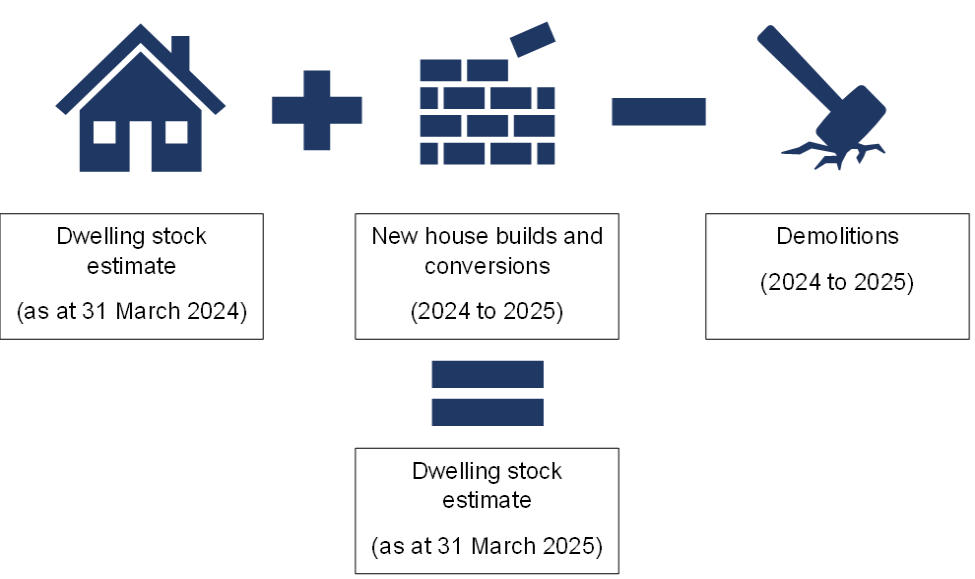
Description of figure 1: an infographic showing that the dwelling stock estimates as at 31 March 2025 are calculated by taking the dwelling stock estimate at 31 March 2024 and adding the new house builds and conversions. The total number of demolitions from 1 April 2024 to 31 March 2025 is then subtracted from this amount
The breakdown of dwelling stock estimates by tenure use:
- local authority returns
- registered social landlord returns
- estimates from the Annual Population Survey (APS)
Figure 2: calculation of private sector stock and tenure split, as at 31 March 2025
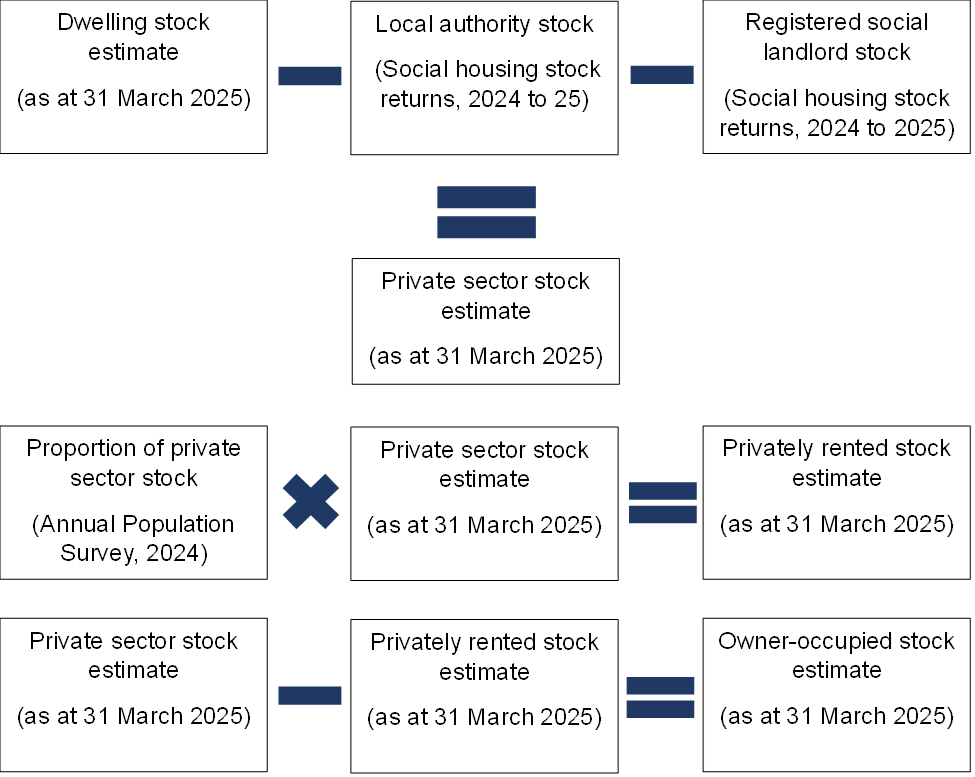
Description of figure 2: an infographic showing the formula used to estimate the private sector, privately rented and owner-occupied stock at 31 March 2025. The private sector stock estimate at 31 March 2025 is calculated by taking the dwelling stock estimate from 31 March 2025 and subtracting the total local authority stock and the total registered social landlord stock from the same date. Privately rented stock estimate is calculated by taking the private sector stock estimate and multiplying it by the proportion of private sector stock, obtained from the 2024 APS. Owner occupied stock estimate for 31 March 2025 is obtained from taking the private sector stock estimate and subtracting the privately rented stock estimate.
Methodological improvement
In 2018 to 2019 we carried out a review of the methodology used to calculate the tenure split of private sector stock. As a result of this review, we introduced a number of methodological improvements. We have:
- switched to using the APS household dataset (as opposed to the APS person dataset)
- used the APS proportion of privately rented dwellings to the estimate of private sector stock (as opposed to all dwelling stock)
- introduced a three-year smoothing technique to decrease volatility in the APS estimates
Historical comparisons should be treated with caution owing to the methodological improvements. Methodological improvements were introduced to owner-occupied and privately rented estimates. These improvements have been applied to estimates from 2013 onwards. Please refer to Dwelling Stock Estimates, as at 31 March 2019 for full details of the methodological improvements.
Strengths and limitations of the data
Strengths
- The information is processed and published frequently to enable users to see the statistics when they are current.
- Data is obtained directly from housing providers and undergoes rigorous quality assurance.
- Detailed statistics are provided via our StatsWales website at local authority level.
Limitations
- Due to the coronavirus (COVID-19) pandemic, data for registered social landlord stock in 2019 to 2020 has been estimated based on previous trends.
- The new house building data used in the annual dwelling stock estimates is based on the reports of local authority building inspectors and the National House Building Council (NHBC). NHBC is a private approved inspector (PAI). This data does not include information from other PAIs, likely resulting in an undercount in the total number of new dwellings started and completed.
- The APS provides estimates for the private rental sector, but it only covers occupied dwellings. Therefore, no account is taken of vacancy rates in producing the tenure split.
- The APS has seen a fall in sample sizes over recent years and the statistical uncertainty for estimates has increased. Additionally, the APS has not yet been reweighted to include the latest population estimates from the 2021 Census. Therefore, the Office for Statistics Regulation (OSR) has agreed it’s official statistics accreditation should be temporarily suspended and the 2025 edition of the dataset is official statistics in development (OSR); the method is subject to change as quality issues in survey sources are addressed and depending on user feedback.
Quality
The published figures provided are compiled by professional analysts using the latest available data and applying methods using their professional judgement and analytical skillset. Statistics published by Welsh Government adhere to the Statistical Quality Management Strategy which supplements the Quality pillar of the Code of Practice for Statistics (OSR) and the European Statistical System principles of quality for statistical outputs.
Data for the Welsh Government dwelling stock estimate publication is collected by Welsh Government directly from local authorities and registered social landlords. The estimates also use data extracted from the APS. Both local authorities and registered social landlords’ complete data collection forms based on data stored on their respective IT systems. Completed forms are then returned to Welsh Government via its secure web data transfer system.
Accuracy
The closeness between an estimated result and the (unknown) true value.
Data sources
This release draws on information from a range of data sources in order to compile a coherent set of statistics. The statistical sources used to calculate dwelling stock estimates include:
- Census 2021 (Office for National Statistics (ONS), Census 2011 (ONS) and Census 2001 (ONS); data on the number of dwellings was published March 2023
- 2024 to 2025 new house building completions (StatsWales); the latest data was published January 2026
- 2024 to 2025 housing demolitions (StatsWales); the latest data was published May 2026
- 2024 to 2025 local authority and registered social landlord stock (StatsWales); the latest data was published December 2025
- 2024 APS (ONS); the APS household dataset (calculated from the person dataset) was published September 2025 and the data is from the calendar year 2024
There have been large-scale voluntary transfers of local authority stock to registered social landlords. This will have affected the social housing stock make-up. All transfers covered 100% of the local authority housing stock. A list of the large-scale voluntary transfers and dates of transfer are shown below.
| Local authority | Date of transfer | Registered social landlord |
|---|---|---|
| Bridgend | 12 September 2003 | Valleys to Coast Housing |
| Rhondda Cynon Taf | 10 December 2007 | Trivallis Limited, formerly RCT Homes |
| Monmouthshire | 17 January 2008 | Monmouthshire Housing Association |
| Torfaen | 01 April 2008 | Bron Afon Community Housing |
| Conwy | 29 September 2008 | Cartrefi Conwy |
| Newport | 09 March 2009 | Tai Hedyn, formerly Newport City Homes |
| Merthyr Tydfil | 20 March 2009 | Merthyr Valleys Homes |
| Ceredigion | 30 November 2009 | Barcud Cyfyngedig, formerly Tai Ceredigion |
| Gwynedd | 12 April 2010 | Adra (Tai) Cyfyngedig, formerly Cartrefi Cymunedol Gwynedd |
| Blaenau Gwent | 26 July 2010 | Tai Calon Community Housing |
| Neath Port Talbot | 05 March 2011 | Tai Tarian, formerly NPT Homes |
Description of table 1: a table showing the large scale voluntary transfer of local authority stock took place between September 2003 and March 2011.
Typically, there is a degree of uncertainty surrounding the tenure split of private sector stock owing to the nature of the APS dataset. Therefore, estimates in this release have been rounded to the nearest 100.
To communicate uncertainty, confidence intervals have been calculated for the estimates, at 31 March 2024.The confidence intervals are based on three-year smoothing.
| Tenure | Dwelling stock estimate | Lower confidence interval | upper confidence interval |
|---|---|---|---|
| Owner-occupied | 1,059,300 | 1,051,300 | 1,070,700 |
| Privately rented | 184,900 | 175,200 | 194,600 |
Description of table 2: a table highlighting that there is a degree of uncertainty surrounding the tenure split of private sector stock. The confidence intervals are relatively narrow for both owner-occupied and privately rented tenures.
The APS estimates are used to calculate the private sector split. To reduce volatility in the APS estimates, a smoothing technique was introduced in 2019.
To improve the timeliness of data, the previous year’s APS data is used to calculate the latest years figures. This means that for the latest two years of data, the same privately rented dwelling proportion is used to calculate the tenure split for the private sector. The 2 latest years are smoothed as follows:
0.75* latest available APS data + 0.25 * previous year APS data.
For all other estimates, as at 31 March each year, APS estimates have been smoothed as follows:
0.25 * previous year APS data + 0.5 * current year APS data + 0.25* following year APS data. For example, estimates at 31 March 2022 have been smoothed using 0.25 * 2021 APS data + 0.5 * 2022 APS data + 0.25* 2023 APS data
In applying this three-year smoothing technique, estimates, as at 31 March 2023 and 2024, have been revised to consider recently published 2024 APS data. Estimates, as at 31 March 2024 and 2025, are currently provisional and will be subject to revision when 2025 APS data becomes available.
Revisions
Small revisions are made annually to estimates of owner-occupied and privately rented stock. This is due to more recent APS data becoming available. For 2022 to 2023, the revised estimate of owner-occupied dwellings in Wales increased by 5,200 (1%) and the number of privately rented dwellings decreased by 5,200 (3%). For 2023 to 2024, the revised estimate of owner-occupied dwellings in Wales increased by 16,100 (2%) and the number of privately rented dwellings decreased by 16,100 (8%). The changes in tenure estimates are likely due to issues in the APS tenure inputs, in part because of the telephone interviewing introduced during the COVID-19 pandemic. This change affected who responds to the survey: there was a notable decrease in the proportion of respondents living in private-rental dwellings and an increase in those living in dwellings owned outright. More information can be found in the Coronavirus and its impact on the Labour Force Survey (ONS) article.
Revisions can also arise from events such as late returns from a local authority or RSL or when a data supplier notifies the Welsh Government that they have submitted incorrect information and resubmits correct data. Occasionally, revisions can occur due to errors in our statistical processes. In all of these cases, a judgement is made as to whether the change is significant enough to publish a revised statistical release. This year there have been no revisions to the dwelling stock estimates data for this reason.
Where changes are not deemed to be significant, i.e. minor changes, these will be updated in the following year’s statistical release. However, minor amendments to the figures may be reflected in the StatsWales tables prior to that next release.
Revised data is marked with an (r) in the statistical release
We follow the Welsh Government’s statistical revisions policy.
Accessibility and clarity
Accessibility is the ease with which users are able to access the data, also reflecting the format(s) in which the data are available and the availability of supporting information. Clarity refers to the quality and sufficiency of the metadata, illustrations and accompanying advice.
Dwelling stock estimate statistics for Wales are published in an accessible, orderly, pre-announced manner. They are published on the Welsh Government website at 9:30am on the day of publication.
We aim to inform known key users of the publication of the statistics when they are published. An e-mail is circulated to the Housing Information Group.
We aim to use plain English in our outputs and all outputs adhere to the Welsh Government accessibility policy. Furthermore, all our headlines are published in Welsh and English.
Further information regarding the statistics can be obtained by contacting stats.housing@gov.wales.
A full set of data on dwelling stock estimates in Wales, including information by individual local authority is available to download from our StatsWales website.
Coherence
Coherence is the degree to which data that are derived from different sources or methods, but which refer to the same phenomenon, are similar.
There are several alternative sources of data on total dwelling stock in Wales, including the council tax system. The Welsh Government collects and publishes annual information on dwellings under the council tax system . This is provided by the 22 Welsh local authorities.
The Welsh Government also collects information on social housing stock . This is based on annual stock returns collected from the 22 Welsh local authorities and all Welsh registered social landlords. The figures published in the social housing stock release will differ slightly from the figures shown in this release. This release assumes 3 bed spaces of a non-self-contained unit is equivalent to 1 dwelling.
New house building completions are one of the most important factors affecting the annual change in the size of the dwelling stock. The Welsh Government publishes a quarterly headline and an annual release covering new build starts and completions. This is based on the reports of local authority building inspectors and the National House Building Council (NHBC) which is a private approved inspector (PAI).
The number of dwellings demolished is also another factor affecting the annual change in the total dwelling stock. Data on demolitions is collected annually by the Welsh Government from all 22 local authorities in Wales. The statistics on demolitions cover all demolitions of residential dwellings that the local authority is aware. They also include dwellings demolished which are to be re-built afterwards.
Related statistics for other UK countries
Annual national and subnational statistics on the dwelling stock are available for each of the four UK countries. For England, Scotland and Wales these are also available with a breakdown of the number of owner-occupied and privately rented dwellings, as well as social housing down to local authority level. Statistics on the breakdown of owner-occupied and privately rented dwellings by local government district are not yet available for Northern Ireland.
These statistics are produced using different methods and data sources, although the concepts measured are the same.
England
The Ministry of Housing, Communities & Local Government (MHCLG) produces accredited official statistics on the number of dwellings by tenure at the national, regional and local authority level in England. MHCLG use a similar method used for the Welsh estimates, using the Census as a baseline and applying annual net changes to the dwelling stock. The net annual changes are also collected and published by the MHCLG in the net additional dwellings statistics (MHCLG).
The statistical release and live tables also include breakdowns of the stock into the 4 tenures: owner-occupied, private rented sector, local authority housing and housing association although MHCLC cannot split the private housing stock into owner-occupied and private rented sector at the local authority district level.
The ONS estimate the number of households and dwellings that fall within each tenure category at the local authority level using the Structure Preserving Estimator (SPREE) method (ResearchGate).
The ONS use the SPREE method to replace the APS with the Generalised Structure Preserving Estimator (GSPREE) method in their 2025 edition of the dataset. This change was in response to high levels of bias present in the APS estimates of tenure following the COVID-19 pandemic (ONS).
Scotland
The Scottish Government publish summary information on the estimated stock of dwellings by tenure in Scotland. This is available in the annual key information and summary tables.
For Scotland, the breakdown of owner-occupied and privately rented dwellings from the Scottish Household Survey are applied to the estimates of privately-owned dwelling stock. This breakdown is achieved by comparing total dwelling figures with social housing stock figures. The total dwelling figures are provided by the National Records of Scotland. The social housing stock figures are held by local authorities and housing associations.
Northern Ireland
Northern Ireland, like Scotland, uses administrative data. Land & Property Services (LPS) provide a valuation for all properties in Northern Ireland which are subject to rates. Housing Stock is defined as a count of properties which are valued as domestic or mixed for the purposes of rating and includes both social sector and private sector dwellings in the Valuation List. Housing Stock information is available for Northern Ireland (Department of Finance) and each of the Local Government Districts within Northern Ireland from 2008 to 2025.
There are several data providers for the social rented sector in Northern Ireland. The Northern Ireland Housing Executive (NIHE) can provide data on NIHE stock. Information on social housing stock owned by Housing Associations can be provided by the NI Federation of Housing Associations (NIFHA) or DfC’s Housing Regulation Branch, upon request.
Tenure estimates, including those for the private rented sector in Northern Ireland, are sourced from survey data. For example, the Continuous Household Survey and the Northern Ireland House Conditions Survey.
Evaluation
We always welcome feedback on any of our statistics. Please contact us via email: stats.housing@gov.wales
Produced by Knowledge and Analytical Services, Welsh Government