Education Maintenance Allowances (EMA) awarded in Wales: September 2024 to August 2025
Data includes information by learning centre type, gender and value of EMA awarded for September 2024 to August 2025.
In this page
Introduction
EMA in Wales provides eligible learners aged 16 to 18 with £40 per week to help with education related costs such as transport, meals, and learning materials. The data included here are obtained from Student Loans Company (SLC). Unless otherwise stated, figures are for the 2024/25 academic year, at the end of August 2025.
This publication uses academic year abbreviations. For example, 2024/25 refers to the September 2024 to August 2025 academic year.
Main points
- 20,160 total applications an increase of 5.1% compared with 2023/24 and 17,555 (87.1%) of the total applications were approved.
- 1,605 (8.0%) rejected applications and 1,000 (4.9%) incomplete applications.
- 7,985 (45.5%) of approved applications aged 16, 6,860 (39.1%) aged 17 and 2,710 (15.4%) aged 18 and over.
- 9,060 (51.6%) of the approved applications were from first year claimants.
- The number of both applications and approvals has increased for the past two years having previously shown a downward trend since 2010/11.
Figure 1: trends in applications and approvals by academic year [Note 1]
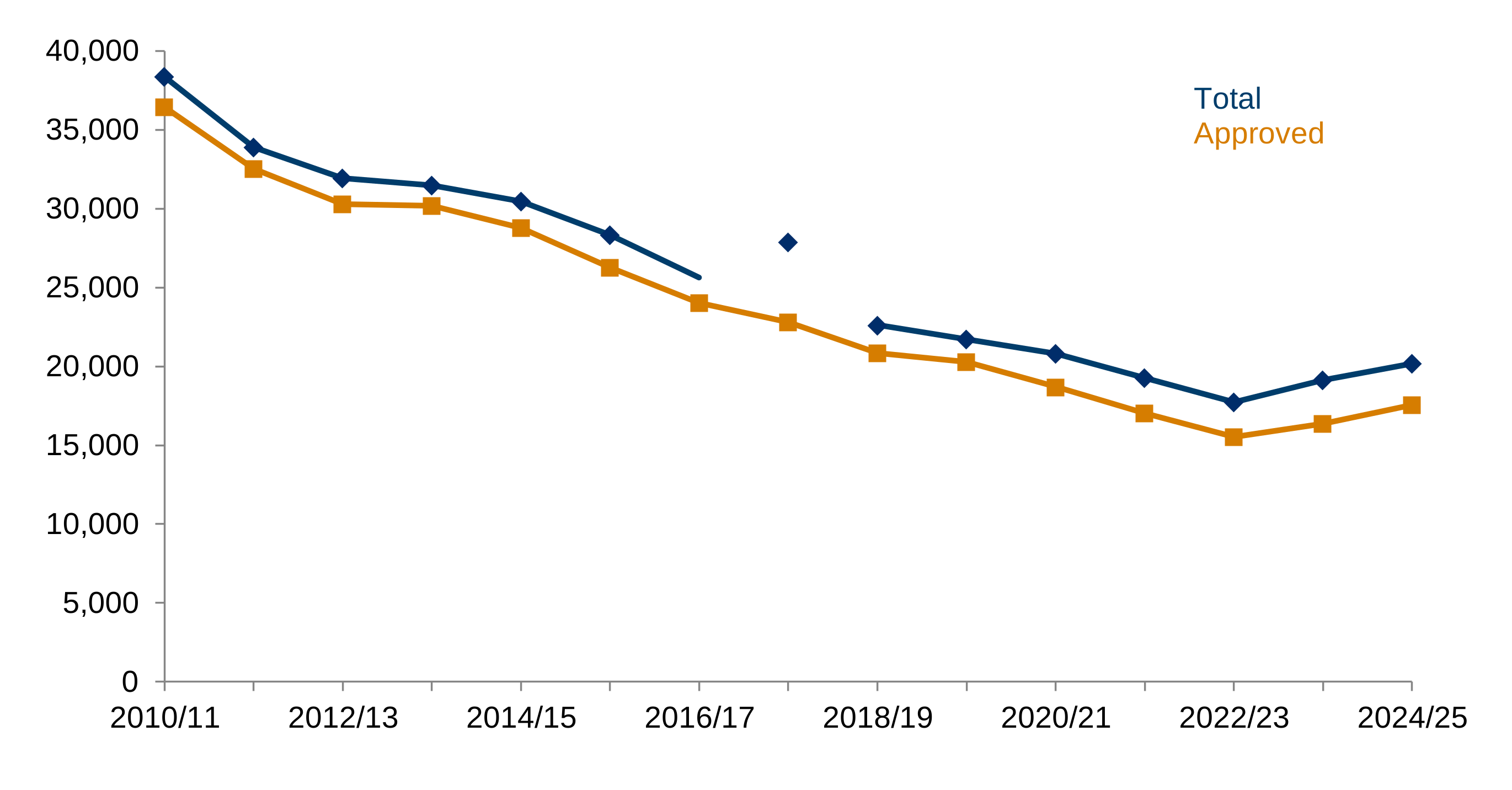
Description of figure 1: a line chart showing total number of applications for EMA and approved number since 2014/15. Total applications have increased by 5.2% in 2024/25 compared with 2023/24. The number of both has decreased from about 30,000 in 2014/15 to 20,160 for total applications and 17,555 for approved applications in 2024/25.
Source: Student Loans Company
[Note 1]: In 2017/18, a number of students were incorrectly included in the total applications figure. This figure should not be compared with any other years.
Policy and operational context
EMA in Wales provides eligible learners aged 16 to 18 with £40 per week to help with education related costs such as transport, meals, and learning materials. During the academic year 2023/24, Welsh Government commissioned an independent review of the EMA Scheme in Wales. The review was published in July 2024 and made 10 recommendations.
The review concluded that EMA should continue to target those from low-income households. It also highlighted that for many students, EMA provides an opportunity for them to work less, focussing on their attendance and studies, enabling them to participate in extra-curricular activities, and reducing the stress and worry about the financial burden their post-16 study had on their family.
The scheme is available to 16 to 18 year olds but entitlement may be extended beyond this if they have not already received 3 years of EMA. For more information on eligibility, see the EMA eligibility criteria section.
Trends in applications and approvals for EMA provided in this release should be considered against the context of trends in the eligible cohort (of mainly 16 to 18 year olds), their participation in education and training, and their household income levels (since EMA is means-tested). The household income thresholds for eligibility have remained the same since 2011/12 but will be increasing from 2025/26. Student numbers for 16 to 18 year olds appear to be increasing, but 2025/26 and 2026/27 numbers are based on projections so should be treated with caution.
| Total student numbers | 2022/23 | 2023/24 | 2024/25 | 2025/26 [Note 1] | 2026/27 [Note 1] |
|---|---|---|---|---|---|
| 16 to 18 year olds | 58,770 | 60,415 | 63,065 | 64,150 | 64,675 |
Source: Lifelong Learning Wales Record (LLWR)
[Note 1] Estimate these projections are for further education institutions and maintained secondary and special schools, counting full time students. Independent schools are excluded.
Applications received by current work stage
Figure 2: applications received by current work stage
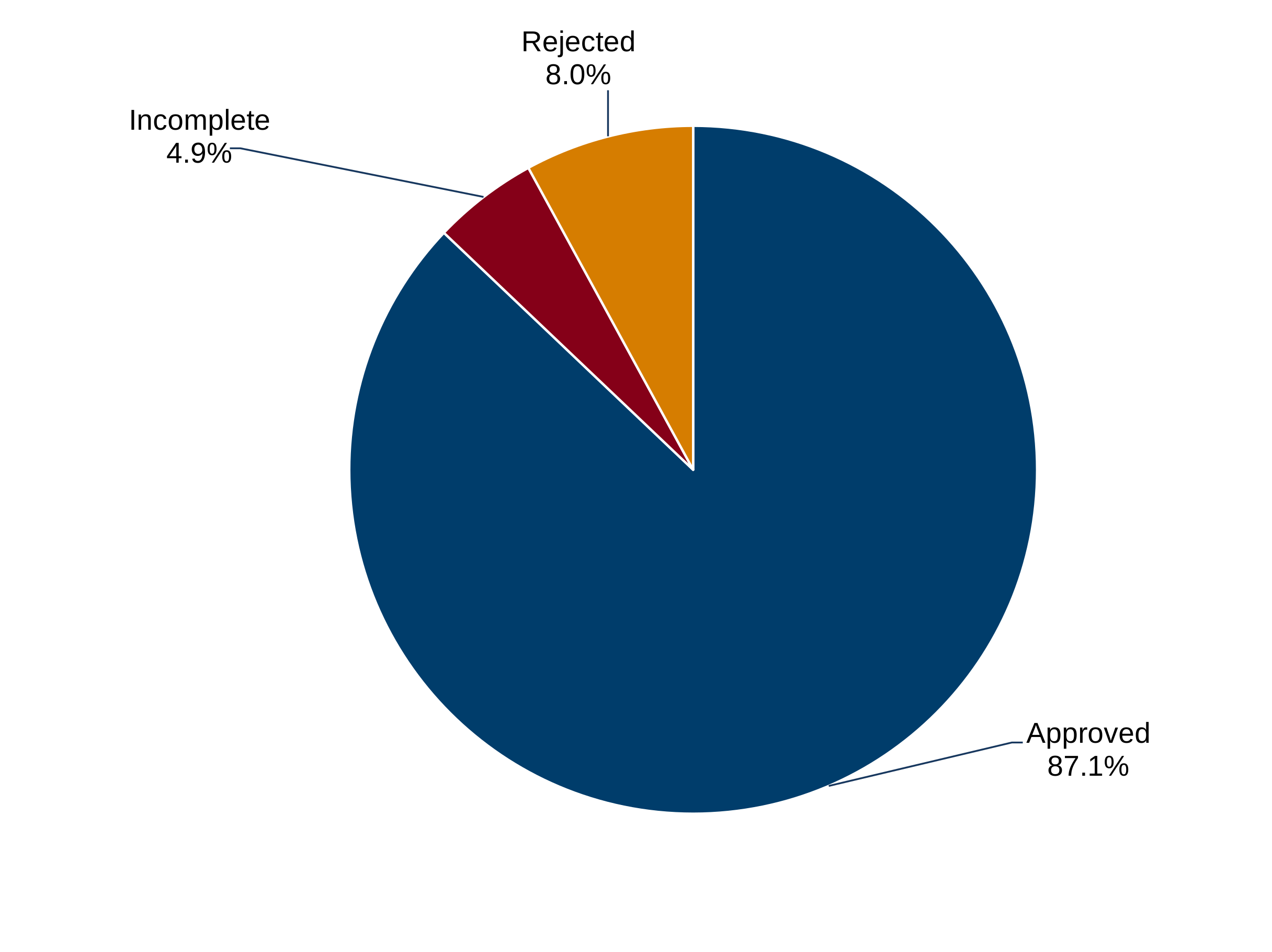
Description of figure 2: a pie chart showing applications received by current works stage with the highest proportion of applications being approved.
Source: Student Loans Company
As at 31 August 2025, 87.1% of applications received had been approved and 8.0% had been rejected. 4.9% were incomplete (either missing information such as no date of birth included or missing evidence such as no birth certificate attached).
| Work stage | 2020/21 | 2021/22 | 2022/23 | 2023/24 | 2024/25 |
|---|---|---|---|---|---|
| Total approved | 18,690 | 17,035 | 15,545 | 16,355 | 17,555 |
| Approved which received payment | 18,480 | 16,870 | 15,395 | 16,310 | 17,555 |
| Rejected | 1,500 | 1,585 | 1,470 | 1,850 | 1,605 |
| Incomplete [Note 1] | 615 | 645 | 720 | 910 | 1,000 |
| Other [Note 2] | 10 | 5 | 5 | 5 | 5 |
| Total | 20,815 | 19,265 | 17,740 | 19,125 | 20,160 |
| Total of which are renewals [Note 3] | 10,850 | 17,190 | 8,640 | 8,995 | 9,985 |
Source: Student Loans Company
The table shows the number of applications at different work stages for the past 5 years. The number of total applications was 20,160 for 2024/25 an increase compared to 19,125 in 2023/24.
Approved applications for 2024/25 made up 87.1% (17,555) of the total 20,160 applications.
[Note 1] These include applications that have missing information (e.g. no date of birth included) or missing evidence (e.g. no birth certificate attached).
[Note 2] These include applications that are in one of the following workstage: assessed; awaiting rejection; data capture incomplete; failed assessment; validated; verified (as defined by SLC).
[Note 3] Applicants who also applied for an allowance in previous academic year.
Approved applications by household income threshold
| Number of dependents | 2020/21 | 2021/22 | 2022/23 | 2023/24 | 2024/25 |
|---|---|---|---|---|---|
| One dependent [Note 1] | 13,940 | 12,775 | 11,605 | 12,095 | 12,610 |
| More than one dependent [Note 2] | 4,710 | 4,260 | 3,750 | 4,255 | 4,935 |
| Unknown | 0 | 0 | 0 | 0 | 0 |
| Total [Note 3] | 18,650 | 17,035 | 15,355 | 16,355 | 17,540 |
Source: Student Loans Company
The table shows approved applications by household income threshold. 71.9% of approved applications were at the lower household income threshold (not over £20,817).
[Note 1] Household income up to £20,817.
[Note 2] Household income up to £23,077.
[Note 3] Totals may not match other tables due to missing income data.
There are two different household income thresholds, which are based on the student s family circumstances. See the Household income criteria section for more information about household income criteria.
In 2024 to 2025, the numbers approved using the higher household income threshold increased by 680 (15.9%). The number approved from the lower threshold increased by 510 (4.2%).
Approved applications by age
Figure 3: approved applications by age
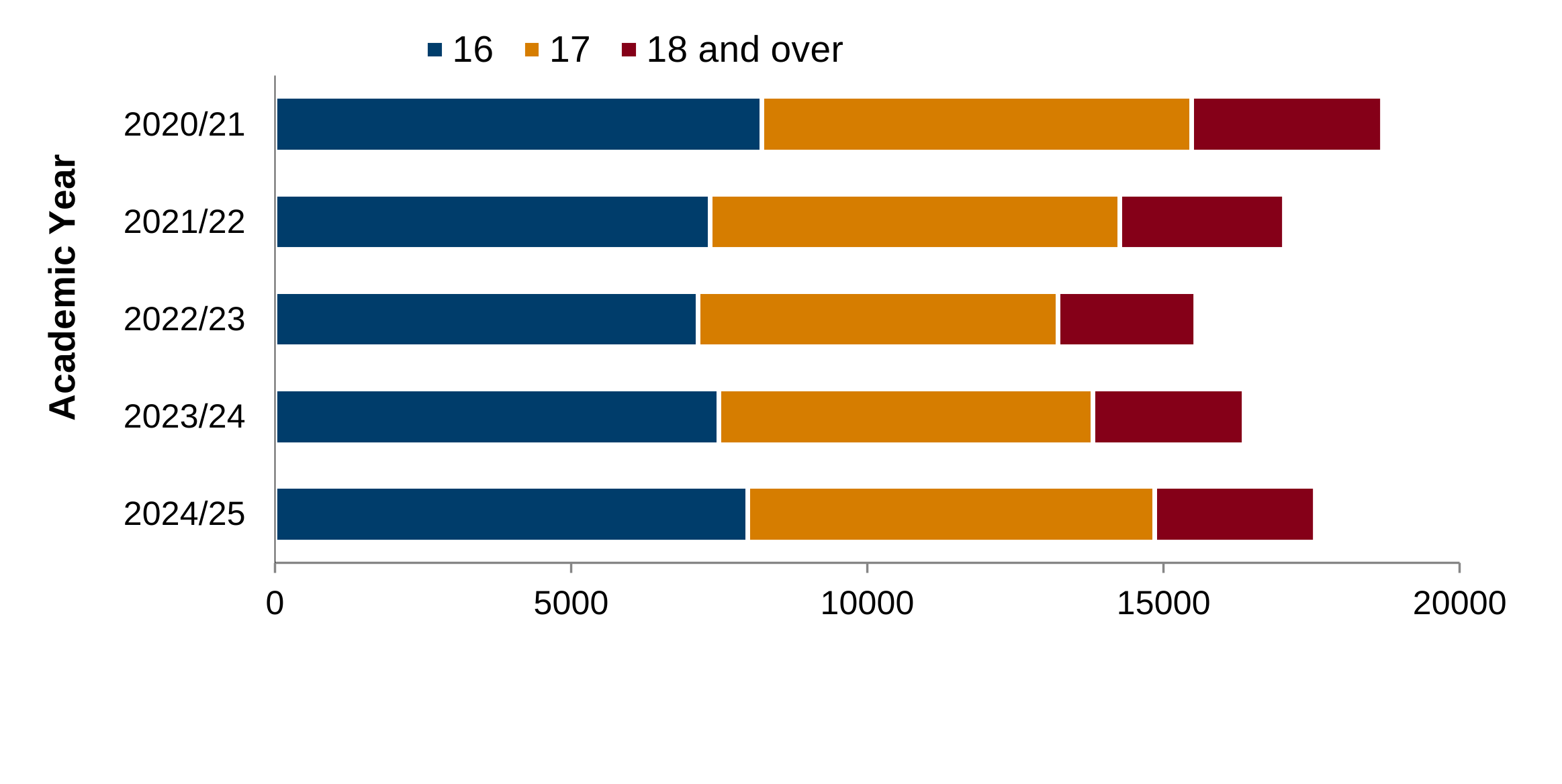
Description of figure 3: a stacked bar chart showing the number of approved applications by age. There were more approved applications for 16 year olds than for either 17 year olds and 18 and over in recent years.
Source: Student Loans Company
In 2024/25, 7,985 (45.5%) of approved applications were from 16 year olds, 6,860 (39.1%) of approved applications were from 17 year olds and the remaining 2,710 (15.4%) of approved applications were from applicants aged 18 and over.
Relating this data to the LLWR population estimate data referred to in Policy and operational context, 38.7% of 18 year old learners received EMA whilst 26.5% of 16 to 17 year olds received EMA.
Approved applications by learning centre type
| Learning centre type | Age 16 | Age 17 | Age 18+ | Total |
|---|---|---|---|---|
| Further education college total | 5,535 | 4,645 | 2,350 | 12,530 |
| Further education college (males) | 2,705 | 2,350 | 1,215 | 6,270 |
| Further education college (females) | 2,830 | 2,295 | 1,135 | 6,260 |
| Secondary school total | 1,800 | 1,535 | 90 | 3,425 |
| Secondary school (males) | 790 | 665 | 40 | 1,500 |
| Secondary school (females) | 1,005 | 865 | 50 | 1,925 |
| Other learning centre total | 160 | 135 | 110 | 400 |
| Other learning centre (males) | 110 | 90 | 65 | 265 |
| Other learning centre (females) | 45 | 45 | 40 | 135 |
| All learning centres total | 7,490 | 6,315 | 2,555 | 16,355 |
| All learning centres (males) | 3,610 | 3,105 | 1,325 | 8,035 |
| All learning centres (females) | 3,885 | 3,205 | 1,230 | 8,320 |
Source: Student Loans Company
| Learning centre type | Age 16 | Age 17 | Age 18+ | Total |
|---|---|---|---|---|
| Further education college total | 6,060 | 5,170 | 2,500 | 13,730 |
| Further education college (males) | 3,085 | 2,490 | 1,290 | 6,865 |
| Further education college (females) | 2,975 | 2,680 | 1,210 | 6,865 |
| Secondary school total | 1,750 | 1,550 | 115 | 3,410 |
| Secondary school (males) | 745 | 655 | 45 | 1,445 |
| Secondary school (females) | 1,000 | 895 | 70 | 1,965 |
| Other learning centre total | 175 | 145 | 95 | 415 |
| Other learning centre (males) | 120 | 100 | 65 | 285 |
| Other learning centre (females) | 60 | 45 | 30 | 135 |
| All learning centres total | 7,985 | 6,860 | 2,710 | 17,555 |
| All learning centres (males) | 3,950 | 3,245 | 1,395 | 8,595 |
| All learning centres (females) | 4,035 | 3,615 | 1,315 | 8,960 |
Source: Student Loans Company
The tables show approved applications by age, learning centre type and sex. 78.2% of the applications were from those in further education colleges.
- 13,730 students attending further education colleges had their applications approved, accounting for 78.2% of all approved applications.
- 3,410 students attending secondary schools had their applications approved, accounting for 19.4% of all approved applications.
- The remaining 415 (2.4%) approved applications were for students attending other learning centres (special schools, independent schools and grammar schools).
Approved applications by sex
| Sex | 2020/21 | 2021/22 | 2022/23 | 2023/24 | 2024/25 |
|---|---|---|---|---|---|
| All students | 18,690 | 17,034 | 15,545 | 16,355 | 17,555 |
| Male | 9,085 | 8,305 | 7,805 | 8,035 | 8,595 |
| Female | 9,605 | 8,730 | 7,735 | 8,320 | 8,960 |
Source: Student Loans Company
Table 5 shows approved applications from males and females since 2020/21. Females accounted for 51.0% of approved applications for 2024/25 a similar proportion compared to 2023/24.
8,960 (51.0%) of approved applications came from female students, this proportion from female applicants has stayed approximately the same since 2020/21.
Figure 4: approved applications by learning centre type and sex, 2024/25 [Note 1]
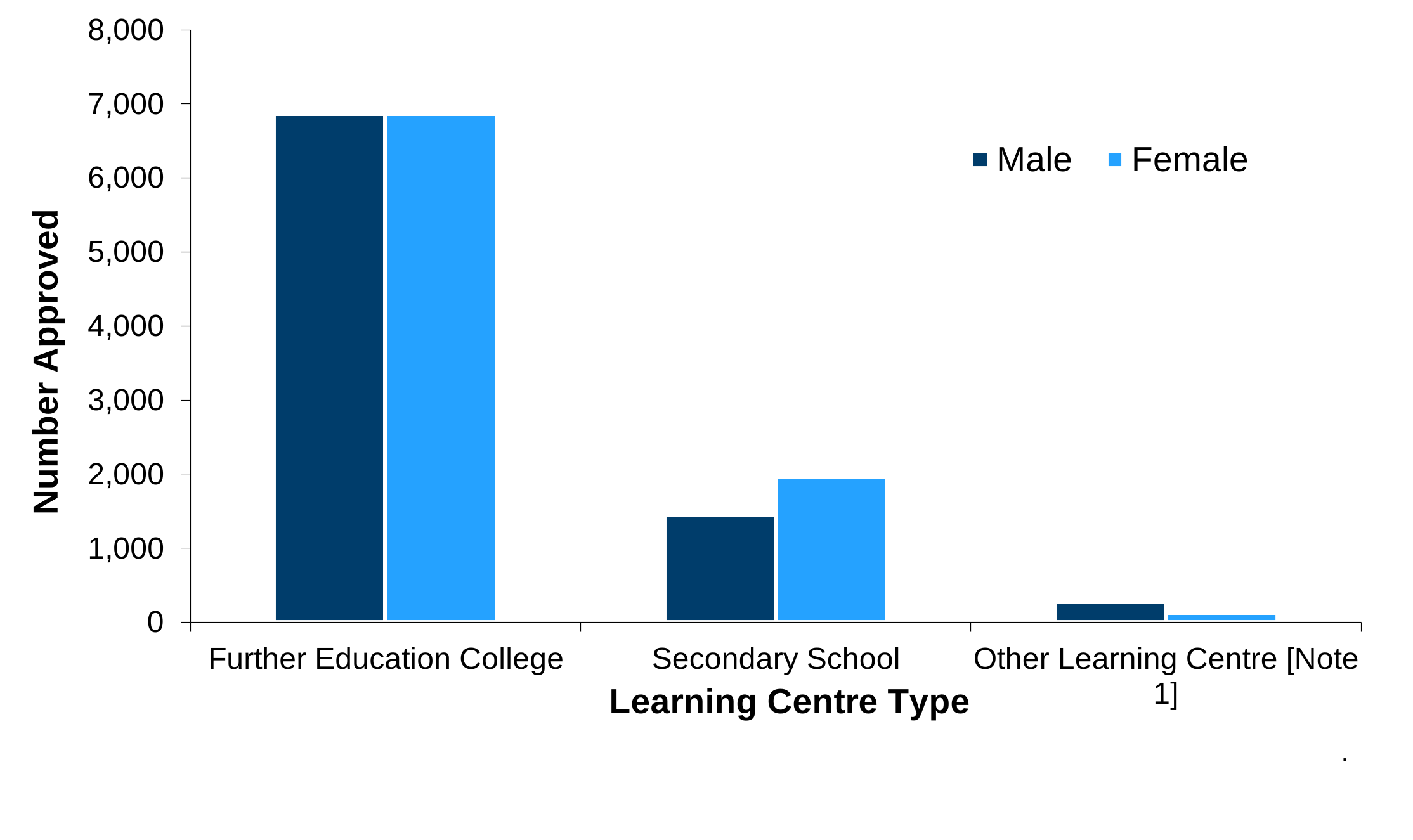
Description of figure 4: a bar chart showing that most approvals are for Further Education Colleges, showing their dominant role. Secondary Schools have moderate uptake, slightly higher for females, while Other Learning Centres contribute minimally.
Source: Student Loans Company
[Note 1] Other Learning Centre comprises Special schools, Independent schools and Grammar Schools.
In further education colleges approved applications were split evenly (50.0%) between male and female students. In secondary schools more of the approved applications were from female students (57.6%) with male students making up the other 42.4%. Unlike secondary schools, the majority of approved applications in other learning centres were from male students (68.0%).
Approved applications by year claiming EMA
| Year claiming | 2020/21 | 2021/22 | 2022/23 | 2023/24 | 2024/25 |
|---|---|---|---|---|---|
| Total | 18,690 | 17,035 | 15,545 | 16,355 | 17,555 |
| First year claiming EMA | 9,185 | 8,300 | 8,155 | 8,620 | 9,060 |
| Second year claiming EMA | 7,060 | 6,535 | 5,720 | 5,915 | 6,570 |
| Third year claiming EMA | 2,445 | 2,200 | 1,670 | 1,820 | 1,930 |
| Fourth year claiming EMA | 0 | 0 | 0 | 0 | 0 |
Source: Student Loans Company
The table shows approved applications by year of claiming. There was an increase in EMA approvals compared with the previous year, both in total and when split by number of years claiming EMA.
In 2024/25, 9,060 (51.6%) of approved applications were from first year claimants.
Quality and methodology information
EMA eligibility criteria
Full criteria can be found on the Student Finance Wales website
Student criteria
- Aged 16, 17 or 18 years old on 31 August at the start of the academic year.
- Meets the nationality/residency criteria.
Course criteria
- Studying full-time at a school; or studying at least 12 guided hours a week at a recognised further education institution.
- Studying an academic or vocational course up to and including level 3 (eligible academic or vocational course include GCSEs, A-Levels, BTECs, NVQs, GNVQs, Basic Skills courses and the Independent Living Skills Programme).
Household income criteria
Evidence of household income in the prior tax year determines whether a student will be eligible for an EMA.
There are two different household income thresholds, which are based on the students’ family circumstances. Students will not be able to receive EMA if their household income is above the threshold levels.
Family circumstances
- There is one dependent child in the household: £20,817.
- There are one or more dependants aged 16 or under in the household: £23,077.
- There are one or more dependants aged 20 or under in full-time education or training and eligible for child benefit in the household: £23,077.
Data source
EMA applications and payments are administered by the Student Loans Company (SLC). Data held on EMA students is used for the purpose of assessing and paying EMA to students. This data is also stored in a management information data warehouse for the purpose of management reporting, operational performance reporting, audit of processes, statistics, future policy planning and forecasting.
Data collection
The data in this release were collected via the SLC management information system and were extracted on 7 November 2025. All information is based on applications received by 31 August of each academic year (31 August 2025 for 2024 to 2025).
Validation and verification
Processes and systems which enable customer and application assessment data to be held electronically are subject to periodic audit and integrity checks. SLC Internal Audit ensures that the processes governing data entry and application assessment are adhered to. Data integrity validation rules are used to identify and correct errors in data. Management Information extracted from SLC systems are subject to quality assurances prior to distribution: statisticians within the Welsh Government review the data and query any anomalies with the SLC before tables are published.
Publication
Once the data has been finalised, the release is compiled and the key points and commentary are drafted. The release is independently checked, and a final sense check is carried out by the relevant statistician prior to publication on the website.
Disclosure control and confidentiality
All the figures are rounded to the nearest 5 for confidentiality. Where figures have been rounded there may be an apparent discrepancy between the sum of the constituent items and the total.
Definitions
Change in applicant circumstances
The data represented in this release refer to applicants most recent learning agreement. Therefore, if an applicant has attended more than one type of learning centre, to avoid double-counting they are only included under their most recent status.
Equal opportunities
6,240 equal opportunities monitoring forms were received in 2024/25 which equates to 33.6% of all applications received. It is not known whether these applications have been approved, rejected or are currently being processed since the data are disassociated from the application process, and not all forms are fully completed. The form allows people to select multiple ethnicities and this should be considered when using these statistics.
The data of applications for which an equal opportunities form was completed as of 29 September 2025 show that:
- 15.7% classed themselves as disabled
- 3.1% said they were Black or British Black
- 11.3% made up the groups who were of Mixed race, Asian or British Asian and Chinese or other ethnic origin group
- 85.7% classed their ethnicity as White
Quality information
This section provides a summary of information on this output against five dimensions of quality: Relevance, Accuracy, Timeliness and Punctuality, Accessibility and Clarity, Comparability and Coherence.
Relevance
The statistics are used both within and outside the Welsh Government to monitor educational trends and as a baseline for further analysis of the underlying data. Some of the main users are:
- ministers and the Senedd Research Service
- officials in the Welsh Government
- Other government departments
- Further Education Institutions, Work-Based Learning providers, schools and local authorities
- Wales Audit Office
- students, researchers, academics and universities
- individual citizens, private companies, and the media
These statistics are used in a variety of ways. Some examples of these are:
- advice to Ministers
- to inform and evaluate the education policy-making process in Wales
- to forecast future expenditure of student support schemes in Wales
Accuracy
Statisticians within the Welsh Government review the data and query any anomalies with the Student Loans Company before tables are published. The figures in this release reflect the final position as at the end of the 2024/25 academic year (31 August 2025) and are correct as at 7 November 2025.
Looking at previous years data, it is possible to estimate how close provisional data are to final data. Below is a table showing the percentage increase/decrease seen between each month s update of approved applications, compared with final (end of August) figures, published in September.
| Academic year | Nov | Dec | Jan | Feb | Mar | Apr | May | Jun | Jul | Aug |
|---|---|---|---|---|---|---|---|---|---|---|
| 2016/17 | 8.4% | 3.6% | 1.4% | 0.6% | 0.1% | -0.2% | -0.4% | -0.5% | 0.1% | 0.0% |
| 2017/18 | 3.9% | 1.8% | 0.5% | 0.4% | -0.1% | -0.3% | -0.6% | -0.5% | 0.1% | 0.0% |
| 2018/19 | 5.5% | 3.1% | 1.4% | 0.9% | 0.1% | -0.2% | -0.5% | 0.1% | 0.1% | 0.0% |
| 2019/20 | 3.4% | 1.1% | 0.3% | 0.4% | 0.1% | -0.1% | -0.2% | 0.1% | 0.1% | 0.0% |
| 2020/21 | -0.4% | 2.8% | 1.1% | 0.4% | -0.2% | -0.6% | -1.0% | 0.1% | 0.1% | 0.0% |
| 2021/22 | 4.4% | 1.8% | 0.1% | -0.4% | -0.7% | -0.9% | -1.0% | -0.5% | 0.1% | 0.0% |
| 2022/23 | 9.7% | 4.9% | 1.3% | 0.2% | -0.9% | -1.3% | -1.7% | -1.6% | 0.1% | 0.0% |
| 2023/24 | 7.2% | 3.4% | 0.7% | 0.5% | -0.5% | -0.2% | -0.6% | -0.5% | -0.3% | 0.0% |
| 2024/25 | 12.9% | 7.1% | 4.1% | 2.4% | 1.6% | 1.1% | 0.6% | 0.4% | 0.2% | 0.0% |
Timeliness and punctuality
For academic year 2024/25, the first monthly publication on the number of EMA applications was released in December 2024, relating to applications up until the end of November 2024. Monthly updates during a given academic year are published as soon as possible on StatsWales, a few weeks following the end of a given month, and according to a planned and pre-announced series of publication dates. Data in this release refers to final 2024/25 data.
Accessibility and clarity
This statistical release is pre-announced and then published on the Statistics section of the Welsh Government website. It is accompanied by more detailed tables on StatsWales, a free to use service that allows visitors to view, manipulate, create and download data.
Comparability and coherence
Exceptionally, a student may continue to be eligible for EMA at 19 years of age. These are the approximate numbers of such students in recent years.
| 2016/17 | 2017/18 | 2018/19 | 2019/20 | 2020/21 | 2021/22 | 2022/23 | 2023/24 | 2024/25 |
|---|---|---|---|---|---|---|---|---|
| 275 | 255 | 230 | 175 | 165 | 155 | 120 | 150 | 155 |
There can be a drop in approved EMA applications, often in the Spring of the academic year. This is due to the annual exercise carried out by SLC to sample check a proportion of those returning EMA applicants who have chosen to self certify their income and assess the application against the applicants' previous years income evidence. If the applicant later fails to provide evidence of household income (if requested) then they will be assumed to no longer be eligible for support.
Students meeting the eligibility criteria qualify for an award of 40 per week. EMA rate increased from 30 to 40, from April 2023.
Northern Ireland Executive and Scotland Government have their own EMA schemes. The EMA scheme in England has been cancelled and has been closed to new applicants since 1 January 2011. This scheme has been replaced by a bursary scheme (GOV.UK) which focuses on students from less wealthy households.
Official statistics status
All official statistics should show the standards of the Code of Practice for Statistics (UK Statistics Authority).
These are accredited official statistics. They were independently reviewed by the Office for Statistics Regulation (OSR) in May 2022. They comply with the standards of trustworthiness, quality and value in the Code of Practice for Statistics.
It is Welsh Government s responsibility to maintain compliance with the standards expected of accreditation. If we become concerned about whether these statistics are still meeting the appropriate standards, we will discuss any concerns with OSR promptly. Accreditation can be cancelled or suspended at any point when the highest standards are not maintained and reinstated when standards are restored.
Accredited official statistics are called National Statistics in the Statistics and Registration Service Act 2007.
Statement of compliance with the Code of Practice for Statistics
Our statistical practice is regulated by the OSR. OSR sets the standards of trustworthiness, quality and value in the Code of Practice for Statistics that all producers of official statistics should adhere to.
All our statistics are produced and published in accordance with a number of statements and protocols to enhance trustworthiness, quality and value. These are set out in the Welsh Government's Statement of Compliance.
These accredited official statistics (OSR) demonstrate the standards expected around trustworthiness, quality and public value in the following ways.
You are welcome to contact us directly with any comments about how we meet these standards. Alternatively, you can contact OSR by emailing regulation@statistics.gov.uk.
Well-being of Future Generations Act (WFG)
The Well-being of Future Generations Act 2015 is about improving the social, economic, environmental and cultural wellbeing of Wales. The Act puts in place seven wellbeing goals for Wales. These are for a more equal, prosperous, resilient, healthier and globally responsible Wales, with cohesive communities and a vibrant culture and thriving Welsh language. Under section (10)(1) of the Act, the Welsh Ministers must (a) publish indicators (national indicators) that must be applied for the purpose of measuring progress towards the achievement of the wellbeing goals, and (b) lay a copy of the national indicators before Senedd Cymru. Under section 10(8) of the Well-being of Future Generations Act, where the Welsh Ministers revise the national indicators, they must as soon as reasonably practicable (a) publish the indicators as revised and (b) lay a copy of them before the Senedd. These national indicators were laid before the Senedd in 2021. The indicators laid on 14 December 2021 replace the set laid on 16 March 2016.
Information on the indicators, along with narratives for each of the wellbeing goals and associated technical information is available in the Wellbeing of Wales report.
Further information on the Well-being of Future Generations (Wales) Act 2015.
The statistics included in this release could also provide supporting narrative to the national indicators and be used by public services boards in relation to their local wellbeing assessments and local wellbeing plans.
Further details
Further information about the EMA scheme can be found on the Student Finance Wales website.
Related articles
The Scottish Government and Northern Ireland Executive publish statistics on recipients of EMA.
List of tables and data Items provided on StatsWales
Cumulative monthly applications for Education Maintenance Allowance by academic year and workstage (StatsWales), which provides data on EMA application on a monthly basis. This annual publication finalises data at the end of August, the monthly data for August are therefore equal to the data presented in figures 1 and 2 above.
Approved applications for Education Maintenance Allowance by academic year (StatsWales). Only data for the 30 award has been provided since the academic year 2013/14 until April 2023 when the rate was increased to 40, other awards were discontinued in 2011/12.
We want your feedback
We welcome any feedback on any aspect of these statistics which can be provided by email to HigherEducationAndStudentFinance.Stats@gov.wales
Contact details
Higher education and finance statistics
Email: HigherEducationAndStudentFinance.stats@gov.wales
Media: 0300 025 8099
SB 4/2026