
Families First annual performance figures: April 2024 to March 2025
A summary review on how the Families First programme has been performing.
In this page
Background
Families First is a Welsh Government programme designed to improve outcomes for babies, children, young people, and their families. It places an emphasis on early help and prevention and works with the whole family to stop problems escalating towards crisis. The programme promotes the development of multi-agency systems of support to ensure families can access tailored support when they need it.
The key elements of Families First are:
- Joint Assessment Family Framework (JAFF) which provides a comprehensive strengths-based evaluation of families’ needs.
- The Team Around the Family (TAF) which brings together a range of professionals to work with a family to help them address the challenges they face.
- Strategically commissioned projects developed in response to identified local and communities’ needs and can include parenting interventions, family mental health support and support for young people.
- Disability Focus where an allocation of funding is expected to be spent on innovative support for families affected by disability. Local authorities determine how this element is spent in their areas.
Local authorities differ in the types of support they commission, and the amount of funding invested in the various elements of the Families First programme. They make investment decisions based on a needs analysis of their local population.
The programme has a suite of National Performance Measures (NPMs) identified to help provide further evidence of the impact of the programme across Wales, particularly in respect of the strategic projects. Local authorities are only required to report on the NPMs that are relevant to the delivery of the programme in their area.
The Welsh Government has provided definitions of the NPMs alongside some examples of how local authorities could mark an individual or family successful against them. The examples are not exhaustive and therefore measures of success against the NPMs are subjective to each local authority and not all local authorities report against all NPMs. Individuals or families may be reported against more than one NPM.
Data is collected by the Local Authorities using a Welsh Government template and reported to Welsh Government on an annual basis.
To prevent disclosure of individuals, data is rounded to the nearest five. Totals and percentages are calculated with the raw numbers and may appear not to match or sum to 100%.
Key points
The number of referrals for a Joint Assessment Family Framework (JAFF) decreased by 8% between 2023-24 (21,675) and 2024-25 (20,050).
Around half of JAFF referrals led to families completing a JAFF assessment in 2024-25, following a similar trend to previous years.
The number of Team Around the Family (TAF) action plans signed experienced a small decrease between 2023-24 and 2024-25, from 9,260 to 9,170.
The number of TAF action plans closed between 2023-24 and 2024-25 also saw a decrease, from 9,305 to 8,825.
The percentage of TAF action plans closed successfully, of those closed in total, has remained consistent over the last 10 years, and is at a similar level in 2024-25 (61%).
The percentage of individuals or families with a successful outcome reported against each NPM has remained above 50% of those that have been worked with in 2024-25, except for two measures: primary school children who have improved their school attendance has decreased from 63% in 2023-24 to 30% in 2024-25, and families affected by disability that report an improvement in family resilience has increased since 2023-24, but remained below 50%, from 34% to 45% in 2024-25.
Joint Assessment Framework for Families & Team Around the Family
The number of referrals for a Joint Assessment Family Framework (JAFF) decreased in 2024-25, after having been the highest on record in 2023-24. There were 20,050 referrals across Wales in 2024-25, which was a decrease of 8% from 2023-24, when the number of referrals was 21,675. A subset of these referrals made were for families with needs relating to disability. The numbers of referrals for these families remained consistent with previous years in 2024-25, increasing slightly to 2,850 from 2,835 in 2023-24.
Around half of JAFF referrals led to families completing a JAFF assessment in 2024-25, following a similar trend to previous years; the number of JAFF assessments completed slightly decreased in 2024-25, from 10,920 in 2023-24 to 10,865 in 2024-25. However, the number of JAFF assessments completed for families with needs relating to disability increased, from 2,330 in 2023-24 to 2,460 in 2024-25. This accounted for 86% of families with needs relating to disability referred for a JAFF assessment.
The number of Team Around the Family (TAF) action plans signed decreased in 2024-25 to 9,170, from 9,260 in 2023-24, despite having risen overall between 2013-14 and 2022-23. The number of TAF action plans signed for families with needs relating to disability also slightly decreased from 2,260 in 2023-24 to 2,250 in 2024-25.
The number of TAF action plans closed in 2024-25 decreased from 9,305 in 2023-24 to 8,825. The number of TAF action plans closed over the same period for families with needs relating to disability followed a similar trend, decreasing from 2,210 in 2023-24 to 2,065 in 2024-25.
The percentage of TAF action plans closed successfully has been consistent over the previous decade, and remained similar in 2024-25 (61%), a small decrease from 62% in 2023-24. The percentage of TAF action plans closed successfully for families with needs relating to disability has also remained consistent over the same period, slightly increasing to 68% in 2024-25, from 65% in 2023-24.
National Performance Measures
In 2024-25, the percentage of individuals or families with a successful outcome reported against each NPM has remained above 50% of those that have been worked with, except for two measures: primary school children who have improved their school attendance has decreased from 63% in 2023-24 to 30% in 2024-25, and families affected by disability that report an improvement in family resilience has increased since 2023-24, but remained below 50%, from 34% to 45% in 2024-25.
For most NPMs except primary school children who have improved their school attendance, the percentage of those worked with who reported a successful outcome in 2024-25 was similar to the previous year. The increase in the number of individuals or families being worked with in 2023-24 compared to 2022-23 persisted into 2024-25, while the number of successful outcomes has remained at a similar level to previous years. This has resulted in large decreases in the percentages of individuals or families with successful outcomes in comparison to 2022-23.
In 2024-25 the NPM with the highest number of successful participants reported was improved emotional/mental wellbeing at 24,500. This represented 77% of the total number of individuals or families worked with against this NPM. The NPM with the highest reported percentage of success was parents benefitting from a parenting intervention (86%).
Figure 1: Percentage of successful individuals or families of total worked with against each National Performance Measure, 2024-25
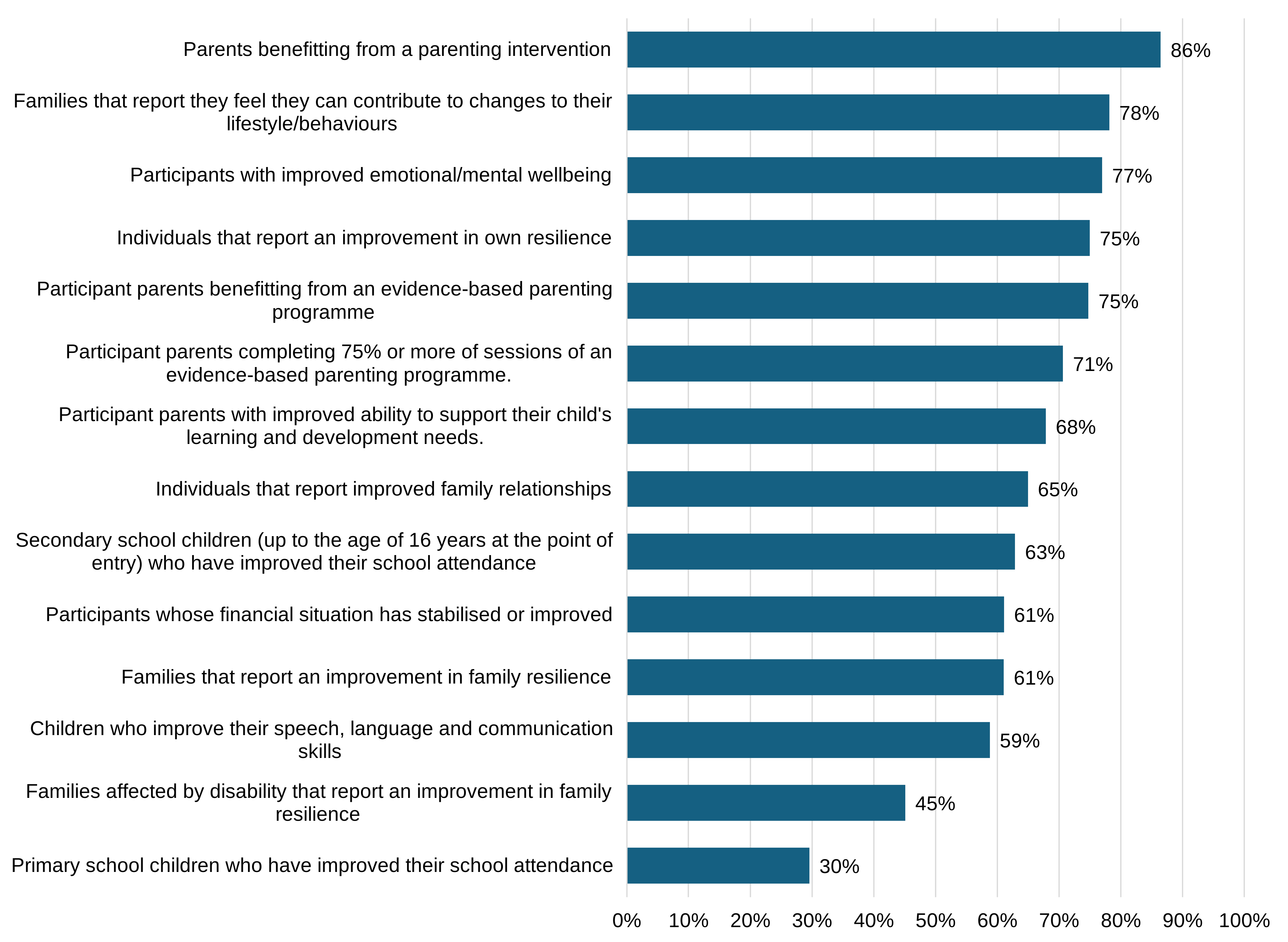
Description of figure 1: Horizontal bar chart showing that, of the 14 National Performance Measures, parents benefitting from a parenting intervention had the highest percentage of successful individuals or families of the total number worked with in 2024-25, at 86%. The lowest percentage was 30%, for families affected by disability that reported an improvement in family resilience. The chart has been ordered from the NPM with the highest reported percentage of successful participants to the lowest reported percentage of successful participants.
Source: Families First interventions data, collected from local authorities by Welsh Government, 2024-25
Data Quality Issues
Families First interventions vary between local authorities, and so numbers may not be directly comparable.
The data clearly show some inconsistencies persist across certain metrics, likely due to variations in reporting interpretations and local practices.
Not all local authorities report on every NPM, and individuals or families may be recorded against more than one NPM. They may also be counted more than once if they access services on more than one occasion or across different quarters.
In Gwynedd, disability interventions do not use JAFF assessments or TAF action plans; instead, other assessments capture key 'what matters' discussions and create suitable intervention plans accordingly.
Additional data is collected on individuals accessing projects commissioned by the Families First programme. This data has not been included in this publication due to data quality concerns.