
Feasibility of using administrative data sources to measure new housing supply
How administrative data could be used to enhance and quality assure new house building statistics.
In this page
Introduction
The Welsh Government’s New house building statistics provide the main source of information on new house building activity in Wales. The information is used by the Welsh Government and local authorities to assess levels of housing supply and inform policy development. The statistics are also used by a range of external stakeholders including housing market analysts and researchers, as well as construction and banking sectors to monitor housing trends.
The Welsh Government’s New house building statistics provide a useful indication of the number of new dwelling starts and completions certified by local authority building control officers and the National House Building Council (NHBC). However, the statistics are subject to several limitations.
- Data is not collected from other building inspectors, leading to an undercount in the overall number of new dwelling starts and completions.
- The information is collected at an aggregate level which prevents granular analysis.
- There is a resource burden associated with the collection and processing of the data, with local authorities typically reporting that the statistical return takes two hours to complete each quarter, and around 2 hours is required within Welsh Government to process and quality assure each return.
- There is typically a five-to-six-month delay between the data collection and publication date.
Alternative sources of data
We have recently explored how alternative sources of data could be used to enhance and quality assure our new house building statistics. This article explores the feasibility of using (i) Energy Performance Certificate (EPC) data and (ii) Ordnance Survey (OS) data. These two sources have been selected as the most relevant for this work, as the data is frequently updated at the property level, allowing for detailed analysis and data linkage.
Energy Performance Certificate (EPC) data
It is a legal requirement for all new dwellings in England and Wales to receive an EPC once construction work is complete. EPC data can therefore provide a useful means to monitor trends in new housing supply. In recent years, the Ministry for Housing, Communities and Local Government (MHCLG) have introduced analysis of EPC new dwellings data to their Housing supply: indicators of new supply (MHCLG) release as EPC data can provide a more timely indication of new supply than building control figures. For England, EPC new dwelling figures have been found to follow a similar trend to building control figures. This means that EPC data can be used to infer future trends in the building control data.
However, there are limitations to the extent to which EPC data can be used to measure new house housing supply. For example, an EPC assessment can be undertaken at multiple stages throughout the construction process, based on the design plans for the dwelling. This means EPC new dwelling counts can represent both new builds starts and completions, as opposed to completions alone. Further to this, EPC new dwellings data does not account for any losses accrued through the construction process. For example, if a house was converted into two flats, this would be recorded as two new dwellings. This differs to our New house building statistics which collect information on net additions only (so in the above example, only one net addition would be recorded). Though MHCLG apply a small downward adjustment to the EPC new dwelling counts presented in Housing supply: indicators of new supplyto account for properties lost through demolition, properties lost through conversion are not accounted for.
Ordnance Survey (OS) data
As Great Britain’s national mapping agency, OS are responsible for providing accurate and up-to-date geospatial data to support the delivery of policy, infrastructure and services across Britain. OS hold a range of datasets which could be used to measure new housing supply, including Built Address and Royal Mail Address from the National Geographic Database (NGD). For this work, the two following indicators have been identified as the most relevant to determining cases of new dwelling completions.
- Built complete status: the movement of a property from ‘prebuild’ to ‘built complete’ indicates council tax readiness (this suggests that construction work is complete and the dwelling is ready for occupation).
- Postal Address File (PAF) entry: the addition of an address to the Royal Mail’s main addressing file indicates that mail can effectively be delivered to the property.
OS data is a particularly useful source for assessing housing supply as data is frequently updated throughout the property life cycle. This means that there is scope to explore more complex cases, such as conversions and changes of use, and identify cases where construction work has stopped or slowed. OS aerial imagery also offers a useful means to sense check and quality assure outputs.
Proposed approach
In working with OS, we have developed the following approach to estimate annual new dwelling completions using OS data. For the 2024 to 2025 financial year, properties have been classified as a new dwelling completion if:
- the property has moved from a prebuild stage to ‘built complete’ between 1 April 2024 and 31 March 2025
- the property address has been added to the Royal Mail’s PAF between 1 April 2021 and 31 March 2026
Addresses may be added to PAF before or after construction work is complete and for this reason, the date range for PAF entry has been extended beyond the reporting year.
This approach indicates that there were approximately 4,981 new dwelling completions in the 2024 to 2025 financial year. This compares to 4,638 new dwelling completions reported in our routine New house building statistics.
Figure 1 below presents the number of new dwelling completions recorded for each of the different data sources noted in this article over a five-year period (the financial year ending March 2025 is denoted as FYE 2025). As shown in Figure 1, the EPC new dwelling count is higher than the OS new dwelling count and the WG new dwelling count published in New house building statistics. There is some variation in the trend observed for each source. This is likely due to differences in the stage at which new dwellings are recorded.
Figure 1: new dwelling completions by data source, FYE 2021 to FYE 2025
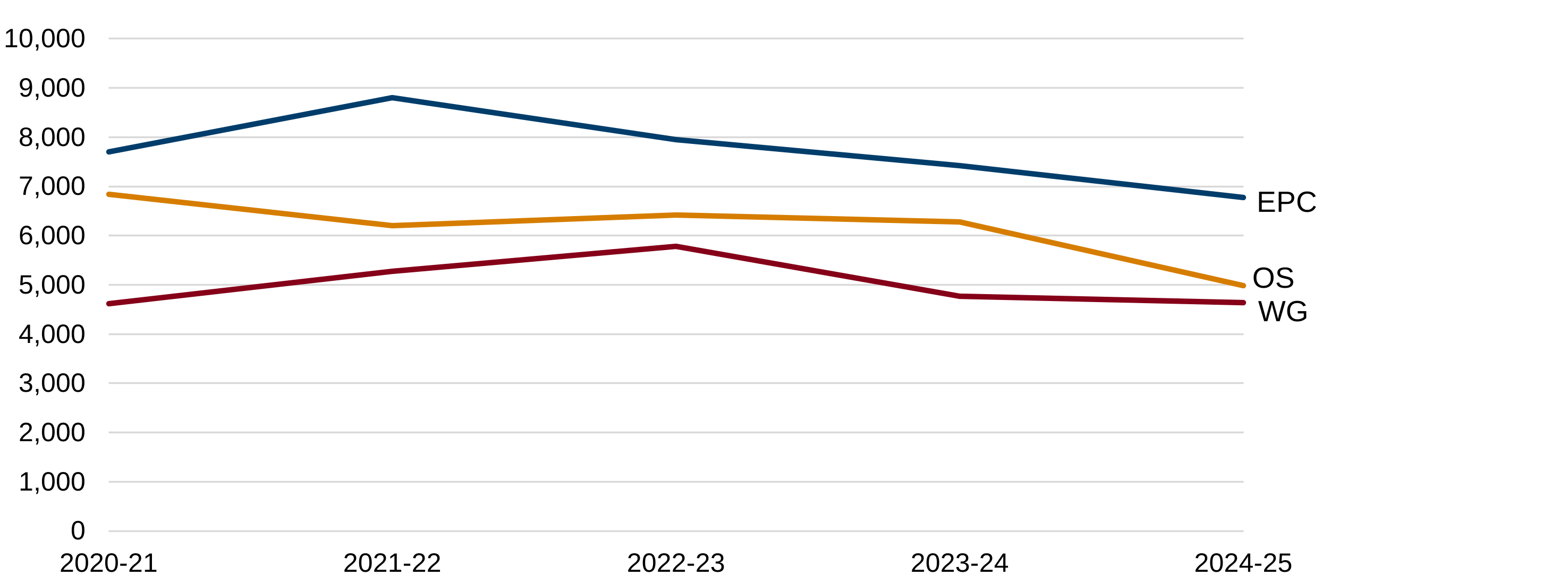
Description of figure 1: trend described in the text above.
Source: Ministry of Housing, Communities and Local Government (MHCLG) Energy Performance Certificate (EPC) statistics; Ordnance Survey (OS) data; Welsh Government (WG) New house building statistics
Live tables on Energy Performance of Buildings Certificates (MHCLG)
New house building (Welsh Government)
The number of new dwelling completions may be higher in the EPC data due to the inclusion of some properties earlier in the construction process (these properties would instead be counted as new dwelling starts in the New house building statistics and would not yet meet the criteria for an OS new dwelling completion). Further work is needed to fully understand other factors which may contribute to the higher new dwelling count in the EPC data.
For the 2024 to 2025 reporting year (ending in March 2025), 74% of OS new build completions could be linked to an EPC new dwelling record (based on records lodged up to October 2025). This provides additional assurance that the properties identified as a new dwelling in the EPC and OS data are legitimate new dwelling completions.
The number of new dwelling completions recorded as part of the proposed approach using OS data is more closely aligned to the current official new house building statistics (based on the reports of local authorities and the NHBC). The additional properties identified in the OS data may be properties certified by smaller building inspectors which are not captured as part of local authority or NHBC reporting. The difference may also be partly explained by nuances in the definition of a dwelling completion. Within the current new house building statistics, local authorities report on dwellings once building work is complete and the dwelling is ready for occupation. As part of the proposed approach utilising OS data, a dwelling is classified as complete if there is an indication that it has recently become liable for council tax and can receive mail. In some cases, the proposed approach may capture new dwelling completions at a later stage in the property life cycle (capturing properties once occupied, as opposed to when first ready for occupation).
There are several benefits to using administrative data to estimate and/or quality assure our existing housing supply statistics, including increased efficiencies, reduced administrative burden and potential for more detailed analysis. This means that there is scope for further data requirements to be met (for example by producing property type or small geography breakdowns). However there are some data requirements, such as tenure breakdowns, which cannot be met by OS or EPC data (whilst EPC data includes a tenure field, tenure is not typically defined for new dwellings). We will explore how a tenure breakdown may be achieved as part of future work.
Next steps
We will continue working with OS, GeoPlace, MHCLG and other stakeholders as part of a newly formed working group to support continuous improvement of the quality and coverage of new house building statistics in Wales.
In 2026 to 2027, we will further test the validity of the proposed approach and investigate differences between the data sources discussed in this article. We will also explore whether the proposed approach may be strengthened through the addition of other data sources (such Land Registry Price Paid data) and consider the feasibility of producing estimates for new dwelling starts. We intend to publish an update to this work later in 2026 to 2027.
We welcome any comments or suggestions from users on this work. Your views and feedback help us to maximise the quality and value of our statistics. Please get in touch with us at stats.housing@gov.wales.
Notes on the use of statistical articles
Statistical articles generally relate to one-off analyses for which there are no updates planned, at least in the short-term, and serve to make such analyses available to a wider audience than might otherwise be the case. They are mainly used to publish analyses that are exploratory in some way, for example:
- introducing a new experimental series of data
- a partial analysis of an issue which provides a useful starting point for further research but that nevertheless is a useful analysis in its own right
- drawing attention to research undertaken by other organisations, either commissioned by the Welsh Government or otherwise, where it is useful to highlight the conclusions, or to build further upon the research
- an analysis where the results may not be of as high quality as those in our routine statistical releases and bulletins, but where meaningful conclusions can still be drawn from the results
Where quality is an issue, this may arise in one or more of the following ways.
- Being unable to accurately specify the timeframe used (as can be the case when using an administrative source).
- The quality of the data source or data used.
- Other specified reasons.
However, the level of quality will be such that it does not significantly impact upon the conclusions. For example, the exact timeframe may not be central to the conclusions that can be drawn, or it is the order of magnitude of the results, rather than the exact results, that are of interest to the audience.
The analysis presented does not constitute an official statistic, but may be based on official statistics outputs, and we have applied the principles of the Code of Practice for Statistics as far as possible during development. An assessment of the strengths and weaknesses in the analysis will be included in the article, for example comparisons with other sources, along with guidance on how the analysis might be used, and a description of the methodology applied.
Articles are subject to the release practices as defined by the release practices protocol, and so, for example, are published on a pre‑announced date in the same way as other statistical outputs.
Contact details
Housing Conditions Evidence
Email: stats.housing@gov.wales
Media: 0300 025 8099