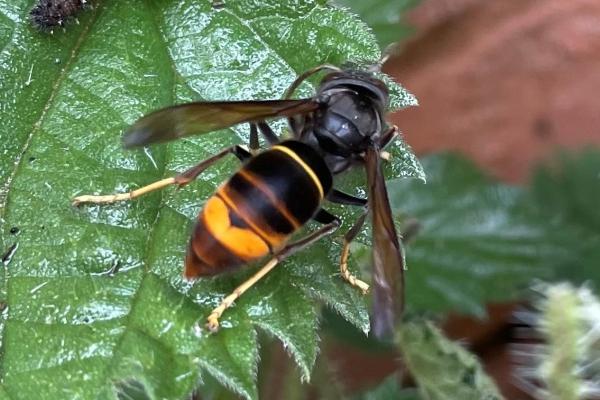
A dead nest of the yellow-legged hornet has been found near Wrexham, in the first confirmed discovery of the insect in Wales.
The yellow-legged hornet (Vespa velutina nigrithorax also known as Asian hornet) is not native to the UK. It comes from Asia and was first seen in France in 2004.
Since then, it has spread and has been found in many European countries like Spain, Belgium, Portugal, Italy, Switzerland and Germany.
The yellow-legged hornet poses a risk to honey bees and pollinating insects, which is why we ask for vigilance around sightings of them in Wales, and ask for suspected sightings to be reported.
In 2016, the yellow-legged hornet was first sighted in England and action has been taken every year since to find and destroy nests.
Using the identification guide will help distinguish yellow-legged hornets from similar looking native insects.
By learning what the yellow-legged hornet looks like and reporting any sightings, members of the public can help stop this invasive insect from spreading.
While the yellow-legged hornet queens hibernate over winter, the insect is active from February to November and most likely to be seen from July onwards.
The Welsh Government has asked the National Bee Unit (part of the Animal and Plant Health Agency) to take action in line with the Asian Hornet Contingency Plan.
Deputy First Minister with responsibility for Climate Change and Rural Affairs, Huw Irranca-Davies said:
“The National Bee Unit has years of experience tracking and locating yellow-legged hornets so their expertise will be invaluable in helping us take action against the insect in Wales.
“I’d like to thank beekeepers and members of the public who I know remain alert and continue to report suspected sightings
“We need everyone to become familiar with what yellow-legged hornets look like. As the weather warms up in the spring and especially on into the summer, please continue to be vigilant.”
If you suspect you have seen a yellow-legged hornet, you should report this using the mobile app ‘Asian Hornet Watch’, which is available on Apple and Android, or by using the online report form.
Please include a photograph and the location of the sighting with each report. Identification guides and more information are available here.
Yellow-legged hornets are not generally aggressive, but care should be taken not to approach or disturb a nest as they will become aggressive if they perceive a threat.
Medical advice about hornet stings is available on the NHS website.
For more information, visit the National Bee Unit’s Yellow-Legged Hornet page.