
Global Entrepreneurship Monitor (GEM UK) Wales report 2025
Summarises the findings for Wales from the Global Entrepreneurship Monitor survey for 2025.
In this page
Introduction
The Global Entrepreneurship Monitor (GEM) is an international research project, involving 53 economies in 2025, that provides comprehensive insights into the entrepreneurial landscape across countries. Extensive research has shown that entrepreneurship plays a crucial role in driving economic growth, enhancing competitiveness, and creating jobs. GEM results are widely used by regional and national authorities as key benchmarking indicators. In 2025, the sample size in Wales was 1,282 adults aged 18 and over, boosted through additional support from the Welsh Government as part of the UK national survey.
Main findings
Early-stage entrepreneurial activity in Wales remained stable at a historically high level
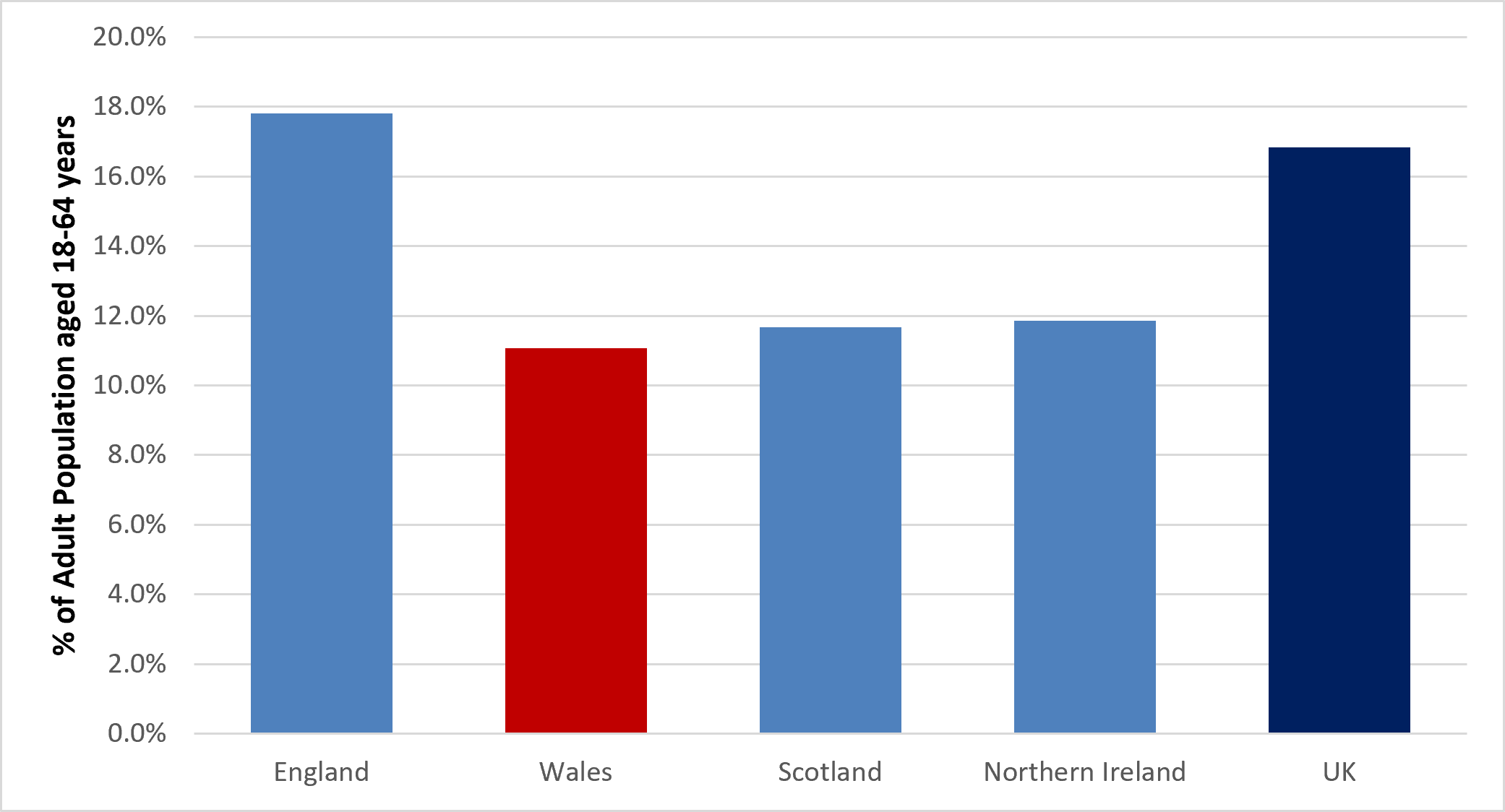
The rate of total early-stage entrepreneurship (TEA) in Wales in 2025 was 11.1 per cent, compared with 10.8 per cent in 2024. This change was not statistically significant. The Welsh TEA rate was significantly lower than the UK rate of 16.8 per cent and the England rate of 17.8 per cent, but was not significantly different from Scotland or Northern Ireland.
Entrepreneurial motivations in Wales continue to reflect a mix of opportunity, necessity and values-based drivers
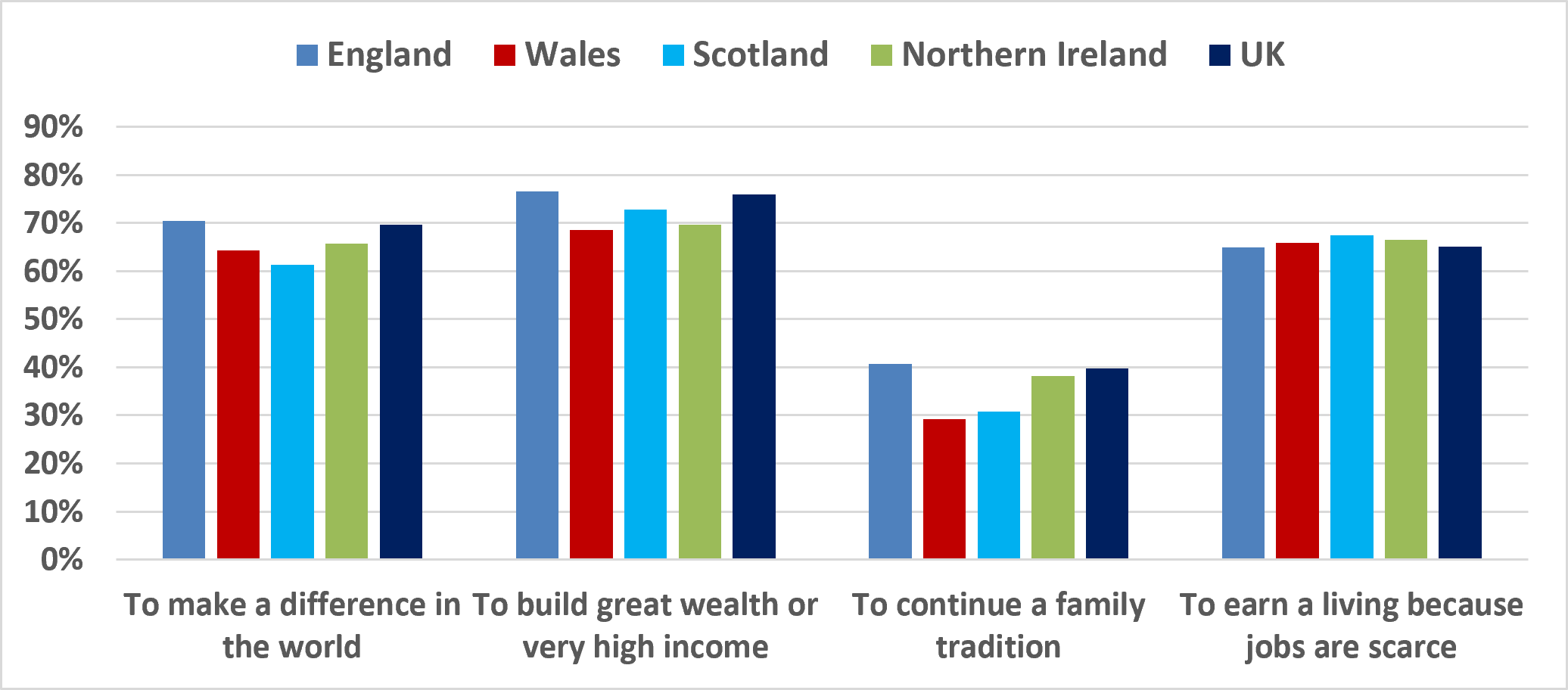
In 2025, early-stage entrepreneurs in Wales were most likely to report being motivated to build great wealth or a very high income (68.5 per cent), to earn a living because jobs are scarce (65.8 per cent), or to make a difference in the world (64.3 per cent). Continuing a family tradition remained the least commonly cited motivation, at 29.1 per cent.
The female-to-male TEA ratio in Wales stood at around 70 per cent in 2025
The female TEA rate was 9.1 per cent, compared with 13.1 per cent among males, although the difference was not statistically significant. The ratio was down from 82 per cent in 2024, reflecting an increase in male TEA alongside a slight fall in female TEA. Both male and female TEA rates in Wales were significantly lower than the equivalent UK rates, which stood at 14.7 per cent for females and 19.0 per cent for males.
Youth entrepreneurship in Wales remained high by historical standards, although below recent peaks
In 2025, the TEA rate among 18–24-year-olds in Wales was 11.3 per cent, slightly higher than 9.9 per cent in 2024, although the change was not statistically significant. Among 18–29-year-olds, the TEA rate stood at 12.3 per cent, down from 13.5 per cent in 2024, but still more than three times the rate recorded in 2002. Over the longer term, entrepreneurial activity has increased more strongly among 18–29-year-olds than among those aged 30–64. However, the difference between the two age groups was smaller in 2025 than in recent peak years, as the TEA rate among 30–64-year-olds also remained elevated.
Graduate status was strongly associated with early-stage entrepreneurship in Wales
In 2025, the TEA rate among graduates in Wales was 15.8 per cent, compared with 7.4 per cent among non-graduates, and this difference was statistically significant. Compared with 2024, the graduate rate increased slightly while the non-graduate rate declined slightly, although neither year-on-year change was statistically significant.
Entrepreneurial attitudes in Wales remained mixed but broadly stable
In 2025, 54.0 per cent of non-entrepreneurs in Wales knew someone who had started a business in the last two years, while 42.5 per cent believed they had the skills, knowledge and experience to start a business. Both measures were broadly in line with the UK, although perceived skills in Wales remained below the UK rate of 48.0 per cent; this difference was not statistically significant.
Young people in Wales reported strong exposure to entrepreneurship, with many knowing someone who had recently started a business, but lower confidence in their own start-up skills
In 2025, 63.4 per cent of young non-entrepreneurs in Wales reported knowing someone who had started a business in the last two years, similar to the UK rate of 64.8 per cent. However, only 31.2 per cent believed they had the skills, knowledge and experience to start a business, significantly lower than the UK rate of 47.0 per cent for this age group.
Perceptions of start-up opportunities remained lower in Wales than in the UK overall
In 2025, 34.9 per cent of non-entrepreneurs in Wales believed there were good opportunities to start a business locally in the next six months, up from 31.9 per cent in 2024, although the increase was not statistically significant. The equivalent UK rate was 41.5 per cent, which was significantly higher than the Welsh rate.
Fear of failure remained a substantial barrier, although the 2025 estimate was lower than in 2024
Among those who perceived good start-up opportunities, 51.7 per cent in Wales said fear of failure would prevent them from starting a business, down from 60.8 per cent in 2024, although this decline was not statistically significant. The Welsh rate was close to the UK average of 51.1 per cent in 2025.
Entrepreneurial intentions reached a new high in Wales
In 2025, 24.3 per cent of non-entrepreneurial working-age adults in Wales expected to start a business within the next three years, up from 22.6 per cent in 2024, although the change was not statistically significant. The UK rate increased more sharply to 34.2 per cent and was significantly higher than the Welsh rate. In Wales, intentions were significantly higher among men than women, at 28.8 per cent and 20.1 per cent respectively.
No significant difference was found in TEA rates by Welsh language ability
In 2025, TEA stood at 11.6 per cent among those fluent in spoken and written Welsh, 15.8 per cent among those who could speak and understand some Welsh, and 9.0 per cent among those with little or no Welsh skills. The differences were not statistically significant.
Background
The Global Entrepreneurship Monitor (GEM) is an international project that measures and monitors entrepreneurial activity, attitudes and aspirations across countries and regions. It is based on the premise that an economy’s prosperity is highly dependent on a dynamic entrepreneurial sector; that entrepreneurial capacity is composed of individuals from all groups in society with varying ability and motivation to identify opportunities, mobilise resources and start businesses; and that positive societal perceptions about entrepreneurship are important in supporting this process. GEM also recognises that entrepreneurship contributes to new employment, innovation and economic resilience, and that national competitiveness depends on the ability of new and growing ventures to develop, survive and access wider markets.
The Welsh Government (WG) sponsors the Welsh component of the GEM UK research project. Stimulating entrepreneurship remains an important policy challenge for Wales, and the Welsh Government has taken the lead in ensuring that entrepreneurship is embedded within its core activities. The WG has been a long-standing funder of GEM UK through its annual boost of the sample in Wales. Across GEM UK surveys for the period 2002–2025, around 400,000 adults have been interviewed, including over 72,000 respondents in Wales. Wales therefore has one of the largest datasets on entrepreneurial attitudes, activity and aspirations among the UK home nations over this period. This provides an important resource for analysing trends among key sub-populations in Wales, including women, young people and older people.
The results from GEM data analysis are used as key benchmarking indicators by regional and national authorities around the world. They also enable comparisons to be made between Wales, the other UK home nations and countries participating in GEM. GEM’s ability to provide comparable evidence on entrepreneurial behaviour over time and across places makes it a valuable resource for understanding and tracking entrepreneurship.
Understanding the determinants of early-stage entrepreneurship is important because there is evidence of a link between entrepreneurial activity and economic prosperity, particularly in advanced and innovation-driven economies. For Wales, GEM provides a long-running evidence base for monitoring these dynamics and informing entrepreneurship policy.
How GEM measures entrepreneurial activity
GEM creates an index of early-stage entrepreneurial activity, known as Total early-stage Entrepreneurial Activity (TEA), using the following approach:
- A telephone and online survey of a representative sample of the working-age adult population is conducted between May and September.
- The TEA index comprises respondents who are classified as nascent entrepreneurs or as new business owner-managers .
The active planning phase in which the entrepreneur has done something during the past 12 months to help start a new business, a new business that he/she will at least part own, and which has not paid wages or other income to the owners in the past 3 months.
The second phase is defined as from 4 to 42 months after the new venture begins to provide income to the owners. Entrepreneurs who at least part own and manage a new business that has been paying some form of income to the owners for at least 4 and not more than 42 months are referred to as new firm entrepreneurs.
The TEA index does not measure all entrepreneurial activity and is not based on a survey of business entities. Instead, it measures the characteristics of entrepreneurial individuals and the types of ventures they are attempting to start or are currently running. As such, it provides a unique and internationally comparable measure of the propensity of a country or region to be entrepreneurial.
Previously, GEM distinguished between different types of entrepreneurial activity by identifying whether the activity was driven by necessity, where there were no better alternatives for work, or by opportunity, where entrepreneurs were seeking to exploit new market potential. The current motivation questions provide a wider set of response options, allowing a more detailed understanding of entrepreneurial motivations than the previous binary distinction allowed. In addition to activity, the GEM survey asks all respondents about their attitudes towards entrepreneurship, and asks entrepreneurs about their aspirations.
The methodology, sample sizes and weighting systems used for the GEM UK 2025 Adult Population Survey are explained in more detail in the GEM UK 2025/26 report. In response to Covid-19 disruptions, GEM UK introduced a blended data collection approach in 2020, combining random digit dialling of landlines and mobiles with BMG’s online panel. This marked a key methodological shift aimed at ensuring robust and reliable results. In 2025, around 20 per cent of the raw sample in Wales was collected via Computer-Assisted Telephone Interviewing (CATI), with approximately 80 per cent gathered through the online panel.
The following report presents a summary of the headline results and key themes arising from the GEM survey in 2025, as well as an analysis of the twenty-four years of GEM data (2002–25).
Total early-stage entrepreneurial activity
The rate of early-stage entrepreneurship in Wales in 2025 was 11.1 per cent, representing a slight increase on the estimate of 10.8 per cent in 2024. This suggests that early-stage entrepreneurial activity in Wales remained broadly stable over the last year. The rate in Wales was significantly lower than the UK estimate of 16.8 per cent, which was influenced by the particularly high rate recorded in England, where TEA reached a historic high of 17.8 per cent. Wales’ TEA rate was significantly lower than that in England, but was not significantly different from the rates in Scotland and Northern Ireland, which stood at 11.7 per cent and 11.9 per cent respectively (Figure 1).
Overall, a TEA rate of 11.1 per cent in Wales equates to around one in every nine adults aged 18–64, or approximately 282,000 individuals. The majority were in the very early stages of starting a business, with the nascent entrepreneurship rate standing at 8.0 per cent. A further 3.6 per cent of adults in Wales were owner-managers of a new business that was between 4 and 42 months old. For comparison, the UK rates were higher for both components of TEA, with nascent entrepreneurship at 11.1 per cent and new business ownership at 6.2 per cent.
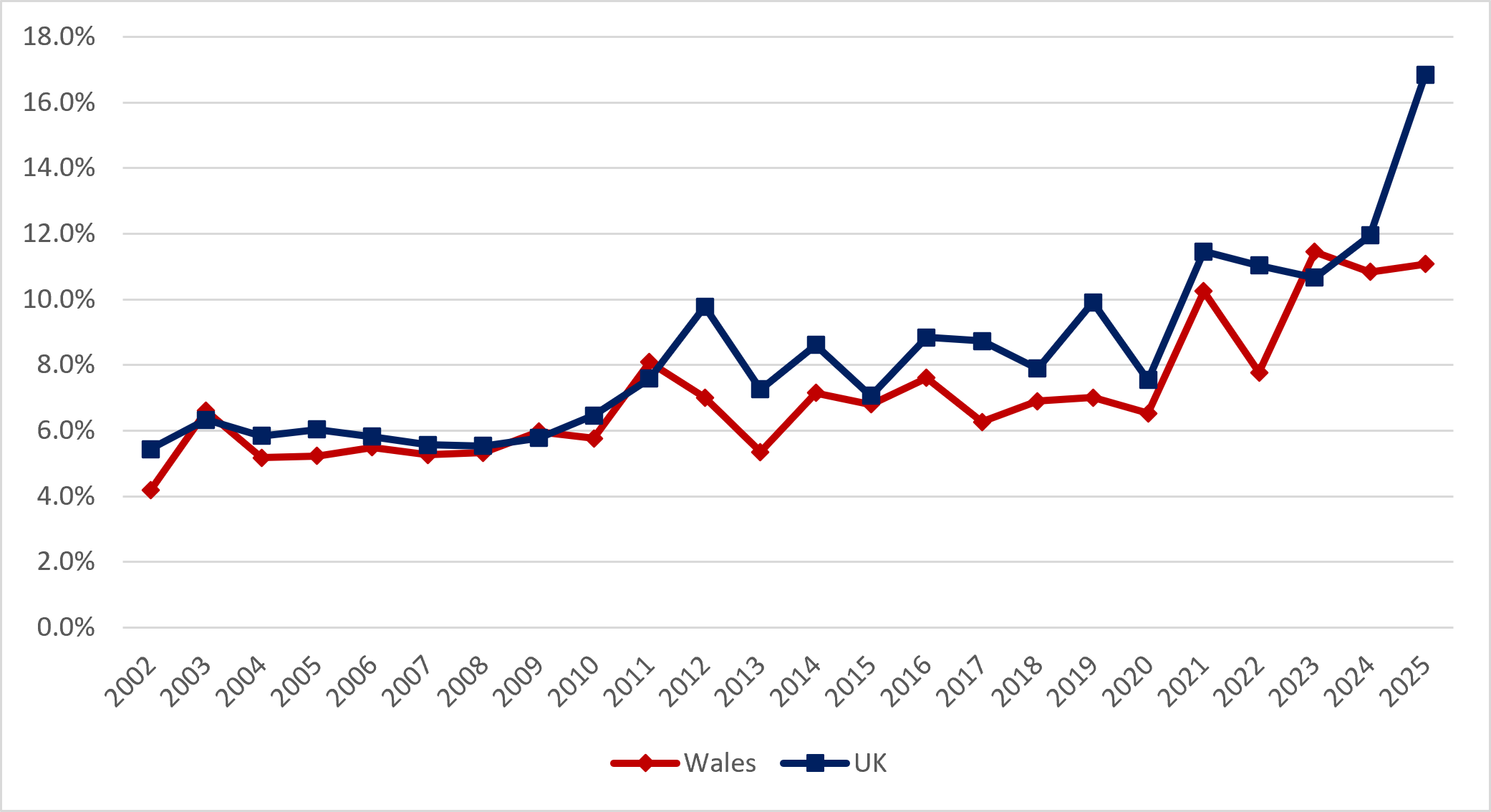
As Figure 2a shows, the rate of early-stage entrepreneurial activity in both Wales and the UK remained relatively stable between 2004 and 2010, at around 6 per cent. The rates diverged thereafter, accompanied by greater volatility in both series. As with other parts of the UK, early-stage entrepreneurial activity in Wales reached a new high in 2021 at 10.3 per cent, before rising further to 11.5 per cent in 2023, when it exceeded the UK rate of 10.7 per cent. In 2025, the TEA rate in Wales remained close to this recent high, at 11.1 per cent. However, the UK rate increased sharply to 16.8 per cent, influenced by the particularly high rate recorded in England. As a result, the gap between Wales and the UK widened in 2025.
In 2025, the nascent entrepreneurial activity rate in Wales was 8.0 per cent, slightly higher than the 7.5 per cent recorded in 2024, although the difference was not statistically significant. The new business ownership rate was 3.6 per cent, down from 4.2 per cent in 2024, but again the difference was not statistically significant. In comparison, the nascent entrepreneurship rate in the UK increased significantly from 8.1 per cent in 2024 to 11.1 per cent in 2025. The new business ownership rate for the UK also increased significantly, from 5.0 per cent in 2024 to 6.2 per cent in 2025. As a result, in 2025 both the nascent entrepreneurship rate and the new business ownership rate in Wales were significantly lower than the equivalent UK rates.
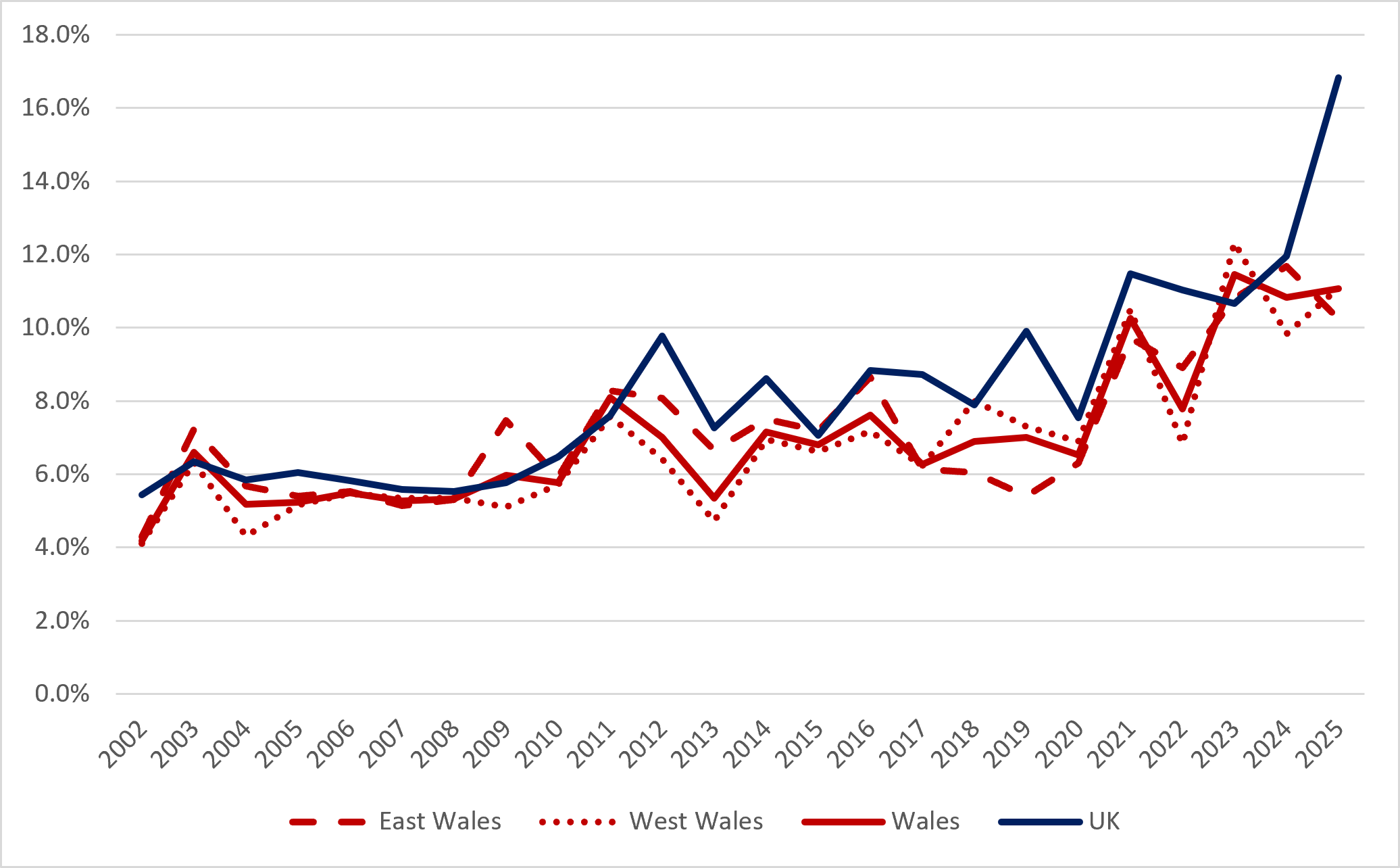
Until 2009, the TEA rates in East and West Wales were similar (Figure 2b). Following the global financial crisis, TEA rates became more volatile, although the differences between East and West Wales have generally remained statistically insignificant. In recent years, East and West Wales have alternated in recording the higher TEA rate, but these differences have not generally been statistically significant. In 2025, the TEA rate in West Wales was 11.1 per cent, compared to 10.2 per cent in East Wales, and the difference was not statistically significant.
Figure 2b uses the two statistical regions previously used for Wales at NUTS2 level: East Wales, and West Wales and the Valleys. This split is retained to ensure comparability with previous GEM Wales reports. More detailed regional breakdowns, for example for North or Mid Wales, are not reported because smaller sample sizes would make the estimates less robust for year-on-year comparison.
Since 2019, GEM has used a revised approach to measuring founders’ motives for starting a business. The earlier question distinguished more narrowly between necessity and opportunity entrepreneurship. The current approach allows entrepreneurs to report a combination of motives, providing a more realistic picture of the drivers of start-up activity.
The four motives are “to make a difference in the world”, “to build great wealth or very high income”, “to continue a family tradition” and “to earn a living because jobs are scarce”. The first two can be interpreted as more opportunity-driven, while the third is more complex, as it could reflect either opportunity or necessity. The final motive can be interpreted as more necessity-driven. Importantly, these options are not mutually exclusive: entrepreneurs can report more than one motivation and indicate the extent to which they identify with each. These motivations do not include autonomy or independence, as GEM pre-tests showed this to be a near-universal motivation among entrepreneurs and therefore less useful in distinguishing between different types of entrepreneurs.
Figure 3 presents a breakdown of entrepreneurial motives by home nation, expressed as a percentage of early-stage entrepreneurs. As in previous years, entrepreneurs across all home nations were least likely to cite “continuing a family tradition” as a motivation for starting a business. In Wales, the most commonly cited motivations in 2025 were “to build great wealth or a very high income” and “to earn a living because jobs are scarce”, reported by 68.5 per cent and 65.8 per cent of early-stage entrepreneurs respectively. A similar proportion, 64.3 per cent, reported being motivated “to make a difference in the world”. Compared with 2024, the share of early-stage entrepreneurs in Wales citing “to make a difference in the world” increased from 59.5 per cent to 64.3 per cent, while the share citing wealth or high income remained broadly unchanged. The proportion citing “earning a living because jobs are scarce” fell slightly from 68.0 per cent to 65.8 per cent, although it remained one of the two most common motivations. Compared with the UK average, early-stage entrepreneurs in Wales were less likely to cite building great wealth or very high income, making a difference in the world, or continuing a family tradition, but reported a similar level of necessity-driven motivation.
Who are the entrepreneurs in Wales?
Gender
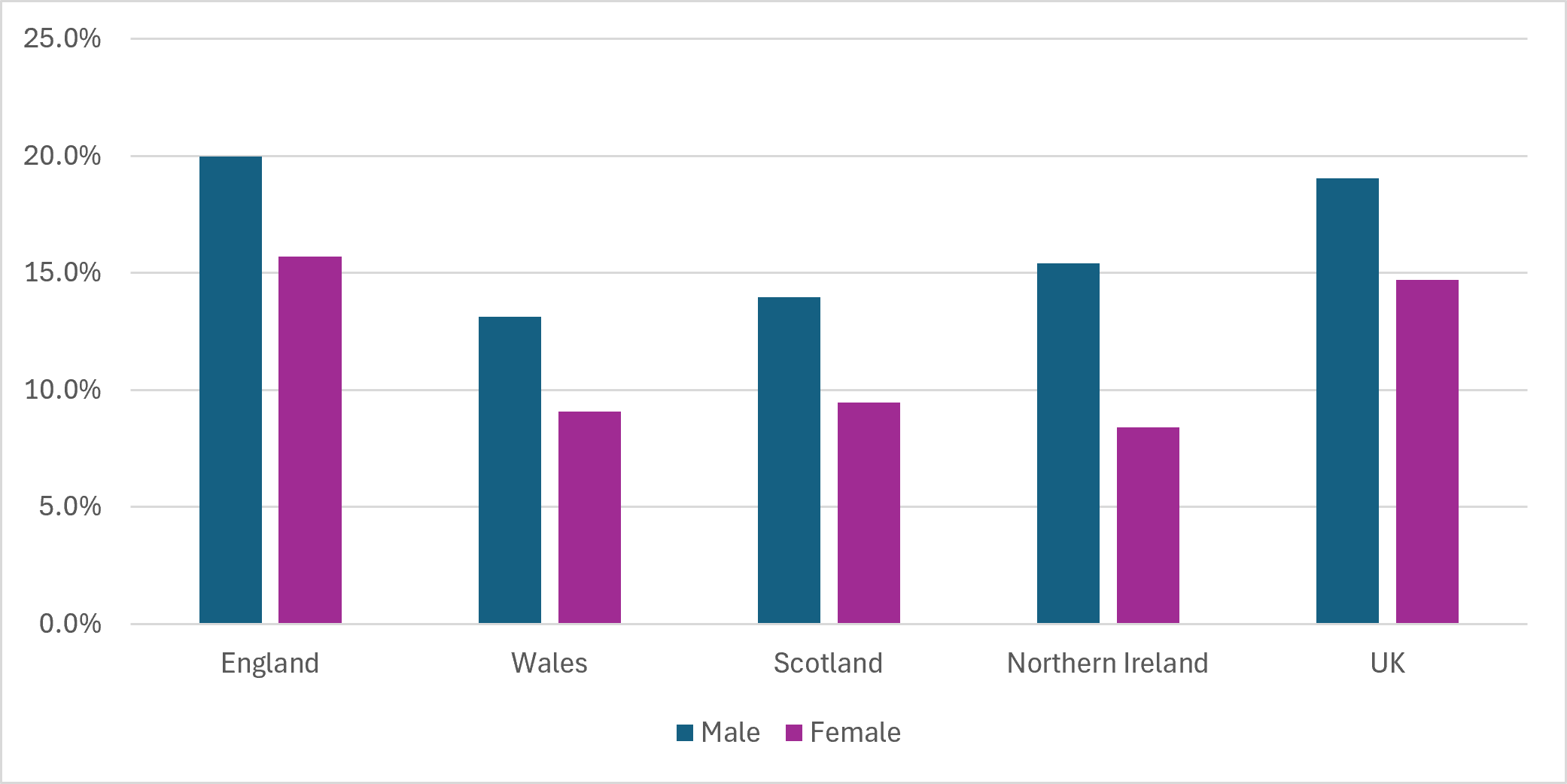
Males typically have higher early-stage entrepreneurial activity rates than females. In 2025, the male TEA rate in Wales was 13.1 per cent, compared with a female rate of 9.1 per cent. Although the male rate was higher, the difference was not statistically significant (Figure 4). Both male and female TEA rates in Wales were significantly lower than the equivalent UK rates, which stood at 19.0 per cent for males and 14.7 per cent for females.
The ratio of female to male early-stage entrepreneurial activity in the UK has historically been around 50 per cent, although the gap has narrowed considerably over time. In 2025, the UK female-to-male TEA ratio stood at 77 per cent, up from 69 per cent in 2024. In Wales, the ratio was 70 per cent in 2025, down from 82 per cent in 2024, reflecting an increase in the male TEA rate alongside a slight fall in the female TEA rate. Among the home nations, England recorded the highest female-to-male ratio in 2025, at 79 per cent, followed by Wales and Scotland at around 70 and 68 per cent respectively. Northern Ireland recorded the lowest ratio, at 55 per cent.
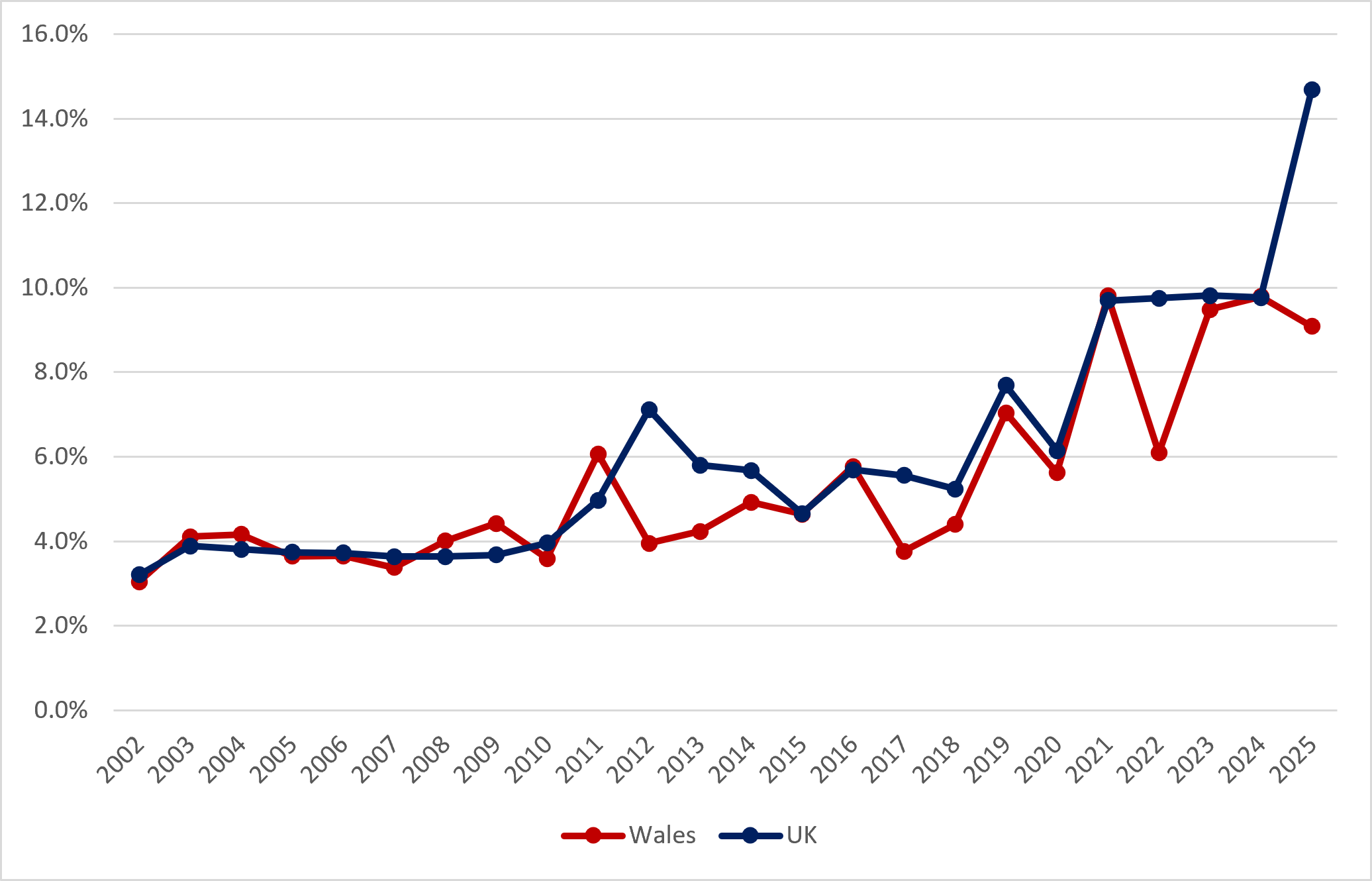
The female TEA rate in Wales has fluctuated since 2011, reaching a record high of 9.8 per cent in 2021, a level that was repeated again in 2024 following the dip in 2022 (Figure 5). In 2025, the female TEA rate in Wales stood at 9.1 per cent, slightly below the 2024 rate, although the difference was not statistically significant and the rate remained above most pre-2021 levels. Figure 5 shows that female TEA rates in Wales broadly matched the UK trend until 2010 and, after a period of divergence, appeared to track the UK trend again from 2018 to 2024. However, in 2025 the UK female TEA rate increased sharply to 14.7 per cent, while the rate in Wales remained broadly stable. As a result, the female TEA rate in Wales was significantly lower than the UK rate in 2025.
Age
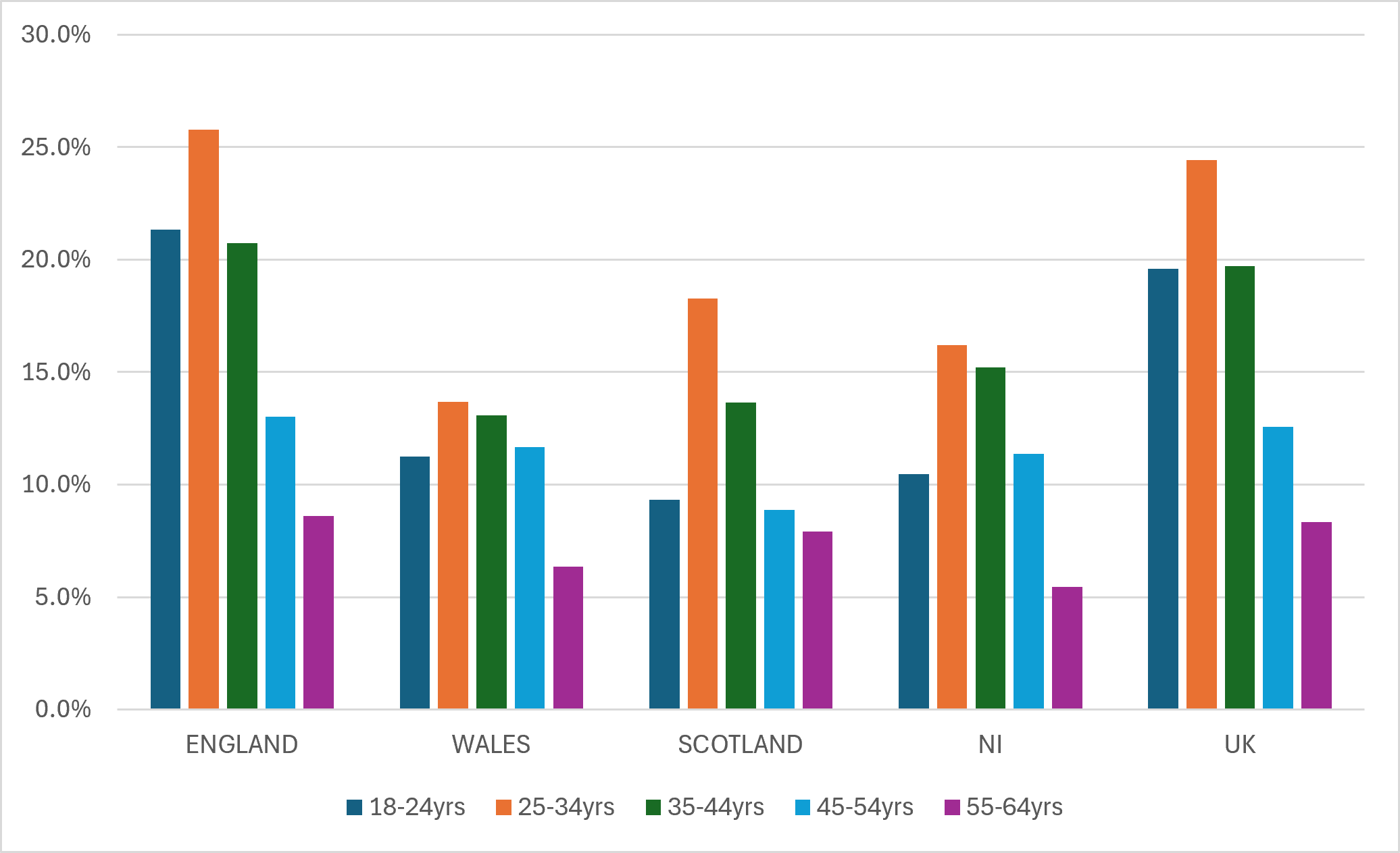
Individuals aged 25–34 typically exhibit the highest rates of early-stage entrepreneurial activity in the UK, and this was again the case in 2025. Across the UK, the TEA rate for 25–34-year-olds was 24.4 per cent, compared with 19.6 per cent among those aged 18–24 and 19.7 per cent among those aged 35–44. Entrepreneurial activity was lower among older age groups, particularly those aged 55–64, where the UK TEA rate stood at 8.3 per cent.
A similar age profile was evident in Wales, although the differences between age groups were less pronounced and were not statistically significant. The highest TEA rate in Wales was among those aged 25–34, at 13.7 per cent, followed by those aged 35–44 at 13.1 per cent. Rates among 18–24-year-olds and 45–54-year-olds were also relatively similar, at 11.3 per cent and 11.7 per cent respectively. As in the UK overall, the lowest rate was among those aged 55–64, at 6.4 per cent (Figure 6).
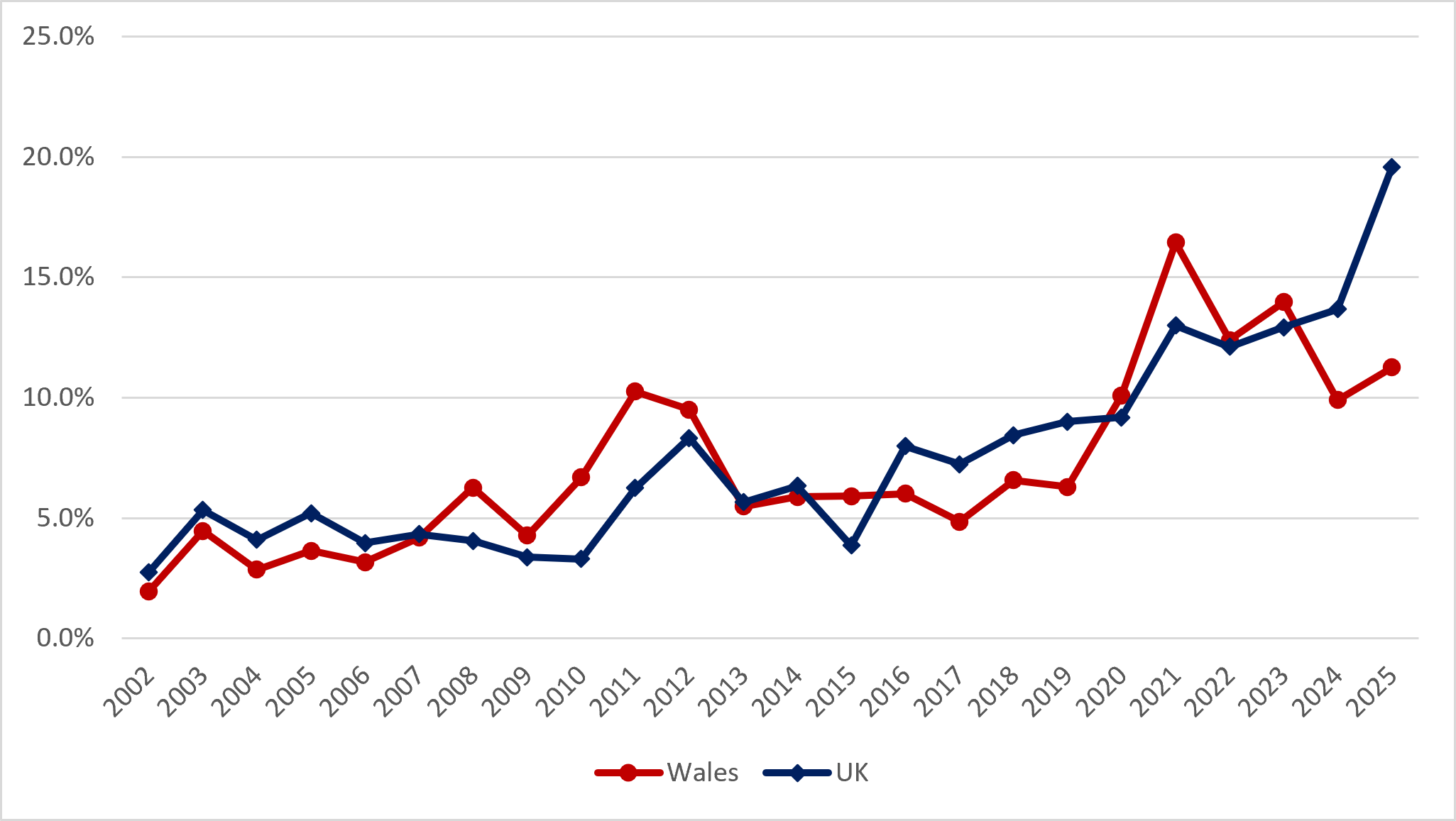
For several years, entrepreneurial activity among 18–24-year-olds in Wales has been relatively volatile, with noticeable increases during periods of economic disruption. During the Great Recession, the TEA rate among 18–24-year-olds in Wales peaked at 10.2 per cent in 2011, before declining in subsequent years. A similar rise was observed during and after the pandemic, when the rate reached a record high of 16.5 per cent in 2021. In 2025, the TEA rate for 18–24-year-olds in Wales was 11.3 per cent, slightly higher than the 9.9 per cent recorded in 2024, although this difference was not statistically significant (Figure 7).
By contrast, the UK rate for this age group increased sharply in 2025, reaching a new record high of 19.6 per cent, up from 13.7 per cent in 2024. This was significantly higher than the rate for 18–24-year-olds in Wales. The Welsh trend therefore appears relatively stable in 2025 when compared with the much sharper increase observed at the UK level, which was strongly influenced by the high rate recorded in England.
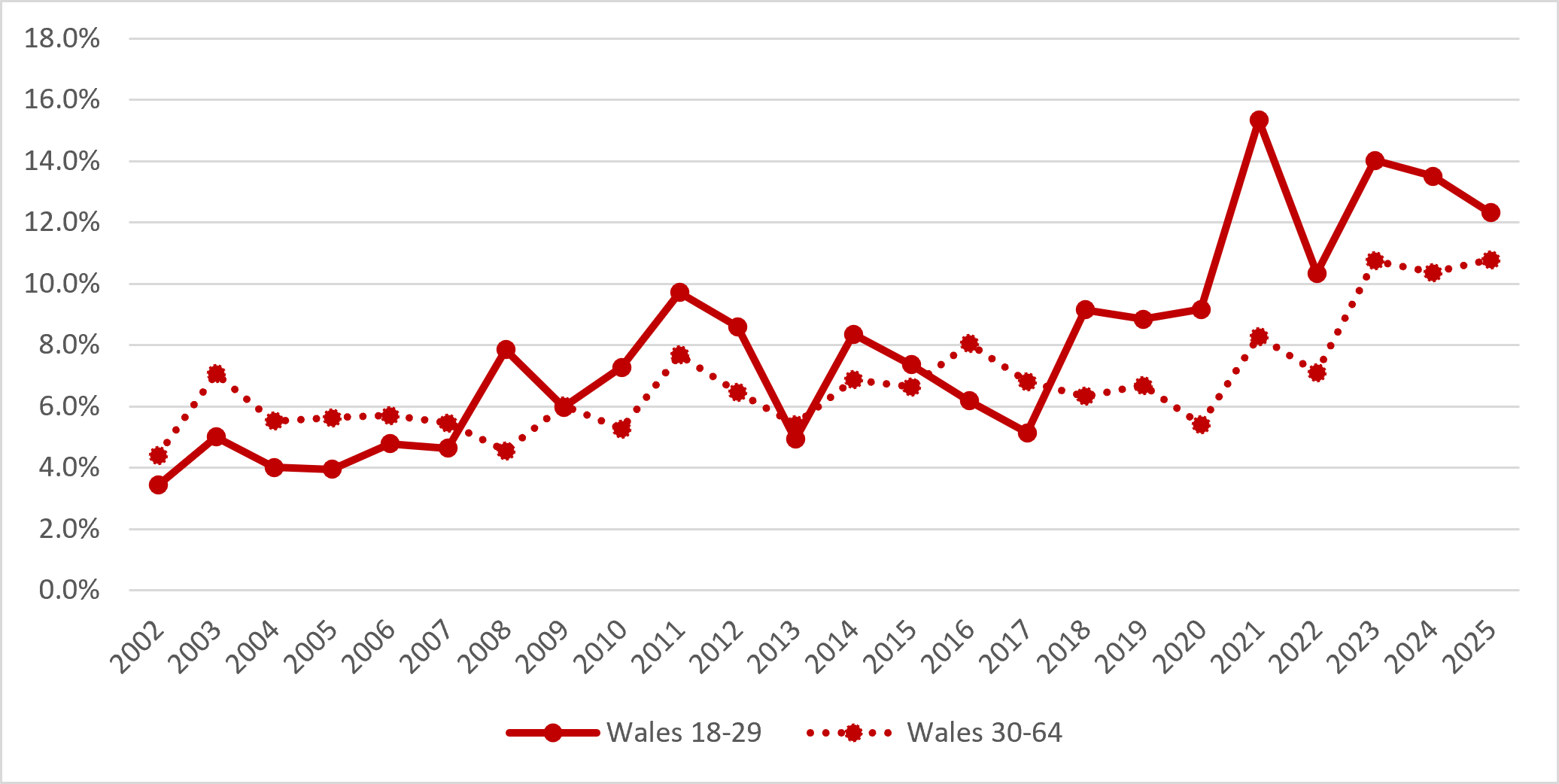
A potentially more insightful analysis is to examine the trend in TEA rates for the 18–29 age group — where a natural break appears in the UK GEM data — and compare it with the 30–64 age group. Figure 8 shows that, despite considerable year-on-year fluctuations, the TEA rate for young adults in Wales has increased more than threefold over the past two decades, rising from 3.4 per cent in 2002 to 12.3 per cent in 2025. Notably, the two main peaks in youth entrepreneurial activity — around 2011 and 2021 — coincide with major periods of economic disruption: the global financial crisis and the Covid-19 pandemic, respectively. Although the 2025 rate was slightly below the 2024 rate of 13.5 per cent, it remained high by historical standards.
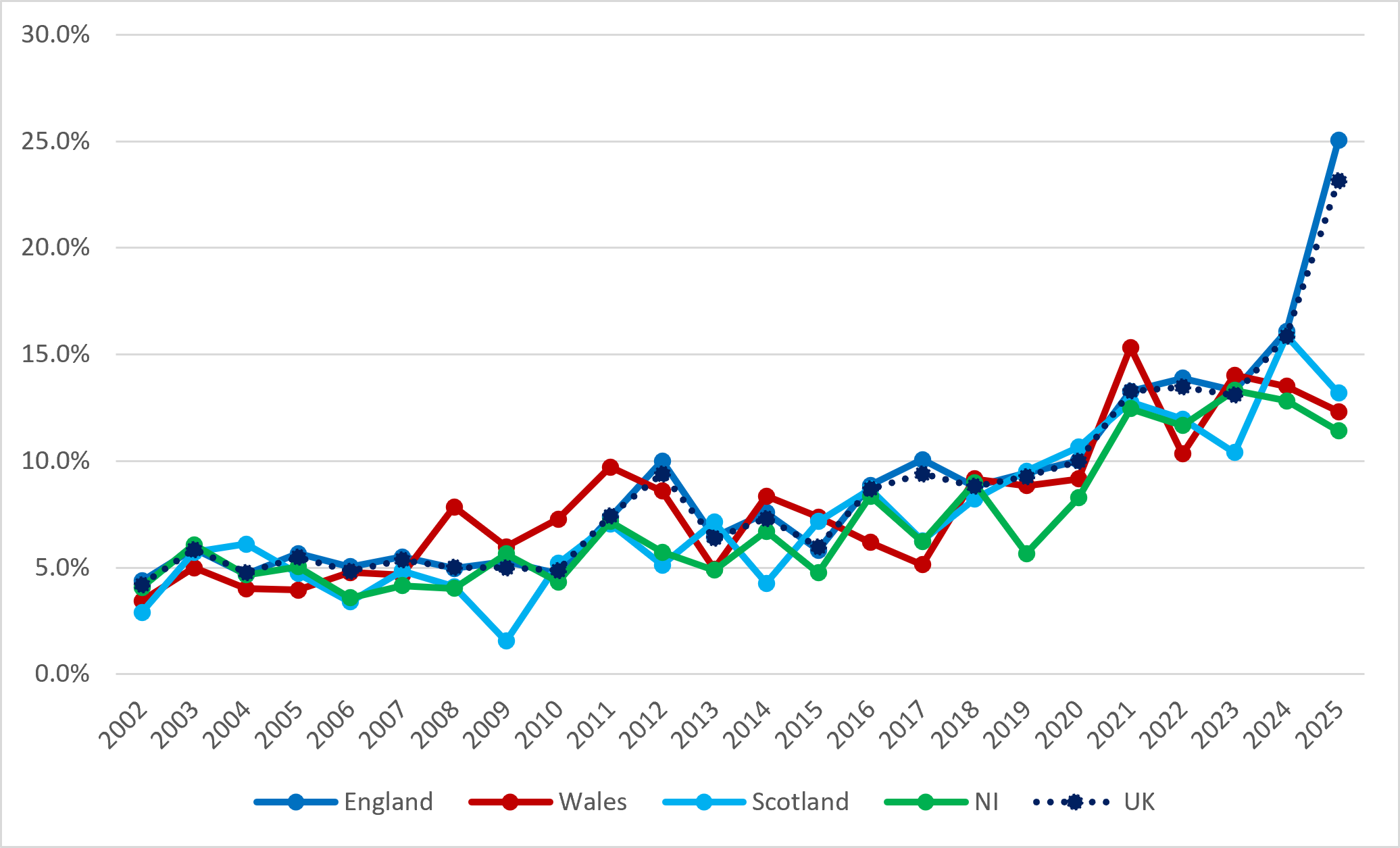
The TEA rate among those aged 30–64 in Wales has also risen over time, reaching 10.8 per cent in 2025, although the increase has been steadier than among younger adults. The gap between younger and older adults in Wales has therefore narrowed compared with the peak seen in 2021. Across the UK, however, the TEA rate for 18–29-year-olds increased sharply in 2025, reaching a record high of 23.2 per cent. This UK increase was strongly influenced by England, where the TEA rate for this age group rose to 25.1 per cent. In contrast, the rates for 18–29-year-olds in Wales, Scotland and Northern Ireland were relatively similar in 2025, at 12.3 per cent, 13.2 per cent and 11.4 per cent respectively (Figure 9a).
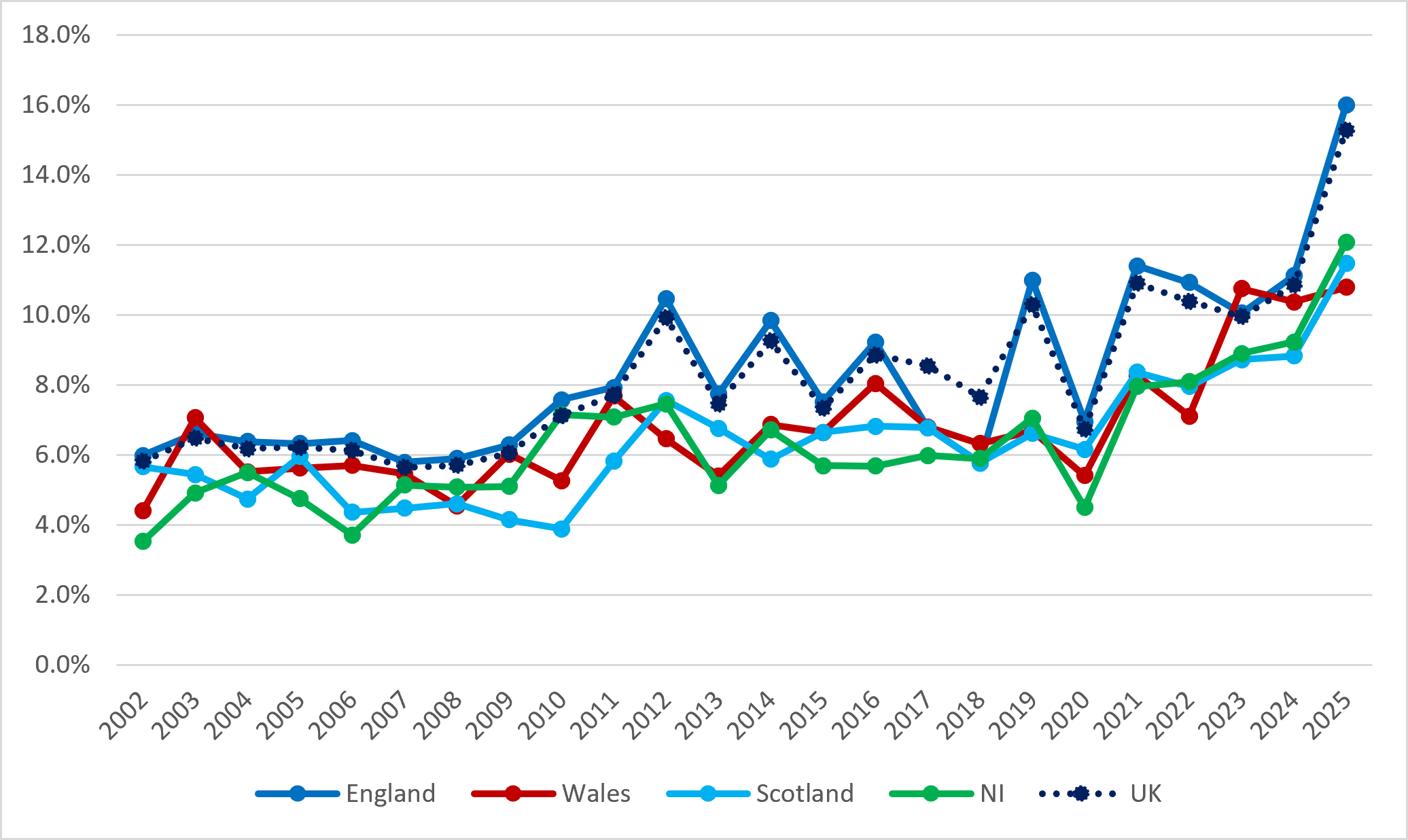
The increase in early-stage entrepreneurial activity among the 30–64 age group has been slower over the past two decades than among the 18–29 age group (Figure 8). In Wales, the TEA rate for those aged 30–64 rose from 4.4 per cent in 2002 to 10.8 per cent in 2025, remaining slightly above the 10.4 per cent recorded in 2024. Scotland and Northern Ireland also recorded rates above 10 per cent in 2025, at 11.5 per cent and 12.1 per cent respectively. The UK rate for this age group increased to 15.3 per cent in 2025, reflecting the higher rate recorded in England, where TEA among 30–64-year-olds stood at 16.0 per cent (Figure 9b).
Education
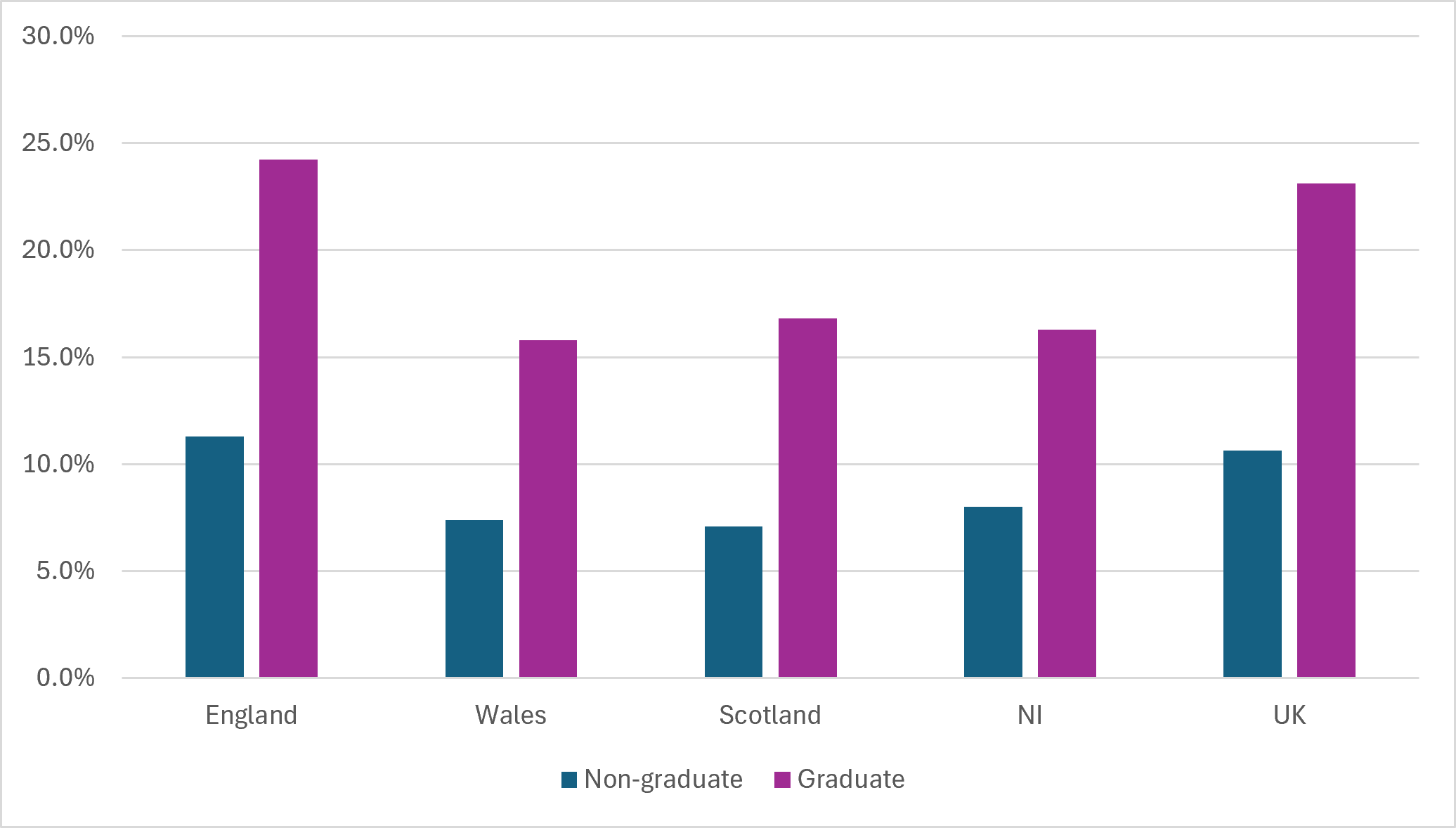
In Wales, as in the UK more generally, graduates typically have higher rates of early-stage entrepreneurial activity than non-graduates. In 2025, the graduate TEA rate in Wales was 15.8 per cent, compared with 7.4 per cent for non-graduates (Figure 10). This means that graduates in Wales were around twice as likely as non-graduates to be involved in early-stage entrepreneurial activity, and the difference was statistically significant. Compared with 2024, the graduate TEA rate increased from 13.9 per cent to 15.8 per cent, while the non-graduate rate declined slightly from 8.3 per cent to 7.4 per cent, although neither year-on-year change was statistically significant.
Across all UK home nations, graduates recorded higher TEA rates than non-graduates in 2025. The graduate/non-graduate ratio was highest in Scotland, where the graduate TEA rate was around 2.4 times the non-graduate rate. Wales and England both recorded ratios of just over two, while the ratio in Northern Ireland was also close to two. At the UK level, the graduate TEA rate rose to 23.1 per cent in 2025, compared with 10.6 per cent among non-graduates. This UK figure was influenced by the particularly high graduate TEA rate recorded in England, at 24.2 per cent.
Entrepreneurial attitudes and intentions
GEM includes a number of attitudinal measures that provide an indication of entrepreneurial potential within a country or region. These include whether individuals know someone who has started a business in the last two years, whether they perceive good opportunities for starting a business, whether they believe they have the skills and knowledge required to start a business, and whether fear of failure would prevent them from doing so.
The attitudinal data reported here relate only to individuals who are not already engaged in entrepreneurial activity. This is because those already involved in entrepreneurship may be more likely to give positive responses in the Adult Population Survey (APS), particularly in relation to perceived skills, opportunities and start-up intentions.
In 2025, 54.0 per cent of non-entrepreneurial individuals in Wales stated that they knew someone who had started a business in the last two years, up from 48.1 per cent in 2024, although the change was not statistically significant. This was similar to the UK rate of 53.1 per cent (Figure 11). The proportion of non-entrepreneurs in Wales who believed they had the skills, knowledge and experience to start a business stood at 42.5 per cent, remaining broadly stable compared with 42.3 per cent in 2024. This was slightly below the UK rate of 48.0 per cent, although the difference was not statistically significant.
In 2025, 34.9 per cent of non-entrepreneurs in Wales believed there would be good opportunities for starting a business in their local area in the next six months, compared with 31.9 per cent in 2024. However, this increase was not statistically significant. Perceptions of start-up opportunities remained weaker in Wales than in the UK overall. The equivalent UK rate in 2025 was 41.5 per cent, which was significantly higher than the rate in Wales. Fear of failure also remained high: 65.3 per cent of non-entrepreneurs in Wales said that fear of failure would prevent them from starting a business, compared with 60.8 per cent in the UK. The difference between Wales and the UK was not statistically significant.
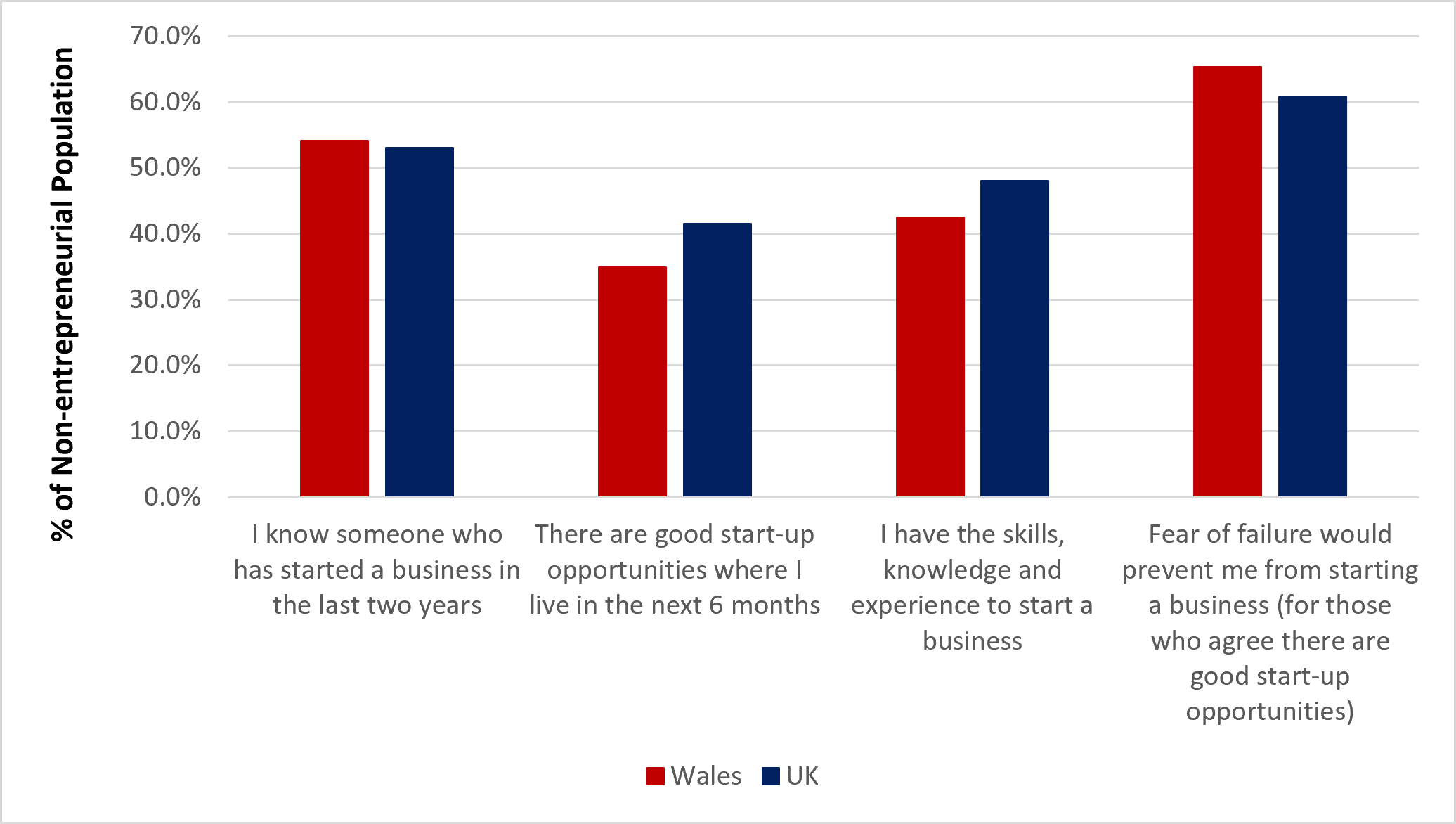
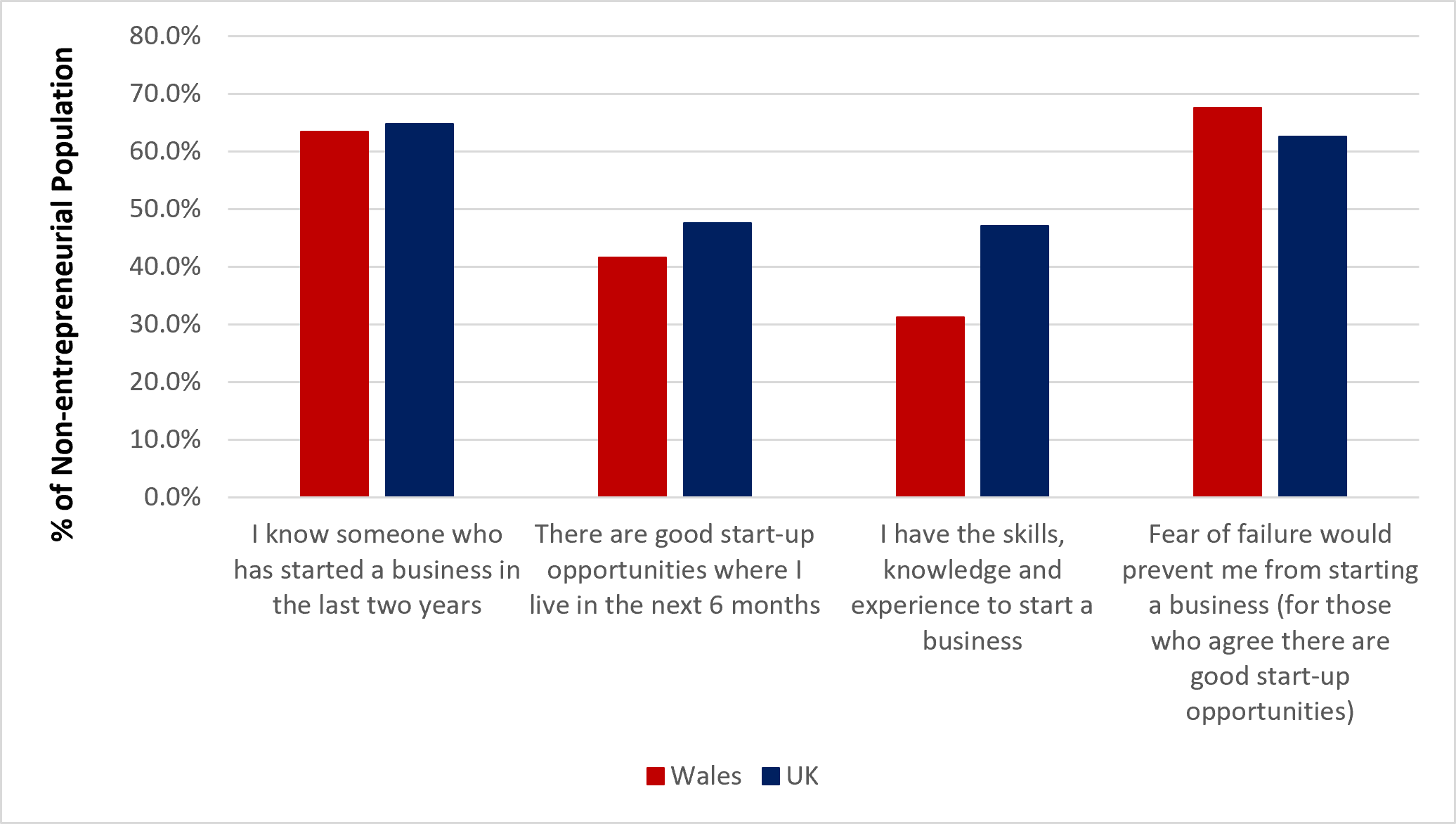
Figure 12 displays the same set of attitudes towards entrepreneurship, focusing exclusively on 18–24-year-olds who are not already engaged in entrepreneurial activity. In 2025, 63.4 per cent of young non-entrepreneurs in Wales stated that they knew someone who had started a business in the last two years, compared with 64.8 per cent across the UK. Perceptions of start-up opportunities were also broadly similar: 41.5 per cent of young non-entrepreneurs in Wales believed there would be good opportunities for starting a business in their local area in the next six months, compared with 47.5 per cent in the UK. Neither difference was statistically significant.
The main difference between young non-entrepreneurs in Wales and the UK was in perceived entrepreneurial skills. In Wales, 31.2 per cent of young non-entrepreneurs believed they had the skills, knowledge and experience to start a business, compared with 47.0 per cent across the UK, and this difference was statistically significant. Fear of failure remained high among young people in both Wales and the UK, at 67.6 per cent and 62.6 per cent respectively, with no statistically significant difference between them.
When compared with the wider non-entrepreneurial population in Wales shown in Figure 11, young people were more likely to know someone who had recently started a business and to perceive good start-up opportunities. However, these differences were not statistically significant. At the UK level, young people were significantly more likely than the wider non-entrepreneurial population to know someone who had started a business in the past two years, but there were no significant differences on the other attitudinal measures.
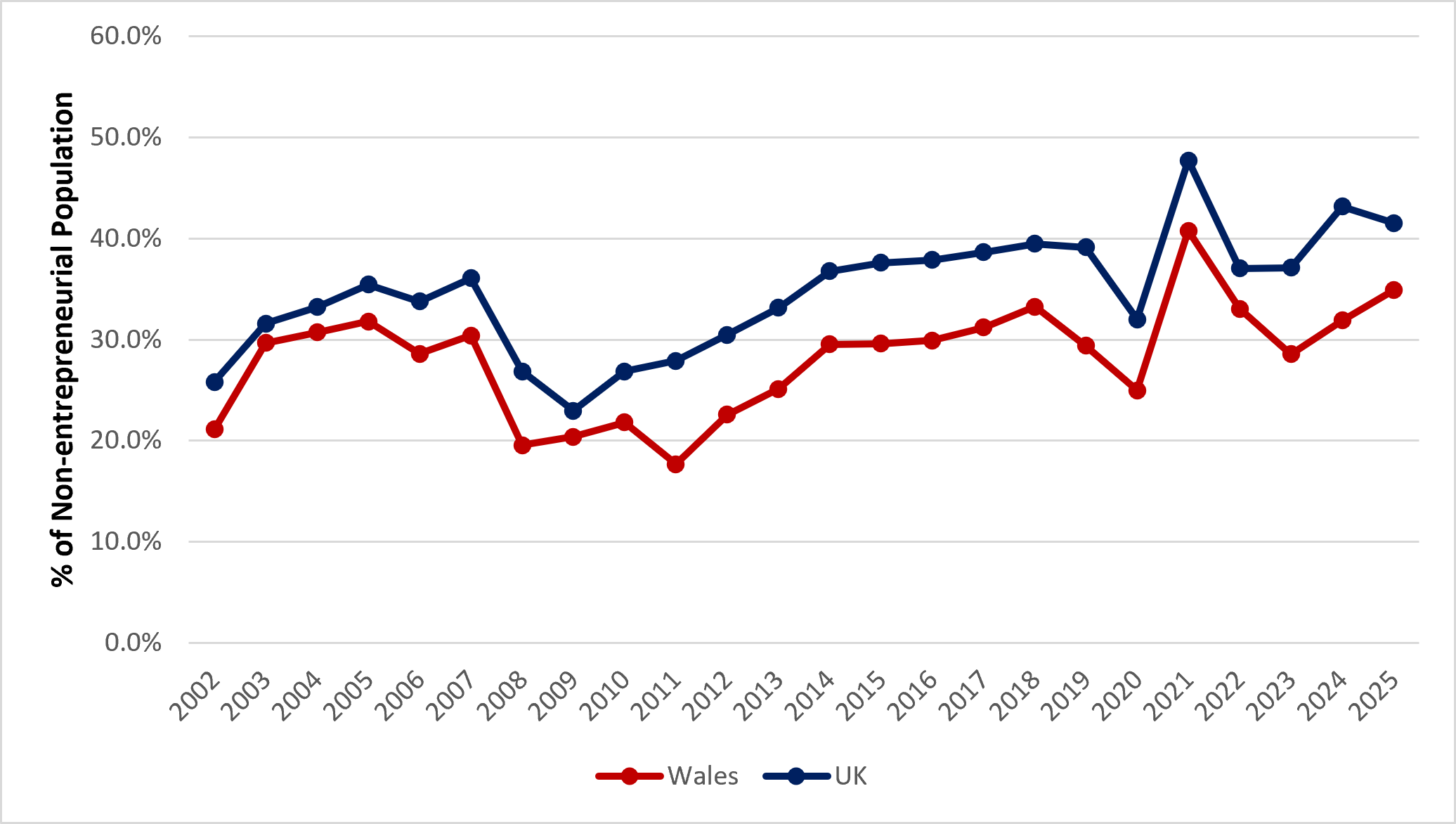
In the 2025 survey, 34.9 per cent of the non-entrepreneurial working-age population in Wales agreed that there were good opportunities to start a business in their local area within the next six months. This was higher than the 31.9 per cent recorded in 2024, although the difference was not statistically significant. Across the UK, the equivalent rate was 41.5 per cent in 2025, slightly below the 43.2 per cent recorded in 2024.
Opportunity perceptions in Wales therefore remained significantly lower than in the UK overall in 2025, although the gap narrowed compared with 2024. Since the global financial crisis, the difference between Wales and the UK has been statistically significant in most years, although it narrowed following the Covid-19 crisis and was not statistically significant in 2022. The gap widened again in 2023 and 2024, before becoming less pronounced in 2025 (Figure 13).
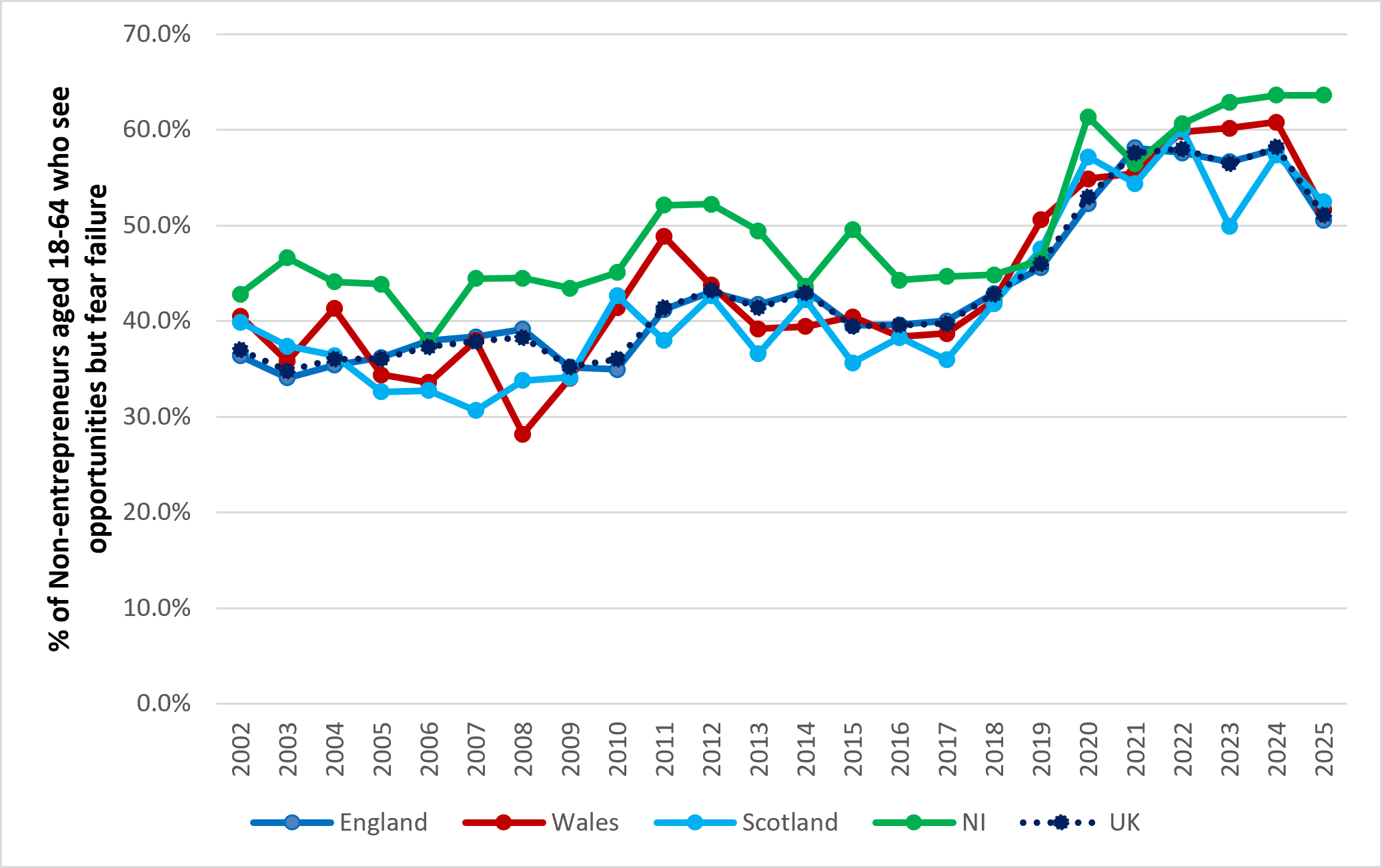
The proportion of the non-entrepreneurial population in Wales who perceived good start-up opportunities but reported that fear of failure would prevent them from starting a business stood at 51.7 per cent in 2025 (Figure 14). This was lower than the 60.8 per cent recorded in 2024, although the difference was not statistically significant. The equivalent UK rate also fell, from 58.2 per cent in 2024 to 51.1 per cent in 2025, and this decline was statistically significant.
Figure 14 shows that fear of failure among those perceiving good start-up opportunities rose markedly in Wales from 2017 onwards, from 38.7 per cent in 2017 to 60.8 per cent in 2024. This broadly mirrored the upward trend observed across the other home nations and may reflect heightened economic and political uncertainty during this period, including uncertainty associated with Brexit and, subsequently, the Covid-19 pandemic. In 2025, the Welsh rate fell to 51.7 per cent, bringing it close to the rates recorded in England and Scotland, at 50.5 per cent and 52.5 per cent respectively, as well as to the UK average of 51.1 per cent. Northern Ireland remained higher, at 63.6 per cent, although the difference with Wales was not statistically significant.
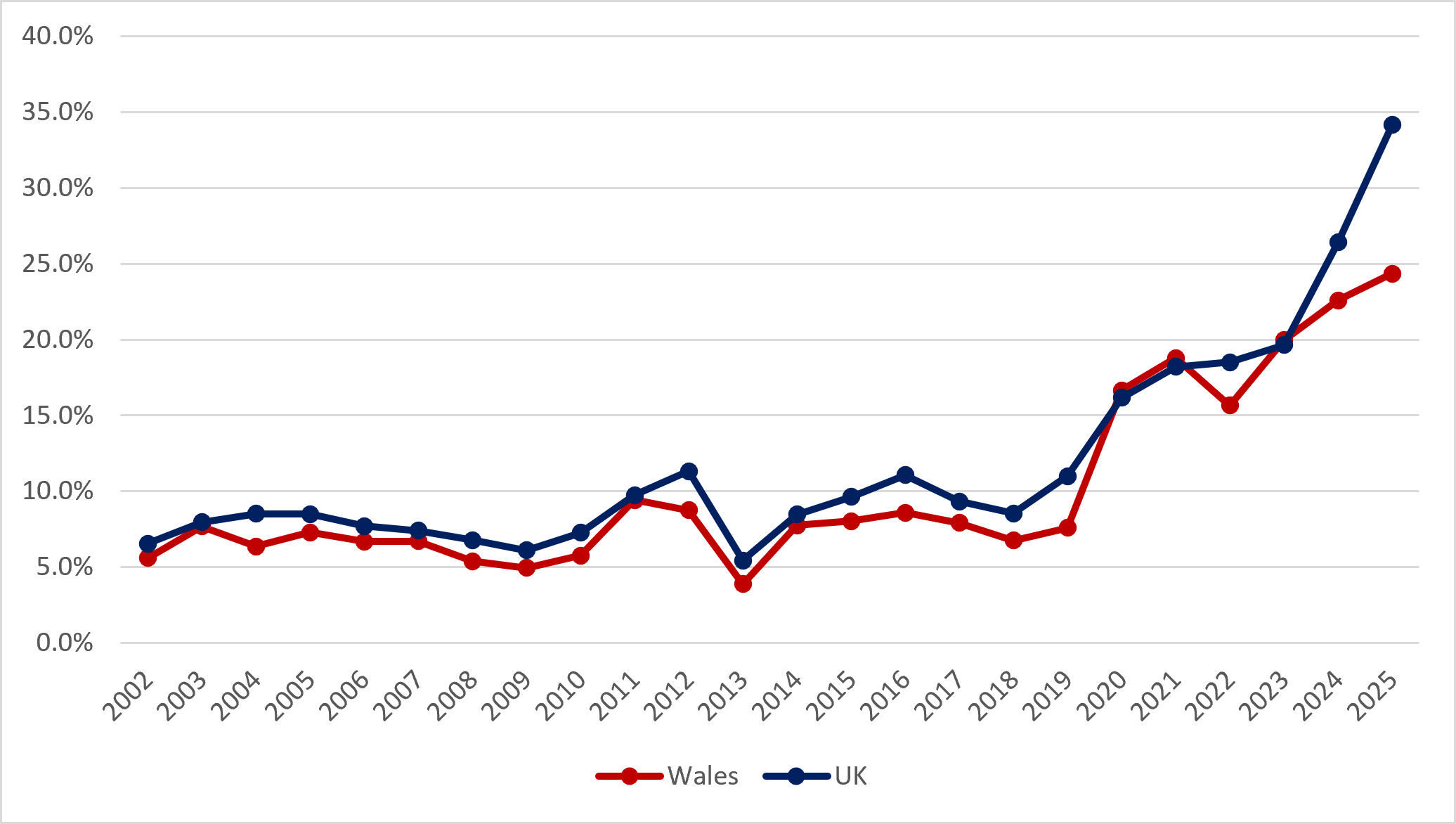
In 2025, 24.3 per cent of non-entrepreneurial working-age adults in Wales reported intending to start a business within the next three years. This was slightly higher than the 22.6 per cent recorded in 2024, although the difference was not statistically significant (Figure 15). Nevertheless, the 2025 rate represents the highest level recorded in Wales over the GEM series and remains well above pre-pandemic levels.
Across the UK, entrepreneurial intentions rose more sharply, from 26.4 per cent in 2024 to 34.2 per cent in 2025, a statistically significant increase. As a result, the UK rate was significantly higher than the rate in Wales in 2025. Past increases in entrepreneurial intentions during periods of economic disruption, such as the global financial crisis and the Covid-19 pandemic, may have reflected a mix of necessity and opportunity motives. The sustained increase since 2020 may similarly reflect both labour market uncertainty and new opportunities associated with changing ways of working and digitalisation.
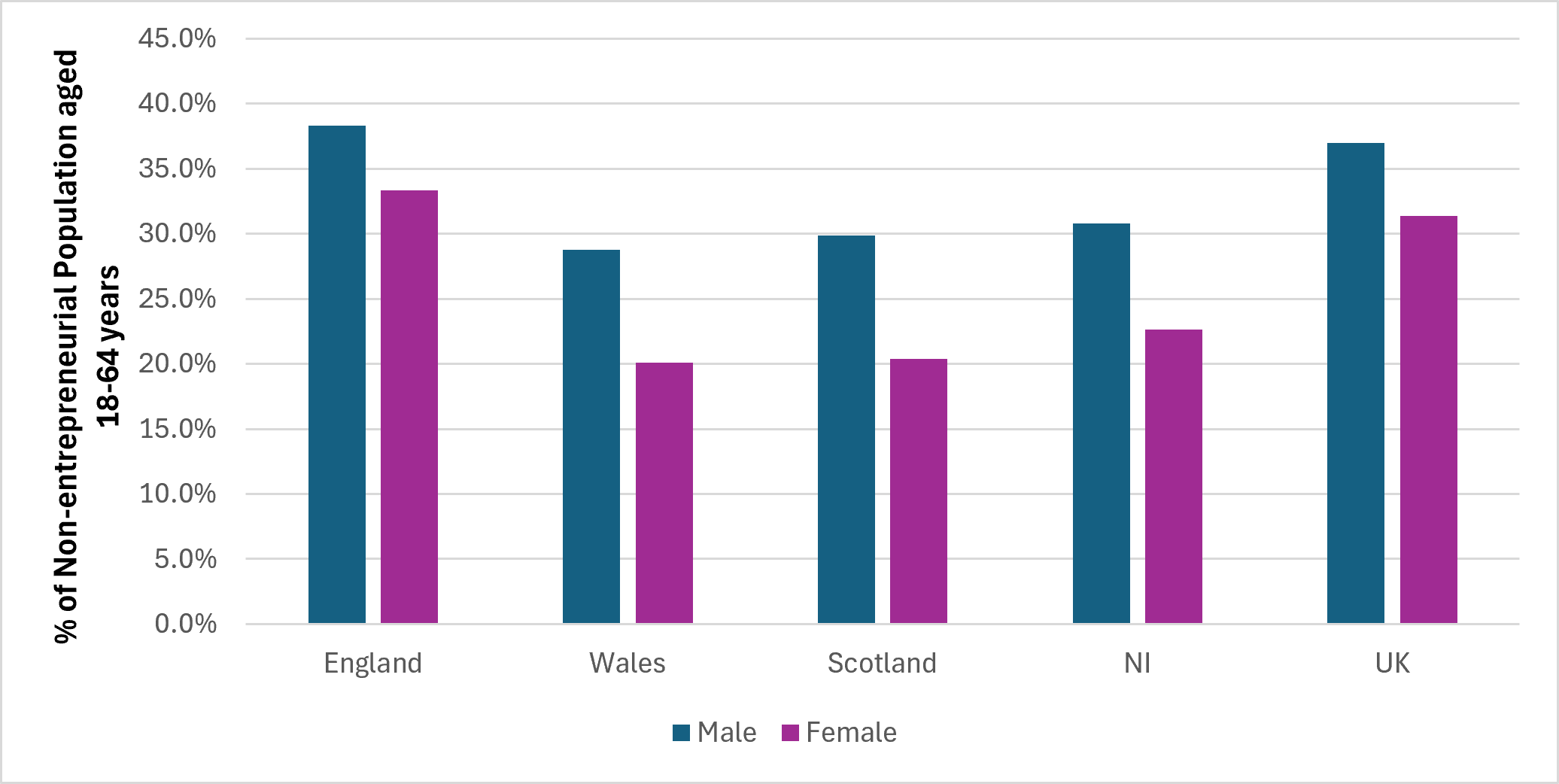
In 2025, 28.8 per cent of non-entrepreneurially active males in Wales indicated an intention to start a business within the next three years, compared with 20.1 per cent of females (Figure 16). Both rates were slightly higher than in 2024, when they stood at 26.3 per cent and 18.9 per cent respectively. In 2025, the difference between male and female entrepreneurial intentions in Wales was statistically significant.
The resulting female-to-male intention ratio in Wales was around 70 per cent, close to the equivalent ratios in Scotland and Northern Ireland, at 68 per cent and 74 per cent respectively. England recorded the highest female-to-male ratio, at 87 per cent, contributing to a UK average of 85 per cent. Entrepreneurial intention rates among both males and females in Wales were significantly lower than the equivalent UK rates, which stood at 37.0 per cent for males and 31.4 per cent for females.
Welsh language fluency and entrepreneurial activity
There were no statistically significant differences in 2025 in the TEA rates of people in Wales by Welsh language ability. The rate was 11.6 per cent among those fluent in spoken and written Welsh, 15.8 per cent among those who could speak and understand some Welsh, and 9.0 per cent among those with little or no Welsh skills.
Concluding observations
Entrepreneurial activity in Wales remained strong in 2025. The TEA rate stood at 11.1 per cent, slightly above the 10.8 per cent recorded in 2024, although the change was not statistically significant. This suggests that early-stage entrepreneurial activity in Wales has remained broadly stable following the recent highs observed in 2021 and 2023. At the same time, the UK rate increased sharply to 16.8 per cent, influenced by the particularly high rate recorded in England. As a result, Wales’ TEA rate was significantly lower than the UK average in 2025, despite remaining high by historical Welsh standards.
Entrepreneurial intentions in Wales also remained elevated. In 2025, 24.3 per cent of non-entrepreneurial working-age adults in Wales expected to start a business within the next three years, the highest level recorded in the Welsh GEM series. The increase from 22.6 per cent in 2024 was not statistically significant, but the longer-term rise since 2020 remains clear. This suggests a continued pool of potential entrepreneurial activity in Wales, even though the UK rate rose more sharply in 2025.
The profile of entrepreneurial activity in Wales continues to point to important differences across groups. Graduates were significantly more likely than non-graduates to be involved in early-stage entrepreneurial activity, with graduate TEA at 15.8 per cent compared with 7.4 per cent among non-graduates. Youth entrepreneurship also remained high by historical standards, although the 18–29 rate in Wales declined slightly from 13.5 per cent in 2024 to 12.3 per cent in 2025. This contrasts with the sharp increase in the UK rate for this age group, which was strongly influenced by England. The female-to-male TEA ratio in Wales stood at around 70 per cent in 2025, down from 82 per cent in 2024, reflecting an increase in male TEA alongside a slight fall in female TEA. However, the difference between male and female TEA rates in Wales was not statistically significant.
Entrepreneurial attitudes in Wales present a mixed picture. The proportion of non-entrepreneurs who knew someone who had recently started a business increased to 54.0 per cent in 2025, while the proportion who believed they had the skills, knowledge and experience to start a business remained broadly stable at 42.5 per cent. Perceptions of local start-up opportunities improved slightly, from 31.9 per cent in 2024 to 34.9 per cent in 2025, although this change was not statistically significant. Opportunity perceptions nevertheless remained significantly lower in Wales than across the UK as a whole. The 2025 estimate for fear of failure among those seeing good opportunities was lower than in 2024, at 51.7 per cent compared with 60.8 per cent, bringing Wales close to the UK average; however, the year-on-year decline in Wales was not statistically significant.
The motivation indicators continue to show that entrepreneurship in Wales is driven by a combination of economic and personal factors. In 2025, early-stage entrepreneurs in Wales were most likely to report being motivated by the ambition to build wealth or high income, and by the need to earn a living because jobs are scarce. A similar proportion also reported wanting to make a difference in the world. This points to a mixed motivational profile, where opportunity, necessity and values-based motives all remain relevant.
Overall, the 2025 results suggest that entrepreneurship in Wales remains resilient and historically strong, rather than undergoing a sharp acceleration. The Welsh picture is one of stability at an elevated level, with high entrepreneurial intentions, continued strength among graduates, and youth entrepreneurship remaining above most pre-pandemic levels. The main challenge remains the relatively weak perception of local start-up opportunities, which continues to distinguish Wales from the UK average. The sharp rise in UK entrepreneurial activity in 2025, particularly in England, means that Wales now appears less strong in relative terms, even though its own indicators remain robust by historical standards.
Disclaimer
This report is based on data collected by the GEM consortium and the GEM UK team; responsibility for analysis and interpretation of the data is the sole responsibility of the authors.
For further information on the GEM UK project, contact:
Professor Mark Hart
Warwick Business School
University of Warwick
Scarman Road, Coventry, CV4 7AL
Email: mark.hart@wbs.ac.uk