
This non-statutory guidance is aimed at local authorities.
Contents
Overview
This document provides non-statutory guidance on the School Funding, Budget Statements and Outturn Statements (No. 2) (Wales) Regulations 2026 (the No. 2 Regulations), apart from Part 4 and Schedule 4, in relation to Financial Schemes, on which separate statutory guidance is provided. This main guidance document deals with matters in respect of education budgets and includes:
- non-schools education budget
- schools budget
- individual schools budget
- local authority funding formula in respect of school budget shares
Section 48(1) of the School Standards and Framework Act 1998 (the SSFA 1998) requires each local authority to maintain a scheme dealing with matters connected with the financing of schools maintained by it. Guidance in relation to such a scheme is set out in separate regulations.
The School Funding, Budget Statements and Outturn Statements (No. 2) (Wales) Regulations 2026 (“the No. 2 Regulations”) revoke and replace the School Funding, Budget Statements and Outturn Statements (Wales) Regulations 2026 (“the 2026 Regulations”).
The No. 2 Regulations revoke and replace the School Funding (Wales) Regulations 2010 (the 2010 Regulations), the Education (Budget Statements) (Wales) Regulations 2002 (the 2002 Regulations) and the Education (Outturn Statements) (Wales) Regulations 2003 (the 2003 Regulations) in relation to financial years that commence on or after 1 April 2027. The No. 2 Regulations come into force on 31 January.
Whilst the No. 2 Regulations are largely a simple amalgamation of the 2010 Regulations, the 2002 Regulations and the 2003 Regulations, some changes have been introduced. These are set out below.
This guidance is issued under section 60 of the Government of Wales Act 2006. There is no statutory duty to have regard to this guidance, but the Welsh Ministers would expect those to whom it is addressed to take it into account when considering matters to which it relates.
This guidance is not and does not purport to be a comprehensive statement of the law and so should not be taken to be advice as to what the law requires.
The guidance is aimed at local authorities. However, they should seek their own legal advice as to what the law requires.
Overview of changes
Whilst the No. 2 Regulations are largely a simple amalgamation of the 2010 Regulations, the 2002 Regulations and the 2003 Regulations, some changes have been introduced.
Federated schools
The No. 2 Regulations introduce the right for a federated school to request a single budget share for the federation. The ability to merge budgets is permissive should a federation request it. That is a federation can choose to receive their individual budgets as one amalgamated budget share.
Deprivation
The No. 2 Regulations bring increased clarity to the nature and value of deprivation factors used in a local authority’s funding formula.
The 2010 Regulations require that a local authority must, in determining budget shares for schools which they maintain, take into account in its formula a factor or factors based on the incidence of social deprivation among pupils registered at all such schools. The No. 2 Regulations include a new requirement that the incidence of social deprivation is to be determined by taking into account the number of pupils eligible for free school meals and (or) the pupil’s residency in relation to the Welsh Index of Multiple Deprivation.
Regulation 21 also requires that the social deprivation factor must not include any funding allocated for the provision of free school meals or for the support of pupils with additional learning needs (“ALN”). This is to ensure that the formula element specifically recognises the incidence of social deprivation to meet the needs of these pupils.
Financial schemes
The No. 2 Regulations include a new requirement regarding publication of financial schemes. The detail of what must be included in the financial scheme is set out in Schedule 4 to the No. 2 Regulations.
They also include a new requirement for a local authority to set out those parts of the Schools Budget which it has opted to retain (as opposed to delegating to governing bodies) (paragraph 2 of Schedule 4).
The No. 2 Regulations provide that a local authority scheme makes provision regarding the use of and monitoring of school surpluses over a prescribed limit. The No. 2 Regulations amend the thresholds for school budget surplus to 5% rather than the previous absolute values (paragraph 20 of Schedule 4).
The No. 2 Regulations introduce a requirement for a local authority to set out how it will monitor the use by a school of such a surplus.
The No. 2 Regulations introduce a requirement for a local authority to include in its financial scheme a requirement on a governing body with a budgetary deficit to submit a deficit recovery plan. They also require a local authority to set out the process in relation to that plan (paragraph 23 of Schedule 4).
Separate statutory guidance on schemes for financing local authority maintained schools is published which provides more detail.
Schedules 2 and 3
The No. 2 Regulations introduce changes in the treatment of non-domestic rates, so that it is now to be included in the non-schools education budget rather than in school budgets. The previous limit applied to the expenditure on licence fees and subscriptions which a local authority may retain is also removed.
Funding formula additional factors or criteria
The No. 2 Regulations do not include an equivalent to Schedule 3 to the 2010 Regulations. Schedule 3 to the 2010 Regulations set out a list of additional factors or criteria which may be taken into account in a local authority’s funding formula. Local authorities will be able to take into account in their formula any factor or criteria they feel appropriately relates to expenditure under the definition of the schools budget.
Examples of appropriate factors and criteria for local authority school funding formula factors are given at Annex A.
Funding formula publication
The No. 2 Regulations bring increased clarity to the publication requirements for a funding formula.
Budget statements
The No. 2 Regulations introduce the separation of funding between areas of expenditure which must be delegated and areas of expenditure which a local authority may opt to retain, but chooses to delegate (see columns 6 and 7 of the Form in Schedule 5). The new layout to reflect this also changes where notional Additional Learning Needs funding is shown (see column 8 of the Form in Schedule 5).
The No. 2 Regulations introduce a requirement for a local authority to include in its budget statement the estimate of each school’s budget share for each of the following two financial years (see columns 14 and 15 of the Form in Schedule 5). The requirement to report to each school its estimated budget shares for each of the following two financial years was introduced by the 2010 Regulations.
The No. 2 Regulations merge what was previously Parts 2 and 3 of the budget statement into a single Part 2 setting out the delegated funding by factor for the local authority as a whole and for each individual school.
The No. 2 Regulations bring increased clarity to the publication requirements for budget statements by making the following changes (see regulation 33):
- 1 copy to the Welsh Ministers must now be provided by email, and
- a copy must be available free of charge on the local authority website
Outturn statement
The deadline for submission of the outturn statement by a local authority to the Welsh Government is moved to on or before 31 July.
The No. 2 Regulations bring increased clarity to the publication requirements for outturn statements by making the following changes (see regulation 37):
- 1 copy to the Welsh Ministers must now be provided by email, and
- a copy must be available free of charge on the local authority website
Budget types
A local authority’s education budget is divided into two parts: the Schools Budget and the Non-Schools Education Budget. These are defined in Part 2 of the No. 2 Regulations.
Non-schools education budget
The Non-Schools Education Budget consists of those expenditure headings listed in Schedule 2 to the No. 2 Regulations and relates to the expenditure on local authority functions that the local authority must retain centrally. It primarily covers areas of education not related to schools (for example, community education, youth services, home-to-college transport), functions to ensure access to education (for example, home-to school transport, school buildings, admissions and general pupil welfare), school improvement and strategic aspects of the education service. As such this will not be delegated to schools and are not included within the school budget.
Schools budget
The Schools Budget is defined in regulation 6 of the No. 2 Regulations as “expenditure incurred in connection with the local authority's functions in relation to the provision of primary education and secondary education” with four exceptions, the main of which is any such expenditure that is specifically listed in Schedule 2 to the No. 2 Regulations. The other exceptions are capital expenditure, school crossing patrols and expenditure incurred for community purposes. It primarily covers areas of direct educational provision in schools.
In the context of the No. 2 Regulations the term ‘Schools Budget’ has a specific meaning which is wider than just the funding to be delegated to schools, and includes many local authority functions in relation to schools, as set out in Schedule 3 to the No. 2 Regulations.
It is expected that local authorities support meaningful devolution that empowers school leaders to make appropriate, and informed decisions to deliver the best outcomes for children and young people.
Whilst headteachers should be given maximum flexibility over their budgets, there are areas of expenditure that are generally not considered suitable for delegation.
The reasons for this may include, but are not limited to, areas of spend that:
- are outside the influence of a headteacher
- are too bureaucratic
- have unacceptable levels of risk
- benefit from economies of scale
- require specific professional expertise
- are complex by their nature
Local authorities must identify and list any areas that are not delegated to schools within their published schemes. This will ensure transparency around which expenditure headings a local authority is choosing to delegate, and which are being retained by the local authority.
Individual schools budget
The default position is that the Schools Budget is delegated to governing bodies unless the local authority decides otherwise. However, the expenditure headings on which a local authority is permitted to decide otherwise is limited to those areas listed in Schedule 3 to the No. 2 Regulations.
Any of those expenditure headings that the local authority does not choose to retain become part of the Individual Schools Budget (the whole of which must be delegated to school governing bodies in accordance with the local authority’s formula within the financial year in question). Any expenditure headings within the Schools Budget that are not listed in Schedule 3 to the No. 2 Regulations also become part of the Individual Schools Budget. The expenditure headings which local authorities are permitted to retain are generally those which it may be more efficient and (or) effective to provide centrally.
As the local authority has discretion to retain funding for the expenditure headings listed in Schedule 3 to the No. 2 Regulations, if it does not choose to retain this funding, which by default places this funding within the Individual Schools Budget, this funding is classified as ‘discretionary delegation’. Conversely, any part of the Schools Budget which is not listed in Schedule 3 to the No. 2 Regulations and therefore must fall within the Individual Schools Budget, is classified as ‘core delegation’. The use of specific terminology to distinguish between ‘core delegation’ and ‘discretionary delegation’ is introduced by the No. 2 Regulations. This is to highlight a distinction that has existed for many years for the purpose of budget reports.
The local authority may, at the beginning of a financial year, retain an element of the Individual Schools Budget for the purpose of redeterminations or the correction of errors. This element is known as the retained allocation. Any retained allocation not used for the purpose of redeterminations or the correction of errors during the financial year must be allocated to schools before the end of the financial year in accordance with the determined formula.
Schools budget share
Aside from the retained allocation, the totality of a local authority’s Individual Schools Budget must be allocated to individual schools as schools’ budget shares in accordance with a funding formula determined by the local authority. The nature and properties of the funding formula are addressed later in this guidance.
In addition to a share of the local authority’s Individual Schools Budget, the budget share of a school with a sixth form also contains that school’s share of the Post-16 grant.
A federation of schools may choose to receive its schools’ individual budget shares as a single budget share.
Core and discretionary delegation
One matter highlighted by stakeholders in recent years is that delegated school budgets are difficult to compare between local authorities because local authorities have some discretion over which expenditure headings to delegate funding to schools. Some expenditure headings are therefore delegated by some local authorities but not by others.
To overcome this, each school’s budget share is to be divided into two categories, ‘core delegation’ and ‘discretionary delegation’, with core delegation being funding for those expenditure headings which a local authority must delegate, and discretionary delegation being funding for those expenditure headings over which a local authority has the discretion to retain centrally should it wish. The expenditure headings over which a local authority has the discretion to retain centrally are listed in Schedule 3 to the No. 2 Regulations. A local authority must actively choose to retain funding for a particular expenditure heading and include it within the listed exceptions in their financial scheme, otherwise, the funding is delegated by default.
This differentiation between core delegation and discretionary delegation is not new. What is new is that a local authority must now report this differentiation in its Budget Statement and must also list (in its Scheme for Financing Schools) those expenditure headings in Schedule 3 to the No. 2 Regulations which it has opted to retain.
The differentiation between ‘core delegation’ and ‘discretionary delegation’ needs to be reflected both in the notional Additional Learning Needs funding (Special Educational Needs (SEN) funding in the 2010 Regulations) and in the remaining element of a school’s budget share. The remaining element of a school's budget share was not explicitly shown on the Budget Statement, only the total budget share with the notional SEN funding therein being shown as a memorandum item. The requirement to distinguish between funding required to be delegated (core) and funding chosen to be delegated (discretionary) means that a local authority may need to assess how some aspects of its delegated funding should be treated. For example, funding notionally intended for the provision of school meals is core delegation in secondary schools (including middle schools designated as secondary schools) but discretionary delegation in primary schools, whilst funding for supply cover is core delegation for training, incidental cover, short term sickness absence and so on but is discretionary delegation for long term sickness absence, maternity, paternity, adoption leave and so on.
Any expenditure listed in Schedule 3 to the No. 2 Regulations is discretionary delegation, whether delegated to schools as budget shares or not.
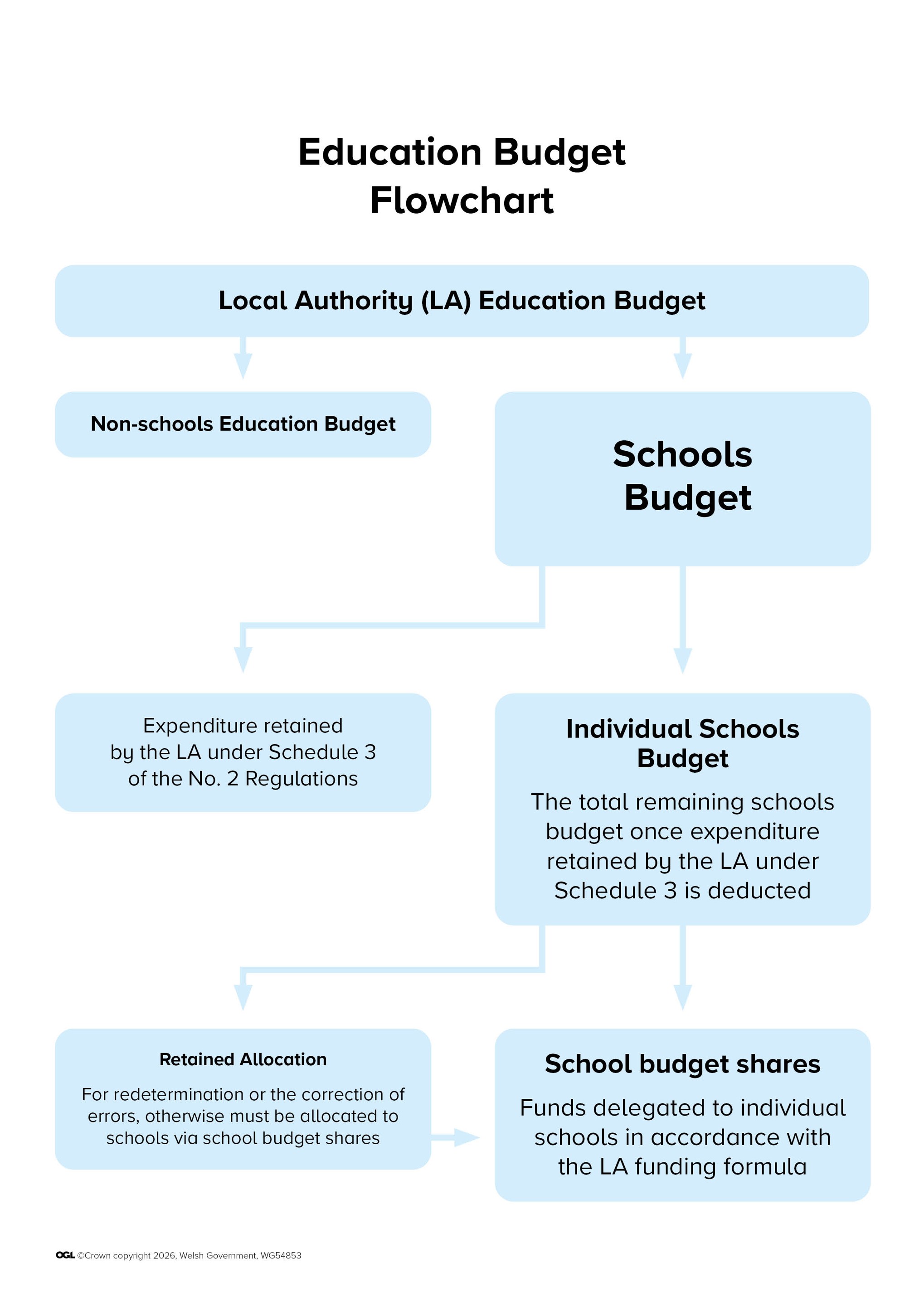
Education budget flowchart
The Local Authority (LA) Education Budget is divided into two parts, the Non-schools Education Budget and the Schools Budget.
The Schools Budget is made up of expenditure retained by the LA under Schedule 3 of the No. 2 Regulations and the Individual Schools Budget (the total remaining schools budget once expenditure retained by the LA under Schedule 3 is deducted).
The Individual Schools Budget itself has 2 elements, the retained allocation and school budget shares. The retained allocation is for the redetermination or the correction of errors, otherwise it must be allocated to schools via school budget shares. School budget shares are funds delegated to individual schools in accordance with the LA funding formula.
Funding formula
General principles
A local authority must have regard to the desirability of such a formula being simple, objective, measurable, predictable in effect and clearly expressed (see regulation 10 of the No. 2 Regulations). A local authority should regularly review its funding formula to ensure it remains fit for purpose.
All factors must be expressed in formulaic terms, for example, A x B = C, where A is the number of items receiving funding (for example, pupils, square metres), B is the value of the funding allocated per item, and C is the total value of the factor included in the school’s budget share.
A local authority may use any factors considered necessary for the allocation of school shares in a fair and appropriate manner. Schedule 3 to the 2010 Regulations, which sought to prescribe the factors which could be used, has therefore been omitted from the No. 2 Regulations. This enables additional factors to be included in formula for example if a school or schools had a particular need not listed or additional functions of a school were required.
Examples of appropriate factors and criteria are given at Annex A.
Unless the grant conditions determine otherwise, funding allocated by the Commission for Tertiary Education and Research (the Commission) (for post-16 education) is to be in accordance with a factor or factors which allocate funding in respect of pupils over compulsory school age.
Pupil numbers
The method to be used in determining pupil numbers is dealt with in regulation 15 of the No. 2 Regulations. The date on which a pupil count is taken must be no earlier than the first day of the school year in which the beginning of the funding period in question falls and must also fall before the beginning of the funding period in question. In practice, this usually means that at least one count must be taken during the period 1 September to 31 March immediately prior to the start of the financial year in question.
Where a local authority uses more than one count, any date used cannot be before the first day of the school year in which the funding period in question falls. It may however, use a future date and estimate pupil numbers at that date.
To aid simplicity, local authorities should look to minimise the number of counts that are used in funding formula. Local authorities must be fully transparent in the data they are using, and it should be predictable in nature.
These date restrictions do not apply to pupils in nursery or reception classes. The authority must however determine the dates on which the count or counts of pupils in nursery and reception classes is or are to take place in accordance with the No. 2 Regulations.
A local authority must ensure that its formula provides that at least 70% of the amount which is its individual schools budget for primary schools and secondary schools is allocated on a pupil-led basis (see regulation 14 of the No. 2 Regulations).
As well as the numbers taken from the pupil count, funding allocated in accordance with the following factors also count towards the 70% minimum:
- those using pupil numbers which provide for the same funding for pupils of the same age irrespective of the nature of the school which they attend
- places the local authority recognises as being reserved for pupils in nursery classes or for pupils with additional learning needs
- pupils with an individual development plan where funding in respect of such pupils forms part of the school’s delegated budgets
Just as every pupil in the required actual pupil count is an identifiable pupil, any funding that is counted towards the 70% must have an identifiable pupil associated with it. This clearly does not apply in the case of funding allocated according to the number of places, as this explicitly counts the number of places rather than the number of pupils occupying those places. However, when allocating funding, whilst the number of funded places (in any one recognised class, whether a nursery class or an ALN class) may be higher than the number of pupils, the number of pupils cannot be higher than the number of places. If the number of pupils is higher than the number of places, then the number of funded places must be increased to a least the number of pupils in place.
Funding per pupil may vary between year groups, whether or not a pupil receives education through the medium of Welsh, in accordance with hours of attendance if under 5 years of age, in accordance with additional learning needs, and whether the pupil also attends a further education institution.
If a pupil is registered at more than one school, then funding per pupil is allocated at its full value to each school at which the pupil is registered, unless the authority’s scheme states otherwise.
Social deprivation factor
The No. 2 Regulations amend the requirement for a social deprivation factor to be included in a local authority’s funding formula.
They now stipulate that to comply a local authority must include as a factor at least one of:
- eligibility for free school meals (not including universal provision) and (or)
- where a pupil’s address falls within the Welsh Index of Multiple Deprivation
Where eligibility for free school meals is used, that the funding is not notionally intended to be for the provision of school meals.
They also require that this social deprivation funding allocation must be additional to any part of a local authority’s notional ALN delegation that uses one or both of these factors to allocate that funding.
Local authorities may use other factors to determine their social deprivation factor, but these must be in addition to at least one of the factors set out above.
Future years’ funding
The estimate of the school’s budget shares for the following two funding periods must use the best available data on forecast pupil numbers. This will enable schools to have information about funding for three years and allow them to reap the benefits of longer-term financial planning. The level of detail contained in the two-year forecasts will be the same level of information provided in the budget set in year 1 and will be set out in the same way, with an explanation that the forecasts are provisional and are subject to change. To obtain the two-year forecast, a local authority can simply re-run the formula for year 1 but using the best available forecast pupil number data for each of years 2 and 3.
Publication
A local authority must publish its funding formula on its public website (see regulation 12 of the No. 2 Regulations). The local authority is not permitted to charge for access to it nor for downloading of it. It must also send an electronic copy of it to the governing body and headteacher of every schools it maintains.
A local authority could choose to use the Budget Statement template that they already use for Part 1 and 2 of the Budget Statement (see section 4, Budget statements below) provided by the Welsh Government to also publish their school funding formula required under regulation 12 of the No. 2 Regulations. The Welsh Government recommends local authorities also provide narrative explanations or supporting information on its funding formula to aid understanding and increase transparency for stakeholders. The local authority may choose to provide additional templates if it considers doing so would assist understanding of the budget.
Miscellaneous
Middle schools
Middle schools are defined as either primary or secondary for the purposes of the No. 2 Regulations. That is determined by the Education (Middle Schools) (Wales) Regulations 2012, where the key principle of which, is that any school providing education to at least year 11 is deemed to be a secondary school.
Funding period
The No. 2 Regulations refer to a ‘funding period’ rather than a ‘financial year’. In practice, the ‘funding period’ is almost always a ‘financial year’. As it is a more natural term, ‘financial year’ is used in this guidance. However, where it is used, it should be construed to mean ‘funding period’ in the context of the guidance.
Consultation
When a local authority proposes to change its funding formula in any way, it must consult with its schools forum and with the governing body and headteacher of every school it maintains.
The formula is the mechanism by which funding is distributed, it is not the funding itself. Therefore, there is no requirement on a local authority to consult on any redetermination of budget shares where the redetermination is made in accordance with the existing formula, examples of this include redeterminations in relation to pupil exclusions, the distribution of any retained allocation (within the Individual Schools Budget) and the allocation of any funding issued by the Commission.
Any consultation which takes place must do so in sufficient time to allow the outcome to be taken into account in the determination of the local authority's formula, which in turn must be done in sufficient time to allow for the initial determination of schools’ budget shares (see regulation 11 of the No. 2 Regulations).
The local authority must inform all consultees of the outcome of any consultation undertaken in relation to its funding formula (see regulation 11 of the No. 2 Regulations).
Whenever a local authority redetermines the determined formula, it must no later than the date that the redetermined formula is due to come into force publish the redetermined formula in accordance with paragraphs (1) and (2), together with a statement that the redetermined formula comes into force on that date. The local authority may wish to use the Budget Statement as a demonstration of its funding formula. The Welsh Government considers that doing so would meet the requirement, and that this would, in many cases, reduce the administrative burden on the local authority (see regulation 12 of the No. 2 Regulations).
Budget shares for school federations
Prior to the No. 2 Regulations coming into effect, every school received, managed and reported on its own budget share regardless of whether it was part of a federation. A federation may now request to receive a combined budget share.
The way in which an individual school’s budget is calculated is not affected, each school in the federation continues to have its own budget determined by the local authority’s funding formula for all schools (see regulation 24 of the No. 2 Regulations). The local authority must still be able to both determine a budget for each school within the federation and be able to split the budget if any of the schools within the federation were to leave the federation.
However, once the budgets are determined, the authority can issue a single budget share for the federation, against which they then report. Importantly, in setting the budget for each school within a federation, the authority must treat it on the same basis within its formula as any standalone school.
This will help federations use their budgets more effectively, reduce their administration and reporting, and support a more strategic approach under their single governing body.
The issuing of a combined budget share for a federation will only happen where the federation so requests and the local authority considers that the governing body can manage a single budget share across the federation.
Where one or more schools are to leave a federation which has been allocated a single budget share, the local authority must determine the budget share for each of the leaving schools and must redetermine the budget share for the federation. This would normally be in proportion to the number of months of the financial year that each of the arrangements exists, but the local authority may apply a different approach if the circumstances justify this.
If agreement cannot be reached on apportioning any surplus or deficit held by the federation at the beginning of the relevant financial year, the local authority is to determine the apportion the surplus or deficit as it deems appropriate.
Budget statements
Part 1: summary
From April 2011, the 2010 Regulations have required local authorities to set an annual budget for each school and to provide each school with estimated budgets for the following two years. This rolling system of a fixed budget for the first financial year, with estimates for the following two years will enable schools to have information about funding for three years, providing more stability and supporting more effective long-term financial planning.
The estimates for years 2 and 3 are not binding on the local authority. The local authority will determinate actual budgets shares on an annual basis.
Apportionment of the retained allocation
Rather than allocate the whole of its Individual Schools Budget to schools at the beginning of a financial year, a local authority may retain an amount for the purpose of redeterminations or the correction of errors.
Schedule 5 to the No. 2 Regulations uses the term ‘Unallocated Individual Schools Budget’ to mean the same as the term ‘Retained Allocation’ used in regulation 8(2).
Any funding issued from the ‘retained allocation’ must be distributed according to factors within the local authority’s funding formula.
The permitted uses of the ‘retained allocation’, unless granted by the Welsh Ministers on specific request by a local authority are:
- The correction of errors in accordance with regulation 27.
- To reflect the permanent exclusion and subsequent admission of pupil to a school in accordance with regulation 26. The formula to be used in any calculation of funding relating to the permanent exclusion and (or) admission are set out at regulation 26.
If a local authority is minded to use the ‘retained allocation’ for any other purpose, it must seek the permission of the Welsh Ministers in accordance with regulation 28.
Part 2: detail
Amalgamation of Parts 2 and 3
Part 2 of a budget statement is the equivalent of what was previously split between Parts 2 and 3. This clarifies that the information is to be in the same format at local authority level and at school level and is consistent across all school sectors. Pupil-led and place-led sections are included for all school sectors.
The site-specific section has been removed. Any funding allocated according to a factor relating to the school premises should be shown in the school-specific section.
As the notional ALN allocation has a separate table within the template, the SEN section of the former template has been removed rather than be renamed as the ALN section.
Common template
The layout of the information required in the budget statement is clearly defined in the No. 2 Regulations. A template to be distributed annually by the Welsh Government will ensure compliance with the No. 2 Regulations but its use is not compulsory. Local authorities may choose to produce their own templates for submission to the Welsh Government, but those templates must comply with the format in the No. 2 Regulations. The Welsh Government strongly recommends all local authorities use the provided template.
The same layout is to be used at multiple levels for multiple entities. It is to be used for each individual school and for the local authority totals. Within each of those, it is also to be used for core mainstream funding, discretionary mainstream funding, core notional additional learning needs funding and discretionary notional additional learning needs funding.
Per pupil funding and per place funding
School sectors have per pupil funding and per place funding in the template. This recognises that both types of funding have the potential to exist in all school sectors.
The regulations in relation to counting pupil numbers do not apply to special schools, to sixth forms or to places reserved for learners with additional learning needs or in nursery classes.
Pupil-led funding
The budget statement template has a specific total line for pupil-led funding. There is a requirement for local authorities to delegate at least 70% of the total of their individual school budget in relation to primary and secondary schools on pupil-led bases in accordance with regulation 14. This means that the value in the pupil-led line on the template must be at least 70% of the total when combining the aggregate of the budgets allocated to all primary schools and all secondary schools.
Any weighting of per pupil funding should be included in the other pupil-led funding section of the template. Each value in the per pupil funding section must remain consistent across all schools.
All pupil-led funding should be (capable of being) supported by a specific and exhaustive list of pupils meeting a specific criterion or set of criteria. Examples could be eligibility for free school meals, having additional learning needs, receiving education through the medium of Welsh.
Demonstrable formulae
Local authorities must have regard to the desirability of a formula being simple, objective, measurable, predictable in effect and clearly expressed. Every element of funding in a school’s budget share should be formulaically derived and expressed as such in the budget statement.
The basic approach is that the funding value assigned to an item multiplied by the number of items equals the total available funding for that element of the formula. For every factor the item count must be something recognisable to the reader, preferably readily in the formula itself or as clear accompanying narrative. However, factors cannot relate to funding received through a Welsh Government grant.
The formula must include a means of allowing for when a school’s organisational status changes.
Budget process
Timetable
By no later than 14 February, the local authority must make an initial determination of its Schools Budget (see regulation 5 to the No. 2 Regulations). The Schools Budget is defined in regulation 6 of the No. 2 Regulations. This is primarily the funding delegated to schools but also includes any funding retained by the local authority for the expenditure headings set out in Schedule 3. This is net of all grants and does not include the post-16 grant.
By no later than 14 February, the local authority must also give notice of that initial determination to the Welsh Ministers. If the local authority fails to give such notice, the Welsh Ministers may determine the Schools Budget of the local authority. If the local authority gives notice of a Schools Budget with whose value is lower than that which is acceptable to the Welsh Ministers, the Welsh Ministers may determine the Schools Budget of the local authority at a value which they deem to be acceptable.
If a local authority subsequently redetermines its Schools Budget, it must, within 28 days of so doing, give notice of such to the Welsh Ministers and to the governing body of every school it maintains (see section 45B of the SSFA 1998).
By no later than 14 February, the local authority must also give notice of that initial determination to the governing body of every school it maintains (see regulation 5 of the No. 2 Regulations).
By no later than 14 February, the local authority must make an initial determination of the proportion of its School Budget which it intends to retain for the purposes of the expenditure headings set out in Schedule 3 to the No. 2 Regulations. Any part of the initial determination of the Schools Budget not so retained becomes the local authority’s Individual Schools Budget.
By no later than 31 March, the local authority must, for every school it maintains, make an initial determination of its budget share (see regulations 8 and 9 of the No. 2 Regulations).
By no later than 31 March, the local authority must give notice of each school’s budget share to the governing body of every school it maintains. The notice to a governing body must contain an explanation of how that school’s budget share was determined. The notice must also contain an estimate of the school’s budget shares for the following two funding periods (see regulation 9 of the No. 2 Regulations).
Consultation and publication requirements
A local authority must publish a Budget Statement by the end of 31 March. A Budget Statement must not be revised other than to correct errors (see regulation 34 of the No. 2 Regulations).
A local authority must publish its Budget Statement on its public website. The local authority is not permitted to charge for access to it nor for downloading of it. It must also send an electronic copy of it to the governing body and headteacher of every schools it maintains and to the Welsh Ministers (see regulation 33 of the No. 2 Regulations).
The data collected on the budget statement provided to the Welsh Ministers is used in the production of statistical releases and also to provide briefing for Ministers. Once the whole dataset has been finalised, data for comparison with all other authorities will be published on our StatsWales web site. Data will also be published on the MyLocalSchools website.
Outturn statements
The Welsh Government will, after the end of each financial year, issue a template for the completion of the outturn statement. Correct completion of the template will ensure compliance with the regulations. A local authority may submit the required information on its own template, but that template must fulfil the requirements set out in the No. 2 Regulations (see Part 6 of the No. 2 Regulations).
The outturn statements seeks to set out the value of financial resources that have been at the school’s disposal for the financial year (consisting of the school’s opening reserve, local authority funding delegated to the school and income received by the school), the gross expenditure the school has incurred during the financial year and how the relationship between these two values has affected the level of reserves held by the school at the end of the financial year.
In relation to a federation which has chosen to manage the budget shares of each as its schools as a single budget share, the local authority must complete the outturn statement at federation level. In relation to any other school, regardless of whether that school is in a federation, the local authority must complete the outturn statement at school level. The completion of outturn statements at federation level represents a change introduced by the No. 2 Regulations.
Each local authority must supply a copy of its outturn statement to the Welsh Ministers by electronic mail and make a copy of the outturn statement available free of charge on a website it maintains, and which is accessible the public. The local authority must complete both these tasks before 31 July.
The data collected on the outturn statement provided to the Welsh Ministers is used in the production of statistical releases and also to provide briefing for Ministers. Once the whole dataset has been finalised, data for comparison with all other authorities will be published on our StatsWales web site. Data will also be published on the MyLocalSchools website.
Apart from reporting at federation level in some circumstances and moving the deadline for its completion, the outturn statement is unchanged by the No. 2 Regulations.
Annex A: Funding formula additional factors or criteria
A local authority may use any factors considered necessary for the allocation of school shares in a fair and appropriate manner.
This list is not exhaustive. A local authority may use additional factors, for example, if a school or schools had a particular need not listed or additional functions of a school were required.
Examples of appropriate factors and criteria are given below:
- Additional learning needs of pupils determined in a manner that the authority consider appropriate as a means of assessing such needs.
- Pupils for whom English or Welsh is not their first language.
- The size and condition of a school’s buildings and grounds relative to those of other schools maintained by the authority.
- A school which has a split site.
- Facilities, for the education of pupils, found at some schools only.
- The fuel type used in a school.
- The need for some areas of a school to require a different cleaning and (or) maintenance specifications.
- The distance from the school to the location of an educational activity.
- Salaries at a school: the funding must be in accordance with a scale published by the authority.
- The need for single payments to be allocated to primary, secondary or special schools, or any combination of such schools, regardless of size.
- The need for payments to be allocated to schools, of a size and (or) satisfying other conditions, specified by the authority.
- Incidence of nursery classes and places recognised by the authority as reserved for children with special educational needs.
- Incidence of Newly Qualified Teachers.
- Incidence of EWC registered staff.
- Incidence of entitlement to free school meals (other than under universal provision).
- A pupil’s residence in relation to the Welsh Index of Multiple Deprivation.
- Any other measure of social deprivation or similar characteristic in relation to specific pupils.
- Prior attainment of pupils entering a school.
- The headteacher category of the school.
- Any other factors or criteria not formulaically driven but for which a clear objective rationale exists provided that the total amount allocated in any one school's budget share, in accordance with the authority’s formula and having regard to such factors or criteria, does not exceed 0.5 per cent of that school's budget share.