
Help to Buy - Wales (Shared Equity Loan Scheme): April 2025 to March 2026
Data on the number of homes purchased and the value of the loans received under the scheme for April 2025 to March 2026.
In this page
Introduction
Help to Buy – Wales is a Welsh Government scheme that provides a shared equity loan to buyers of new-build homes. Throughout the release Help to Buy - Wales (Shared Equity Loan Scheme) is referred to as Help to Buy.
In July 2026, the government announced the extension of Help to Buy-Wales shared equity loan scheme to 31 March 2027.
All homes sold through the scheme need to meet a minimum of Energy Performance Certificate (EPC) B with a purchase price cap of £300,000. This price cap has been in place since 1 April 2023. It is higher than the previous price cap of £250,000. Further information on price cap changes is available in the Help to Buy - Wales (Shared Equity Loan Scheme) quality report.
Further breakdowns by household type, number of bedrooms and by local authority are available on the StatsWales website.
Main points
- During 2025 to 2026, 457 property purchases were completed using a Help to Buy shared equity loan.
- The cumulative total since the scheme was introduced in January 2014 is 15,239.
- The number of completions using Help to Buy decreased by 24% from the previous year and is the lowest recorded annual figure since the scheme began (this excludes 2013 to 2014 as this only includes 3 months for this period).
- During 2025 to 2026 the mean (average) purchase price paid for completions was £265,064 and the median purchase price paid was higher at £273,500.
Completed purchases
Figure 1: annual Help to Buy completions between 2013 to 2014 and 2025 to 2026 [Note 1] [Note 2] [Note 3]
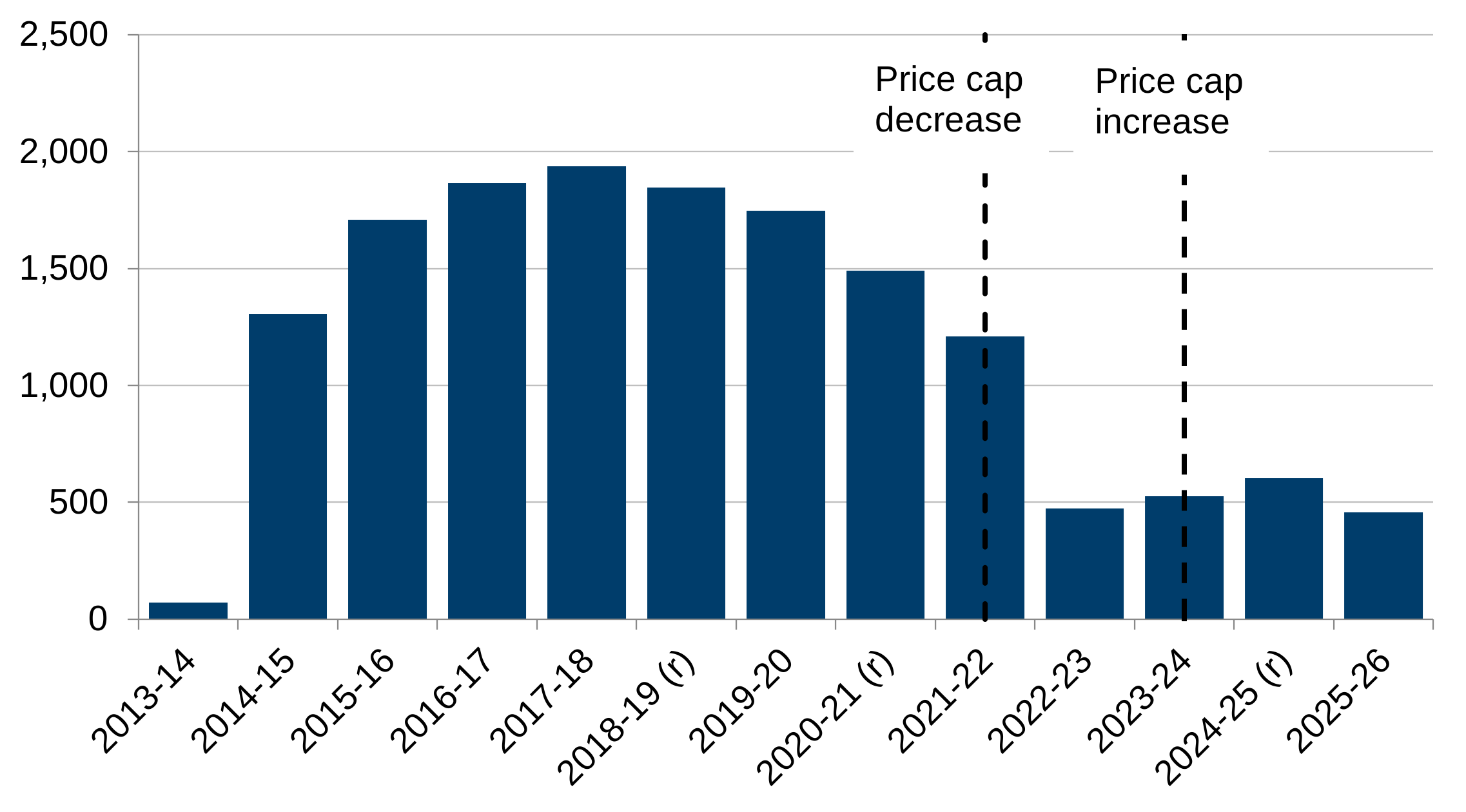
Description of figure 1: a bar chart showing that the number of completions increased each year to a peak in 2017 to 2018 before decreasing each year to 2022 to 2023. The number has remained fairly consistent since 2022 to 2023.
Source: Help to Buy – Wales Ltd
Help to Buy - Wales completed purchases by local authority, first time buyer and date (StatsWales)
[Note 1] From 1st April 2021, the purchase price cap decreased from £300,000 to £250,000. From 1st April 2023, the purchase price cap increased from £250,000 to £300,000, with all homes sold through the scheme needing to meet a minimum of EPC B. These price changes have been marked by dotted lines in the chart.
[Note 2] Minor revisions can occur at any point after statistics have been published as the data is reviewed and updated from official documents related to the purchases. Usually, these revisions are minor such as completion date. Please see the quality report for further information.
[Note 3] 2013 to 2014 is not a complete year as the scheme began on 2 January 2014
(r) Revised
The figures for Help to Buy are based on legal completion dates for transactions through the scheme. The legal completion date is the point at which Help to Buy (Wales) Ltd receives a completion notice from either the buyer’s conveyancer or solicitor. 2025 to 2026 figures capture all completions from 1 April 2025 to 31 March 2026. Cumulative completions between 2 January 2014 (when the scheme began) and 31 March 2026 is also included.
In 2025 to 2026, 457 properties were purchased using a Help to Buy shared equity loan, a 24% decrease on the previous year. The value of the equity loans for 2025 to 2026 was £23.9 million. The value of the properties purchased totalled £121.1 million.
This brings the total properties purchased since 2 January 2014 to 15,239. The cumulative value of these equity loans is £618.3 million and the value of the properties purchased totals £3,129.3 million.
Quarterly data
Figure 2: Help to Buy, completions quarterly, 2 January 2014 to 31 March 2026 [Note 1]
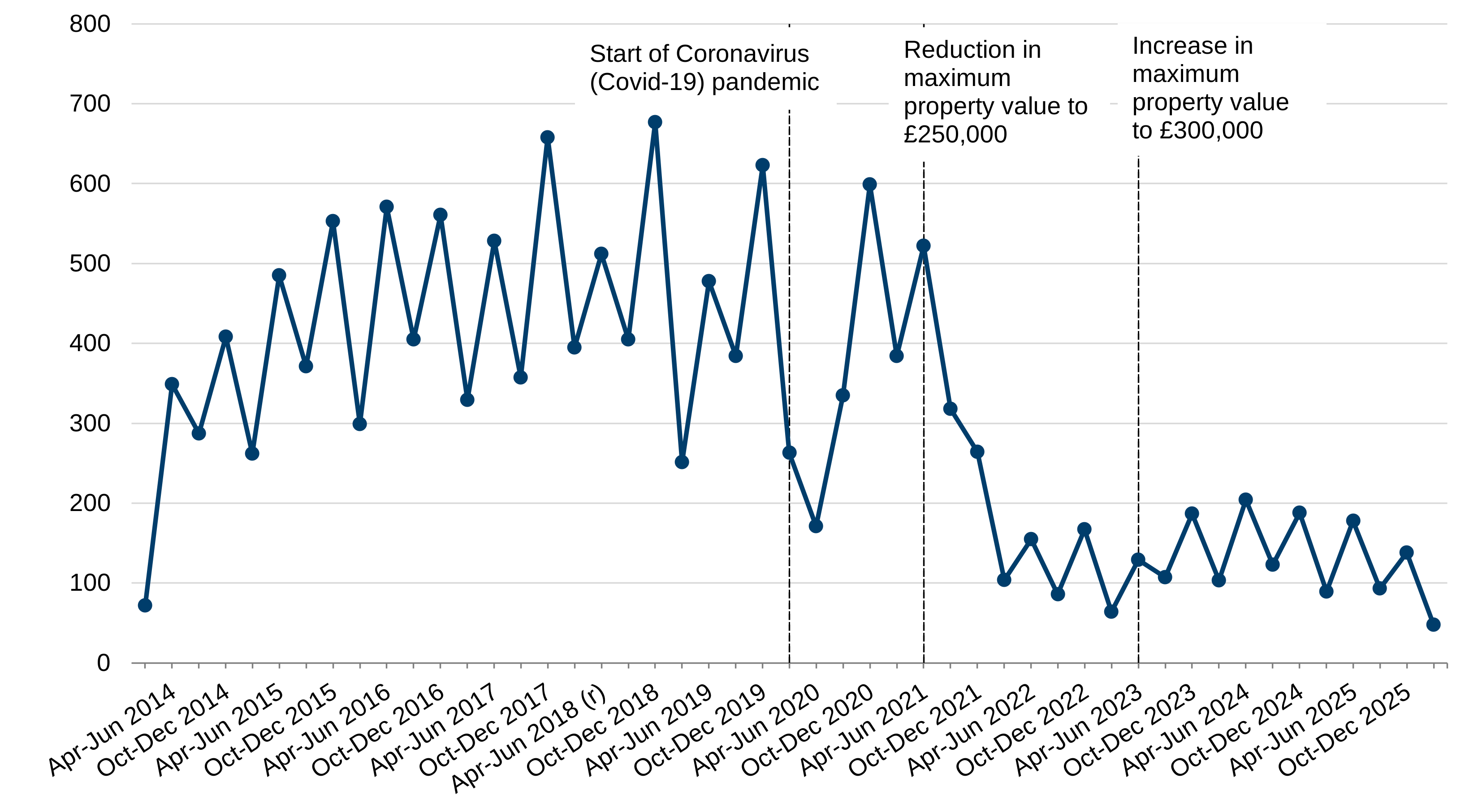
Description of figure 2: a time series showing the fluctuations in completions each quarter since 2 January 2014.
Source: Help to Buy – Wales Ltd
Help to Buy - Wales completed purchases by local authority, first time buyer and date (StatsWales)
[Note 1] The quarterly totals for April to June 2018, January to March 2021 and January to March 2025 have been revised since previously published.
Care should be taken with any comparisons over time, particularly those which involve data from spring 2020 to summer 2021. This is due to the coronavirus (COVID-19) pandemic and changes to land taxation thresholds. The national lockdown on 23 March 2020 resulted in the housing market being mainly closed until 22 June 2020, when it partially re-opened. The market was re-opened more fully on 27 July, to coincide with a change in land transaction tax. This may have affected the timings of some transactions as people looked to benefit from the temporary tax reduction.
In general, there is higher activity in the April to June and October to December quarters, which may be influenced by the quarterly sales targets used by larger developers. June and December correspond with the mid and end year sales target dates for a majority of the larger developers. However, during the early months of the COVID-19 pandemic the usual pattern was disrupted. Since the quarter starting April 2021, there has been an overall decrease in completions, but the usual pattern in the quarterly figures can again be seen.
The lower number of completions during the January to March quarters in each year could also be due to external seasonal factors such as holiday periods and weather conditions. The figures shown in this release have not been seasonally adjusted.
Separate statistics on the number of new house building have shown a similar pattern of generally lower numbers during the January to March quarter each year. The most recent figures for new dwellings completed extend to June 2026.
Purchase price
From 1 April 2023, Help to Buy can be used to purchase new build properties up to the value of £300,000. All homes sold through the scheme need to meet a minimum of Energy Performance Certificate (EPC) B. The scheme provides a maximum equity loan of £60,000 (20% of the purchase price of the property).
66% of all completions in 2025 to 2026 were in the top price range of £250,001 to £300,000. A further 20% were within the £225,001 to £250,000 price range.
For 2025 to 2026, the mean (average) purchase price paid for completions was £265,064 (higher than the mean of £254,403 (r) seen the previous year). The median purchase price paid in 2025 to 2026 was £273,500 (higher than the median of £260,000 the previous year). The increase in both the mean and median purchase prices may be due to the increase in average house prices across Wales. The HM Land Registry (GOV.UK) release monthly statistics on Wales house prices in the UK House Price Index: reports (GOV.UK). They reported a 0.9% increase in new build house prices in Wales from 1 April 2025 to 1 April 2026.
| Purchase Price | Completed purchases | Percentage of completed purchases |
|---|---|---|
| £50,000 to £100,000 | 0 | 0% |
| £100,001 to £125,000 | 0 | 0% |
| £125,001 to £150,000 | 1 | <1% |
| £150,001 to £175,000 | 4 | 1% |
| £175,001 to £200,000 | 33 | 7% |
| £200,001 to £225,000 | 25 | 5% |
| £225,001 to £250,000 | 91 | 20% |
| £250,001 to £300,000 | 303 | 66% |
| All properties | 457 | 100% |
Description of table 1: a table showing the majority of completions in 2025 to 2026 were in the top price range of £250,001 to £300,000, with a further 20% being within the £225,001 to £250,000 range.
Source: Help to Buy – Wales Ltd
Purchaser deposits
Figures within this section have been rounded to the nearest 3 as it relates to individual’s finances.
In 2025 to 2026, the majority of completions through Help to Buy were made by first-time buyers, representing 86% of all completions (394).
The remaining 63 completions (14%) were by former owner-occupiers who used the scheme.
| Deposit band | Completed purchases (Non-first-time buyers) | Completed purchases (First-time buyers) | Total completed purchases |
|---|---|---|---|
| 5% | 24 | 237 | 261 |
| 5.1% to 10% | 15 | 21 | 122 |
| 10.1% to 15% | 6 | 108 | 27 |
| 15.1% to 20% | 9 | 15 | 24 |
| 20.1% or more | 9 | 12 | 21 |
| All properties | 63 | 394 | 457 |
Description of table 2: a table showing that the majority of completions between April 2025 and March 2026 were by first-time buyers. Over half of all purchasers provided the minimum 5% deposit. All figures have been rounded to the nearest 3.
Source: Help to Buy – Wales Ltd
[Note 1] Individual deposit percentages are calculated by dividing the deposit amount by the full purchase price of the property, then multiplying by 100. All individual calculations are then rounded to the nearest 3.
[Note 2] Figures for ‘All properties’ for all properties may not equal total from each category due to rounding.
In 2025 to 2026, 57% of all recipients of Help to Buy shared equity loans (261) provided the minimum 5% deposit. Of first-time buyer recipients, 60% (237 completions) provided a 5% deposit whilst for non-first-time buyers this percentage was 38% (24).
5% of completions were made with a deposit of over 20% though again this varied with the type of purchaser. 14% (9) of completions by non-first-time buyers were made with a deposit of over 20% compared with 3% (12) of completions by first time buyers.
Since the scheme was introduced, first-time buyers have accounted for most Help to Buy completions, making up 77% (11,733) of completions. Most recipients (64%) provided the minimum 5% deposit, with a further 19% providing between 5.1% to 10%.
Applicant household income
‘Total applicant household income’ reported below refers to the total gross income of all named applicants for each individual Help to Buy property. Figures within this section have been rounded to the nearest 3 as it relates to individual’s finances.
Figure 3: number of completions by total applicant household income, 1 April 2025 to 31 March 2026 [Note 1] [Note 2]
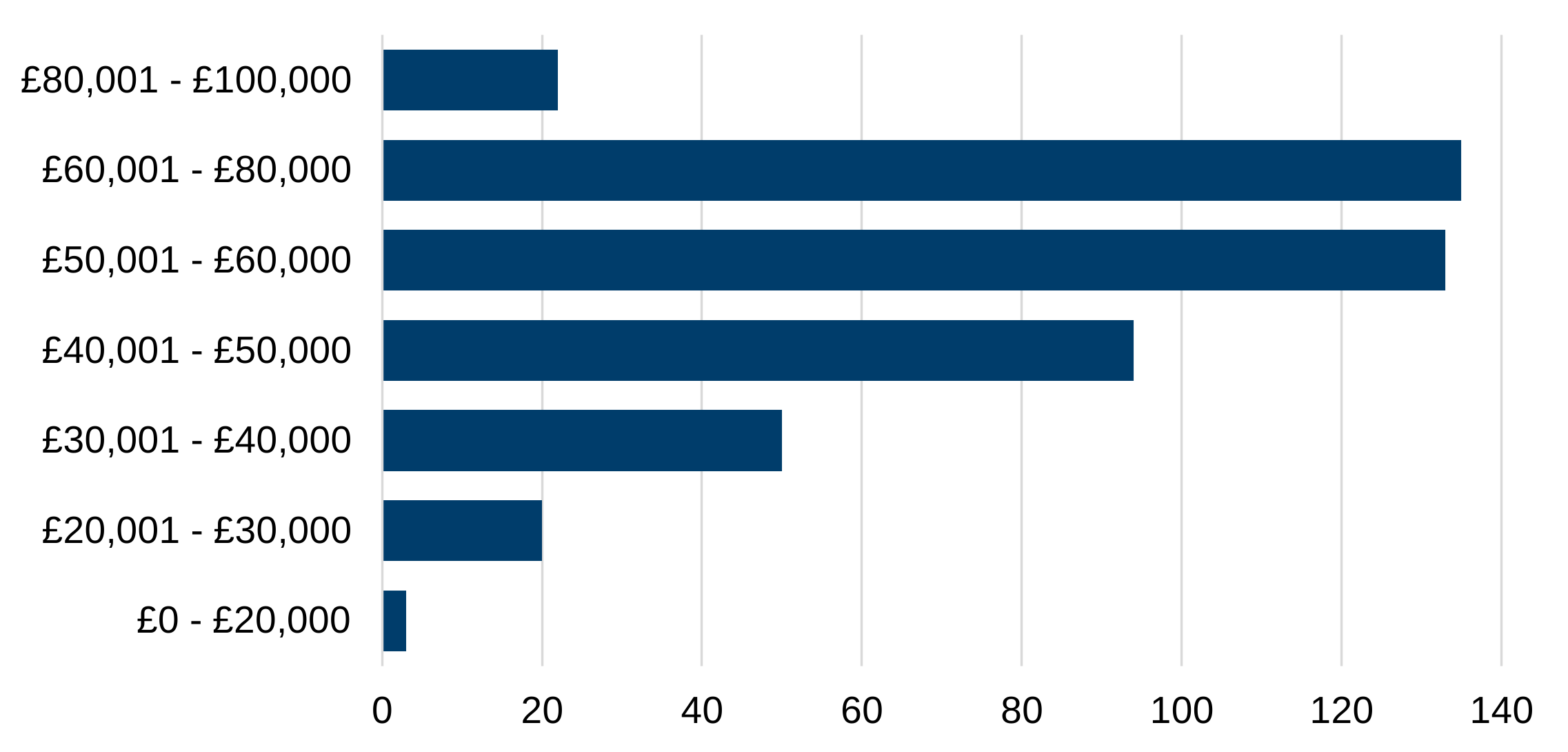
Description of figure 3: a bar chart showing that the majority of all homes purchased under the scheme were by those with a household income of £40,001 to £80,000.
Source: Help to Buy – Wales Ltd
[Note 1] Total applicant household income is registered on the Help to Buy - Wales (Shared Equity Loan Scheme) Property Information Form completed at the point of reservation. Income brackets presented here reflect total applicant household income, which does not discriminate between single person applications and joint applications under the scheme.
[Note 2] The scheme allows for property purchase up to £300,000 with a maximum 20% equity loan. After accounting for the purchaser deposit and equity loan, the remaining balance must be financed through a mortgage which is not in excess of 4.5 times the applicant's household income e.g. a £300,000 property, with a 5% purchase deposit (£15,000) and a 20% equity loan (£60,000) must fund the remainder of the purchase through a mortgage (£225,000). In this instance, the total applicant household income must be £50,000 per annum.
During 2025 to 2026, 50% of all homes purchased under the scheme were by those with a total household income of £40,001 to £60,000; 2 percentage points higher than the previous year. Homes purchased by those with a household income of £20,000 or less accounted for fewer than 1% of all completions using the scheme. For those with a household income of more than £60,000, the proportion of completions has increased to 34% compared to 32% seen last year and 28% two years ago.
Completed leasehold purchases
Since April 2017 information has been collected by Help to Buy - Wales Ltd on the number of completions using the scheme which were for leasehold properties.
During 2025 to 2026, 13 completions were of leasehold properties, all of which were flats, accounting for 3% of the 457 completions over the year. The number of completed leasehold purchases has fallen each year since 2021 to 2022. In March 2018, the Welsh Government announced a package of measures in regard to the sale of leasehold properties which is the main contributing factor to the reduction in purchases of leasehold houses.
For further breakdowns please visit Help to Buy - Wales completed leasehold purchases by date (StatsWales).
Quality and methodology information
Detailed information on data quality and methodology can be found in the Help to Buy - Wales (Shared Equity Loan Scheme) quality report.
More detailed breakdowns are available on the StatsWales website.
Statement of compliance with the Code of Practice for Statistics
Our statistical practice is regulated by the Office for Statistics Regulation (OSR). OSR sets the standards of trustworthiness, quality and value in the Code of Practice for Statistics that all producers of official statistics should adhere to.
All of our statistics are produced and published in accordance with a number of statements and protocols to enhance trustworthiness, quality and value. These are set out in the Welsh Government’s Statement of Compliance.
These official statistics demonstrate the standards expected around trustworthiness, quality and public value in the following ways.
Trustworthiness
The data is provided directly from Help to Buy - Wales Ltd who collect all the information provided to them by users when they enter the Help to Buy - Wales (Shared Equity Loan Scheme) as well as information on the properties that are being purchased.
Quality
The published figures provided are compiled by professional analysts using the latest available data and applying methods using their professional judgement and analytical skillset. Statistics published by Welsh Government adhere to the Statistical Quality Management Strategy which supplements the Quality pillar of the Code of Practice for Statistics (UK Statistics Authority) and the European Statistical System principles of quality for statistical outputs.
Validation checks are performed by Welsh Government statisticians and queries referred to Help to Buy – Wales Ltd where necessary. The statistical release is then drafted, signed off by senior statisticians and published in line with the statement on confidentiality and data access which is informed by the trustworthiness pillar contained in the Code of Practice for Statistics (UK Statistics Authority).
Value
The purpose of this statistical release is to provide evidence to Ministers and policy makers for review and development of home purchase schemes as well as inform the wider public of the progress of Help to Buy.
The information will provide details on what is currently successful and what wider trends will need to be considered when looking at future stages of Help to Buy.
You are welcome to contact us directly with any comments about how we meet these standards. Alternatively, you can contact OSR by emailing regulation@statistics.gov.uk or via the OSR website.
Well-being of Future Generations Act (WFG)
The Well-being of Future Generations Act 2015 is about improving the social, economic, environmental and cultural wellbeing of Wales. The Act puts in place seven wellbeing goals for Wales. These are for a more equal, prosperous, resilient, healthier and globally responsible Wales, with cohesive communities and a vibrant culture and thriving Welsh language. Under section (10)(1) of the Act, the Welsh Ministers must (a) publish indicators (“national indicators”) that must be applied for the purpose of measuring progress towards the achievement of the wellbeing goals, and (b) lay a copy of the national indicators before Senedd Cymru. Under section 10(8) of the Well-being of Future Generations Act, where the Welsh Ministers revise the national indicators, they must as soon as reasonably practicable (a) publish the indicators as revised and (b) lay a copy of them before the Senedd. These national indicators were laid before the Senedd in 2021. The indicators laid on 14 December 2021 replace the set laid on 16 March 2016.
Information on the indicators, along with narratives for each of the wellbeing goals and associated technical information is available in the Well-being of Wales report.
Further information on the Well-being of Future Generations (Wales) Act 2015.
The statistics included in this release could also provide supporting narrative to the national indicators and be used by public services boards in relation to their local wellbeing assessments and local wellbeing plans.
Contact details
Housing Statistics
Email: stats.housing@gov.wales
Media: 0300 025 8099