
Hydrogen policy: summary of responses
A summary of responses to a consultation on the preferred policy position on hydrogen.
In this page
Overview
This report presents a summary of responses to the consultation on the preferred policy position on hydrogen.
Action Required
This document is for information only.
Further information and related documents
Large print, Braille and alternative language versions of this document are available on request.
Contact details
For further information:
Energy Division
Welsh Government
Cathays Park
Cardiff
CF10 3NQ
Email: energypolicymailbox@gov.wales
Additional copies
This summary of response and copies of all the consultation documentation are published in electronic form only and can be accessed on the Welsh Government’s website.
Digital ISBN: 978-1-80633-915-0
Introduction and background
In February 2025 the Welsh Government consulted on its preferred strategic policy on Hydrogen. The policy was drafted as part of our response to the climate and nature emergencies, and seeks to encourage sustainable decarbonisation and avoid deindustrialisation.
The consultation ran from 21 February 2024 to 30 May 2025, and sought views on a policy that would support the targeted production and use of hydrogen where:
- it makes a clear, measurable and sustained contribution to decarbonisation, the transition away from fossil fuel consumption, and prosperity for Wales (supported by evidence)
- the hydrogen meets the requirements of the UK Low Carbon Hydrogen Standard
- the developer(s) can provide evidence of contributing to a just-transition for those communities and industries affected by the deployment of hydrogen
The consultation sought the views of industry, power generators, the public and other stakeholders. This report summarises the issues raised in the consultation responses and provides the Welsh Government response to these issues.
We have considered every response during our analysis. However, we have aimed to keep summaries succinct and focused on the points that directly answered the questions. Some stakeholders provided general responses, as opposed to responding directly to individual questions, and may have provided additional evidence/annexes alongside their submissions. Whilst these are not included in the scope of the document below, they have and will continue to be considered as our policies are developed.
Overall response
The consultation contained seven questions. Three questions were focused on the preferred policy position, two on the potential impact of the policy on the Welsh language, one on the nature of the respondent, and an option to provide additional information not covered by a specific question.
Sixty-two consultation responses were received, fifty-eight of which either entirely or partially responded directly to the questions asked.
Some questions generated a clear yes or no response, whereas other responses were nuanced with additional information and context provided by responders. Not all respondents answered all questions. However, only those responses that were formally submitted, either by email or pressing the submit button on the online survey, were considered within the analysis.
Figure 1 provides a high-level analysis of questions one and two, where agree and supportive statements, or disagree and unsupportive statements, are combined to form an overall view. Figure 1 suggests that overall, the proposed strategic policy was viewed favourably. However, the responses to question two make clear that additional information and guidance is required to ensure that Planning Policy Wales can give effect to the proposed policy.
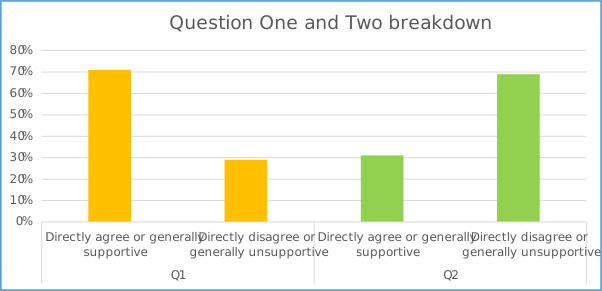
Question One: 71% directly agree or generally supportive, 29% directly disagree or generally unsupportive.
Question Two: 31% directly agree or generally supportive, 69% directly disagree or generally unsupportive.
Question 1
Do you agree with the proposed policy position set out in this document? If not, please indicate where you disagree and your reasons for disagreeing?
There were 58 responses to question one, of which, 30 responses indicated clear agreement with the proposed policy position. 16 responses disagreed with the policy position. A further 11 responses partially agreed, and one partially disagreed. Therefore, almost 71% of responses indicated agreement or partial agreement with the proposed policy. A further 29% disagreed or partially disagreed.
It is clear from the responses that both supportive and unsupportive statements are nuanced and qualified on key issues. A detailed analysis of the questions is presented below.
Key points raised in responses to question one
Views on the Low Carbon Hydrogen Standard
The majority of responses supported the policy aligning with the UK Government Low Carbon Hydrogen Standard (LCHS), both in terms of facilitating access to UK Government support mechanisms that are predicated on achieving the LCHS, and the focus on carbon intensity rather than a particular technology to produce hydrogen. A focus on carbon intensity was seen as encouraging innovation that might be difficult to achieve should a more technology prescriptive approach be adopted.
However, some respondents felt that the focus on carbon intensity, combined with the statement that fossil fuel use was to be avoided, signalled that electrolytic hydrogen (green hydrogen) would be favoured over fossil fuel derived hydrogen (blue hydrogen). In contrast, others felt that this technology neutral approach, that did not explicitly exclude the use of fossil fuels, could encourage further fossil fuel use.
Several respondents felt that Wales should have a period of “blue” hydrogen (fossil fuel derived hydrogen with Carbon Capture and Storage (CCS)), as blue hydrogen was important to grow the market while transitioning to lower carbon methods of production. In contrast, others felt we should not rely on CCS to produce lower carbon hydrogen as any fossil fuel derived hydrogen would prolong the wider extraction and use of fossil fuels in the economy.
Welsh Government response
The LCHS sets a maximum greenhouse gas (GHG) emissions threshold for hydrogen production, currently 20g CO₂e per MJ of hydrogen at the point of production. To participate in UK Government Hydrogen Allocation Rounds, a project must demonstrate compliance with the LCHS. Both electrolytic (green) and CCS-enabled (blue) hydrogen projects can achieve the LCHS.
Welsh Government consider compliance with the standard will help ensure new low carbon hydrogen production makes a direct contribution to our carbon reduction targets. Additionally, use of LCHS hydrogen aligns Welsh Government policy with the UK Government policy, the UK Government business models approach and associated financial support mechanisms. Adopting a consistent approach across the UK avoids the creation of regulatory barriers and facilitates cross-border infrastructure developments.
UK Government will review the LCHS regularly to ensure it remains fit for purpose and reflects a growing understanding of how new technologies work in practice, including how hydrogen production interacts with the broader energy system and wider standards. Welsh Government, through various regulatory and Ministerial working groups, will continue to work with the UK Government to inform the development of the standard.
Views on the possibility of the proposed policy creating administrative burden that could stymie investment in Wales
Many responses requested greater clarity around the evidence required to satisfy the policy. There were also some concerns raised that the proposed policy would introduce additional consenting barriers to the production and deployment of hydrogen in Wales, when compared to Scotland and England, which could harm investment in decarbonisation in Wales. Many responses highlighted the need to ensure there was no additional administrative burden in Wales, that there was clarity on how the policy would be applied to consenting and funding decisions, and strong alignment with the UK Government policy.
A small number of responses also suggested the policy could result in a duplication of evidence requirements as compliance with the LCHS is already required as part of the UK Government Hydrogen Production Business Model (HPBM), strict environmental standards are already in place, and the Emission Trading Scheme (ETS) already incentivises producers to reduce emissions.
Many responses highlighted the importance of alignment with wider Welsh and UK Government energy and decarbonisation policy and strategies, with some suggesting there was misalignment between policy areas and regulatory requirements.
Several respondents recognised the importance of a just transition to net zero, and the need to ensure hydrogen deployment enables a fair transition and does not lead to further inequalities in health and prosperity in our communities. However, it was requested that clarity be given on how a just transition should be evidenced in a development application.
Welsh Government response
Welsh Government expects all new developments to mitigate the causes of climate change in accordance with the energy hierarchy for planning, as set out in the Planning Policy Wales energy policies. The energy hierarchy will remain an important consideration for energy related planning decisions, including the deployment of hydrogen.
The policy has been drafted to emphasise that the hydrogen strategic policy should not be viewed in isolation, but together with the full weight of policy and legislation that will drive hydrogen deployments towards genuine net decarbonisation gains.
The proposed policy does not introduce new evidence requirements, rather it provides further context to the existing evidence requirements in planning regime. We do agree that the evidence requirements need to be more clearly defined, and therefore guidance will be published to assist developers and decision makers.
Welsh Government is committed to developing our policies and working with UK Government, regulators, academia and industry to ensure hydrogen develops sustainably and delivers the necessary decarbonisation. Welsh Government has regular discussions with UK Government at both an official and Ministerial level to ensure proposed hydrogen projects across Wales are subject to robust regulatory controls, facilitate long-term decarbonisation and build a stronger, greener economy. We are also engaging with the UK Government on the importance of developing appropriate and timely support to enable key decarbonisation projects to reach fruition.
Views on the focus on production without consideration for off-takers
Several responses called for the policy to be focused on the role of the off-taker sector (those industries that consume the hydrogen), who they believed were better placed to define the right path for hydrogen infrastructure investment and deployment. These responses highlighted that hydrogen should be used where it can make the most positive impact on decarbonisation and jobs, with demand determining production levels, rather than working towards government mandated production targets.
Some responses highlighted that there was a role for Welsh Government in co-ordinating potential producers and off-takers, through facilitating the creation of hubs and co-locating developments with compatible production and off-take requirements. Responses suggested that this approach would better facilitate the sustainable decarbonisation of hard-to-abate sectors and support key hydrogen locations such as ports and clusters through ensuring production and off-take infrastructure was developed in parallel.
Welsh Government response
This policy is intended to serve as a high-level strategic policy, outlining clear support for hydrogen production and utilisation, where the hydrogen complies with the LCHS, and contributes to wider well-being objectives and a just transition.
The UK Government Hydrogen Strategy details how UK Government will look to capture the economic benefits of growing the UK hydrogen economy, supporting innovation and stimulating investment to develop the supply chains and skills needed and create jobs and export opportunities for the UK. The UK Government strategy, the Hydrogen Allocation Round funding mechanism, and the hydrogen business models are designed to de-risk investment, stimulate production, and build infrastructure.
The Welsh Government policy has been designed to support these UK Government mechanisms, making clear the importance of hydrogen infrastructure for Welsh decarbonisation and prosperity, and to ensure that the needs of Welsh industry are met in full by the UK strategy.
Views on necessity of a strong vision for hydrogen in Wales
Many responses agreed with the vision that hydrogen is an enabler to grow sustainable industries in Wales, to avoid de-industrialisation, and deliver high quality careers and well-being benefits. However, many responses also highlighted that Wales lacks a cohesive narrative for hydrogen in Wales. There is no national hydrogen strategy with clear ambitions, targets and timelines for hydrogen production, storage, distribution, utilisation and the development of a skilled workforce. Stakeholders highlighted that without this, Wales is at risk of not being able to articulate and realise the ambition and needs of its industry.
It was highlighted that certain aspects of hydrogen deployment such as the planning and environmental consenting regimes are devolved to Welsh Ministers. However, responses recognised that fiscal and support levers for hydrogen were largely reserved to UK Government. Responses advised that Welsh Government could work more closely with UK Government to influence its strategic decisions and communicate the potential impact on Welsh industry.
Many responses also highlighted the need for Welsh Government to take a more holistic view of hydrogen as part of the wider energy system, considering generation, grid flexibility, and consumption to better inform decision-making and investment.
Welsh Government response
The hydrogen policy is part of the wider policy approach to reduce our reliance on fossil fuels and to reduce emissions to the atmosphere, while making Wales a more prosperous, healthy, resilient and globally responsible nation.
Welsh Government has commissioned numerous reports, information and research to inform our understanding of hydrogen, and its potential impact on Welsh citizens, economy and the environment. These reports, combined with Energy generation in Wales reports, Future energy grids for Wales, Net Zero Wales: Carbon budget, Planning Policy Wales, the Welsh Industrial Hydrogen Research Report and Local Area Energy Plans (LAEPs) all contribute to developing our understanding of how hydrogen should be deployed in Wales.
To further encourage innovation, we established Net Zero Industry Wales (NZIW) in 2022 as an independent organisation to support the development of decarbonisation pathways and help co-ordinate sectoral pathways to net zero. We also continue to work closely with the South Wales Industrial Cluster (SWIC), the North-East Wales Industrial Cluster (NEWID) and the HyNet project to understand and inform how industry and energy generation in Wales will deliver decarbonisation.
Providing a clear policy framework, publishing reports and information, and working with UK Government to develop a clear and effective regulatory framework will facilitate and encourage both academia and industry exploring and investing in the necessary research and development. Working with NZIW, the Clusters and emerging infrastructure projects helps develop our understanding of the needs of industry, and how best to unlock the potential of hydrogen in Wales.
However, Welsh Government also recognises the value of a focused, clear, consistent and evidence driven narrative and strategy to support the development of hydrogen in Wales. We expect the UK Hydrogen Strategy to meet the needs of Welsh industry and society in full, and to exploit the enormous decarbonisation potential of projects in Wales. We are committed to working with UK Government on delivering its UK Hydrogen Strategy, through its various technical and regulatory groups.
Following the publication of the UK Government Strategy we will further consider the potential benefits of preparing a Wales specific hydrogen strategy.
Question 2
Do you think the energy hierarchy within Planning Policy Wales (PPW) is sufficient to inform planning officials in the development and employment of hydrogen within Wales? If not, do you think it needs to be reflected in further detail within PPW?
In total, there were 55 responses to question two. There were 30 responses that did not consider the energy hierarchy provided adequate clarity to support hydrogen decisions, whereas 17 responses considered it did provide adequate clarity. A further 8 responses did not provide a clear yes or no response to questions 2, but indicated they did not believe the energy hierarchy provided adequate clarity to support hydrogen decisions.
Responses that considered the energy hierarchy to be sufficient for hydrogen decisions generally highlighted that it is effective at providing a high-level structure for decision making, and that the intent of the hierarchy to deliver decarbonisation is established, understood and generally supported.
Responses that considered the energy hierarchy to be insufficient typically raised concerns around the hierarchy not accurately covering the wider hydrogen economy from production, to transport and storage, and utilisation by off-takers (i.e. the hierarchy does not align with the UK Government business model approach developed to support growth of a low-carbon hydrogen economy across hydrogen production, hydrogen to power, and hydrogen transport and storage sectors). Some responses also suggested the energy hierarchy was too high-level, lacking sufficient detail and nuance to properly inform hydrogen specific consenting applications.
Responses, whilst broadly supportive of PPW, felt that additional guidance was needed to clarify how the energy hierarchy might apply to hydrogen developments so that effective, fair and transparent planning applications and determinations can be achieved.
Some responses expressed concerns that the energy hierarchy, through favouring renewable energy and discouraging fossil fuel consumption, would create a presumption against low-carbon hydrogen produced from fossil fuels.
Responses also noted the energy hierarchy prioritises energy demand reduction, energy efficiency gains and expanding renewables, and as hydrogen is not an inherently renewable energy source, the hierarchy appears to allocate its production a low priority. This perception could detract from the investment necessary to develop the emerging hydrogen market.
Welsh Government response
Welsh Government planning policy recognises an energy hierarchy. The Welsh Government expects all new development to mitigate the causes of climate change in accordance with the energy hierarchy for planning, as set out in the energy policies outlined in Planning Policy Wales.
The hydrogen policy is intended to add to the body of energy policies within Planning Policy Wales, providing additional context for planning officers and developers when determining where a hydrogen proposal sits in the energy hierarchy.
Welsh Government recognises that additional guidance is required to ensure that the relationship between the Energy Hierarchy and the hydrogen policy is consistently understood by both planning officers and developers.
Guidance will also be prepared to clarify how developers can evidence compliance with the policy though existing evidence requirements already embedded within Planning Policy Wales (with the exception of the LCHS which is already embedded within the UK Government hydrogen business models).
This guidance will be supplemented with a regulatory route map, identifying how hydrogen developments engage with the wider regulatory framework (including the planning regime, environmental permitting, the Emissions Trading Scheme and relevant Health and Safety regulatory requirements).
Question 3
What type of appropriate additional information or guidance would help give effect to this policy, for developers, investor and decision makers?
Question three received 45 responses. The majority of these reiterated comments in questions one and two. Due to the nature of the question the responses were wide ranging in content. Key issues not already covered under questions one and two are summarised below.
Guidance
In addition to calls for further guidance, there were also requests for sector specific technical standards, planning tools to support the optimised siting of infrastructure, publication of best practice examples, and clarification on the definition of hydrogen production methods. Life Cycle Emissions analysis tools were also requested to enable a full assessment of the carbon intensity of various hydrogen deployment pathways.
Growing the hydrogen market
Some responses highlighted a need for more Welsh Government led intervention to grow the emerging hydrogen market, including setting production targets, streamlining consenting requirements and providing financial incentives for early-stage projects and Small to Medium Enterprises. Responses also requested additional support from Welsh Government to access UK Government funding mechanisms.
Supply chain development and skills
Supply chain and workforce challenges were raised in many responses. There were calls for dedicated support for Small to Medium Enterprises and Welsh manufacturing supply chains and services. The importance of developing a skilled workforce was raised by many respondents, including calls for an in-depth analysis of the need for skills and training.
Grid connectivity and water supply
The importance of access to national electricity grid infrastructure was consistently raised as a critical issue to deploying hydrogen, both in terms of the necessary access to electricity to generate hydrogen, and in terms of grid-balancing requirements. Responses generally recognised that responsibility for grid access is not a devolved function, but suggested that Welsh Government could work more closely with UK Government to resolve grid access issues.
The importance of access to adequate water resources was raised, suggesting a strategic approach to water for hydrogen production purposes was necessary, incorporating water recycling and sustainable extraction. There were further requests for guidance that focused on access to water resources for hydrogen production, covering consenting requirements and environmental impact mitigation.
Risks and public perception
Many responses raised issues relating to safety and environmental concerns, in particular, public perception of safety and the availability of the expertise and experience necessary to manage the risks associated with deploying new technologies at scale. Responses suggested that both public perception and access to expertise could stymie the scale and scope of early hydrogen projects and thereby prevent the sector from delivering necessary decarbonisation. Targeted public communication strategies and detailed guidance on consenting requirements were suggested as mechanisms to inform the wider public discussion on hydrogen and ensure environmental consenting is effectively applied to manage environmental risks.
The role of the Health and Safety Executive was raised, with responses suggesting sector specific guidelines were required, followed by effective public engagement.
Welsh Government response
Welsh Government recognises the importance of hydrogen to reaching net-zero, but also the significant economic opportunities the technology can deliver for industry, business and citizens in Wales. Hydrogen projects will create jobs and careers during construction, operation and maintenance, as well as safeguarding jobs in other sectors and providing wider supply chain opportunities.
Welsh Government recognises the need for sector specific guidance to assist developers in acquiring the necessary consents and UK Government support. Welsh Government will work with industry and regulators to deliver guidance and a route map outlining those regulatory requirements that apply to hydrogen production, transport and storage.
The UK Government has also published its Hydrogen Strategy. The Strategy focuses on delivering hydrogen where it is needed most, building new infrastructure, and supporting the development of jobs and supply chains for the UK. The objective of the Strategy is to support energy security, deliver good jobs and economic growth, while securing a low carbon future for the UK.
Welsh Government is committed to working with the UK Government to ensure the UK Hydrogen Strategy delivers for Wales.
Question 4
What type of organisation are you answering on behalf of e.g. power generation, large industry user, SME, transport, academic, consultancy, individual?
There was a broad distribution of categories of respondents, with the five main types being Public Bodies (16), Individuals (11), Industry Representation (10), Large Enterprises (9), and Small to Medium Enterprises (9). The remainder of respondents came from Social Enterprises & Charities (3), Professional Institutions (2), and Academia (2).
Questions 5 and 6
We would like to know your views on the effects that 'Hydrogen production, storage, transportation and use' would have on the Welsh language, specifically on opportunities for people to use Welsh and on treating the Welsh language no less favourably than English. What effects do you think there would be? How could positive effects be increased, or negative effects be mitigated?
Please also explain how you believe the proposed policy could be formulated or changed so as to have positive effects or increased positive effects on opportunities for people to use the Welsh language and on treating the Welsh language no less favourably than the English language, and no adverse effects on opportunities for people to use the Welsh language and on treating the Welsh language no less favourably than the English language?
Questions five and six were similar in relation to what impact the policy could have on the Welsh language, and how policy could be formulated to positively assist those impacts. There were 29 respondents in total commenting on question five, with 21 respondents in total commenting on question six, with some of those responses referring to answers within question five. Responses were generally positive towards the Welsh language and acknowledged the potential impact of hydrogen policy. Some of the key elements within the responses were:
- identification of opportunities to engage bilingually
- bilingual technical documentation, courses, education and re-skilling
- community engagement and partnerships
- promote the use of the Welsh language
- welcome Welsh language correspondence and communication
Opportunities for the Welsh language
There were multiple responses that proposed the deployment of a hydrogen infrastructure in Wales would be ultimately beneficial to the Welsh language and especially high-density Welsh-speaking communities. There was also wide-spread acknowledgement of the importance of the Welsh language and the need to consider it within the context of policy development, through reflecting on associated strategies and legislation such as Cymraeg 2025, and the Well-being of Future Generations (Wales) Act 2015.
Some responses suggested development of hydrogen in Wales had the potential to protect the language for future generations as those employed within the industry, both Welsh and non-Welsh speakers, would have access to Welsh medium education within those regions of development. It was further suggested that this would in turn grow the number of Welsh speakers, especially within industrial regions. The inclusion of bilingual training materials and placement of Welsh speakers in operational roles was also seen as an opportunity for strengthening the use of the Welsh language.
It was also raised that the delivery of hydrogen infrastructure projects could help to retain and create jobs in high density Welsh speaking areas. This would further support the language through benefiting communities and Welsh speakers linked to hydrogen developments and their wider supply chains. Some comments added that the policy could increase opportunities for people to use Welsh. There were also some comments suggesting a potential for hydrogen to support the just transition of rural Welsh-speaking communities, particularly those reliant on agriculture and forestry.
A correlation between work ethos and productivity typically being higher in communities with a clear cultural identity was also noted as a benefit of the Welsh language being strengthened by hydrogen development. Some responses also commented that the Welsh Government must ensure a range of projects, both on and offshore, and across the whole hydrogen value chain are delivered to realise the maximum benefit to the Welsh language and culture.
Potential negative effects and mitigation
There were some less positive and neutral responses, however these were more concerned with the question being relevant as opposed to negating the importance of the Welsh language, with some seeing no change or affect to it in the context of hydrogen deployment. There were however some concerns raised within the responses regarding potential negative impact on the Welsh language, specifically the attractiveness of employment within the hydrogen sectors could attract non-Welsh speakers, which could reduce the opportunities for Welsh speakers within those regions. A proposed method to mitigate that risk is to engage locally with groups such as the mentrau iaith, which promotes the use of the Welsh language and works in partnership with a wide range of stakeholders to strengthen the use of Welsh as a thriving community language. It was also stressed that failure to deliver low-carbon hydrogen in Wales could lead to job losses and mobilise Welsh speakers away from those impacted areas.
Ideas on how to increase positive effects
There were various suggestions on how the policy could increase the use of the Welsh language. Ideas included:
- community engagement, partnering with Welsh language communities and stakeholder groups to co-design projects
- ensure inclusive consultation processes
- prioritise contractors with Welsh language capabilities via procurement policies
- ensure public engagement and messaging concerning hydrogen are bilingual
- foster socio-economic conditions for Welsh speakers to remain in their communities
- value, respect, and welcome all correspondence and enquiries through the medium of Welsh
- produce and provide bilingual training, education, up & re-skilling for rural residents including Welsh speakers, to enable equal access to opportunities and remove barriers
- integration and adoption of the Welsh language into technical text (and glossaries) associated with emerging low-carbon technologies, the Net Zero Industry Wales (NZIW) glossary was highlighted
- promote Wales through hydrogen related branding, highlighting the Welsh language as an integral part of Wales’ identity
- further develop the Welsh Language Impact Assessments required by developers in line with the emergence of a hydrogen infrastructure
Welsh Government response
It was very positive to see the actions already in place to support Welsh language in the community. The Welsh language belongs to everyone across the whole of Wales, and we want to see the language thrive in all parts of Wales. Although securing investment and long-term growth should result in opportunities for the language to flourish, this cannot assumed, and developers should seek out ways to create favourable conditions for the language to thrive within the community where they are based. Planning Policy Wales (PPW) requires new developments to consider the impacts on the Welsh language and to be fully aligned with the Well-being goals of Future Generations and sustainable development principles, this includes cultural considerations on how a proposal can support the use of the Welsh language.
It is important that all developments have a positive effect on the Welsh language across Wales. The Planning (Wales) Act 2015 requires that all developments must carry out a sustainable appraisal in accordance with the Well-being of Future Generation (Wales) Act 2015. PPW requires everyone to embrace the concept of placemaking, a more holistic approach considering the social, economic, environmental and culture value of a development.
Question 7
We have asked a number of specific questions. If you have any related issues which we have not specifically addressed, please use this space to report them
There were 30 responses for question seven. The responses were very wide ranging. Many used this as an opportunity to highlight specific hydrogen projects and the benefits they could bring to Wales. A common theme was the economic opportunity that hydrogen offered Wales, and many used their response to put forward ideas on how Wales could best benefit from the technology. Suggestions included:
- fast tracking strategically important projects through planning and permitting regimes
- coordinating onshore hydrogen projects with offshore wind energy projects to ensure a renewable source of energy was readily available
- develop a hydrogen innovation hub to support Small to Medium Enterprises with funding for innovation and developing their export potential
- Welsh Government to assist in linking hydrogen producers with off-takers
- Welsh Government to work with UK Government to ensure funding associated with the Hydrogen Business Models and Hydrogen Allocation Rounds (HAR) is available for as long as the sector requires it, and that Wales receives a fair share
- Welsh Government to provide funding and support to facilitate proposals in Wales maturing to the point where an application for HAR is viable
There were requests for Welsh Government to better articulate the strategic role of hydrogen within the wider energy system, and to work with National Energy System Operator (NESO) to ensure its infrastructure planning work could provide optimum outcomes for Wales via Regional Energy Strategic Plans (RESPs) and the Strategic Spatial Energy Plan (SSEP).
Responses highlighted the extensive work already undertaken as part of South Wales Industrial Cluster (SWIC) and North East Wales Industrial Decarbonisation (NEWID) projects, which provide pathways for the decarbonisation of industry in Wales, both demonstrating a clear role for hydrogen.
Responses reiterated the critical need for close collaboration between the Welsh, Scottish and UK Governments to ensure alignment of policies to deliver shared decarbonisation and economic goals. The importance of linking the hydrogen policy to the wider ecosystem of energy and decarbonisation policy was highlighted to facilitate a consistent approach across the various energy technologies and issues.
Responses highlighted the potential for hydrogen as a fuel switching option for transport, especially where electrification is not a practical option. This was coupled with the importance of haulage to Wales and an observation that dual fuel options could ease the transition in rural areas.
There were calls for the Welsh Government to consider support for hydrogen for residential heat generation.
Some responses highlighted that hydrogen is a relatively new technology within the energy sector, and this may impact on the risk associated with any investment.
Welsh Government response
The Welsh Government strategic policy on hydrogen is designed to make clear we recognise the vital importance of hydrogen in delivering decarbonisation and prosperity, and avoiding deindustrialisation for many sectors in Wales. The policy provides high-level objectives for the deployment of hydrogen, and a foundation for continued working with Scottish and UK Governments on shared decarbonisation and economic outcomes.
The UK Hydrogen Strategy is critical to the deployment of hydrogen in Wales, as are the actions that Welsh Government will take to ensure citizens and businesses in Wales benefit from the technologies.