Final report of the commission detailing options to strengthen Welsh democracy and deliver improvements for the people of Wales.

First published: 17 January 2024
Last updated: 17 January 2024

Executive summary

Introduction

The questions considered in this report are vital to Wales’ future. Whether people support independence, devolution, or any other constitutional form, it is vital to discuss the options openly and constructively. Without informed discussion, the popular debate will become ever more reactive and polarised.

Commission objectives

The commission had 2 broad objectives:

  1. to consider and develop options for fundamental reform of the constitutional structures of the United Kingdom, in which Wales remains an integral part
     
  2. to consider and develop all progressive principal options to strengthen Welsh democracy and deliver improvements for the people of Wales.

We are grateful for this opportunity to contribute to creating a more informed and mature debate, based on strong evidence and expert analysis. Some of us on the commission are politically aligned and some are not. We have brought the diversity of our own perspectives to the work and have sought to keep an open mind and to carefully analyse the evidence presented to us. Through our cross-party inquiry, Wales has shown the way towards a constructive, evidence-based debate.

The views of citizens

Our first task was to hold a 'national conversation’ with the citizens of Wales about how they see the future of their nation. This has been a challenging task, especially in the current political climate where citizens often feel removed from those who govern them. We have sought to engage citizens where they are, while also inviting them to come to us. We complemented this engagement work with representative quantitative and qualitative data on citizens’ perspectives.

This engagement and research gave us valuable insights into how citizens view government and their relationship with their elected representatives. It revealed their aspirations for the way their country is run now and could be run in the future, and highlighted the shortcomings of Welsh democracy from the citizens’ perspective.

Chapter 2 describes the national conversation and chapter 3 considers the health of democracy in Wales.

One of the strongest messages was that many citizens feel they have no influence on the actions of government. Despite the growing maturity of Wales’ democratic institutions, devolution does not yet enjoy citizens’ full confidence, and we recommend action to tackle this.

Recommendations to strengthen Welsh democracy

1. Democratic innovation

The Welsh Government should strengthen the capacity for democratic innovation and inclusive community engagement in Wales. This should draw on an expert advisory panel, and should be designed in partnership with the Senedd, local government and other partners. New strategies for civic education should be a priority for this work, which should be subject to regular review by the Senedd.

2. Constitutional principles

Drawing on this expertise, the Welsh Government should lead a project to engage citizens in drafting a statement of constitutional and governance principles for Wales.

3. Senedd reform

We recommend that the planned review of the Senedd reforms should be resourced to ensure a robust and evidence-based analysis of the impact of the changes, including from the perspective of the voter and of democratic accountability.

Protecting devolution

Chapters 4 and 5 consider the state of relations between the Welsh and UK governments and the pressures at the boundaries of devolved powers.

Since the referendum on the UK’s membership of the EU, the Westminster Parliament and UK government have overridden the conventions designed to protect devolution several times. The current settlement cannot be taken for granted and is at risk of gradual attrition if steps are not taken to secure it. ‘No change’ should be an option for citizens, but without urgent action there will be no viable settlement to protect.

Our recommendations to protect devolution are set out below. They are designed to reinforce inter-governmental relations, give weight to the Sewel convention, and extend the devolved powers to improve accountability and service delivery. These changes are needed urgently to make devolution a viable option for the long term.

Recommendations to protect devolution

4. Inter-governmental relations

The Welsh Government should propose to the governments of the UK, Scotland and Northern Ireland that the Westminster Parliament should legislate for inter-governmental mechanisms so as to secure a duty of co-operation and parity of esteem between the governments of the UK.

5. Sewel convention

The Welsh Government should press the UK government to present legislation to the Westminster Parliament to specify that the consent of the devolved institutions is required for any change to the devolved powers, except when required for reasons to be agreed between them, such as: international obligations, defence, national security, or macroeconomic policy.

6. Financial management

The UK government should remove constraints on Welsh Government budget management, except where there are macro-economic implications.

7. Broadcasting

The Welsh and UK governments should agree mechanisms for a stronger voice for Wales on broadcasting policy, scrutiny and accountability, and robust work should continue on potential routes to devolution.

8. Energy

The Welsh and UK governments should establish an expert group to advise urgently on how the devolution settlement and inter-governmental engagement in relation to energy could be reformed to prepare for rapid technical innovation in energy generation and distribution, to ensure that Wales can maximise its contribution to net zero and to the local generation of renewable energy. The remit of the group should include advising on the options for the devolution of the Crown Estate, which should become the responsibility of the devolved government of Wales, as it is in Scotland.

9. Justice and policing

The UK government should agree to the legislative and executive devolution of responsibility for justice and policing to the Senedd and Welsh Government, on a timescale for achieving the devolution of all parts of the justice system to be agreed by the 2 governments, starting with policing, probation and youth justice, with necessary funding secured, and provision for shared governance where needed for effective operations.

10. Rail services

10. The UK government should agree to the full devolution of responsibility for rail services and infrastructure to Wales, with fair funding and shared governance on cross-border services.

The external context

Constitutional change for Wales cannot be considered in isolation from developments in the rest of the UK. Public opinion does not exist in a vacuum. Citizens respond to the circumstances they find themselves in, and when those circumstances change, so does their assessment of what is best for Wales. By planning ahead, our citizens and politicians will have the opportunity to engage constructively with external changes and their potential impact on Wales.

In chapter 6 we summarise citizens’ views on the constitutional options and consider the implications of changes in the composition of the UK, such as Scottish independence, the re-unification of Ireland, radical constitutional change in Westminster or a change in the UK’s relationship with the EU.

Options for the future governance of Wales

In our interim report published in December 2022, we identified 3 viable options for the future:

  1. enhanced devolution (this option was referred to as ‘entrenched devolution’ in the interim report, but in our conversations with citizens we learnt that this term did not carry much meaning for them; in this report we refer to this option as enhanced devolution, to convey our meaning more clearly)
  2. a federal structure
  3. an independent Wales.

In chapter 7 we set out definitions of the options and our assessment of each against the criteria in our analysis framework. We applied the framework equally to each option in a neutral and objective way.

Our conclusion is that each option is viable, each offers strengths and weaknesses, risks and opportunities. We make no recommendation as to which is best for Wales, because choosing between the options depends on:

  • the relative weighting given to each of the criteria
  • the level of risk and uncertainty people are prepared to accept in reaching for the opportunities each option presents.

This is not a judgement that the commission can make. Choosing between the criteria and evaluating risk is a choice to be made by political parties and individual citizens.

Our aspiration is that there should be a constructive debate focused on what is best for Wales, based on the best evidence and analysis available, so that the people of Wales can make an informed and thoughtful choice.

Foreword by the co-chairs

We are delighted to present the final report of the Independent Commission on the Constitutional Future of Wales. For us both, it has been a genuine privilege to lead this inquiry and to make what we hope is a serious contribution to the debate about the constitutional future of Wales.

In our deliberations, commissioners have grappled with critical questions about the way Wales is governed, about the health of our democracy and how to engage citizens from all parts of our country. From the start, we placed the people of Wales front and centre: it is vital that their voices are heard and that they lead this debate, so that in the future they may have a real sense of agency and influence in the decision-making of our nation.

This report places Wales on the front foot at an uncertain time for politics. Our commission stands out as a cross-party enterprise, with the voices of the 4 political parties elected to the Senedd represented, alongside the expertise and experience of those with no party allegiance. None of us has approached this work with any agenda beyond the commitment to explore what institutions and practices will best serve the people of Wales. Through our discussions and unanimous conclusions, Wales has shown the way in demonstrating reasoned, inclusive debate based on data and evidence.

We began our work by starting a conversation with the people of Wales. We did this through multiple channels of engagement which continued for over 12 months. Citizens were keen to engage and, given the opportunity, made thoughtful, measured and insightful contributions. We believe that the results of this approach have demonstrated the kind of engagement that’s needed to revitalise Welsh democracy, and the appetite for serious and constructive political debate among the people of Wales.

In our report we tackle 4 key issues:

First, we address the challenges to democracy. These are by no means unique to Wales and are faced in countries across the world with a wide diversity of constitutions. They extend far beyond structures and electoral systems. It is vital that we learn by listening to international experience on how to overcome such challenges. We believe that Wales has the potential to create a more robustly democratic culture, to become an expansive democracy, through innovative engagement mechanisms that enrich the work of elected representatives. This is absolutely critical if we are to overcome the disengagement and cynicism that puts our democracy at risk.

Second, we consider the state of inter-governmental relations and the boundaries of the Welsh devolution settlement. The relationship between the UK government and the devolved governments has fallen far short of the co-operation that citizens expect and which is essential to the successful operation of the Union. We call for urgent steps to strengthen the legal and procedural pillars of the relationship.

Third, we identify areas where new devolved powers are essential to protect the current settlement, and others where the voice of Wales could and should be strengthened through shared governance mechanisms. These are changes are urgently needed to put the settlement on a stable and secure footing.

Fourth, we present our in-depth analysis of 3 options for Wales’ constitutional future:

  • enhanced devolution
  • Wales in a federal UK
  • an independent Wales.

We are grateful to the members of our Expert Panel, whose work on this analysis was invaluable. We conclude that the analysis demonstrates the viability of all 3 options. Each has strengths and weaknesses, each poses risks and opportunities. It has not been our task to select any one of these as the best option for Wales; rather it has been our intention to illuminate the future choices for the people of Wales.

We are a diverse and independent commission, each of us contributing from our own experience and expertise. We have tried to be as impartial as possible in our analysis and conclusions.

With a UK general election on the horizon, followed by a Senedd election in 2026, we are optimistic that the political parties will respond without delay to our analysis and conclusions, in the same spirit of openness and constructive debate that has guided our work. Crucially we hope that the people of Wales will use the findings of our report to raise their voices and help shape how Wales is governed in future.

Professor Laura McAllister and The Rt. Hon. Dr Rowan Williams

Chapter 1: introduction

Summary

This is the final report of the Independent Commission on the Constitutional Future of Wales. This chapter explains how we approached our inquiry and explains the report structure.

Our remit comprised 2 broad objectives.

Commission objectives

  • to consider and develop options for fundamental reform of the constitutional structures of the United Kingdom, in which Wales remains an integral part
  • to consider and develop all progressive principal options to strengthen Welsh democracy and deliver improvements for the people of Wales.

Why this matters

Our inquiry shows that democracy in Wales – as throughout most of the contemporary world - needs urgent attention. Most people do not understand how their country is governed and who is responsible for what. Many feel that the system is not listening to their concerns and that they lack the information and understanding to discuss alternative constitutional options. There is a perception of powerlessness and distance between citizens and government, and a dearth of participatory structures that provide time and space for genuine public discussion and scrutiny. Many see democracy as beginning and ending with the ballot box and know little about the way representative institutions work.

It is important for supporters of the Union, of independence, and of any other constitutional future, to have their proposals discussed and scrutinised in an open and constructive manner. Without informed discussion, the popular debate will become ever more reactive and polarised.

Our research shows that, for many people, calls to change the system of devolved government arise not so much from systematic opposition to devolution, but from dissatisfaction with how the settlement is perceived to work. This in turn may arise from a lack of understanding of, or confidence in, the democratic process for initiating, debating and implementing change.

We hope that our inquiry and its legacy will move the debate forward, and help people understand the trade-offs involved in democratic governance by:

  • providing more information about how democracy works in Wales, so that people are equipped to engage
  • offering a model of democratic participation through multi-channel engagement in complex issues
  • starting a different debate, recognising that all options for future governance, including ‘no change’, offer opportunities, risks and costs
  • moving away from slogans to focus on the best future for Wales.

A constructive approach

In assessing the constitutional options we have applied exactly the same criteria to all potential models, including the current devolution settlement. We have taken a broad and a long view which we believe will stand the test of time.

Our inquiry shows that it is possible to examine the options for future governance objectively in good faith, avoiding the divisions that have characterised the debate in other countries.

We hope that our constructive approach will continue, as debate on the findings of this report carries into Welsh and UK public life.

Interim report

We published an interim report on our first year of work in December 2022. This report does not repeat that material.

In that report we explained our approach to engaging with the people of Wales, and set out our analysis of the current pressures on Welsh governance based on the evidence we received. We included a history of Welsh devolution and explained its main features, including the financial arrangements, as well as a series of papers on key aspects of the settlement. We considered the viability, benefits and risks of the current devolution settlement, assessing whether there was indeed a problem which required constitutional reform to resolve. We concluded that there was: continuing as we are is not a viable option because the powers of the devolved institutions are unstable, and vulnerable to being changed without the consent of the people of the Wales.

Constitutional options

In the interim report we identified 3 options for the future:

  1. enhanced devolution 
  2. Wales in a federal UK
  3. an independent Wales

What we set out to do

Through our inquiry we set out to do 3 things:

  • engage with the people of Wales about the way their country is governed and the options for the future
  • consider how to strengthen Welsh democracy and the workings of the current settlement
  • produce an assessment of the constitutional options that is as objective as we can make it, to enable an informed debate in which the people of Wales can determine their future.

We want to make clear at the outset that we consider all the constitutional options to be viable. Each has strengths, weaknesses, risks and opportunities. The choice between them depends on the value attached to these, and the trade-offs people wish to make between those outcomes. These choices are ultimately for the people of Wales and their political representatives to make.

Views of citizens

Our first focus has been on the citizens of Wales, and how their lives can be improved by more coherent and sustainable governance. In this report, we use the term ‘citizens’ in an expansive sense, to mean all of those who live in our community in Wales. This includes those who do not meet the strict legal definitions of citizenship, but nevertheless are part of the present and the future of Wales.

From the start we have put the views of citizens front and centre. We have been encouraged to find that people are keen to contribute to the debate, when it is presented in practical ways that are relevant to them. The language citizens use to discuss governance is different from that of people who work in politics and public affairs. They are more likely to express their aspirations through their experience of public services, but this does not mean that they are uninterested in how Wales is governed. People care deeply about how their country is run and want it to work efficiently in their best interests.

Evidence and analysis

We have benefited from the advice of our Expert Panel (details at appendix 8) whose work has been invaluable. We have spoken to elected representatives and experts on governance and constitutional systems from across the UK and internationally.

We gathered evidence through 3 main methods, summarised below:

  • citizens’ views, gathered through 2 online questionnaires, quantitative and qualitative research, including citizens’ panels across Wales, online engagement, Community Engagement Fund groups and public engagement activities. Chapter 2 and appendix 7 provide more detail of our engagement activity.
  • written evidence and discussion with those experienced in Welsh governance, including representatives of the political parties, officials, third sector and business groups. A full list is attached at appendices 5 and 6
  • advice from academics and practitioners, through expert seminars on key topics, details of which are provided in appendices 4 and 5

Evidence from all these sources has informed our findings and conclusions.

To enable us to assess the case for each constitutional option, we asked the Expert Panel to design an analysis framework, based on the values we identified in our interim report and practical delivery criteria. We published this framework for comment in March 2023 and the final version in May so that our criteria were transparent and could be challenged. The framework can be found here.

Recommendations

We summarise our conclusions and recommendations in chapter 8. These reflect our evaluation of the full body of evidence we received. They are as robust as we can make them and reflect careful consideration and debate amongst us.

We make 10 recommendations, of which 3 relate to strengthening Welsh democracy. The remaining 7 are designed to protect the devolution settlement from the instability and vulnerability identified in our interim report.

Report structure

Chapter 1 is the introduction to the report.

Chapter 2 describes how we conducted a national conversation with the people of Wales, using multiple modes of engagement and qualitative and quantitative research.

Chapter 3 considers ways of strengthening Welsh democracy, in the context of an increasingly disengaged and polarised political culture across the world.

Chapter 4 reviews how the Welsh Government and the UK government work together and argues for essential changes to protect the devolution settlement and improve its operation.

Chapter 5 considers the boundaries of the Welsh devolution settlement and their implications for good governance and constitutional reform.

Chapter 6 explores the views of citizens on the constitutional options and considers the impact of potential changes in the structure of the UK on both the constitutional options and citizens’ perception of them.

Chapter 7 considers the long-term constitutional options available to Wales and presents our assessment of their strengths and weaknesses.

Chapter 8 sets out our conclusions and recommendations.

Conclusion

We have sought to engage with all views, across the spectrum of constitutional preferences. We have heard from citizens, including supporters of each political party represented in the Senedd and supporters of none. We have heard from experts from universities and public life, from Wales, the UK and internationally.

We have brought the wide diversity of our own perspectives to the work, but have sought to keep an open mind and to carefully analyse the evidence presented to us.

Conwy Youth Service

The commission invited Conwy Youth Service to join a discussion event whilst on a trip to Cardiff to visit the Senedd.

Youth service members had been exploring the work of the commission in their regular sessions and had followed the launch of the interim report. This event offered an opportunity to meet Commissioners Leanne Wood and Albert Owen in person, discuss their thoughts and ideas and ask them plenty of questions!

Main message from the Youth Forum Members

There was a very strong feeling in the room that politics and “How Wales works” should be included in the Curriculum at an early age. The participants had an appetite to get involved with politics and democracy from around 11 years old and they wanted the option to vote on local issues much earlier than the current voting age of 16/18.

Chapter 2: a national conversation

Introduction

One of our most important tasks has been to hold a 'national conversation’ with the citizens of Wales about how they see the future of their nation.

This was an ambitious exercise, especially in the current political climate where many citizens feel disconnected from their elected representatives, along with the pandemic restrictions at the start of our inquiry. We took a multi-modal approach that sought to engage citizens where they are, going to them as well as inviting them to come to us.

We provided a platform to talk to us through several different mediums. We went to those who would not normally choose to engage proactively with a commission such as this: we went to shopping centres, to days out such as family fun days and food festivals, to high streets, and to community centres. We reached out to those who face structural barriers in making their voices heard. We established citizens’ panels to hear views from across Wales, from those who are politically engaged with strong opinions to those who have not formed views on constitutional matters before now. We have supported new quantitative research into people’s views on how Wales is governed and their aspirations for the future.

Taken together, this has given us an insight into how citizens view government and their relationship to government. It has shown us what the people of Wales, and the wider UK, think about the Union and Wales’ place within it. Most importantly, it has shown us their aspirations for the future of their nation.

Giving people a direct line to the commission

From early in the commission’s work, we kept an open line to citizens to tell us what they think and what matters to them.

In March 2022 we opened Dweud eich Dweud: Have your Say, a web-based survey which asked open questions about what matters to citizens, what they see as the strengths and weaknesses of the current system, and how they feel about different governance models. This included contact details to send free-form responses by email or by post, if people wanted to tell us something that did not fit the structure of the survey, and the option to upload video or audio messages.

Over 2,500 people responded to the Dweud eich Dweud: Have your Say survey. We discussed the views expressed in those responses in the interim report. Dweud eich Dweud: Have your Say gave us a valuable insight into the priorities of those who responded, but there were limitations to the data we received. This led us to create other channels for engagement and for understanding citizens' views, shaping the broader conversation we have had in 2023.

One message from Dweud eich Dweud: Have your Say is that people were keen to have their say on constitutional reform, but felt that they did not have the information they need to engage meaningfully. In response, in April 2023, we set up the online engagement platform, which asked people specific questions about possible options for constitutional reform. Importantly, it also included information about devolution and governance, blogs on topical aspects of governance, and a moderated comment and chat function so that people could ask questions and get answers, as well as communicate points that did not fit the survey questions. We received 1,025 separate responses through the online engagement platform, as well as numerous comments and emails (there were over 15,600 hits on the online engagement platform website, where visitors could access information about Wales’ governance system and options for governance in the future as well as having the option to submit a survey response).

Clearly, the views we heard through both of our online surveys are self-selecting. Respondents contributed due to personal motivation and commitment, not because they had been selected to be representative of the views of people in Wales generally. It would therefore be misleading to present a quantitative analysis of the preferences expressed in these responses as representative of ‘what Wales wants’. However, responses to our online surveys gave us valuable insights into what the respondents think about constitutional reform.

We learnt that there are citizens who have given deep thought to the future constitution of Wales and are actively engaged in the process of reform. We wanted to get their insights and better understand what they know, their aspirations and expectations.

There are other citizens who are passionate about improving their nation and the quality of life for those who live here, but may not think about it in terms of governance and constitutional reform. We wanted to learn about their priorities and aspirations for Wales.

There are also citizens who are frustrated by the direction the country is taking, who feel that their voices are not being heard. We wanted to hear what they are unhappy about, what they feel is going wrong and what they feel would redress these issues.

Hearing the views of those who are often unheard

One drawback of both of our online surveys is that they required people to seek out such channels and respond through a digital medium. Self-selecting methods depend on respondents knowing about the commission’s work. We made extensive use of promotion channels, but to reach everyone in Wales in a 2-year period would have required considerably more resources than were available to us.

While many prefer to respond online, this method does not reach those who are not active on social media or similar platforms, and is of no use to anyone digitally excluded.

Another flaw of self-selecting communication methods is that they do not reach those who, for whatever reason, do not wish to engage. This can include those who face structural barriers to engagement, be that language, education, technology, or disability. Some people may simply not be interested or believe that their views are not valued.

To overcome these barriers, we tried to bring the commission to people directly. We commissioned Cazbah to run pop-up engagement events at 26 different sessions across Wales (Cazbah is a Wales-based, bilingual marketing and event management company with extensive experience of managing public engagement roadshow events, specifically in areas relating to skills, careers, education, health and government).These were located at the heart of communities where we could reach people as they went about their day; at shopping centres and supermarkets, at summer family fun days run by local councils, at community centres and on high streets. Over the summer of 2023 this reached 3,545 people, of whom 2,327 completed a short survey (this survey was a different, shorter, survey than that hosted on the online engagement platform and was closer in structure to the Dweud eich Dweud: Have your Say survey) to express the values they thought were important for a future Wales, and 600 gave their email addresses to receive further information on the work of the commission.

Additionally, we wanted to hear from those who have characteristics that are underrepresented in the general population, and to understand how their experiences and needs have shaped their views of constitutional change. Population-weighted, balanced, representative research can include some of those perspectives, but the views of smaller groups can get overshadowed by the wider population in the aggregate analysis.

To address this, we launched the Community Engagement Fund. The purpose of this fund was to enable groups from more marginalised communities to gather and reflect the views of their community to the commission. 42 groups bid for up to £5,000 in funding. We were able to fund 11 organisations across Wales between October 2022 and January 2023. A final report was received by May 2023. The full list of groups who received funding is listed in appendix 7 – Citizens’ Voices.

The method of communication can be a barrier to this kind of participation. Often, responses are expected in writing, using formal or professional language. This can exclude people who cannot comfortably express themselves in formal written English or Welsh. We offered groups maximum flexibility in how they engaged and reported back to us. There was some overlap in the demographics that each group reached, but each report took a different approach and contributed a different perspective. The reports took a range of forms including poetry, rap, music, creative writing, visual arts, and photography, alongside more traditional written summary reports.

By enabling people to tell us in their own words what matters to them about governance, we gained valuable insights on experience of government, governance and constitutional reform from people who are seldom heard on these topics. This revealed information about priorities, about conceptions of government and the role of the citizen, and aspirations for the future that would not have reached us through less targeted methods.

Hearing the views of the whole of Wales and beyond

The engagement methods discussed above gave us some rich qualitative information on the views of citizens, based on self-selecting or targeted responses. We wanted to complement this with qualitative and quantitative data, both from Wales and the wider UK. We did this in 2 ways.

Firstly, we commissioned Beaufort Research to run a series of deliberative citizens’ panels and a pan-Wales survey. Secondly, we partnered with Professor Richard Wyn Jones at Cardiff University’s Wales Governance Centre and Professor Ailsa Henderson at the University of Edinburgh on their 2023 State of the Union research.

Qualitative data

Citizens’ panels

We set up 8 citizens’ panels to consider constitutional options in different locations across Wales. This strand of work was undertaken by Beaufort Research who have extensive experience in this field, enabling us to access a wider range of participants than we could have found ourselves.

These were deliberative sessions rather than focus groups. They followed the principles of deliberative process: giving balanced information, supporting discussions and enabling participants to reach informed decisions. We discuss the value of deliberative mechanisms in chapter 3.

Each panel was made up of 16 people selected to reflect a broad cross section of the population of Wales in terms of age, gender, political views, socio-economic background, rural/ urban residency, disability, Welsh speakers, LGBTQ+, life stages (e.g. parents with young children, people who are leaving education, retired people, etc.), ethnicity, and perceived knowledge and interest in the constitution. Out of a total of 128 citizens invited to participate in the panels (16 per panel, with 8 panels taking place across Wales), 127 took part in the first stage and 121 people took part in the second stage. Less than full attendance was anticipated, due to factors such as sickness, lack of childcare, work patterns and so on.

Each panel met twice. The first time, participants talked generally about government and governance, and about their priorities for government in Wales. Next, members of the panels took part in a period of online engagement, designed to increase their knowledge and awareness in preparation for the second deliberative stage of face-to-face discussions. This generated good levels of engagement with over 1,150 posts on the platform in total (excluding polling questions). This stage also gave participants the chance to ask questions and receive information in response, which was provided during the second panel meetings

The panels then met again, this time to consider specific options for constitutional reform.

Participants were presented with balanced information about how Wales is currently governed and the different options for the future. Then they were asked to reflect on, discuss, and come to their own assessment of the constitutional options. Participants sometimes reached a different conclusion by the end of the final session than when they began the process, demonstrating the impact that information, discussion and thinking space had had on their views.

This part of the national conversation was valuable for telling us what citizens think now, and how their views sometimes changed after discussing with their peers and receiving information about how government works and constitutional reform.

Quantitative data

In between the citizens' panel sessions, Beaufort Research conducted a survey on constitutional reform with a representative sample of 1,596 members of the Welsh adult population aged 16+ through a combination of online and telephone research. Quotas were set for gender, age and social class and adjusted by data weighting to ensure that the sample was as fully representative as possible of the Welsh adult population.

The State of the Union research

Any significant constitutional reform for Wales would have implications for other parts of the UK. To support our discussions on the future of Wales, we wanted to get quantitative evidence on the views of citizens across the UK. To get this 360-degree view from all 4 parts of the UK, we partnered with staff at Cardiff University’s Wales Governance Centre and the University of Edinburgh on their 2023 State of the Union research. They have regularly surveyed a representative population in each nation of the UK on constitutional issues since 2011, tracking changes over time. Partnering with them enabled us to include new questions, tailored to the work of the Commission.

This research gave us invaluable new insights into the views of people in Wales and across the UK.  It stimulated our thinking on how constitutional change in one part of the UK could impact on changes, and perceptions of potential change, in other parts, and how citizens’ views both align and differ across the nations.

Publicising the commission’s work

At the start of our work in 2022, opportunities to engage were constrained by the last phase of Covid restrictions. Once these were lifted, we made the most of meeting people in-person, as well as online. Commissioners attended both national and local events, including taking part in sessions run through the Community Engagement Fund. A full list of these events is set out in appendix 7 – Citizens’ voices.

It was a priority to ensure that opportunities to hear about the commission and its work were offered across the whole of Wales. The Cazbah roadshow landed in all 22 local authorities, sometimes on more than one occasion.

The citizens panels were geographically representative, with each held in a different part of Wales. Appendix 7 sets out the locations of the panels and the Cazbah roadshow visits.

The online engagement platform had a facility to record where people accessing the platform lived (respondents provided the first 4 digits of their postcode to give us their location data). This enabled us to monitor survey responses by geographical area and target communications towards areas we had not heard from as much as others.

Image
Map depicting in-person engagement events held or attended by the commission 2022-2023

What we learned from the national conversation

Much of what we learned informed the findings set out in the chapters that follow. The general messages from the conversation were:

1. Levels of understanding of the UK’s constitutional set-up are low, and most people do not feel informed enough to contribute to the debate about changing it

This finding has 2 aspects: how informed people are about the constitutional arrangements of their country (a general baseline of knowledge), and how informed people feel they are (citizens’ confidence in their own understanding). These 2 aspects are linked, but different, and have a different impact on citizens’ ability to engage with the debate on constitutional reform.

The national conversation has confirmed what has long been thought: people in Wales (and in the wider UK) generally have a low level of understanding of how they are governed. Even those who were motivated to respond to us directly through our online surveys frequently demonstrated misunderstandings about the devolved responsibilities and how governments take decisions.

In the citizens’ panels, many started from a position of ‘don’t know’ when asked about their preferences for the 3 options. Some did not feel confident in selecting an option even after having the opportunity to learn, discuss and consider preferences. It must be noted that this is based on the qualitative data stage, and is not statistically significant, but does give an indication of the challenges citizens’ face in discussing constitutional futures.

Citizens panels and constitutional options
Image
Voting results from the start and end of the concluding qualitative sessions of the Citizens’ panels, numbering represents number of individuals responding

Question: Looking ahead, which is best for Wales?

  • Devolution strengthened and secured
  • Federal structure
  • Independence
  • Something else
  • Don't know

Graph taken from 2023 Beaufort Research report (Concluding deliberative qualitative research findings: views on the Commission’s three preferred options for Wales, Beaufort Research, 2023)

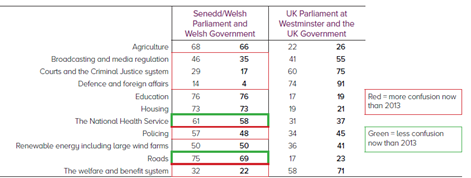
When members of our citizens’ panels were asked which government was responsible for what, the majority identified most subjects correctly except for policing and broadcasting which they thought were devolved matters (Concluding deliberative qualitative research findings: views on the commission’s 3 preferred options for Wales, Beaufort Research, 2023). But in the quantitative survey carried out by Beaufort Research, significant minorities got it wrong – a third thought that benefits are devolved, and just under a third thought that health policy in Wales is the responsibility of the UK government (Gathering public views on potential options for Wales’s constitutional future: Quantitative survey findings summary, Beaufort Research, 2023). Data from a similar survey by Beaufort Research in 2013 suggests that levels of knowledge have not increased (ibid), despite a decade of expanding Senedd legislation and the heightened visibility of the Welsh Government during the Covid pandemic.

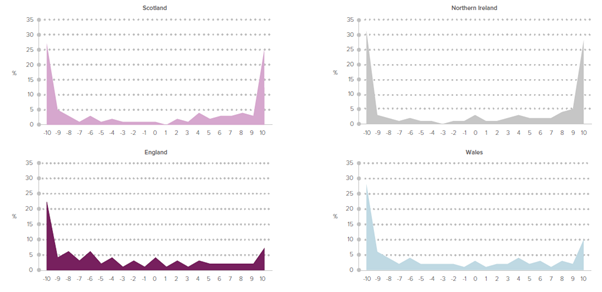
What also emerged from the national conversation is that people’s confidence in their knowledge seems even lower than their understanding would suggest. For example, in the State of the Union research, when citizens were asked about where they stood on the spectrum of parliamentary sovereignty as opposed to shared sovereignty with national governments, one of the most popular answers in all four parts of the UK was ‘don’t know’.

Parliamentary sovereignty
Image
When people talk about changing the way the UK is governed, this sometimes includes the notion that the UK Parliament should share sovereignty (its supreme power to make laws) with the devolved legislatures. Other people argue that the sovereignty of the UK Parliament should remain undiluted. On the following scale, which comes closest to your view? Note: 1, 2 and 3 denote points on a spectrum of views.

Graph from 2023 State of the Union research (Henderson, A., Jones, R. W., 2023, Public attitudes towards the constitutional future of the UK: Analysis from the 2023 State of the Union Survey, Wales Governance Centre and University of Edinburgh)

Both in the citizens’ panels and in several of the Community Engagement Fund reports, many participants started by saying that they did not know anything about how Wales was run (and a few added that they did not care). However, when pressed, or asked about their views in the context of public services, many revealed a much higher level of understanding about Welsh governance than they acknowledged.

The generally low levels of knowledge and understanding, even among those who are politically engaged, is striking. It is not unique to Wales, but it is a problem that undermines confidence in democratic institutions at each level of government. When the UK government intervenes on devolved matters, this adds to confusion. Citizens are uncertain about who is making decisions on their behalf even on subjects of great importance to them, like health services.

The cumulative effect is that people are disengaged, are not aware of the influence they could have in the current system and are unaware of the options for change.

2. In general, citizens are interested in constitutional reform, but may not express that interest in those terms. Many citizens frame their views on constitutional reform in terms of immediate priorities rather than in abstract terms.

When asked about their overarching priorities, people often rank constitutional change below matters such as the NHS, education, and other public services (The economy and inflation remain the country’s biggest concerns, closely followed by the NHS).

The work of Beaufort Research suggests that it would be a mistake to interpret this as ‘citizens are not interested in the subject of how Wales is run, and therefore government should concentrate on other priorities.’

When citizens are asked about their interest in how Wales is run, without reference to technical terms about governance, 81% of those surveyed across Wales say they are very or fairly interested. This figure is fairly consistent across all demographic groups and political affiliations (the outlier is non-voters – 62% - Gathering public views on potential options for Wales’s constitutional future: Quantitative survey findings summary, Beaufort Research, 2023) .

We have also seen that when given the opportunity to get involved in the debate, people are keen to make the most of that opportunity.  We received over 5,900 responses to our online surveys. The attrition rate of members of the citizens’ panels was extremely low and attendance was high, even at the second stage panels held on sunny summer evenings, though some of this attendance can be attributed to participants being paid for their time

When we asked people what matters to them, they told us about their values and policy priorities for government action. These varied widely, including climate change, social justice, efficient delivery of public services and many more. The consistent message is that people care about having a voice in these decisions. Often, they are not satisfied with the decisions made on their behalf and want a greater voice in government.

When asked about options for constitutional change the people we engaged with, both self-selecting and those who contributed through the quantitative research surveys and citizens’ panels, were able to give clear views about governance models, what they perceive as benefits and drawbacks, and their preferences for the future.

People do not generally conceive of governance in abstract terms, they think about its direct impact on the life of communities and individuals in Wales. They may not have a fixed view about what would be best for Wales: what they want is an efficient, effective system of government that delivers the policies that they support, with high quality public services that meets their needs.

People may not want to engage in the debate on constitutional change if it appears to be divorced from the concerns of daily life, but they care deeply about how their country is governed and want their voices to be heard.

3. Many people conflate questions about constitutional structures with judgements on the actions of the government of the day.

Many citizens do not distinguish between the actions of a government and the governance structures within which it operates. In the citizens’ panels people talked about service provision rather than sovereignty or autonomy. In discussing governance, people talked about corruption and poor use of public funding (this view was most prominently shared in the online survey responses and the Community Engagement Fund reports, and to a certain extent in the citizens’ panels).

Similarly, the reports from Community Engagement Fund groups noted that participants talked about government in terms of the services it provides. In many of these reports, participants described their relationship to government as service user to service provider. The quality of the service, and its suitability for their needs and preferences is how they gauge the performance of the government.

This delivery-based view of government, combined with a low level of knowledge about local and national structures, means that, for many people, their views on governance derive from their experience of government policy and performance. For example, the most common reasons given by respondents who support independence related to disaffection with the actions of the current UK government. Conversely, many of those arguing for less devolution, or abolition of the devolved institutions, did so because they object to the policies of the Welsh Government or felt that services in Wales are not good enough (this was observed in responses to the online surveys).

4. Identity and political affiliation have an impact on what people see as the way forward

If people see the government in power and national governance structures as one and the same, it is not surprising that their political affiliation affects their governance preferences.

In the interim report we noted a polarisation of views expressed by citizens, aligned to their constitutional preferences.

The citizens’ panels research gives an insight into how different characteristics affect people’s experiences of devolution, and views of the best constitutional future for Wales.

54% think the current system of government for Wales works very or fairly well, 43% that it does not. Younger people are more positive compared to older cohorts (but the differences are small).

Effectiveness of Welsh governance
Image
Question: How well do you think the current system of government in Wales works? % responses by age. Bases: all (1,596), 16 to 34 (465), 35 to 54 (506), 55+ (339) (Gathering public views on potential options for Wales’s constitutional future: Quantitative survey findings summary, Beaufort Research, 2023)
Effectiveness and party affiliation
Image
Question: How well do you think the current system of government in Wales works? % responses by political affiliation Bases: Conservative (284), Labour (567), Lib Dem (126), Plaid Cymru (196), Reform UK (58), Green (61), other (14), None (197), Prefer not to say (41), Don’t know (48). The small base sizes need to be noted, and care needs to be taken when interpreting this data.

Conservative and Reform UK supporters, those who did not support a political party, and those who supported parties other than the options offered, were less satisfied with how the current system of government in Wales works. Supporters of the other listed parties were significantly more positive about the current system of government.

Views expressed to us in the Welsh language were almost entirely in favour of greater autonomy, often more in favour of the EU and likely to support policies that promoted societal goals (tackling poverty, minority rights, environmental measures). Conversely, the minority who told us that they were Welsh speakers but chose to respond in English were generally against greater autonomy, and often objected to how the Welsh Government promoted the Welsh language (this was observed in the online survey responses and to an extent in some of the Community Engagement Fund reports).

Views on options for constitutional reform

Drawing these strands of the national conversation together showed us that:

  • on balance, the majority of people in Wales support devolution, and many would favour greater autonomy, though their aspirations vary on its extent.
  • Wales in a federal UK is an attractive aspiration for some. Federalism can take many forms and no existing version appears to be self-evidently right for the UK. It becomes less attractive when the practicalities of implementing a functioning federation across the UK are discussed.
  • support for independence and for abolition of the devolved institutions are currently minority, but strongly held, views. Support for each has grown significantly over the past few years. The growth in support of these positions appears to reflect a higher level of political polarisation in the population at large.

We explore these views in more detail in later chapters.

Conclusion

Taking diverse approaches, designed to engage with as many people as possible, has given us a rich and detailed perspective on the views of citizens in Wales.

We succeeded in reaching many people through cost- effective methods, but there are still significant gaps in our engagement: 18 months is not long enough to hold a comprehensive national conversation. We were not able to hear from representatives of all communities across Wales. We began to engage with communities representing D/deaf, blind and partially sighted people and Gypsy, Roma and Traveller communities in particular. Important steps were made, with thanks to third party organisations working with us, but the time needed to overcome barriers and enable them to participate fully was not available to us. A national conversation needs to be continuous and long term, over years rather than months, to build on and develop the start we have made.

In the next chapter we consider how to respond to these issues by revitalising democracy in Wales.

Commission roadshow

Our roadshow took the work of the commission to the heart of communities across Wales

We held 26 engagement events across Wales and reached over 3500 people as they went about their day; at shopping centres and supermarkets, at summer family fun days run by local councils, at community centres and on high streets.

Insights from our team

A successful day at Barry, Family Fun Day today. We had an incredible response on our stand where at times, we had queues. A high number of surveys completed and over 323 engagements. A great location next to the stage where many families sat and watched the entertainment and we kept super busy engaging with parents when the children were busy looking at the merchandise. We found many parents had time to talk and engage more than other venues, possibly as it was a day event with plenty to do. Many of the community seemed to have attended, apparently over 3000 people entered the gates. Prestatyn held a lot of insightful opinions and enthusiasm with regards to completing the survey, making for some really interesting conversations throughout the day.

As soon as we got set up and started in Aberystwyth a gentleman in his twenties approached us who wanted to complete the survey straight away. He mentioned he’d seen the post on Twitter and wanted to make the effort to pop down. He wasn’t the only one as we came across another 5/6 people who also mentioned they had seen our presence advertised on social media. We had great, in-depth conversations and really found it to be a positive engagement.

Many took interest in the stand at Blackwood Beach Party and were thankful for attending the town. Spirits were high, we even had the Mayor join us at the stand and speak with the team for over half an hour. They were impressed with the engagement and were really happy that we had a successful day.

Chapter 3: strengthening Welsh democracy

Introduction

This chapter tackles the second part of our remit - strengthening Welsh democracy. We propose an expansive view of democracy, with citizen engagement routinely embedded in politics and policy making. We argue for strengthening electoral democracy, making greater use of democratic innovations, with myriad opportunities for citizens to participate on the issues they care about.

Representative democracy under strain

In our interim report, we noted the international context of declining trust in democratic institutions and our intention to focus on ways of responding to this in Wales. The democratic process derives its legitimacy from the electoral process, but it involves much more than elections.

Despite the growing confidence and maturity of Wales’ democratic institutions during the two decades since devolution, there are weaknesses in the country’s democracy, not least in citizen engagement. Turnout at Senedd elections remains stubbornly low, but this is only a headline indicator of deeper issues. Several recent reports have highlighted the growing challenges facing Welsh democracy, including low levels of public knowledge of and engagement with Wales’ democratic institutions and “democratic backsliding” where democratic standards gradually decline over time (Defining, Measuring, and Monitoring Democratic Health in Wales, 2023 and Building Bridges: Wales’ Democracy – now, and for our future, 2023).

As set out in the previous chapter, one of the strongest arguments citizens made for constitutional change is that they feel that their votes, and their voices, do not have enough influence on the actions of government. This message came through from all the qualitative sources, including the citizens’ panels and the online survey responses. Citizens have told us that the power to vote is an inadequate mechanism for meaningful influence over decisions made in their name.

We noted in chapter 2 that many people conflate the actions of the government with the governance structures that it works within. This is a particular challenge in Wales, where the democratic institutions have been subject to repeated change, and there have been relatively long periods of Conservative-led government at Westminster and Labour-led government in Wales.

Strengthening trust and engagement with the process of government is the responsibility of the whole of civic society, not just the political parties and the media. All need to contribute to countering the cynicism that corrodes trust in politics and politicians and undermines democracy. The mechanisms we discuss below are ways of enriching democracy by giving elected members better information on the views and ideas of citizens, when they are enabled to participate and given reliable information to draw on.

Regaining citizens’ confidence in representative democracy

Senedd reform

The objective of the current proposals for Senedd reform is to strengthen its capacity to represent people in Wales and to scrutinise and hold the Welsh Government to account. The Senedd has previously legislated to expand the franchise to include 16 and 17-year-olds, to improve the electoral registration process and to enable innovation in the way in which citizens can vote, using the powers devolved by the Wales Act 2017.

As part of its Co-operation Agreement with Plaid Cymru, the Welsh Government has brought forward proposals to increase the size of the Senedd from 60 to 96 Members, for implementation in time for the 2026 election. This is to increase its capacity to discharge its existing responsibilities, and to enable it to take on additional ones as and when the devolution settlement is modified. We strongly welcome these proposals, which build on the work of the Expert Panel convened by the Llywydd in the previous Senedd term.

Electing 96 members requires new electoral arrangements. The proposed scheme will create 16 Senedd constituencies, each returning 6 members on a ‘closed list’ proportional system calculated using the d’Hondt formula. Voters will be asked to choose between lists of candidates nominated by the political parties. The 6 members returned from each constituency will closely reflect the levels of support gained by each party in that constituency, but voters will not have the opportunity to select individual candidates.

We welcome the steps to increase proportionality and capacity in the current proposals, and we strongly support plans to review the new system after the 2026 election. The proposals in the Senedd Cymru (Members and Elections) Bill would require a Senedd Committee to prepare and publish a report on the operation and effects of the Act, considering issues such as:

  • the impacts of the new voting system on proportionality
  • the introduction of multi-member constituencies
  • the experience of closed lists

The method of electing our representatives is crucial. The proposed closed list method is an improvement on the current ‘mixed member system’, where in the constituency vote, voters choose between one candidate selected by each party and, in the regional vote, between closed lists selected by political parties. This will deliver greater proportionality but means that voters will no longer have a direct connection with their local MS. Voters will only be able to choose between lists put forward by political parties and individual independent candidates, should they stand for election; they will not be able to vote in favour of, for example, a candidate who has been ranked in a lower position than another by their party.

We see a good case for alternatives such as a Single Transferable Vote or an open list system, where voters can choose between named individuals representing parties or independent candidates as well as between political parties. We recognise that this can lead to internal rivalries between candidates from the same party, but we encourage the committee to consider these factors along with voters’ perceptions of fairness in the system as part of its review.

The Explanatory Memorandum for the Senedd Cymru (Members and Elections) Bill set out that the committee will be able to

consider any other Senedd reform issue that it considers relevant in the context of undertaking a review of the extent to which the elements of a healthy democracy are present in Wales, and may consider:

  • the awareness and understanding of devolved Welsh government and elections
  • an assessment of turnout levels and an exploration of proposals for how this may be increased
  • support for members and parties to undertake their Senedd roles
  • the infrastructure in place to support a strong Welsh democracy

We recommend the planned review of the Senedd reforms should be resourced to ensure a robust and evidence-based analysis of the impact of the changes, including from the perspective of the voter and of democratic accountability.

Access to the franchise

The Welsh and UK governments are pursuing different approaches to electoral reform and the franchise. The former has made it easier to vote in Welsh national and local elections, extended the franchise to citizens of other countries who have the right to reside in Wales, restricted the rights of UK citizens living abroad to vote, and extended votes to 16 and 17-year-olds.

The UK government has taken the opposite approach, restricting the voting rights of citizens of other countries, expanding those of British citizens overseas, and introducing a requirement for ID before voting in elections to the Westminster Parliament and for Police and Crime Commissioners. The Electoral Commission has noted that the latter change was not based on evidence of fraud and many commentators have argued that it reflects an attempt at voter suppression.

We welcome the Welsh Government’s policy of maximising the participation of electors who pay taxes in Wales and making it easier for people to cast their vote. The different approaches mean that voters in Wales will participate in elections operating under different rules, with Senedd and local government elections operating under the Welsh Government approach, and elections to the Westminster Parliament and for Police and Crime Commissioners operating under UK government rules. This is confusing for voters, but in our view is a better outcome than extending the restrictive UK government model to devolved elections.

Democratic literacy

A strong message from our engagement is that citizens feel that they lack knowledge and understanding about how government systems work, who is responsible for what and how they can influence the political agenda.

Wales in the media

Citizens have told us that they do not get enough information through the media about what is happening in Wales. In the representative survey conducted for us by Beaufort Research, 73% of respondents agreed that “You don’t see or hear enough about how Wales is run in the media”. This was highlighted during the pandemic; many citizens told us of their confusion surrounding lockdown rules, when broadcasters mistakenly presented English rules as applicable in other parts of the UK (this was observed in Community Engagement Fund Reports and in Dweud eich Dweud: Have your Say responses, which were carried out under the final covid restrictions).

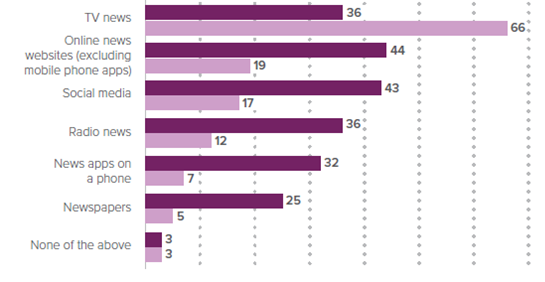
This is important for democratic literacy as for many people in Wales, especially older people, TV broadcasting is their main source of news.

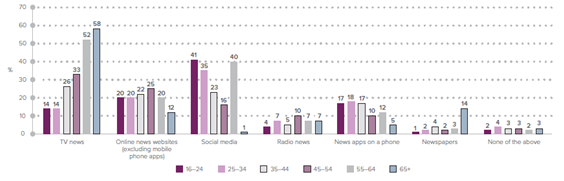
TV news is the main source of news and information generally for people in Wales, followed by online news websites and social media, but there are marked differences by age group.

Image
Question: Where do you get your news and information from? (%)

Graph from the 2023 Beaufort Research report  (Gathering public views on potential options for Wales’s constitutional future: Quantitative survey findings summary, Beaufort Research, 2023)

Image
Main source of news and information, by age (%)

Graph from the 2023 Beaufort Research report  (Gathering public views on potential options for Wales’s constitutional future: Quantitative survey findings summary, Beaufort Research, 2023)

Younger people are more likely to access news and information online, via websites, news apps and social media (Gathering public views on potential options for Wales’s constitutional future: Quantitative survey findings summary, Beaufort Research, 2023). These digital sources can be connected to traditional broadcast media; almost all news channels and newspapers have social media presence and dedicated apps.

If these sources do not accurately inform citizens of what is happening in Wales, and the actions that the government is taking in their names, then citizens will not be able to take well-informed decisions.

Enhancing democratic literacy in Wales

The response to the low levels of democratic literacy in Wales must include giving people more and better information about how democratic government works.

However, it must go further than simply information provision: people need the critical thinking skills to make sense of such information from a range of sources in the age of disinformation, social media, and polarised political views. The new Welsh curriculum is designed to strengthen the focus on these skills in schools, but a much wider reach is needed.

Participation in democratic processes, through political parties and trade unions, has an important part to play, as does involvement in campaigns and voluntary activities locally and nationally.

Democratic innovation

Adjusting the institutions and operation of representative democracy, such as reforming the electoral system, is one way of tackling the weaknesses of Welsh democracy. Another way involves introducing innovative mechanisms for including citizens in decision-making processes, as a way of reinvigorating democracy. Such mechanisms are often introduced alongside, and aim to complement, existing structures for electing politicians and governments. Through a focus on enhancing the participation of diverse social groups in democracy, and promoting informed, reasoned, and respectful deliberation between citizens, these innovations offer the potential for a more legitimate and effective form of democracy.

Local and central governments in many countries are using participative and deliberative mechanisms to support the work of democratic institutions and give citizens’ practical experience of debate and compromise. None of these are silver bullets but used judiciously they can have a significant effect on how citizens and elected representatives understand democracy and share power.

Participative and deliberative democracy

These terms are sometimes used interchangeably, and there is much overlap between the two. Neither approach is superior, both have value in enabling greater involvement of citizens in public life, alongside more conventional engagement mechanisms and traditional representative democracy.

‘Participatory democracy’ approaches are broadly concerned with involving citizens in active and meaningful ways in decisions that affect their lives (Public participation for 21st century democracy, 2015). Within these, ‘deliberative democracy’ approaches are typically more structured processes aimed at giving citizens information about a topic, and then supporting reflection and discussion in order to arrive at informed viewpoints (Innovative Citizen Participation and New Democratic Institutions: Catching the Deliberative Wave, 2020). Both terms nevertheless encompass a huge variety of practices aimed at increasing citizens’ participation and deliberation in democracy.

The term ‘democratic innovations’ is often used to describe different participatory and deliberative formats. Democratic innovations are “processes or institutions developed to reimagine and deepen the role of citizens in democratic governance by increasing opportunities for participation, deliberation and influence” (Defining and typologising democratic innovations, 2019, p11). In practice, democratic innovations assume a wide range of forms (ibid, p25).

Examples of democratic innovations:

  • Mini-publics (such as climate assemblies or citizens’ juries)
  • Participatory budgeting
  • Collaborative governance (such as community anchor organisations, Community Wealth-Building, or public-community partnerships)
  • Ballots and citizen initiatives
  • Digital crowdsourcing

Strengths and weaknesses

Advocates of democratic innovations argue that, when done well, these can lead to better policies and policy outcomes. They can enable policymakers to make hard policy choices, contribute to citizens becoming more informed, and restore citizens’ trust in the democratic political process.

However, there is also a rapidly growing body of evidence from across the world – based on evaluation of the design, implementation and outcomes of a diverse range of democratic innovations – of the limitations of these approaches. It was beyond the Commission’s scope to fully review this work, but the key challenges identified relate to recruitment to such democratic innovations, how they are organised and the extent to which they result in any policy or political change. The international experts that we spoke to nevertheless drew on this evidence base to outline three components of ‘what works’ in any participatory and deliberative process.

Democratic Innovations should be:

  • multi-modal: combining a range of democratic innovations
  • inclusive and deliberative
  • empowered and consequential

(Taken from a presentation given to the Commission by Prof. Oliver Escobar, Professor of Public Policy and Democratic Innovation, Edinburgh University, 2023)

To be effective, these innovations must be central to the policy making process. There needs to be a clear connection to the decision-making process; if there is not enough political will to follow through on these processes, or if the outcomes become subject to partisan wrangling, this can increase disaffection and cynicism.

Democratic innovations can be resource intensive, so they should be introduced carefully and with clarity on how they will be used. In the UK such approaches have often been small, one-off pilots lacking sufficient connection to the political decision-making process to have meaningful long-term impact.

Moreover, such approaches should be used selectively, as not every democratic innovation will be suitable for all issues. There can be an alienating effect if governments over-promise and under-deliver in responding to the outcomes of significant time invested by citizens.

Processes should be tailored to the local communities involved. Much care is needed to design processes that are meaningful, impactful and representative, and include those who face barriers to participation. Democratic innovations across the world demonstrate the opportunities and challenges of gathering a truly representative body of citizens.

The Welsh experience

In Wales, there has also been growing interest in the potential of democratic innovations for engaging citizens with democratic processes and decision-making. This principle is central, for example, to the Wellbeing of Future Generations Act 2015, where one of the 5 ‘ways of working’ is “involvement”, with the aim of ensuring that public bodies in Wales involve people with an interest in achieving the well-being goals set out in the Act (Well-being of future generations act: the essentials). However, there is, as yet, no comparative data on how public bodies have implemented this principle in practice, and the extent to which the Act is driving a fundamental transformation of citizen engagement practices in Wales remains unclear.

There is nevertheless evidence of increased efforts across Wales to use different participatory and deliberative democracy approaches. We heard evidence, for example, of co-production strategies for enhancing citizens’ voice in developing social care and support plans, whilst the ‘Measuring the Mountain’ project convened a citizens’ jury to deliberate on what matters in social care to individuals in Wales. The Senedd, then known as the National Assembly for Wales, organised a citizens’ assembly in July 2019 to consider how people in Wales can shape their future through the work of the parliament, whilst in March 2021 the Blaenau Gwent Climate Assembly considered ways of tackling the climate crisis. The Institute of Welsh Affairs has also engaged a citizens’ panel to examine the role of the media in Wales.

Participatory budgeting has also been trialed in different places: it was used by the Police and Crime Commissioner in North Wales to allow community groups in Wrexham and Flintshire to allocate a proportion of money seized from criminals (Participatory Budgeting: an evidence review, 2017), whilst in Newport participatory budgeting is becoming normalised as a process of resource allocation to community wellbeing projects. We also received evidence of pilot projects across Wales that are developing creative approaches to deliberation, and which demonstrate the potential for Wales to innovate in this sphere and inform strategies for citizen engagement beyond Wales (Creative approaches to deliberation, 2023).

Despite these initiatives, the Welsh experience of participatory and deliberative democracy remains relatively limited and ad hoc. Some projects, such as that for improving the citizens’ voice in social care, have been impacted by austerity, the UK’s exit from the EU and then the global pandemic. The evaluation of the project so far found a significant gap between Welsh Government aspirations for transforming citizen engagement and actual achievements to date (taken from a presentation by Welsh Government officials to the commission in June 2023).

Other initiatives, like citizens’ assemblies, were only designed as one-off events with no clear route for influencing policy-making or political debate more broadly. The projects developing new creative methodologies for deliberation remain at a very small scale. Whilst promising in terms of their capacity to generate more inclusive and reflective deliberative conversations, they lack funding to be scaled up and to further explore how to link them to decision-makers at local, regional or national scales.

There is potential for public bodies in Wales to do much better than they have so far, to use innovative mechanisms to strengthen democracy in Wales.

A “constitution” for Wales?

The UK does not have a written constitution, nor do its constituent nations. The devolution settlement already contains some components of a written constitution, for example, the definition of powers in Schedule 7 to the Government of Wales Act 2006, the statutory partnership provisions in the Wales Act 1998, and the Wellbeing of Future Generations Act 2015. Moreover, the Government of Wales Act 2006 established the Senedd and the Welsh Ministers, delineated their powers, and set their rules of operation and the relationship between them.

Given the interaction with Westminster legislation which authorises the existence of the devolved institutions (most of which cannot be amended by the Senedd), it would not be possible to create a self-standing and comprehensive constitution for Wales under a devolved governance structure. However, drawing on these statutory examples and amplifying them with some general principles of good governance to produce a declaratory statement about how Wales is and should be governed could be a valuable step. If done by involving the citizens of Wales, this could provoke debate and reflection and enhance democratic and civic literacy in Wales.

Consulting widely on drafts and deploying deliberative and participatory democracy mechanisms would be an important way of bringing citizens into the process and giving the ‘constitution’ significance. This declaratory statement would need to be ratified by the Senedd, and its existence used to inform public understanding of governance in Wales. We believe that the production of a ‘made-in-Wales’ declaratory statement about our governance could have value in clarifying what the citizens of Wales want and expect from their governing institutions.

On this basis, we recommend that, drawing on the capacity and the expertise we recommend creating, the Welsh Government should lead a project to engage citizens in drafting a statement of constitutional and governance principles for Wales. Several countries have undertaken similar exercises, including Australia, Iceland, Egypt and Chile, while others such as Ireland and Canada have used democratic innovations on aspects of constitutional reform. These projects have had varying degrees of success; in undertaking such a project the Welsh Government should draw on the international experience of what works and what does not (How to Have a National Conversation on Wales’s Constitutional Future, 2023).

Subsidiarity and local government

We discuss how the different options for the future compare in terms of subsidiarity in chapter 7. In addition, we believe there is scope to extend subsidiarity within the current devolution settlement.

The principle of subsidiarity is that decisions are made at the level closest to the citizen, consistent with effective delivery. This involves a balance between economies of scale, local control, and accountability. Compared with its neighbours in Europe, the UK is a centralised state, with fewer powers held at regional or local government level than in many other similar sized nations.

Some argue that the Welsh Government holds too many responsibilities that could be delegated to local authorities or to regional groups of authorities. Proposals to enhance subsidiarity in this way depend on the capacity of authorities to take on new responsibilities. Many commentators argue that 22 local authorities in a country the size of Wales is too many. Since 1999, the Welsh Government has tried without success to reduce the number, including an option for voluntary merger of neighbouring authorities (which no local authority has taken up). Those who oppose change cite the cost of reorganisation, and the scope for disruption to services on which people rely.
Other factors militating against reform include:

  • the limited funding available in the context of austerity, and relative increase in hypothecated funds, albeit that the Welsh Government has a Programme for Government commitment to reduce the number of specific grants, giving more control over spending to local authorities.
  • pressure from voters and Members of the Senedd for the Welsh Ministers to have oversight, control, or intervention powers on local issues, so that Welsh Ministers can be held accountable for those issues.
  • Welsh Ministers wanting to influence delivery more directly, and centralising services to make efficiency savings.
  • A general centralising culture in political life across the UK, meaning decentralisation involves actively working against the way things have been done before and are done elsewhere in the UK.

Against this background, Welsh Ministers have legislated to strengthen regional collaboration between authorities and to strengthen local democracy by, for example, better remuneration for councillors and improved scrutiny mechanisms.

We met the Welsh Local Government Association on 2 occasions and considered their localism manifesto. Beyond this, we did not take evidence on the powers of local government, as we felt that this was beyond our remit.

Local government is a vitally important part of Welsh democracy, and local councillors have a very direct mandate and accountability within their area. We believe that their role should be part of the constitutional debate, and that elected members should engage constructively with the issues of scale and capacity mentioned above. The aim should be to achieve greater devolution within Wales as scale and capacity allows, and the Welsh Government, local authorities and other partners should work together on tackling these.

Conclusions

Our understanding of democracy should be more expansive than just a system of governance. Power as the capacity to make change is enhanced by distributed leadership which includes elected representatives and citizens. We need to complement and enrich representative democracy with deliberative and participatory mechanisms.

We encourage elected representatives to reflect on how democratic innovation can enhance the relevance of representative democracy and the quality of decision-making in Wales.

We make 3 recommendations to strengthen Welsh democracy. These initiatives are important, whatever constitutional model is ultimately supported by the people of Wales.

Recommendations

1. Democratic innovation

The Welsh Government should strengthen the capacity for democratic innovation and inclusive community engagement in Wales. This should draw on an expert advisory panel, and should be designed in partnership with the Senedd, local government and other partners. New strategies for civic education should be a priority for this work, which should be subject to regular review by the Senedd.

2. Constitutional principles

Drawing on this expertise, the Welsh Government should lead a project to engage citizens in drafting a statement of constitutional and governance principles for Wales.

3. Senedd reform

We recommend that the planned review of the Senedd reforms should be resourced to ensure a robust and evidence-based analysis of the impact of the changes, including from the perspectives of the voter and of democratic accountability.

Voices from Care Cymru

Community Engagement Fund Partner: Voices from Care Cymru

Voices From Care Cymru is the national organisation supporting care experienced children and young people in Wales. It is a Children’s Rights organisation. It provides practical and emotional support to care experienced children and young people and supports them to get their voices heard by influencers and decision makers. Voices from Care Cymru has over 30 years’ experience of supporting young people in this way, people who often experience multiple disadvantage including homelessness, unemployment and mental health issues. This work supports them to understand and engage with decision making processes, and to influence them effectively.

“It took us a while to get through to our members how important this is for them, but once they began to understand that there was no stopping them! If there are further opportunities to engage with this work they would welcome the chance to do so.”

Voices from Care Cymru facilitator

Voices

Engagement participants (anonymous) in discussion:

“They [Senedd members and Welsh politicians in general] don’t always get it right. In fact, they often mess up. But at least we can talk to them.”

“We are a small country. We need to work with our neighbours.”

“It doesn’t make sense. Social workers are doing what one government tells them is right. But the court is controlled by a different one. I don’t understand how anyone came up with that.”

“They gave us votes at 16 didn’t they? That shows that they think that what we say is important.”

“After all, pollution doesn’t stop at borders does it? If they pour [….] into the sea in Bristol it won’t take long until it gets to Swansea.”

“When you get your own house you don’t ask your neighbours how to decorate it or when to put the heating on. Why are we (the people of Wales) still letting our neighbours (the people of England) tell us what to do?”

“We are too small to compete with other countries on our own”.

“Well, if they are going to carry on sharing power they need to work properly together.”

Chapter 4: protecting devolution

Introduction

This chapter reviews the workings of inter-governmental relations. We make recommendations for changes needed urgently to protect devolution, whatever constitutional model the people of Wales choose for the long term.

The relationship between the devolved institutions and Westminster is a crucial pillar of Welsh governance. In our interim report we noted that in recent years relations have become fragile and unstable.

Devolution in 1999 was a major step forward for democracy in Wales, and in 2011 the popular vote endorsed the devolved institutions as a fully formed system of government with primary law-making powers. The fallout from Brexit has exposed the fragility of this governance structure. The UK government and Parliament have overridden the Sewel convention on 11 occasions since the 2016 referendum to leave the EU, with virtually no scrutiny or challenge at Westminster. In these cases the Welsh and UK governments agreed that consent was required; in one of these consent was given except for a late amendment where the timetable did not allow for Senedd consideration. There were a further 5 cases where the UK government took the view that consent was not required but the Welsh Government believed that it was.

We make no recommendation as to which long-term constitutional option is best for Wales; that is a decision for citizens and their representatives. It is clear to us that the current devolution settlement cannot be taken for granted, and is at risk of gradual attrition if steps are not taken to protect it. Citizens should be able to choose ‘no change’, but without urgent action there will be no viable settlement to protect.

Citizens’ views

The call for governments to work together to deliver efficiently in the public interest has been a strong theme in our evidence. Many of those we heard from expressed frustration at what they see as ‘political point-scoring’, ‘being different for the sake of it’, and governments working against each other instead of co-operating to improve life for citizens (these points were made in the online survey responses, in citizens panels and in some of the community engagement fund reports).

Co-operation

The State of the Union research indicates that in all 4 UK territories, between 58% (Scotland) and 65% (England) of respondents agreed that the governance of the UK would be improved if the UK and devolved governments collaborated more (Henderson, A., Wyn Jones, R., 2023, Public attitudes towards the constitutional future of the UK: Analysis from the 2023 State of the Union Survey, Wales Governance Centre and University of Edinburgh).

Inter-governmental collaboration

Image


Question: Which comes closest to your views?

  • UK governance would be improved if the UK and devolved administrations collaborated more on issues of common interest
  • UK governance would be improved if the UK and devolved administrations concentrated on their own responsibilities
  • Don't know

Graph taken from State of the Union 2023

Citizens do not use the term ‘inter-governmental relations’ when they talk about how governments interact, but they make it clear that they want governments to collaborate. 92% of those surveyed believe it is important for both governments to work well together (Gathering public views on potential options for Wales’s constitutional future: Quantitative survey findings summary, Beaufort Research, 2023). This holds true even if they dislike one of those governments: they exist, they are making decisions and they should work collaboratively (this view was presented in online survey responses, particularly the online engagement platform survey where there were specific questions on inter-government co-operation).

When inter-governmental relations fail, both governments fall in many citizens’ estimation. As we noted in chapter 2, people often do not differentiate between party politics, constitutional structures and public services. Citizens generally have very little time for governments blaming each other instead of focusing on improving services (this view was presented, occasionally forcefully, by respondents to both online surveys and through the community engagement fund reports).

Governments’ inability to work constructively together feeds disaffection with politics. Citizens see finger-pointing and blaming as a case of elected representatives promoting their own interests. In our online engagement platform survey, many people told us that they did not believe the UK government and the Welsh Government could ever work together constructively while opposing political parties were in power because this was not in the ruling parties’ interests (the online engagement platform survey included a specific question on whether the UK and Welsh governments could work better together in the future, a plurality felt that this was only a possibility when the same political party was in power in both Cardiff and London).

Citizens rarely used the term ‘mechanisms for inter-governmental relations’, but there was strong support across the 4 territories of the UK for a written constitution or independent mechanisms to resolve disputes between governments (Henderson, A., Wyn Jones, R., 2023, Public attitudes towards the constitutional future of the UK: Analysis from the 2023 State of the Union Survey, Wales Governance Centre and University of Edinburgh – this point is explored more in chapter 6).

This support seems to reflect a sense of fairness, distinct from respondents’ constitutional preferences. Many respondents thought that such mechanisms would protect the things they value. For example, those who want to preserve the UK Parliament’s supremacy supported steps to prevent the Welsh Government exceeding its powers. Those who support at least protecting the current devolution settlement wanted mechanisms to protect the devolved institutions from being undermined by the UK government (the first 2 questions of the online engagement platform survey concerned a written constitution, requesting respondents shared why they would be for or against having one for Wales).

Respect

Our research reveals that citizens in Wales expect parity of treatment and equality of respect with the other nations of the UK. The State of the Union research shows that across the UK, citizens are in favour of respecting the devolved institutions and do not support UK government intervention or legislation on devolved matters without consent.

Amongst these respondents there was little support for a UK government attempting to block devolved governments from acting within their powers. A plurality of respondents favoured intervention only when the devolved institutions were acting outside their powers (Henderson, A., Wyn Jones, R., 2023, Public attitudes towards the constitutional future of the UK: Analysis from the 2023 State of the Union Survey, Wales Governance Centre and University of Edinburgh). To note - ‘plurality’ has a specific meaning in relation to statistical analysis – the largest proportion, but not a majority.

Asked whether the UK Parliament should be able to legislate on devolved matters, only 17% in England said it should be able to ‘whenever it wants’ – proportions were lower in Scotland (12%) and Wales (14%) and similar in Northern Ireland, though there was a much higher level of ‘don’t knows’ (33%) in England, reflecting lack of familiarity with the issue (Henderson, A., Wyn Jones, R., 2023, Public attitudes towards the constitutional future of the UK: Analysis from the 2023 State of the Union Survey, Wales Governance Centre and University of Edinburgh).

By contrast, 45% in Scotland, 37% in Wales and 37% in Northern Ireland favoured strengthening the Sewel convention so that it prohibited such legislation without permission or in any circumstances. The comparable figure was only 26% in England. When combined with the 28% who favoured the current Sewel principle of the UK Parliament legislating ‘not normally without consent’, this means that a majority of English respondents are in favour of at least Sewel approaches to legislation. There was a similar pattern in respect of the UK government’s powers to spend on devolved matters, with less than a fifth of respondents in England, Scotland and Wales saying there should be no constraint.

UK government action in devolved areas

Image

Question: The current devolution settlements allow the UK government to block various activities of the devolved legislatures under certain circumstances. In which circumstances, if any, should the UK government attempt to block the activities of devolved administrations?

  • If they believe that the devolved body is acting outside its allotted powers
  • If they believe that the devolved body is acting within its allotted powers but they don't agree with the policy aims
  • Whenever they want, the UK Parliament is supreme
  • Never, the devolved bodies have their own democratic mandates
  • Don't know

Graph taken from State of the Union 2023 (Henderson, A., Wyn Jones, R., 2023, Public attitudes towards the constitutional future of the UK: Analysis from the 2023 State of the Union Survey, Wales Governance Centre and University of Edinburgh)

When should the UK Parliament legislate in devolved areas? (%)

 EnglandScotlandWalesNorthern Ireland
Whenever it wants17121417
Not normally without consent24192028
Only with permission21242428
Never522139
Don't know33232918

Question: The current devolution settlements allow the UK parliament to "legislate" on devolved matters for Scotland, Wales or Northern Ireland. Which of the following statements comes closest to your view?

  • The UK Parliament should legislate on devolved matters whenever it wants
  • The UK Parliament should not normally legislate on devolved matters without the consent of the devolved legislatures
  • The UK Parliament should only legislate on devolved matters if it has the permission of the devolved legislatures
  • The UK Parliament should never legislate on devolved matters
  • Don't know

(Henderson, A., Wyn Jones, R., 2023, Public attitudes towards the constitutional future of the UK: Analysis from the 2023 State of the Union Survey, Wales Governance Centre and University of Edinburgh)

When should the UK government spend in devolved areas?

 EnglandScotlandWalesNorthern Ireland
Whenever it wants14151722
Not normally without consent21181923
Only with permission21282729
Never111264
Don't know33273222

Question: The current devolution settlements allow the UK parliament to "spend" on devolved matters for Scotland, Wales or Northern Ireland. Which of the following statements comes closest to your view?

  • The UK parliament should spend on devolved matters whenever it wants
  • The UK parliament should not normally spend on devolved matters without the consent of the devolved legislatures
  • The UK parliament should only spend on devolved matters if it has the permission of the devolved legislatures
  • The UK parliament should never spend on devolved matters
  • Don't know

Table from the 2023 State of the Union report (Henderson, A., Wyn Jones, R., 2023, Public attitudes towards the constitutional future of the UK: Analysis from the 2023 State of the Union Survey, Wales Governance Centre and University of Edinburgh)

Knowledge and understanding

Most citizens have some understanding of how policy responsibilities are split between the UK government and the Welsh Government, but few have full knowledge. Despite the higher profile that the pandemic gave to devolution, public understanding has not greatly improved in the last 10 years (Gathering public views on potential options for Wales’s constitutional future: Quantitative survey findings summary, Beaufort Research, 2023).

Who is responsible

Image

Base: All 2023 (1,596), Commission on Devolution in Wales survey 2013 (2,009) Care should be taken when comparing the results of these surveys due to different methodologies (2023 = online, 2013 = Telephone) Comparisons made where possible.

Question: Here is a list of areas. For each one, please select who you think has main control of the area in Wales: the Senedd / Welsh Parliament and Welsh Government or the UK Parliament at Westminster and the UK government? (%)

  • Agriculture
  • Broadcasting and media regulation
  • Courts and the criminal justice system
  • Defence and foreign affairs
  • Education
  • Housing
  • The National Health Service
  • Policing
  • Renewable energy including large wind farms
  • Roads
  • The welfare and benefit system

Figures in bold from Commission on Devolution Survey 2013

Chart from the 2023 Beaufort Research report (Gathering public views on potential options for Wales’s constitutional future: Quantitative survey findings summary, Beaufort Research, 2023)

Who should be responsible

Image

Question: In the following policy areas, who do you think SHOULD have the most power and responsibility with respect to Wales? (weighted sample of 959 adults in Wales - 14-15 October 2023)

  • Transport
  • Housing
  • Education
  • Cultural issues
  • Policing
  • Environment
  • Welfare
  • NHS
  • Gender reform
  • The economy
  • Immigration
  • Foreign policy

Graph from polling carried out by Redfield and Wilton for Wales Online, October 2023.

Often, citizens’ primary concern is that services are delivered efficiently, effectively, and meet their needs. Where people have firm views about the division of policy responsibilities, this often depends on their perception of who is best able to deliver a high-quality service. This was a view presented to us repeatedly by citizens in the online surveys, the Community Engagement Fund reports and the citizens’ panels – the quality of public service delivery was the yardstick by which they measured the effectiveness of government, and for many it was a deciding factor for which constitutional framework they saw as best for Wales.

Protecting devolution

Welsh devolution is based on the outcome of 2 referendums and continues to enjoy popular support. It should not be eroded without the consent of citizens.

To recap, the key features of the current settlement are:

  • Law-making powers on most domestic matters are devolved to the Senedd but the UK Parliament can pass laws affecting devolved matters without the Senedd’s agreement.
  • Relations between the UK government and the devolved governments rely on convention. The initiative in these relations rests with UK government. The system was reformed, by agreement, in 2022 but still relies on the commitment of individual ministers.
  • The powers devolved to Wales are broadly the same as Scotland, with the exception of justice and policing, some tax-varying powers, some social security benefits and some aspects of rail services.

The fundamental flaw in the current system of devolution is its vulnerability to unilateral change by a majority in the Westminster Parliament. This vulnerability is intrinsic to the devolution model which rests on powers conferred by the Westminster Parliament, which it can be taken away by the Westminster Parliament at any time.

Constraining the right of the UK Parliament to legislate as it sees fit could only be achieved by abandoning the principle of parliamentary sovereignty, which is widely seen as a cornerstone of the UK constitution (The contested boundaries of devolved legislative competence, 2023). It is difficult to envisage this occurring in the short to medium term. However, there are a range of measures that could, and should, be put in place to ensure that devolution is a stable and viable governance structure for Wales.

The inter-governmental process

The UK’s inter-governmental process is built on 2 foundations:

  • Principle: the Sewel convention, which constrains Parliament in legislating on devolved matters. The Wales Act 2017 specifies that ‘it is recognised that the Parliament of the United Kingdom will not normally legislate with regard to devolved matters without the consent of the Assembly.’ The same provision for Scotland is included in the Scotland Act 2016.
  • Practice: the inter-governmental arrangements established in 1999 and restructured in 2022, following a joint review by the 4 governments.

The most important elements of any inter-governmental process are:

  • predictability
  • a dispute resolution mechanism
  • parity of esteem for each government’s electoral mandate
  • procedures which all parties feel to be fair.

An effective process is essential to manage the interaction of responsibilities between the nations of the UK. Such interaction is unavoidable in any devolution settlement, and shared borders mean that it would persist under other constitutional models. Improving the relationship in a spirit of co-operation and parity of esteem, is essential, whatever option is pursued.

Shared governance is often undervalued as a feature of devolution. Whether a matter should be devolved or reserved is often seen as a binary question which overlooks the need for shared governance in relation to both devolved and reserved matters. The creation of a new internal market within the UK after Brexit has enhanced the scope for shared governance and makes good working relationships between governments considerably more important than it was in 1999. Further devolution of matters such as taxation have also increased the importance of shared governance.

Shared governance does not mean pitting the policy preferences of one government against the other. It means recognising each other’s interests and enabling tensions to be addressed through an agreed process. The findings of the transport sub-group (we discuss the sub-groups to the commission in chapter 5) on Wales’ rail infrastructure make a compelling case for greater use of shared governance on cross-border infrastructure.

The new structure of inter-ministerial groups creates a potentially coherent framework for shared governance, provided that the agendas and work plans cover the most important issues requiring co-operation between governments. It is essential that this structure develops to provide the continuity and stability that builds trust and shared understanding, so that it can sustain changes in personnel and become sufficiently robust to manage crises or disagreements when they arise.

Above all, effective inter-governmental relations are a priority for citizens. The changes we recommend below should be enacted by any government concerned about the stable and effective governance of the UK.

Lessons from federal systems

Differences between governments within a state are inevitable whatever their political affiliation, as seen in federal systems around the world.

Federal states such as Australia and Canada have well-established structures for relations between tiers of government. Typically, these are respected by all parties as necessary to the effective operation of the state, and are underpinned by a culture of co-operation and collaboration, or ‘federal spirit’, which includes:

  • acceptance of the place and legitimacy of the sub-state institutions in the governance of the state as a whole
  • a commitment for governing institutions at all levels to work together for the greater good
  • respect for the underpinning machinery which facilitates such collaboration.

Features of internal relations in federal states

  • Certainty: standing, formally established, structures linked to the constitution.
  • Predictability: timetables are agreed in advance linked to the decision-making cycle
  • Conflict management: conflict between levels of government is expected and provided for.

The state of inter-governmental relations

In 2022, the 4 governments of the UK agreed new inter-governmental arrangements, following the Dunlop Review established by Prime Minister Theresa May (Review of UK Government Union Capacity, 2019). The new structures have some of the features of a federal model, except that in the UK, the arrangements are discretionary, and there is no mechanism for challenging the decisions of the Treasury. More fundamentally, the collaborative ‘federal spirit’ is not a strong feature of inter-governmental relations in the UK.

The Sewel convention

The value of the Sewel convention (footnote 1) in protecting the powers of the devolved institutions is in doubt, because the UK government and Parliament have overridden it on numerous occasions since 2016, as discussed above. Many of these related to legislation directly or indirectly connected to Brexit, such as the EU Withdrawal Act and the Internal Market Act 2020. The UK government took the view that it is consistent with the Sewel convention for Westminster to legislate without consent in some circumstances, and that the legislation to implement Brexit was exceptional.

We accept that under the pressure to implement a working Withdrawal Agreement or face a no-deal Brexit, the UK government and Parliament felt it had to legislate without consent. However, this does not justify the unilateral process followed, including cutting the devolved governments out of the successor to EU structural funds, and making trade agreements detrimental to devolved interests. Nor does it justify failing to honour the commitments made to the devolved governments to engage them in the negotiations on exiting the EU.

The constructive joint work by the 4 governments on common frameworks (the common frameworks were a series of agreements for managing the powers previously exercised by the European Commission, and now exercised within the UK as a mix of devolved and reserved powers) is a notable exception to the decline in relations after Brexit. The House of Lords Common Frameworks Scrutiny Committee has suggested that the frameworks are at risk of becoming a missed opportunity, partly because the Internal Market Act 2020 and the Subsidy Control Act 2022 have ‘challenged the consensus approach taken in the common frameworks’ (Common frameworks: an unfulfilled opportunity?, 2022).

The evidence reaffirms the concerns we set out in chapter 7 of our interim report. We do not believe that the Sewel convention can be restored to its previous standing without reinforcement.

Procedural and legislative remedies

In the early stages of our work, it seemed that this problem was insoluble because the supremacy of the Westminster Parliament is seen as fundamental to the unwritten constitution of the UK. As we delved deeper, we discovered that there may be ways of constraining a Westminster Government with a majority in the House of Commons without calling into question the fundamentals of the British constitution.

Of course, any such constraints could be overturned by a subsequent government with a majority, in the same way as the Fixed-Term Parliament Act 2011 was repealed by the Dissolution and Calling of Parliament Act 2022. However, changing constraints set in statute raises the political bar significantly, making it more difficult to unilaterally undermine the devolution settlement. We recommend the following provisions to achieve this:

Legislative provisions to protect devolution

  1. Putting into statute and making justiciable some key principles of inter-governmental relations and structures
  2. Putting into statute that the consent of the devolved institutions is required as a matter of law for any of the following:
    • Any change of the scope of devolved legislative or executive powers
    • Any other change to the devolution settlement
    • Any exercise of legislative power by the UK Parliament within devolved competence, other than changes strictly required to fulfil the UK’s international obligations, maintain its defence or national security, or its macroeconomic policy
    • Any exercise of executive power by UK government ministers within devolved competence
  3. Structuring the legislation enacting this in such a way that it could not readily be repealed or amended by a simple majority of the House of Commons without, at a minimum, significant reputational damage.

We suggest that these protections should apply to all 3 devolution settlements, if the legislatures and executives for Scotland and Northern Ireland support them. For Wales, we believe that these remedies are essential.

Inter-governmental mechanisms

In writing to Lord Dunlop in March 2021, the then Chancellor of the Duchy of Lancaster, Michael Gove, set out the UK government’s intentions (Letter from Rt Hon Michael Gove MP, 2021). He said that the objective was to create ‘a system of governance that will help build long term trust between governments’ and ‘support effective and regular consultation and, when appropriate, joint decision-making in areas of shared interest’.

Review of Inter-governmental Relations, January 2022
  • A joint review by the 4 governments of the UK, with the report agreed by the heads of the 4 governments.
  • The report proposed creating a new 3 tier structure:
    • Tier 1 of portfolio Inter-Ministerial Groups
    • Tier 2 of cross-cutting Ministerial Groups
    • a top tier of Heads of Government.
  • The report was based on a commitment to collaboration, trust and transparency.
  • There would be an independent secretariat, recruited from the 4 governments, and a new independent arbitration mechanism binding on all departments except HM Treasury.

(Review of Inter-governmental Relations, 2022)

The evidence on progress towards this objective is mixed. The new arrangements announced by the 4 heads of government in 2022 make significant improvements, including the new structure of inter-ministerial groups dealing with 16 Whitehall portfolios.

These changes have the makings of a more effective structure, and the independent arbitration mechanism should enhance confidence and trust. However, excluding the decisions of HM Treasury from this mechanism is hard to justify, given the impact that Treasury decisions have on devolved government.

The Welsh Government’s report published in July 2023 identified a number of areas where practice in implementing the reforms has fallen short of the principles set out in the joint review. The key problems have been:

  • limited involvement from the Prime Minister
  • delay in convening some of the inter-ministerial groups
  • questionable commitment from some UK ministers to the groups as forums for genuine engagement, which was not helped by the rapid turnover of UK ministers
  • poor communication
  • lack of preparedness for meetings

The evidence suggests that the potential of the new structures has not yet been fully tested. Genuine inter-governmental collaboration requires considerable energy and commitment across all parts of government and throughout the lifetime of an administration. This has been lacking in recent years.

A lack of respect for the devolved administrations, as elected legislatures and as executives accountable to their own electorate, undermines inter-governmental relations in the UK. While UK Parliamentary sovereignty is a cornerstone of the UK’s constitution, there is no legal basis for an ‘executive sovereignty’ that would justify seeing devolved governments as subordinate to UK government departments.

The culture, and working assumptions, of Whitehall does not hold the Welsh Government in parity of esteem. This is particularly the case with HM Treasury which seems to view the devolved governments as subject to its scrutiny in the same way as Whitehall departments.

Inter-governmental relations: tax and finance

In our interim report we said that the budget restrictions applied by HM Treasury undermine the Welsh Government’s ability to manage its budget and plan for the long term. Given the Welsh Government’s accountability to the Senedd’s Public Accounts Committee, and thus to its electorate, there is no justification for these restrictions.

The Welsh Government is seeking the following financial flexibilities to improve value for money. We believe the Treasury should accept these or explain its reasoning for withholding its agreement.

Borrowing and draw-down limits

The improvements made to the Scottish Government’s Fiscal Framework in relation to reserve and borrowing limits should be applied to Wales automatically without the need for a review of the Welsh Government’s Fiscal Framework. Applying the same arrangements for Wales would mean:

  • Indexing their borrowing and overall reserve limits to inflation.
  • The abolition of their reserve draw-down limits.

There is also a case for increasing capital borrowing limits.

Flexibility to manage in-year changes

Late changes to budgets present several challenges, including: difficulty in using large, unexpected allocations before the end of the financial year in ways which maximise value for money; and in managing large, unexpected cuts. Changes like those to the Scottish Government’s Fiscal Framework would help with this problem but might not be sufficient to deal with big additions or reductions late in the year. A principle should be established that funding changes confirmed after an autumn fiscal event can be managed across financial years, in addition to any carry forward permitted under reserve arrangements, to ensure effective budget management at the end of the financial year.

Large in-year announcements

The UK government should consider a solution similar to the Covid Guarantee when making decisions that potentially involve the allocation of substantial sums of money in-year. This would mean providing additional funding to devolved governments in good time, even when offsetting budget changes might affect overall funding levels later in the year. Any required changes could be reconciled later. This would give devolved governments some degree of certainty about the funding available ahead of the overall UK government departmental positions being finalised at UK Supplementary Estimates near the end of the financial year.

While the steps outlined above would represent a significant improvement over the status quo, we believe that in principle the Welsh Government should be free to manage its financial resources, with accountability to the Senedd, except where restrictions are necessary for the operation of UK macroeconomic policy, and that this principle should form the basis for future agreement between the Welsh and UK governments.

Devolved taxes

This raises the wider question of the UK government’s approach to proposals from the Welsh Government for new Welsh taxes. At present the Treasury requires a detailed policy justification for all proposals for new taxes. This can cause long delays and is incompatible with the Welsh Government’s accountability to the Senedd. The Welsh Government’s proposed Vacant Land Tax was considered to be a suitable start for the programme of developing new taxes. As HM Treasury has not completed its scrutiny after 4 years, it seems reasonable to conclude that this is intended to act as a block on innovation.

More widely, the scope for the Welsh Government to modify income tax is more limited than that of the Scottish Government. There is no case in principle for this different treatment. When the Welsh Government seeks further powers or greater flexibilities, in line with the other devolved governments, there should be a presumption of agreement unless there is a strategic case for continued reservation to the centre, in line with the recommendations we make later in the report for the exercise of powers.

The financial and tax flexibilities we propose can be made within the existing framework of the Barnett formula. Longer term, there is widespread recognition that the formula is an inadequate mechanism for determining the expenditure needs of the devolved nations. Devolution has evolved beyond recognition since it was introduced over 40 years ago, and there have been substantial changes over that time in the governance of the regions of England.

We believe that there is a growing case for a review of the funding of the devolved governments, jointly led by the UK and devolved governments. This review should consider from first principles how to allocate resources across the different parts of the UK, based on a shared assessment of relative needs and with a strong element of independent oversight.

Inter-governmental relations: data

The work of the commission sub-group on justice and policing (chapter 5) shows that the lack of Wales-specific data is a significant barrier to accountability and performance improvement. We have not taken evidence on data sharing in other areas but underline that Wales-specific data on reserved matters is essential to support better policy making. There should be a presumption in favour of compiling, sharing and publicising service data as a matter of routine.

Inter-governmental relations and the boundaries of the settlement

The failure of inter-governmental relations has led to poor policy outcomes at the boundaries of the devolution settlement. This is particularly the case for justice, and in transport. We explore the challenges that the current boundaries of devolution present for good governance and effective delivery in Chapter 5.

Policy innovation

One of the early arguments for devolution was to enable the devolved governments to try out new ideas, as happened with charging for plastic bags in Wales which was later adopted in the rest of the UK. Citizens, when polled, seem to prize policy uniformity across the UK, but support for policy uniformity drops when asked about policies where there has been significant divergence between nations such as prescription charges (The Ambivalent Union: Findings from the State of the Union Survey, 2023). It is also plausible that citizens in devolved nations believe there should be UK-wide uniformity with the policies in their nation, feeling that other parts of the UK should benefit from successful policies trialled ‘at home’.

All 4 governments have supported this policy laboratory approach in principle. In practice the political culture has been more suspicious, taking a ‘not invented here’ approach rather than embracing of diversity.

The British-Irish Council has been a more supportive context for shared learning, perhaps because it is more detached from internal UK politics.

Recent examples of Welsh devolution as a policy laboratory

Tax

As a new small body of 80 staff, responsible for 2 devolved taxes, the Welsh Revenue Authority has been able to innovate with a digital and partnership led business model. The UK government’s HM Revenue and Customs has taken a positive interest in the Authority’s approach and invited the Chief Executive to share learning with its staff.

Basic income pilot for care leavers

The Welsh Government is testing the impact of a minimum income on the prospects of young people leaving care, who are vulnerable and at risk of being drawn into offending and self-harming behaviour. UK government ministers have attacked the pilot in public and shown no interest in learning from it.

Asylum seekers

The commission’s welfare sub-group (chapter 5) explored with the Welsh Government the scope for an area-based pilot to test the impact on public services and tax revenues of reducing the barriers to asylum seekers seeking employment. They felt that such a pilot would be unlikely to gain UK government support, partly for policy reasons and partly because primary legislation would be required.

We recognise that these examples vary in their complexity, and that legislative competence can be a constraint. In a spirit of collaboration to facilitate new approaches, the UK government could confer competence on the relevant devolved legislature on a temporary basis to enable a policy pilot to be run.

This could be done through the Order in Council procedure provided for in the Government of Wales Act following the 2013 precedent when an order was made giving the Scottish Parliament temporary competence to legislate for an independence referendum. A pilot allowing asylum seekers greater access to work could be a possible use of such a power, with the Senedd given power for the lifetime of a Parliament to set up a scheme and see how it could work. The next UK Parliament could legislate if there was a desire to expand the pilot across the UK.

Conclusions

The mechanisms for managing devolution need to be strengthened to protect devolution in respect of the Sewel convention, inter-governmental relations and devolved financial management.

The effective conduct of relations between the 4 governments of the UK is too important to be left to the discretion of individual ministers. The only basis for successful relations is parity of esteem. Insofar as the UK government views the devolved governments as stakeholders to be managed, inter-governmental relations will be characterised by poor relations and poor outcomes. A spirit of genuine co-operation is needed, as exists in federal states. Those with long experience of the system can recall very few, if any, examples of where the UK government has announced that UK government policy has changed due to representations made following a formal meeting with the devolved governments.

A mature relationship would recognise that all governments have something to learn from each other. At times the UK government seems to see good relations as an optional extra; they are not. They are fundamental to the functioning of the countries of the UK jointly or separately.

Recommendations

To strengthen the mechanisms that protect devolution and to enable more effective management of the Welsh Government budget, we make the following recommendations. The legislative provisions required for recommendations 4 and 5 are set out above.

4. Inter-governmental relations

The Welsh Government should propose to the governments of the UK, Scotland and Northern Ireland that the Westminster Parliament should legislate for inter-governmental mechanisms so as to secure a duty of co-operation and parity of esteem between the governments of the UK.

5. Sewel convention

The Welsh Government should press the UK government to present to the Westminster Parliament legislation to specify that the consent of the devolved institutions is required for any change to the devolved powers, except when required for reasons to be agreed between them, such as: international obligations, defence, national security or macroeconomic policy.

6. Financial management

The UK government should remove constraints on Welsh Government budget management, except where there are macro-economic implications.

Community engagement partner: Letters Grow

“Letters Grow is a small group of grass roots creative practitioners based in Bangor, Gwynedd, who provide rap and creative writing workshops for children andadults in Bangor, Caernarfon, Blaenau Ffestiniog and other rural towns around North Wales. For this project Letters Grow teamed up with North Wales Recovery Communities, which runs a recovery centre, food-growing operations, a food share scheme and a community-oriented cafe – Bwyd Da Bangor – all working together as an integrated system. Together, they took creative engagement out to a range of community groups to tap into a wealth of experience and opinion on the future of our nation.”

A note from Letters Grow on participation and research ethics.

“The places of Wales the people of Wales, there’s a community here, a spirit of community, which people in the big cities in England can only dream of, mate.”

Extracts taken from letters Grow Final Report.

“Some people we spoke to were coming from rich perspectives of lived experience and had in fact already given deep thought to various issues relevant to the constitutional future of Wales. Others we met were as young as 9 – and spoke to us fresh, green, unencumbered by learned perspectives and reinforced narratives, but just as earnestly gave us their thoughts. Each person was given deep listening, in capacity of their own lives and experience.”

“Wrth gysidro dyfodol Cymru, mae’n rhaid i ni gysidro pob opsiwn – rhaid bod pob syniad ar y bwrdd.”

“You can’t just sort of get all poetic about the hearth of the community and neglect the fact that people are addicted and poor and not eating and cold and all of that. So there’s a reality to the poverty.”

“This generation is suffering from a bombardment of things (climate crisis, poverty crisis, impossibility of getting on the housing ladder, etc, etc), and this trauma has been collectively ‘given’ by society, with no sense that they can do anything about it. What young people need above all is to find their sense of agency, and be given belief in their own ability to change things.”

“Rydan ni angen dod at ein gilydd, a rwan ydy’r amser i gwleidyddion i ddod lawr i gael trafodaethau pwysig efo pobl. Mae na digon ohonom ni efo experience i ddatrys lot o’n problemau.”

Footnotes

  1. The Sewel convention is strictly speaking one of interparliamentary relations, as it concerns legislation rather than executive functions. However, we are considering it in the context of a UK government party having a majority in the UK Parliament and therefore being able to direct the actions of the UK Parliament when legislating. (Back to text)

Chapter 5: devolution boundaries

Introduction

This chapter considers the scope to broaden the Welsh devolution settlement to improve service delivery and accountability. The scope of the devolved powers has remained largely the same as those exercised by the Secretary of State before 1997, despite the transformation of the Assembly into a Senedd with full legislative powers.

We considered the breadth of the settlement through the lens of 6 key areas where the boundaries are a matter of live debate.

To do justice to these issues, we established 6 sub-groups to review the available evidence on the following topics:

  • Broadcasting and public service media
  • Employment rights and protections
  • Energy
  • Justice and policing
  • Transport
  • Welfare benefits

There are many other potential candidates for review of the devolution boundaries, but we lacked the time or capacity to include them in our inquiry. These too should be subject to rigorous study and consideration with a view to making the settlement stronger and more effective.

In some cases, the neglect of shared governance that we identified in the previous chapter led us to conclude that further devolution is necessary to ensure fair treatment for Wales. That might not have been the case had the UK government invested more in inter-governmental relations and treated the Welsh Government as an equal partner in the governance of Wales.

Our approach

We considered the findings of recent and concurrent expert inquiries into these subjects from a constitutional perspective and took evidence to give us an understanding of the pressures on the devolution settlement.

We did not re-interrogate the findings of these inquiries: where they made recommendations for further devolution, we considered whether this was urgent and essential to the viability of the settlement, or whether the issues could be addressed in longer time.

The matters we consider urgent include those where the need for greater policy coherence is most acute. Governance arrangements where there is tension between the objectives of the 2 governments do not serve citizens well. We recognise that such tension will always exist to some degree, but the division of responsibilities should aim to minimise its impact on citizens.

The depth of evidence available to the sub-groups from the relevant inquires varied considerably. On some subjects the group was able to consider a well-evidenced case for change, with others the picture was less complete. Overall, this work deepened our understanding of the workings of devolution and has informed our findings and conclusions.

We set out summaries of the findings of the 6 sub-groups below. Their full reports are published on the commission’s website.

Background

We noted in our interim report that, apart from the specific taxes devolved in the Wales Act 2014 [footnote 1] and the limited expansion of powers conferred by the Wales Act 2017 [footnote 2], the progress of devolution since 1999 has generally involved deepening (devolving primary legislative powers in respect of the devolved matters transferred in 1999) rather than widening (expanding the scope of devolved matters).

As a result, the legislative powers of the Senedd in 2023 largely reflect the set of executive functions held by the National Assembly in 1999, which in turn were based on those previously held by the Secretary of State for Wales. In the run-up to 1999, there was no process of review of the suitability of those executive functions for exercise by a democratically elected assembly; nor in 2007, when the National Assembly gained primary legislative competence, was any assessment made of what would be an appropriate set of legislative responsibilities.

These responsibilities are defined in Schedule 7A of the Government of Wales Act 2006, as amended by the Wales Act 2017. This sets out the matters reserved to the UK Parliament, so that all other matters fall within the powers of the devolved institutions. Schedule 7A includes some matters that are reserved in all 3 devolution settlements, such as economic and fiscal policy, foreign affairs, nuclear policy and national security.

Schedule 7A includes other matters where the settlement for Wales is different from Scotland and Northern Ireland. These include the reservations in respect of the legal jurisdiction, justice and policing, and rail infrastructure.

The boundaries of the settlement matter for reasons that are sometimes evident to the public, and for technical reasons that are less obvious. Some reservations have far-reaching implications: the reservation of justice and policing in the Welsh settlement is the basis for reserving anti-social behaviour and alcohol licensing, which are primarily local matters.

Negative impacts at the boundaries of the devolution settlement do not necessarily mean that everything should be devolved. In our view, they suggest that the UK government and Welsh Government should be open to reviewing the settlement to reduce the impact that it is having on service delivery, unless there is a strong strategic or efficiency case for the current settlement.

Citizens’ views

Our research shows that many people do not know which government is responsible for what and are confused about responsibilities for policing or the health service (see chapter 4). In general, the balance of opinion is more in favour of devolving more powers than not, but people express some reservations when asked about specific powers (see Chapter 4 and 6). In our online surveys, many who expressed opposition to devolution did so on grounds of efficiency and cost (this was particularly the case for responses to Dweud eich Dweud: Have your Say). For both supporters and opponents of further devolution, the perception of which government could deliver services most effectively was a significant factor in their views on the desirability of further devolution (this was a theme throughout all of our citizen engagement, with respondents basing their views on governance arrangements on their experiences of public service delivery. We discuss this in more depth in chapters 2, 4 and 6). This suggests the importance to citizens of defining the devolved powers in ways that minimise inefficiency and waste and enable effective delivery.

Shared governance

The sub-groups noted that in some cases further devolution was proposed as a solution to problems which were not fundamentally caused by the division of powers set out in the devolution legislation. The problems identified were:

Policy differences

Where the priorities of the UK government are at odds with the values of the majority centre-left opinion in Wales. Examples of this are calls for the devolution of benefits because of the perceived punitive approach of the current benefits sanction regime, including the 5-week waiting time and limiting benefit payments to the first 2 children in a family.

Unfairness

Where UK government control has led to Wales being short-changed in terms of planning and investment. For example, the very low proportion of the UK’s rail infrastructure investment that is directed to Wales.

Neglect

Where UK government control means the interests of Wales are sidelined, for example in the context of post-Brexit trade negotiations where the interests of the manufacturing and agricultural sectors, both of relatively greater significance in Wales, seem often to be of secondary importance to those of financial and professional services.

Weak accountability

Where UK government control limits the scope of scrutiny and accountability to the Senedd and the people of Wales, as is the case with broadcasting, rail or the regulation of the energy industry.

In such cases, there is a temptation to assume that devolution would solve the problem. The issues are often more complex than that and there may be solutions, short of devolution, that should be considered.

Shared governance arrangements between the Welsh Government and the UK government could be a better solution than either continued reservation or devolution, provided the mechanisms established are effective and underpinned by a relationship of trust and respect.

Shared governance arrangements might include a requirement for agreement; formal arrangements for consultation; and processes for appointments to governing or regulatory bodies. Such shared arrangements form a crucial part of Welsh governance, but they often fall short of the partnership model that is required. They can be inconsistent, arising from diverse pieces of legislation and reflecting a particular relationship with individual Whitehall departments. We believe that these arrangements, ranging from minimal consultation through to something akin to shared governance, need further attention.

Findings of the sub-groups

The findings of the sub-groups are summarised below, in alphabetical order. The full report of each sub-group is included in the commission working papers published on our website.

Broadcasting and public service media

‘Broadcasting and other media’ is defined as a reserved matter in Schedule 7A of the Government of Wales Act 2006, as amended by the Wales Act 2017. Westminster sets the framework for the regulation of broadcasting, with the most relevant legislation being the Broadcasting Act 1996 and the Communications Act 2003. As in Wales, broadcasting is a reserved matter in both Scotland and Northern Ireland.

In parallel with the commission’s work programme there were 4 inquiries into broadcasting in Wales:

The sub-group met the joint chairs of the Expert Panel on a Shadow Broadcasting and Communications Authority and the authors of the Institute of Welsh Affairs report. The sub-group felt that no further evidence was needed for their work, in the light of the 4 inquiries.

The sub-group reviewed the inquiries' findings and considered their constitutional implications. It endorses their common theme that there is a strong case for strengthening the influence of Wales in this complex and rapidly changing landscape. A stronger voice for Wales would help address the significant cultural and democratic challenges posed by changes in technology, viewing habits and the growth of unregulated global digital platforms.

The Welsh perspective on UK affairs is often absent in media content which would be strengthened by Welsh produced and Welsh inflected commentary. The goal is to strengthen Welsh output, content creation, and public engagement with democratic institutions in Wales to safeguard the Welsh language, identity and culture and ensure that the needs of the citizens are met.

The sub-group found that there is a broad consensus that Wales should have more influence in policy decisions, governance, and accountability mechanisms in this area. Current accountability arrangements mean that scrutiny of activity in Wales and about Wales lacks robustness and depth. This is a priority to address.

There are several ways to achieve this, for example, more co-operation between committees in Westminster and Senedd; closer co-operation between the Welsh and UK governments on key decisions in relation to policy, funding and regulation; and including Welsh representation on any independent funding commission.

The report of the Expert Panel on a Shadow Broadcasting and Communications Authority identifies several pathways to further devolution which could strengthen Wales’s influence. The sub-group agrees with the panel that further technical work is needed to understand the complex regulatory arrangements and the implications of the different pathways. This should not be a barrier to progress on strengthening Wales’ voice through stronger inter-governmental and inter-parliamentary co-operation.

Employment rights and protections

Employment law is an interface where Welsh Government and UK government policies collide. There is continuing tension between the Welsh Government's policies of social partnership and fair work, and the UK-wide regime of employment rights and protections. This is a reserved matter in Scotland.

The case for reservation is to enable a UK-wide regime of employment rights and protections which underpins the single UK market. However, problems such as low pay and poor employment practices have a major impact on the Welsh Government’s ability to reduce child poverty, promote fair work and improve health and well-being.

The starting point for this sub-group was the research of the Commission on Devolution and Work established by the Wales Trades Union Congress (TUC), which ran in parallel with our inquiry. At the time of writing the TUC Commission’s report was due for publication in December 2023 (Jenkins, J. Future of Devolution and Work Commission, TUC Commission on Devolution and Work – the sub-group received an advanced copy of the report, noting that there may be further changes before publication). The commission met the Chair, Professor Jean Jenkins, to discuss the research conducted by her commission and its emerging findings.

The Wales TUC Commission’s research indicates that trade union members are evenly split on whether powers on employment rights and protections should be devolved. The commission found that devolution could risk undermining current collective bargaining structures, and proposes that further work is done on this. Its report gives priority to action by the Welsh Government to strengthen political leadership on fair work, to support better enforcement of existing rights and protections, and to promote trade union activity and democracy in the workplace across the devolved public services.

The report recognises that responsibility for funding enforcement rests with the UK government. In calling on the Welsh Government to supplement these non-devolved responsibilities, the Wales TUC report underlines the concerns about the pressures on the Welsh budget.

The sub-group sought the views of business on the potential devolution of employment law, and received evidence from the Federation of Small Business, the Institute of Directors and Make UK. The general view was support for the value of a common set of rights and protections across the UK to business, in and outside Wales.

The sub-group noted that there is no consensus on devolving employment rights and duties, and that the priority for the workforce is the enforcement of existing protections and UK government funding of the relevant agencies.

Energy

The energy sub-group did not have the benefit of a substantial recent inquiry to inform its work. In the time available the sub-group was only able to take a broad overview of the issues, but from the evidence it identified 4 key issues:

  • Inter-governmental engagement and the boundaries of the settlement
  • Regulation
  • Local energy generation and trading
  • The management of the Crown Estate.

The sub-group considered evidence from the Institute of Welsh Affairs, the Welsh Government, Community Energy Wales and the Crown Estate.

Energy generation and distribution is an area where the binary devolved or reserved nature of the devolution settlement does not sit easily with the practical realities of delivery. Rapid technological change will change the role of the (reserved) National Grid and its current monopoly on distribution, and hence the role and powers of government in relation to its operations.

UK energy policy and strategy has a huge impact on devolved matters, including economic development, housing, poverty, health and wellbeing. However, the UK government’s engagement with the Welsh Government in the passage of the Energy Act 2023 was late and inadequate. In the view of the sub-group, the 2 governments’ overlapping responsibilities on energy would work much better with stronger consultation and co-operation, with the Welsh Government as an equal partner.

Some of the current reservations in this area seem outdated and lacking strategic rationale, such as local heating systems and energy efficiency. The UK government should be open to reviewing and amending these by agreement between the 2 governments.

The role of the regulator in relation to energy development is crucial, but the Welsh Government has no formal role in its governance. This too should be the subject of a joint review. Ofgem’s proposal for Local System Plans has been welcomed by the Welsh Government as a means of ensuring that regulation is more responsive to the specific needs of each area.

Many of the barriers to local energy generation and trading are policy and funding issues. Some barriers will be reduced by technological change, for example, access to the National Grid. Devolution of energy incentives would help but would require access to more funding than is currently available to the Welsh Government.

The sub-group was not able to consider the implications of devolving the management of the Crown Estate in Wales in detail. The UK government’s Silk Commission which reported in 2014 did not recommend devolution of the Crown Estate (Empowerment and Responsibility: Legislative Powers to Strengthen Wales, 2014), but the Smith Commission’s 2014 recommendation, now enacted, to devolve the management of the Crown Estate in Scotland has created a new precedent which should apply to Wales.

The sub-group recommends an urgent review of the devolution settlement and inter-governmental relations in relation to energy and the Crown Estate, by an expert group capable of taking a forward-looking view of the settlement.

Justice and policing

Justice and policing are devolved in Scotland and Northern Ireland. The possibility of devolving these policy areas to Wales has been considered extensively, most recently by the Thomas Commission, which made the case for devolution in its 2019 report: Justice in Wales for the People of Wales.

The sub-group took the report as its starting point. Its authority derives from its comprehensive evidence base and the expertise of its members, which included senior members of the judiciary, experts in penal reform and the operation of prisons and probation, a retired Chief Constable and legal practitioners practising in Wales and internationally.

The sub-group found that the evidence makes a strong case for change to secure better outcomes, better value for money, increased transparency and more accountability.

The sub-group made efforts to find evidence in support of the current boundaries of devolution for policing and justice, but the responses were few and far outweighed by the evidence for change. The sub-group found that with careful planning, devolution is achievable with minimal disruption to services. The sub-group was agreed in its findings from the evidence on the shortcomings of the present system and the feasibility of devolution, with the member nominated by the Welsh Conservatives dissenting from the recommendation for devolution, on the basis of her party’s strong commitment to maintaining the single jurisdiction of England and Wales and wider concerns, including value for money.

The evidence received by the sub-group reinforced that of the Thomas Commission in relation to the problems of the current system. The case for devolution rests on weaknesses in governance, policy coherence and accountability at the Welsh level. These would persist whichever party formed a government in Westminster. Personal commitment by individuals in devolved and reserved services is not enough to overcome the consequences of structural failings which result from incoherence in the allocation of statutory responsibilities between the 2 governments.

Furthermore, the England and Wales justice system faces major challenges of funding and leadership and in tackling these Wales will always be a relatively low priority for the UK government. With devolution, there would be scope for innovation and reform, building on the expertise of the justice workforce and national and local stakeholders such as local authorities and health boards.

Evidence from Northern Ireland demonstrated the opportunities to improve outcomes through whole-system delivery and accountability in a small jurisdiction, and the scope to adapt a small prisons estate to changing requirements. The only evidence the sub-group received making the counter case to the Thomas Commission was that of the UK government, in a letter from Lord Bellamy to the Co-Chairs in March 2023, and in the oral evidence of the Secretary of State for Wales.

The sub-group decided that it could best add value to the work of the Thomas Commission by focusing in detail on the practical implementation of its recommendations.

The sub-group concluded that devolution could be achieved without major disruption, through a programme of work led jointly by the UK and Welsh governments, which should be tasked with agreeing a timetable and implementation plan, likely to require some 10 years to deliver. The most straightforward services to begin the process are policing, given its funding and governance structure and close working relationship with devolved services at national and local level; youth justice; and probation.

Transport

Transport is partially devolved. Most aspects of road building and maintenance are devolved, but most aspects of traffic management are reserved. Some aspects of buses and taxis are devolved. Aviation and shipping are largely reserved. The Welsh Government has a limited role in managing rail services, but rail is largely reserved. This is a highly complex area of devolution, very few aspects are wholly devolved or reserved, and there many exceptions within the reservations.

In the absence of a recent inquiry to inform its work, the sub-group conducted a rapid review of pressure points in transport. It found that the evidence points to rail infrastructure as the most pressing area of tension, and a strong case for change in respect of the funding and governance of rail infrastructure, where there is long-standing unfairness in the current arrangements.

The sub-group heard evidence that the current settlement drives up the cost and complexity of delivering rail services while underfunding provision in Wales. This is unfair to passengers and taxpayers and constitutes a continuing grievance that is undermining confidence in devolution.

The sub-group considered calling for a shared governance solution based on better inter-governmental relations. However, the recent history of relations outlined in the preceding chapter led it to conclude that such a solution is unlikely to produce a fair outcome. It would also not address the accountability gap in the current arrangements, where the complex governance structure for rail decisions does not allow for enough direct scrutiny of bodies such as Transport for Wales, Network Rail, the Welsh Ministers or the Secretary of State for Transport by the UK Parliament and the Senedd. Nor are these arrangements clear to the public when they wish to raise concerns over rail provision.

The commission therefore concludes that full devolution of rail services (‘Railway services’ is used in broad sense to include rail infrastructure as well as the related rail operation powers) in Wales, funded fairly, would achieve better outcomes for citizens and better value for money for public investment. It would give the Welsh Government the responsibility for creating a coherent, efficient, and fair transport network, thus improving governance and accountability.

It is essential that devolution is based on a fair and transparent funding settlement, agreed by both governments and scrutinised by elected members of Parliament and the Senedd. The sub-group received several sources of evidence that rail infrastructure in Wales has been underfunded compared to need for many years.

This is compounded by the Welsh Government’s fiscal framework, which with tightly limited borrowing powers and limited year-end flexibility was not designed with managing rail assets in mind. As a result of this, public services in Wales are adversely affected as funding is diverted from other programmes to manage cost pressures on the rail network. The Welsh Government does not have to fund railways. But if it does not, the rail infrastructure will degrade over time and make it difficult of the Welsh Government to meet its other objectives, such as mobility for those without cars and mitigating climate change.

In light of the sub-group’s work, the commission believes that the sense of injustice on this issue is significant and justified. If not resolved, it will continue to fester and erode trust in the settlement. Accordingly, we see devolution of rail infrastructure and the related services as a priority for the viability and stability of the current settlement, alongside a fair funding transfer and a review, and if necessary, adaptation of the fiscal framework to effectively deliver these responsibilities.

Welfare benefits

There is some, limited, devolution of welfare benefits to Wales at present. Council tax benefit and free school meals have been devolved since 1999. The Discretionary Assistance Fund was devolved later by the UK government, when it was devolved to local government in England. Powers in relation to the remaining cash benefits (the state pension, Universal Credit, disability benefits, winter heating allowance) are reserved to the UK Parliament and government and administered by the Department of Work and Pensions (DWP). The level of payments and the conditions governing eligibility are set out in regulations made by the UK Parliament.

The sub-group based its work on evidence from the Bevan Foundation on a common approach to benefits in Wales. The sub-group drew on the expertise of the commission’s Expert Panel on the history of the partial devolution of benefits in Scotland, following a recommendation of the Smith Commission in 2014.

This partial devolution of benefits led to substantial additional costs to the Scottish Government’s budget, both from increasing the rates of those benefits and creating a new agency, Social Security Scotland, to administer them. One of the challenges that Scotland had faced was the interaction of devolved and non-devolved benefits which means that complex administrative changes are required every time the UK government makes changes to reserved benefits.

Social security benefits are wholly devolved in Northern Ireland, but the powers to diverge have not been used.

The sub-group noted the report of the Wales Governance Centre which suggested that, for reasons of demography and benefit take-up, the Welsh budget might have benefited considerably if the benefit powers devolved to Scotland had been devolved to Wales at the same time. It found that the report’s assumptions might not have materialised, but it was likely that Wales would face similar cost pressures to those experienced in Scotland.

The sub-group heard from the Minister for Social Justice about the work initiated by Bevan Foundation research  and delivered in partnership with the Welsh Local Government Association, to improve the operation of those benefits already devolved to Wales. These include housing benefit, council tax benefit and free school meals. The aim is to create a streamlined Welsh benefit system, with a single point of entry and common eligibility criteria, which is much easier for citizens to access.

The sub-group noted the case for reservation of social security based on solidarity and risk sharing at the UK level.

The sub-group’s view was that further devolution of benefits to Wales would be feasible only with a substantial increase in tax and borrowing powers to enable the Welsh Government to take on the related risks and liabilities.

Funding pressures

The demands on the Welsh Government to fund or supplement non-devolved services, for which it has no budget provision, is a source of significant pressure on the devolved budgets. This can be a form of devolution by stealth, where the Welsh Government takes on responsibility for funding matters for which the UK government is responsible. Examples include:

Rail infrastructure

The Welsh Government has made substantial investments when the UK government has not prioritised investments that the Welsh Government regards as essential. For example, the Welsh Government has taken responsibility for the Core Valleys Lines and is contributing significant sums towards electrifying and otherwise improving rail infrastructure. Transport for Wales 2022/2023 plans for how to spend Welsh Government funding include £243 million for design and build works to transform the Core Valley Lines rail assets (net £106 million ERDF funding); £23 million for infrastructure maintenance renewals and other rail related capital spend; and £10 million for design and build works on other non-Core Valley Lines railway stations.

Police and Community Support Officers (PCSOs)

Since 2011, the Welsh Government has funded over half of the PCSO cohort in Wales, at a cost of £23 million (2023-2024 Budget provision) after the UK government ceased ring-fenced funding for PCSOs in the police funding settlement.

Discretionary Assistance Fund

the Welsh Government created this emergency support fund when the UK government abolished the DWP’s social fund. The current cost is more than £30 million a year.

Employability programmes

Welsh Government funding is designed to fill gaps in DWP employment support provision. Some schemes have been funded largely with EU money, but Welsh Government funds are also used.

Provision for Ukrainians fleeing the war

The Welsh Government funded accommodation and a range of services which were not provided for Ukrainians arriving in England. Although the UK government provided some funding, the Welsh Government has spent over £50 million on this in 2022-2023.

These investments are policy choices by the Welsh Government, made under pressure arising from UK government decisions. In the first 2 examples, these pressures would be removed by adjusting the devolution settlement, with fair funding, in line with the findings of the sub-groups.

Where the Welsh Government takes on significant new powers, there will be a requirement for new policy capacity and expertise to exercise those powers, over and above the resources transferred from the relevant Whitehall department. This means that the merits of proposals for further devolution have to be considered in relation to other candidates and the capacity pressures they would create.

Conclusions

In line with the evidence received by our sub-groups, we make the 4 recommendations set out below.

In relation to justice and policing and rail services the current settlement does not serve the people of Wales well. Unless this is addressed, the problems will continue to fester, and it will appear that the UK Government is not willing to listen to a reasoned case for change. Reform is essential to ensure the viability and stability of the settlement.

In relation to broadcasting and energy, our recommendations relate to strengthening the role of the devolved institutions on matters that are of great importance to Wales.

On the same grounds there is a strong case for enhanced inter-governmental engagement and co-operation on employment rights and social security benefits. Further consideration of these areas is needed to ensure that the arrangements provide an effective voice for the devolved institutions on behalf of the people of Wales.

Recommendations

7. Broadcasting

The Welsh and UK governments should agree mechanisms for a stronger voice for Wales on broadcasting policy, scrutiny and accountability, and robust work should continue on potential routes to devolution.

8. Energy

The Welsh and UK governments should establish an expert group to advise urgently on how the devolution settlement and inter-governmental engagement in relation to energy could be reformed to prepare for rapid technical innovation in energy generation and distribution, to ensure that Wales can maximise its contribution to net zero and to the local generation of renewable energy.  The remit of the group should include advising on the options for the devolution of the Crown Estate, which should become the responsibility of the devolved government of Wales as it is in Scotland.

9. Justice and policing

The UK government should agree to the legislative and executive devolution of responsibility for justice and policing to the Senedd and Welsh government, on a timescale for achieving the devolution of all parts of the justice system to be agreed by the two governments, starting with policing, probation and youth justice, with necessary funding secured, and provision for shared governance where needed for effective operations.

10. Rail services

The UK government should agree to the full devolution of responsibility for rail services and infrastructure, to Wales with fair funding and shared governance on cross border services.

In discussion at Hay Festival 2023

“What we’re seeing is that it is possible, it is doable, it is really, really possible to have a meaningful debate on constitutional issues in Wales once people are given the resources to understand it and engage with it properly, and also to make it real. And I think that’s what’s often missing, I dare say from other commissions as well, is that it’s so academic and it’s so abstract. But here we are, we’re making it real….looking at key areas that are being considered for devolution in a way that people understand the outcomes for them directly.”

“The biggest challenge, I think is to persuade people that they have a stake in how the country is run. And that’s the fundamental democratic question isn’t it? In any good democratic system you have to organise your life together, so that people who’ve lost the election, don’t think they’ve lost hope, that there is something to invest in and something to work with. To get to that sort of point, you need quite a lot of grassroots consultation. Quite a lot of trust building, quite a lot of work at local and national institutions that will build that kind of political trust so that you don’t end up with the situation where the victory of one party over another or one interest group over another is the end of the world. And that’s not trivial because there are plenty of examples of how that is emerging in different political context around the world. And we need to avoid that at all costs for the health of democracy’s future.”

“I think we need to think differently about how we structure our economy. And now there’s an argument there that touches on the issues that we’re covering, which is the tools to do the job. And of course, they’re not just always about policy areas, they’re about fiscal autonomy, about borrowing capacity and so on, which are really fundamental things...because I think we have to almost strip away some of the party politics. We’ve got to try and step back a little bit from that and try and work out whether these are really significant systemic issues around the Welsh economy, for which levers could be introduced that would improve it.”

Footnotes

1. The Wales Act 2014 devolved stamp duty, landfill tax and business rates to Wales, with a power to legislate to replace them with taxes specific to Wales. The Act also contained provision for further taxes to be devolved with the agreement of the UK Parliament and the Senedd. The Act extended the borrowing powers of the Welsh Government, gave the Senedd powers to vary income tax rates under certain circumstances, and made some miscellaneous changes about the operation of Senedd and government in Wales. (Back to text)

2. The Wales Act 2017 expanded the responsibilities of the Welsh Ministers in the areas of transport and energy. It gave the Welsh Ministers and Senedd more control over the operation of the Senedd, including powers over Senedd election. The 2017 Act also gave the Welsh Ministers executive functions (‘common law type’ powers) and changed the legislative model from a conferred powers model to a reserved powers model, bringing the operation of the Welsh devolution settlement into the same model as the Scottish devolution settlement. (Back to text)

Chapter 6: citizens’ views and alternative scenarios

Introduction

The first part of this chapter explores the views that citizens expressed to us about the constitutional options for Wales. These reflect perceptions at a particular moment in time. The second part considers how these views might be affected by possible future changes in the governance of the UK.

Any substantial change to Wales’ status within the UK could affect the other parts of the state. In the same way, constitutional changes elsewhere in the UK would affect perceptions of the options for Wales. These developments would be beyond Wales’ control, though by planning ahead our citizens and politicians could engage constructively with the potential impact of these developments for Wales.

Part 1: citizens’ views of the constitutional options

The current devolution settlement

Our engagement and research revealed mixed levels of satisfaction with how Wales is run now, although some people found it difficult to comment because of their limited understanding of the subject.

On the citizens’ panels, some participants modified their views in response to information about what powers are devolved. Knowing the extent and the limitations of devolved powers, and where responsibility for delivery lay, affected their assessment. How devolved government is funded was often not understood by participants. Improved understanding appeared to hold the key to some participants’ opinions on what would be best for the future of Wales.

Views on the performance of the Welsh Government heavily influenced participants in the citizens’ panels. They found it difficult to separate these perceptions from opinions on the structures in place to run Wales. This was echoed in the online survey responses, where the perceived performance of the Welsh government and the UK government were often cited as reasons for seeking constitutional change. Even so, according to the qualitative research conducted by Beaufort Research, the principle that Wales should have its own governing institutions was largely supported, on the basis that a Welsh government would know Wales better and could make decisions in the national interest (Gathering public views on potential options for Wales’s constitutional future: Stage 1 Findings, Summary and Project Progress, Beaufort Research, 2023). Regardless of whether they were in favour of more devolution or less, participants expressed concern about the relationship between the Welsh Government and the UK government.

A sizeable minority of the self-selecting respondents to our online surveys were strongly opposed to devolution. The representative State of the Union research shows that generally there is support for the main principles of devolution, including in England, as we set out in more detail below.

Enhanced devolution

Across the different strands of the national conversation described in Chapter 2, enhanced devolution was seen as the lowest risk option for Wales. It would be an evolution of the current model, rather than radical change. This was not the view of those who wanted to see the end of devolution. For this group, enhancing devolution would embed the Welsh Government and Senedd further into the constitutional landscape.

Expanding the powers devolved to Wales

For Welsh citizens, greater powers for the devolved institutions within the Union is currently the most popular option, though support varies by age and political affiliation (see chapter 2). The research carried out for the Commission by Beaufort Research indicates that support for this option is less than it was 10 years ago, while support for independence and abolition of the Senedd has increased (Gathering public views on potential options for Wales’s constitutional future: Quantitative survey findings summary, Beaufort Research, 2023).

Constitutional preferences
Image

Question: At present, overall, which of these statements comes closest to your view about Wales?

  • Wales should become independent from the UK
  • The Senedd / Welsh Parliament should have more powers than it currently has
  • The powers it currently has are sufficient and it should remain as it is now
  • The Senedd / Welsh Parliament should have fewer powers than it currently has
  • The Senedd / Welsh Parliament should be abolished
  • Don't know

Graph taken from the 2023 Beaufort Research report  (Gathering public views on potential options for Wales’s constitutional future: Quantitative survey findings summary, Beaufort Research, 2023)

There are a range of factors that might explain this change. In the past ten years more powers have been devolved in fields such as transport, energy and tax. Distinctive policy and legislation has made the role of the Welsh Government more apparent to citizens. The experience of the Covid pandemic highlighted how the powers of the Welsh Government and Senedd can affect people’s daily lives. A reduction in support for more powers to be devolved could be driven by people feeling that the current (expanded) scope of devolution is satisfactory, or it could be that people are dissatisfied with how these powers are being used, or both factors could be present. Further research would be needed to understand this.

Responses from Community Engagement Fund groups were generally in favour of more autonomy and expanded powers, as a means of bringing decision making closer to those who receive services. However, these reports generally showed a low level of understanding about the devolved powers and where decisions on public services were currently taken.

Protecting and strengthening devolution

Though people rarely used technical terms such as ‘the Sewel convention’ or ‘independent dispute procedures’ [Footnote 1] in their responses, there was generally strong and cross-party support for constitutional mechanisms to ensure that the powers of respective governments and Parliaments were respected (we explore the evidence for this in chapter 4, when we discuss citizens’ attitudes towards intergovernmental relations).

The State of the Union research indicated a plurality, and a majority of those with a view, across all parts of the UK in favour of a written constitution, which was replicated in the responses to our online surveys.

Dispute resolution
Image

Question: When people talk about changing the way the UK is governed, this sometimes includes a body that can resolve disputes between levels of government. Thinking about possible arrangements for managing disputes between different levels of government in the UK who do you think should have the final say?

  • The UK government
  • An independent UK body with equal representation from England, Scotland Wales and NI
  • An independent international body
  • Something else
  • Don't know

2023 State of the Union Survey report  (Henderson, A., Wyn Jones, R., 2023, Public attitudes towards the constitutional future of the UK: Analysis from the 2023 State of the Union Survey, Wales Governance Centre and University of Edinburgh)

Written constitution
Image

Question: When people talk about changing the way the UK is governed, this sometimes includes a written constitution that identifies the rights and responsibilities of citizens as well as the powers of different levels of government. To what extent, if at all, do you agree or disagree that this would improve the governance of the UK?

  • Agree strongly
  • Tend to agree
  • Neither agree or disagree
  • Tend to disagree
  • Disagree strongly
  • Don't know

Graph from the 2023 State of the Union report (Henderson, A., Wyn Jones, R., 2023, Public attitudes towards the constitutional future of the UK: Analysis from the 2023 State of the Union Survey, Wales Governance Centre and University of Edinburgh)

Abolition and referendums
Image

Question: Since the devolved legislatures in Scotland, Wales and Northern Ireland were established through referendums, the only way to get rid of them should be through another referendum.

  • Strongly agree
  • Tend to agree
  • Neither agree or disagree
  • Tend to disagree
  • Strongly disagree
  • Don't know

Graph shows percentage agreeing, by all and by national identity.

Graph from the 2023 State of the Union report (Henderson, A., Wyn Jones, R., 2023, Public attitudes towards the constitutional future of the UK: Analysis from the 2023 State of the Union Survey, Wales Governance Centre and University of Edinburgh).

Preference for a written constitution related to national identity but did not seem to relate to other constitutional preferences; many respondents saw a written constitution as a way to protect the powers of whichever government they saw as most important and to prevent overreach by the other one.

In all 4 parts of the UK, there was little support for a UK government blocking devolved governments from taking action within their powers, with a plurality (‘plurality’ has a specific meaning in relation to statistical analysis – the largest proportion, but not a majority) of respondents favouring intervention only when the devolved institutions were acting outside their powers (see chapter 4). A similar pattern emerged in respect of the UK Parliament and government’s powers to spend on devolved matters, with fewer than a fifth of respondents in England, Scotland and Wales believing that the UK government should be able to spend in devolved areas whenever they want (Henderson, A., Wyn Jones, R., 2023, Public attitudes towards the constitutional future of the UK: Analysis from the 2023 State of the Union Survey, Wales Governance Centre and University of Edinburgh). This suggests that most people want to see a system in which all governments respect the established parameters and conventions governing their actions.

Finally, there was support for the notion that devolution should not be ended unilaterally by the UK Parliament. A plurality of respondents across all 4 territories agreed that devolved institutions should only be abolished after a referendum according to the State of the Union research, though there was a high proportion of ‘don’t knows’ in England.

Wales in a federal UK

This option attracted some strong supporters but was generally the least attractive option for citizens across all the strands of our engagement. For many it was seen as neither one thing nor another, and too complicated and expensive. The structure of the UK was often seen as a barrier, particularly the risk of domination by England due to its population size in relation to the other nations.

For the citizens’ panels, this was a model that found favour in the first stage but became much less popular in the third stage after people had time to think through its possible implications (see chapter 2).

The wide range of federal models available

The variety of potential federal models that could be adopted by the UK might also have been a factor in people’s responses; they may have felt uncertain about the potential implications as there were so many variables to consider. We received complaints through the online engagement platform that the federal questions could not be answered as there were so many models available.

It is notable that no consensus emerged in our online surveys on how a federal UK might work, or even that it could work. Respondents had widely different ideas for how powers could be split in a federal model: at one extreme some believed that only defence and/or foreign policy should be a federal matter; at the other some respondents believed that sub-state nations’ responsibilities should be limited to one or two policy areas such as health, or local government.

Should federalisation become a concrete prospect for the UK it is likely that there would be more clarity about proposals and their implications, but at present it seems an unfamiliar concept to citizens.

Attitudes to the Union, national governance, and the implications for a federal UK

Some commentators have argued that a federal UK would allow the Union to continue while giving the nations more autonomy. Citizens’ views of the Union are an important factor when considering the viability of federalisation as an option for the UK.

Our research indicates that, across the UK, many people seem unconcerned about a significant change to the composition of the Union. While they may have strong views about the position of their own part of the UK, overall people do not feel strongly about changes to the status of other parts. On average, citizens in all parts favour Irish reunification, and thus the exit of Northern Ireland from the Union, with Scots most in favour and respondents in Northern Ireland just above the midpoint of the scale. On Scottish independence, opinion in Scotland and in Northern Ireland is also finely balanced.

Constitutional change across the UK
Image

Question: On a scale of -10 to +10, where -10 is Definitely No and +10 is Definitely Yes, do you think that [x] should become an independent country.

Graph from the 2023 State of the Union report (Henderson, A., Wyn Jones, R., (2023), Public attitudes towards the constitutional future of the UK: Analysis from the 2023 State of the Union Survey, Wales Governance Centre and University of Edinburgh)

From this research it appears that, across the UK, people are most interested in their own nation’s relationship with the UK. A federal UK would require a 4 nations perspective, and all nations to change their relationship with each other. Achieving this requires people across the UK to develop a different conception of what the Union is, and their nation’s place within it.

At present, public opinion is not heading in that direction. It also indicates that citizens may not view a federation as necessary to preserve the Union if their conception of the Union does not rely on maintaining its present composition.

The State of the Union research indicates that citizens are not enthusiastic about the changes to English governance that would be required to establish a federal UK. This research found low levels of support for the idea of England being governed by an English Parliament, and even lower levels of support for regional governance arrangements.

Governance of England
Image
Support across the UK nations for changes to how England is governed

Question: In the past 5 years the following ideas for changes to how England is governed have been proposed. Please indicate to what extent, if at all, you agree or disagree with each idea (strongly agree, tend to agree neither agree nor disagree, tend to disagree, strongly disagree, don't know):

  • A UK government minister for England
  • UK government ministers for each of the regions of England
  • An English parliament
  • Regional authorities based around the major cities in England (sometimes called city-regions led by metro mayors)
  • Changing the rules in the UK parliament so that only English MPS can vote on laws that would apply only in England (sometimes called English votes for English laws)

Graph from State of the Union 2023 report (Henderson, A., Wyn Jones, R., (2023), Public attitudes towards the constitutional future of the UK: Analysis from the 2023 State of the Union Survey, Wales Governance Centre and University of Edinburgh)

The relative size of England compared to the other countries of the UK is a factor in how a federal UK might function, and so attitudes to the governance of England as one sub-state or as several smaller regions have a bearing on the possibility of a federation in the future. Citizens throughout the UK tend to favour the option of England remaining as a single unit in terms of governance.

Regional governance in England
Image

Question: Thinking about possible arrangements for making laws for England, 2 options are often mentioned. If you had to choose, which ONE would you prefer?

  • For the whole of England to be treated as a single unit
  • For each English region to be treated as a different unit
  • Other
  • Don't know

Graph from the 2023 State of the Union (Henderson, A., Wyn Jones, R., (2023), Public attitudes towards the constitutional future of the UK: Analysis from the 2023 State of the Union Survey, Wales Governance Centre and University of Edinburgh).

Independence

Independence was the option that online survey respondents were most comfortable discussing, based on the relative willingness to expand on their viewpoints in their written answers. They seemed more familiar with the concept and implications of independence than those of federalism or enhanced devolution. This included respondents who opposed independence as well as those who supported it.

In the Beaufort Research quantitative survey, when asked what sort of constitutional changes respondents would want to see only 6% identified independence unprompted (Gathering public views on potential options for Wales’s constitutional future: Quantitative survey findings summary, Beaufort Research, 2023). However, when prompted, there is a different picture – particularly among the young.

Constitutional preferences by age

Image

Question: At present, which of these statements comes closest to your views about Wales?

  • Wales should become independent from the UK
  • The Senedd / Welsh Parliament should have more powers than it currently has
  • The powers it currently has are sufficient and it should remain as it is now
  • The Senedd / Welsh Parliament should have fewer powers than it currently has
  • The Senedd / Welsh Parliament should be abolished
  • Don't know

Graph from the 2023 State of the Union (Gathering public views on potential options for Wales’s constitutional future: Quantitative survey findings summary, Beaufort Research, 2023)

The possibility of leaving the UK is a polarising issue, as demonstrated in the graphs below. In Scotland and Northern Ireland views on whether to remain in the UK or become independent/ reunified with Ireland are strongly held at either end of the spectrum. In England and Wales, many respondents do not have a such a pronounced preference either way. On aggregate, Welsh respondents are more sceptical about independence for Wales than respondents in any other part of the UK about their nation leaving the UK.

Constitutional reform across the UK

Image

Distribution of support for independence/reunification in own territory. Questions: Scotland - On a scale of -10 to +10, where -10 is Definitely No’ and +10 is ‘Definitely Yes’, do you think that Scotland should become an independent country? Northern Ireland – And using a slightly different scale what about Northern Ireland? If -10 Is Definitely remain in a union with the United Kingdom and +10 is Definitely should become part of a united Ireland, what do you think should happen in Northern Ireland? England – And using the same scale, what about England? Do you think that England should become an independent country? Wales – And using the same scale, what about Wales? Do you think that Wales should become an independent country.

Graph from the 2023 State of the Union research (Henderson, A., Wyn Jones, R., 2023, Public attitudes towards the constitutional future of the UK: Analysis from the 2023 State of the Union Survey, Wales Governance Centre and University of Edinburgh).

Attitudes in Wales towards independence

The online survey responses provide some insight into the motivations of those who support independence. The Dweud eich Dweud: Have your Say responses revealed that support for independence was often driven by attitudes towards the UK government and grievances (historic and current) about how Wales has fared within the UK. Very few responses in favour of independence expressed a different motivation. This survey was open during a period of particular instability in the UK government with 3 Prime Ministers in a 6-week period, and a mini-budget with a large-scale economic fall-out. This may have influenced support for independence at that time.

The online engagement platform survey responses, which contained detailed questions about the practicalities of independence, indicated that many respondents who support independence had not considered these matters in depth. When asked about, for example borders, currency, or future relations with England/ the rest of the UK, supporters of independence often gave vague answers, along the lines of ‘same way other similar sized countries manage’, and ‘lots of other places do well in this situation’. Some drew on international examples, such as the experience of Ireland, of former UK colonies, of the separation of Czechoslovakia, or of former USSR countries such as Estonia, without considering whether these were comparable to the Welsh context.

Supporters of independence held a positive view of the fiscal position of an independent Wales, with some believing that independence would automatically improve Wales’ finances – either because they believe that Wales contributes more to UK taxes than it receives in public spending (this is factually incorrect; Wales raises less in taxes than it receives in public funding), or because Wales would no longer have to contribute to funding the UK defence forces or large UK infrastructure projects. There were some who thought that taxes and government borrowing would rise but were content with this as life in Wales would improve overall.

Responses that opposed independence cited practical considerations such as borders, currency and public finances. They took the view that there would be higher taxes, high government borrowing and reduced public service provision, and were unwilling to accept these consequences in return for greater sovereignty. Others argued that independence would be ‘an economic disaster’.

Opposition to devolution

As set out in the interim report, the abolition of the Senedd was not one of the options we took forward for analysis in this report. We received a number of responses to our online engagement calling for the end of devolution, these gave us an insight into their perceptions and concerns (in 'Dweud eich Dweud: Have your Say' 20% of responses indicated a preference for unwinding devolution. In the online engagement platform survey, which asked specific questions about aspects of constitutional change rather than general constitutional preferences, responses that favoured an end to devolution ranged from 2% of responses to 29% of responses by question).

These responses showed that advocacy for abolition of the devolved institutions is often grounded in disagreement with the decisions of the current Welsh Government. Specific policies were cited in several responses, most often votes at 16, second homes policies, promotion of the Welsh language, and 20mph speed limits, as well as more general negative perceptions of competence in public services particularly health, education, and transport infrastructure.

Some expressed support for abolition of the devolved institutions as they perceive that the Welsh Government is not interested in their local area. Some held this view because their preferred political party has never been represented in government in Wales. Others expressed positive support for the Union and a belief that devolution undermines it, but many more cite the actions of the (Welsh) government in power as a reason to reject the devolved system of government.

Wales seems to be unusual in that citizens who are dissatisfied with the actions of their government and parliament respond by calling for their abolition. We have not seen evidence to suggest that that this is the case in other parts of the UK.

We have not received a reasoned proposal for reversing devolution and how it would be achieved, as opposed to criticism of the current workings of devolution. Those that did express a view often suggested returning to the position in the 1990s when Wales was governed by the UK government, without considering the practicalities of doing so in the context of 25 years of devolution to nations, and the direction set by the UK government to delegate more powers to the regions of England.

We received little evidence on what might replace devolution, either from our engagement with citizens or from political/ expert advocates. We made attempts to engage with Reform UK, they did not respond to our invitations to give evidence. As a result, self-selecting online survey responses were our main source of evidence on support for unwinding devolution.

Part 2: The impact of major constitutional changes in the wider UK - alternative scenarios

In this section we explore the impact that changes in the composition of the UK might have on attitudes towards constitutional change in Wales. The analysis below reflects our consideration of the advice of our Expert Panel on the impact of the scenarios discussed.

Major constitutional change in Scotland or Northern Ireland

The Scottish Government is committed to seeking a further referendum on independence. For Northern Ireland, the procedure for holding a referendum on reunification with Ireland is set out in statute. While neither of these scenarios appear to be imminent, there is a realistic prospect that either or both may occur in the future.

Reunification of the island of Ireland

On balance, this development would have a relatively modest impact on the constitutional position of Wales. The geography and history of Northern Ireland means that reunification would have a limited impact on the constitutional debate in Wales.

The process reunification would follow would not be applicable to Wales. Northern Ireland would not become an independent nation, with a land border to a larger country. It would leave to become part of Ireland, and the border with Great Britain would be the Irish Sea. So, if this took place, the debate and negotiations on exiting the Union would have few parallels with what would be expected for Wales in the event of constitutional change.

In theory it is possible that Irish reunification could lead to Great Britain reconsidering its constitution along more federal lines. That would depend on the extent to which Scotland saw its future within the UK, and the willingness of England to change its governance structures.

If Northern Ireland were to leave the Union, Great Britain would no longer share a land border with another country, which could open the way to a UK government pursuing greater divergence from the EU. This could create difficulties in establishing a relationship with the EU for an independent Wales, whether it sought to join the EU itself or not.

An independent Scotland

Many commentators see an independent Scotland as a necessary first step in a journey to independence for Wales. There is no practical reason why Wales could not leave while Scotland remained part of the Union, but the trajectory towards independence in Scotland has greater momentum and public support. Therefore, it seems likely that Scottish independence would occur ahead of a mandate for Welsh independence.

Unlike Irish reunification, there is no legal process in place for Scotland to leave the UK. It is possible that the process followed by Brexit - a referendum vote in favour of exit followed by a period of negotiation to agree the practical implications of departure – could provide a broad precedent. However, the Brexit process was established to achieve a different aim to that of Scottish independence, and so there is a limit to how far this precedent could be applied. A negotiation would be between Scotland and the government of the rest of the UK. It is possible that the UK government may see this as a bilateral negotiation, without the involvement of the Welsh or Northern Irish governments, or they may seek to involve the devolved governments in the process.

Whatever process was followed towards Scottish independence, it is likely that this would be seen as a template for Wales, which could affect public opinion on independence within Wales. A confrontational process which worked to the detriment of Scotland might work against the case for independence in Wales. At the same time, the existence of a path to independence, even a rocky one, could create greater certainty which may be encouraging to supporters of independence.

If Wales were the only devolved nation in the UK

Devolution did not lead to significant changes in the way the UK government and Parliament operate in governing the UK. Even change as significant as the departure of one or two countries might not automatically lead to an immediate and fundamental change to the constitution of the UK.

In practice, it seems likely that the departure of both Scotland and Northern Ireland from the UK would affect the operation and viability of Welsh devolution. This would partly depend on how the UK government and English voters viewed Wales in that situation, and how the people of Wales saw their country and devolved institutions.

Wales held the status of a country within the UK for generations before devolution. It is hard to predict how many people in Wales or England would see the existence of a devolved government as central to the concept of ‘Wales: the nation’ in this scenario.

There is a risk that in a UK of 2 nations, one of 3 million and one of 56 million, people might question the practicality of continued devolution. For cross-border matters such as transport or economic development, devolution might seem more of a complication than a benefit when there is only one border involved. If this became the majority view, then some might argue that legislative devolution was no longer viable for Wales and that the regional devolution models of England should apply instead.

Alternatively, a future UK government might see furthering or protecting devolution to Wales as a bulwark against the last devolved nation seeking independence. It is also possible that in a union of 2 nations, regions of England such as Cornwall, London, Greater Manchester and others, might advocate for their own legislative powers. Without the northern pull of Scotland and Northern Ireland, the UK economy could become even more centralised and weighted towards the southeast of England. Regional devolution, including legislative devolution, might be seen as a counter to that tendency. In that scenario, there could be more popular support for devolution as a governance model for Wales and England.

Should Wales choose to remain in a union with England, following the secession of Scotland and Northern Ireland, it is unlikely that its current constitutional framework could continue unamended in the medium to long term.

In that scenario, it would be vital for Welsh citizens and elected representatives to be actively engaged in discussions about the implications of potential changes to their country’s governance.

UK government with significant programme of constitutional reform

In this scenario, Wales would be a small part of a UK-wide reform programme. The government of Wales would need clear objectives and proposals in order to influence this programme.

There is a risk that major UK-level constitutional reforms would not leave space for Welsh constitutional reform. A reformed second chamber or changes to representation in the House of Commons might later change the electoral and political maths in a way that facilitated reforms of Welsh governance, but that might not be a priority for the UK government.

Further undermining of the devolution settlement

We have noted that support in Wales for abolition of the Senedd has risen to 15% from around 9% a decade ago (Gathering public views on potential options for Wales’s constitutional future: Quantitative survey findings summary, Beaufort Research, 2023). There is limited support for devolution to the regions of England, though this seems to be driven by lack of interest rather than hostility. However, there is solid support for the idea that UK and devolved governments should have their authority respected, and act within their boundaries.

Any immediate attempt to abolish the Welsh governance structure would probably be met with popular opposition, but slow erosion could go unnoticed until it was too late to remedy.

Some argue that the Internal Market Act 2020 is in effect already substantially undermining the settlement. The UK Ministerial funding powers are so broad that they could be used to undermine the delivery of core devolved functions such as education, health, transport, local government and housing. The consequential reductions in funding through the Barnett formula could effectively starve the Welsh Government of resources. In the light of declining services and the unpopular policy choices required to balance reducing budgets, calls for an alternative to devolution could become louder.

Changes in relationships with the EU

The nature of the UK’s relationship with the EU will impact on the viability and attractiveness of constitutional change for Wales.

A future UK government might choose to build closer ties to the EU or the EEA, rejoin the customs union or even rejoin the Single Market. Becoming part of a shared regulatory framework would address some of the current difficulties of the devolution settlement, and would provide a shared point of reference for the structure of a federation or for independence negotiations.

The evolution of the EU could affect the appeal of constitutional change for Welsh citizens. Nations such as Ukraine joining the EU would change its centre of gravity. How the four freedoms are embedded into EU law and how the integrity of the external borders are protected will have significant impacts on whether Wales would benefit from EU membership, and whether it would be attractive to citizens in Wales as either part of the UK or as an independent nation.

Conclusions

Our consideration of the results of our engagement and research and analysis of potential scenarios makes clear that constitutional change for Wales cannot be thought of in isolation from the rest of the UK. Change elsewhere will affect the viability and attractiveness of the options for Wales. The impact of the possible scenarios discussed above depends on public opinion in Wales and the other parts of the UK.

It is vital that Welsh citizens and political leaders engage in the debate about constitutional change in the UK, as the direct and indirect impacts of those changes could have significant implications for Wales. This will ensure that the people of Wales can respond positively to changing constitutional realities, rather than scramble to respond to changes triggered by external events.

Footnotes

  1. As set out in chapter 3, the Sewel Convention is a non-binding Parliamentary agreement that UK Parliament does not normally make legislation in a devolved area without the consent of the devolved legislature. An independent dispute procedure would be, for example, a process to refer Treasury funding decisions in relation to devolved governments to an independent body to reach a verdict. (Back to text)

Citizens' panels

We set up 8 citizens’ panels to consider constitutional options in different locations across Wales.

The deliberative sessions equipped many participants with the information they needed to have a more informed opinion on how Wales is run. The deliberative approach also saw many participants become more engaged with the subject on their journey with us over several months. This was especially the case for some younger participants who felt the process had opened their eyes to a subject they had given little thought to previously.

“We all learned a lot from it, and from other people.”

“Mae’r sgwrs wedi bod yn defnyddiol iawn i fi i helpu creu fy marn fy hun…nawr dwi’n gwybod mwy am sut mae Cymru yn cael ei rhedeg a sut gallai hi gael ei rhedeg.  / The discussion has been very useful for me to help me form my own opinion…I now know more about how Wales is run, and how it could be run in the future.”

“This evening has been a real eye opener for me. I’ve enjoyed it immensely and I’ve learned a lot. It’s fantastic to be given the opportunity to voice my opinion.”

“It’s really important to have information. I’ve learned things today, but generally, we don’t have that information about how Wales is run.”

“Eye opening. Didn’t realised I cared as much as I did about Welsh politics. I’ve never liked Welsh politics. I’m not Tory or Labour, I vote for who I think is right.”

“I’ve really really enjoyed it and I definitely want to do something like this again. I think more things like this would help people my age, and people of any age, become more interested in what’s going on in Wales.”

“I love ’Politics Live’, I love all the politics shows, [but] you don’t hear about Wales on them. I know more probably about what’s going on in the UK government compared to Welsh Government because the media doesn’t show it the same. I know more about what’s going on in Scotland than I do in Wales.”

Quotes from members of our Citizens' Panels on taking part in deliberative discussions with Beaufort research.

Chapter 7: constitutional futures

Introduction

This chapter sets out our assessment of the 3 constitutional options we identified in our interim report, to help the citizens of Wales decide the future they want for Wales. It explains the process we applied to all 3 options to ensure an objective and fair assessment. We summarise the process and analysis in illustrations at the end of the chapter.

We have not come to a view on which option is the right one for Wales; that choice is for citizens and their representatives. We agree that each option has strengths, weaknesses, risks and opportunities. The purpose of the infographic is to assist readers in weighing up these aspects, and reaching their own decisions.

We asked our Expert Panel to propose a framework on which to base our assessment. We published this in draft in March 2023, and revised it in response to comments before publishing the final version in May 2023.

This chapter has 2 parts:

  • part 1 explains the 3 options.
  • part 2 sets out our assessment based on our analysis framework.

Part 1: rationale and definition

The 3 options we identified are:

  1. entrenched devolution (renamed enhanced devolution in this report to communicate our meaning more clearly)
  2. Wales in a federal UK
  3. an independent Wales.

In our view, each of these is a viable option for the governance of Wales in the long term. Devolution and federation are ways to reconcile the territorial and political diversity of the UK while maintaining the Union state. Independence would create a new Welsh state.

Enhanced devolution

Under this option, devolution would be the long-term model for the governance of Wales, providing a degree of self-government on most domestic policy matters with membership of the Union providing solidarity and security for citizens across the UK. The analysis of this option assumes that the remedies we advocate in chapters 4 and 5 have been enacted.

In addition to those changes, the following would be needed to put devolution on a viable long-term footing:

  1. A fundamental review of territorial funding in relation to need across the UK, agreed by the four governments of the UK.
  2. The UK government pursues a reform of the Westminster Parliament’s second chamber which guarantees a formal voice for the nations and regions of the UK and their devolved institutions.
  3. A regular process for reviewing and updating the reservations in Section 7A of the Government of Wales Act to remove reservations which lack a strategic rationale (through primary legislation or Ministerial Order as appropriate), agreed by the Welsh Government and the UK government.

Wales in a federal UK

This option would reconstitute the UK as a federal state, enabling greater autonomy for Wales within the Union state. There would be shared governance on matters of mutual interest. Inter-governmental structures and financing arrangements would be specified in the constitution as part of the internal governance of the UK.

This would involve UK-wide constitutional change, with a written constitution setting out:

  1. the responsibilities of the ‘federal’ government and the ‘sub-state’ governments
  2. the structures and mechanisms for the relationship between them, including formal representation of the sub-states in the federal structures and arrangements for shared governance where needed (such as for cross-border transport infrastructure)
  3. mechanisms for dispute resolution, through the courts or another independent body.

This option assumes the creation of political institutions equivalent to the Senedd and Welsh Government with broadly similar powers either for England as a whole, or for regions of England. The current legislative and executive England-only powers of the UK government and Parliament in policy areas such as health or education would sit at the sub-state level.

The UK Parliament and government would be responsible for federal matters only. Those would almost certainly include such matters as foreign policy, immigration and the armed forces, but might also extend to areas that are currently devolved such as agriculture or some elements of environmental policy.

This option would require new, independently verified funding arrangements at both sub-state and federal level, with local taxes forming the major part of sub-state budgets.

An independent Wales

This option would involve the creation of a sovereign Welsh state, eligible to join the United Nations and other international institutions. This would be created after negotiations and with the ultimate agreement of the rest of the UK. An independent Wales could choose its own trading arrangements and other links, and devise policies which reflect the priorities of the people of Wales in all aspects of life.

It assumes that in the medium term, the Welsh Government would take on financial responsibility for the provision of all public services in Wales. It allows for a range of outcomes, to be negotiated with the UK government, on:

  • possible transitional arrangements on state pensions
  • UK sovereign debt and what, if any, share should be allocated to Wales
  • currency
  • participation in a ‘single market’ with the rest of the UK

The analysis of this option assumes that there would be formal arrangements for co-operation between an independent Wales and the rest of the UK on matters such as defence and immigration.

The base case assumes independence could take place without major constitutional change in the rest of the UK apart from that which was the direct consequence of Wales leaving the Union. Welsh independence would not necessarily be preceded or accompanied by Scottish independence or the re-unification of Ireland.

Part 2: assessment of the options

In this part we assess the 3 constitutional options against the twelve criteria in the analysis framework. We have grouped them in 3 sections:

  1. Principles
  2. Practicalities
  3. Policies

The analysis underlines that each option has merits and disadvantages, each carries risk and opportunity. The choice between them depends on how much weight to give to each criterion. People will legitimately differ on the weight they attach to such criteria, and a variety of cultural, political and strategic affiliations will determine how the options are seen.

Section 1: principles

In our interim report we set out our values drawn from widely recognised standards of governance. This section considers how the 3 options fit with the values of accountability, agency, subsidiarity, and equality and inclusion.

Accountability

How far there is clarity about where and by whom decisions are made, and how decision-makers can be held to account.

Devolution, by definition, involves some shared or overlapping accountability. For example:

  • the UK government determines overall public expenditure and thus the size of the Welsh Government’s budget, and the Welsh Government decides on spending priorities within it. Accountability for decisions on, for example, funding the NHS or local government is therefore shared between the 2 governments.
  • The UK Parliament can legislate on devolved matters, with or without the consent of the Senedd. The number of occasions when the UK government has legislated despite the opposition of the Senedd has increased significantly since Brexit.
  • Devolved and non-devolved services impact on each other. For example, entitlement to UK benefits acts as a passport to devolved benefits, and under-investment by the UK government in non-devolved areas such as legal aid or rail infrastructure can generate pressure on the Welsh Government to spend more in related areas.
  • Devolution settlements include concurrent (shared) powers that can be exercised by both Welsh Ministers and UK ministers, with a variety of different mechanisms for each to consult the other. The number of concurrent powers increased substantially due to Brexit.

The changes required under enhanced devolution would reduce many of these problems, but there would still be a complex interplay between devolved and reserved powers, for example in respect of:

  • taxation, where it is unlikely the Senedd would have significant flexibility to depart substantially from the fiscal policy of the UK government
  • social security policy, which would remain reserved
  • employment policy, with employment legislation reserved to the UK Parliament but with the devolved services continuing to employ a very significant proportion of the Welsh workforce.

A federal UK would require a written constitution. If sufficiently detailed and clearly drafted, a written constitution would undoubtedly enhance the clarity of responsibility and accountability. However, in most federal countries accountability for outcomes (such as prosperity, equality, poverty, health) is shared between the federal government and sub-state governments, but it is the federal government who usually controls fiscal and economic policy and benefit entitlements.

Where inter-governmental decisions are negotiated and where there are shared responsibilities between sub-state and federal governments, there will always be scope for overlapping layers of accountability. In Australia, where there are mixed competences there is provision in the constitution for the federal level to take precedence over the state level in certain circumstances. This would be one of the considerations were there to be a federal constitution for the UK.

Federal constitutions do not therefore provide total clarity of accountability, nor do they prevent disputes between the federal and sub-state level. Such disputes are a regular feature of countries with federal constitutions, but the constitution provides an authoritative rulebook for negotiation and dispute resolution.

An independent Wales would have the most clarity of accountability for decision making, though, should it join the EU (or another confederal structure), its autonomy would be curtailed in relation to matters within confederal competence. Clarity would depend on public understanding of the rules of the confederation and the scope for autonomous Welsh Government decisions within them.

In any structure of governance, how effectively decision-makers are held to account depends on the quality of scrutiny by elected representatives and by the media. No governance structure can guarantee high quality scrutiny, which depends on resourcing, prioritisation and politics, as evidenced by the Stirbu review of scrutiny in the Senedd and the Institute for Government’s research on scrutiny at Westminster (Parliamentary Monitor, 2021 and The Slow Death of Parliamentary Scrutiny, 2023).

The role of the citizen

Effective accountability requires the attention of citizens. As we discuss in earlier chapters, under current arrangements the extent of disengagement from the political process is a problem in Wales, as it is in the UK overall and in many other countries.

In Wales, this is the product of many factors: lack of knowledge and understanding about the role and workings of political institutions; cynicism about politicians due to the political culture, principally in Westminster; and the absence of strong media to provide information about the performance of institutions and services (we explore how these issues manifest in Wales in more depth in chapters 2 and 3). Improvement will require substantial initiatives in political education for all ages, as well as more deliberative and participative engagement, as we set out in chapter 3.

No constitutional structure can guarantee better citizen engagement. The extent that governments undertake such engagement is a policy choice, but each of the 3 options could enable better understanding and more participation than the current devolution settlement:

  • enhanced devolution would increase clarity, stability, and certainty for the long-term, so that as the devolved institutions become more familiar over time to their electorate, their powers will be better understood, with more citizens having direct experience of them.
  • a federal constitution would be likely to enhance the profile and permanence of the sub-state governments in Wales and the rest of the UK.
  • an independent Wales would only come about with majority support, which would almost certainly be expressed in a referendum and grounded in a popular movement.

Agency

How far the people of Wales can exercise control or influence over the key decisions made in Wales that affect their lives, and have confidence that Wales’ voice is heard in decision-making outside Wales.

Citizen agency is exercised through the ballot box and through participation in engagement with the UK government, the Welsh Government, and local authorities, either directly or through third sector and other groups. As noted in chapter 3, effective citizen engagement requires investment. In any governance structure, the funding available will depend on the fiscal position of the government and its priorities.

Devolution gives Welsh citizens considerably greater agency than was the case when the UK was a unitary state. The devolved institutions exist solely to focus on the needs of Wales, and by virtue of size and culture they are more accessible than is possible for UK institutions with much broader responsibilities. Enhanced devolution would protect and strengthen their powers.

At the same time, the extent of citizen agency in relation to the budgets for devolved services is constrained by the lack of any significant influence by the Welsh Government on UK government decisions on tax and spending overall.

In a federal UK, fundamental reform of funding mechanisms would be required. In federal systems, sub-state governments have more control over taxes and spending at their level, which would almost certainly increase the agency of Welsh citizens. But for powers held at a federal level, the influence of Wales would be limited, relative to England, Scotland and Northern Ireland.

In an independent Wales, citizens would have complete agency over many more, and more significant decisions, than under devolution or a federal UK where their agency would be shared with citizens across the rest of the UK. This would depend on the degree of autonomy of the Welsh state and whether it chose to join confederal structures which constrain its decision-making.

It is difficult for small countries to exert any real control over global challenges such as climate change and environmental degradation, or key aspects of economic policy that depend on meeting the expectations of global financial markets. This is why many smaller nations see collective action through bodies such as the EU as a vital way of exercising at least some influence over such global issues.

Agency and inter-governmental relations

One aspect of agency is the scope for the Welsh Government to represent the people of Wales on inter-governmental issues. This depends on strong inter-governmental mechanisms, as we discuss in chapter 4. Enhanced devolution assumes that these mechanisms will be enhanced by statutory underpinning, but legislation alone is not enough to create a collaborative culture.

Federal constitutions provide a framework for inter-governmental relations and protect the powers of the constituent territories. In federal countries these constitutional protections are reinforced by a spirit of collaboration in the public interest.

In an independent Wales, inter-governmental relations would be a matter of international law and treaty obligations, and so would operate on a different basis entirely. The need for governments to work co-operatively across the border would remain, and constructive inter-governmental relations would be central to that.

Subsidiarity

How far does it ensure that decisions are taken as close as meaningfully possible to the people and communities they affect.

Subsidiarity involves a balancing of central and local powers. The principle requires that decisions are taken at the level of government where they can be most effectively implemented. Subsidiarity does not require every decision to be taken at the lowest tier of government, but there is a presumption in favour of local decision-making, wherever that is practically feasible.

Devolving legislative and executive powers from Westminster to the Senedd and Welsh Government significantly increased subsidiarity within the UK. Where matters were reserved to Westminster, this should have been based on a careful assessment of considerations such as efficiency, effectiveness and the UK’s national aspirations including its internal solidarity. This was not undertaken when devolution was planned and implemented, and the case for many reservations was contested.

At present, the 3 devolution settlements in the UK assume that the following responsibilities are best exercised at UK level:

  • market regulation
  • defence
  • foreign policy
  • macro-economic and fiscal policy
  • immigration

This is consistent with the position in most federal systems and would be likely to be formalised in a federal constitution for the UK.

Where there is agreement that powers cannot be exercised effectively at a lower level, it is reasonable that decisions are made by a Westminster Parliament with equal representation of all citizens of the UK.

The inter-governmental machinery is designed to provide mechanisms for the concerns of the devolved governments to be considered in UK government decision making. This could be more easily achieved in a federal constitution with parity of sub-state and federal governments.

Under the current constitutional framework, the Sewel convention can be seen as a mechanism for subsidiarity, in that it seeks the consent of the devolved legislatures to the exercise of powers within their area of responsibility. However, the convention has been ignored repeatedly in recent years.

The line between federal and sub-state responsibilities would have to be considered in detail in drawing up a federal constitution for the UK. The draft Bill published by the Constitution Reform Group provides a possible template for a consistent set of powers for each of the devolved territories, with the reserved powers broadly reflecting the current system of devolution.

The EU approach to subsidiarity also offers a template to consider for the future governance of Wales. Subsidiarity in an EU context is defined in treaties and applied in shared areas of competence only. Some other federal states manage shared competence by the federal decision taking precedence over the state decision. Should a future form of UK governance feature shared legislative and/ or executive competence then the EU mechanisms might be a useful model to consider.

We discuss subsidiarity and local government in chapter 3. None of the 3 constitutional options would of itself enhance or constrain the powers of local authorities. All 3 models offer the opportunity to develop and strengthen the relationships between local authorities and the national tier. In general, the broader the powers of the Welsh Government, the greater the need to delegate significant responsibilities to local authorities and other agencies. Thus, a federal constitution that substantially enhanced the Welsh Government’s responsibilities, or independence which would transform its role, would be likely to require a substantially enhanced role for local government in Wales.

Equality and inclusion

How far does it ensure inclusion in the democratic process for all those who live in Wales, and more broadly enable policies to be put in place which ensure equality of treatment and access to services for all the people of Wales.

Of all the values of the commission, equality and inclusion is most susceptible to political choices and hardest to guarantee by constitutional form.

The more powers a nation has, the more opportunities it will have to incorporate equality and inclusion into its governance structures and policies, should it choose to do so. A written constitution can give security and clarity to equality and inclusion rights, but equally can give more authority to rescind or move away from equality protections. In any system political choices determine which rights, and whose rights, are given constitutional status.

In the same way, structures do not determine democratic participation or equality of treatment and access. Personal circumstances, resource constraints and geographic factors all play a part. The constitutional form of a country can help (or hinder) the realisation of equality and inclusion, but practical action will depend on political choices. That said, provisions in the constitution for proper checks and balances on the exercise of power, and for independent regulators with robust enforcement powers, can help deliver these practical steps.

Electoral systems illustrate the interaction between rights and political choices. The recently published Senedd Cymru (Members and Elections) Bill raises significant and pressing questions about equality and inclusion: votes for prisoners, requirements for voter ID, job sharing and mechanisms to ensure gender balance in the Senedd in the proposed closed list system.

There is an international dimension to inclusion and equality rights. Some are contained in Council of Europe conventions and the European Convention on Human Rights. An independent Wales would likely sign up to these treaties, which would require incorporating them into the law and constitution of Wales, in line with the great majority of European states.

Implications of constitutional options for citizens’ rights

Under the current settlement, matters of citizenship and rights of access to (certain) services are reserved to the UK government, but the Welsh Government has taken a different approach within some devolved policy areas. The Welsh Government has brought the socio-economic duty contained in the Equalities Act 2010 into force. This duty requires devolved public bodies in Wales to consider the impact of their plans on people who experience socio-economic disadvantage.

Under enhanced devolution, and to an even greater extent in a federal UK, the scope for policy variation between the nations of the UK on inclusion could increase, but this would depend on the balance of powers in the UK federation.

In an independent Wales, the definition of constitutional rights would form part of the constitution building process for the new state. An immediate question would be the determination of Welsh citizenship. Would it be open only to British citizens residing in Wales at the time of independence? Those who were born in Wales or have lived in Wales for a certain length of time? Would Welsh citizens be able to hold British citizenship as dual nationals? Would the Welsh diaspora in other parts of the UK or wider world be able to apply for citizenship?

Additionally, there would be a question as to how to secure the rights of residents who were not Welsh citizens. Some residents will not wish to, or be able to, claim Welsh citizenship - for example, people living in Wales on work or study visas, dependents of those who do have citizenship but are not eligible for citizenship themselves, refugees and asylum seekers, or EU citizens with settled status. The government of an independent Wales would need to determine its own immigration policies, and how immigration status would affect access to public funds, services and facilities, and be held to account for these by the Welsh legislature.

Section 2: practicalities

This section considers the practical implications of taking the 3 options from concept to implementation.

External dependencies

What would need to happen in terms of the agreement or goodwill of institutions outside Wales to enable this option to become a reality, recognising that any outcome depends on negotiation.

We said in our interim report (chapters 7 and 8) that the current system of devolution is vulnerable to change from outside of Wales, without the involvement or consent of the people of Wales, and this undermines the viability of devolution.

None of the 3 options is entirely within the gift of the people of Wales or the Senedd they elect. Enhancing devolution would require legislation in the Westminster Parliament; the creation of a federal UK or an independent Wales would need to be negotiated with the UK government. In the case of a federal structure, the other parts of the UK would also need to be involved in those negotiations. An enduring goodwill would be needed to make the negotiations a collaborative, and not a confrontational, experience especially as, until the new arrangements were ratified, the UK Parliament would remain sovereign and could implement change unilaterally.

The 3 options also depend on other institutions outside Wales, particularly the courts. We anticipate that under both enhanced devolution and a federal UK, the Supreme Court would have a role in determining constitutional disputes between Wales and the rest of the UK.

There appears no consensus in favour of changes to English governance, either for the creation of an English Parliament and Government or of powerful English regional structures with legislative, executive and financial powers equivalent to Wales or Scotland. These would be needed to bring about a federal structure. There would need to be a seismic shift in attitudes across the UK for a federal UK to come into being, even if it were the preferred option in Wales.

A federal UK would require a positive will of all parts of the UK to stay in the Union and reform its constitutional machinery. At present, Scotland is split as to whether its future is within the UK or outside it. Northern Ireland has a complex relationship with the Union. This has been stabilised by the Good Friday Agreement but has not been settled for good, while opinion elsewhere in the UK seems to favour Irish reunification (see chapter 4).

Enhanced devolution or independence would have a more limited impact on the constitutional structures of the UK. Both would require a shift in political culture and thinking to enable effective negotiation on these options. The present UK government has ruled out any further devolution to Wales and has, in Scotland’s case, blocked the referendum mechanism which would likely be a necessary precursor to any legally recognised move to independence.

Though it would be theoretically possible for Wales to make a unilateral declaration of independence, such a step would make it difficult for an independent Wales to secure international recognition. This could have devastating consequences for the government’s ability to finance itself.

Even if the UK government recognised the legitimacy of a decision by the people of Wales to become independent, the UK’s exit from the EU demonstrates that it is not simple for a country to cut ties with a neighbour. There would need to be a negotiation between Wales and its neighbours on a wide range of cross-border matters, such as the movement of people, goods, services and capital. And, as with the UK leaving the EU, Wales would be negotiating these with a much larger, wealthier and more powerful party. If negotiations were to become acrimonious, Wales could find itself facing the choice of a poor deal or international isolation.

Capacity and cost

What additional state capacity would Wales need to build (e.g. to manage policing and justice or welfare, or to ensure Wales’ place in the world was maintained and promoted), in order to make it a reality, and what would be the net financial impact of developing this capacity, relative to the costs implied by the status quo and the other options for change.

Our recommendations in relation to chapters 4 and 5 above would involve expanding Welsh Government policy capacity for justice and policing, and transport, over and above the resources transferred from the UK government. They would also require additional resources to be dedicated to formal intergovernmental relations.

An independent Wales would need to create new state institutions to exercise responsibilities including social security and pensions, public spending and taxes, immigration and border management, international trade, external relations and regulation of the utilities and broadcasting. This would entail substantial cost and recruitment challenges.

New policy capacity would also most probably be required under a federal UK, depending on which policies were allocated to the sub-state level. At the same time, in a federal UK it is not certain that the Senedd and Welsh Government would have responsibility for all policy areas which are currently devolved. Federation would require increased fiscal and financial capacity if, as expected, the sub-state governments acquired significant control over their own tax and spending.

Much would depend on the fiscal climate at the time of acquiring these new responsibilities. At present devolved services, and public services across the UK, are under severe pressure from a prolonged period of austerity. Constitutional change could occur while services are still experiencing or recovering from this.

Creating new government capacity involves recruiting staff, developing new facilities and repurposing buildings. In addition to the costs involved, recruiting staff with the necessary skills and expertise would take time. Any constitutional change more radical than enhanced devolution would require fundamental change in the structure of the Welsh public sector. At present, many of the most senior and influential public sector roles are based in London. In an independent Wales, and to some extent in a federal UK, more senior roles would be based in Wales. This gap could be filled by a mix of home-grown talent and secondments from elsewhere, as happened in the early stages of devolution.

There is currently a substantial UK government presence in Wales. The Driver and Vehicle Licensing Agency employs over 6000 staff at its headquarters in Swansea, the Office of National Statistics is based in Newport with around 3000 staff and Companies House has its headquarters in Cardiff. Other departments such as HM Revenue and Customs, Ministry of Justice and Department for Work and Pensions are also represented in Wales.

The number of civil servants based in Wales is greater than its population share would suggest (GOV.UK blog); approximately 35,000 civil servants compared to 3.1 million residents, while the UK has 552,000 civil servants for 67.7 million residents. It is reasonable to expect that these roles would remain while Wales remains part of the Union, but if Wales were to become independent it is likely that the Westminster government would relocate these functions outside of Wales. It seems likely that jobs created to manage the new functions of the Welsh state would be balanced by the loss of jobs currently providing UK government services in Wales and (in some cases) across the UK.

Scotland has established a range of bodies to exercise functions that would be needed in the event of independence. The experience of Social Security Scotland, for example, is that the cost and complexity of new bodies to carry out functions previously run on a UK-wide basis can easily be greater than expected. In this instance, the Scottish Government predicts that the implementation costs for Social Security Scotland will be £658 million to 2024/2025, more than double the initial 2017 estimate of £308 million for implementation costs over the life of the programme (Audit Scotland, 2022).

In the longer term, independence would create opportunities to simplify structures which could mitigate the loss of UK or GB wide economies of scale. For example, Estonia has created a simplified tax system with reduced compliance costs, that some see as an international model (International Tax Competitiveness Index 2022). At the same time, the transition to a new tax and benefit system would create gains and losses to individuals which could be substantial.

The challenge to system reform of this kind is that capacity needs to be built in advance of delivery, but capacity is gained through experience. One argument in favour of the gradualism implied by enhanced devolution is that it is possible to create capacity incrementally over time.

Under the federal option, capacity building in advance, or by step change, would be more challenging if it were to involve significant transfers of additional responsibilities. The sub-state institutions would need to take on new functions from the date of the adoption of the federal constitution, although it could be possible for these functions to be delivered on an interim basis under contract or agency agreement by a former UK-wide government organisation, for example using HM Revenue and Customs in the case of additional tax raising powers.

In summary, the most severe capacity issues are likely to be felt in the event of independence, because it is the option involving the most substantial change. The Scottish Government’s policy of state-building is a useful indicator of what would be required. Under a federal model, the degree of change would be less, because most of the major federal state institutions would remain central government functions, but there might need to be increased capacity to manage additional functions and new taxation regimes.

Enhanced devolution assumes additional Welsh Government capacity for justice and policing, rail infrastructure, and inter-governmental relations has already been created. There is reason to believe that in the medium term, there could be delivery gains which would mitigate extra costs.

Stability

How far does it provide a stable and sustainable model for government in Wales in the long term.

The UK famously has no written constitution, a status it shares with only a handful of other nations, notably New Zealand and Israel. The mechanism for reform of an unwritten constitution is less clearly defined but thus more flexible. Whether this is a good thing depends on your point of view. There is a trade-off between flexibility and stability and countries need both. However, a well-designed constitution can be both transparent and stable.

The development of Welsh devolution has been haphazard with a ‘Christmas tree’ approach where new elements are hung on the existing framework. As we said in chapter 8 of our interim report in our view this model is fundamentally unstable because it is vulnerable to unilateral amendment by the UK government. But politics and public opinion contribute to stability as much as the design of the settlement.

There has not been a settled political or public will about the extent of the autonomy of the Senedd and Welsh Government. Incremental devolution has enabled the settlement for Wales to develop in step with the expectations of the public. To be accepted, further changes will also need to reflect the public will and we hope that our report will help inform the debate on this.

Enhanced devolution would create greater stability by reducing the capacity of the UK Government to unilaterally vary the settlement. However, without fundamental reform of the UK constitution, it is hard to fully protect devolution because of the principle of UK Parliamentary sovereignty, which means that anything done by one Westminster Parliament can be undone by a future one (or even the same one, if the Government changes its mind). Given the Parliament Acts, the House of Lords cannot prevent a majority in the House of Commons from having its way, and the monarchy will not interfere in politics. This means that UK Parliamentary sovereignty effectively gives a government with a working majority at Westminster almost complete freedom to repeal or amend any legislation. In essence, unfettered UK Parliamentary sovereignty makes devolved governance fundamentally unstable.

In chapter 4 we recommend changes that would reduce this instability by creating significant obstacles to the UK Government over-riding the settlement. Should it wish to do so, the UK Government would be required to make this explicit in bringing legislation before Parliament. Our proposals include making the requirement to consult the devolved legislatures (the Sewel convention) more visible in parliamentary procedures.

Under enhanced devolution it is possible to envisage legislation which raises the bar for amending the devolution settlements (and other constitutional acts) even without a written constitution (such legislation is suggested in Brown, 2023 and Sargeant, 2023). An Act of Parliament creating a reformed second chamber with powers to block changes to constitutional legislation would represent a very significant change to the practical meaning of UK Parliamentary sovereignty and provide greater stability and certainty to the people of Wales about the machinery which governs them. But, without a written constitution, a government with a majority in both Houses of Parliament could still change (or even abolish) the devolution settlements. The legislation would have to prescribe mechanisms to resolve a stalemate between the 2 Houses, which would likely favour the Commons.

A federal option with a written constitution which included protections for sub-state governments would undoubtedly offer greater formal political and legal stability, because written constitutions are more difficult to change once in place. At the same time, this could reduce flexibility to adjust the settlement when agreed between governments, but such adjustments have not been easy to achieve under the devolution model. A federal constitution built on engagement with the public, civic society and all the political parties would derive stability from its consensual roots.

An independent state established on the basis of a written constitution co-produced by the political institutions and the people of Wales would enjoy a greater degree of legal and constitutional stability than is possible under devolution. However, the wider stability of an independent Wales would depend on external factors such as the assessment of the financial markets and rating agencies of its fiscal and financial stability, and the strength of its relationships with its neighbours and international partners.

Joined-up government

How far does it facilitate the necessary co-ordination between different policy areas and effective service delivery across the border with England.

There are 2 aspects to joined up government – coherence within Wales, and across the border with England. These are distinct but linked issues.

Joining up within Wales

Independence would offer the fullest scope for integration of government services within Wales, but in the context of international constraints such as the need to maintain cross-border movement into England and/or trade agreements with bodies such as the EU.

In an independent state, all the functions of government would be exercised by the Welsh Government, its agencies, and local authorities. Unified political control should enable greater coherence than under devolution or federation, but coherence does not automatically flow from control. For example, the UK government is not well-coordinated as it comprises large, powerful departments of state and government agencies which intervene directly in local public services in England.

Joining up within the UK

In chapter 5 we discuss areas where the boundaries of devolution are causing friction. A general point is that the allocation of responsibility to devolved administrations and to the Mayoral combined authorities in England is based on history and political negotiations. In the case of the devolved territories the allocation of powers assumed that the UK would always be within the EU, thus limiting the scope for divergence between the UK nations in areas such as environmental protection, agriculture and fisheries. In non-EU federal countries these policy areas are often exercised at federal level.

As there is no underlying logic to what is devolved and what is not, this has led to a haphazard system that varies widely between the nations. UK government officials in departments that operate in partially devolved areas, such as transport, must understand the nuances of the systems in 4 different nations and across different regions of England. It is not surprising that co-ordination across the devolution boundaries is not as strong as it could be.

For devolution to be sustainable there need to be strong inter-governmental processes, to minimise friction between governments. Enhanced devolution assumes that friction will be reduced by stronger mechanisms for co-operation and more coherent powers.

A federal system would imply a formal shared sovereignty, which opens potential for shared competence and stronger co-ordination. For example, transport networks such as rail could benefit from shared governance, given the cross-border nature of rail travel and the monopoly on heavy rail assets.

In the event of an independent Wales, there would be a need to negotiate agreements on how to manage cross-border service delivery. Such agreements are routine political considerations in other parts of the world and are dealt with in various ways in different countries with different constitutions. Plaid Cymru have submitted evidence to us on the possible implications of a national border between England and Wales (Hayward, K. and McEwan, N. Wales and its Borders: The implications of independence for managing Wales’ land and sea borders, 2023).

Many citizens live near the border and access core services such as schools, further education, and primary health care in the neighbouring country. Welsh patients rely on specialist health care services in England that provide for small numbers of patients across very large populations. It could be possible – though most likely expensive - to replicate these in Wales in the long term, but in the short to medium term it seems likely that provision on a cross-border basis would continue to be the best option.

Under any governance system, the governments of Wales and England would need to agree cross-border arrangements, including funding. This has worked effectively under the present settlement, for example the inter-governmental protocol on cross-border health care. Many nations across Europe have similar cross-border relationships.

Section 3: policies

Public Finances

How far does it provide for an adequate financial basis for maintaining and improving public services, relative to the status quo and the other options for change.

Each of the 3 options would require major change to the financing of public services in Wales.

In chapter 7 of our interim report we identified problems with the system for financing devolution as one of the key pressures on the settlement. We said that the objective of ‘an evidence-based, independently verified and transparent process for allocating resources between the nations and regions of the UK, remains essential and should underpin any proposals for constitutional change’.

The current Barnett formula system has some serious flaws, including a a lack of robust and clearly understood evaluation of spending levels in relation to need in each territory. The original concept is straightforward but, over the years, several adjustments and exceptions have been made leading to complexity which makes it very difficult for citizens to understand.

We explore this issue in chapter 4, which recommends greater borrowing powers and fiscal flexibilities to enable the Welsh Government to plan better for the long term. Building on this, enhanced devolution would involve a fundamental review of the Barnett mechanism and its replacement by a needs-based system, to be phased in to manage gains and losses over a time-period to be agreed.

In a federal system, it is highly unlikely that Barnett could continue. It is based on the decisions that the UK government takes for the funding of public services in England, but under a federal system the UK government would no longer have responsibility for determining detailed spending plans for England or its regions. Parliament(s) or assemblies in England (independent of the UK wide federal government) would determine these matters for their region(s). Benchmarking the nations’ funding allocations to the funding decisions of England/ English regions would not make sense in a federation where the sub-state entities were equal.

A different system would need to be created to finance public services in a federal UK. Most likely, this would be a reverse of the current system. Instead of taxes being raised centrally then allocated out to the sub-state institutions, taxes would be raised by the sub-state institutions. Federal responsibilities would be funded either by federal taxes or by contributions from the sub-state level.

Such a system would highlight differences in revenue and expenditure between the nations, which are not visible under the Barnett formula. Experts disagree about the scale of Wales’ fiscal deficit, but they agree that it is substantial. Public expenditure in Wales is supported by taxpayers elsewhere in the UK, as is the case for most regions of England outside the south-east. In the case of Wales, the deficit is largely the result of relatively low incomes and productivity which leads to lower-than-average taxation revenues, in contrast to Scotland where higher spending accounts for the deficit (this is covered in more detail in our interim report).

Should England be administered regionally, rather than as a single nation, then the sub-state governments of London and the southeast would raise considerably more in tax per capita than the other sub-state governments. Should all states be expected to contribute to the federal government at the same level per capita, there would be considerably less revenue left to spend on sub-state functions in Wales and its economic counterparts in England, than within the more prosperous parts of the UK.

A federal UK would need mechanisms to accommodate these regional disparities. In line with most federal systems (including the EU) there would very likely be mechanisms for redistributing resources between different parts of the UK reflecting need and the strength of the tax base.

To work comprehensively and fairly across the UK this would need to be rules-based and supported by all nations of the UK federation. Wales would be unlikely to gain any additional funding under such a system, given the benefit of the Barnett floor, but it is likely that Scotland would stand to see significantly reduced funding levels, with ‘their’ funding transferred to less prosperous English regions. While a federal funding system might be more predictable, it is unlikely to be more generous to Wales.

It is also possible that, Wales’ overall level of funding relative to the rest of the UK would not survive in a federal system, making it harder to fund the level of public services and taxation that currently exists under the Barnett formula. There might be some compensation in the form of greater consistency and sustainability of funding, if it were underpinned by agreed constitutional principles and operational rules.

For example, the German constitution, which has had to accommodate the vast economic difference between East and West Germany after reunification, contains a solidarity principle. Such a principle would be an option for those designing a constitution for the UK, and its effectiveness would depend on how it was enforced. Even in a federation where all states and nations had equal status, Wales alone would not be able to influence these matters without a coalition of governments in agreement.

In highlighting fiscal transfers between the regions/ nations of the UK, a federal system could undermine solidarity by stoking resentments between gainers and losers. With greater responsibilities, sub-state governments would also need more extensive borrowing powers and financial flexibility than are currently available to devolved governments.

It is widely accepted that an independent Wales would face a fiscal deficit, though experts disagree about its likely scale. We accept that the most recent fiscal deficit calculation of £14.4 billion by the Wales Governance Centre includes some costs that an independent Wales might choose not to incur. For example, an independent Wales, like Switzerland, could adopt a position of neutrality in international affairs and thus incur lower defence costs than a population share of UK spending.

Professor Doyle of Dublin University argues that the Wales Governance Centre figures overstate the likely Welsh deficit. His assumptions (including in relation to defence above) produce a reduction in the deficit of some £2-3 billion per annum. He makes other assumptions which are harder to accept. These include the Irish precedent in relation to sovereign debt applying to Wales. The UK’s debt when the Irish Free State was created was incurred during the First World War, which those elected to the new Irish Government had opposed. This is not comparable to the modern state debt to which expenditure in Wales has contributed.

Moreover, the SNP-led Scottish Government has accepted that an independent Scotland would have to take responsibility for meeting a share of the UK debt, which would undermine any attempt by the Welsh Government to argue the contrary. In the same way, it does not seem likely that a UK government would continue to pay the costs of pensions in Wales as these are funded from current taxation revenues and not from an accumulated National Insurance fund (though it could be reasonable to expect the UK government to either fund the pensions of those who have worked in England then chosen to retire in an independent Wales, or reciprocate by funding pensions for Welsh workers who retire to England).

The bald position is that the scale of the fiscal gap would depend on the terms of a negotiated independence settlement. These negotiations would include:

  • decisions on state pensions
  • the proportion of UK debt to be allocated to Wales
  • whether Wales used its own currency or continued to use sterling
  • decisions on defence and overseas presence.

There is no question that there would be a significant fiscal challenge, but its scale would depend on the circumstances in which Wales left and the terms negotiated.

The inherited deficit would mean that an independent Wales would face hard choices in the short to medium term. This is due to the structural reasons underlying Wales’ low tax revenues: it's the low wage, low productivity economy. It might be argued this is a legacy of Wales’ relative political and economic powerlessness in a UK context.

Additionally, it is not straightforward to model the real-world implications of independence on tax revenues. Businesses would make decisions on where to locate themselves, which could see more, or fewer, businesses located within Wales. A new taxation system tailored to Welsh conditions might raise more revenue than at present, but this is not guaranteed. As a newly independent country, Wales would likely face problems similar to those of post-independence Ireland with regard to borrowing and fiscal flexibility, because of the need to demonstrate creditworthiness to the international capital markets.

Should an independent Wales choose to use a different currency, there could be capital flows away from Wales. People might choose to keep their savings in England, or continue to use sterling where possible, particularly if there is a disparity between wages and the cost of living and purchasing power in each country.

This could mean citizens of an independent Wales facing higher taxes and lower public spending over an extended period while their government sought to realise the economic and social benefits of self-government. Plaid Cymru has submitted evidence to us on currency in an independent Wales (Laurentjoye, T. 2023. Currency Options for an Independent Wales).

This does not mean that an independent Wales could not be successful in the long term, given the potential to set an economic and fiscal policy designed specifically for Wales. But long-term benefits could be very far away – it took Ireland more than 50 years and EU membership to grow its economy to match the UK’s.

Appropriate economic policies

How far it is likely to enable macro- and micro-economic policies geared to sustainably meeting Wales’ needs, including the needs of future generations.

Under devolution, the economic interests of Wales and regions of England outside the south-east have been low on the priority list of successive UK governments. The scope for the Welsh Government to address the negative impacts of this is limited.

Some would argue the interests of Wales and the UK are aligned, so that UK government action for the UK must also be in Wales’ interests. In practice economic decisions taken in London have reinforced the economic dominance of the south-east of England, and this has not changed significantly over 50 years regardless of which party has been in power (we explore this issue in more detail in our interim report).

Economic development has been a devolved matter for Wales, Scotland and Northern Ireland since 1999, but the programmes that impact most significantly on economic inequality are reserved, such as social security payments and work incentives. The fiscal framework applied by the UK government to the Welsh Government constrains capital investment, including in transport systems which are essential to economic growth.

Following Brexit, investment in disadvantaged regions made possible by the rules and partnership-based EU structural funds has been removed from the UK’s economy and replaced with considerably less funding through the UK government’s Levelling Up Funds. These are allocated at the discretion of UK government ministers, in response to bids from public and private bodies, meaning funds have been allocated to one-off short-term initiatives rather than longer term strategic programmes (Funding for Levelling Up – Report Summary, 2023). This approach has created significant problems for the Welsh Government and its partners by sidestepping the usual rules of devolution and of the Barnett formula, as well as providing substantially less investment than was previously available.

Within the EU, the rules specified how much each region would get and how that funding must be used, but now funding is directed according to UK government priorities. As a result, the role of the established partnerships in Wales has been diminished. Respecting these partnerships, and the established relationship between local government and the Welsh Government, would have enhanced the strategic impact of these funds. As a result of the uncoordinated bidding process and lack of transparent decision making, the projects supported seem disconnected and short term, and lack compatibility with policies and interventions by the devolved governments in Wales, Scotland and Northern Ireland (Funding for Levelling Up – Report Summary, 2023).

In contrast, a rules-based system is always likely to benefit a smaller polity. In its absence, UK Government can and has departed from established principles of inter-governmental relations and respect for the devolved institutions.

Should enhanced devolution include a system of independent arbitration of disputed financial matters, such as the application of the Barnett formula, and proposals for new taxation, then the scope for conflict between governments would be reduced. However, this would be unlikely to result in significant change: there have been very few examples of significant disputes between governments, mainly in relation to the 2012 London Olympics and the HS2 rail investment programme. Both resulted from Treasury decisions on the geographic impact of the expenditure, claiming that Wales benefited even if the spending was incurred outside Wales.

A federal system would likely give Wales greater freedom on taxation and spending. But current arrangements have highlighted the (perhaps understandable) conservatism of Welsh governments in using their tax powers given the inter-connectedness of the Welsh and English economies and the ease with which ‘tax flight’ might take place. Though it is still very early days in terms of fiscal devolution, the Welsh Government has not made use of its powers to vary the income tax rates.

Even in a federal system, then, Welsh institutions might be deterred from exercising the political choices over taxation they would ideally wish to make because of the risk of such choices leading to the loss of investment and potentially people across the border to a lower tax environment.

It seems intuitive that the more fundamental economic decisions are taken in Wales, the more those decisions are likely to reflect Wales’ economic interests. Under a federal system (to a certain extent) and certainly with independence the Welsh Government would have greater freedom to shape macroeconomic policies, but its options would be constrained by markets, fiscal capacity, and agreements made with the Westminster government, EU, and other bodies.

Economic stability

How far (if at all) it risks destabilising the Welsh economy relative to the status quo and the other options for change.

There are different views about the extent to which the current constitutional settlement is delivering economic stability, and the extent to which the poor performance of the economy and falling living standards in Wales are the result of policy choices in Westminster (including the form of Brexit and the disastrous impact of the 2022 ‘mini-budget’) or of the numerous global crises (COVID-19, the invasion of Ukraine, climate change) which we are experiencing.

It does, however, seem true that the size and diversity of the UK economy does, to some extent, shield Wales from the most significant impacts of such global crises. An independent Wales would need to weather a crisis as a smaller economy, unless it benefited from the protection of a wider economic alliance.

Moreover, international markets prefer certainty, are wary of change and react badly to political instability and uncertainty. It is therefore likely that any major change in constitutional arrangements would generate economic instability in the short to medium term. The extent of this would be determined by the process of change. The assumption is that there will be a gap between any referendum on independence (or the creation of a federal UK) and implementing the outcome of that referendum.

Long term constitutional uncertainty can lead to economic instability. In Quebec and Catalonia such uncertainty has had a negative impact on business investment, along with people choosing not to migrate to those areas and residents choosing to move away. The uncertainty about currency and debt in an independent Wales is also likely to affect market confidence.

The UK’s experience of leaving the EU demonstrated the impact on investment, market confidence, and business confidence when a transition period is extended or becomes hostile, especially when there is the risk of constitutional change being implemented without mutual agreement. Were Wales to leave the UK, a hostile separation would benefit neither party, though Wales would be more substantially harmed. By contrast, a collaborative and mutually supportive approach to secession would minimise the economic instability for both parties while negotiations took place.

Additionally, a hostile negotiation period for independence, or even a negotiation based on the interests of England as the largest economy in a federation, could have negative impacts for economic stability in the future. Wales might struggle to gain international recognition, and markets might be more cautious in relation to the UK as a whole.

From this perspective, enhanced devolution would be more likely to provide economic stability, than the radical change involved in federalism or independence. At the same time, in a devolved or federal system, the Welsh Government has no choice but to work within the economic decisions taken by the UK government, which as we set out above risks continued problems of disadvantage and relatively weak economic performance.

Flow of people and goods across borders

How far it enhances or inhibits individuals and businesses working effectively across the border between Wales and England and how it might impact on Wales’ demographic challenge.

In the event that Wales had more autonomy, retaining a border as open as at present would require a great deal of work and concessions on both sides, and place limitations on how far the countries’ policies could diverge from each other.

The impact of independence on the Wales/England border would depend on the agreement between Wales and England. Ireland is part of a Common Travel Area with the UK, and it seems reasonable to expect that a similar arrangement would be made for a federal UK or an independent Wales, but this is not a certainty. There would need to be a negotiated agreement about how matters such as pensions and taxes were to be handled for people who resided in one country but worked (and were therefore paid) in another.

We have limited information about trade flows between Wales and England. For comparison, it is estimated Scotland’s trade with the rest of the UK is around 4 times larger than its trade with the EU (How might Scottish independence affect the costs of international trade? - Economics Observatory. More academic consideration has been given to trade between Scotland and the rest of the UK, compared to trade between Wales and the rest of the UK, as this was a significant point of debate during the 2014 referendum). It cannot be assumed that trade between England and Wales would remain as it is now under independence or a federal model. As set out in 'Wales and its Borders' (Hayward, K., McEwan, N. 2023, Wales and its Borders: The implications of independence for managing Wales’ land and sea borders, report commissioned by Plaid Cymru and shared with the commission), the closer that Wales aligns with the UK in terms of regulatory alignment, the lower the friction at the border. There is a progressively larger risk to the UK’s internal market the further along the spectrum of autonomy Wales goes. The current Internal Market Act would need to be revised and may not be fit for purpose if significant powers affecting the internal market were devolved to Wales.

The flow of goods across the border might become challenging if Wales introduced different standards, or had different import/ export/ sales taxes, or indeed opted to become a low tax haven. A federal government would need to have a role in maintaining a functioning internal market that prevented these policy choices translating into hard borders.

For an independent Wales, it might be a matter of political trade-off in the negotiations with the other parts of the UK: greater freedom to diverge from UK rules could only come at the price of more border controls. To achieve full freedom for people, goods, services and capital to cross the borders, there would need to be more than a free trade agreement with the other parts of the UK, there would need to be a single market which would inevitably constrain the freedom of the new Welsh state to diverge in many significant respects from the position in England.

Ironically, after voting to leave the EU to gain greater sovereignty, the fact that neither Wales nor England is part of the EU and its single market makes it harder for any nation of the UK to assert its own sovereignty by choosing independence. Even in the absence of a UK single market, any trade deal between Wales and the rest of the UK would need to specify common regulatory approaches, measures for retaining currency and so on. Most likely this would form part of exit negotiations between Wales and the rest of the UK.

The extent to which sovereignty is curtailed also depends on the political choices made during the period of secession. Independence is unlikely to be a binary choice between in and out of the UK as it is sometimes presented. In 2013 Alex Salmond, as leader of the SNP, gave a series of speeches on the 6 unions they had identified between Scotland and the rest of the UK: namely the currency union, the defence union, the European Union, the social union, the union of the Crowns, and the political and economic union. The SNP argued that they were seeking to end only the political and economic union in the 2014 referendum and retain the other 5 (The Impact of Brexit on the SNP’s narrative of independence).

Devolution enables complete freedom of movement of goods, people, capital and services across the UK, but at the expense of freedom to set rules for Wales’ specific situation. For example, Wales is subject to UK immigration policies, which affect the flow of people into Wales, and the workforce available to businesses and public services.

Under the federal option, much would depend on what powers are retained by the federal government and what would be held at sub-state level. One feature of federalism is that it could offer the opportunity for co-decision making on areas that affect cross-border flows. A federal constitution would at least make these decisions more transparent. The constitution could include an inter-sub-state commerce role for the UK government, as it does in the US. This would need to be rules-based and contain a dispute process with independent arbitration to counter the differences between the economic weight of certain parts of the federation, but this may not be sufficient to mitigate the greater economic contribution (and therefore influence) that the wealthier members of the federation could have.

Immigration and emigration

Immigration is a reserved matter in each of the devolution settlements. Having some powers in this area would enable tailored policies to meet the needs of each territory. Some of this could be done with little change to the devolution settlement, for example through fresh talent programmes, or tailored specialist occupation lists.

The further along the spectrum of autonomy Wales goes, then the more scope there would be for a distinct immigration policy. There would need to be a negotiated agreement with the rest of the UK about how this would affect freedom of movement across the UK’s borders. This need not be problematic: countries within the Schengen area have different immigration rules for people outside of the EU, and still maintain freedom of movement.

An independent Wales would be able to determine its own citizenship rules, which could be very different from UK citizenship. There is a risk that too great a divergence could undermine the remaining UK countries’ willingness to continue open borders with Wales. However, Ireland has operated a much less restrictive model of citizenship for decades without interference to the Common Travel Area.

Should an independent or federal Wales suffer economic decline or shocks, then the larger risk will be emigration as people seek to avoid the economic challenges facing Wales, to avoid the higher taxes required in this circumstance, or to access public services that Wales could no longer afford to provide. The Holtham report considered how many people might cross the border in the event of taxation changes and the impact that could have on public finances, concluding that the proximity of their home to the border was a factor in someone’s likelihood of leaving Wales. As 90% of the population of Wales live within 50 miles of the border this is potentially significant (Crossing the border: road and rail links between England and Wales, 2013).

The Scottish Government has made use of its income tax varying powers, and so there is a growing evidence base on the impact of income tax disparity on immigration and emigration within the UK. However, the population of Scotland is generally further away from the border, making regular commuting between England and Scotland less of a viable option and therefore of limited comparability for Wales.

Summary

The analysis above shows that in considering our 3 options, each has strengths and drawbacks. The trade-offs are mostly between the different criteria in our analysis framework rather than between the options.

Thus:

In terms of accountability, agency, constitutional stability, joined up government within Wales and appropriate economic policies, independence would in principle offer a significant advantage over protected or enhanced devolution, and would provide greatest clarity on who makes the decisions. But, in an inter-dependent world, formal ‘taking control’ is not the same as having complete freedom to shape policy: any independent country, particularly one with a small population and small economy, will face significant constraints from the expectations of global markets and the transnational nature of many of the most significant issues, particularly climate change and sustainability.

In contrast, in terms of capacity and cost, co-ordination of the planning and delivery of services across the (currently internal) borders in the UK, economic stability, flow of people and goods across borders, and (since the negotiation of the Barnett floor mentioned above), public finances, the current settlement protected and enhanced would offer significant advantages over the other options. These would maintain economic integration within the UK, and as we are discovering with Brexit, this would be extremely difficult to replicate in negotiations between two independent states. At the same time, financial markets invariably react negatively to constitutional change and instability and this reaction would be exacerbated by the uncertainty about the currency and the share of UK sovereign debt inherited by an independent Wales. Independence would require a redesign of the internal governance of Wales, including rebalancing responsibilities and capacity between the Welsh Government and local authorities. Many new national bodies would need to be established and recruited to operate functions previously run by the UK government on behalf of Wales. These risks need to be considered alongside the severe disadvantages of the current settlement overall which have led us to conclude that the current model of devolution is not a stable basis on which to move forward.

In many ways, a federal solution might seem to offer a desirable middle way which improves on devolution in relation to the first set of factors and offers less disruption than independence in relation to the second set. A federal structure would be based on a written constitution defining and guaranteeing the powers of the sub-state governments which would be a major step forward compared with devolution. But in terms of external dependencies a federal solution looks more challenging than either enhanced devolution or independence because it would require fundamental constitutional change in the way England is governed – for which there appears little appetite at present – and would require Scotland and Northern Ireland to make a much stronger commitment to a long-term future within the UK than seems likely in the foreseeable future.

Finally, in terms of subsidiarity and equality and inclusion, there is no clear pattern. The extent to which governments promote equality and inclusion is a matter of political choice, rather than constitutional form. A written constitution, either for an independent Wales, or a federal UK, could make it more difficult for a government to undermine or dilute the rights of minorities and could promote them through codification. In terms of subsidiarity any simple verdict is impossible: the principle of subsidiarity does not prescribe that every issue should be dealt with as close to the people affected as possible but rather at the lowest level at which they can be implemented effectively. For some critical policy areas, including climate change and responding to the financial markets, even the largest nation state cannot hope to a take effective action on its own.

Conclusion

We make no recommendation as to which long-term constitutional option is best for Wales. Choosing between the options depends on:

  1. the relative weighting given to the criteria in the analysis framework
  2. the level of risk and uncertainty people are prepared to accept.

This is not a judgement that the commission can make; choosing between the criteria and evaluating risk is a choice to be made by citizens and their elected representatives.

In presenting this analysis, we hope that it will help inform a reasoned and measured debate with citizens about both the opportunities and risks that constitutional reform, or even constitutional stagnation, can bring.

Chapter 8: conclusions and recommendations

Introduction

Our final chapter sets out our conclusions and recommendations for improvements to the governance of Wales.

Overview

When we began this final work, we thought we were embarking on an inquiry about constitutional principles, sovereignty, and governance. These have indeed been major themes of our work, as indicated by our interim report. Once we embarked on our conversation with the people of Wales it became clear that there were important issues with the workings of democracy in Wales that also needed our attention. We began our report with a summary of citizens’ views and our proposals to strengthen Welsh democracy.

A national conversation

In chapter 2 we set out the findings of our engagement and research into the views of the people of Wales. Our experience has been that by using multiple channels to reach people and speaking to them in everyday language, it is possible to have a serious and constructive conversation about the future they would like to see. Chapter 2 sets out the key messages we heard from the conversation, which are summarised here.

Citizens’ views: key messages

People’s understanding of government structures (at UK, Wales or local level) is low, and most people do not feel informed enough to contribute to the debate about changing them.

In general, citizens’ interest in constitutional reform increases as they become aware of the connection between possible reforms and the issues that most concern them.

Many people conflate constitutional structures with the actions of the government of the day.

Identity and political affiliation influence people’s view of the way forward.

Most people in Wales support devolution and would favour greater autonomy, in some form.

For some people, federalism is an attractive concept, but it is ill-defined, and their support diminishes when the practical challenges of creating a federal structure for the UK are spelled out.

There is support for unwinding devolution and for an independent Wales; currently these are strongly held but minority positions and support for both has increased in recent years.

Democracy

In chapter 3 we note that representative democracy is under threat across the world, as we set out in our interim report. We believe that Wales has the opportunity to build a stronger democratic culture to withstand these threats, based on consent for, and active engagement in, its system of governance.

Principle of consent

The starting point for any consideration of constitutional options should be the principle that the UK is a voluntary union of nations (expressed by Prime Minister Theresa May in her speech on the Union on 4 July 2019: "Our Union rests on and is defined by the support of its people… it will endure as long as people want it to – for as long as it enjoys the popular support of the people of Scotland and Wales, England and Northern Ireland"). Therefore, the people of Wales should have the right to determine the constitutional future of their nation. Our commission has begun an evidence-based debate designed to inform the exercise of that right as and when it might be invoked. We have not had time to consider fully the question of what specific processes should be followed to enable a referendum to be held on major changes in the relation of Wales to the United Kingdom as a whole. However, we believe that this question needs urgent consideration by the governments of Wales and the UK so as to clarify the specific conditions under which a referendum could and should be held.

Senedd reform

We welcome the current proposals for Senedd reform to enable it to do a better job of scrutiny and challenge. The legislation currently before the Senedd will introduce, in 2026, an expanded membership, 4-year terms, an option to elect a Deputy Llywydd, and a reformed electoral system with a single category of Member (replacing the current system of constituency and regional MSs).

This will deliver greater proportionality but means that voters will no longer have a direct connection with their local MS. Voters will only be able to choose between lists put forward by political parties and individual independent candidates, should they stand for election; they will not be able to vote in favour of, for example, a candidate who has been ranked in a lower position than another by their party.

We welcome the commitment to a full and proper review by a Senedd committee of the first election to operate under the new system. Our recommendation is designed to ensure that it is adequately resourced to provide robust evidence.

Civic education and democratic literacy

A thriving democracy requires informed citizens who understand how their country is governed and have the skills to evaluate choices and trade-offs. Our engagement indicates that these skills are in short supply. Tackling this requires better civic education for all age groups, and opportunities for citizens to learn about the practice of government. A revitalised democracy requires investment in participative and deliberative mechanisms to enable citizens to contribute to resolving critical challenges facing Wales.

To take this forward, Wales needs new capacity and leadership, supported by an expert advisory panel, to draw together expertise and experience across government and public services and inject new energy and ideas. The objective is to build a democratic culture to combat the cynicism that erodes trust in government, elected representatives and democracy itself. This requires leadership from all the political parties, and dedicated capacity to promote democratic innovation in Wales.

We propose a project to create a statement of constitutional and governance principles for Wales, as a way of consolidating constitutional principles in the devolution legislation and involving citizens in the way their country is governed.

We make 3 recommendations to strengthen our democracy These initiatives are important, whatever constitutional model is ultimately supported by the people of Wales:

Recommendations to strengthen Welsh democracy

Democratic innovation

1. The Welsh Government should strengthen the capacity for democratic innovation and inclusive community engagement in Wales. This should draw on an expert advisory panel, and should be designed in partnership with the Senedd, local government and other partners. New strategies for civic education should be a priority for this work, which should be subject to regular review by the Senedd.

Constitutional principles

2. Drawing on this expertise, the Welsh Government should lead a project to engage citizens in drafting a statement of constitutional and governance principles for Wales.

Senedd reform

3. We recommend that the planned review of the Senedd reforms should be resourced to ensure a robust and evidence-based analysis of the impact of the changes, including from the perspectives of the voter and of democratic accountability.

These initiatives are important, whatever constitutional model is ultimately supported by the people of Wales.

Vulnerability of the current settlement

In chapters 4 and 5 we set out why we believe the current devolution settlement is vulnerable and unstable. This instability is due to the way the UK government has appealed to UK Parliamentary sovereignty to override the powers of the Senedd and the Welsh Government, thus undermining the established conventions on inter-parliamentary and inter-governmental relations.

As a result, the current settlement is vulnerable to continued erosion by the Westminster Parliament and Government; it is not capable of delivering the degree of consistent Welsh control of devolved matters which has been confirmed by Welsh voters in the referendums of 1997 and 2011 and is essential for the Welsh Government to deliver its manifesto commitments.

Governments working together

Chapter 4 notes that inter-governmental relations are crucial to Welsh governance, and that successful co-operation relies on the commitment of all parties. It notes that since 2019 progress has been mixed, with positive developments undermined by the UK government’s actions in overriding convention to push through its Brexit legislation.

Citizens place a high priority on governments working together in the public interest and take a dim view of arguments between governments. There is strong public support for more robust mechanisms for regulating how governments interact. Chapter 4 concludes that inter-governmental relations should be put on a statutory basis as part of a more secure devolution settlement.

Boundaries of devolution

Chapter 5 reports on the work of the 6 sub-groups we established to review the areas of tension at the boundaries of the devolved powers: broadcasting and public service media, employment, energy, justice and policing, transport and welfare benefits. The groups’ objectives were to review the debate on each topic, drawing on recent and concurrent expert inquiries, and determine the constitutional implications.

Sub-groups took evidence in proportion to the case for change being made. There are other policy areas that could benefit from a review of the current powers, but we did not have the time and capacity to consider them. These too should be subject to rigorous review to strengthen accountability and delivery.

Based on the evidence gathered by the sub-groups, we recommend that the Welsh devolution settlement should be reformed to place it on a stable footing and resolve long standing tensions that undermine delivery in relation to justice and policing, rail services, and budget management. We further recommend strengthening the voice of Wales through stronger inter-governmental co-operation and shared governance.

Tackling the immediate flaws in the current settlement should be a priority for all the political parties committed to devolution, whatever their view of the long-term destination. Our recommendations to protect devolution are set out below.

Recommendations to protect devolution

Inter-governmental relations

4. The Welsh Government should propose to the governments of the UK, Scotland and Northern Ireland that the Westminster Parliament should legislate for inter-governmental mechanisms so as to secure a duty of co-operation and parity of esteem between the governments of the UK.

Sewel convention

5. The Welsh Government should press the UK government to present to the Westminster Parliament legislation to specify that the that the consent of the devolved institutions is required for any change to the devolved powers, except when required for reasons to be agreed between them, such as: international obligations, defence, national security or macroeconomic policy.

Financial management

6. The UK government should remove constraints on Welsh Government budget management, except where there are macro-economic implications.

Broadcasting

7. The Welsh and UK governments should agree mechanisms for a stronger voice for Wales on broadcasting policy, scrutiny and accountability, and robust work should continue on potential routes to devolution.

Energy

8. The Welsh and UK governments should establish an expert group to advise urgently on how the devolution settlement and inter-governmental engagement in relation to energy could be reformed, to prepare for rapid technical innovation in energy generation and distribution, and to ensure that Wales can maximise its contribution to net zero and to the local generation of renewable energy.  The remit of the group should include advising on the options for the devolution of the Crown Estate, which should become the responsibility of the devolved government of Wales as it is in Scotland.

Justice and policing

9. The UK government should agree to the legislative and executive devolution of responsibility for justice and policing to the Senedd and Welsh Government, on a timescale for achieving the devolution of all parts of the justice system to be agreed by the 2 governments, starting with policing, probation and youth justice, with necessary funding secured, and provision for shared governance where needed for effective operations.

Rail services

10. The UK government should agree to the full devolution of responsibility for rail services and infrastructure to Wales, with fair funding and shared governance on cross border services.

Constitutional options

Having considered the changes needed to strengthen the workings of Welsh democracy and protect the devolution settlement, Chapter 7 presents our analysis of the constitutional options identified in our interim report: enhanced devolution, Wales in a federal UK, and an independent Wales.

Options

Enhanced devolution

This option would require further changes to make devolution viable for the long term, building on the changes recommended above. It would not require a referendum and would avoid some of the risk (and opportunity) of wholesale change. It is strong on capacity and cost, co-ordination of cross-border services, economic stability, flow of people and goods across borders, and public finances. It would not fundamentally change the fiscal and economic position of Wales in the United Kingdom economy, with the risk of continued relatively poor economic performance, low incomes and poverty.

Wales in a federal UK

In principle, a federal model for the UK currently offers a middle way between some form of continuing union and full independence. It is strong on accountability, stability, sustainability, cross-border movement, finances and economic prospects. It also faces fundamental obstacles because it depends on support from the rest of the UK for a basic constitutional re-set. There is currently little appetite for this in England, and it runs counter to the aspirations of the Scottish Government, and equally of those in Northern Ireland who prefer a future outside of the UK.

Independence

Wales as an independent country is strong on agency, accountability, subsidiarity (at national level) but has the highest risks in terms of currency, borders, trade, cost and capacity. These risks are greater post-Brexit but may decrease if the UK adopts a closer relationship to the EU in the future. The theoretical advantages of full agency to chart our own future would in reality be constrained by financial markets and other dependencies.

This is by far the most uncertain option: independence could offer potential for long term positive change by having the powers to make significant improvements in the economy, but most commentators agree that in the short to medium term Wales could be significantly worse off, with substantial risks in relation to government finances, currency and the border.

Our assessment of the options

We undertook the assessment of the constitutional options in an objective way, based on the analysis framework we published in May 2023, and applied this to each option equally. It is not possible on this basis to identify a single ‘solution’ to the governance of Wales. The judgement on what is best for Wales depends on values and choices. The greater the degree of change, the greater the opportunities and risks.

We conclude that all the options are viable, all have strengths and weaknesses, and all present opportunities and risks. Each scores high on some measures and low on others. The preferred solution depends on the value placed on each measure. Citizens’ views of options may well change if there are changes to the UK’s constitutional make-up.

The choice as to which of the 3 options should be the ultimate destination for Wales depends on whether the priority is:

  1. to achieve greater control by the people of Wales over the widest range of policy areas and the opportunity to shape our future as a nation and change the current economic trajectory – and to accept the risk that this may leave people in Wales financially worse off in at least the short and medium term, or
  2. to pursue a lower-risk strategy, based on whatever reforms of the current settlement can realistically be achieved, and grounded on the idea of solidarity with the rest of the UK’s population. This is less disruptive but risks no improvement in Wales’ relative economic prospects.

Radical change entails short-term uncertainty as well as longer-term opportunity. Moving to a federal structure for the UK, or an independent Wales, would require a referendum, or referendums, preceded by extensive debate and public information. A federal structure would require the support of the rest of the UK.

Avoiding radical change provides greater short-term certainty, but economic and social policy will continue to be determined by the tax and spending policies of the UK government, with the risk that Wales’ relative economic position will not change.

Conclusion

Our recommendations offer a forward-looking response to the views of citizens and the other evidence we have received and considered over the past two years. The evidence has led us to these recommendations which we believe will strengthen the governance of Wales, and lead to better decisions and better outcomes for its citizens.

Appendices

Appendix 1: members of the commission

Image

Professor Laura McAllister (Co-chair)

Professor Laura McAllister is a Professor of Public Policy and the Governance of Wales at Cardiff University's Wales Governance Centre. She is an expert on constitutional politics, specifically devolution and Welsh politics and elections.

Laura was chair of the Expert Panel on Assembly Electoral Reform in 2017. Alongside this, Laura is currently Vice President of UEFA and a member of its Executive Committee.

The Rt. Revd. and Rt. Hon. Dr Rowan Williams (Co-chair)

Dr Rowan Williams was the Bishop of Monmouth (1992-2002) and Archbishop of Wales (1999-2002), before becoming Archbishop of Canterbury between 2003 and 2012.

He was Chancellor of the University of South Wales 2013-2023, and Chair of Christian Aid 2013-2021. He has published widely on religion and social affairs.

Dr Anwen Elias

Dr. Anwen Elias is a Reader in Politics at the Department of International Politics, Aberystwyth University. Educated at Ysgol Dyffryn Teifi, Llandysul, she is a graduate of Cambridge University and the European University Institute, Florence, where she completed a PhD in Political and Social Science. Her research interests include comparative territorial and constitutional politics, political parties and deliberative democracy.

She is Co-Director of the Centre for Welsh Politics and Society and the Wales Institute of Social and Economic Research and Data.

She has been a Visiting Fellow at the Universitat Pompeu Fabra, Catalonia and the Universidade de Santiago de Compostela, Galicia.

Miguela Gonzalez

Miguela Gonzalez is a diversity and inclusion practitioner and a former journalist. She is currently the Head of Diversity and Inclusion at Abcam, a global life sciences firm, where she is working to build an open, inclusive culture. Prior to this, she worked in the media for 15 years, mostly as a journalist with the BBC, but also in data analysis, project management and subject matter expertise roles.

As a Diversity and Inclusion Lead with the BBC's Workforce D&I team, she designed, project managed and implemented the extensive consultation that led to the broadcaster's current 3-year Diversity and Inclusion strategy.

Miguela has worked with the Welsh Government on the implementation of the Culture Connect Cymru project and has also been a visiting lecturer at Cardiff University's School of Journalism, Media and Culture. She is also on the board of trustees for Shelter Cymru and National Theatre Wales.

She brings to the Commission insights gained from wide-ranging experiences in key roles across a number of committees, teams and projects, including innovation funds, school governing bodies, art installations and music festivals.

Professor Sir Michael Marmot

Sir Michael Marmot has been Professor of Epidemiology at University College London since 1985, and is Director of the UCL Institute of Health Equity. He is the author of The Health Gap: the challenge of an unequal world (Bloomsbury: 2015), and Status Syndrome (Bloomsbury: 2004).

Professor Marmot is the Advisor to the WHO Director-General, on social determinants of health, in the new WHO Division of Healthier Populations; Distinguished Visiting Professor at Chinese University of Hong Kong (2019-), and co-Director of the of the CUHK Institute of Health Equity. He is the recipient of the WHO Global Hero Award; the Harvard Lown Professorship (2014-2017); the Prince Mahidol Award for Public Health (2015), and 19 honorary doctorates.

Marmot has led research groups on health inequalities for nearly 50 years. He chaired the WHO Commission on Social Determinants of Health, several WHO Regional Commissions, and reviews on tackling health inequality for governments in the UK.

He served as President of the British Medical Association (BMA) in 2010-2011, and as President of the World Medical Association in 2015. He is President of the British Lung Foundation. He is a Fellow of the Academy of Medical Sciences and Honorary Fellow of the American College of Epidemiology and of the Faculty of Public Health; an Honorary Fellow of the British Academy; and of the Royal Colleges of Obstetrics and Gynaecology, Psychiatry, Paediatrics and Child Health, and General Practitioners. He is an elected member of the US National Academy of Medicine and of the Brazilian Academy of Medicine.

He was a member of the Royal Commission on Environmental Pollution for six years and in 2000 he was knighted by Her Majesty the Queen, for services to epidemiology and the understanding of health inequalities.

Philip Rycroft

Philip Rycroft was a civil servant for 30 years. He worked at a senior level for the devolved government in Scotland before moving to the Cabinet Office in London where he led civil service work for the UK government on the constitution and devolution. His last posting was as Permanent Secretary at the Department for Exiting the EU.

He is now a non-executive director, a consultant and an academic at Edinburgh University and the Bennett Institute for Public Policy at Cambridge University.

Lauren McEvatt

Lauren McEvatt is a Conservative former UK government Special Adviser to the Wales Office from the Coalition Administration, where she worked under David Jones MP the then Secretary of State for Wales. Her term of service covered the drafting and submission of the UK Government's contribution to the Silk Commission, as well as the drafting and initial stages of the Wales Act 2014.

She has subsequently worked for several governments across East Africa and the Caribbean, including the government of a British Overseas Territory, where her background in devolution has proved most useful time and again, as she supported negotiations on British Overseas Territory constitutional reform, and on trade and investment across devolved and national government offices in an East African nation.

She was born in England to Irish and American parents, and was raised in Hong Kong. She currently works in international government affairs covering public and private sector engagement with multilateral institutions and development organisations.

She is studying remotely for an MA in Global Diplomacy at SOAS, where her proposed thesis topic will be on sub-nation state/ devolved administration representation at multilateral institutions.

Albert Owen

Albert Owen is a former Member of the UK Parliament, elected to represent his home constituency of Ynys Môn for 5 parliamentary terms. During his time as a Member of Parliament, he was an advocate for the constituency and Wales on a range of political, industrial, social and environmental issues.

He has diverse experience on Welsh affairs, energy, international development and procedures through membership of select committees, All-Party Parliamentary Groups and serving on the Speakers' Panel of Chairs. As a Member of the Speakers' Panel of Chairs, he was an early supporter of pre-legislative scrutiny of draft Bills to include interest groups, organisations and the public in shaping government legislation.

During his time as Member of the House of Commons Welsh Affairs Committee, he had a special interest in devolution, transport and energy matters.

His interests include Welsh and Maritime history, holding the roles of patron of the local Maritime Museum and Vice President of the RNLI. He enjoys coastal walking, travel, reading, cooking, and watching sport.

Shavanah Taj

Shavanah Taj is Wales TUC's first BME General Secretary. She joined Wales TUC in February 2019 from the Public and Commercial Services Union (PCS), where she was the Welsh Secretary from 2013. Shavanah is a graduate of the TUC Organising Academy 2002.

Prior to joining PCS as a full-time officer in 2002, Shavanah worked in retail, call centres and the third sector.

Shavanah is a passionate campaigner and activist for equity and social justice. She is a board member for a number of charities, including the Bevan Foundation and the People's Health Trust and Chair for Women Connect First. Shavanah is a visible advocate for workers' rights, often appearing on TV, Press, giving advice and evidence to Welsh Ministers and Committees, contributing speeches at round table debates and protest marches. Key areas of expertise include worker exploitation, low pay, anti-racism, human rights, women's rights and climate justice.

Kirsty Williams

Kirsty Williams served for 22 years in the Senedd, prior to which she was a member of the National Assembly Advisory Group appointed by the then Secretary of State for Wales to advise on the establishment of the newly devolved institution. In 2008 she was elected leader of the Welsh Liberal Democrats, the first woman to lead one of the four main political parties in Wales.

Between 2016-2021 she was Minister for Education, leading a national mission of education reform. She retired from front line politics in May 2021 and now chairs the advisory board of the International Learning Exchange Programme, Wales' replacement for Erasmus+.

She lives on the family farm in the heart of the Brecon Beacons and is an enthusiastic volunteer at Pontfaen Young Farmers Club.

Leanne Wood

Leanne Wood has more than 25 years' experience as a political activist. She has held many roles in political life including local councillor, MS for the Rhondda and leader of Plaid Cymru. She was the first woman to represent the Rhondda and the first woman to lead Plaid Cymru. She is the Co-executive director of Community Energy Wales and the ambassador for Ramblers Cymru.

Leanne has championed many and various social and economic issues and is determined to work to ensure that whatever Wales' constitutional future looks like, those who are struggling and those who are marginalised have a chance to see real improvements in their lives.

Appendix 2: Broad objectives of the Independent Commission on the Constitutional Future of Wales

Objectives

The commission has 2 broad objectives:

  • To consider and develop options for fundamental reform of the constitutional structures of the United Kingdom, in which Wales remains an integral part
  • To consider and develop all progressive principal options to strengthen Welsh democracy and deliver improvements for the people of Wales.

Working practices

The commission will be co-chaired by Professor Laura McAllister and Dr Rowan Williams. Including the Co-chairs, the commission will comprise 11 members drawn from a broad range of political opinion and sections of Welsh society. The commission will be supported in its work by a Secretariat and a panel of experts.

In carrying out its work the commission should develop a programme of inclusive engagement with civic society and the Welsh public to stimulate a national conversation; and commission research, analysis and expert opinion through a panel of experts established for this purpose.

Appendix 3: Commission expenditure (1 August 2021 - 31 October 2023)

Secretariat Staff costs£815,850
Commissioners' costs£102,288
Expert Panel costs£38,291
Research, engagement and events£550,948
Total£1,507,377

Appendix 4: Meetings of the commission

2021

25 November 2021 - Business meeting
9 December 2021 - Constitutional context workshop

2022

12 January 2022 - Engagement workshop
19 January 2022 - Evidence and business meeting

16 February 2022 - Evidence meeting

7 March 2022 - Engagement workshop
16 March 2022 - Evidence meeting

26 April 2022 - Business meeting
27 April 2022 - Evidence meeting

5 May 2022 - In person meeting
24 May 2022 - Evidence meeting
25 May 2022 - Fiscal context workshop

9 June 2022 - Business meeting
22 June 2022 - Evidence meeting
28 June 2022 - Business meeting

15 July 2022 - Evidence meeting

7 September 2022 - Business meeting 
20 September 2022 - Evidence meeting
27 September 2022 - Evidence meeting

6 October 2022 - In person meeting
12 October 2022 - Evidence meeting
18 October 2022 - Research and polling workshop
18 October 2022 - Evidence meeting
20 October 2022 - Evidence meeting

8 November 2022 - Business meeting

6 December 2022 - Business meeting
7 December 2022 - Evidence meeting

2023

9 January 2023 - Business meeting
9 January 2023 - Evidence meeting

7 February 2023 - Business meeting
14 February 2023 - Constitutional workshop

7 March 2023 - Business meeting
21 March 2023 - Fiscal workshop

18 April 2023 - Business meeting
25 April 2023 - Evidence meeting

16 May 2023 - Business meeting
25 May 2023 - Evidence meeting

6 June 2023 - Business meeting
22 June 2023 - Deliberative democracy workshop

6 July 2023 - Business meeting
20 July 2023 - Evidence meeting

7 September 2023 - Evidence meeting
12 September 2023 - Business meeting
28 September 2023 - Evidence meeting

19 October 2023 - Business meeting
26 October 2023 - Business meeting

7 November 2023 - Business meeting
23 November 2023 - Business meeting

14 December 2023 - Business meeting

Appendix 5: participants in evidence sessions and workshops

Participants in evidence sessions (including sub-groups)

  • Adam Price MS, Leader, Plaid Cymru
  • Alun Michael, Police and Crime Commissioner for South Wales
  • Andy Burnham, Mayor of Greater Manchester Combined Authority
  • Andy Dunbobbin, Police and Crime Commissioner for North Wales
  • Angus Robertson, Cabinet Secretary for the Constitution, External Affairs and Culture, Scottish Government
  • Anthony Slaughter, Leader, Wales Green Party
  • Black Lives Matter Cymru
  • CBI Wales
  • Chambers Wales
  • Chris Jennings, Executive Director of HM Prison and Probation Service Wales
  • Cllr Huw Thomas, Leader, Cardiff Council
  • Cllr Llinos Medi, Welsh Local Government Association Plaid Group Leader, and Leader of Isle of Anglesey County Council
  • Cllr Mark Pritchard, Welsh Local Government Association Independent Group Leader, and Leader of Wrexham Borough Council
  • Dafydd Iwan, Welsh language campaigner, musician, and former President of Plaid Cymru
  • Dafydd Llywelyn, Police and Crime Commissioner for Dyfed Powys
  • Darren Millar MS, Shadow Minister for Constitution and North Wales, Welsh Conservatives
  • David Hughes, Public Law Wales
  • David McNeill, Director of Public Affairs and Campaigns, Law Society
  • Democracy Box
  • Dr Robert Jones, Cardiff University
  • Dr Christoph Niessen, Leiden University
  • Dr Lisa Claire Whitten, Queen's University Belfast
  • Dr Matt Wall, Swansea University
  • Dr Oliver Escobar, University of Edinburgh
  • Dr Victoria Winkler, Director, Bevan Foundation
  • Dyfed Alsop, Chief Executive, Welsh Revenue Authority
  • Dylan Moore Institute of Welsh Affairs
  • Elin Jones MS, Llywydd, Senedd Cymru
  • Enrique Uribe Jongbloed, Cardiff University
  • Ethnic Minorities and Youth Support Team Wales
  • Federation of Small Businesses, Wales
  • Future of Devolution and Work Commission, Wales TUC
  • Gethin Jones, PCS (Prisons)
  • Gwenith Price, Acting Welsh Language Commissioner
  • Gwern Gwynfil, Chief Executive, Yes Cymru
  • Hannah Blythyn MS, Deputy Minister for Social Partnership (and supporting officials)
  • Heléna Herklots, Older People’s Commissioner for Wales
  • Independence Commission, Plaid Cymru
  • Institute of Directors, Wales
  • Jane Dodds MS, Leader, Welsh Liberal Democrats
  • Jane Hutt MS, Minister for Social Justice (and supporting officials)
  • Jeff Cuthbert, Police and Crime Commission for Gwent and Chair of Policing in Wales
  • Joe Allen, Wales TUC
  • Jonathan Davies, Head of Wales, Law Society
  • Joshua Hurst, Wales Public Affairs and Policy Adviser, Law Society
  • Lee Waters MS, Deputy Minister for Climate Change (and supporting officials)
  • Liz Withers, Head of Welsh Affairs, Solicitors’ Regulation Authority
  • Lord Peter Hain, member of the Constitution Reform Group, and former Secretary of State for Wales
  • Lord Neuberger
  • Lord Thomas of Cwmgiedd
  • Mabli Siriol Jones, Chair, Cymdeithas yr Iaith
  • Mark Barry, Professor of Practice in Connectivity, Cardiff University
  • Mark Davies, Chair, Law Society National Board for Wales
  • Mel Doel, Co-chair of the Welsh Government's Broadcasting Expert Panel
  • Mick Antoniw MS, Counsel General for Wales
  • Neath Port Talbot Council for Voluntary Service
  • Neil O’Brien MP, Minister for Levelling Up, the Union and Constitution, UK government
  • Nicky Ryan, Police Federation of England and Wales
  • Nisreen Mansour, Wales TUC
  • Professor David Phinnemore, Queen's University Belfast
  • Professor Elin Haf Gruffydd Jones, Co-chair of the Welsh Government's Broadcasting Expert Panel
  • Professor Jean Jenkins, Chair of the Commission on the Future of Devolution and Work in Wales
  • Professor Jim Gallagher
  • Professor John Denham
  • Professor Mererid Hopwood, Chair of Welsh and Celtic Studies, Aberystwyth University
  • Rebecca Evans MS, Minister for Local Government and Finance
  • Rhodri Williams KC
  • Rt Hon David TC Davies MP, Secretary of State for Wales
  • Rt Hon Gordon Brown
  • Rt Hon Lord Paul Murphy
  • Rt Hon Mark Drakeford MS, First Minister of Wales
  • Rt Hon Michael Gove MP, Secretary of State for Levelling Up, Housing and Communities and Minister for Intergovernmental Relations
  • Rt Hon Professor Carwyn Jones)
  • Rt Hon Simon Hart MP, Secretary of State for Wales
  • Sally Holland, Children’s Commissioner for Wales
  • Sarah Rigby, Prison Officers Association
  • Sir David Lidington
  • Sir Paul Silk, member of the Constitution Reform Group, and former Chair of the UK government’s Commission on Devolution in Wales
  • Sophie Howe, Future Generations Commissioner for Wales
  • Su McConnel, Vice Chair, NAPO Cymru
  • The Lord Dunlop
  • Transport for Wales
  • Urdd Gobaith Cymru
  • Voices From Care Cymru
  • Wales Council for Voluntary Action
  • Wales Race Forum
  • Wales Young Farmers Club
  • Welsh Local Government Association, Political Leaders and Officers
  • Welsh Government officials
  • Young Carers Academy
  • Yes Cymru

Participants in expert workshops

  • Adam McDonnell, You Gov
  • Akash Paun, Institute for Government, and Expert Panel
  • Alan Renwick, University College London
  • Auriol Miller, Director of Institute of Welsh Affairs, and Expert Panel
  • Dr Christoph Niessen, Leiden University
  • Cian Sion, Wales Governance Centre
  • David Melding CBE
  • David Phillips, Institute of Fiscal Studies
  • Dr Matt Wall, Swansea University
  • Ed Poole, Wales Governance Centre
  • Gareth Williams, Expert Panel
  • Guto Ifan, Wales Governance Centre
  • Hugh Rawlings, Expert Panel
  • Jac Larner, Wales Governance Centre
  • Jane Wallace, Head of Public Affairs, Which
  • Jerry Latter, YouGov
  • Jess Blair, ERS Cymru, and Expert Panel
  • Jill Rutter, National Conversation on Immigration
  • Katie Alpin, Head of Strategic Insight, Which
  • Mairi Spowage, Director, Fraser of Allender Institute, University of Strathclyde, and Expert Panel
  • Nicholas Duffin, Fellow, The Consultation Institute
  • Noreen Blanluet, Co-production Network
  • Professor Aileen McHarg, Durham University
  • Prof Diana Stirbu, London Metropolitan University, and Expert Panel
  • Professor Erin F. Delaney, Northwestern University, Chicago and Distinguished Visiting Professor at UCL Faculty of Laws
  • Professor John Doyle, Dublin City University
  • Professor Meg Russell, The Constitution Unit, University College London
  • Professor Oliver Escobar, University of Edinburgh
  • Professor Rick Rawlings, University College London
  • Richard Wyn Jones, Wales Governance Centre
  • Sir Paul Silk, Constitutional Reform Group
  • Stephen Noon, Edinburgh University
  • Sophie Beesley, Research Data Analyst, Which
  • Welsh Government officials with expertise in specialist areas

Appendix 6: written evidence received from organisations

  • Adult Learning Wales (submitted a response summarising discussions in its regional forums, and 42 individual responses from learners)
  • Anti*Capitalist Resistance, supported by Socialist Resistance and Ecosocialist.scot
  • ASLEF
  • Auditor General for Wales
  • Bevan Foundation
  • Catholic Bishops' Conference of England and Wales
  • Centre for Welsh Politics and Society, Aberystwyth University
  • Children's Commissioner for Wales
  • Climate Cymru
  • Community Energy Wales
  • Cymdeithas yr Iaith Gymraeg
  • Co-operatives and Mutuals Wales
  • Cyngor Cyfathrebu Cenedlaethol
  • Cytun
  • Electoral Reform Society
  • Federation of Small Businesses
  • Gwlad -Plaid Annibyniaeth Cymru
  • Institute for Welsh Affairs
  • Institute of Directors
  • Labour for an Independent Wales
  • Left Unity Wales
  • Make UK
  • Melin Drafod
  • Monmouth branch of Plaid Cymru
  • National Pensioners Convention
  • Neath Port Talbot Council for Voluntary Service
  • Network Rail
  • North & Mid Wales Association of Local Councils
  • Older People's Commissioner for Wales
  • Plaid Cymru
  • Police and Crime Commissioners (PCC) (Jeff Cuthbert, PCC for Gwent, Dafydd Llywelyn, PCC for Dyfed Powys, Andy Dunbobbin, PCC for North Wales, Alun Michael, PCC for South Wales)
  • Presbyterian Church of Wales
  • RMT
  • Royal College of Psychiatrists Wales
  • Solicitors Regulation Authority
  • The Crown Estate
  • The Law Society
  • The Learned Society for Wales
  • The Sovereign Party
  • Unison
  • Wales Council for Voluntary Action
  • Wales Green Party
  • Welsh Language Commissioner
  • Welsh Liberal Democrats
  • Women’s Equality Network Wales
  • Welsh Government, (in response to commission requests)
  • UK government(in response to commission requests)
  • Welsh Justice Union Group

Appendix 7: citizens' voices

The following engagement events are in addition to our engagement through evidence sessions, sub-groups and other meetings. The events are also in addition to the Commissions engagement through our online platforms. This list describes how we went out into communities across Wales and beyond to meet people in their localities.

Citizens' panel sessions

Number of focus group sessions: 26

Locations:

  • Cardiff
  • Ceredigion
  • Gwynedd
  • Monmouthshire
  • Pembrokeshire
  • Powys
  • Rhondda Cynon Taff
  • Wrexham

Roadshow of engagement events in public locations

Number of engagement events in public locations: 24

Locations:

  • Sioe Môn, Isle of Anglesey
  • Ebbw Vale, Blaenau Gwent
  • Bridgend, Bridgend
  • Blackwood, Caerphilly
  • Butetown, Cardiff
  • Gabalfa, Cardiff
  • Carmarthen, Carmarthenshire
  • Aberystwyth, Ceredigion
  • Colwyn Bay, Conwy
  • Mold Market, Denbighshire
  • Prestatyn, Flintshire
  • Bangor, Gwynedd
  • Merthyr, Merthyr Tydfil
  • Abergavenny Food Festival, Monmouthshire
  • Neath, Neath Port Talbot
  • Newport, Newport
  • Haverfordwest, Pembrokeshire
  • Newtown, Powys
  • Royal Welsh Agricultural Show, Builth Wells, Powys
  • Aberdare, Rhondda Cynon Taff
  • Swansea, Swansea
  • Cwmbran, Torfaen
  • Barry, Vale of Glamorgan
  • Wrexham, Wrexham

Commission engagement events

Number of publicly accessible commission engagement events: 8

Locations:

  • Royal Welsh Agricultural Show
  • National Eisteddfod (2022 and 2023)
  • Urdd Eisteddfod
  • Free live online Q&As
  • Hay Festival
  • Tregroes community

Attendance at conferences

Number of conferences attended: 8

List of conference organisers:

  • Institute for Government roundtable
  • Conservatives spring conference
  • Labour party spring conference
  • Lib Dems spring conference
  • Plaid Cymru spring conference
  • Women’s Institute annual conference 2023
  • WISERD
  • Wales Assembly of Women

Engagement with groups of organisations (in addition to those listed in Appendix 6)

Number of organisations: 11

List of organisations:

  • Conwy Youth Forum
  • Democracy Box
  • House of Commons
  • House of Lords
  • Pembrokeshire Youth Assembly
  • Senedd Cymru
  • The Talking Shop
  • Urdd Youth Theatre
  • Welsh Youth Parliament
  • All local authorities through joint engagement with WLGA
  • YFC Wales

Funded engagement

  • Community Engagement Fund recipients
  • All Wales Forum of Parents and Carers of People with Learning Disabilities (AWF) (Pan Wales)
  • ArtsFactory and Cwm Taf People’s First (Rhondda Cynon Taf, Merthyr Tydfil and Blaenau Gwent)
  • Autistic Minds (Caerphilly and South Wales)
  • Community Impact Initiative CIC (Neath Port Talbot and South Wales)
  • National Pensioners Convention Wales, Cymru, Cymru Older People’s Alliance (COPA) and Active Wales, supported by Age Cymru (Pan Wales)
  • North Wales Africa Society (North Wales)
  • Race Council Cymru, Chinese in Wales Association and African Community Council (Swansea and Neath Port Talbot)
  • Swansea MAD (Swansea and Neath Port Talbot)
  • Tai Pawb and Home4U (Cardiff)
  • Voices from Care Cymru (Pan Wales)
  • Letters Grow, in collaboration with North Wales Recovery Communities (North Wales)

Appendix 8: members of the expert panel

  • Gareth Williams (Chair) – Former Special Adviser to the Welsh Government on European Transition
  • Prof Diana Stirbu – Professor of Policy and Governance at London Met University
  • Jess Blair – Director of the Electoral Reform Society Cymru
  • Prof Emyr Lewis – Head of Department of Law and Criminology at Aberystwyth University
  • Auriol Miller – Director of the Institute of Welsh Affairs
  • Akash Paun – Head of Institute for Government’s devolution programme
  • Dr Hugh Rawlings – Former Director of Constitutional affairs at the Welsh Government
  • Prof Mairi Spowage – Professor of Practice and Director of the Fraser of Allander Institute

Appendix 9: glossary

Independent / independence

A state which is recognised by other members of the international community as politically independent and is therefore eligible to join international organisations such as the United Nations or the European Union as a full member.

Sovereign

A state or the political authority within it which has full autonomy to determine its own legislation and policies, subject only to the membership of international or supranational organisations which it (at least in theory) could decide to withdraw from (as the UK has done from the European Union). In practice of course, sovereignty is constrained by the decisions and attitudes of other states and international actors, reflected in the development of the global economy, environmental challenges, and the broader geopolitical situation.

Federal / federation

Arrangements within a sovereign state which distribute legal and political powers between a federal government and a number of component ‘states’ or regions and in which the distribution of powers is set down in a constitution or fundamental law which can only be amended if special constitutional thresholds are met. Usually, but not invariably, all the component ‘states’ have the same powers, and are represented in the institutional governance structures at the federal level. Examples of federal states are the USA, Germany, Canada, Australia, etc.

Home rule / 'Devo Max’

A constitutional settlement in which all ‘internal’ policies are devolved, with only foreign affairs, defence, security and macro-economic policy retained at the ‘federal’ level.

Asymmetric devolution

Constitutional arrangements within a sovereign state in which certain regions or component nations have specific political and legislative institutions which are not common to other parts of the state. Spain and the UK are the two most obvious examples of this sort of arrangement. In the UK, because of the doctrine of Parliamentary sovereignty, devolution is also in one sense provisional, since nothing could prevent a Parliamentary majority from fundamental re-writing of the devolution statutes.

Sewel convention

The convention, now codified in s.107(6) of the Government of Wales Act 2006, that Westminster should not normally legislate on matters which are within devolved competence or which alter the scope of devolved competence without the consent of the Senedd. This convention - which the Supreme Court has said is not legally enforceable - has been undermined by Parliament ignoring the refusal of consent on several occasions since 2018 even where it is not disputed that Sewel is engaged, having previously been respected by Westminster governments.

Appendix 10: bibliography

Articles, reports and publications

Henderson, A., Wyn Jones, R., (2023), Public attitudes towards the constitutional future of the UK: Analysis from the 2023 State of the Union Survey, Wales Governance Centre and University of Edinburgh

Henderson, A., Jones, R.W. (2023) The Ambivalent Union: Findings from the State of the Union Survey, Institute for Public Policy, London

Blunt, A. (2023) Gathering public views on potential options for Wales’s constitutional future: Stage 1 Findings, Summary and Project Progress, Beaufort Research

Blunt, A. (2023) Gathering public views on potential options for Wales’s constitutional future: Quantitative survey findings summary, Beaufort Research

Blunt, A. (2023) Gathering public views on potential options for Wales’s constitutional future: Qualitative online stage engagement feedback, Beaufort Research 

Blunt, A. (2023) Concluding deliberative qualitative research findings: views on the Commission’s three preferred options for Wales, Beaufort Research

Valgardsson, V., Ryan, M., Jennings, W., Downe, J., Notman, G. (2023) Defining, Measuring, and Monitoring Democratic Health in Wales, Wales Centre for Public Policy

Moore, D. (2023), Building Bridges: Wales’ Democracy – now, and for our future, Institute of Welsh Affairs

Nabatchi, T. & Leighninger, M. (2015). Public participation for 21st century democracy. Hoboken, NJ: John Wiley & Sons

OECD (2020), Innovative Citizen Participation and New Democratic Institutions: Catching the Deliberative Wave, OECD Publishing, Paris

Clemence, M., Skinner, G., (2023) The economy and inflation remain the country’s biggest concerns, closely followed by the NHS, Ipsos Issues Index October 2023

Elstub, Stephen and Escobar, O. (2019) ‘Defining and typologising democratic innovations’, in S. Elstub and O. Escobar (eds) Handbook of Democratic Innovation and Governance. Cheltenham: Edward Elgar

Cynnal Cymru – Sustain Wales (n.d.) Blaenau Gwent Climate Assembly [accessed November 2023]

Moore, D., Seargeant, P., Smith, D., (2022) Citizens’ Voices, People’s News: Making the Media Work for Wales, institute of Welsh Affairs, Cardiff

Willams, E., St. Denny, E., Bristow, D. (2017) Participatory Budgeting: an evidence review, Public Policy Institute for Wales

Elias, A. & Wood, J. (2023) How to Have a National Conversation on Wales’s Constitutional Future: Discussion paper presented to the Independent Commission on the Constitutional Future of Wales Centre for Welsh Politics and Society, Aberystwyth University

Stirbu, D. (2021) Power, Influence and Impact of Senedd Committees: Developing a framework for measuring committees’ effectiveness, London Metropolitan University

Lilly, A., White, H., Shepley, P., Sargeant, J., Osei, K., Olajugba, S., (2021)  Parliamentary Monitor 2021, Institute for Government

Lilly, A. (15 May 2023) The Slow Death of Parliamentary Scrutiny, The House, [accessed November 2023]

Bunn, D. (2022) International Tax Competitiveness Index 2022, Centre for Global Tax Policy, Tax Foundation, Washington DC

Clarke, D., (12 September 2023) Number of public sector employees in the civil service UK 1999-2023, Statista.com, [accessed November 2023]

Hayward, K., McEwan, N. (2023) Wales and its Borders: The implications of independence for managing Wales’ land and sea borders, report commissioned by Plaid Cymru and shared with the commission

Ifan, G. Siôn, C and Wincott, D. (2023) Devolution, Independence and Wales’ Fiscal Deficit, National Institute Economic Review, Cambridge University Press

Doyle, J. (2023) The “Fiscal Deficit” in Wales: why it does not represent an accurate picture of the opening public finances of an Independent Wales, Dublin City University

Komorowski, M., Moore, D. (2022) Broadcasting Regulation in Wales: Part 1, institute of Welsh Affairs, Cardiff

Komorowski, M., Moore, D., Uribe-Jongbloed, E., (2023) Broadcasting Regulation in Wales: Part 2 and 3, Institute of Welsh Affairs, Cardiff

Jenkins, J. (due to be published 2023) Future of Devolution and Work Commission, TUC Commission on Devolution and Work

Cooke, K., Iredale, R., Williams. R., Wooding, N. (2019) Measuring the Mountain: What Really Matters in Social Care to Individuals in Wales. University of South Wales, Pontypridd

Hayward, W., (21 October 2023) The Powers People Think Westminster Should Give to Wales, Wales Online, [accessed November 2023]

McHarg, A. (2023) The contested boundaries of devolved legislative competence: Securing better devolution settlements, Bennett Institute for Public Policy, Cambridge, and Institute for Government, London

Laurentjoye, T. (2023), Currency options for an independent Wales, Report commissioned by Plaid Cymru Senedd Group

Government and Parliament publications

Senedd Cymru (2019) Our First Citizens Assembly Senedd Now [accessed November 2023]

Newport City Council, (n.d.) Participatory budgeting 2022/23 programme [accessed November 2023]

Civil Service Local (n.d.) Cymru Wales, Civil Service Local Blog [accessed November 2023]

Auditor General for Scotland (2022) Social security: Progress on implementing the devolved benefits, Audit Scotland, Edinburgh

House of Commons Levelling Up, Housing and Communities Committee (2023) Funding for Levelling Up: Sixth Report of Session 2022-23, House of Commons Levelling Up, Housing and Communities Committee Report

House of Lords, Common Frameworks Scrutiny Committee (2022) Common frameworks: an unfulfilled opportunity? 1st Report of Session 2022–23

Welsh Government, (2023) Inter-Institutional relations agreement between the Senedd and the Welsh Government: report on intergovernmental relations covering the period 2021 to 2023

Transport for Wales (2023) Business Plan 2022/23

Doel, M., Jones, E.H.G. (co-chairs) (2023) A new future for broadcasting and communications in Wales: Report of the Expert Panel on a Shadow Broadcasting and Communications Authority for Wales, Welsh Government

Culture, Welsh Language and Communications Committee (2021) Exploring the devolution of broadcasting: How can Wales get the media it needs? Culture, Welsh Language and Communications Committee report, Senedd Cymru

House of Commons Welsh Affairs Committee (2023) Broadcasting in Wales, Welsh Affairs Committee report, Fifth Report of Session 2022–23

Lord Dunlop, (2019) Review of UK Government Union Capacity, the Dunlop Review

Letter from Rt Hon Michael Gove MP, Chancellor of the Duchy of Lancaster, to Lord Dunlop in response to the findings of the Dunlop Review, 24 March 2021

Department for Levelling Up, Housing and Communities, (2022) Review of Inter-governmental Relations, Cabinet Office

Commissions referenced

Holtham, G. chair (2010) Fairness and accountability: a new funding settlement for Wales, The Independent Commission on Funding & Finance for Wales, House of Commons Library, London

Lord Thomas of Cwmgiedd, chair (2019), Justice in Wales for the People of Wales, The Commission on Justice in Wales, Welsh Government, Cardiff

Silk, P. chair (2012) Empowerment and Responsibility: Financial Powers to Strengthen Wales, The Silk Commission Report No. 1, The National Archives, Kew

Silk, P. chair (2014) Empowerment and Responsibility: Legislative Powers to Strengthen Wales, the Silk Commission Report No. 2, The National Archives, Kew

Lord Smith of Kelvin, Chair (2014) Report of the Smith Commission for further devolution of powers to the Scottish Parliament, The Smith Commission, The National Archives, Kew

Legislation referenced

Welsh Senedd/ National Assembly for Wales legislation

The Senedd Cymru (Members and Elections) Bill 2023 and Explanatory Memorandum

Wellbeing of Future Generations Act 2015

UK Parliament legislation

Act of the Union Draft Bill [House of Lords] 2018

Government of Wales Act 2006

Wales Act 2014

Wales Act 2017

Energy Act 2023

Broadcasting Act 1996

Communications Act 2003

Scotland Act 2016

The European Union (Withdrawal) Act 2018

The European Union (Withdrawal) Act 2020

United Kingdom Internal Market Act 2020

Subsidy Control Act 2022

Fixed-Term Parliament Act 2011

Dissolution and Calling of Parliament Act 2022

Equalities Act 2010

Parliament Act 1911

Parliament Act 1949

Further reading

Articles, reports and publications

Paun, A., Henderson, D., Hourston, P. (2023) The art of the devolution deal: How England’s counties and cities can make a success of devolution, Institute for Government, London

Gomes, L (8 February 2023) Taxing Times: WRIT and the Welsh Government’s Draft Budget 2023-24, Thinking Wales – Meddwl Cymru [accessed November 2023]

George, J. (2023) The ‘Modern’ Bill of Rights Bill: Substituting ‘common sense’ with contradictory constitutionalism, The Constitution Society, London

Stansbury, A., Turner, D., Balls, E. (2023) Tackling the UK’s regional economic inequality: Binding constraints and avenues for policy intervention, Mossavar-Rahmani Center for Business & Government, Harvard Kennedy School, M-RCBG Associate Working Paper Series, No. 198

Renwick, A., Lauderdale, B., Russell, M., Cleaver, J. (2023) Public Preferences for Integrity and Accountability in Politics: Results of a Second Survey of the UK Population, The Constitution Unit, London, Third Report of the Democracy in the UK after Brexit Project

Bradbury, J., Davies, A. (2023) Regional Economic Development and the Case of Wales: Theory and Practice and Problems of Strategy and Policy, National Institute Economic Review, Cambridge University Press

Tierney, S., (23 March 2023) The Gender Recognition Reform (Scotland) Bill: Time for the United Kingdom to learn from other Federal Systems? IACL-AIDC Blog [accessed November 2023]

Newman, J., Kenny, M. (2023) Devolving English Government, Bennett Institute for Public Policy, Cambridge, and Institute for Government, London

Charlesworth, Z., Clegg, A., Rowlands, J. (2023) A Common Approach to Welsh Benefits; a Feasibility Study, The Bevan Foundation, Merthyr Tydfil

Murphy, Y. (2023) The Ballot Box: Beyond The Democracy Box© Report and Proof of Concept 2020 to 2023, Omidaze Productions

Rycroft, P., Not by Design: the erratic evolution of the British constitution since 1997, Bennett Institute for Public Policy, Cambridge, and Institute for Government, London

Taylor-Collins, E., Bristow, D. (2020) Administering social security in Wales: Evidence on potential reforms, Wales Centre for Public Policy

Stirling, T., Winckler, V., Blake, Jo. (2018) Universal Credit: Implications for devolved policies and services, The Bevan Foundation, Merthyr Tydfil

The Bevan Foundation, (2016) Making Welfare Work for Wales: should benefits for working age people be devolved? With support of the Joseph Rowntree Foundation

Melding, D. (2013) The Reformed Union: The UK as a Federation, Institute of Welsh Affairs, Cardiff

Jones, G. C. (2 August 2023) The unfinished business of UK constitutional reform, LSE Blog [accessed November 2023]

Evans, A., (2023) From an experiment to a new normal: Indirect Rule in Northern Ireland, Wales Governance Centre, Cardiff University

Jones, R., Jones, R.W., (2019) Justice at the Jagged Edge in Wales, Wales Governance Centre, Cardiff University

Government and Parliament publications

Tudor, S., Building a Stronger Union (2023), House of Lords Library, London

Constitution, Europe, External Affairs and Culture Committee, (2023) How devolution is changing post EU, Scottish Government, Edinburgh

Deputy Minister for Climate Change, Lee Waters AS/AM (20 April 2023) Speech to Rail Cymru 23 Conference at Holland House Hotel Cardiff, [text taken from Lee Waters personal blog Amanwy, accessed November 2023]

Welsh Affairs Committee (2021) Railway Infrastructure in Wales, Welsh Affairs Committee report, House of Commons

Books

Johnson, R. (ed.), Yuan Yi Zhu, (Ed.) (2023) Sceptical Perspectives on the Changing Constitution of the United Kingdom, Hart Publishing, London

Jones, R., Jones, R.W., (2022) The Welsh Criminal Justice System: On the Jagged Edge, University of Wales Press, Cardiff