
Licence exempt electricity supply: guidance
Guidance to support the setting up of renewable energy systems without a full supply licence.
In this page
Purpose
Licence Exempt Supply (LES) allows energy generators and consumers to trade electricity without a full supply licence, offering a practical way to reduce costs, support local renewable generation, and improve energy resilience under clear regulatory exemptions.
This guide is intended to provide practical, accessible information on the key regulatory, commercial, and technical considerations involved in setting up a LES arrangement. It gives the essential headlines to help you identify viable opportunities and take the first steps toward implementation. The guide explains proven models, highlights the strategic, and financial benefits, and sets out potential risks and limitations. Establishing a compliant scheme means working through complex electricity market regulations, which typically requires specialist knowledge and support.
Whether your goal is to lower electricity costs, improve energy resilience, or make better use of local clean energy, this guide is designed as a practical starting point.
For further advice, practical support, or help turning your ideas into action, contact Ynni Cymru.
Summary
Overview
Licence Exempt Supply (LES) allows generators and consumers to trade electricity without a full electricity supply licence. This is possible under specific legal exemptions, which allow some supply levies and network charges to be avoided. When structured correctly, this can reduce costs for consumers, increase revenue for generators, and support local and community energy projects.
Legal and regulatory framework and considerations
Under the Electricity Act 1984, supplying electricity over the public grid usually requires a licence to manage billing, network charges, and regulatory compliance. LES operates under class exemptions set out in the Act and the Electricity Order 2001. The most commonly used are Class A (small suppliers) and Class C (on‑site supply via private wires). Recent changes to the Balancing and Settlement Code (BSC) provide additional clarity. BSC Modification P441 (awaiting approval) defines “Complex Sites”, where multiple meters share a single grid connection. BSC Modification P442, effective from April 2025, introduces the Exempt Supply Notification Agent (ESNA) to ensure exempt electricity is correctly recorded. There is no formal approval process for LES, compliance is based on self‑assessment, so specialist legal and commercial advice is strongly recommended.
Models
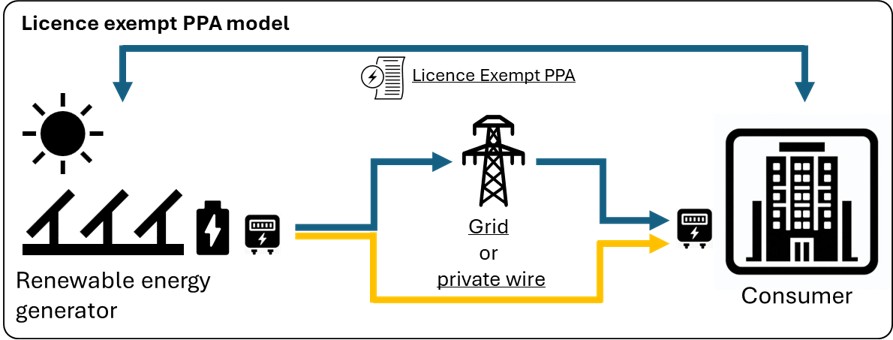
- Licence Exempt PPA: the most common model. A generator sells power directly to a consumer under a Power Purchase Agreement (PPA), often using Class A exemptions and the public grid.
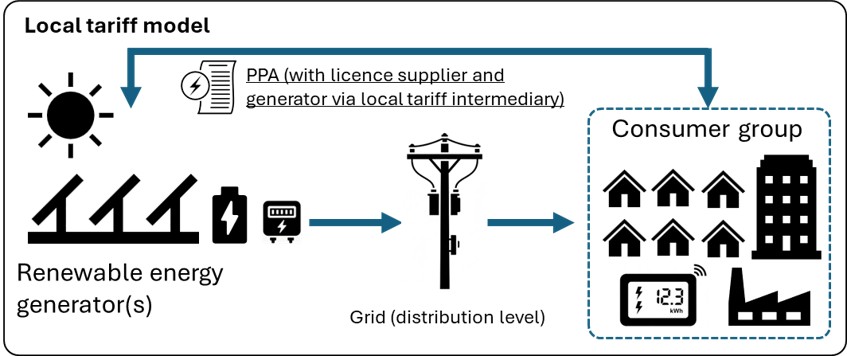
- Local Tariff Schemes: these use "Complex Site" exemptions to balance local generation against multiple consumers connected at the same grid point, often through a discounted local tariff.
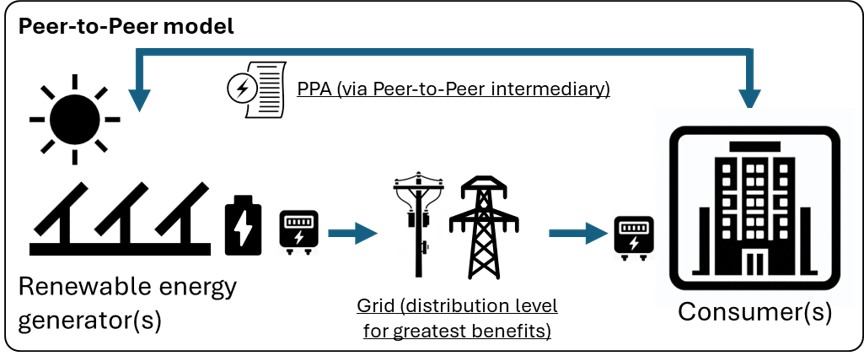
- Peer-to-Peer (P2P) Trading: online platforms match generators and consumers, typically by commercial or larger non-domestic users with half-hourly metering.
Key enablers
- Regulatory limits: under Class A, a generator may supply up to 5 MW at any time, with no more than 2.5 MW to domestic consumers, measured on an hourly or half-hourly basis.
- Generation threshold: assets must be under 50 MW to avoid a generation licence.
- Infrastructure: reliable grid connections or private wires, along with appropriate metering, are necessary.
- Partnerships: a licensed supplier, or intermediary, is usually required to handle meter registration, billing, and balancing.
- Commercial Design: clear PPAs and careful matching between generation and consumer demand are essential for compliance and financial viability.
Benefits
- Cost savings: consumers can benefit from lower electricity prices where supply levies and some network charges are avoided.
- Increased revenue: generators often secure prices higher than selling into the wholesale market.
- Resilience and efficiency: using electricity closer to where it is generated can reduce distribution losses and support local energy resilience.
- Community value: LES can keep financial value within the local area and support the growth of renewable energy.
Costs, limitations and risks
- Financial risks: High upfront costs for legal and commercial advice are often necessary. Savings may also fluctuate based on market conditions.
- Regulatory risks: LES relies on self‑assessment and is sensitive to changes in policy or industry rules.
- Operational risks: accurate ongoing administration is essential to avoid billing or compliance errors.
- Matching demand: if generation and consumption are not carefully balanced, expected savings may not materialise, or surplus revenue may be lost.
Case study: Bethesda Energy Local Club (Gwynedd)
Since 2016, approximately 150 homes and businesses have been linked to a 200 kW hydro turbine through a local tariff scheme, using the Complex Site exemption. Managed by the local Energy Local Club, in partnership with Octopus Energy, members use smart meters to access a discounted local tariff when the turbine is generating. This model has delivered average estimated consumer savings of about 20% and increased average revenue for the generator of around 25%, while keeping the financial value within the local community.
1. Overview
In the UK, electricity is usually supplied through licensed suppliers. A generator sells electricity to a licensed supplier, who then sells it to the end consumer. This process is required under the Electricity Act 1984, which states that anyone supplying electricity over the public grid must hold a valid supply licence. Licensed suppliers perform key roles such as acting as intermediaries between wholesale markets and consumers, registering meters, handling billing, ensuring regulatory compliance, and paying network charges and levies.
Licence Exempt Supply (LES) offers an alternative. Under exemptions in Section 4 of the Electricity Act 1984, electricity can be supplied without a full supply licence. This can be highly beneficial because many mandatory charges are linked to the licence. By operating under an exemption, generators can avoid costs such as the Renewables Obligation, Contracts for Difference (CfD), Feed-in Tariff (FiT), Capacity Market charges, and the Climate Change Levy (CCL). LES can also reduce or avoid network-related charges like Transmission Network Use of System (TNUoS), Distribution Use of System (DUoS), and Balancing Services Use of System (BSUoS).
The Electricity Act sets out specific exemptions. The two most relevant for local schemes are:
- Class A (Small Suppliers): for generators supplying no more than 5MW at any time, of which no more than 2.5 MW supplied to domestic consumers. In practice, licensed suppliers apply this limit on a half-hourly or hourly basis when assessing compliance.
- Class C (On-site Supply): for generators supplying non-domestic consumers through a private wire connection that does not use the public network. Electricity must be generated by the supplier or combined with electricity from a licensed supplier.
Where a generator uses more than one licence exemption, such as Class C for behind-the-meter or private wire supply and Class A for grid-based supply, the 5 MW limit applies across both combined. Any electricity supplied under Class C must be deducted from the amount that can be supplied under Class A.
If a generator qualifies for an exemption, the savings can be considerable. These benefits are usually shared between the generator and the consumer through a direct Power Purchase Agreement (PPA). The generator earns more than selling to the wholesale market, and the consumer pays less than standard retail prices. Even with direct sale, a licensed supplier or intermediary is often still needed for essential tasks such as meter registration, separating LES-supplied electricity from licenced-supply, and managing billing and balancing.
Recent changes to the Balancing and Settlement Code (P441 and P442) provide additional clarity and technical mechanisms for LES schemes. These updates make compliance simpler and improve confidence in the financial benefits.
2. Legal and regulatory framework
2.1 Background
The foundation for LES was established by the Electricity Act 1984, which began the liberalisation of the UK electricity market. The Act introduced specific conditions and categories for operating without a full supply licence, known as class exemptions, which are further detailed in the Electricity Order 2001.
These exemptions were designed to encourage innovation and make compliance simpler for small-scale, localised, and low-impact electricity operations. The aim was to allow local and community generation schemes (such as private wire networks to operate without the complexity and cost of a full licence, while supporting the growth of renewable energy.
As technologies and business models evolved, the need for clearer rules became more important to ensure the LES framework remained practical and provided certainty for those involved. To address this, the UK Government launched a Call for Evidence in 2020. Stakeholders supported keeping the exemptions but asked for clearer definitions, standardised rules, and protection for existing investments. This feedback has shaped recent updates to improve clarity and make LES easier to implement.
2.2 Balancing and Settlement Code Updates Supporting LES
Recent updates to the Balancing and Settlement Code (BSC) have made it easier for licence exempt supply schemes to operate. The BSC sets the rules for how electricity is measured and paid for in the UK. Two key modifications are particularly relevant:
- BSC Modification P441 (Complex Site Exemption): At the time of writing (January 2026), P441 is still awaiting Ofgem approval. It proposes to make it easier for local energy schemes to operate fairly and efficiently by setting clear rules. P441 defines what counts as a “Complex Site,” which often characterise LES arrangements where everyone shares one common grid point for access. It explains when electricity imports and exports can be balanced (or “netted”) across different meters, helping ensure accurate billing and preventing unnecessary costs. By adding these rules to the official market code, P441 removes uncertainty and provides a consistent framework for measuring and settling electricity flows. These changes can unlock savings by reducing or avoiding certain levies and network charges, making local energy projects more viable without complex bespoke arrangements.
- BSC Modification P442 (Exempt Supply Notification Agent - ESNA): Approved by Ofgem and effective from April 2025, this update creates a new role, called the Exempt Supply Notification Agent (ESNA), to make sure electricity supplied under licence exemptions is recorded correctly. The ESNA’s job is to separate exempt electricity from standard licensed electricity and report this to the electricity market’s official system for tracking and billing. This prevents billing mistakes, ensures the right charges and exemptions are applied, and gives projects using licence exemptions a clear and fair way to fit into the electricity market. By improving accuracy and transparency, P442 helps local and small-scale energy schemes benefit from existing rules without unnecessary complexity.
Together, these recent updates to the industry code give licence-exempt supply models greater clarity and stability. They simplify how local energy schemes are measured and billed, reduce uncertainty, and make it easier to access financial benefits such as savings on levy and network charges.
3. LES models and variations
Licence Exempt Supply (LES) is not a single, fixed approach. Instead, it can be delivered through a range of commercial models that rely on specific licence exemptions, such as Class A and Class C under the Electricity Act and Complex Site arrangements under the Balancing and Settlement Code. These models create financial benefits by legitimately avoiding certain electricity supply levies and charges.
Some models combine different exemptions, for example on‑site or private wire supply alongside grid‑based licence exempt supply. In these cases, the relevant supply limits must be considered together. The most suitable model will depend on factors such as the size of the generating asset, the objectives of the project, and the characteristics of the site. The sections below outline LES models currently in use in Wales.
Model 1: Licence Exempt PPA
Overview
This is one of the most common LES models. It usually operates under the Class A exemption, which applies to small suppliers. The generator sells electricity directly to a consumer under a Power Purchase Agreement (PPA), often using the public grid for delivery.
Requirements
- Must qualify for the Class A exemption: supply must not exceed 5 MW at any time, with no more than 2.5 MW supplied to domestic consumers, taking account of any other licence exempt supply used by the generator.
- Both generator and consumer need grid connections.
- Accurate metering is essential to separate LES-supplied electricity from licensed supply.
Mechanism
Electricity can be delivered via the grid rather than a private wire, so the generator and consumer do not need to be on the same site. This makes the model flexible but less focused on local supply.
Contract and administration
A PPA sets out the terms of sale, including pricing and duration (typically six months or longer). Prices can be fixed, linked to wholesale rates, or adjusted based on avoided levies. The generator and the consumer can negotiate the specific terms of the PPA. Legal support is often needed to ensure the agreement is compliant and robust. A licensed supplier or intermediary usually handles meter registration, billing, and settlement.
Benefits
- Generator earns more than selling to the wholesale market.
- Consumer pays less than standard retail prices.
- Relatively simple to set up compared to other LES models.
Limitations and Risks
- Still requires a licensed supplier for administration.
- Dependent on accurate metering and compliance with exemption rules.
- Financial benefit depends on market conditions and charges avoided.
- Future changes to exemption rules or market charges may reduce savings or add complexity.
Model 2: Local Tariff Schemes
Overview
Local tariff schemes aim to maximise the use of locally generated electricity within a community. They often use the Complex Site exemption under the Balancing and Settlement Code (BSC), which allows electricity imports and exports to be balanced across meters at the same grid point. This model gives consumers access to cheaper local electricity when available.
Requirements
- A generator and a group of consumers connected to the same grid point or primary substation.
- All consumers must have smart meters.
- Consumers are usually supplied by the same licensed electricity supplier.
- Compliance with relevant BSC rules, such as those introduced under modification P441.
Mechanism
Electricity generated locally is ‘sleeved’ (routed via the licensed supplier) to the consumer group. Customers typically have two tariffs:
- A local tariff linked to the generator’s output, which is usually cheaper.
- A standard tariff for any additional electricity drawn from the grid.
This encourages consumers to use electricity when local generation is available, reducing reliance on the wider grid.
Contract and administration
The licensed supplier plays a key role in managing the arrangement, including metering, billing, and settlement. The generator and consumers agree on the local tariff structure, often supported by an intermediary such as Energy Local.
Benefits
- Consumers pay less for electricity during periods of local generation.
- Generators receive a better price than selling to the wholesale market.
- Supports local energy resilience and reduces grid stress.
- Keeps more of the economic value within the community, as savings and income stay local.
- Can deliver wider system benefits such as lower distribution losses and improved flexibility.
Limitations and risks
- Requires all participants to have smart meters and use the same licensed supplier.
- More complex to set up and administer than simpler LES models.
- Financial benefits depend on generation patterns and consumer behaviour.
- Regulatory changes could affect the viability of the model.
Model 3: Peer-to-Peer (P2P) Trading
Overview
Peer-to-Peer (P2P) trading allows generators and consumers to buy and sell electricity directly through an online platform. These platforms match generation with demand and handle much of the administration, making it easier for smaller generators and consumers to participate in local energy trading. This model is generally used by commercial consumers rather than domestic customers.
Requirements
- All participating sites must have half-hourly metering with remote communications.
- A licensed P2P platform or service provider is required to manage trading and compliance.
- Grid connections are needed for both generators and consumers.
Mechanism
Electricity is supplied via the public grid rather than a private wire. The platform matches generation with consumption, either automatically or through a customer portal. When generation and consumption occur within the same primary substation, certain levies and network charges can be reduced or avoided. Any unmatched electricity is supplied from other sources on the platform or from a licensed supplier to ensure continuity.
Contract and administration
The P2P provider usually holds a supply licence and manages most of the contractual and administrative work. This includes billing, settlement, and compliance. Participants pay a platform fee, which may be a flat rate or charged per kilowatt-hour traded.
Benefits
- Enables direct trading between generators and consumers, often at better prices than standard tariffs.
- Reduces reliance on traditional suppliers and supports local energy use.
- Provides flexibility for generators to sell surplus electricity and for consumers to access cheaper local power.
- Can integrate with smart technologies for better matching of supply and demand.
Limitations and risks
- Requires advanced metering and communications, which can add cost.
- Dependent on the platform’s reliability and correct administration.
- Financial benefits depend on generation and consumption patterns and local network conditions.
- Regulatory changes could affect how levies and charges are applied, reducing potential savings.
4. Case Study: Bethesda Energy Local Club
Overview
The Energy Local Bethesda Club in the Ogwen Valley, Gwynedd, is a leading example of a Local Tariff Scheme (Model 2) operating in Wales. Since 2016, the scheme has successfully connected around 150 homes and businesses with a 200kW run-of-the-river hydro turbine, using licence exemptions under the Class A supply licence (Electricity Act) and Complex Site (BSC) regulatory exemptions. These exemptions reduce supply levies and certain network charges, creating savings shared between the generator and the members of the Bethesda Energy Local Club.
How it works
The Club uses a hybrid supply arrangement managed by a licensed supplier, Octopus Energy, and supported by smart metering. Members’ electricity use is matched against two tariffs:
- Local tariff that matches members’ electricity use against the local hydro generation on a half-hourly basis. When local power is generated, members can access it at a discounted rate.
- Time of use tariff which is used to supply any extra electricity demand from the grid.
This dynamic matching encourages members to use local power when it’s available, reducing reliance on the wider grid.
Benefits
The Bethesda model demonstrates a viable mechanism for local energy resilience, delivering meaningful benefits:
- Consumer savings: members save an estimated 10% to 30% on annual electricity bills.
- Generator viability: the hydro generator earns a premium price, supporting long-term operation.
- Local investment: savings and income stay within the community.
- Scalability: the model has been successfully replicated by Energy Local CIC in other Welsh communities.
Key takeaways
Bethesda demonstrates how LES can deliver financial benefits, improve energy resilience, and keep value local. It shows that with the right partnerships, smart metering, and clear tariff structures, small-scale, local energy projects can thrive under licence exemptions.
5. Key enablers for licence exempt supply
Setting up a licence exempt supply (LES) arrangement depends on meeting strict regulatory requirements, having the right physical infrastructure, and designing a clear commercial structure. Below are the main enablers:
Regulatory compliance
Compliance with the relevant licence exemptions is essential. Most schemes rely on the following:
- Small Supplier Supply Licence Exemption (Class A)
- Generation Licence Threshold.
Small Supplier Supply Licence Exemption (Class A)
The key condition for this exemption is the amount of electrical power supplied at any time, not the size of the generating asset. An organisation, including any parent or associated organisations, must not supply more than 5 MW of electricity at any time, of which no more than 2.5 MW may be supplied to domestic customers. In practice, licensed suppliers apply and monitor this limit on a half-hourly or hourly basis.
This limit applies across all generating assets owned by the organisation, rather than per asset. For example, if an organisation owns multiple generators, their combined licence exempt supply must remain within these thresholds. The cap relates to the amount of electricity supplied under the exemption, not the installed capacity of the generator. This means a generator larger than 5 MW can still participate, provided only part of its output is supplied under the exemption and the remainder is sold through licensed routes.
Where a generator uses more than one licence exemption, for example Class C for behind-the-meter or private wire supply alongside Class A for grid-based supply, the limits apply across both combined. Any electricity supplied under Class C must therefore be deducted from the total amount that can be supplied under Class A.
Generation Licence Threshold
Generating assets must be smaller than 50 MW to avoid the need for a generation licence. This threshold applies to the installed capacity of the asset, not the volume supplied under LES.
Other LES models, such as local tariff schemes or private wire arrangements, may use different frameworks. These include Class B exemptions or Complex Site rules under the Balancing and Settlement Code (BSC). These often require generators and consumers to share the same Grid Supply Point (GSP), Primary Substation, or be connected by a private wire.
Because these rules are complex and compliance relies on self-assessment, specialist legal advice is strongly recommended to confirm eligibility and design robust contractual arrangements, such as Power Purchase Agreements (PPAs).
Physical and commercial components
Several practical elements must be in place for LES to work effectively:
Key parties
At least one generator and one consumer, plus a licensed supplier or intermediary (essential for meter registration, balancing, and billing).
Grid connection
Enables electricity transfer and provides backup supply to the consumer if needed.
Consumption capacity
Consumer demand must match the supply limits (e.g., under Class A: less than 5 MW at any time / 2.5 MW for domestic)
Metering
Accurate metering for generators and consumers is critical. Smart meters are mandatory for local tariff schemes.
Matching and commercial design
Generation and demand should be matched for the LES to be commercially viable. The commercial design (the actual sale and purchase of electricity) is generally facilitated by a PPA that is supported by the facilitating intermediary organisations.
6. Legal, regulatory and commercial considerations
LES is inherently complex from both a legal and administrative perspective. Given the material financial benefits and the technical nature of the regulations, seeking specialist legal and commercial advice is recommended for any organisation considering this approach.
There is no formal application or approval process for LES. Compliance relies entirely on self-assessment. This means participants must interpret the rules, document evidence, and monitor performance to ensure compliance. If a scheme is later found to be non-compliant, enforcement action may follow.
The commercial implementation of LES relies heavily on establishing robust contractual and administrative arrangements:
- Power Purchase Agreements (PPAs): a PPA usually governs the sale and purchase of electricity, either directly between the generator and consumer or through an intermediary.
- Administrative Support: regardless of the commercial model, a licensed supplier or an intermediary service is generally required to provide the necessary administrative and legal frameworks, including meter registration, electricity balancing, and customer billing and settlement.
As compliance is self-assessed and the rules are complex, specialist advice should be sought before launching or expanding any LES project.
7. Benefits and advantages
Licence Exempt Supply (LES) offers strong financial benefits for both generators and consumers. The main driver is the ability to avoid certain electricity supply levies and charges that apply to licensed supply. These avoided costs create savings that can be shared between the parties:
- Generator benefit: the generator can secure a higher price for their electricity compared to selling through traditional, licenced routes.
- Consumer benefit: the consumer pays a lower price because avoided levy costs are reflected in the price.
Although the regulatory framework for LES is complex, implementation has become easier thanks to established models. Specialist intermediaries have developed proven approaches that include the necessary legal and administrative processes. Using these models reduces the need for bespoke legal work and lowers setup costs.
Recent changes to the Balancing and Settlement Code (P441 and P442) provide additional clarity and technical mechanisms for LES schemes. These updates make compliance simpler and improve confidence in the financial benefits.
LES also enables local supply. Certain models allow direct physical or virtual supply between generators and consumers connected at the same Grid Supply Point or Primary Substation. This can unlock additional financial benefits for generators and consumers (known as embedded benefits), improve overall system efficiency by using power closer to where it’s generated, reduce energy losses that occur when electricity travels long distances, and help manage peak demand on the wider grid.
8. Limitations, costs and complexities
While LES offers compelling benefits, it also comes with challenges related to complexity, cost, and eligibility.
Setting up a compliant scheme requires navigating detailed electricity market regulations, which usually demands specialist expertise. In most cases, legal and commercial advice is essential to interpret exemption rules correctly, draft contractual documents, and manage administration. These costs can represent a significant upfront investment for new schemes.
Using established LES models can simplify the process and reduce costs because they provide proven frameworks for compliance and administration, avoiding the need for bespoke legal work.
9. Risks
LES carries several risks that need careful consideration. The most significant risk is that compliance relies entirely on self-assessment. There is no formal application or approval process, so participants are responsible for interpreting complex rules and maintaining evidence of compliance. If a scheme is later found to be non-compliant, enforcement action may follow.
LES models are also exposed to changes in government policy, legislation, or industry codes such as the Balancing and Settlement Code (BSC). Future changes could alter the scope of exemptions, affect how avoided charges are calculated, or introduce new administrative requirements. These changes could reduce financial benefits or make existing schemes non-compliant.
Strict power-based limits under the Class A exemption, applied on a half-hourly or hourly basis, can constrain scalability and replication. Where a generator also supplies electricity on-site or via a private wire, this further reduces the headroom available for licence exempt supply to third parties. Some models also depend on specific site conditions, such as being connected to the same Grid Supply Point or Primary Substation. In other cases, complex legal structures may be required, which can make replication difficult.
Commercial risks also apply. LES arrangements typically rely on Power Purchase Agreements (PPAs), which carry standard counterparty risks such as failure to deliver agreed volumes, late payments, or insolvency.
Careful matching between generating capacity and consumer demand is essential. If generation significantly exceeds demand, the generator may lose revenue because surplus electricity cannot be sold under the exemption. If demand exceeds generation, consumers may not achieve the expected cost savings. This balance is critical for financial viability.
Finally, LES requires accurate and ongoing administration. Licensed intermediaries often manage essential tasks such as meter registration and billing separation. If these tasks are not performed correctly, settlement errors can occur, leading to incorrect billing and loss of financial benefits. Robust planning and continuous monitoring are essential to manage these risks.
10. Next steps
If you're interested in exploring a Licence Exempt Supply (LES) arrangement for your organisation or community, you can:
- Consider local opportunities: Identify nearby renewable generation that could supply electricity under an exemption. Proximity matters for some LES models, especially those using Complex Site rules.
- Review electricity use: Check that your demand profile is large and consistent enough to support a long-term arrangement and fits within exemption limits (e.g., Class A: 5 MW at any time, with no more than 2.5 MW to domestic customers).
- Understand the model options: Consider whether a simple Licence Exempt PPA, a local tariff scheme, or a peer-to-peer trading model best suits your objectives.
- Speak to the right people early: Contact potential generators, licensed suppliers, and any intermediaries who can help with metering, billing, and compliance: Who’s my electricity network operator? Energy Networks Association (ENA)
- Explore funding options: Check for grants or finance support that could help with upfront costs such as metering or legal advice: Welsh Government Energy Service Grant Funding / Finance locator | Business Wales / Funding Wales
- Get expert advice: LES rules are complex and compliance relies on self-assessment. Seek specialist legal and commercial guidance before launching a scheme. For tailored guidance and practical support, contact Ynni Cymru: YnniCymru@localpartnerships.gov.uk
11. Conclusion
Licence Exempt Supply offers a practical way to make local energy projects more affordable, resilient, and strategically valuable. While the rules can seem complex, proven models and recent updates to the Balancing and Settlement Code mean it’s now easier than ever to take advantage of these exemptions. Establishing a compliant scheme still involves navigating complex electricity market regulations, so specialist advice is strongly recommended. With the right planning and partnerships, LES can unlock real financial savings, support renewable generation, and keep value within your organisation or project.
This guide is intended as a starting point, an introduction to the essentials, not a full implementation manual. Use it to understand the basics, explore practical options, and start shaping a local energy solution that works for your project.
For further advice, practical support, or help turning your ideas into action, contact Ynni Cymru.