NHS dental services: July to September 2025
Data on patients receiving NHS dental treatment and the activity performed in NHS dental practices for July to September 2025.
In this page
Introduction
This report provides new data for headline measures relating to patients treated and courses of treatment provided for the quarter July to September 2025.
Additional datasets which are normally updated annually have been published with new data for the financial year 2024 to 2025 on StatsWales. These relate to clinical activity, dental contracts and practices and Welsh speaking dentists.
Background
Following the National Institute for Health and Care Excellence (NICE) guidance, statistics on adults treated are based on the previous 24-month period, and statistics for children refer to the previous 12-month period.
Each patient is counted only once in the total patients treated statistics even if they have received multiple episodes of care during the reference period. However, all courses of treatment are counted in the activity statistics, even if the same patient had multiple treatments.
Patients may be treated outside of their resident health board and orthodontic patients are included.
Main points
The percentage of Welsh children treated by an NHS dentist increased over the last year with close to half of the child population treated in the last year, while the percentage of Welsh adults treated has remained broadly stable over the last two years.
The number of courses of treatment provided decreased in the latest quarter, but has remained broadly stable over the previous two years, with small quarterly variations.
Patients treated in a 12 and 24-month period
Data refers to Welsh resident patients treated at NHS dental practices in Wales and England only. Any non-Welsh resident patients treated in Wales are not included in this measure but are included on separate StatsWales datasets showing data for all patients treated in Wales:
Patients treated in Wales in a 12-month period (StatsWales)
Patients treated in Wales in a 24-month period (StatsWales)
Figure 1: percentage of Welsh resident adults and children treated in rolling 24-month and 12-month periods, 30 September 2019 to 30 September 2025 [Note 1]
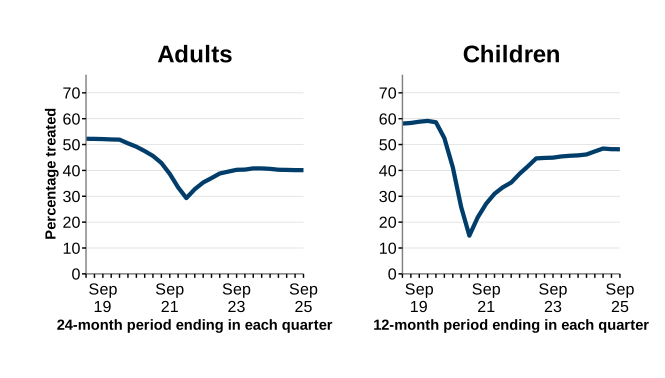
Description of figure 1: line charts showing the percentage of both adults and children treated in recent quarters remains below their pre-pandemic levels. The percentage of children treated has been on a steady upward trend over the last two and a half years, while the percentage of adults treated has remained broadly largely stable over the last two years.
Source: FP17W form, NHS Business Services Authority; mid-year population estimates, ONS
[Note 1] Adults refers to those aged 18 years or older. Children refers to those aged 0 to 17 years.
Welsh resident children treated in a 12-month period by local health board (StatsWales)
Welsh resident adults treated in a 24-month period by local health board (StatsWales)
Just more that than 1 million adults were treated in the 24-month period that ended on 30 September 2025. This is equivalent to 40.1% of the adult population and is 0.5 percentage points lower than in the 24-month period that ended on 30 September 2024.
Just fewer than 300,000 children were treated in the 12-month period that ended on 30 September 2025. This is equivalent to 48.2% of children living in Wales and is 2.0 percentage points higher than in the 12-month period that ended on 30 September 2024.
New patients treated
Data for ‘new patients’ is published on StatsWales.
New patients are defined as: a unique count of patients at each NHS dental contractor who completed a Band 1, 2, or 3 treatment with a complete Assessment of Clinical Oral Risks and Need (ACORN) in the year, whose previous Band 1, 2, or 3 treatment at the contractor was completed more than 48 months prior to the ACORN; or who have not previously been treated by the NHS dental contractor.
For the financial year to date (1 April 2025 to 20 January 2026) nearly 112,000 new patients had routine treatments in Wales.
While new patients are unique counts for each specific dental contractor, it is estimated that around 80% of new patients in the financial year to date did not have a separate Band 1, 2 or 3 treatment at another Welsh contractor in the previous 4 years.
A further 65,000 urgent treatments have also been provided to new patients in the year to date.
Activity
Activity statistics refer to all NHS courses of treatment provided by dental practices in Wales. It includes treatments provided to patients who did not live in Wales at the time of the treatment, but does not include any privately funded treatments.
Figure 2: courses of treatment provided per quarter, quarter ending September 2016 to quarter ending September 2025 [Note 1]
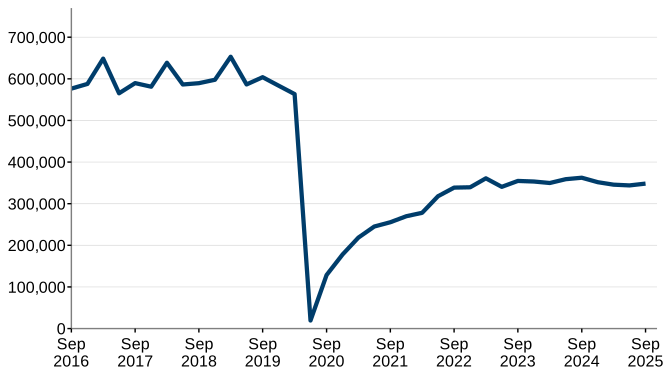
Description of figure 2: line chart showing that the number of courses of treatment provided each quarter has remained broadly stable for the last two years, with some small quarterly variations. While treatments have increased since the height of the pandemic, they remain below the pre-pandemic level.
Source: FP17W form, NHS Business Services Authority
Number of courses of treatment by quarter ending March each year (StatsWales)
[Note 1] Data for April to September 2025 is provisional and will be revised at the end of the financial year.
During the quarter July to September 2025, there were more than 348,000 NHS dental courses of treatment delivered to both adults and children. This is a decrease of 3.9% compared to the same period last year.
The number of courses of treatment in the quarter July to September 2025 was 42.3% lower than the number in the last equivalent quarter that was unaffected by the pandemic (July to September 2019).
Quality and methodology information
NHS dental services: quality report
New data for dental workforce joiners and leavers in financial year 2024 to 2025 is not available. This is because ‘dental care professionals’ who performed treatments were recorded in financial year 2024 to 2025 but not in financial year 2023 to 2024. If a dental care professional performed treatments in financial year 2023 to 2024, their work was recorded under the dental practitioner’s ID. Joiners and leavers are calculated by counting workforce IDs who performed treatments in one year but did not appear in the dataset in the other year. This means that 100% of dental care professionals would appear as joiners, even though they may have performed treatments in the previous year; and some dental practitioners would be recorded as leavers, even though they did not perform treatments in the previous year. This is only an issue for financial year 2024 to 2025 and joiners and leavers statistics can be published again for financial year 2025 to 2026, should the data source for dental workforce remain the same.
Contact details
NHS Workforce and Primary Care Statistics
Email: stats.healthinfo@gov.wales
Media: 0300 025 8099
SFR 17/2026