
Research on the potential for establishing a National Centre for Independent Living in Wales - Activities
We worked with the Disability Rights Taskforce to conduct research into options for a National Centre for Independent Living and how it could operate. We wanted to test how we co-produce research to support disabled people.
In this page
Proposed activities
Participants explored what activities a National Centre for Independent Living (NCFIL) could undertake to support disabled people in Wales. Discussion was based on activities proposed by the co-production team, which are listed below. Overall, the suggested activities matched what participants had expected an NCFIL could do. One breakout group quickly concluded ‘A resounding yes’ to the question of whether the activities could help to address the implementation gap by ensuring that policies aimed at supporting disabled people work properly in practice. Discussions centred around how the different types of activity might work to support Independent Living. Participants also explored practical considerations such as what resources would be required, who would be involved in delivery and how stakeholders could be engaged.
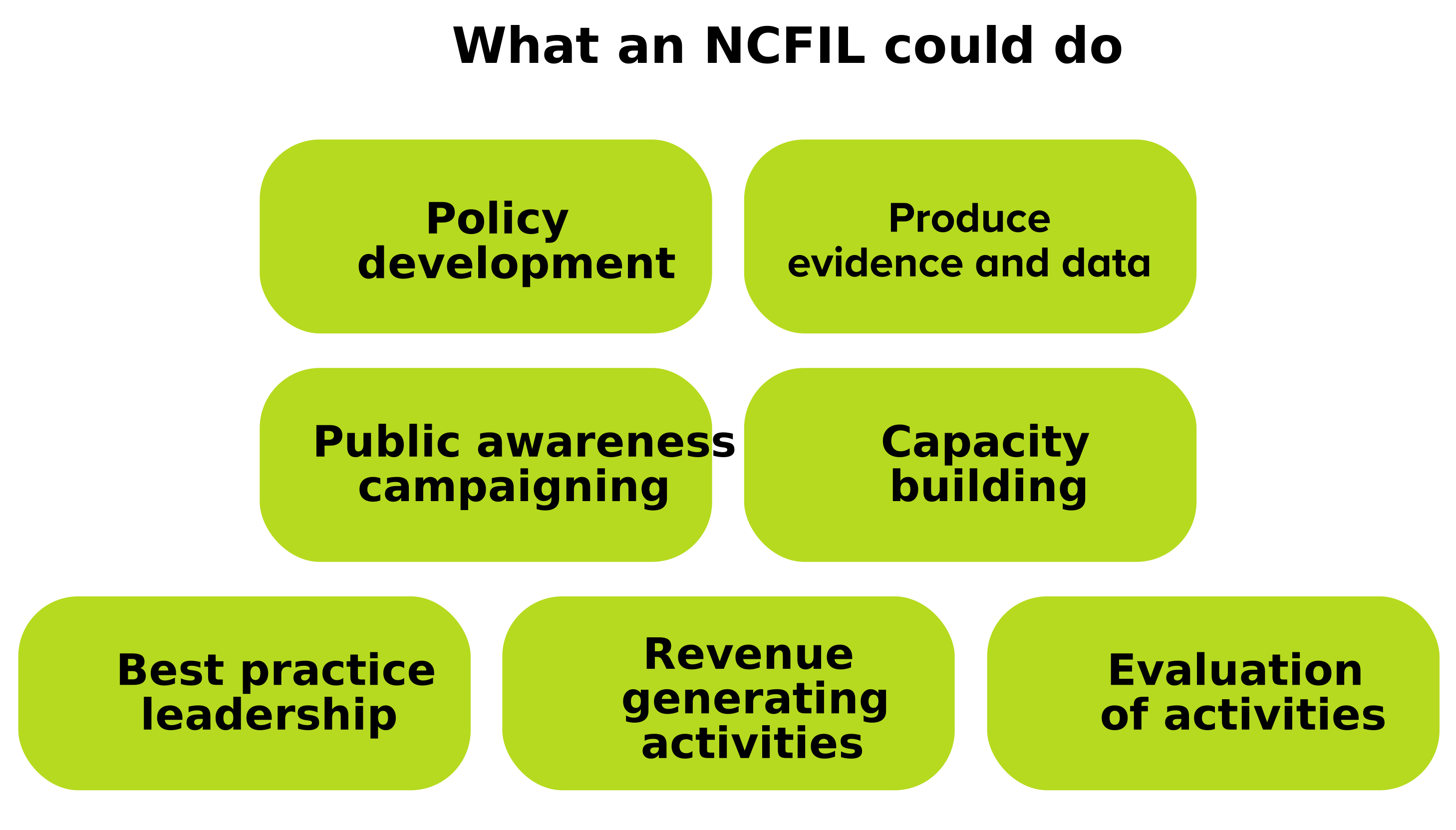
The seven activity categories
- Policy development: advocate for disabled people’s involvement in policy making in Wales to support Independent Living.
- Produce evidence and data: on Independent Living and disseminate findings to inform policy.
- Public awareness: campaigning, educational activity to change societal attitudes.
- Capacity Building and Networks: support local Centres for Independent Living (CILs) and other organisations supporting disabled people.
- Best practice leadership: develop guidance and best practice, training and networking opportunities to support organisations.
- Potential for revenue-generating activities: including consultancy services, training and product development.
Evaluation to monitor the Centre’s activities against agreed success criteria.*
*Evaluation of an NCFIL’s activities will be addressed in the final part of this section.
Figure 2: Suggested activities for a National Centre for Independent Living taken from the co-production team’s Vision
Leading best practice through employment and engagement
“Nothing about us without us” is widely used in the disability activism movement. Some participants referenced this term during the workshop. It describes the need for those with lived experience to have a say in policies which affect them. Having disabled people in leadership positions, where they may be involved in and influence policy decisions, service design, and evaluation, was identified as foundational to successful Independent Living and imperative to consider in a NCFIL.
“These are things that [an NCFIL] could really help with. Gathering best practice. […] Gathering the experience of disabled people and really focused on lived experience and run and controlled by disabled people. So that policy ideas and suggestions are all rooted in that proper experience.” - individual participant
Several participants felt that disabled people’s voices were under-represented in decision-making in Wales, both nationally and within communities. Many explored the idea that an NCFIL could facilitate meaningful engagement between disabled people and the bodies making decisions on the care and support they receive.
Participants felt strongly that an NCFIL led by disabled people would demonstrate that lived experience is valued and would showcase best practice in accessible working.
“Representation should be at all levels, that it should be encouraged at a local level, regional level and national level. And that opportunity should be made available, but also skills and development for those people that are taking up those opportunities’ - DPO
One group suggested that having disabled people in leadership would be an important point of difference from other organisations, and would help to make an NCFIL effective at supporting Independent Living. However, it was acknowledged that there are disabled people working in central and local government, and other stakeholder organisations as well as DPOs and CILs.
“It’s assumed that disabled people can’t do leadership roles and they can, it’s just they’re never given the opportunity to do it. And they should be doing it when it’s about their own lives.” - Individual participant
Making sure employment is fully accessible for disabled individuals was noted by many as integral to support the aims of an NCFIL.
“Offering those opportunities for employment, but also using that as a way of sharing best practice by […] designing these roles around disabled people and saying, of course it can be done. Other people should be doing it too.” - breakout group summary feedback
It was suggested that demonstrating disabled people thriving in employment could also help to address public misconceptions about disabled people’s ability to work. One participant summarised their own experience:
“It shows other employers then that disabled people can work and want to work. […] There is always a surprise, ‘oh, you're disabled, and you've got a job’”. - local government organisation
Opportunities to upskill individuals and organisations were discussed by some, and participants felt this could also help in engaging with local stakeholders. Suggestions included training disabled citizens to conduct access audits, and offering workplace mentoring programmes.
Throughout the workshop, many groups explored the important role of volunteers, particularly within DPOs and CILs. Participants recognised that volunteer posts in third sector organisations can be a way for disabled citizens to give their views, which are then represented more widely in national level conversations via the organisation. Volunteers were also deemed to play an important part in delivering services through third sector organisations, but participants felt that relying on volunteer posts rather than paid positions represented a risk to sustainability. To ensure that services can be delivered consistently, participants felt that paid positions would be fundamental to the success of an NCFIL.
“There’s a reliance on volunteers at the moment. […] There’s an opportunity here for one more consistency by offering permanent work to disabled people, but then also that people should be fairly reimbursed for their labour’ - breakout group summary feedback.
It was also acknowledged that as long as they are not relied on instead of paid employees, volunteer posts fulfil an important role in allowing engagement for individuals.
Many participants shared concerns around societal expectations of disabled people to provide labour and lived experience expertise free. One group noted that in some cases a large burden may be placed on individual volunteer representatives to act as spokespeople for all disabled people. This group felt that an NCFIL could provide best practice leadership on engaging volunteers. This would aim to improve outcomes for disabled people, through encouraging organisations to engage with a greater diversity of voices. This would also aim to reduce the burden on individuals. One participant identified ways in which their early experiences as a representative could have been improved.
“I clearly remember the first time […]. Just sitting there and thinking, what the hell am I doing in this room and what can I bring, because I knew nothing. […] I could have been helped a great deal in the early days. […] Somebody teaching me what I needed to know, it would have removed a lot of that stress.” - DPO
It was suggested that an NCFIL could provide training and development for citizens to empower them to take up opportunities to represent disabled people. It was deemed that this could include policy and service delivery consultations, social media campaigns, or to be community ambassadors.
Some mechanisms for sharing best practice on supporting and promoting Independent Living and incorporation of lived experience were suggested as a potential function of a NCFIL, largely based on working with existing relationships and networks. One group identified Regional Partnership Boards as a potential Wales-wide structure to reach stakeholder groups.
Communication and public awareness
Many participants saw a function of an NCFIL would be to present a strong and unified voice to drive change.
It was felt that ensuring that lived experience was represented, would also help to increase public understanding of issues facing disabled people. It was noted that:
“There’s perhaps a potential for [an NCFIL] to run and promote public campaigns promoting independence. […] Having a strong, unified [..] voice that would influence and should influence legislation to better protect and to enhance the rights of disabled people” - Welsh Government Official
As identified in Section 1 Defining Independent Living, agreeing what is meant by ‘Independent Living’ was noted by many participants as an important early task of an NCFIL, with associated work to promote awareness and understanding publicly.
“The fact that in every description of independent living we have to say, ‘it's not about doing things by yourself’, so we are constantly having to define Independent Living by what it is not as well as what it is.” - Individual participant
It was felt that with a clear, common understanding of what an NCFIL was aiming to achieve, and proactive communication it would be possible to improve public understanding about Independent Living.
“If the vision is clear and the mission is clear, then it becomes less a discussion around what does 'independent' mean or 'centre', but a wider understanding of the mission.” - local government organisation
Regional Partnership Boards were identified by one group as a potential dissemination route, well positioned for public engagement. It was acknowledged that campaigning about rights for disabled people was already being done by Disability Wales, and other organisations.
Policy and service development and review
Finding a way to influence policy locally and nationally was agreed by many as being an important function of an NCFIL. It was agreed that this would aim to provide an overview of how different policy areas impact disabled people’s ability to live well. Participants mentioned in particular Housing, Transport, Healthcare and leisure. Some noted needing to work at a cross-party level.
“I think [an NCFIL] could drive policy change at a local and national level. It would be crucial to do that. And I think that potentially involves lobbying for increased funding, for accessible housing, transportation, health care services, those sorts of things” - Welsh Government official
Several participants suggested that Independent Living could be better supported with improved use of equality impact assessments, when designing services and policies. Many felt there was little recourse if assessments are not done, and suggested an NCFIL could support with promoting a need for better accountability. Some suggested that there should be a panel or body for disabled people to refer to with issues.
Many participants felt that taking a national approach by having a NCFIL could help to address regional variations in support for disabled people. Suggestions included the NCFIL developing a Wales-wide strategy for Direct Payments and developing a market for Personal Assistants. One group suggested exploring centralised funding to improve access to support services. Several suggested that an NCFIL could promote better collaboration through supporting networks and providing guidance.
“A really productive [NCFIL] should be focused on overcoming fragmentation across all services and spaces.” - DPO
Evidence and data
Many participants discussed needing to be able to monitor and evaluate Independent Living in Wales. Some participants said there is not enough data on inequalities experienced by disabled people. The relatively small number of disabled people in Wales means that it is harder to have more detailed data for analysing inequalities. A few participants felt that having better monitoring data on outcomes for disabled people, such as employment rates, and qualifications, could be a way to understand where policies to help disabled people were not working correctly. This was also deemed to help with the perceived issues around accountability for supporting Independent Living through services aimed at supporting disabled people. It was also suggested that data on the impacts of services and policies on citizens is needed, rather than only monitoring outputs, such as numbers of people supported or receiving care. Impact assessments were mentioned as useful ways to check that what is being done is not discriminatory. However, they were thought to not be widely or systematically used.
Participants suggested that an NCFIL could contribute evidence to policy decision-making by having research involving lived experience. This was deemed to improve the quality of policymaking and demonstrate the difference lived experience can make, as one participant described, an NCFIL could: “Collect stories and data from citizens to highlight systemic issues in policy discussion”. - DPO
Some participants suggested collaborating with the technology industry. This could support the development of new assistive technologies by connecting citizens with experts to make cross-cutting innovations.
Whilst participants explored the role of evidence and data, many suggested that there could be value in creating a dedicated academic centre for disability studies in Wales. There was wide support among participants for being able “to live, study and work in Wales” – breakout group summary feedback. Others suggested that a centre for Disability Studies could help third sector organisations to develop the skills and knowledge they need to generate income, such as providing training and consultancy to others. Options for situating an NCFIL within or as a partner of an academic institution are explored further in the third section of this chapter.
Supporting stakeholders
Effective collaboration was identified by participants as necessary for Independent Living to work well. Several barriers and failures of working together were shared – see the section on Barriers to Independent Living.
Many saw a primary function of an NCFIL as making it easier for existing organisations such as DPOs to continue delivering services. It was thought that this could be achieved through practical help as well as bringing people together to share ideas, and to amplify disabled people’s voices nationally.
“I think I would see a national hub centre of this nature being about enabling. Enabling what's out there already better, just helping the existing organisations to grow what they are doing and achieve their own sustainability and ensure their resilience.” - DPO
Some explored the idea of an NCFIL as a coordinating hub for local organisations, providing a single point of contact with expertise and information for individuals and other organisations.
Strengthening local services, including third sector and local authority services, was discussed widely across breakout groups. Many felt strongly that an NCFIL should build on what exists already, linking the local with the national. It was considered that a national centre would only be successful if local and community services were working well, to provide direct support to individuals.
To address some of the barriers outlined in Findings Section 1, participants suggested that an NCFIL could play a role in providing practical business support. This could help the sustainability of DPOs, CILs and support organisations. It was suggested that these organisations often do not have the resources to employ professional services such as HR, Digital, Accountancy etc.
“DPOs and local centres for Independent Living need support in terms of the business side of things. They're often set up as grassroots organisations […] not expecting to have to become employers” - breakout group summary feedback.
One participant shared an experience of struggling to find accessible business support for their organisation and peer networks could help.
“Some of the support that's out there, for example, with business development, is not accessible and it doesn't take into account the specific needs and challenges of disabled people and disabled people's organisations.” - DPO
Information sharing was identified by many as a way to support particularly smaller organisations. Case studies of projects supporting Independent Living could be shared with other organisations and more widely outside Wales.
“We’re seeing really inspiring, exceptional models of Independent Living. Part of the problem is we don’t share that information or knowledge widely enough and don’t support people to actually look at those methods of developing very different models of Independent Living.” - public sector organisation
Providing training to address gaps in skills and expertise to third sector organisations was identified as another way to help organisations grow and operate sustainably.
Guidance on working with volunteers was also suggested. It was noted that although many smaller DPOs are reliant on volunteers to deliver commissioned work, project funding that is available may not take additional costs of making a workplace accessible into account.
“The core of a DPO is that it’s run by disabled people themselves. […] We haven’t got the money to bring in volunteers, because we can’t make the workplace accessible for them because we can’t afford to buy the equipment.” - DPO
Participants also suggested that the NCFIL could play a role in overcoming barriers faced by delivery organisations around government contracts and procurement processes. DPOs were described as uniquely placed to feed information and ideas from citizens with lived experience to national level organisations. This function was seen to be at risk if DPOs were not supported.
Participants agreed on the benefits of establishing networks, to better present a unified voice on policy nationally. Less tangible impacts on wellbeing such as the benefits of advice and support from others in similar roles were also noted.
“I think [an NCFIL] would potentially foster those partnerships with existing organisations, […] By working together, I think, with healthcare providers, social care, education institutions, that the group could create a really comprehensive […] system that could address various aspects of Independent Living.”- Welsh Government Official
Many were clear that any new entity should align with and complement existing organisations including Disability Wales. When considering how to avoid duplicating or crowding out existing organisations, many acknowledged potential overlaps with Disability Wales’s remit, particularly around campaigning. Participants were keen that an NCFIL focused on activities which did not duplicate any of this work.
Some voiced concerns that establishing an NCFIL could pose a risk to other organisations:
“Are we in danger of diluting the impact if we end up with Disability Wales, a National Centre for Independent Living and DPOs. Will we be spreading scarce resources too thinly” - third sector organisation