
Research on the potential for establishing a National Centre for Independent Living in Wales - What does Independent Living mean in practice?
We worked with the Disability Rights Taskforce to conduct research into options for a National Centre for Independent Living and how it could operate. We wanted to test how we co-produce research to support disabled people.
In this page
Defining Independent Living
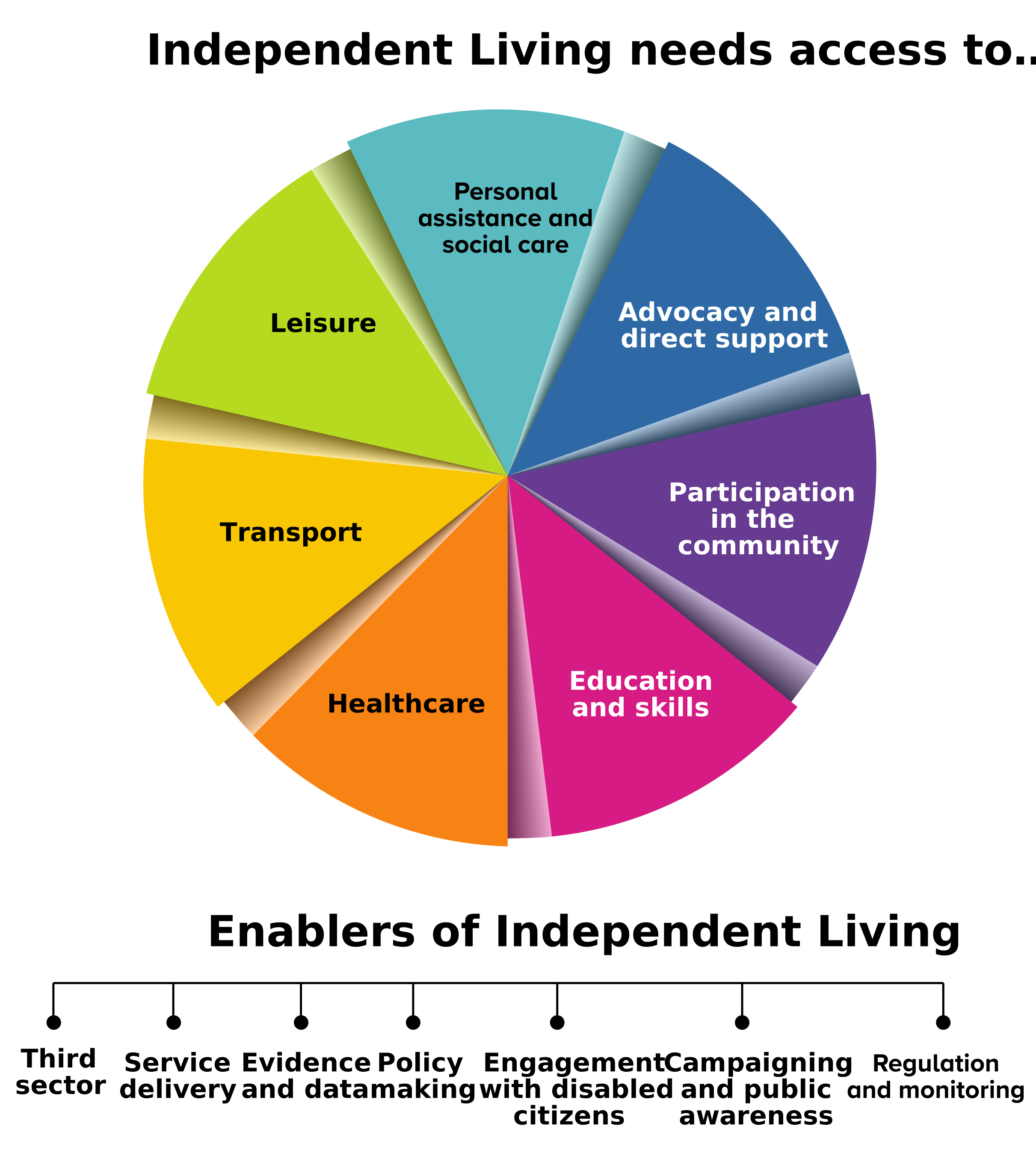
Participants deliberated the following elements which the co-production team identified within their vision for an NCFIL as being necessary for Independent Living.
- Personal assistance and social care
- Advocacy and direct support
- Participation in the community
- Education and skills
- Healthcare
- Transport
- Leisure
Figure 1: Elements of Independent Living and enablers taken from the co-production team’s Vision
Many participants felt that defining Independent Living should be the first step in exploring what an NCFIL could do to support disabled people. Several participants noted having heard interpretations of Independent Living which differed from their own. Some had heard it used to refer to financial independence and employment. Others mentioned that it can be interpreted as living independently rather than in supported housing. One participant felt that some people potentially wilfully misunderstand the term to justify the removal of support. There was strong agreement among participants that the definition should go beyond personal care, to take a fuller and overall view of disabled people’s lives. Support in the home was deemed to be a vital enabling factor for many, but participants were keen to highlight other essential elements needed to enable Independent Living. Examples shared included accessible travel, education, participation in cultural events, and leisure activities.
Participants also noted that some interpretations focus exclusively on the UNCRDP Article 19. Some thought that this was potentially limiting because they felt the scope of Independent Living described in this Article is too narrow. Many participants felt that as discussions on Independent Living can often be focused on or limited to social care, disabled people who do not use personal care services may not be aware of their rights.
“I'm not sure how far everybody would understand that and what it means. […] I do wonder if the term Independent Living reinforces a particular view or perception of disability and what disabled people, and their lives look like.” - DPO
When considering how to define what Independent Living should mean, many mentioned that ‘independence’ can be interpreted in a variety of ways. In order to discuss what improvements and support are needed, there needs to be an agreement of the overall goal. However, many felt that as ‘Independent Living’ originated in the disabled people’s movement, there is value in using the term. It was seen to have strong cultural understanding and significance. It was deemed that people find it hard to define Independent Living. As a result, it is often defined in terms of what it is not rather than what it is. For example, it could be described as ‘meaning more than just financial independence’. This lack of clarity can make it challenging to discuss what people’s rights for Independent Living are. The need for a clear understanding among stakeholders about what it is, or should be, was agreed to be important to the success of an NCFIL.
There was strong agreement that an empowering definition of Independent Living would be centred on access to the same quality of life as non-disabled people. An individual participant suggested, and others agreed, it should be grounded in ‘living a good life of your choice, in your community’. It was thought that this could come from being well supported in practical terms, but also through personal fulfilment. This was summarised by another individual participant as ‘feeling that you are supported, feeling that you have a role, a purpose, that your talents are recognised’.
Some groups explored the role which the wider community and range of stakeholders with different perspectives need to play. It was noted that responsibility for ensuring accessibility is currently shared by providers of education, employment and other services. Those with lived experience should be able to identify challenges and barriers and communicate these with service providers and policymakers. One group summarised that they thought ‘responsibility for Independent Living in that format lies with the whole community. […] Stakeholders well beyond local authorities and state agencies.’
It was noted that currently two Centres for Independent Living (CILs) offer direct support around social care and advocacy to citizens in their local areas. One group felt that using the term ‘centre for Independent Living’ within the name of an NCFIL could mislead people about the services it offered. They felt some might assume that an NCFIL provided the same services as CILs, but on a national basis.
Participants agreed that clear communication of the aims and scope of an NCFIL would be needed in order to advertise what the organisation would do. This was thought important no matter what name was chosen. It was raised that clear communication would also promote wider understanding of what Independent Living means and why it is needed. It was observed that this could ‘help inform broader cultural understanding of those terms. […] Having a clear vision or mission can help that’ - local government services representative.
Independent Living in practice
Participants were shown the following suggested types of organisation and activities which the co-production team identified within their vision as helping to enable and support Independent Living. See Figure 1.
- Third sector.
- Service delivery.
- Evidence and data.
- Policy making.
- Engagement with disabled citizens and co-production.
- Campaigning and public awareness.
- Regulation and monitoring.
When considering ‘excellence’ for Independent Living, it was widely agreed that disabled people need to be represented within decision-making which affects them and the support they receive. They should also have a role in evaluation and monitoring of policies.
A significant theme observed throughout the discussions was the ‘golden thread’ of incorporating lived experience at every level of an NCFIL. This would include positions of leadership, management and staffing. Throughout the workshop, having an understanding of lived experience and it being at the heart of Independent Living in Wales was deemed to be essential.
Many felt that decisions were made without involvement of disabled people. Several participants shared positive examples of when lived experience has been incorporated into policy and service design work. Participants felt that this was perceived as adding value.
Others voiced frustrations about sharing their own lived experience with policymakers and not finding out if their contributions had made a difference.
“They're all feeding in a lot but waiting to hear the outcomes and that can cause a lot of frustration and apathy.” - DPO
Several participants spoke about the negative mental health impacts of feeling unable to influence decisions that impact their lives. Some participants felt like many things were out of their control, and worried about potential future changes impacting the support they receive. Some suggested that being ‘at the mercy of’ decisions made by politicians about services and policies that affect them, could not constitute true Independent Living.
“I think there's a greater anxiety at the moment with regard to new governments and budgets and disability payments, carers allowance. So, a lot of disabled people are just absolutely terrified about what's going to happen there.” - DPO
“A lot of disabled people are anxious or fighting or highlighting and getting very […] tired with raising voices, but then […] you’re not in control when it's down to central government or budgets.” - DPO
The most frequently mentioned factor in achieving Independent Living was having viable choices. This meant also having the necessary information and control to make informed decisions about your own life.
“We should go back to basics on what do we expect as a minimum standard, and the ability to make decisions about your own life and your own care should be key to that.” - individual participant
Looking more widely than social care, participants agreed that Independent Living should mean having access to and choices about appropriate resources to enable equal access. Many highlighted that disabled people may face additional barriers to accessing fundamental aspects of life such as work and study.
One group summarised this as ‘having all the pieces of the puzzle that is your life work together, so Health Boards, social services […] fit together nicely to achieve the outcomes of what you want, to live independently’.
Participants felt that support should be flexible, tailored to the individual, and should accommodate intersectional needs. Another group summarised the need to find ‘a way that multiple systems can work for everyone’.
“I think the key is for it to be ‘person-centred’, where the person is given the skills, resources, and support they need and in the form that suits them, when or where they need it, without having to fight or struggle to access it” - DPO
It was noted that effective support and connected systems can mean that when one element works well, it positively impacts other areas of an individual’s life. Examples shared included support into employment reducing reliance on benefits and improving housing options, and reliable daily personal care enabling work.
Even where choices about personal care or other elements supporting Independent Living are available, participants noted the need for options to be viable, to be accessibly communicated, and to be effectively and consistently delivered by people who have appropriate skills and training. Participants shared experiences of good quality, reliable, personal care supporting disabled individuals’ relationships, avoiding family members needing to provide care, and enabling disabled parents to focus on parenting their children.
‘It’s about choice, and it’s also about routine and consistency.’ - local government organisation
Direct Payments were seen by many participants as essential in helping give greater control to disabled individuals. This was felt to be an enabler of Independent Living, making it easier for those who rely on personal care to go about their daily lives.
“Without the direct payments […] working well, I can't do my job.” - local government organisation
It was also noted that individuals might choose not to use Direct Payments, because of the additional responsibilities and management involved.
“Some people might not want the responsibility of directly employing a PA themselves. They might want somebody to take all of that on for them.” - DPO
It was noted that using Direct Payments to pay for personal care requires individuals to become an employer, and it was suggested that this can be off-putting. It was raised that receiving support from a single Personal Assistant (PA) can also mean that individuals need to find someone to cover their annual leave. One participant highlighted that in some cases the monetary value allocated for personal care is not enough to pay a PA’s hourly rate. It was also mentioned that in some areas there are high numbers of unfilled vacancies for PA positions. Another participant noted finding it hard to source PAs who are trained in providing support for specific impairments or in using specialist assistive technology.
There was agreement that Independent Living should mean offering appropriate support options rather than a one-size-fits-all approach. This would aim to empower individuals to make decisions for themselves.
“Excellent for me is that you have that balance of access to the right support […] and then also access to Direct Payments to give you that choice and to give you that control.” - DPO
Participants noted several examples of not being adequately informed to make choices. Common barriers included information not being available in an accessible format or not being shared at the right time. Some noted that if options are not appropriate for those with multiple needs, this means there may be no viable choice for some individuals. Some participants shared experiences of not receiving appropriate information on options from providers including local authorities to support informed choices. This included information on care options available, and on using Direct Payments to access personal care. For those using Direct Payments, some participants noted examples of restrictions on which payroll services individuals could use.
Examples shared by participants of well-communicated information included access statements for venues or other physical spaces, and making websites compatible with assistive technology.
In contrast to this, participants also noted a lack of clarity around multiple sources of support, such as Access to Work (Gov.UK) and Personal Independence Payment (PIP) (Gov.UK). They felt there should be clearer information about if or how these supports work together. Further experiences were shared involving barriers to receiving appropriate information through exclusionary technology, as well as reading ability. One respondent shared an example of the support which an 18-year-old disabled person received moving from children’s to adult social services, without being told what this meant and how their support would change.
Barriers to Independent Living
Collaboration was agreed to be vital to ensure that service providers worked together to avoid gaps, duplication or conflicts. Many agreed that Independent Living requires different stakeholders to share knowledge, and experiences so others can learn from their successes. Participants agreed that Independent Living ought to be the responsibility of whole communities.
“You can have individual pockets of things that work well and are great, but it needs to be one cohesive thing” - local government organisation
Many participants described social care services for disabled people as ‘fragmented’. An example was raised about issues arising in a particular area where support for individuals using Direct Payments was provided by several different organisations.
“I still think there's some waste in the system where the systems don't work together properly. [..] I think there's efficiencies that can be made there that could then be diverted into other areas of actually supporting people where they need it” - public sector organisation
Dealing with multiple healthcare providers was also identified as a common stressful barrier by a representative of a DPO:
“So many of our members are exhausted by trying to navigate lots of healthcare appointments and specialties, when none of them 'talk' to each other, or treatment or meds contradict each other”
Several participants thought that the services available to disabled people were inconsistent and sometimes varied across different parts of Wales. Experiences included an example of funding to attend an exercise activity granted to one individual but refused to another, in the same local authority area. Another participant shared the feeling that “Direct Payments are a postcode lottery within Wales” - DPO.
Many participants felt that a vital element of good Independent Living was effective engagement between disabled people and those making decisions which affect them. Participants considered Disabled People’s Organisations (DPOs) to be integral to this. DPOs were felt to provide a way for disabled people to have their experiences and opinions heard. Similarly, they were deemed to provide a way for policymakers and delivery organisations to reach citizens. It was noted that DPOs, regional Centres for Independent Living (CILs) and Access Groups may also deliver services to citizens, including advocacy, and payroll support as well as using their own knowledge and expertise to support disabled people directly.
Several representatives of DPOs and CILs noted that running these kinds of organisation can be difficult. Issues included finding it hard to secure regular long-term funding which means they are only able to deliver certain services. They felt that this reduced their ability to campaign about issues they felt were important and meant they could not be very innovative in their work. These participants felt they would have liked to do more to engage with citizens and to support representation of lived experience nationally. Others mentioned encountering barriers with funding eligibility as smaller organisations can be excluded from applying for certain grants, and some contracts include requirements which they would find impossible to meet.
The bidding process itself was described by some as too complex and some felt that contracts were too low value. One participant noted that their organisation had not been allowed to provide advocacy services as well as payroll activities, due to a conflict of interest. They felt this stopped them from being able to support disabled people in the way they would like to.
“If we are really going to survive [….] the reality is that we need to be removed from the shackles of really, really tight […] local government contracts that prevent us from doing what we do best.” - third sector organisation
DPOs also shared experiences of struggling to access essential services to run their organisation such as legal, accountancy or IT services. It was raised that their staff may not have the expertise to cover these types of activities, and many are unlikely to be able to afford to pay external suppliers. Finding external suppliers who can provide these services accessibly was deemed to also be hard. Difficulty providing an accessible working environment for volunteers was also highlighted. It was raised by participants that workplace adjustment funding is not available to support voluntary posts.
Participants noted that impact assessments for policy were an important way to embed the principles of Independent Living in decision making. It was felt, however, that their use was inconsistent. Participants felt they had seen better decisions being made where lived experience was taken into account. One example involved access needs for a new building development being thought about at an earlier stage. Many agreed that this kind of engagement should be a required part of into decision-making.