
Building culture for the future - Chapter 10. Leadership and theory of change
A manual for applying the Wellbeing of Future Generations Act.
In this page
Concepts
Leadership occurs at all levels and in all places. Good leaders encourage leadership that:
- brings people together to share their knowledge and experiences
- creates spaces in which people can make well-informed decisions together
- makes use of our collective understanding of physical, environmental and financial limits
- uses our imaginations to identify opportunities
- secures integrated, innovative action that is measured, monitored or evaluated scientifically
- increases people’s energy, enthusiasm, and care for each other, the natural and built environment and future generations.
We have a simple theory of change that can be summarised as practice-based change.
Practicing means trying new things, reflecting on what happens and learning to learn.
Practicing new behaviours changes our habits.
Changing our habits changes our relationships.
Changing our relationships changes our culture.
Learning through practice is a continuous process.
What is the new professionalism?
Looking at almost any aspect of the state of the world is enough to indicate that change is needed, not just in what we do but in how we do it. Hence the call for a ‘new professionalism’ to suit our times.
What are the key attitudes of the new professionalism?
- Being kind to ourselves and others
- Recognising that we are part of nature, not something separate
- Caring about and trying to make a practical difference (at any scale)
- Knowing that we can’t know everything and being curious to learn
- Paying attention to feedback; inside ourselves, from others, from the world around us, from people we do not usually meet
(Based on the work of Etienne and Beverly Wenger-Trayner)
What are the key competencies of the new professionalism?
- Pausing
- Listening
- Asking a good question
- Learning to act collectively
The competencies are described in more detail in the underlying competency framework.
What did we learn about the new professionalism during Covid?
During the Covid pandemic we learned that interruptions are important.
When welcomed, pauses, distractions and moments away from the task or the screen can help us to feel and think more clearly.
Practicing new-professionals pay attention to interruptions, do whatever needs doing in that moment, and return thoughtfully to the meeting.
| So, if our meeting is interrupted by children | The world is reminding us of the importance of future generations | When we come back to the work of the meeting, we ask ourselves, “How are we involving future generations in this work?” |
| Or, if our meeting is interrupted by pets, insects or other creatures | The world is reminding us of the importance of the natural world | When we come back to the work of the meeting, we ask ourselves, “How will this work maintain and enhance nature?” |
| And, if our meeting is interrupted by elderly relatives | The world is reminding us of the importance of eldership | When we come back to the work of the meeting, we ask ourselves, “Are we becoming good ancestors to everyone?” |
How can we perform at our best?
See Am I working too hard?, Where shall we start? or the graph below:
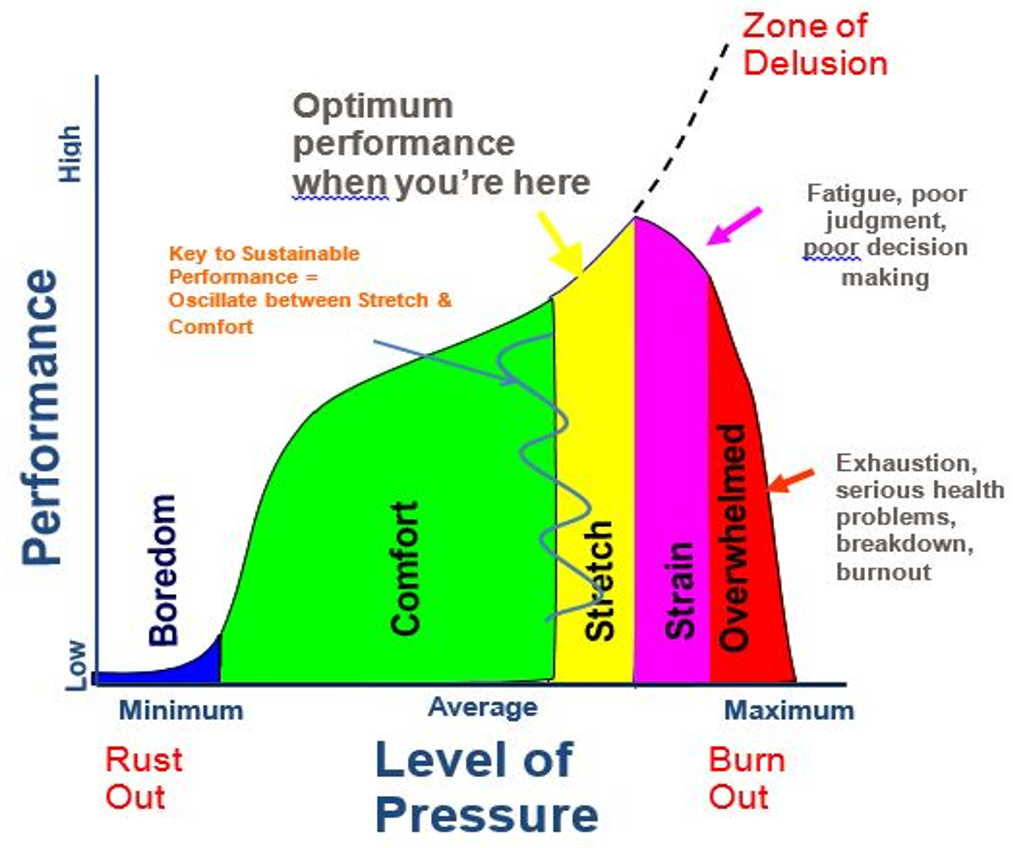
Adapted from Williams (1994) Pressure Performance Curve, this diagram is reproduced with permission of GSK Training from Resilience for Change Management Reuters Events.
How can we step up to the leadership challenge?
Increasing engagement through our daily work
Thank you: When you receive a thank you, make sure to pass it on next time you see the other people who were involved.
Memo: When you receive written communications, don’t just read it and/or email it; make time to discuss key aspects with your team and feedback a few key points.
Feedback: At the end of the day, event or meeting, remember to ask for some quick feedback for yourself. Try asking for one thing that you did that was helpful and one thing that you did that wasn’t so helpful. Politely accept whatever feedback is given and make time to consider what you might do to improve.
Managing change
Situation: At the very earliest opportunity, bring people together who are likely to be involved and/or affected by the decision.Tell them honestly about the parameters, ask for ideas, try to solve both your problems and theirs, together.
Options: As soon as you have a rough outline of how you might tackle things, meet again over your draft options. Ask about the potential effects of each option, ask what changes might both mitigate the negatives and increase the positives of all options.
Decision: Meet again to explain what you decided and what will happen next. Make time to continue to talk, think about and improve the plan as you go along.
Improving our involvement practice
During 2021/2022 the Involvement subgroup of the Well-being of Future Generations Stakeholder Forum met to reflect on our current practices and consider how we can deepen and improve our understanding and application of involvement within the 5 ways of working in the Wellbeing of Future Generations Act.
Here is what we are beginning to learn:
We recognise that our old ways were extractive.
We used to try to cover or own everything, e.g. piloting and rolling out. Now we are learning how to give people and places our time, generosity and respect. Use prototyping, emergent planning or inspiring across and working in particular ways that suit specific places and particular people.
When applying the Act, we recommend taking a creative, kind and practical approach that embodies the following key elements:
- Start with Involvement. Ask people what matters to them. Use involvement as a starting point to consider and apply all 5 ways of working.
- Mainly, we just need to know whether people are ok and that they will ask for help if they need it. We also need to ask ourselves these questions, too. What matters to us? What do we need to help us be at our best and how do we create space for others to be at their best?
- Work with. Don’t do to. Beware the service model mind-set! You do not need to know what is best, or to organise something for others. Think instead of the social model. How can you work together with others, not over them? Social Model animation in English, Social Model animation yn Gymraeg
- Look for what is strong not what is wrong. Don’t try to fix people. Look for what is strong in both individuals and in communities. When asking the question, 'What is wrong?', we should address this at a system level, which will affect both individuals and communities.
- Most of our work is about listening and learning; whether we are Local Area Coordinators, Welsh Government Officials or anyone else.
- It is important to start every conversation confident that all participants have strengths. We do not need to know the strengths of everyone before we start, but be curious and actively encourage these strengths to surface and to be shared as and when they are needed.
- Bear in mind the up-to-date definition of consistency.
- Weave relationship-building into all activities. Make space to bring it back to feelings. The brain-body system works best when feeling, thinking and working together. This is skilled work – ask for help if you need it!
- Meet, listen, connect, don’t map! Do not identify, map or list people, resources, needs or strengths. These activities just reproduce the existing power imbalance. Try signposting or connecting instead.
- Show appreciation: Show thanks where necessary. How was that helpful to you? Sometimes the first time we notice our hidden strength is when someone else tells us about it.
- Don’t make extra things. Morph, blend, link and/or re-prototype what is already here.
- Use the safety position (hand on heart), not the protection position (arms folded)
Leading successful strategic interventions at a local level
Three top tips
- Ask what really matters to the locality and respond.
- Use the assets of all in the locality.
- Communicate, communicate, communicate – your leadership will inform your success.
Basic principles
- Be open, honest and responsive and listen hard!
- Provide, at the outset no more than; a few high-level principles, attractive/accessible/draft form evidence, your time, some financial resources OR a clear statement that you haven’t got these.
- Commit to working together alongside/with people for an extended period
- Start from an asset-based perspective
- Work with people to identify action that you genuinely want to take together
- Agree a shared mechanism for monitoring and evaluating emergent outcomes
- Set up the simplest possible governance
- Get on with working together while continuing to discuss the more difficult elements of your relationship/situation
- Evaluate using a methodology that allows you to assess achievements towards local ambitions as well as national targets
An underpinning competency framework for leadership in Wales
“Leadership practice is an enquiry. Our role is not to assume knowledge but to be prepared to find out. To ask what is needed to thrive and to enable others to thrive.”
Charlotte Von Bullow (Founder of Crossfields Institute) 2019
Key transformation skills
It has taken some time to boil it down, but we have finally devised a competency framework that might underpin all others. We have identified four skills for development:
- Pause (long, short, with others, alone, meditative, in movement, outdoors, just waiting for things to emerge)
- Listen (to myself, to others, to nature, to understand, to help someone else understand, in generative conversations)
- Ask a good question! Then listen again, ask again, pause again
- Learn to act collectively (coproduce, learn by doing, experiment, prototype, have a go)
Experiment with how much you need of each of these elements: try doing more of 1 and 2 (especially to break a previous pattern; don’t jump to action without pausing and listening), how can you balance pausing/listening/questions with taking action? What happens in an emergency or a crisis?
Our intention is a key element – aim to understand things better i.e. ourselves, others, human beings, nature, the organisation, the political landscape, etc. Through understanding we can use our attention to make better decisions and take more effective action.
Paying attention to our attention: a 3-point plan
Developed from: Bülow, C. v. (2019) The Practice of Attention in the Workplace – Phenomenological Accounts of Lived Experience.
What’s the problem?
By neglecting our attention in the current attention economy, we end up mismanaging ourselves.
The workplace needs to become an environment that offers time and space for inner work, flow experiences, the development of mastery and convivial sociality, i.e. ensuring that our moral and social existence is never split between our thoughts and feelings, mind and body.
This mental fragmentation leads to ill-health. Melancholy, stress and depression play a major role in our story, particularly in terms of how we participate in the modern socioeconomic reality. Yet with the pressures we are under, the daily onslaught of digital stimuli, and what seems to be a losing battle against distraction, this is at risk of becoming a state of normality for us.
Globally, a lack of respect for management practice as an art and craft that requires mastery, and the resultant lack of practical wisdom in the conduct of management practitioners, has contributed to some of the most disastrous events in our most recent environmental, political and financial history.
The reluctance we may feel about tackling this problem, or developing a deliberate practice of attention, may be caused by the lack of guidance on how to even begin that journey.
What’s the challenge?
We are attempting to initiate the start of a conversation among colleagues, along with inviting development of communities of practice. We are assuming that a deliberate practice of attention in the workplace can grow out of one person’s initiative, one team, a focus group or a cooperative inquiry, conversations between colleagues, journaling or just trying it and not hiding it.
We invite everyone to take responsibility not only for our own path of self-development but for the positive difference that every courageous and conscious role model can make in the workplace. Coming out and advocating a deliberate practice of attention in the average workplace is not an easy thing to do, but walking the path regardless is essential currently.
Where can we start?
The following 3 keystones link attention to 3 of the elements that require constant awareness, persistent scrutiny and continuous dedication. If we are to be conscious role models and successful leaders in the transformation of today’s workplace, we might start from here:
- Attention and ethics
- Attention and intention
- Attention and self-knowledge
Leadership, in this context, can be understood as the practice of:
- readiness to be authentic
- willingness to transform
- courage to take responsibility for self and others
- trust in the wisdom of each moment, and
- love of the deed (the work).
Attention and ethics
The landscape of captured attention (email, social media, deadlines etc) is at risk of undermining our natural abilities to discern and control how we attend in everyday life. It is our moral obligation to consider the consequences of our attentional behaviour. We need to develop an ethical attitude of consent in our practice of attention, and this requires of us that we create spaces in the day to ask – who might I be hurting or helping by paying attention in this or in that way? The power we hold by having the capacity for attention and consciousness at the same time is immense – it comes with an obligation to hold ourselves to account in every moment.
Attention and intention
If management practice requires a commitment to self-development, then we have work to do to create environments where such a practice is not constantly undermined. We need to dedicate actual clock time to the exploration of our inner landscape, and we need to create an environment in which we can safely peel off the different layers of the onion. Without scrutinising our intentions in this way, we cannot be sure that our decisions and actions are morally justifiable.
Attention and self-knowledge
Without ongoing, rigorous self-examination, unconscious fears and ingrained thinking can shape our actions. If these behaviours are automatic, deliberate attention helps reveal and address them. By recognising latent fears and the narratives behind our biases, we can challenge and change them. This requires a sustained commitment to reflective practice as the route to self-knowledge.
Conclusion
By inviting colleagues on a journey with these keystones, we hope to take a step towards creating a culture of moral integrity and ethical attention practice in our workplace.
How can you make space in your work patterns for all 3 of these practices?
The Wellbeing check-in
The skills above can be put into practice by extending our usual handovers and team meetings to cover 3 (instead of one) key elements:
The wellbeing of colleague, patient or customer (project or place), ask: How are you?
Our wellbeing as a team of individuals: How are we?
The wellbeing of our organisation (or wider system): How are we?
Is there any feedback we need to provide and how will we pass this on?
Responding to our emotions
Each of us as individuals, all human groups and natural systems are dynamic. We are continuously changing and developing, as is the environment around us.
Emotions play an important role in our ability to; make decisions, manage our internal energy and create deeper connections with other people and with nature.
There are at least 3 different ways we can respond to our own internal emotions in the moment, when they occur:
- express them in their raw form – sometimes necessary but comes with a risk of harming yourself or others
- suppress them by holding them in – which can also be harmful to our physical and mental health, but may be a necessary temporary response
- articulate them – by describing how we feel to ourselves or others, allowing us to be present with the feelings, allowing them to shift and change
Each of the 3 ways of responding to emotion may be appropriate in different circumstances.
Later we can reflect on what happened and the feelings we felt. We can pause to consider the new feelings that are arising now. This can help us understand better what occurred and how our emotions and the emotions of others were involved.
Key questions for organisations
What are the conditions in which we feel safe to articulate our emotions and how can these conditions be encouraged?
How can we learn to articulate our emotions more clearly?
How can we create more/better spaces for reflection and self-reflection?
Feedback so far…
“I really like the Key Skills and the Wellbeing check-in. The intention behind them is the key part; to better understand ourselves, others, the organisation and the political landscape, etc. Through understanding, we can make better decisions.”
“It seems so simple, but at the same time it’s so important to highlight to people that our thoughts and how we feel comes into play in everything we do.”
“I suspect that how we respond depends on how ‘safe’ we feel, and the safer we feel the more likely we are to articulate it. I.e. if we are with someone who is a good listener, we’re more likely to articulate the emotion rather than suppress or express.”
Key questions for organisations (2)
How can we create more time in handovers, check-ins and team meetings to allow these wider and deeper conversations to take place?
How can we invite people to take up the opportunity to have a go/learn by doing?
Basic training
A lot of this is about learning by doing but here are three key areas we might want to explore through formal training:
- Pause and be present – through mindfulness, meditation, and presencing practices like Theory U.
- Behavioural insights and behavioural science – various courses covering elements of the latest science. For a recent overview see this report (Supporting policy with scientific evidence).
- Relational reflection – warm data, appreciative inquiry, action learning, action research, team coaching
Cutting edge research is beginning to show that these 3 areas of expertise, if used in combination, can enhance our productivity and effectiveness, within complex and challenging environments.
See also training opportunities below.
Embodiment, meditation and presencing
The continual practice of meditation; whether through seated yoga, mindful movement, or immersion in nature, facilitates the cultivation of calm and enhances alertness. This approach improves our capacity to observe thoughts, emotions, and sensations as transient experiences without attachment. Engaging in ‘sitting’ with an attitude of loving kindness towards oneself fosters acceptance, both individually and within broader contexts, free from judgement. Such practices establish a foundation of equanimity that supports sound decision-making. Furthermore, they can deepen one’s sense of connection to the world or promote a peaceful detachment from external concerns.
When we experience ‘sitting’, we are learning to experience a meditative state of alert attention, receptivity, non-judgemental openness towards what is happening, just here, right now.
Turned inward: meditation offers the opportunity to uncover the space of awareness and observe our inner (physical, mental, emotional) states and how these change, moment to moment.
Embodiment and presencing is meditation in action. It refers to our ability to be fully present with people or in a situation: ‘being with’, bringing our full consciousness to being present in this moment, and recognising the deep impersonal connections between us.
It involves us in the act of paying attention to the other person (or people or nature) in ways that recognise and create opportunities for mutual healing. ‘Being with’ enables us to access a deeper state of awareness, in which we can become more aware of our own and others’ feelings; we can notice how things are changing and engage in mutually supportive, generative conversations.
Turned outward: embodiment and presencing offers the opportunity to build deeper connection with others.
Both ‘sitting’ and ‘being with’ invite us to notice with compassion. As we learn to apply these skills in everyday life, we can begin to transform relationships.
This may be best achieved by using a mixture of short and long meditative practices, in combination with learning about behavioural insights, and engaging in collective reflective practices or appreciative enquiry.
Whether or not we practice a sitting meditation, we can use meditation-in-action by incorporating short mindful moments, along with developing conscious use of our attention when working with others.
How can we develop these skills together and increase our sense of flow?
No silver bullet
Sometimes the life situations we are in or external factors around us can affect us deeply. We can find ourselves:
- Becoming disconnected – refusing to feel others’ emotions and potentially suppressing our own, not necessarily even being aware that this is happening
or - Becoming agitated – feeling our own emotions but (in the heat of the moment) not noticing them, eventually becoming stressed or overwhelmed
When these patterns emerge, the way forward is to become more present but gently so. First, we need to notice. (Perhaps others will give us feedback if we don’t notice for ourselves?) Once we have noticed, we need to be compassionate towards ourselves, not leaping into a huge meditation, but taking small steps to become present with compassion to ourselves, accepting our difficult emotions, and gently reviving ourselves through breath, being present, a walk in nature, some music… perhaps finding a friend to articulate to… getting some sleep! Trying again in a different way.
We are dynamic. There will always be cycles of up and down, in and out etc. As we learn to notice and accept these more immediately, as they arise, the shape and frequency of these changes will also change.
Take small steps and practise being present, being attentive, sitting. All these activities become transformative with practice, allowing us to function and be with others, and in our organisations in ways that allow us to thrive.
How can we encourage ourselves and others to notice and manage our states of being proactively?
How can we learn about our collective histories so that this can inform our action?
Action
You are invited to experiment with new practices from this manual or elsewhere, try them in different situations, reflect upon what happens and learn more. It is important that you choose the practices that feel right for you just now. We recommend that you select a maximum of 3 practices to work on at any one time. If you have questions or feedback about the practices, please contact: Sustainable.Futures@gov.wales