
Welsh Index of Multiple Deprivation (WIMD) 2025 results report - Community safety domain results
WIMD is designed to identify the small areas of Wales that are the most deprived.
In this page
Introduction
The purpose of this domain is to measure the proportion of people experiencing deprivation relating to living in a safe community. It covers actual experience of crime and fire, as well as perceptions of safety whilst out and about in the local area. The domain has a relative weight of 5% in the overall index.
Indicators
Figure 8.1: community safety domain indicator, WIMD 2025
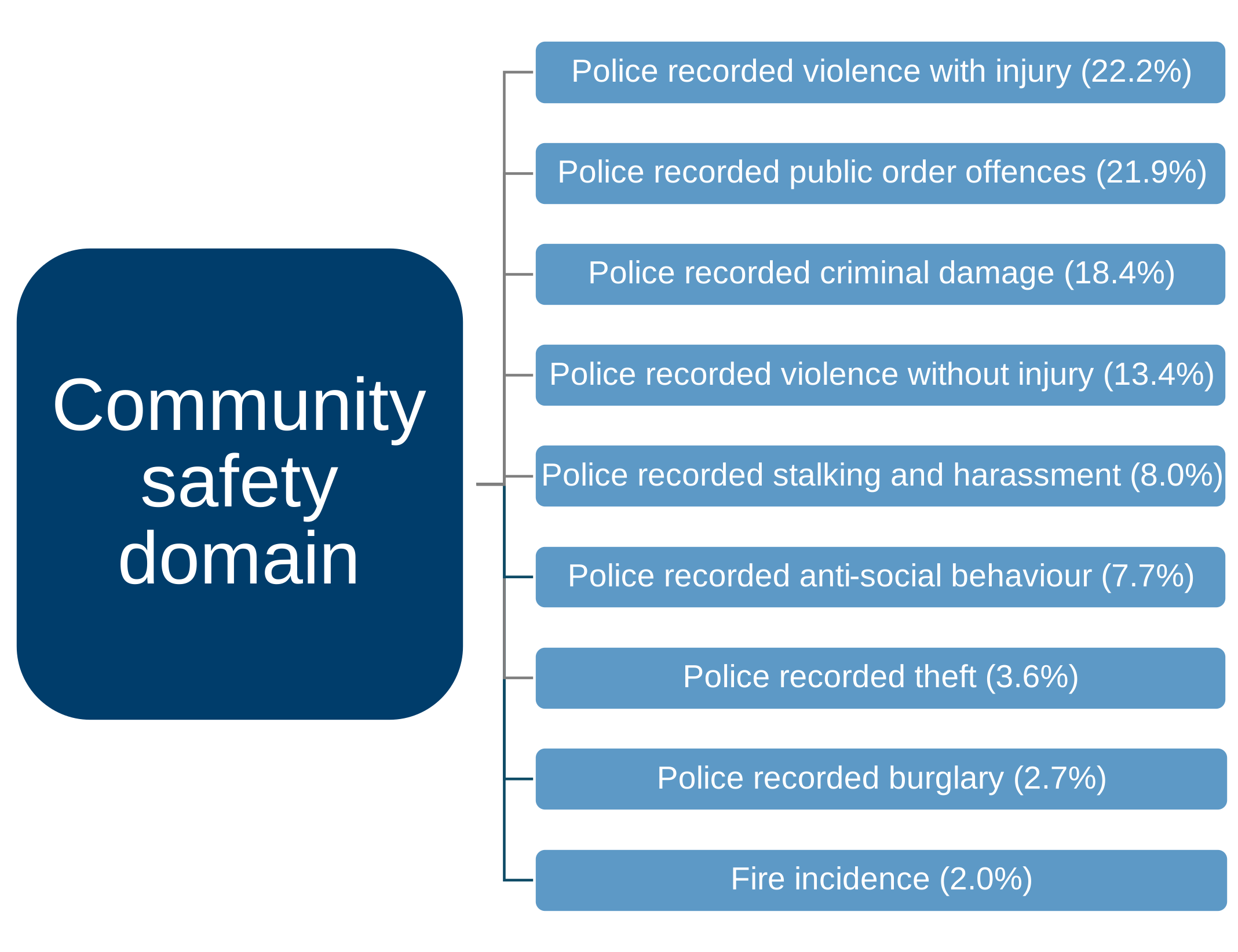
Description of figure 8.1: diagram showing that the community safety domain has 9 indicators, of these 7 are based on the rates of various categories of police recorded crime data, one relates to the rate of anti-social behaviour and one relates to the rate of fire incidence compared to the population at risk. The percentage shown next to each indicator is the amount it contributes to the overall domain.
The indicator numerators are the average number of incidents across 6 financial years, April 2018 to March 2019 (2018-19) to 2023-24) for the following categories of police recorded crime:
- violence with injury
- violence without injury
- public order offences
- stalking and harassment
- criminal damage
- burglary
- theft
The numerator for the anti-social behaviour indicator is the average number of recorded incidents across two financial years (2022-23 and 2023-24).
The numerator for the fire incidence indicator is the average number of fires attended across three financial years (2021-22 to 2023-24).
We have introduced some changes to the indicators used within the domain since WIMD 2019. These include:
- splitting the previous police recorded violent crime indicator into the first four categories of crime listed above
- a change in the number of years of police recorded crime data from an average of 6 years (from 2 years of data), to avoid the impact of unusual patterns of recorded crime during the years affected by the COVID-19 pandemic
- changes to the population at risk of crime in an area to reflect that it is not just those who are resident in an area that might be impacted, and to include prison populations
Full details on the indicators and construction of the domain is available in the WIMD 2025 technical report.
Main points
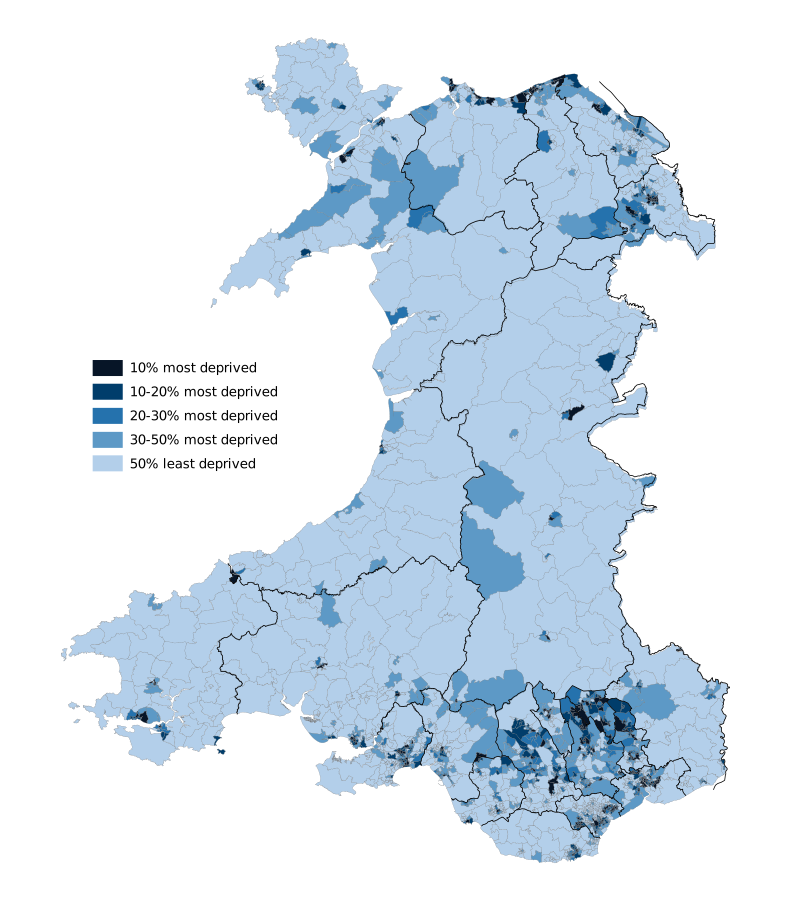
Figure 8.2: map of LSOAs shaded by community safety deprivation group, WIMD 2025
Crown copyright 2025: Cartographics, Welsh Government, ML/35/25.26, September 2025, OGL.
Description of figure 8.2: the map shows that in the WIMD 2025 community safety domain, there were pockets of high deprivation in the South Wales valleys and large cities, and the coastal and border towns in North Wales.
- Monmouthshire was the only local authority to have no LSOAs in the most deprived 10% of areas.
- The local authorities with the highest proportion of areas in the most deprived 10% were Blaenau Gwent (at 28%) followed by Newport (23% of LSOAs in the local authority).
- The overall patterns of community safety deprivation in WIMD 2025 are broadly similar to those for WIMD 2019.
- The most deprived area in Wales was Rhyl West 2 in Denbighshire, (in WIMD 2019 this LSOA was ranked seventh).
- Of the 10 most deprived areas in WIMD 2025, 3 were also in the 10 most deprived areas in WIMD 2019.
- Of the 10 most deprived areas in Wales, 3 were in Denbighshire and 2 were located in Conwy.
Comparison between WIMD 2019 and WIMD 2025
One of the police recorded crime indicators from WIMD 2019 has been split into four separate indicators, and there have been several other methodological changes for the domain. Therefore it is not directly comparable with that for WIMD 2019. For full information on how the domain has changed since 2019 see the technical report.
| WIMD deprivation group | 10% most deprived 2025 | 10% to 20% most deprived 2025 | 20% to 30% most deprived 2025 | 30% to 50% most deprived 2025 | 50% least deprived 2025 |
|---|---|---|---|---|---|
| 10% most deprived 2019 | 61% | 19% | 5% | 10% | 5% |
| 10% to 20% most deprived 2019 | 21% | 33% | 18% | 18% | 9% |
| 20% to 30% most deprived 2019 | 12% | 23% | 29% | 29% | 7% |
| 30% to 50% most deprived 2019 | 3% | 11% | 19% | 36% | 30% |
| 50% least deprived 2019 | 0% | 1% | 2% | 14% | 84% |
The table shows the percentage of small areas (LSOAs) in each deprivation group for WIMD 2019 that have stayed or moved group in WIMD 2025. For an explanation of how we have treated the minority of areas that changed boundary, please see the guidance report.
The diagonal, top left to bottom right, shows the percentage of areas which have remained in the same deprivation group. Above the diagonal are percentages of areas which have moved from a more to a less deprived group. Below the diagonal are the percentages of areas which have moved from a less to a more deprived group.
The table shows that:
- most LSOAs in the most deprived and least deprived deprivation groups remained in the same group between 2019 and 2025
- of the 10% most deprived areas in 2019, 61% remained in that group in 2025
- of the 50% least deprived areas in 2019, 84% remained in that group in 2025
Only 62 LSOAs moved by more than two deprivation groups. The below focusses on areas that have moved most in or out of the more deprived groups.
Relatively more deprived
Five areas moved from the 50% least deprived in WIMD 2019 to the 10% to 20% most deprived in WIMD 2025, 2 were in Monmouthshire, 2 in Rhondda Cynon Taf and one in Ceredigion
Relatively less deprived
Of the areas in the 10% most deprived group in WIMD 2019, 10 have moved to the 50% least deprived group in WIMD 2025, located in Newport, Cardiff, Wrexham, Neath Port Talbot and Swansea. These areas had some of the largest non-resident workplace populations which are now included in the denominators of police recorded crime rates.
Local authority analysis
Figure 8.3: box plot of WIMD 2025 community safety domain ranks, by local authority
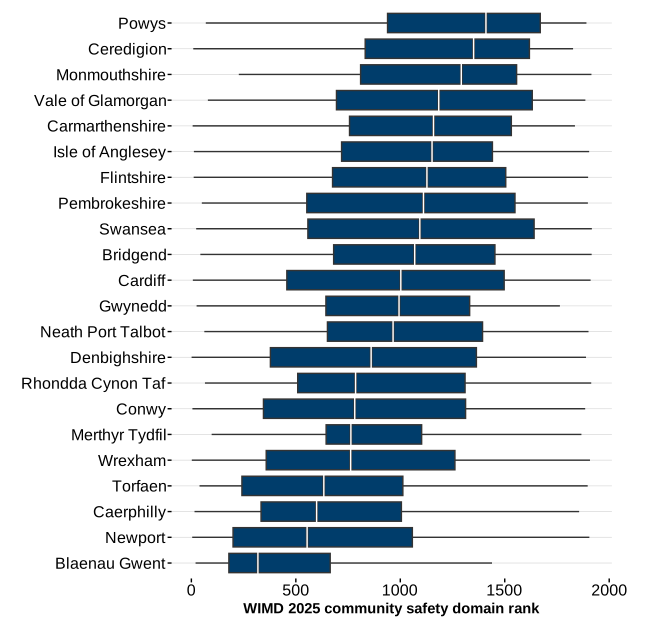
Description of figure 8.3: the chart shows the spread of community safety domain ranks for each local authority. The blue boxes contain half the total number of small areas (LSOAs) in each local authority, centred on the median (middle) rank for each local authority and the ‘whiskers’ show the full range of ranks within each local authority. Deprivation increases with decreasing rank (that is, towards the left-hand side of the plot).
The spread of community safety domain ranks is greatest in Swansea and Cardiff and narrowest in Merthyr Tydfil and Blaenau Gwent. Powys has the highest median rank (less deprived) and Blaenau Gwent has the lowest (more deprived).
Concentrations of community safety deprived areas, by local authority
One way of considering WIMD data at the local authority level is to look at the proportion of areas within the local authority that are in the most deprived 10% (or 20% etc) of all areas in Wales. This method can be seen as identifying the concentration of the most deprived areas in a local authority, rather than an average level of deprivation.
The WIMD 2025 community safety domain results show that:
- the local authority with the highest proportion of areas in the most deprived 10% in Wales was Blaenau Gwent (28% or 13 areas) followed by Newport (23%) and Torfaen (20%)
- after Monmouthshire (which had no small areas in the most deprived 10% in Wales) the Vale of Glamorgan and Rhondda Cynon Taf had the smallest proportion of LSOAs in this deprivation group (each with 4% of LSOAs in their areas)
- Powys and Ceredigion were the local authorities with the lowest concentrations of areas in the most deprived 50% of Wales, at 27% and 31% respectively
- Blaenau Gwent and Caerphilly had the highest percentage of areas in the most deprived 50% in Wales, at 91% and 74% respectively
Concentrations of WIMD 2025 community safety deprived areas, by local authority on StatsWales.
Related information
Police recorded crime
Since the publication of WIMD 2019, there has continued to be a focus on the quality of crime recording by the police. This follows the inspections of forces by Her Majesty’s Inspectorate of Constabulary (HMIC), the Public Administration Select Committee (PASC) inquiry into crime statistics and the UK Statistics Authority’s (UKSA) decision to remove the National Statistics designation from police recorded crime statistics. More recently the UKSA conducted another quality review and ONS have published an action plan as first steps towards reaccreditation.
It is thought the focus on quality has led to improved compliance with the National Crime Recording Standard (NCRS), leading to the recording of a greater proportion of crimes coming to the attention of the police. It was considered and agreed by the community safety domain group that police recorded crime data remained the best source of crime data available for WIMD 2025 at the small area level.
Crime Survey for England and Wales
The Crime Survey for England and Wales measures the extent of crime by asking people whether they have experienced any crime in the past year. The Crime Survey records crimes that may not have been reported to the police and it is therefore used alongside the police recorded crime figures to show a more accurate picture of the level of crime in the country.
An additional element that the Crime Survey provides is information on perceptions of crime and anti-social behaviour. This is a key element of community safety deprivation, in terms of feeling safe whilst out and about in your local area. Data and further information on the Crime Survey for England and Wales can be found on the Office for National Statistics' website. These data are not included in WIMD 2025, as the data are not statistically robust below a Wales level.
National Survey for Wales
The National Survey for Wales asks about feeling unsafe after dark in your local area. Perceptions of safety are included in the definition of community safety deprivation. Further information and data can be found on our website.