
Welsh Index of Multiple Deprivation (WIMD) 2025 results report - Housing domain results
WIMD is designed to identify the small areas of Wales that are the most deprived.
In this page
Introduction
Conceptually, the purpose of the housing domain is to identify inadequate housing, in terms of physical and living conditions and availability. Here, living condition means the suitability of the housing for its inhabitant(s), for example in terms of health and safety, and necessary adaptations.
The domain has a relative weight of 9% in the overall index. This has increased from 7% in the 2019 index, due to the addition of new indicators on energy efficiency and the inability to afford to enter owner occupation or the private rental market.
Indicators
Figure 7.1: housing domain indicators, WIMD 2025
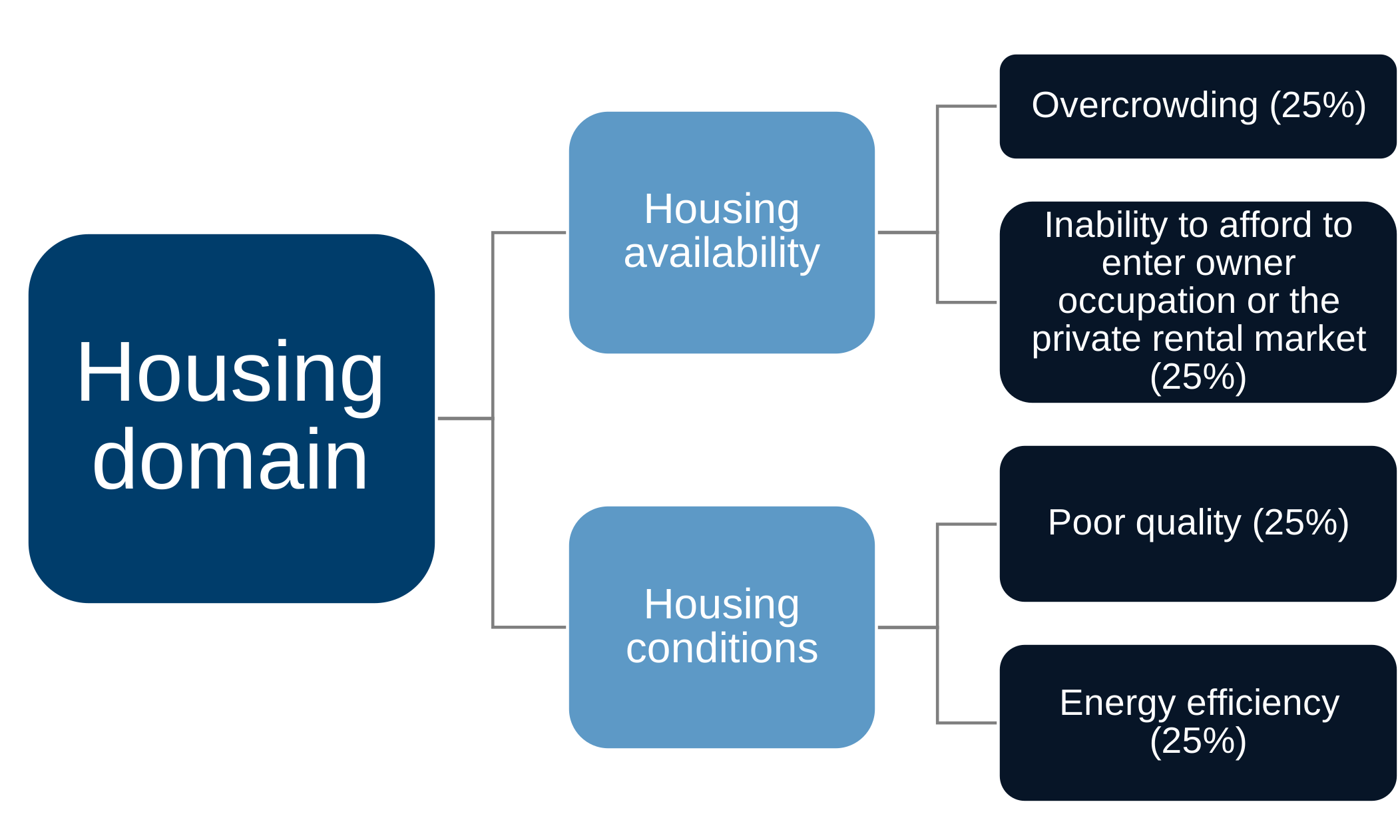
Description of figure 7.1: diagram showing that the housing domain has two equally weighted sub-domains, housing availability and housing conditions, with two equally weighted indicators each.
The housing availability sub-domain contains indicators of:
- the percentage of households that are overcrowded on the Census 2021 based bedroom measure
- inability to afford to enter owner occupation or the private rental market, 2023 (new for WIMD 2025, further details below)
The housing conditions sub-domain contains indicators of:
- poor quality, the likelihood of housing being in disrepair or containing serious hazards (for example, risk of falls or cold housing), 2023
- energy efficiency, 2012 to 2024 (new for WIMD 2025, further details below)
We are introducing a new indicator on inability to afford to enter owner occupation or the private rental market produced by Heriot-Watt University. This indicator has been used in several iterations of the English indices of deprivation, for younger households with head of household aged under 40. Our measure also considers older private renters with a head of household aged 40 to 65. These are modelled estimates based on lower quartile house prices and private rents by dwelling size, and modelled household incomes. The indicator estimates whether households in an LSOA can afford to buy or privately rent a suitable home within a broader local housing market area, based on the income and dwelling size needs of households.
We are introducing a new measure of energy efficiency, based on average Standard Assessment Procedure (SAP) scores for residential properties in the area, using data from Energy Performance Certificate (EPC) records. MHCLG have developed this indicator for residential dwellings in England and Wales, imputing estimated EPC scores for all dwellings that do not currently have a valid EPC.
Full details on the indicators and construction of the domain is available in the WIMD 2025 technical report.
Main points
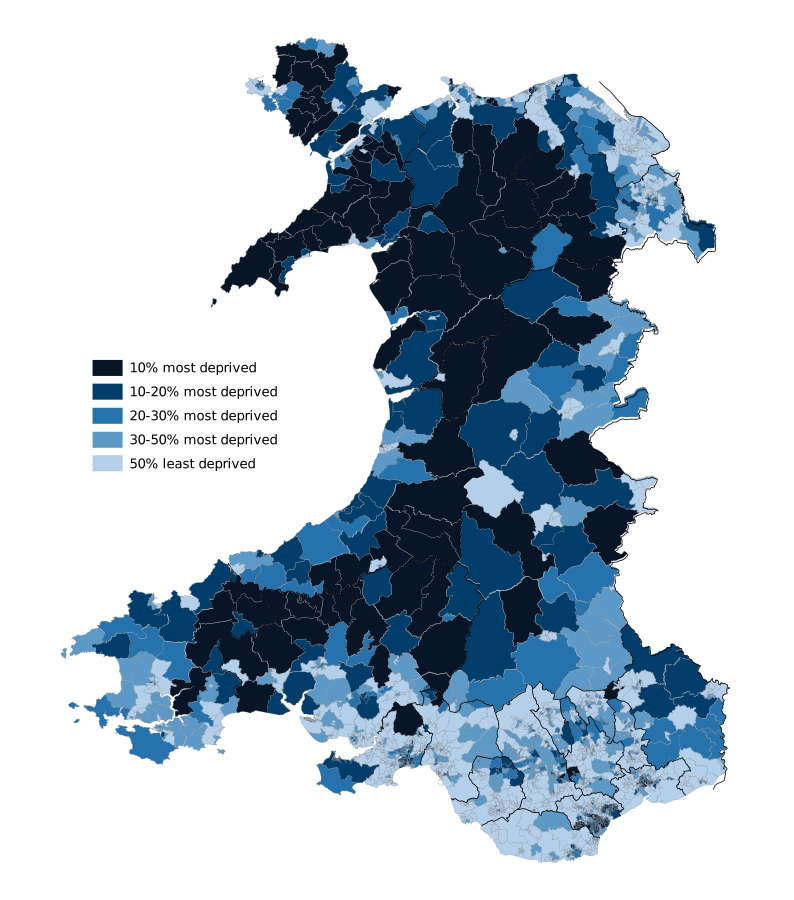
Figure 7.2: map of LSOAs shaded by housing deprivation group, WIMD 2025
© Crown copyright 2025. Cartographics. Welsh Government.
Description of figure 7.2: the map shows that in the WIMD 2025 housing domain, pockets of high housing deprivation tend to cluster in the larger towns and cities (driven by the housing availability aspect), and in more rural areas of West and North Wales (driven by the housing conditions aspect).
- The local authorities with the highest proportion of areas in the most deprived 10% in Wales were Gwynedd (38%), followed by Cardiff (33%).
- Six local authorities had no small areas in the most deprived 10% in Wales: Blaenau Gwent, Bridgend, Flintshire, Merthyr Tydfil, Torfaen and the Vale of Glamorgan.
- Five of the 10 most housing deprived areas in Wales were in Gwynedd, and 2 of these border 'Uwch Conwy’, an area of Conwy also in the top 10 most deprived.
- The other 4 of the 10 most housing deprived areas were in Cardiff, in Grangetown and Riverside.
The most housing deprived area was the same as for WIMD 2019: Grangetown 9 around the North end of Corporation Road. Together with its neighbour Grangetown 6, they are the only areas to appear in the most deprived decile of both the housing conditions and housing availability sub-domains.
There have been some changes in the patterns of housing deprivation seen in WIMD 2025 compared to those seen in WIMD 2019. This is to be expected given the inclusion of the new indicators on energy efficiency and inability to afford to enter owner occupation or the private rental market.
Comparison between WIMD 2019 and WIMD 2025
There are two new indicators in this domain, therefore it is not directly comparable with that for WIMD 2019. For full information on how the domain has changed since 2019 see the technical report.
| WIMD deprivation group | 10% most deprived 2025 | 10% to 20% most deprived 2025 | 20% to 30% most deprived 2025 | 30% to 50% most deprived 2025 | 50% least deprived 2025 |
|---|---|---|---|---|---|
| 10% most deprived 2019 | 54% | 19% | 13% | 12% | 3% |
| 10% to 20% most deprived 2019 | 20% | 24% | 17% | 27% | 12% |
| 20% to 30% most deprived 2019 | 11% | 16% | 18% | 36% | 19% |
| 30% to 50% most deprived 2019 | 5% | 13% | 13% | 27% | 41% |
| 50% least deprived 2019 | 1% | 3% | 5% | 14% | 77% |
The table shows the percentage of small areas (LSOAs) in each deprivation group for WIMD 2019 that have stayed or moved group in WIMD 2025. For an explanation of how we have treated the minority of areas that changed boundary, please see the guidance report.
The diagonal (top left to bottom right) shows the percentage of areas which have remained in the same deprivation group. Above the diagonal are percentages of areas which have moved from a more to a less deprived group. Below the diagonal are the percentages of areas which have moved from a less to a more deprived group.
The table shows that:
- most LSOAs in the most deprived and least deprived deprivation groups remained in the same group between 2019 and 2025
- of the 10% most deprived areas in 2019, 54% remained in that group in 2025
- of the 50% least deprived areas in 2019, 77% remained in that group in 2025
Just over 100 LSOAs moved by more than 2 deprivation groups. Below we focus on those that have moved in or out of the most deprived group.
Relatively more deprived
Nine areas have moved from the 50% least deprived group in WIMD 2019 to the 10% most deprived in WIMD 2025, 6 were in Cardiff and ranked high on deprivation of housing availability, and the other 3 were in Gwynedd or Isle of Anglesey and ranked high on housing conditions deprivation.
Relatively less deprived
Five areas moved from the 10% most deprived group in WIMD 2019 to the 50% least deprived group in WIMD 2025. These were areas in or near towns in 5 different local authorities in South and Mid Wales.
Local authority analysis
Figure 7.3: box plot of WIMD 2025 housing domain ranks, by local authority
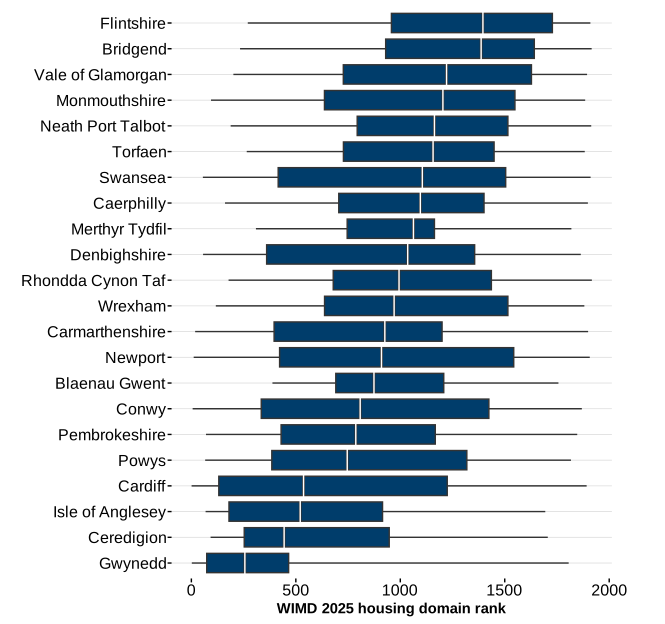
Description of figure 7.3: the chart shows the spread of housing domain ranks for each local authority. The blue boxes contain half the total number of small areas (LSOAs) in each local authority, centred on the median (middle) rank for each local authority and the ‘whiskers’ show the full range of ranks within the local authority. Deprivation increases with decreasing rank (that is, towards the left-hand side of the plot).
The spread of housing domain ranks is greatest in Newport, Cardiff, Conwy and Swansea and narrowest in Gwynedd and Merthyr Tydfil. Flintshire and Bridgend have the highest median ranks (less deprived) and Gwynedd has the lowest (more deprived).
Concentrations of housing deprived areas, by local authority
One way of considering WIMD data at the local authority level is to look at the proportion of areas within the local authority that are in the most deprived 10% (or 20% etc) of all areas in Wales. This method can be seen as identifying the concentration of the most deprived areas in a local authority, rather than an average level of deprivation.
The WIMD 2025 housing domain results show that:
- the local authority with the highest proportion of areas in the most deprived 10% in Wales was Gwynedd, with 38% or 27 of its areas in that group, driven by deprivation in housing conditions (but with five of the 27 also in the most deprived 30% on housing availability)
- this was followed by Cardiff which had 33% or 73 of its areas in the most deprived 10% in Wales, driven by deprivation in housing availability
- Gwynedd also had the highest percentage of areas in the most deprived 50% in Wales, at 83%
- 6 local authorities had no small areas in the most deprived 10% in Wales: Blaenau Gwent, Bridgend, Flintshire, Merthyr Tydfil, Torfaen and the Vale of Glamorgan
- Bridgend and Flintshire were the local authorities with the lowest concentrations of areas in the most deprived half of Wales, at 26% and 25% respectively
Concentrations of WIMD 2025 housing deprived areas, by local authority on StatsWales.
Related information
Homelessness
Homelessness can be the most extreme form of deprivation in relation to access to housing. Data relating to statutory homelessness and those who present to local authorities for housing support are available at local authority level. We are developing a new collection of individual level homelessness data in Wales, and we will explore progress on this ahead of the next index.
Housing Conditions
The Welsh Housing Conditions Survey, which collects information about the condition and energy efficiency of all types and tenures of housing in Wales, was last conducted in financial year April 2017 to March 2018 (displayed as 2017-18). There are plans for a Welsh Hosing Survey in 2027-28. This will include a standard housing conditions survey, as conducted in 2017-18, and a broader social survey element covering various housing related topics. Fieldwork will take place over the financial year 2027-28, with headline results due in December 2028.
Fuel poverty
A household is regarded as being in fuel poverty if they are unable to keep their home warm at a reasonable cost. In Wales, the full income fuel poverty definition states that a household is in fuel poverty if it needs to spend more than 10% of its income (including housing related benefits and net of council tax) on all household fuel use to maintain a satisfactory heating regime. Modelled estimates of fuel poverty for Wales as at October 2024 are available.
Private outdoor space
The natural capital team at ONS have produced and published statistics relating to private gardens (private outdoor space) down to MSOA level for the whole of Great Britain (GB). These statistics were derived from the Ordnance Survey (OS) AddressBase Plus database (and include ‘non-green’ private outdoor spaces at the front, back and side of properties, as well as ‘green’ garden space).
The Ministry of Housing Communities & Local Government (MHCLG) have used this work as the basis for an indicator for the 2025 English indices of deprivation. We decided not to include such an indicator in WIMD 2025, for reasons set out in our proposals report and subsequent summary of user feedback.