
Welsh Index of Multiple Deprivation (WIMD) 2025: guidance
How to interpret and use WIMD 2025.
In this page
About WIMD
Background
The Welsh Index of Multiple Deprivation (WIMD) is the official measure of relative deprivation for small areas in Wales. It identifies areas with the highest concentrations of several different types of deprivation. WIMD ranks all small areas in Wales from 1 (most deprived) to 1,917 (least deprived). It is an accredited official statistic produced by statisticians at the Welsh Government.
An index is a group of separate measurements which are combined into a single number. They are designed to show changes in a complicated variable like industrial output, prices or in this case, deprivation. An index then allows comparisons between different values. For WIMD, the comparison is between small areas.
The concept of an Index of Multiple Deprivation was developed by the Social Disadvantage Research Centre of Oxford University, who produced the first WIMD in 2000. Updates were made in 2005, 2008, 2011, 2014 and 2019 by the Welsh Government.
What WIMD measures
WIMD is both an area-based measure and a measure of relative deprivation.
Deprivation
This is the lack of access to opportunities and resources which we might expect in our society. The domains used in WIMD relate to material and social aspects of deprivation.
- Material deprivation: having insufficient physical resources, for example food, shelter or clothing, necessary to sustain a certain standard of life.
- Social deprivation: the ability of an individual to participate in the normal social life of the community.
- Multiple Deprivation: more than one type of deprivation.
WIMD is calculated from 8 different domains (or types) of deprivation. Each domain is compiled from a range of different indicators.
An area is multiply deprived if it has a high concentration of deprivation in more than one domain. The more domains with a high concentration of deprivation, the greater the overall deprivation in that area. This does not mean the same people experience all types of deprivation, though we would expect some overlap.
Area-based measure
WIMD is calculated for all small areas (lower layer super output areas or LSOAs). The boundaries of LSOAs are produced by the Office of National Statistics (ONS) following each census and are a standard statistical geography used for reporting small area statistics. Following the 2021 Census, 1,917 LSOAs were defined in Wales, and they have an average population of 1,600. WIMD is based on indicators that consider the aggregate characteristics of the people living in the area and, in some cases, the characteristics of the area itself (for example, in the physical environment domain).
Relative measure
The index provides a way of identifying areas in the order of least to most deprived. It does not provide a measure of the level of deprivation in an area, but rather whether an area is more or less deprived relative to all other areas in Wales. Therefore, we can identify which areas are more (or less) deprived than others, but not by how much. The reason for taking such an approach is to allow the different domains to be combined together.
Domains that make up WIMD
WIMD is made up of 8 separate domains (or types) of deprivation, each compiled from a range of different indicators.
The index adds up scores from different domains, but some domains count more than others. Domain weights control the relative contribution of each domain to overall deprivation. Their values are based upon expert advice and the quality of the indicators available. If a domain has a higher weight, changes in that domain will have a bigger impact on the overall index.
The domains and their WIMD 2025 weights
- Income, 22%
- Employment, 20%
- Health, 15%
- Education, 14%
- Access to services, 10%
- Housing, 9%
- Community safety, 5%
- Physical environment, 5%
Changes for the 2025 edition
How WIMD 2025 differs from WIMD 2019
The methodology is broadly the same as for previous indices, with the same 8 domains or types of deprivation captured. However some new datasets, methodologies and geographies have been used to produce WIMD 2025, meaning outputs are not directly comparable to previous indices.
New indicators
- Housing: inability to afford to enter owner occupation or the private rental market.
- Housing: dwellings with poor energy performance.
- Access to services: travel times to childcare services.
- Physical environment: noise pollution.
Main changes to existing indicators
- Income: indicator reviewed due to rollout of Universal Credit (UC).
- Employment: as above, and now includes those not working due to caring responsibilities.
- Education: absenteeism split into primary and secondary stages, small change to qualifications indicator.
- Access to services: new approach to calculating average travel times and some changes to location data sources.
- Physical environment: new data source for ambient green space, and some changes to what’s included as a green space in the proximity measure.
- Community safety: police recorded violent crime split into sub-indicators with some changes to offence codes, and most crime rate denominators now include non-resident daytime population.
Indicators no longer included
These two indicators have been removed from the index for WIMD 2025 as updated datasets are not available, these are:
- education domain, Foundation Phase average point score
- education domain, Key Stage 2 average point score
Changes to domain weighting
The addition of 2 new indicators in the housing domain has led to a small increase in its weight from 7% to 9%. To allow for this, the weight for the employment domain has been reduced slightly from 22% to 20%.
These changes are based on user survey feedback and advice of domain group experts, following the inclusion of new data in the housing domain. To allow for a small increase in housing weight, the weight of the employment domain has been reduced slightly, but this remains the second highest weighted domain.
Changes to geographies
The ONS reviewed LSOA boundaries after the release of Census 2021 data, and there are now 1,917 LSOAs instead of the previous 1,909 for WIMD 2019.
What’s different in the published material
There are several updates to the range and the content of WIMD outputs for 2025.
Changes to WIMD 2025 compared to WIMD 2019
- The main report, guidance and technical report (except for annexes) will be published in HTML.
- The main report will be split into chapters.
- Technical content will be moved from the main report either into the guidance document or the technical report to reduce duplication and streamline the main report.
- The main interactive mapping facility for WIMD 2025 is now hosted within DataMapWales.
- WIMD 2025 tables will be published on the new StatsWales.
- Main data will be published as an OpenDocument Spreadsheet file alongside the new StatsWales tables.
- Some indicator data split by age previously published (for WIMD 2019) will not be available for the new data; we will integrate income deprivation rates for children and older people into main indicator tables.
Using WIMD
Uses
The distribution of deprivation across Wales is important when developing area-based policies, programmes and funding. WIMD can be used to inform these decisions and give a greater understanding of deprivation trends within Wales including:
- identifying the most deprived small areas
- comparing relative deprivation of small areas
- exploring the 8 domains (types) of deprivation for small areas
- comparing the proportion of small areas within a larger area that are very deprived
- using indicator data (but not the ranks) to compare absolute change over time
The index is most useful when used together with other information, either from the index indicators, other published data or local information.
How to find WIMD data for a specific area
Additional information on small areas is available through the underlying WIMD indicator data. The detail contained in these indicators can inform area profiling and help community groups make the case for improvements in areas of need.
There are 3 approaches to find WIMD data
- LSOA level data can be filtered to show a specific area on StatsWales.
- DataMapWales is the main mapping tool for WIMD 2025: it can be used to explore rank data by domain, view how deprivation varies across an area and search for an area using a variety of geographies (including postcodes and street names).
- An OpenDocument Spreadsheet contains the ranks for the domains and the overall index along with information on which decile, quintile and quartile of deprivation an area falls into.
Deprivation groups
High ranking areas (LSOAs) can be referred to as the ‘most deprived’ or as being ‘very deprived’ to aid interpretation. However, there is no definitive threshold above which an area is described as ‘deprived’. WIMD rankings are often grouped into deciles, quintiles and deprivation groups for analysis and mapping purposes.
Deciles split a set of data into 10 equal parts, and quintiles into 5. The first decile is the lowest 10% of values, the second decile is the next 10%, and so on.
The deprivation groups are used within the main WIMD analyses, including maps. They are designed to have smaller groups at the more deprived end of the distribution, where the difference between areas is greater than at the less deprived end, which can be seen by plotting deprivation indicator values from highest to lowest in a chart.
Figure 1: income deprivation rate for small areas, from highest rate (rank 1) to lowest (rank 1,917), WIMD 2025
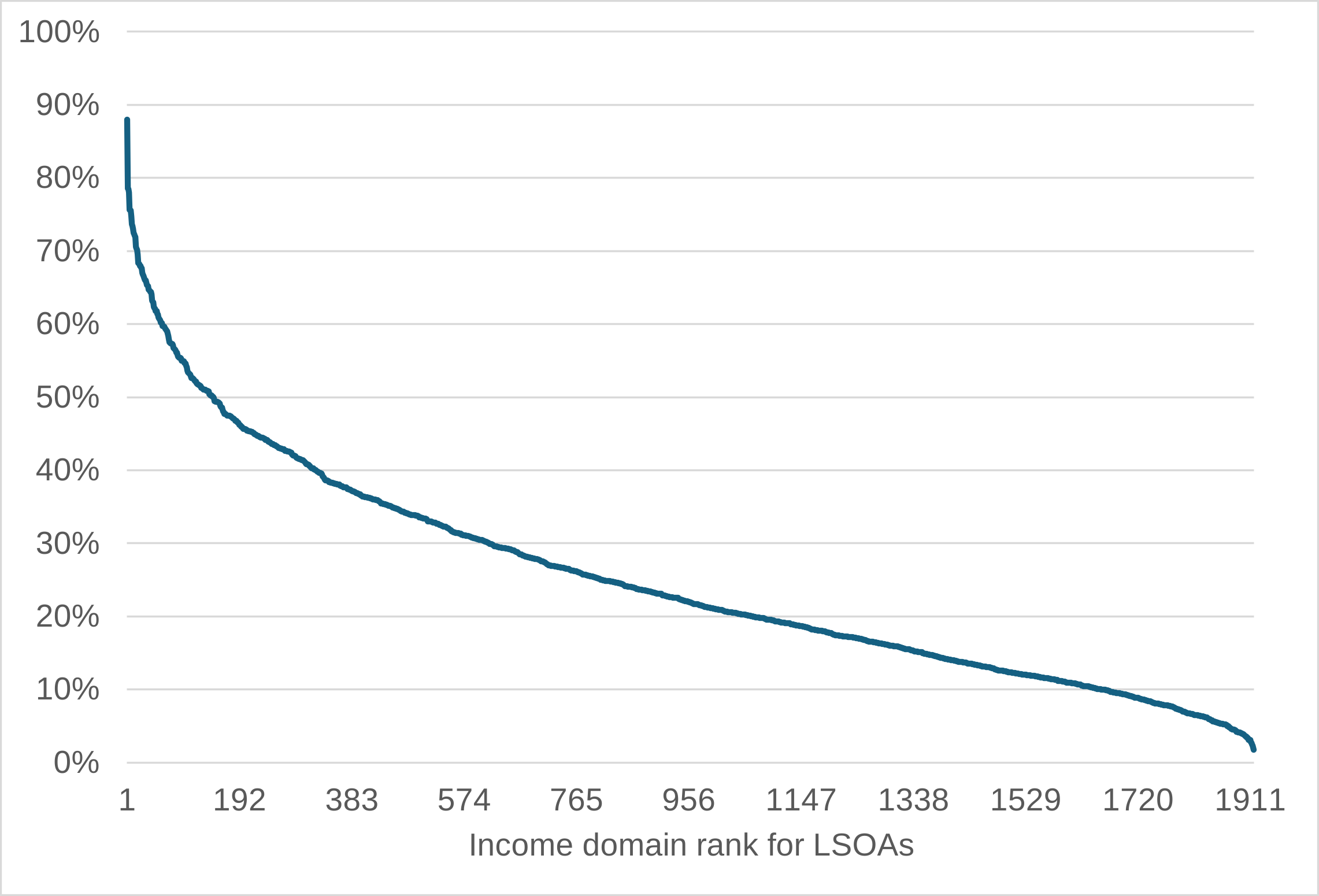
Description of figure 1: the chart shows how the percentage of income-deprived people in small areas varies (ordering values by their income domain rank), and that:
- deprivation rates increase steeply at the most deprived end of the distribution (large changes in the indicator value may only result in small changes to ranks)
- at the less deprived end, the curve is flatter, and small changes to the indicator values could result in large movements in the ranks
The ‘s-curve’ shape of the distribution is seen to a greater or lesser extent in all the indicators of deprivation.
Comparing 2019 and 2025 by deprivation group
The WIMD 2025 results report looks at movements between deprivation groups between WIMD 2019 and WIMD 2025, for each domain. Due to changes in the total number of LSOAs and the boundaries of some LSOAs between 2019 and 2025 this comparison is approximate, and follows these steps:
- for the WIMD 2019 groups, we used increments of 191 ranks for each decile, with ranks 956 and above forming the least deprived group
- for the WIMD 2025 groups we use increment of 191 or 192 ranks for deciles (as detailed in metadata), with ranks of 959 and above forming the least deprived group
- for LSOAs from WIMD 2019 which split into 2 or more areas for WIMD 2025, we allocated the same rank as the original larger area had to the new, smaller areas
- for LSOAs from WIMD 2019 which merged with one or more other areas for WIMD 2025, we allocated the most highly deprived of the ranks for the original, smaller areas to the new, merged area
How to use WIMD to help target resource or activity
WIMD is often used to target activity or resource on the most deprived areas. This is most effective:
- when the underlying issue has a strong geographical concentration
- where the response is best delivered at a small area or community level (for example where resources are aimed at regeneration of housing or town centres, or a scheme to reduce concentrated unemployment).
In some circumstances, a different approach may be more appropriate, such as when the issue is specific to sub-groups of the population, like the elderly. In other scenarios, a combination of approaches may be most effective, and the index may be useful as a starting point for targeting activity.
WIMD is not the only way to measure deprivation. The index is most useful when used with other information, either from the underlying indicators, other published sources or local information, to supplement your understanding of the areas. For example, ONS have published data and information relating to the 2021 census as well as local statistics (ONS). Statistics specifically for areas in Wales can be found at National Survey for Wales.
If you plan to use WIMD to inform a targeting exercise, start by considering which data are most relevant, as this may not always be the overall index. For example, it may be more appropriate to use ranks for one of the specific types of deprivation, like community safety or health. The access to services domain is often used as a local area measure of sparsity.
Aggregating to larger geographies
WIMD is calculated for all small areas (LSOAs). To compare larger geographies, you can calculate the proportion of small areas in a larger geography which are in the most deprived (say) 10% or 20% of areas in Wales. For example, if an area has more than 10% of its small areas in the most deprived 10% in Wales it can be considered relatively deprived. If it has fewer than 10%, then it can be considered relatively less deprived.
We will publish deprivation profiles for selected larger geographies shortly after the initial WMD 2025 publication, as well as indicator datasets for larger geographies. Datasets for local authorities will be prioritised.
Ranks and scores can’t be aggregated to larger geographies by averaging the values for the small areas. This is because of the way the index is constructed.
- A change in geography would affect steps in the calculation of the index (such as factor analysis).
- The ranks provide no sense of scale of the differences between areas, therefore averaging them is not meaningful.
The domain scores have been subject to an exponential transformation, which reduces the extent to which deprivation in one domain is cancelled out by lack of deprivation in another. Averaging scores for a group of areas would have the same (unintended) effect across areas. This may not make sense, for example, where two regions with the same proportion of deprived people could have very different average scores due to the spread of those people across the small areas in the region.
It is also not valid to aggregate underlying indicators to larger geographies by taking an average of the values of the small areas. Most indicators are expressed as a rate or proportion of the population, and averaging indicators does not take account of differences in the size of the population.
Deprivation scores
The overall index and domain ranks are the main output for WIMD. As part of the process for calculating WIMD ranks, scores (domain and overall) are produced. The WIMD scores are a stage in the construction of the index and not a product. The scores do not represent a level of multiple deprivation. This means that the scores do not contain any more information on levels of multiple deprivation than the ranks do. To assess levels of deprivation, underlying indicator data should be used.
The WIMD scores will be published for:
- transparency (so that users have access to all stages of construction)
- users to experiment with different weighting systems for the index, if required
How to adjust the domain weights or remove a domain
Domain scores will be published in an OpenDocument Spreadsheet. The scores for individual domains can be combined in a weighted sum to provide overall index scores, which are then ranked to provide the index ranks.
The weights can be adjusted to place lower or higher weight on a given domain, or to reduce its weight entirely to zero. A new weighted sum of the domain scores can then be calculated to provide adjusted index scores and ranks. For example, if you are a health researcher interested in the impact of wider deprivation on certain health outcomes, you may want to produce an adjusted set of ranks with the health domain removed.
Limitations of WIMD
WIMD is not the only way to measure deprivation. It has been developed to measure concentrations of several types of deprivation at a small area level.
Quantifying deprivation
WIMD ranks do not give a measure of the amount of deprivation in an area. The ranks can only be used to say, “area A is more deprived than area B”. and do not allow for statements such as “area A is twice as deprived as area B”.
Comparing absolute deprivation between index iterations
Change in ranks over time may not mean change in absolute deprivation levels (as it is a relative index). A change in rank for an area may be due to other areas moving up or down the ranks, rather than any change in the area itself. If an area’s rank remains the same, the level of deprivation in that area could have gone up or down but just not enough to affect its position relative to other areas. However, the underlying WIMD indicators can sometimes be used to monitor change over time.
Comparing relative deprivation between index iterations
WIMD can be used to look at the change in relative deprivation ranks between iterations, for example which areas have left, joined or remained in the most deprived group.
However, care should be taken in interpreting changes in rank due to changes in the way the index is calculated between different publications.
For WIMD 2025, to produce the best possible snapshot of relative deprivation using the latest available data, we have changed some of the indicators and domain weights. These improvements to the measurement of deprivation may have contributed to an area becoming more (or less) deprived relative to others, as well as underlying shifts in deprivation since WIMD 2019.
Deprived individuals
There may be people:
- living in deprived areas that would not be considered deprived,
- that would be considered deprived living in the least deprived areas
This is illustrated using income deprivation data in table 1.
| Income deprivation group | Percentage of all income deprived people living in this group |
|---|---|
| Most deprived 10% (rank 1 to 191) | 22% |
| Most deprived 20% (rank 1 to 382) | 38% |
| Most deprived 30% (rank 1 to 574) | 51% |
The table shows that:
- over a fifth of people who are income deprived live in the most deprived 10% of small areas for the income domain
- over half of those who are income deprived live in the most deprived 30% of areas for the income domain
So, although deprivation is much more concentrated in some areas than others, nearly 4 out of 5 income deprived people live outside the 10% most deprived areas. This is important to remember when targeting resources. Targeting those ‘most deprived’ areas mean including some people in those areas who may not be deprived and missing many deprived people living in less deprived areas.
Individuals who are deprived in several ways
WIMD does not identify individuals who are deprived in several ways. It identifies areas where there are concentrations of several different types of deprivation. We cannot link all the data included in the index at an individual person level to understand the extent of multiple deprivation for individuals.
Deprivation across the UK
England, Scotland and Northern Ireland all produce their own Indices of Multiple Deprivation (IMD). These datasets are based on the same concept and general methodology.
Reasons why it is not possible to compare with the indices for England, Scotland and Northern Ireland directly
- They are produced for different geographies (there is no suitable small area geography which is consistent across the four nations).
- There are differences between the indicators, and not all data are collected consistently across the UK (for example, the education systems are different from Wales, so some education indicators are not comparable).
- The indexes have developed according to the policy drivers in each of the countries (as devolution of UK constituent countries has evolved, these differences have grown).
- The indices are produced on different timescales so they do not tend to refer to the same year of data across the UK (this is often driven by different policy requirements in the different countries).
We continue to work with the Ministry of Housing, Communities and Local Government (MHCLG) and devolved administrations to explore opportunities to produce harmonised outputs. This includes sourcing data which will enable the publication of UK-wide products. Release plans are yet to be confirmed but will be announced on GOV.UK in due course.
Affluence
A lack of deprivation is not the same as being affluent. The least deprived area is not necessarily the most affluent area. WIMD is particularly effective at identifying differences between the most deprived areas. However, it is less reliable when comparing areas that are less deprived. Care should be taken in drawing conclusions about the differences between less deprived areas.
Deprivation and rural areas
WIMD’s purpose is to identify concentrations of deprivation across all parts of Wales, including rural areas. Deprived people in rural areas of Wales tend to be more geographically dispersed than in urban areas. This means that pockets of deprivation in rural areas of Wales tend to be on a considerably smaller scale than even the small-scale geography at which WIMD is produced.
People in rural communities can experience many of the same issues as deprived people in other areas. However, some commentators argue that certain issues can disproportionately affect people in rural areas, for example lack of employment opportunities and access to services. It can also be argued that some deprivation issues can disproportionately affect people in urban areas, such as congestion.
Those with an interest in rural deprivation may be interested in analysing deprivation in rural areas published as part of WIMD 2014. This statistical article provides guidance on how WIMD and its indicators can and can’t be used to analyse deprivation in rural areas.
Following the initial publication of WIMD 2025, we will explore producing new deprivation profiles and indicator data tables for the new Rural-Urban Classification 2021 (ONS).