
Non‑statutory guidance for public services boards and regional partnership boards: Assessments, data and evidence - 5. Prioritisation and partnership added value
This guidance supports public services boards (PSBs) and regional partnership boards (RPBs) as they prepare their statutory assessments under 2 separate Acts.
In this page
Introduction
The aim of prioritisation is to turn the evidence gathered as part of the assessments into a clear and manageable set of issues that the partnership can act on collectively. Rather than producing long lists or extensive thematic chapters, partnerships may wish to focus on identifying a small number of priorities where joint effort will have the greatest impact. This reflects a shift in approach: from describing everything that matters, to concentrating on the issues that require coordinated, strategic action across the partnership.
Focusing on a smaller number of priorities at the assessment stage does not remove the expectation that wider evidence has been considered. Partnerships may undertake broad analysis internally while choosing to publish a more selective narrative, ensuring that important issues are not overlooked even where they do not emerge as priorities for collective action at this stage.
5.1 What we mean by ‘priorities’ in this guidance
In this guidance, references to “priorities” describe the small number of key issues emerging from the assessment that require partnership attention. These are not formal Welsh Government statutory priorities or objectives but what has been identified through a needs assessment exercise.
For PSBs, statutory well-being objectives are set later as part of Well-being Plan development, following local government elections and potentially involving a different PSB membership. For RPBs, formal commitments are agreed through the Area Plan and Market Stability Report.
We encourage partnerships to identify a focused set of priorities at the assessment stage, as this supports clearer, more strategic planning later on. A small number of priorities where collective action is essential and no single organisation can deliver change alone, provides a stronger basis for developing Well being Objectives, Area Plan priorities and coordinated partnership commitments.
These priorities should be informed by a broad and representative range of voices, including communities and groups whose experiences are less often reflected in formal engagement.
5.2 Reflective, evidence-informed prioritisation
Prioritisation should bring together the full range of insight available – quantitative data, qualitative evidence including community voice, lived experience and professional judgement – and translate this into a shared understanding of what matters most. At this stage, it may be particularly helpful to consider how each issue might develop in the coming years, using simple futures and scenario planning techniques to explore opportunities, risks or emerging pressures e.g. Future Trends Report. Partnerships may wish to draw on support from organisations such as the Hwb Dyfodol who can offer PSBs support in futures and long-term thinking, and/or Public Health Wales for systems thinking approaches.
Partnerships may find it helpful to structure this stage around a small number of questions:
- What does the evidence consistently show?
Consider priorities that appear across quantitative data, qualitative insight and community voice. - Why does this matter for well-being or for care and support in your area?
Reflect on the implications for people, communities or services. - What are the underlying causes of this priority?
Partnerships may wish to explore the factors, behaviours, pressures or conditions that are creating or reinforcing the priority, rather than focusing only on what is most visible. Understanding underlying causes can help identify where early intervention and preventative action may be effective. - How does lived experience reinforce the importance of this priority? Pay particular attention to groups whose voices are less often represented.
- Where does the partnership add value?
Focus on priorities that cannot be addressed effectively by any single organisation acting alone. - What is within the partnership’s gift to change or influence?
This can help distinguish between priorities suited to collective action and those issues driven by factors beyond local control. - How might this priority change over time?
Use futures thinking to explore what may happen over the next 5 to 10 years. - Is collective action feasible and proportionate?
Be realistic about influence, resources and timing.
These prompts are not intended as a scoring framework. They are simply a way to support reflective, evidence‑informed discussion.
The following example illustrates how one PSB has approached prioritisation using evidence and collective influence:
The output of this stage should be a short narrative that explains the priorities chosen and the reasoning behind them. This narrative does not need to be lengthy. It simply needs to:
- describe the small number of priorities identified
- summarise the evidence and insight that led to them
- explain why they require partnership‑wide action
- reflect briefly on how the priority may change in future
- set the direction for more detailed exploration during planning
Supporting data, analysis and community insight do not need to be embedded in the assessment although the rationale for each priority should be transparent, and readers should be able to identify the principal evidence, data sources, research and engagement findings that support each key conclusion and priority. Partnerships have flexibility in how they choose to do this. Partnerships may wish to do this through the use of live dashboards, annexes or data catalogue or within the body of the assessment, if they wish to do so. Partnerships should provide a clear list of key evidence sources considered, rather than reproducing detailed analytical outputs. This enables clarity for readers without requiring the publication of every dataset, chart or detailed analysis.
Data catalogues and supporting material
Partnerships should maintain a record of the principal datasets, research and insight used in developing the assessment. This should be incorporated within the assessment, published as a data catalogue, technical annex or maintained through an accessible digital resource. As part of the assessments, it is important that the methodology and approach used to inform the assessment is clear, and that any limitations with the methodology are noted clearly. To enable the assessments to be focussed it is recognised that a summary of the methodology may be appropriate in the assessment itself, and that a more detailed overview of the approach may be provided as a technical annex.
Partnerships may also find it helpful to give themselves explicit permission to keep the assessment process proportionate. This may include focusing on depth rather than breadth, avoiding unnecessary technical detail, and recognising that not every issue identified in the evidence will become a priority.
5.3 Publication and accessibility
Assessments must be published by PSBs and RPBs in line with statutory requirements. Partnerships may choose different publication formats, including web first formats, interactive digital content, or traditional reports, as long as outputs are accessible, bilingual and transparent.
Publication should make clear how evidence, engagement and futures insight have informed findings, conclusions and priorities set out in the assessment. Readers should be able to understand what evidence was used, where it came from and how it contributed to the assessment's conclusions. What is published should focus on the narrative, the reasoning behind the chosen priorities and a simple list of key evidence sources, rather than the full analytical content. Detailed data, analysis and engagement summaries do not need to be reproduced within the assessment itself. However, partnerships should ensure that the key supporting evidence is accessible through linked annexes, data catalogues, dashboards or other supporting resources.
5.4 Summary of internal and published outputs
The diagram below summarises the distinction between:
- the work undertaken during the assessment
- the outputs that need to be published
It is intended to support a proportionate approach, where partnerships undertake rich analytical and engagement work, but publish only what is needed to justify and explain their agreed priorities.
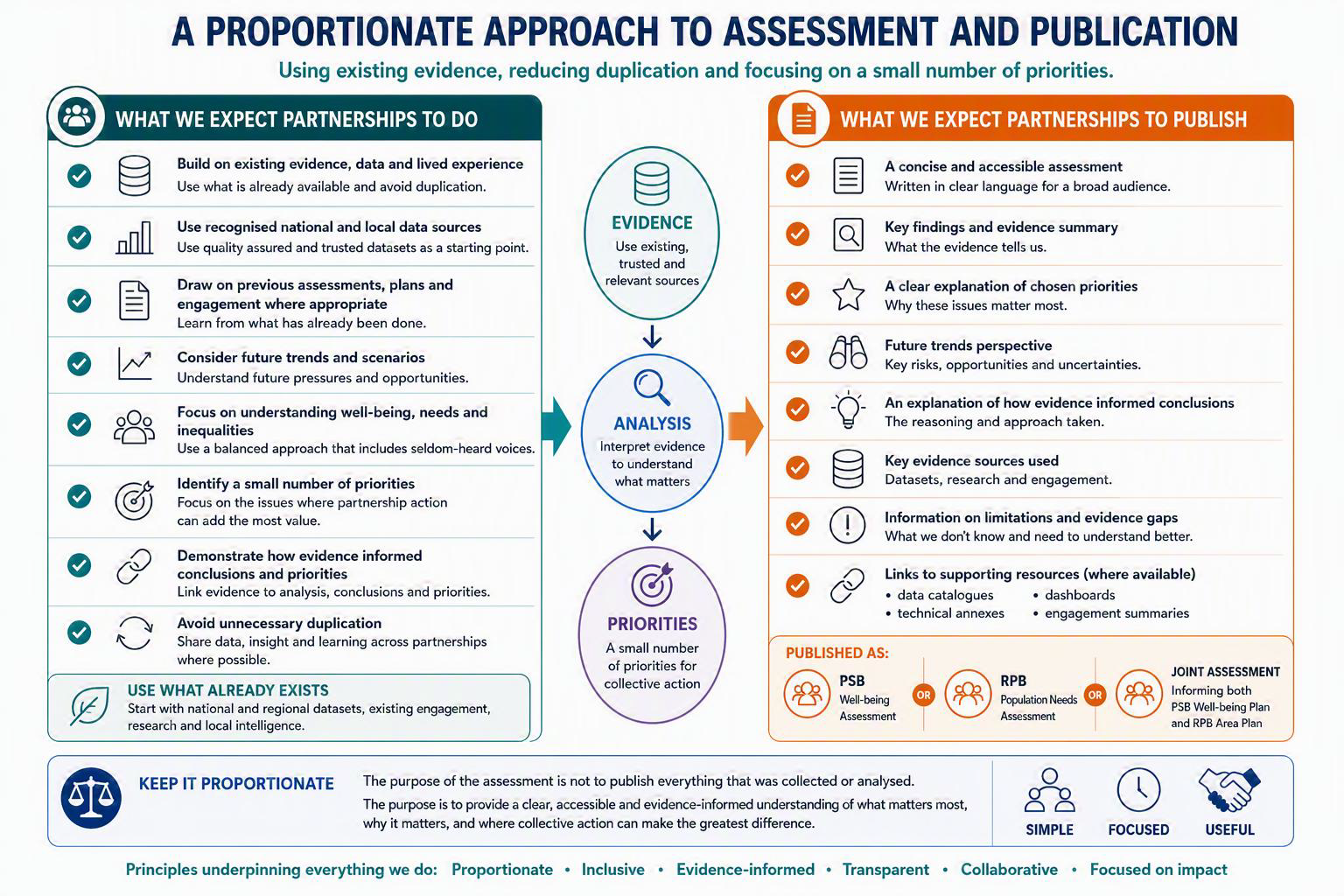
This infographic summarises the approach to assessment and publication set out in the guidance for Public Services Boards (PSBs) and Regional Partnership Boards (RPBs). It illustrates how partnerships should build on existing evidence, data, research, engagement and lived experience to understand well-being, needs and inequalities, identify a small number of priorities, and demonstrate how evidence has informed conclusions. It also summarises the information expected to be published in assessments, including key findings, future trends, priorities, evidence sources and supporting resources. The infographic emphasises that assessments should be proportionate, accessible, evidence-informed and focused on collective action.
The assessment should demonstrate a clear line of sight between evidence, analysis, findings, priorities and subsequent plans. Supporting materials, such as data catalogues, methodologies, dashboards and technical annexes, can be used to support transparency while allowing the assessment itself to remain focused on interpretation, priorities and collective action.