
Personal education plans for children looked after: draft guidance for practitioners
Guidance on creating, reviewing, and improving Personal Education Plans (PEPs).
In this page
Guidance document no: 296/2025
Date of issue: 6 October 2025
Digital ISBN 978-1-83715-601-6 WG52053
Overview
This document provides guidance to local authorities and schools on initiating, developing and reviewing PEPs. It sets the context for local authorities to discharge their statutory duty under the Social Services and Well-being (Wales) Act 2014 to ensure each child looked after should have a high-quality PEP until they have finished statutory education.
Audience
This guidance is for all those who have a responsibility for personal education plans (PEPs) in their school or local authority. This includes the designated person for children looked after within schools, headteachers, governors, local authority officers with responsibility for children looked after (including Looked-After Children in Education (LACE) Coordinators and Virtual School Heads), social services staff, Independent Reviewing Officers, and pupil referral units, further and higher education institutions. This guidance may also be read by staff in Third sector organisations whose work helps support children looked after.
1. Introduction
Development of this guidance
- The Welsh Government worked collaboratively with a wide range of professionals to inform the development of this guidance. A Personal Education Plan Task and Finish Group was established made up of individuals from local authorities who have a strategic role in promoting the education of care experienced learners. The task and finish group were a subgroup of the National Delivery Group (NDG) for the education of care experienced leaners. The NDG comprises external stakeholders who work to promote and support the educational outcomes of care experienced children in Wales.
- The Welsh Government also engaged with care experienced learners on what is important to them in their education and what should be included in this guidance. Their views are reflected throughout the guidance. We are very grateful to the young people for sharing their views.
Background and Context
Welsh Government Commitment
- Through Our national mission: high standards and aspirations for all, we have committed to ensure high standards and the wellbeing of every child and young person in Wales. The Welsh Government wants every child to take part in and enjoy learning and have the best education possible to progress and expand their knowledge, skills and experience. This will support them to become:
- ambitious, capable learners ready to learn throughout their lives
- enterprising, creative contributors ready to play a full part in life and work
- ethical, informed citizens ready to be citizens of Wales and the world
- healthy, confident individuals ready to lead fulfilling lives as valued members of society
- The Programme for Government also includes eight commitments which, taken together, describe a new vision to radically transform Children’s Services. One of these commitments is to “strengthen public bodies in their role as corporate parents”. It is about our ambition to ensure that care-experienced children have the same life chances as all children.
- The ‘Corporate Parenting Charter: A Promise from Wales’ sets out the shared principles all bodies and their leaders should follow when providing services (including education) to care-experienced children and young people. This includes the following principle:
A Good Education: We will provide opportunities and support for all care-experienced children and young people to learn and develop and help them become who they want to be.
- Children looked after are not a homogeneous group but they are more likely to have experienced trauma in their lives, including abuse, neglect or loss. They may need support to overcome attachment difficulties which can affect the way they engage at school, including their concentration and behaviour. Providing children and young people with the right support will help them achieve their potential and progress in the next steps of their life.
- This guidance is based on the understanding every child looked after:
- is unique with individual strengths and needs
- should have their voice heard
- is central to the planning put in place for them
- should have the opportunity and support to build positive, secure relationships and social interactions with adults and their peers
- has a right to an education in a safe, enabling and inclusive environment where there is a culture of high educational aspirations
- can thrive with the right skills and support
- Enabling adults working with children looked after should provide developmentally and pedagogically appropriate support:
- respecting and promoting the rights of the child as set out in the UN Convention on the Rights of the Child (UNCRC) (see paragraph United Nations Convention on the Rights of the Child)
- celebrating and valuing diversity and demonstrate inclusivity
- providing emotionally safe environments that support learners to express and regulate their feelings and behaviours in positive ways
- being consistent in their care, and model compassion and kindness
- for learners to cope with uncertainty and change, preparing them to manage transitions and changes in daily routines
- providing opportunities for learners to develop secure attachments and relationships, so that they can feel confident in themselves and participate positively in everyday activities
- actively engage with the wider system around the child including social workers, carers, therapeutic support, youth workers or other trusted adults to ensure integration of care and support
- The Curriculum for Wales Enabling Learning guidance provides more information on the key principles for holistic and meaningful learning for all learners.
Promoting resilience
- Resilience research highlights the factors which increase the risk of children having poor outcomes and the factors that mitigate the effects of such risk factors and promote resilience. Risk factors include Adverse Childhood Experiences (ACEs), low income, neglect, harsh and inconsistent parental discipline, and conflict or violence. Protective factors include caring family, sensitive caregiving, close relationships, emotional security, belonging, problem-solving skills, executive function skills, self-regulation skills, emotion regulation, self-efficacy, positive view of the self or identity, routines and rituals, engagement in a well-functioning school and connections with well-functioning communities.
- Teachers and other school staff have been identified by children and young people looked after as key to their educational progress. Teachers and other staff have a vital role as ‘trusted adults’ whose support provides benefits such as greater self-confidence, decreased feelings of worry, and better school engagement and achievement.
- Young people have told us:
“I would like more space to chill out, or to talk in private with teachers who understand me.” Young Person
“Schools need a list of kids who are care experienced, so we can have more support and help us make more friends with shared experiences.”Young Person
“Have staff trained to support care experienced young people. They would better understand us and you could talk about how you feel. Have an older person who has been in care who understands us and advocates for us.” Young Person
“For some of us, especially when we are younger, school is our safe place. But if you constantly pick us up on little things, things we often can’t help like not having all the right uniform or all the right books, that can make us feel unsafe in what should be our safe space. Try to be understanding. It might be harder for us to stick to all the rules all the time.” Young person
2. Duties in relation to the education of children looked after
United Nations Convention on the Rights of the Child
- The UN Convention on the Rights of the Child (UNCRC) outlines the fundamental rights of every child, regardless of their race, religion or abilities. Most pertinent to care experienced children and young people the UNCRC sets out that:
- every child has rights, without discrimination of any kind (Article 2)
- the best interests of the child must be a top priority in all decisions and actions that affect children (Article 3)
- children and young people have the right to express their views, feelings and wishes in all matters affecting them, and to have their views considered and taken seriously (Article 12)
- children who cannot be looked after by their own family must be looked after properly, by people who respect their religion, culture and language (Article 20)
- when children are adopted the first concern must be what is best for them (Article 21)
- children who come into a country as refugees should have the same rights as children born in that country (Article 22)
- children and young people have the right to an education regardless of race, gender, disability, detention status, or refugee status (Article 28)
- education should develop each child’s personality and talents to the full (Article 29)
Children and Young Persons Act 2008
- Section 20 of the Children and Young Persons Act 2008 states that the governing body of a maintained school must designate a member of staff (“the designated person”) as having responsibility for promoting the educational achievement of children who are looked after in the school. This duty applies regardless of whether there are children looked after on the school roll. Schools need to be prepared to respond quickly to the needs of children looked after who may join the school at very short notice.
Social Services and Well-being (Wales) Act 2014
- The Social Services and Well-being (Wales) Act 2014 places a duty on local authorities to promote the educational achievement of children looked after. The Social Services and Well-being (Wales) Act 2014 Part 6 Code of Practice (Looked After and Accommodated Children) provides advice on the care and support planning duties of local authorities in relation to care and support plans, including health and education.
- The Part 6 care and support plan is a plan for children looked after, which brings together all the key information from the assessment of the child’s developmental needs and from any other assessments of the child and their family. The Care Planning, Placement and Case Review (Wales) (CPPCR) Regulations 2015 also require the preparation of a health plan, a Personal Education Plan (PEP), and a placement plan for the child. These should all be incorporated into and form an integral part of the overall Part 6 care and support plan for the child.
- The provisions under Part 6 of the Act, also apply to unaccompanied asylum seeking children, who have the same rights and entitlements as children looked after who are born in Wales and the UK.
- This guidance provides further good practice advice in relation to PEPS, which supplements the duties highlighted here.
3. Personal education plan: purpose
- In order to be impactful, the PEP should:
- support and meet the child’s educational and emotional needs, allowing them to thrive in their education setting and achieve their full potential
- be an effective, high quality, and personalised plan that the child has ownership over
- be a live and evolving document showing how professionals are working (and plan to work) with the child supporting their progression
- support effective communication and partnership working between all those who have responsibility for the PEP (for example, the education provider, local authority officers, the child and their carers)
4. PEP minimum requirements
- The Part 6 Code of Practice sets out the:
- Information that must be included in the PEP.
- Time scales for initiating the PEP.
- Transition arrangements.
- Cross border arrangements.
Please refer directly to the Code for more information.
5. Giving the child a voice
Taking account of the child’s views
“Listen to us. Don’t just read our files, or listen to other teachers and professionals. Of course they know some things, but they don’t know everything. We are much more than just what’s written about us. And lots of those things might have been written long ago. Ask us what would help us learn now, listen to what we say and act on it. And if you can’t do what we’re asking you to, explain why.” Young person
- The most important person in the PEP process is the child looked after. Listening to their voice is vital to understanding and meeting their needs and it should be evident in their PEP. According to their age and understanding, views should be considered when identifying their educational needs and deciding on actions at a school or individual level.
- What this participation looks like may depend on:
- the level of participation the child wishes or is supported to have
- the nature of issues being discussed at the PEP meeting
- what the people who know the child best feel is in their best interests
- A member of school staff who has a good relationship with the learner should support them to express their views, identify their strengths, goals and aspirations. Alternatively, they may be supported to share their views by an independent advocate (for example, as provided by Tros Gynnal Plant, The National Youth Advocacy Service).
- The child or young person may wish to:
- stay for part or all of the PEP meeting
- share their opinions themselves
- choose an adult to share their views at the meeting
- Supporting learners and their care giver to participate meaningfully in the PEP process will help them to:
- feel confident their views are listened to and valued
- have an awareness of their rights and the support available to them
- develop a sense of responsibility for, and control over, their learning
- These quotes from learners who are looked after in Wales suggest that young people are not always fully engaged in the PEP process:
- I have never seen one of these before in my life, am I meant to have?
- If these are meant to be done with us, they aren’t. I’m not sure it would even be helpful as most of the issues I have in school are more emotional wellbeing or placement related. I can do the schoolwork if I’m in the right mindset. I’m not dull, I’m very clever.
- I have seen this sheet with boxes on before and filled it in. I didn’t know what it was or what it meant though?
Ways of getting a child or young person’s views
- The child or young person should be provided with appropriate information to understand the PEP process and participate meaningfully. Their views could be collected through a conversation, a questionnaire or through pictorial representations. The way views are gathered depends on their age, stage of development and any additional needs they may have.
Useful Resources
- Estyn’s ‘Supplementary guidance: listening to learners on inspection, September 2021’.
- The Children’s Commissioner for Wales’ guide ‘Participation: How? What? Why? A guide for professionals’.
- The Education Endowment Foundation’s ‘Teacher Feedback to Improve Pupil Learning’.
- NSPCC’s The voice of the child: evidence snapshot.
- The Welsh Government’s National Standards for Participation.
- Children in Wales resource for young people “Having a say in your education”.
Case Study: using a trauma informed style questionnaire to gather the views of learners
In Powys, the Virtual School team use a trauma informed style questionnaire to gather the views of learners and to understand whether they need support in school. This is done prior to the PEP being completed and feeds into the PEP process. The intention is to use the questionnaire as a proactive approach to any issues the learner might have so that the right support can be identified. For example, if it is an issue with attendance the virtual school team will try to sign post them to support (e.g. Child and Adolescent Mental Health Services) or work with the school directly. This has started to increase the engagement of schools with the PEP process and helped them to understand their purpose, as this case study exemplifies:
Situation
Child K is an out of county child looked after on a placement with parents’ agreement to support reunification over a 12-month period. Previously the child had been in long term foster care. Due to attachment needs, the transition to high school was difficult and led to several fixed term exclusions for dysregulated behaviour and verbal and physical assault.
PEP Questionnaire
In the Autumn PEP the child was not present due to illness however the school recorded their views and all appeared well, with no concerns. However, a wellbeing questionnaire was completed on the child’s return to school which raised some concerns around the child’s well-being and not feeling safe on the school bus.
Intervention
To ensure the child felt safe at school, they were provided with an emotionally available adult who listened to the child’s concerns. They helped them avoid internalising their feelings, which may have risked a return to dysregulation and increased the risk of exclusion. The school also ensured the child was aware of several staff members they could talk to in school if they felt unhappy or had concerns. This will ensure a timelier response to any future concerns as opposed to waiting for the PEP meeting. Issues on the school bus were appropriately dealt with, including having an increased adult presence on the bus.
Follow up
This was followed up in the Spring Term PEP so K’s views could be sought before and during the PEP and the questionnaire repeated.
One page profile
- One Page Profiles can be helpful as the starting point for person centred planning. It is a simple summary of what is important to a child or young person and how they want to be supported.
- A one-page profile captures positive information about the child on a single sheet of paper. It might include the following information:
- What people like and admire about me
- What is important to me
- How best to support me
- The child or young person should be involved as much as possible in the development of the one-page profile using a person-centred approach. It should be reviewed regularly and prior to transition so the new school has a clear and accurate picture of the child or young person.
Useful resources
- Welsh Government guidance: Person-centred practice in education: a guide for early years, schools and colleges in Wales.
- Adoption UK’s Psychology and Therapy Hub team have designed a one page profile template.
Case Study: Using an electronic PEP Portal
The Vale of Glamorgan has created a virtual school which uses an online Personal Education Plan (PEP) portal. The virtual school education team keep the PEPs in a central, secure location and provide training on how to use the PEP portal to teachers, foster carers, social workers and Independent Reviewing Officers. Once all the information is submitted, Social Services are notified and the portal will trigger a reminder every 6 months when the PEP needs to be updated. The professional portal to populate the PEP is secure because the education team manually authenticates users.
The online PEP portal has the following advantages:
- It is easier to ensure that only the master copy is updated and there are not multiple versions of the PEP in circulation.
- It is easy to access and quality assure.
- It uses a traffic light system for when PEPs are due and completed.
- Notifications are sent to schools when there are changes to the PEP, such as legal status or address change.
- Secure access means there is greater transparency.
- The virtual school team can share the PEPs with schools promptly.
- The steps to input information are clear to follow.
- More than one professional can view the PEP at the same time.
- The professional portal to complete the PEP is accessible for schools, both in and out of county.
- The PEP is secure on the portal so carers can be part of the process. This is essential as the Independent Foster Agency does not have secure emails.
The education team in the Vale of Glamorgan quality assures the PEP on a regular basis and they expect:
- the PEP to be person centred
- education information to be updated regularly and by those who know the child best
- the child’s views to be clear for all professionals to see
- appropriate historic information to be recorded and shared
- outcome data and relevant reports to be recorded
Emotional and mental well-being
“What has happened to us shapes who we are and how we respond in certain situations. Care experienced children have all experienced trauma. Just being taken into care is a trauma in itself. That means that we may respond differently in some situations to the way someone else does. Please make sure that everyone who works in education understands this so they understand how we might respond to things and how to help us feel safe and supported.” Young person
- Emotional well-being has a strong influence on cognitive skills such as maintaining attention, memory, executive function, motivation to learn, problem-solving and regulation. As such, emotional and mental well-being plays an integral role in supporting or undermining learning and teaching. It therefore needs to be at the centre of the PEP process and embedded through teaching and all the other aspects of school life.
- According to the latest Children Receiving Care and Support (CRCS) Census, 50% of all children receiving care and support in Wales on 31 March 2023 started to do so because of the risk of, or actual, abuse or neglect. The proportion was higher (65%) for children looked after compared to children who were not looked after and not on the child protection register (33%). These adverse childhood experiences increase the risk of mental health challenges in childhood or adulthood. Mental health issues can further compound difficulties in education.
- Supporting a child or young person’s emotional well-being enables them to thrive and achieve their full potential. It is therefore crucial to consider the emotional health and wellbeing of the child as part of the PEP process.
- The Welsh Government’s 'Framework on embedding a whole-school approach to emotional and mental well-being' provides guidance for schools and education settings to support good emotional and mental well-being. This is achieved by promoting a positive cultural environment in schools, where children and young people form positive relationships with staff and other learners, and relationships are strengthened.
- School senior leadership teams are expected to consider their more vulnerable learners (including children looked after) when developing their well-being plan. This should be part of the wider school improvement process, to ensure it accommodates their needs. The framework includes guidance for schools about the collection of a range of data and intelligence which can be used to inform and understand the well-being of learners and school staff.
- To support the emotional and mental wellbeing of children looked after it is helpful if schools work with the wider system of support for the young person. This includes social workers, carers, therapeutic support workers, youth workers and other trusted adults. Where children looked after are accessing mental health support, education staff should be aware of the intervention and understand the approach being taken and any dysregulation or behavioural change that may occur as a result.
“A quiet word from the teacher to ask if I am OK is welcomed if this is done without drawing the attention of the other students. With one teacher there is a code between us. I exchange a glance with the teacher and give them a small nod to show I am OK.” Young Person
“The support I’ve received in school has been brilliant. I’ve got a brilliant rapport with every single teacher, whether they’ve taught me in lesson or not.” Young person
Useful resources
- The Welsh Government’s ’Framework on embedding a whole-school approach to emotional and mental well-being’ provides guidance for schools and education settings to support good emotional and mental well-being.
- ACE Hub Wales provides information, resources and training on ACEs and taking a trauma informed approach to policy and practice.
- Trauma-Informed Wales have resources to support the implementation of the Trauma-Informed Wales Framework.
- Traumatic Stress Wales is funded by the Welsh Government and aims to improve the health and wellbeing of people of all ages living in Wales at risk of developing or with post-traumatic stress disorder or complex post-traumatic stress disorder.
- NEST framework aims to ensure a whole system approach for improving mental health and wellbeing services for babies, children, young people and their families.
- National Practice Guidance for Therapeutic Support for care experienced children for health, social care and third sector.
- Adoption UK has information for schools on supporting previously looked after children to thrive in school. It explores why school can be challenging and offers strategies to help.
6. Personal Education Plan Process
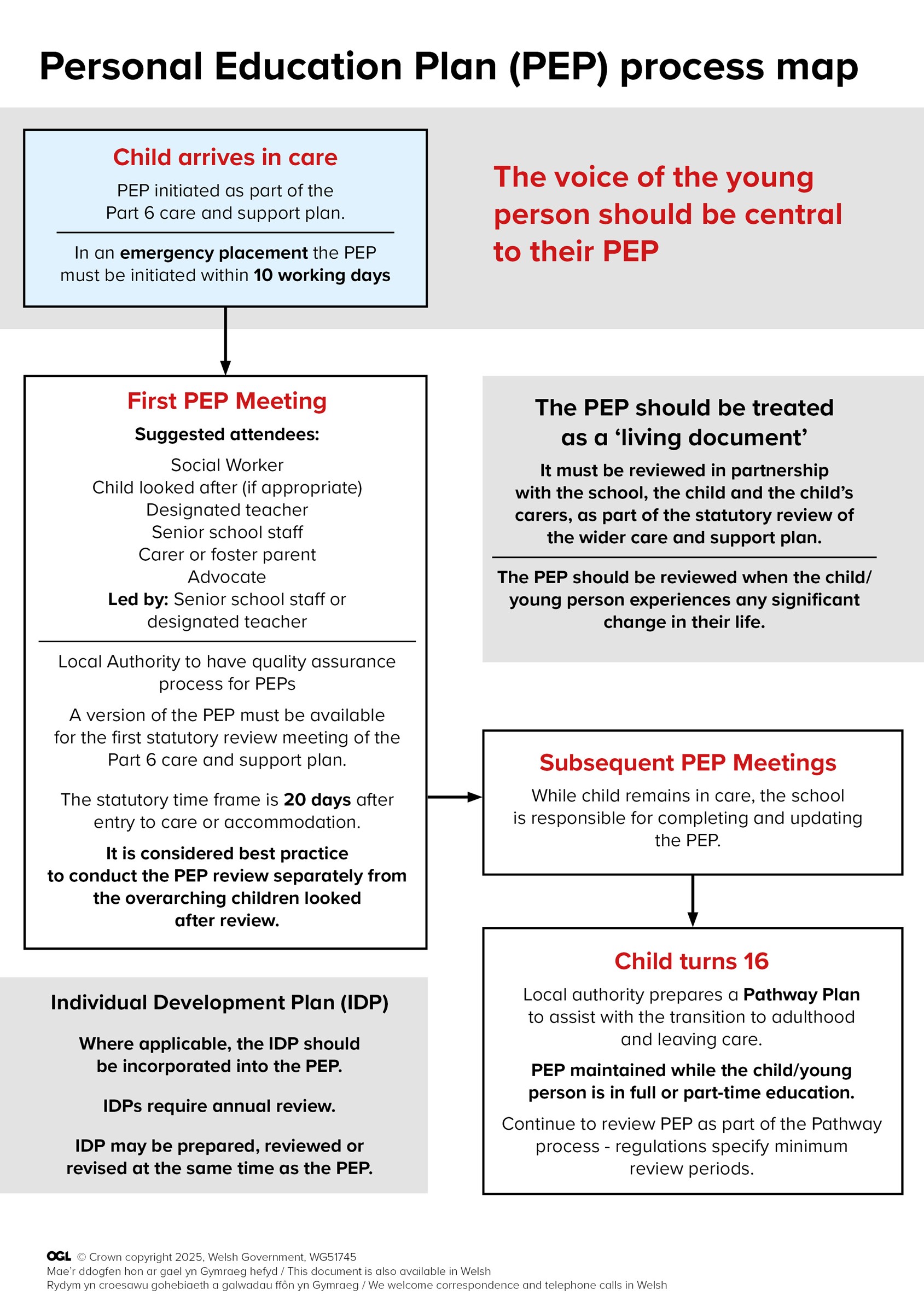
The PEP process is a cycle of consultation, planning and review which should ensure that the child or young person can maximise their potential. The following diagram sets out the PEP process:
7. Initiating, developing and reviewing the PEP
“When we are taken in to care please work with our social workers and whoever else you have to try and keep us in our own school, if it is safe. I was able to stay in my school, and it made a real difference to me. The teachers already knew me, they were already supporting me.” Young Person
PEP meeting
- Key points:
- Every child or young person is unique. Attendance at the meeting will depend on each learner’s needs and who is involved in supporting them. The meeting should only involve professionals and adults who need to be there so the child or young person feels safe and comfortable attending.
- It is considered best practice to conduct the PEP review separately from the children looked after review so that a thorough review can take place. When the PEP meeting is part of the broader child looked after review it may involve discussion of issues which trigger an emotional response in the young person thus colouring the PEP discussion. Children looked after said that:
“When our education is addressed in the wider care review, it is skimmed over. They only asked us if we are ‘doing well’ at school. No one asked us for our views and there was no detailed discussion about the plan for our education or about next steps. There isn’t enough time in the child looked after review for a proper discussion about our education and there is not enough focus on it from social services. We were not asked about what we would like to talk about.” Young people
- Children looked after said they do not want their lessons to be disrupted by a PEP or care review meeting. Therefore, where possible, meetings should be held outside of lesson times. If this is not possible, provide an appropriate room to ensure privacy for the meeting.
- The child or young person should have enough notice to prepare for the meeting (for example, think about what they want to say or if they want somebody to attend with them).
- Be sensitive and empathetic in the language you use to record information about a young person in the PEP. Bear in mind the young person you are writing about may read them. This infographic (which uses findings from the Economic and Social Research Council funded Innovate Project)(theinnovateproject.co.uk) may be useful.
- Make every effort to consider and accommodate the young person’s preferences about:
- whether to have the meeting face to face or virtually
- whether they want to attend the meeting or would rather have a trusted adult share their views
- who they would like to support them at the meeting
- what time of day the meeting should take place
- Young people fed back the following about their PEP meeting:
- If I feel I am going to be judged I don’t say anything.
- If you have just met us, give us time to warm up.
- I am asked if I want to go.
- I don’t like going to meetings. Sir says in the meeting what I want to say.
- I like to go to meetings and say what I like and don’t like.
- I prefer on-line [PEP meetings] as this is less awkward. Sometimes there can be five people round the table so it can be intimidating.
Quality assuring the PEP
- The quality of the PEP is the joint responsibility of the local authority that looks after the child or young person and the school or education setting.
The PEP should not be seen as a ‘tick box’ exercise
- When working with schools or education settings the local authority should have a quality assurance process in place that ensures:
- the child or young person’s views and aspirations have been captured
- all statutory information as set out in the Social Services and Well-being (Wales) Act 2014 Part 6 Code of Practice (Looked After and Accommodated Children) has been collected (see section 4. PEP minimum requirements)
- there has been an analysis of the child or young person’s barriers to progress or achievement and an appropriate plan to deal with these
- there are plans to support the child or young person’s transitions between classes within a school, between settings, schools and further education or training and where a young person moves school due to a placement change
- the action being put in place to support the child or young person is practical and clearly linked to the analysis of needs and strengths
- everyone knows who is responsible for supporting the child or young person in relation to implementing the PEP
- there is a clear sense of progression and how progress on the child’s outcomes is being measured or will be measured.
- there is a well-defined pathway for securing high quality education provision where a child or young person is not in school or other education setting. This should set out how the child or young person and their carers will be supported so that they can be re-integrated into an appropriate educational placement
- Some PEP audit templates will be available when the final guidance document is published, which may provide ideas for other local authorities developing something similar.
Reviewing the PEP
- The PEP should be treated as a ‘living document’ which helps create a shared understanding about how everyone can support the child or young person to succeed.
- It is recommended as good practice that the PEP is reviewed:
- at least every 6 months to provide an update at the child looked after review meeting
- when the child experiences any significant change in their life (for example, placement move, changing school, ALN assessment, turning 16)
- The review of the PEP should be an opportunity to ensure:
- current targets continue to be relevant and sufficiently challenging
- approaches put in place to support the child’s progression have had a positive impact on the child’s outcomes, as intended
Transition arrangements
- The Part 6 Code of Practice sets out the arrangements that should be made where a child changes school due to a placement change.
Transition to post 16 education
“I want to be a barber, I think you need natural talent and an eye for the finer details to do this. I don’t want to work for someone else I’ll have my own studio, I’ve never learnt how to set up a business like this in school.” Young person
“I have disability, dyslexia and dyspraxia. I found lessons where I had to sit and listen difficult but also the practical side of day-to-day life with my co-ordination. There was no winning in school, now I’m a school leaver and have no job. I go to Inspire but this will be finishing soon, I don’t know what I will do.” Young person
- The Part 6 Code of Practice sets out requirements in relation to the young person’s transition to further education, training and employment. This needs to be considered at the earliest opportunity. [Note: Young people attending the Care Experienced Summit in March 2024 said that discussions on future pathways or post-16 need to start earlier for care experienced learners. They felt many changes are made once a child is 16 and by then they felt it was too late to begin discussions about higher education options.]
- The local authority should work closely with the Engagement and Progression Coordinator (EPC) and Youth Homelessness Coordinator (YHC) to ensure that children looked after who are at risk of disengagement are supported and have a planned transition to an appropriate post-16 setting. Local authorities have staff in place to fulfil the EPC role and a YHC, and these play a critical role in implementing the Youth Engagement and Progression Framework. The EPC role is about preventing young people disengaging from learning and supporting young people who are not in education, employment or training. The YHC role is focussed on the prevention of youth homelessness.
8. Roles and responsibilities
- The Welsh Government’s guide for the designated person for looked after children in schools sets out the roles and responsibilities of key professionals in relation to the education of children looked after:
Designated person in a maintained school
- It is expected that the designated person for children looked after will ensure that:
- the school shares and supports high expectations for the child looked after
- the well-being of the child or young person is monitored effectively and their welfare needs addressed
- there is access to current and accurate information on the child oryoung person on roll
- education information is transferred promptly between agencies and individuals
- there is regular dialogue with the child or young person to provide support in the school environment and to ensure their views are reflected in the PEP
- the child or young person’s educational needs are identified, addressed and planned for by setting appropriate targets
- a PEP is drawn up in partnership with the child or young person, parent and(or) relevant family member, carer, social worker and any other relevant person
- sufficient time is allocated for the school to be represented at the child looked after review
- regular liaison on issues, including poor attendance, takes place with the Education Welfare Officer
- children with learning or behavioural difficulties are assessed to identify and provide for their support needs
- referrals are made to support services, for example, school-based counselling service
“We need someone who is always free to talk to. Give the designated teacher more time so their sole job is to support care experienced young people in school rather than that being part of their other job”. Young person
Social worker
- The social worker should:
- take account of the child or young person’s educational needs and the availability of appropriate schools and services when making placement arrangements
- attend a PEP meeting with the school, child looked after, and VSH/LACE Co-ordinator. If possible, they should invite the Independent Reviewing Officer (IRO). This will precede the child looked after review. This may not always be possible, but it should be adopted as best practice
- ensure that care plans and PEPs are made and reviewed in accordance with statutory timescales. Where this does not happen, the social worker should report this to the designated manager within the department
“[We should] have the same social worker longer. I have had 5 or 6 social workers and I had to repeat my story to each new one. They don’t know me.” Young person
Independent Reviewing Officer (IRO)
- The independent nature of the IRO should support the opportunity for monitoring the activities of the local authority as a corporate parent, assess the quality of services and challenge activities where necessary.
- The IRO should be sent a copy of the PEP and any amended versions of it so they can fulfil this role.
The Looked-After Children in Education (LACE) Coordinator, Virtual School Head (VSH) or equivalent coordinating role
- The LACE/VSH (or equivalent role on the local authority) will:
- ensure high quality PEPs are in place for each child and provide guidance to schools on their implementation
- work with schools and colleagues in the local authority to ensure that expenditure via the Pupil Development Grant (PDG) for children looked after is used appropriately to support care experienced learners
- attend looked after children reviews as appropriate
Foster carers, carers and residential staff
- Foster carers, carers and residential staff should:
- encourage and support each child or young person to meet the objectives and targets in their PEP (owned by the child or young person and their carers)
- provide a home environment and appropriate equipment which enables a child or young person to learn, study and do homework
- ensure the child or young person attends school or the equivalent in accordance with the care plan
- contribute to the child or young person’s PEP and care plans
The designated person should meet carers to complete or review the PEP regularly.
Personal Adviser
- Section 106 of the Social Services and Well-being (Wales) Act 2014 requires a local authority to arrange for a young person who falls within the definition of a category 1, 2, 3 or 4 young person, to have a personal adviser. They will act as a mentor during their transition to adulthood. The personal adviser and social worker will use the PEP as a basis for drawing up a Pathway Plan that builds on the Care Plan.
- The personal adviser will:
- ensure the Pathway Plan is realistic
- arrange review meetings
- take responsibility for communicating the outcomes to other agencies and individuals as necessary, including schools and post-16 providers
- It is essential that the Pathway Plan captures the young person’s intentions to go on to post-16 learning, to ensure they get the support and funding required.
“My YPA [Personal Advisor] has been helpful in ensuring I had everything I needed to do my digital photography course after leaving school. I needed a lot of equipment they had grants I could access”. Young person
For more information on the wider responsibilities of each role to the education of children looked after please see ‘Making a difference A guide for the designated person for looked after children in schools’.
9. Children with Additional Learning Needs
- Under the Additional Learning Needs (ALN) system duties to identify ALN and prepare and maintain individual development plans (IDPs) in respect of children looked after are placed on the local authority that looks after the child.
- The mandatory Additional Learning Needs (ALN) Code sets out that an IDP for a child looked after must be incorporated into the child’s PEP. This is to support a holistic approach and enable the additional learning provision (ALP) for a child that is looked after and the wider educational provision made for them, to complement one another.
- As a minimum, IDPs are reviewed annually. Where possible and appropriate, the IDP may be prepared, revised or reviewed at the same time as the PEP.
- For more information in relation to decisions about ALN, the preparation and maintaining of IDPs, and the securing of the ALP included in an IDP, for children looked after see Chapter 14 of the ALN Code.
10. Cross border arrangements
- The Part 6 Code of Practice sets out the arrangements that should be made for a child or young person’s education or training before any placement is made. These should be consistent with their PEP.
- Any admissions decisions made must also be consistent with the Welsh Government’s Admissions Code.
11. Example PEPs
- Examples of PEPs developed by local authorities in Wales will be available when the final guidance document is published.
12. Further information and sources of support
Sources of support
Adoption UK Cymru
Provides support and services across Wales and works in collaboration with their partners in the National Adoption Service.
Contact: Email: wales@adoptionuk.org.uk. Helpline number: 0300 666 0006. The helpline is available Monday to Friday between 10am and 2.30pm
Website: Wales | Home | Adoption UK Charity
The Fostering Network Wales
Work directly with their members throughout Wales. They support foster carers and other professionals by providing learning and development, research, and information services.
Contact: Email: wales@fostering.net. Tel: 029 20 440940.
Website: Our work in Wales | The Fostering Network
Voices From Care Cymru
Is a national, independent, Welsh organisation. They are dedicated to upholding the rights and welfare of care experienced children and young people.
Contact: Email: admin@vfcc.org.uk. Tel: 029 2045 1431
Website: Voices From Care Cymru
Tros Gynnal Plant (TGP) Cymru
Is a leading independent Welsh children’s charity working with some of the most vulnerable and marginalised children, young people and families in Wales.
Contact: Email: admin@tgpcymru.org.uk. Tel: 029 2039 6974
Website: Who we are « TGP Cymru
The National Youth Advocacy Service (NYAS)
Is a charity that supports children, young people and adults in vulnerable situations across England and Wales. It offers advocacy, mental health advocacy support, monitoring, safeguarding, and NYAS Legal Services.
Contact: Email: help@nyas.net. Freephone Helpline Number: 0808 808 1001 (opening hours are Monday to Friday, from 9am to 8pm, and Saturday 10am to 4pm).
Website: Supporting People in Wales | Children's Rights in Wales | NYAS Cymru
Children in Wales
Is the national umbrella body for organisations and individuals who work with children, young people and their families in Wales.
Contact: Email: info@childreninwales.org.uk. Tel: 029 2034 2434
Website: About Us | Children in Wales
Careers Wales
Helps young people to plan their career, prepare to get a job, and find and apply for the right apprenticeships, courses and training.
Contact: Contact | Careers Wales
Tel: 0800 028 4844 (Monday to Thursday: 9am to 5pm, Friday: 9am to 4:30pm)
Website: Careers Wales | Careers Wales
Care Leavers Activities and Student Support, (CLASS) Cymru
The CLASS Cymru site is designed to give tips that are relevant to a care-experienced person (or someone who supports those with care experience) and direct them to helpful resources to support access into further and higher education.
Website: CLASS Cymru
School Essentials Grant
All children in local authority care qualify for the School Essentials Grant. Families with children in reception to year 11 can apply for:
- £125 per learner and extra funding for your school
- £200 for learners entering year 7 (to help with increased costs associated with starting secondary school) and extra funding for your school
Parents and carers can claim once per child per school year. For more information visit the Welsh Government’s website.
Further Information
On-line resources
- Making a difference: A guide for the designated person for looked after children in schools.
- Community focused schools guidance.
- Links between community focused schools and other policies.
- Developing family engagement in community focused schools.
- Family and community engagement toolkit.
- Curriculum for Wales: Hwb.
- School improvement guidance: Framework for evaluation, improvement and accountability: Hwb.
Books
- Inside I’m hurting: Practical strategies for supporting children with attachment difficulties in schools, Louise Michelle Bombèr.
- Know me to teach me: Differentiated discipline for those recovering from Adverse Childhood Experiences, Louise Michelle Bombèr.
- The trauma and attachment aware classroom, Rebecca Brooks.
- The A to Z of trauma informed teaching, Sarah Naish, Anne Oakley, Hannah O'Brien, Sair Penna and Daniel Thrower.
- When the adults change everything changes: Seismic shifts in school behaviour, Paul Dix.
Annex A: Terminology
Care experienced children and young people
Are those who have:
- previously been looked after by the local authority (for example, children who have been adopted, are in SGO arrangements or have returned after a period in care to their biological family) or are
- currently being looked after by a local authority. This includes children in foster care, residential care, kinship care (where it is a foster kinship arrangement), hostels, or living independently under the supervision of social workers
There is only a statutory duty to develop a PEP for children currently in the care of the local authority.
Child looked after
The definition of children looked after or looked after children (children in care) is found in the Social Services Wellbeing Act 2014 under section 74. A child is looked after by a local authority if a court has granted a care order to place a child in care, or a council’s children’s services department has cared for the child for more than 24 hours. Children have said they prefer the term ‘Children looked after’ so this is the terminology used in this guidance. In the context of this guide, ‘children looked after’ refers to both children and young people in care.
Personal Education Plan (PEP)
Children in care, who are not over compulsory school age, should have a PEP. The PEP is used to share information and plan for the child’s education. It should also be used to review progress and determine strategies to support the child and is a record of the child’s education and training. It should describe what needs to happen to help them to fulfil their full potential. There is no statutory responsibility on a local authority to develop and maintain a PEP for care experienced children not currently in the care of a local authority.
Person-centred practice
Puts the child, child’s parent or young person at the centre of decisions. A range of resources to support practitioners in using person-centred practice approaches is available online (gov.wales).